
AI Literacy: The New Mandatory Business Skill
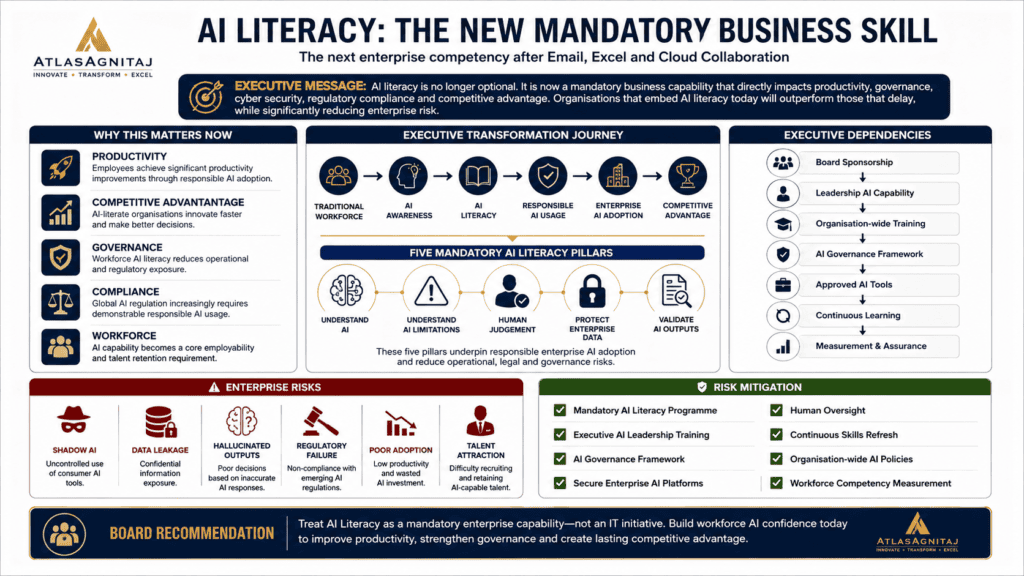
AI Literacy: The New Mandatory Business Skill Why every organisation must now treat artificial intelligence fluency with the same discipline once reserved for email, spreadsheets and collaboration platforms. There was a time, not so long ago, when the ability to send a professional email, structure a spreadsheet or navigate a shared collaboration platform was considered a specialist competency. Organisations invested materially in training programmes to build these skills across every level of the workforce. Today, we would not dream of hiring an executive, a manager or a graduate who could not perform these tasks with fluency. They are simply the baseline expectations of modern professional life. Artificial intelligence now stands at precisely this inflection point. The technology is no longer an experimental capability confined to research laboratories or specialist digital teams. It is embedded in the tools our employees use every day, in the decisions our customers expect us to make faster and more accurately, and in the competitive positioning of every serious enterprise. And yet the majority of organisations have not yet formalised AI literacy as a mandatory workforce competency. That must change, and it must change now. The organisations that will define the next decade are not necessarily those with the largest technology budgets or the most sophisticated model deployments. They are the ones building genuine AI confidence across their entire workforce, systematically, deliberately, and with the same rigour once applied to digital transformation programmes of previous generations. AI literacy is no longer an information technology initiative. It is a core business skill, and it belongs at the very centre of the organisational learning agenda. The Historical Parallel and Why It Matters To understand the scale of the opportunity in front of us, it is instructive to recall how earlier waves of workplace technology were absorbed into everyday practice. When electronic mail first arrived in the corporate environment, it was treated with suspicion, delegated to technical teams, and used sparingly. It took a deliberate programme of user education, executive sponsorship and cultural reinforcement to move email from a novelty to an indispensable tool of professional communication. The same trajectory played out with spreadsheets, which transformed from an accountant’s curiosity into the analytical backbone of virtually every commercial function. Collaboration platforms, video conferencing and cloud-based document management followed the same arc. In each case, the organisations that moved decisively to build workforce fluency captured disproportionate value. Those that hesitated found themselves managing legacy behaviours long after their competitors had moved on. Artificial intelligence differs from these earlier waves in one critical respect. The technology is advancing faster than any prior enterprise capability, and the gap between organisations that build fluency early and those that defer will be considerably more damaging than any previous digital divide. AI is not a tool that employees will learn to use over the course of a career. It is a rapidly evolving capability that must be understood, adopted and continuously refreshed as part of the ordinary rhythm of professional development. Why This Moment Is Different There are three features of the current moment that make the case for mandatory AI literacy particularly urgent. The first is the pervasiveness of the technology. Generative AI has arrived not through a single vendor or channel but through the entire ecosystem of enterprise software. Every major productivity suite, every leading customer relationship management platform, every collaboration tool and virtually every specialist application is being embedded with AI capability. Employees will encounter AI whether or not their organisations have prepared them for it. The second is the asymmetric nature of the risks and rewards. An employee who understands how to use AI thoughtfully can generate remarkable productivity gains, sometimes measured in multiples rather than percentages. An employee who uses AI without understanding its limitations can just as easily introduce material risks, from inadvertent disclosure of confidential information to the propagation of inaccurate outputs into consequential business decisions. The distribution of outcomes is highly uneven, and it is almost entirely determined by the quality of user understanding. The third feature is the regulatory and governance environment now taking shape. Jurisdictions across Europe, the Middle East, Asia and North America are moving rapidly to codify obligations around AI use in the workplace. Boards and audit committees are asking searching questions about AI governance, model provenance, data handling and human oversight. An organisation that cannot demonstrate a baseline of AI literacy across its workforce will struggle to satisfy regulators, insurers, investors and, increasingly, its own customers. The Five Pillars of Organisational AI Literacy A credible AI literacy programme rests on five foundational pillars. Each is necessary. None is sufficient on its own. Understanding What AI Can Do Every employee, regardless of function or seniority, should possess a working understanding of the tasks at which contemporary AI systems genuinely excel. These include summarisation of long documents, extraction of structured information from unstructured content, drafting of first-pass written material, pattern recognition across large datasets, language translation, ideation and the generation of code or analytical logic. When employees understand where AI adds real value, they can redirect their effort towards higher-order activities and use the technology as a genuine force multiplier. Understanding What AI Cannot Do Equally important is a candid appreciation of the current limitations. AI systems do not reason in the way humans reason. They do not possess judgement, ethics, contextual understanding of an organisation’s history, or accountability for outcomes. They can be confidently wrong, particularly on matters requiring specialist expertise, current information or subtle interpretation. Employees who understand these boundaries are far less likely to over-rely on AI outputs or to defer inappropriately to a machine on decisions that require human deliberation. Recognising Where Human Judgement Remains Essential There are categories of decision where human judgement is not merely useful but indispensable. These include decisions involving significant financial exposure, decisions affecting employees, decisions with regulatory or legal consequence, decisions involving customer relationships of material value, and decisions that will shape the culture or strategic direction of the organisation. AI can inform
Buying AI is Easy. Building AI Capability is the Real Challenge.
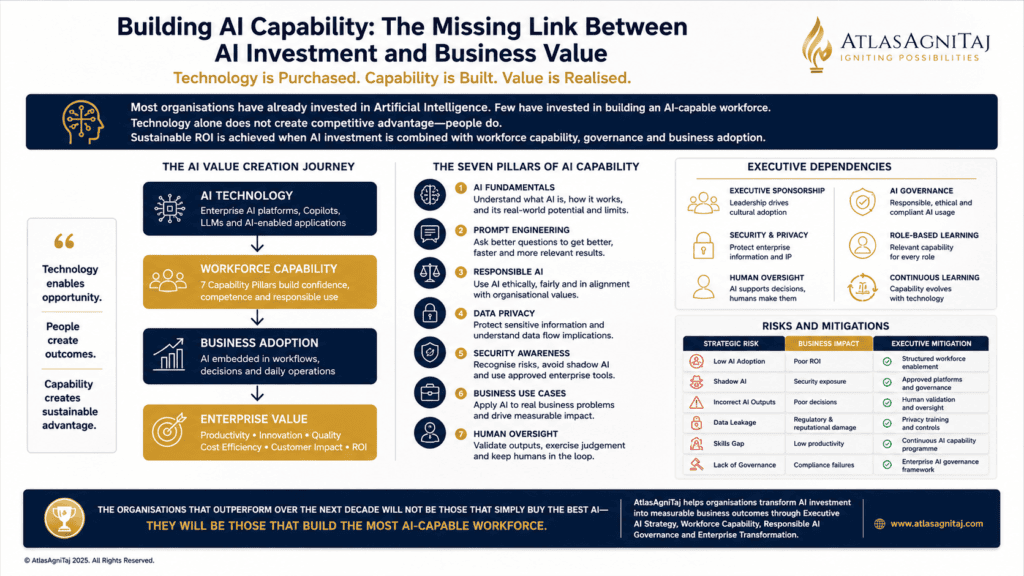
Why the return on artificial intelligence depends less on the technology you procure and more on the workforce you develop. Across the boardrooms of the Gulf, Europe and beyond, artificial intelligence has firmly established itself as a strategic priority. Enterprise licences have been signed. Copilots have been rolled out. Foundation models have been embedded into productivity suites, customer service platforms, engineering workbenches and analytics stacks. On the surface, the enterprise appears to have moved decisively from experimentation into deployment. And yet, a growing body of evidence from Chief Executives, Chief Information Officers and Chief People Officers points to an uncomfortable truth. Purchasing AI is now the easy part. The far greater challenge, and the one that determines whether the investment ultimately delivers value, is the development of the human capability required to use it well. The distinction is not academic. It is the difference between a technology programme that becomes a source of measurable productivity, competitive differentiation and cultural renewal, and one that quietly joins the long history of enterprise software investments that were procured with conviction, deployed with fanfare, and adopted with indifference. The Capability Gap Behind the Adoption Curve The prevailing narrative around AI adoption tends to celebrate rapid enterprise deployment. Licence counts, platform integrations and pilot volumes are reported as evidence of progress. These metrics matter, but they are input measures. They tell us what an organisation has bought. They tell us very little about what it has become capable of doing. Independent research from major consultancies and academic institutions consistently identifies the same pattern. A substantial proportion of employees who have been given access to generative AI tools use them infrequently, superficially, or not at all. Where usage does exist, it is often confined to a small cohort of enthusiasts. The wider workforce remains hesitant, uncertain of the boundaries, unsure of the risks, and unclear about how the technology relates to the work they are paid to perform. This is not a failure of the technology. It is a failure of enablement. It is the return, in a new form, of a phenomenon that senior leaders will recognise from earlier technology cycles. Enterprise resource planning systems, customer relationship management platforms, collaboration suites and cloud infrastructure have each, in their time, produced their own version of the same story. The tools were deployed. The workflows were not redesigned. The people were not equipped. The value did not fully materialise. Technology alone does not create business value. People do. Why Technology Alone Cannot Deliver the Return It is tempting, particularly in the current moment, to assume that AI is different. The interfaces are conversational. The learning curve appears gentle. Anyone who can write an email can, in principle, write a prompt. On that basis, some executive teams have concluded that formal enablement is unnecessary. The workforce, it is assumed, will discover the value on its own. The evidence does not support that assumption. Writing a prompt is not the same as writing a good prompt. Receiving an output is not the same as knowing whether to trust it. Recognising an opportunity for automation is not the same as understanding where automation is appropriate, where it introduces risk, and where human judgement must remain sovereign. These distinctions are learned. They are not intuitive. Moreover, the risks associated with unstructured adoption are real and material. Confidential information has been pasted into public models by well-meaning employees who did not appreciate the data flow implications. Fabricated citations have appeared in client-facing reports because no one taught the author to verify. Regulated advice has been given by unregulated interfaces. Shadow AI, the use of unsanctioned tools on unsanctioned devices, has emerged as one of the fastest-growing categories of information security concern. The organisations that have avoided these outcomes have not done so by accident. They have invested, deliberately and systematically, in building the capability of their people to use AI safely, effectively and in a manner aligned with the values and obligations of the enterprise. The Seven Pillars of an AI-Ready Workforce Effective AI enablement is not a single training course. It is a curriculum, layered and role-appropriate, that equips every employee with a working understanding of seven interconnected disciplines. Each pillar reinforces the others. Weakness in any one of them undermines the whole. 1. AI Fundamentals Every employee, from the graduate analyst to the executive director, benefits from a working understanding of what artificial intelligence is, how modern models are constructed, what they can and cannot do, and where their limitations lie. This is not a technical deep dive. It is the vocabulary and the mental model that enables informed conversation, sensible expectation-setting and defensible decision-making. Without this foundation, the workforce is left to construct its own mythology about the technology, which is invariably a mixture of overestimation, underestimation and misunderstanding. 2. Prompt Writing and Interaction Design The quality of an AI output is, in large measure, a function of the quality of the input. Effective prompt writing is a skill. It combines clarity of intent, structured thinking, contextual framing and iterative refinement. Employees who master it produce work in a fraction of the time and to a higher standard than those who do not. Employees who do not master it often conclude that the technology itself is deficient, when in reality they have not yet learned how to instruct it. 3. Responsible AI AI systems can reproduce and amplify bias. They can generate outputs that are plausible but false. They can be applied to decisions where their use is inappropriate or unlawful. Every employee who interacts with these systems has a role to play in identifying and mitigating these risks. Responsible AI is not the exclusive concern of the ethics committee. It is a daily practice embedded in the choices individual employees make about what to ask, what to accept and what to escalate. 4. Data Privacy Personal data, commercially sensitive information, client confidential material and regulated content each carry specific legal and contractual obligations. Employees must understand which
AI Doesn’t Fail Because of Technology. It Fails Because People Never Learned the Basics.
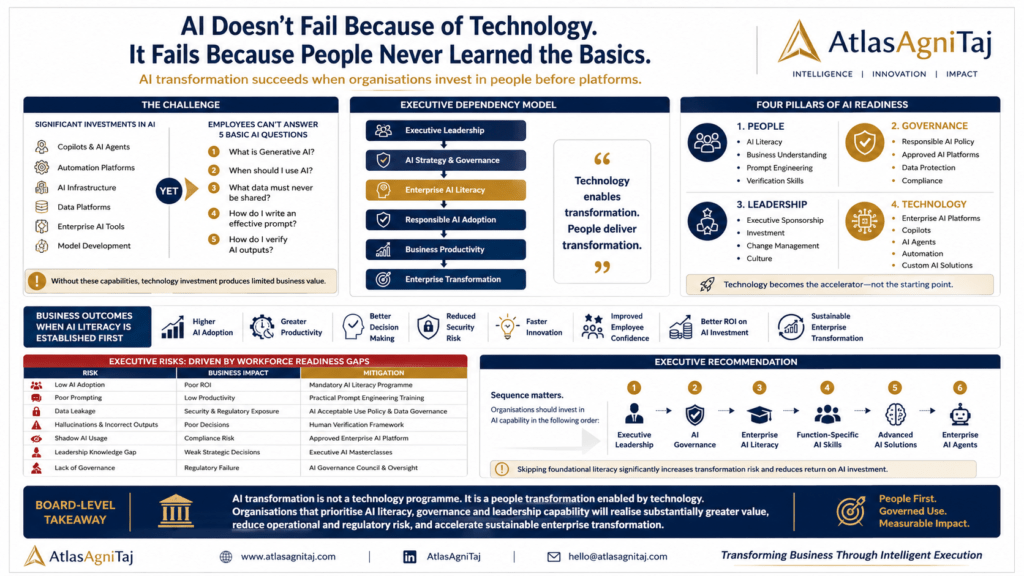
An executive perspective on AI literacy as the true precondition for enterprise transformation. Over the past two years, boardrooms across every major industry have made artificial intelligence a defining strategic priority. Enterprise budgets have been redirected. Copilots, agents and automation platforms have been procured at pace. Data estates have been re-architected. And yet, when one sits with the employees who are supposed to derive value from these investments, a rather uncomfortable pattern emerges: many of them cannot answer the most basic questions about the technology now sitting on their desktops. They struggle to articulate what generative AI actually is. They are uncertain when to use it and when not to. They do not know which categories of data they must never place into a public model. They have not been taught how to construct an effective prompt. And, perhaps most concerning of all, they have no reliable method for verifying whether the output they receive is trustworthy. This is not a technology problem. This is a readiness problem. And unless it is addressed with the seriousness it deserves, the return on billions of pounds of AI investment will remain stubbornly disappointing. The Paradox of the Well-Funded, Under-Adopted Programme In my work with boards and executive committees across the GCC, the United Kingdom and Asia, I have observed a recurring pattern. The organisation announces an ambitious AI agenda. Vendors are engaged. Platforms are deployed. Executive dashboards begin tracking licences issued, models fine-tuned and use cases piloted. Twelve to eighteen months later, the sponsoring executive stands before the board and quietly reports that adoption is well below expectation, that measurable productivity gains are elusive, and that the compliance function has raised concerns about shadow usage. At that point, the natural instinct is to interrogate the technology. Was the wrong platform chosen? Is the integration insufficient? Are the models the right size for the task? These are reasonable questions. But in nine cases out of ten, they are the wrong questions. The technology, in most cases, is perfectly adequate. What has failed is the human system around it. The Five Foundational Questions Every Employee Must Be Able to Answer If an organisation wishes to derive genuine value from its AI investment, every employee — from the analyst to the executive — should be able to answer five foundational questions with confidence. The first is deceptively simple: what is generative AI, and how is it different from the software I have used for the past twenty years? Employees who cannot answer this question tend to treat AI either as a magical oracle or as a slightly cleverer search engine. Neither mental model is correct, and both lead to poor outcomes. The second is a question of judgement: when should I use it, and when should I not? Generative AI is superb at drafting, summarising, structuring, translating and exploring. It is markedly less reliable for tasks that require precise numerical calculation, verified sourcing, or definitive legal, medical or regulatory judgement. Employees who lack this discernment either under-use the technology or, more dangerously, over-trust it in situations where the cost of error is high. The third concerns data stewardship: what information must never be shared with an external model? This is the question that keeps chief information security officers awake at night. Client-identifiable data, personal data protected under UAE, GCC or European regulation, commercially sensitive intellectual property, board papers, unpublished financial results, source code containing proprietary algorithms — none of these belong in a public generative model. And yet, without explicit guidance, employees frequently paste them in. The fourth is a craft skill: how do I write an effective prompt? Prompting is not incantation. It is structured communication with a system that has no memory of your organisation, no understanding of your objectives and no visibility of your constraints unless you provide them. Employees who have not been taught to specify role, context, task, format and constraints will receive generic, mediocre output and conclude, incorrectly, that the technology is disappointing. The fifth is the discipline of verification: how do I know whether the answer I have been given is correct? Generative models are, by design, plausibility engines. They produce language that reads convincingly, whether or not it is accurate. An employee who forwards an unverified AI-generated summary to a client, a regulator or a board member is exposing the organisation to reputational, commercial and legal risk. Five questions. Every employee should be able to answer them. In most organisations, fewer than one in ten actually can. The Cost of Poor AI Literacy The consequences of neglecting AI literacy are not theoretical. They manifest in four measurable ways. The first is low adoption. Licences are issued, dashboards report deployment, and yet actual usage is concentrated among a small enthusiast cohort while the majority of employees quietly revert to their previous tools. The business case is not realised. The board asks difficult questions. The programme is scaled back or quietly de-prioritised. The second is poor productivity. Where the technology is used, it is often used badly. Employees produce weak prompts, receive mediocre outputs, spend more time correcting AI-generated work than they would have spent producing the work themselves, and conclude that the technology is not worth the effort. This is not a failure of the tool. It is a failure of training. The third is data leakage. In the absence of clear guidance, employees paste sensitive information into public models with alarming regularity. This has already produced a well-documented series of incidents at global corporations. The reputational cost is significant. The regulatory cost, particularly under UAE Personal Data Protection Law, GDPR and forthcoming AI-specific regimes, will only grow. The fourth is erosion of trust. When employees encounter poorly performing AI, when clients receive AI-generated content that is factually incorrect, when boards are presented with AI-derived analysis that turns out to be fabricated, the organisational appetite for further AI investment declines. The very transformation the organisation was pursuing becomes politically untenable. Each of these outcomes is preventable. None
Moved From Demonstrations to Enterprise Delivery
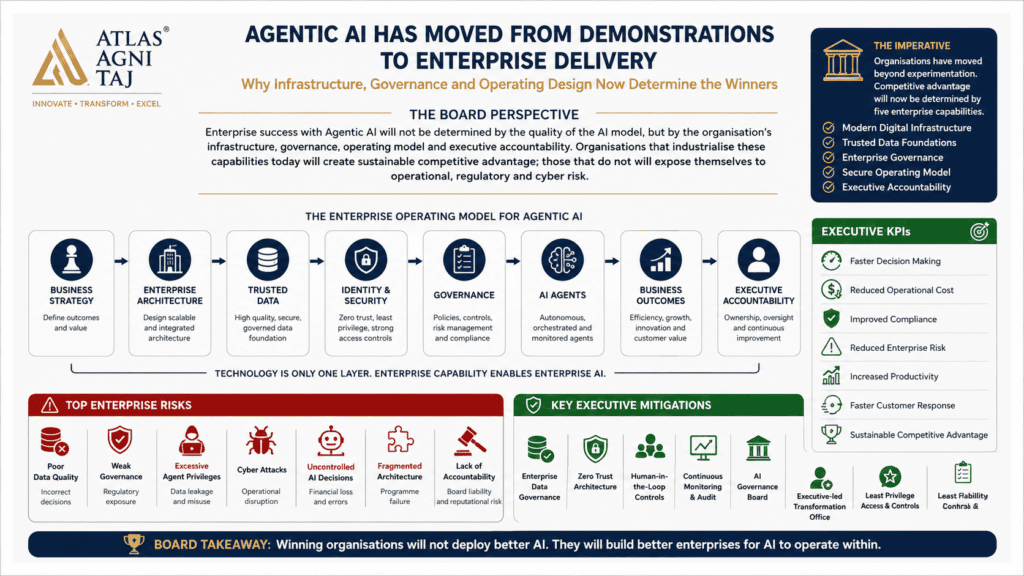
Agentic AI Has Moved From Demonstrations to Enterprise Delivery The Shift From Spectacle to Substance Agentic AI has entered a new phase. The past two years produced an extraordinary volume of demonstrations, prototypes and controlled experiments, most of which succeeded in showing what the technology could do in principle. That phase is now closing. Boards, chief executives and regulators are no longer asking whether autonomous agents can perform impressive tasks in isolation. They are asking whether these agents can be deployed inside operating enterprises, at scale, under regulatory scrutiny, and with clear lines of accountability. The distance between those two questions is considerable, and it is where the current wave of enterprise transformation will succeed or falter. The recent Google Cloud study that reported eighty-three per cent of surveyed information technology leaders believe their infrastructure requires improvement to capture the agentic-AI opportunity should not be read as a technical footnote. It is a strategic signal. It tells us that even in organisations that have committed to AI ambitions publicly, the underlying platforms, data foundations and control environments are not yet ready to carry autonomous decision-making at production scale. This is not a criticism of those organisations. It is the natural consequence of a technology cycle that has moved faster than most enterprise architectures were designed to accommodate. The organisations that will lead the next phase will not be those with the most sophisticated model access or the largest experimentation budgets. They will be those that treat agentic AI as an operating model challenge first and a technology deployment second. That reframing changes what leadership must do, what programmes must fund, and what governance forums must own. Understanding What an Enterprise Agent Actually Requires An agent operating inside a large organisation is not a chatbot with additional functionality. It is a semi-autonomous actor with the ability to read enterprise data, invoke transactional systems, initiate workflows, and, in more mature configurations, take decisions that commit the organisation to financial, operational or contractual outcomes. To perform that role, the agent requires connectivity to enterprise resource planning platforms, customer relationship systems, human capital records, financial ledgers, cloud services, document repositories and, frequently, third-party systems belonging to suppliers, regulators or partners. Each of those connections is a decision. Each decision touches identity, entitlement, data classification, audit, retention, regulatory reporting and commercial contract. In a well-run enterprise, the sum of those decisions is not a technical integration exercise. It is a governance construct that must be designed deliberately, approved by accountable executives, and monitored by functions that understand the risks being taken. When agents are deployed without that construct in place, the consequences are predictable. Data leaks across boundaries that were previously controlled. Decisions are taken by non-human actors whose reasoning cannot be reconstructed after the fact. Audit trails fragment across model providers, orchestration layers and business systems. And when something fails, accountability becomes ambiguous, because no executive was ever formally assigned ownership of the agent as an operational asset. The Five Questions Every Board Should Be Asking Any senior leadership team preparing to industrialise agentic AI should be able to answer five questions with clarity. If the answers are absent, incomplete or contradictory across functions, the organisation is not ready to move beyond the pilot stage, regardless of how many demonstrations have been delivered. Who authorises the agent? This is a question of executive sponsorship and formal accountability. Every agent operating in the enterprise should have a named business owner who has approved its scope, its data access, its decision authority and its operating parameters. The absence of a named owner is a governance failure, not a documentation gap. What data can it access? Agents inherit the entitlements of the systems they connect to. Without deliberate design, they will often inherit more than they need, more than the organisation would authorise a human employee to hold, and more than data protection regulation permits. Entitlement design for agents must be built on least-privilege principles, with time-bound and purpose-bound access rather than standing rights. How are its decisions monitored? Monitoring an agent is fundamentally different from monitoring a deterministic system. The organisation must be able to observe not only what the agent did but why it did so, what alternatives it considered, and what evidence it relied upon. That capability requires investment in observability, decision logging and explainability tooling that most enterprises have not yet made. What happens when it fails? Failure modes for agents are not limited to unavailability. They include hallucination, reasoning drift, adversarial manipulation, silent degradation and cascading errors across dependent agents. Each failure mode requires a defined containment, escalation and remediation protocol, embedded in the operational runbook and rehearsed by the teams that will respond. Who remains accountable for the business outcome? This is the question that boards must answer explicitly, and it must not be delegated to the technology function alone. Accountability for outcomes generated by autonomous systems rests with the executives who commissioned them. That accountability cannot be transferred to a vendor, a model provider or an internal engineering team. Regulators in financial services, healthcare and government have already made this position clear, and other sectors will follow. The Enterprise Operating Model for Agentic AI Organisations that succeed with agentic AI will not deploy isolated agents into disconnected departmental use cases. They will establish an enterprise operating model that spans architecture, identity, security, data, governance, integration and value measurement. That operating model is not a document. It is a set of standing capabilities, forums and controls that determine how agents are commissioned, run, monitored and retired across the enterprise. Architecture The architecture layer defines the reference patterns through which agents interact with enterprise systems. It answers questions such as which orchestration platforms are approved, how agents are packaged for deployment, how they interact with core transactional systems, and how they are separated from one another when their decision boundaries could otherwise collide. Without a reference architecture, every department will invent its own, and the enterprise will accumulate technical debt at
Enterprise AI Has an Infrastructure Problem Nobody Is Talking About
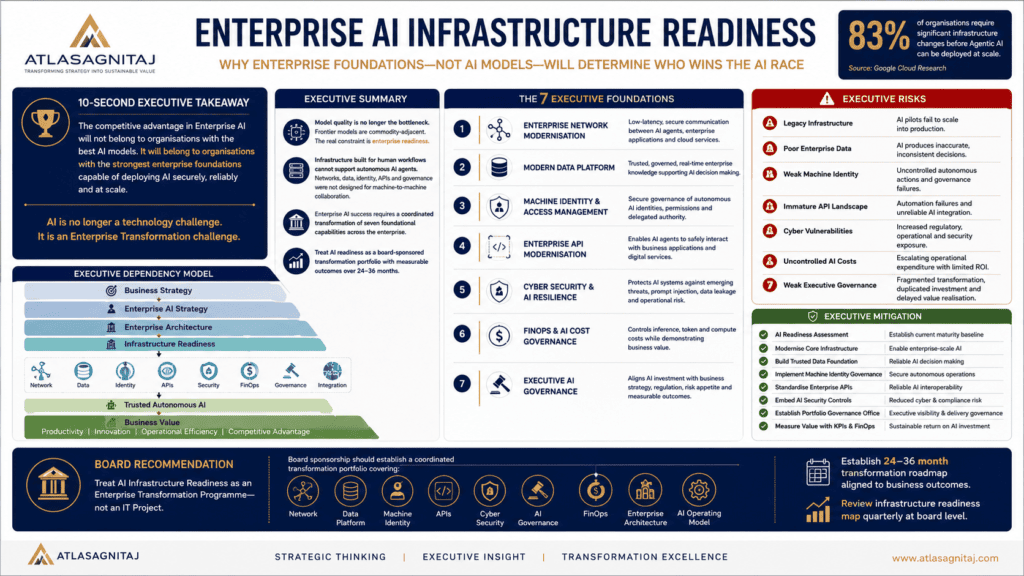
Most AI Strategies Will Fail Because Infrastructure Was Never Designed for Autonomous AI Enterprise AI Has an Infrastructure Problem Nobody Is Talking About For the better part of three years, boardrooms across the Gulf and beyond have been consumed by a single question: which large language model should we adopt? Which foundation model, which hyperscaler, which partner ecosystem? The debate has been intense, well-funded, and, as it turns out, almost entirely misdirected. The uncomfortable truth is that model quality is no longer the binding constraint. Frontier models have become commodity-adjacent, capable of reasoning, coding, planning and orchestrating tools to a standard that most enterprises will not fully exploit for years. The binding constraint is the enterprise itself: the network fabric that was never designed for agent-to-agent traffic; the data platforms that were built for overnight batch analytics rather than sub-second retrieval; the identity systems that assume human users at every interaction; and the API estates that are undocumented, ungoverned, and manifestly unfit for machine consumption. Google Cloud’s recent research puts a hard number on this discomfort. Eighty-three per cent of organisations report that their existing infrastructure requires major changes before agentic AI can be deployed at scale. That figure, on its own, should reset every AI strategy currently sitting in front of a board. The bottleneck has moved. Most executive teams have not. The Silent Shift From Model Risk to Enterprise Risk The last eighteen months have marked a quiet inflexion point in enterprise AI. The centre of gravity has moved decisively from experimentation to deployment, from demonstrations to dependable production, and from single-turn chat interfaces to persistent, tool-using agents that act on behalf of the business. This shift has exposed a set of assumptions that have gone unchallenged since the era of packaged ERP: that the enterprise data estate is broadly fit for purpose; that the network is a passive utility; that identity is a solved problem; and that the API estate can be governed through documentation and goodwill. None of these assumptions survives contact with production-grade agentic systems. A single autonomous agent tasked with, for example, closing a customer complaint will interrogate half a dozen systems of record, invoke multiple APIs, cross regulatory boundaries, generate reasoned action, and require a defensible audit trail. Multiply that by the thousands of concurrent agent invocations that a large enterprise will run once the paradigm takes hold, and the picture changes entirely. What was tolerable friction for a human user becomes catastrophic latency for an agent. What was acceptable data staleness for a dashboard becomes actionable misinformation for an automated decision. What was benign identity ambiguity becomes an unbounded failure of governance. This is why the honest conversation with the board is no longer about which model to license. It is about whether the enterprise itself is architected to host autonomous intelligence at all. In the majority of cases assessed across regional and global markets, the answer is a qualified no. The path forward is neither cheap nor short, but it is knowable, and the organisations that address it first will convert AI ambition into durable competitive advantage. The remainder will spend the next two years debugging pilots. “The bottleneck has moved from model quality to enterprise readiness. Most executive teams have not.” Networks Were Not Designed for Agents Talking to Agents Enterprise networks have been optimised over three decades for two dominant traffic patterns: users reaching applications and applications reaching databases. Firewalls, proxies, load balancers, and identity gateways were tuned accordingly. Agentic AI does not respect this topology. The dominant new pattern is east-west: agents calling other agents, agents invoking tools, agents retrieving from vector stores, and agents crossing what were formerly hard boundaries between systems, business units and, increasingly, jurisdictions. Three consequences follow immediately. First, latency becomes a first-order business variable. When a customer-facing agent must call an inference endpoint, retrieve context from a vector database, reconcile against a system of record, and return a coherent answer within a two-second envelope, network hops that were previously invisible become material—second, private connectivity moves from optional to foundational. Public-internet paths between model providers, enterprise data, and downstream systems introduce cost, jitter, and regulatory exposure that no serious agentic deployment can absorb. Direct interconnects, private endpoints, and sovereign landing zones are no longer procurement conversations; they are architectural preconditions. Third, the emerging protocols for agent interoperability, of which the Model Context Protocol is the most visible example, presuppose a network capable of secure, low-latency, mutually authenticated machine-to-machine traffic at scale. Most enterprise networks are not. For chief information officers in the Gulf, this has a particular resonance. Data residency requirements, sovereign cloud commitments, and the pace of national AI strategies mean that network architecture is now a matter of both regulatory alignment and competitive positioning. The organisations that treat this as a network engineering exercise will underdeliver. The organisations that treat it as an enterprise architecture programme, sequenced against a broader modernisation portfolio, will succeed. A further, often underestimated, complication is the interaction between agentic traffic and the observability estate. Traditional network monitoring, application performance management, and log aggregation platforms were sized and priced for human-mediated activity. Autonomous agents, particularly those operating in multi-step reasoning loops, generate telemetry at volumes that stress both the cost model and the operational competence of the existing tooling. The observability platform must be reconsidered alongside the network itself, not as an afterthought once the first bill arrives. The Data Platform Assumption That Will Not Hold For twenty years, the enterprise data conversation has orbited around one artefact: the warehouse. Whether cloud-native, hybrid, or lakehouse in flavour, the underlying assumption has been that data is analysed periodically, by humans, for decisions taken at a human tempo. Agentic AI shatters that assumption. Agents require fresh, structured and unstructured data, retrievable at sub-second latency, with provenance and lineage attached, in formats optimised for both vector search and relational queries. This has three practical implications for the modern data platform. The first is that retrieval-augmented generation is now a first-class
AI Workforce Management: Governing Digital Employees
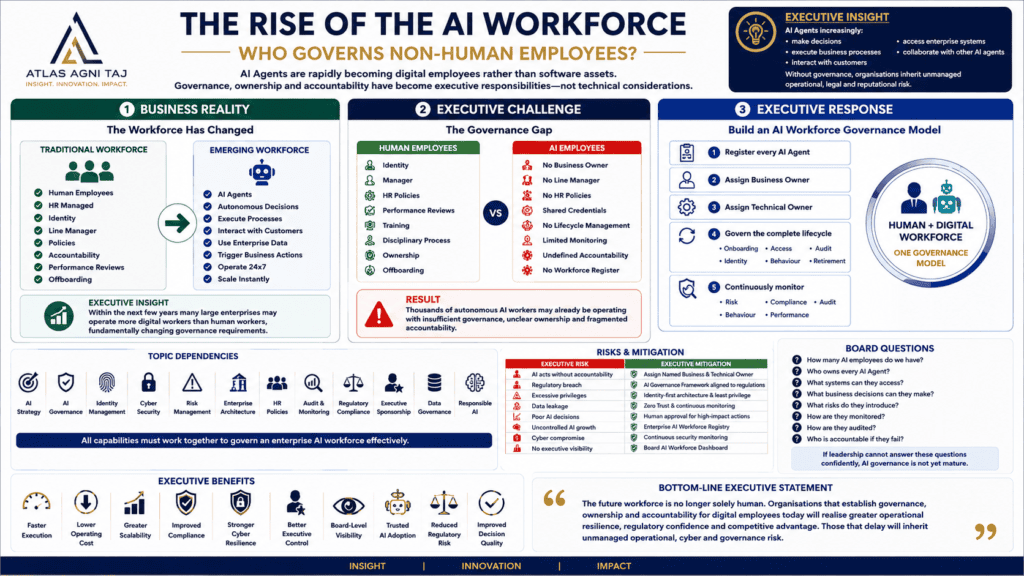
The Rise of AI Workforce Management: Who Manages Non-Human Employees? Every CIO will soon oversee thousands of digital employees. The governance question is no longer theoretical — it is urgent. There is a curious moment in every technology cycle when the surface of enterprise operations appears unchanged, yet the substrate beneath has shifted irrevocably. We are living in one such moment. Across boardrooms in London, Dubai, Singapore and New York, chief executives continue to discuss headcount, succession planning and talent retention in the familiar vocabulary of human resource management. Meanwhile, quietly and at increasing scale, a second workforce is arriving — one that does not sleep, does not resign, does not require a visa, and multiplies at the pace of a software release. This second workforce is composed of AI agents: autonomous, goal-directed digital entities capable of executing multi-step business processes with minimal human intervention. They are not the chatbots of the last decade. They are not the deterministic scripts of robotic process automation. They are systems that reason, plan, delegate to other agents, invoke tools, negotiate with counterparties, and — most consequentially — take actions that carry commercial, legal and reputational weight. Within three years, the majority of large enterprises will operate blended workforces in which digital employees outnumber their human colleagues by an order of magnitude. Some organisations will manage this transition with intention and discipline. Most will drift into it, discovering only in retrospect that they have accumulated thousands of unmanaged, unaccountable, unsupervised non-human workers acting in their name. The question that follows is deceptively simple, and it is one that few executive teams have yet answered with clarity: who, precisely, manages the AI workforce? From Software Assets to Non-Human Colleagues For four decades, the CIO’s remit has been organised around a stable conceptual model. Software was an asset to be procured, deployed, patched and eventually decommissioned. Users were people. The two interacted through interfaces, and accountability flowed cleanly along human reporting lines. When something went wrong, an individual — identifiable, employed, and answerable — was ultimately responsible. That model is now obsolete. An AI agent, once deployed, does not sit passively on a server awaiting instruction. It acts. It initiates communications, opens tickets, moves money, updates records, contacts customers, drafts contracts and, in the more sophisticated architectures now entering production, instructs other agents to do the same. It operates on behalf of the organisation, using the organisation’s credentials, in the organisation’s name. To describe such an entity as “software” is to miss the essential shift. A conventional application waits to be invoked; an agent pursues objectives. A conventional application follows deterministic paths; an agent selects among options. A conventional application produces predictable outputs; an agent produces outcomes whose specific route to completion may never be reproduced. In behaviour, if not in ontology, the agent has crossed a threshold. It is closer in operational character to a junior employee than to a piece of code. This is not a matter of anthropomorphism. It is a matter of governance. The moment an entity acts with agency, on behalf of an organisation, the governance apparatus designed for passive software becomes structurally inadequate. The Governance Vacuum Consider the current state of controls in most large enterprises. Human employees are onboarded through a formal process that establishes their identity, verifies their right to work, provisions their access, records their reporting line, sets their objectives, and subjects them to performance review, disciplinary procedures and termination protocols. There is a clear owner, a clear line manager, and a clear escalation path. Now consider the typical AI agent in production today. It is often deployed by a development team, integrated with production systems via API keys or service accounts, assigned permissions based on expedience rather than principle, and monitored — if at all — through generic logging tools designed for infrastructure rather than behaviour. It has no line manager. It has no performance review. It has no defined objectives beyond those expressed in a system prompt that may have been written by a contractor eighteen months ago and never revisited. When this agent acts in a manner that harms a customer, breaches a regulation, or exposes the organisation to reputational risk, who is answerable? The developer who wrote the prompt? The vendor whose foundation model underpins it? The business owner whose process it automates? The CIO whose infrastructure hosts it? In most organisations today, the honest answer is that no one has been formally assigned. The governance vacuum is complete. Regulators are noticing. The European Union’s AI Act, the emerging UAE frameworks for high-risk AI deployment, the Monetary Authority of Singapore’s guidance on model risk, and the developing United States executive-branch requirements around agentic systems all point in the same direction. Accountability for the actions of autonomous systems must be located in specific, named human beings within the deploying organisation. Diffuse responsibility is no longer acceptable, and it will not survive the first significant enforcement action. The First Pillar: Identity for the Non-Human Workforce Any credible governance model for AI agents begins with identity. Every human employee has an identity: a name, an employee number, a role, a department, a set of entitlements, and an authoritative record in the human-resources system of record. That identity is the anchor to which everything else — access, accountability, compensation, review — is attached. Digital employees require an analogous framework. Each agent must possess a distinct, non-shared identity. It must be registered in a system of record that is authoritative for the non-human workforce. That identity must carry metadata: what the agent is designed to do, which business owner sponsors it, which technical owner maintains it, which foundation model or models it invokes, what data it may access, what actions it may take, and under what circumstances it must escalate to a human. Critically, agent identities must not be conflated with the service accounts that IT teams have historically used for machine-to-machine authentication. A service account executes narrowly defined, deterministic tasks. An agent identity represents a purposeful,
Why Institutional Intelligence Will Define AI Leadership
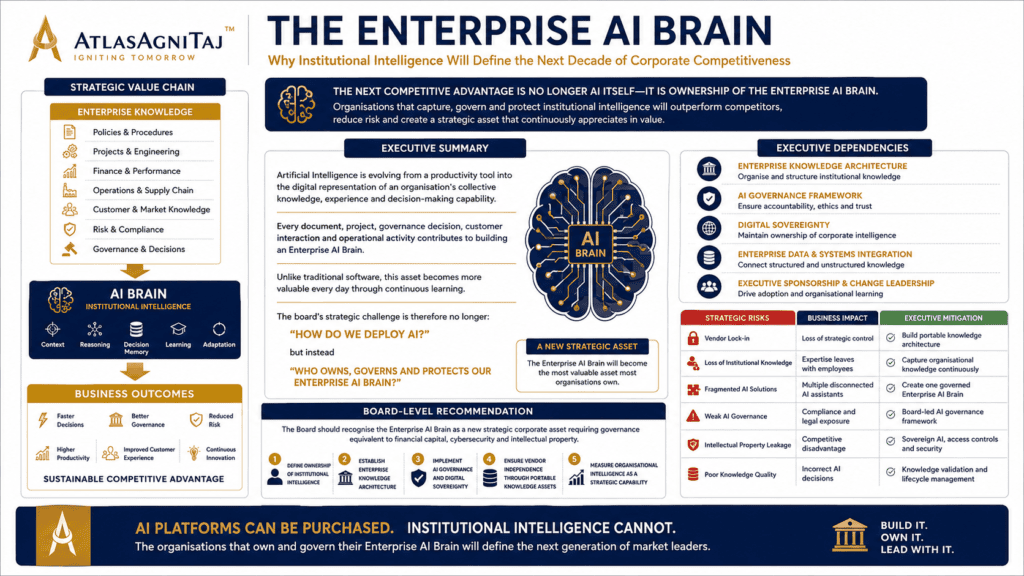
Enterprise AI Strategy: Why Institutional Intelligence Will Define the Next Decade of Corporate Competitiveness For much of the past decade, boardroom conversations regarding Artificial Intelligence have revolved around a single, deceptively straightforward question: how do we adopt AI at scale? Enterprises across every sector have committed substantial capital to generative platforms, machine learning capabilities, intelligent automation and conversational assistants, all in pursuit of productivity, efficiency and improved competitive positioning. The prevailing emphasis has been upon experimentation, rapid deployment and the identification of practical use cases capable of demonstrating measurable business value within a compressed strategic timeframe. That chapter of the enterprise AI journey is now drawing to a close. Executive teams at the leading edge of digital transformation are beginning to ask a materially more sophisticated question — one with profound implications for corporate strategy, governance, valuation and long-term competitiveness. Who owns our organisation’s AI brain? At first hearing, the question can sound philosophical, even abstract. In practice, it may prove to be among the most commercially consequential issues confronting the modern enterprise. Whoever controls the answer will, in the years immediately ahead, control a category of asset that has not previously existed on the corporate balance sheet. Over the past three decades, organisations have invested billions in constructing the digital scaffolding of the modern enterprise. Enterprise Resource Planning systems reshaped finance, procurement and operations. Customer Relationship Management platforms have redefined the way commercial relationships are cultivated and managed. Data warehousing and business intelligence unlocked new analytical capabilities. Cloud computing subsequently rewrote the rules of scalability, resilience and time-to-market. Each of these waves conferred competitive advantage — for a period — before eventually maturing into a foundational commodity available to all serious market participants. Artificial Intelligence represents something fundamentally different. Unlike previous generations of enterprise technology, AI does not merely process information or automate a predefined set of tasks. It learns organisational behaviour. It observes patterns in decision-making. It develops an appreciation of the relationships among data, documents, policies, procedures and precedents. Most significantly, it accumulates — session by session, project by project, decision by decision — a coherent representation of institutional knowledge. Every proposal is reviewed. Every engineering design is approved. Every procurement negotiation concluded. Every risk assessment is recorded. Every financial model is refined. Every governance decision is reasoned through. Every customer interaction is resolved. Every operational procedure is executed. Collectively, these activities begin to constitute something that has never previously existed within the enterprise: a continuously evolving digital representation of institutional intelligence. That is the Enterprise AI Brain. And it will, in remarkably short order, become the most valuable asset most organisations own. The maturing executive dialogue around AI reflects this shift. Where boards once concerned themselves principally with adoption metrics and pilot outcomes, they are now increasingly focused upon accountability, ownership and long-term strategic control. The vocabulary is changing accordingly. Terms such as knowledge architecture, institutional intelligence, AI sovereignty, and cognitive continuity are entering executive discussions with increasing regularity. This is not a matter of fashion. It is the natural consequence of enterprises recognising that the next horizon of AI value creation lies not in the platforms themselves, but in what those platforms come to know. From the Data Economy to the Intelligence Economy For more than twenty years, the business community has repeated a familiar refrain: data is the new oil. The analogy served its purpose. Data fuelled the digital economy in much the same way that hydrocarbons fuelled industrialisation. Organisations invested heavily in the collection, storage and analysis of information, in the reasonable expectation that deeper insight would translate into superior commercial performance. Whole disciplines emerged around this proposition. Data governance became a formal function. Chief Data Officers took their place within the executive suite. Data lakes, master data management, predictive analytics and enterprise reporting became strategic priorities. Substantial value was created — much of it durable, well documented and rightly celebrated. Artificial Intelligence, however, is quietly redefining the economics of information itself. Data, in isolation, rarely creates enduring competitive advantage. Thousands of organisations may possess broadly similar customer demographics, financial ledgers, operational metrics or market data. Yet enterprises operating from comparable datasets consistently deliver dramatically different results. The reason is straightforward: competitive advantage has never resided within information alone. It resides within interpretation. Within judgement. Within accumulated experience. Within institutional memory. Within context. The difference between an outstanding organisation and an average one is rarely a question of what it knows. It is almost always a question of how it applies what it knows. This distinction signals the transition from the Data Economy to what will soon be recognised as the Intelligence Economy. Institutional intelligence encompasses every lesson learned across years of operation; the reasoning behind strategic decisions; the criteria applied when selecting suppliers; the regulatory interpretations refined through practical experience; the engineering principles matured across multiple project lifecycles; and the commercial negotiation strategies developed through decades of customer engagement. Above all, institutional intelligence records why decisions were made — not simply what was decided. Artificial Intelligence is uniquely capable of preserving, connecting, and continuously enhancing this form of knowledge in ways no previous technology could. The executive implication is significant: leaders should begin thinking rather less about managing data and rather more about stewarding organisational intelligence. The distinction may appear subtle. In reality, it alters almost everything about how competitive value is created, defended and sustained. Understanding the Enterprise AI Brain When many executives encounter the term “AI”, their first reference points remain chatbots, virtual assistants or generative content tools. Such framings materially underestimate what enterprise AI is becoming. The organisational AI Brain should not be regarded as another application or platform. It is more accurately understood as a continuously evolving knowledge ecosystem — a digital counterpart to the enterprise’s collective reasoning capacity. Just as the human brain integrates memory, reasoning, experience and learning into a unified faculty, the Enterprise AI Brain integrates information from across the organisation to produce contextual understanding. It brings together the structured and the unstructured: policies,
The Future of UAE Family Businesses: Platform, Not Company
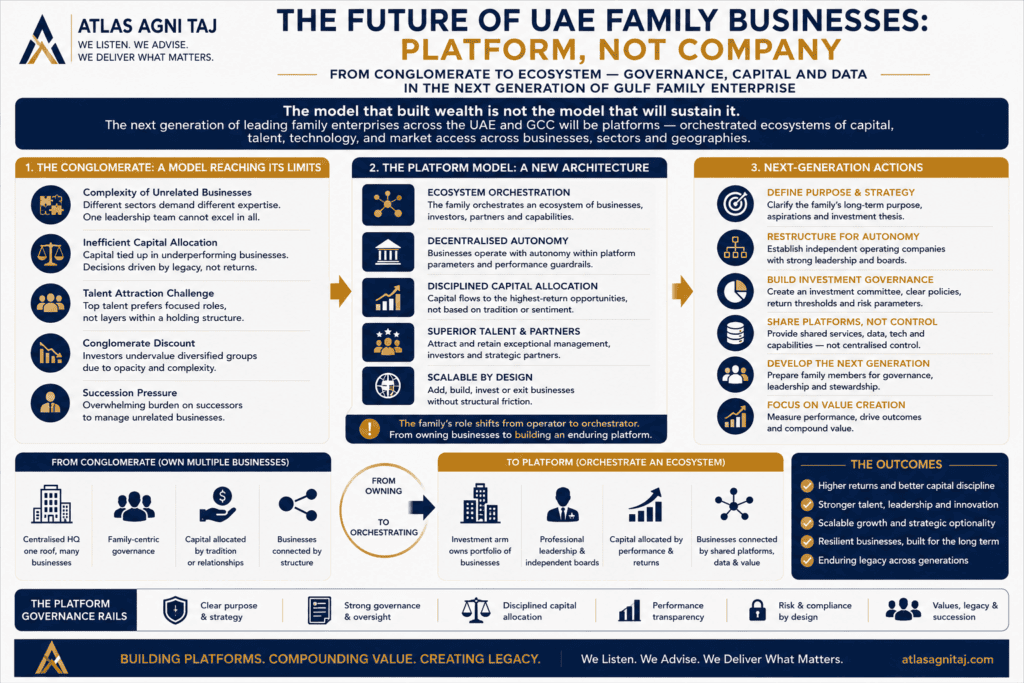
Executive Thought Leadership From Conglomerate to Ecosystem — Governance, Capital and Data in the Next Generation of Gulf Family Enterprise For fifty years, the family conglomerate has been the defining institution of Gulf commerce. A founder builds a core trading or distribution business, cash is generated, confidence grows, and the enterprise diversifies into real estate, retail, healthcare, and financial services. This model has created extraordinary wealth and remains, in many respects, a Gulf success story without parallel. But the model that built this wealth is not the model that will sustain it. The next generation of leading family enterprises across the UAE and the wider GCC will not resemble the conglomerates of their founders. They will be platforms: orchestrated ecosystems of capital, talent, technology, and market access, spanning multiple businesses, sectors, and geographies. This is not a distant prospect. It is already under way, and it is reshaping how the region’s most consequential private enterprises will be governed, capitalised, and led. The Future of UAE Family Businesses: From Conglomerate to Platform The conglomerate structure served its purpose well. A core business generated cash, which funded diversification. Risk was distributed across sectors. Scale conferred negotiating power. For a first generation building an enterprise from limited capital and limited institutional infrastructure, this was a rational, resilient design. Its constraints, however, are becoming difficult to ignore. Managing unrelated businesses under one roof demands fundamentally different operating expertise, and a leadership team well suited to automotive distribution is rarely equally suited to healthcare delivery or financial services. Capital allocated to one line of business is capital unavailable to another, and without disciplined, comparable metrics across sectors, optimal allocation becomes more art than science. Attracting exceptional talent is harder still: a distinguished healthcare executive is seldom drawn to a role inside an automotive-led group, however successful that group may be. Perhaps most tellingly, investors and capital markets have long applied a “conglomerate discount” to diversified holding structures, unable to cleanly value which businesses create value and which merely consume it. And when the founding generation steps back, the burden of overseeing an unrelated portfolio of businesses frequently overwhelms a single successor or even a small group of them. These are not new observations. What is new is the confluence of external pressure and internal readiness that is now driving family enterprises to resolve them — not through incremental adjustment, but through structural transformation. Defining the Platform Model A platform, in its modern sense, is an ecosystem that creates value by connecting multiple parties — businesses, investors, service providers, and customers — and by enabling transactions and relationships between them. Applied to a family enterprise, the platform model represents a shift in the family’s role: from a family that owns multiple businesses, to a family that orchestrates an ecosystem of businesses. The distinction is subtle in language but consequential in practice. Under a conglomerate model, the family owns and operates its businesses directly. These businesses connect through corporate structure and internal capital flows. A single centre — typically the corporate head office or family office — manages all businesses and makes strategic decisions centrally, allocating capital according to founder judgement. Under a platform model, the family instead owns an investment arm that invests in and manages a portfolio of businesses. These businesses connect through shared infrastructure, customer networks, and capital flows, but the centre’s role shifts from control to governance, capital provision, and capability building. Business units retain significant operating autonomy within platform parameters, and capital is allocated according to comparative return, not tradition or sentiment. This shift carries several practical implications for how a group is run. Each business gains a clear leader and a distinct operating model, held accountable on its own terms rather than absorbed into a single corporate identity. Because businesses operate with meaningful autonomy, they become able to attract professional management talent that would not otherwise consider a role several layers beneath a family holding structure. External investors — private equity in particular — find it far easier to invest in a specific, well-defined business than to acquire an entire diversified conglomerate. Capital allocation becomes more dynamic, directed toward the highest-return opportunity regardless of whether that opportunity sits within the group’s traditional “core.” And the structure itself scales more naturally: new businesses are added to the platform rather than absorbed into an increasingly unwieldy centralised entity. From Conglomerate to Platform: An Illustrative Evolution To make this transition concrete, consider how a diversified regional group might evolve from a classical conglomerate toward a platform architecture. In its conglomerate form, such a group typically operates through a single central headquarters overseeing business units in retail, automotive, real estate, and industrial sectors. Governance is family-centred, and capital allocation is determined at the centre, largely by relationship and precedent rather than comparative return. In its platform form, the same group would establish separate operating companies for each business line, each with its own identity, professional CEO, and board. An investment arm — a dedicated capital allocation vehicle — takes responsibility for the group’s overall portfolio strategy, deploying capital across operating companies according to return expectations rather than historical allegiance. Shared services such as finance, HR, and IT remain centralised, but are repositioned as internal service providers to the operating businesses rather than as instruments of central control. Family governance is retained, but is exercised at the level of the investment company, not within the day-to-day management of individual operating businesses. The dividends of this evolution are considerable. Each operating company becomes simpler to understand, govern, and value in isolation. Each is better positioned to attract world-class talent by offering genuine autonomy alongside clear accountability. External capital — whether private equity, sovereign co-investment, or institutional debt — becomes accessible either at the level of an individual operating company or at the level of the platform itself. And the platform gains the capacity to acquire and integrate new businesses without forcing them into a predetermined corporate mould. Several prominent Gulf groups are widely regarded, in industry
Business Transformation Strategy: The Cost of Inaction
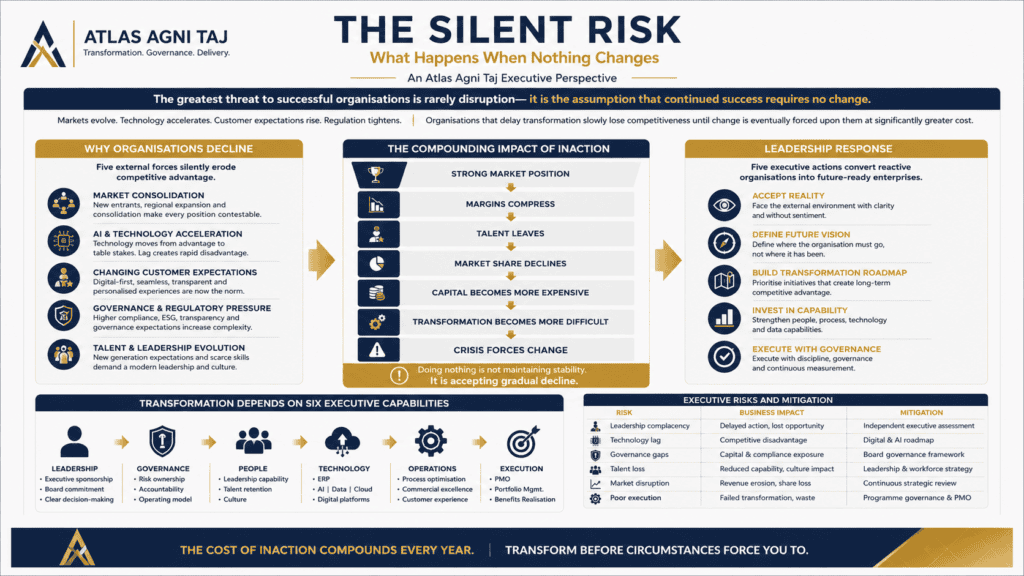
Business Transformation: The Cost of Doing Nothing There is a particular comfort that accompanies decades of commercial success. Markets have been generous. Cash flows are healthy. Customers are loyal. Employees have long tenure. Suppliers understand how the business works. The regulatory environment feels settled. The enterprise has thrived by doing, consistently and diligently, what it has always done. That comfort conceals a dangerous assumption: that continued success requires nothing more than the continuation of current practice. It is an understandable conclusion. It is also, for a great many organisations across the Gulf, a potentially catastrophic one. The external environment in which businesses operate is not static. Markets are consolidating. Competition is intensifying. Technology is displacing established models. Customer expectations are evolving. Regulatory frameworks are becoming more exacting. Labour markets are shifting. Generational expectations inside the organisation are changing. The very stability that produced yesterday’s success is, increasingly, the source of tomorrow’s decline. The Risk Landscape: What Is Actually Changing To understand the silent risk of inaction, leadership must examine, unsentimentally, the forces reshaping the operating environment. Market Consolidation and New Competition For decades, many established businesses operated within a stable, predictable competitive order. The leading players remained the leading players. New entrants arrived rarely, and with difficulty. Margins were durable. That order is dissolving. Global multinationals are now comfortable operating directly in regional markets, entering through acquisition, partnership, or direct investment. Technology-enabled competitors are disintermediating traditional distribution and retail models. Regional players from adjacent markets are expanding across borders with modern operating models and leaner cost structures. Within the region itself, consolidation is producing larger, more sophisticated competitors with specialised functions and greater operational discipline. The consequence is straightforward and uncomfortable: a secure market position, however long-held, is becoming a contestable one. An organisation that assumes it will retain its position through existing approaches alone is operating from a flawed premise. It is worth noting that consolidation does not only threaten smaller organisations. Mid-market and even large regional incumbents have discovered that scale built decades ago does not automatically translate into scale advantage today, particularly where a newer entrant carries lower overhead, a leaner technology stack, and no legacy structure to defend. Incumbency, in this environment, is a starting position rather than a guarantee. Changing Customer Expectations Customer expectations are evolving in ways that many established organisations have not fully absorbed. A newer generation of customers, frequently younger, internationally educated, and accustomed to global consumer standards, expects seamless omnichannel experience, responsive multi-channel service, transparency over data use, credible sustainability practice, and personalisation grounded in purchase history. Organisations that built their reputation on personal relationship and in-person service often lag in digital capability. A retail business that was world-class in the physical store may be structurally unprepared for e-commerce competition. Business-to-business relationships are subject to the same pressure: corporate customers increasingly expect platform integration, real-time supply chain visibility, and data-led reporting rather than relationship-based ordering. Loyalty today attaches to organisations that meet evolving expectations, not to the manner in which business has traditionally been conducted. An organisation that disregards this shift will cede share to more responsive rivals. Technological Disruption The pace of technological change continues to accelerate. Capabilities that were speculative a decade ago are now affordable and, in many sectors, table stakes: artificial intelligence and machine learning automating tasks once thought to require human judgement; cloud computing placing enterprise-grade software within reach of mid-sized organisations; advanced analytics enabling visibility and optimisation previously unattainable; mobile technology enabling direct customer engagement that bypasses traditional channels. An organisation without modern data and enterprise resource planning visibility into its own cost base will lose the margin contest to a competitor operating with real-time production and commercial analytics. Technology, in this environment, is not a discretionary enhancement. It is a condition of continued competitiveness. The risk is compounded by the fact that technology adoption is rarely a single project. It is a capability that must be continuously renewed. An organisation that completed a technology implementation a decade ago and has not meaningfully revisited its architecture since is, in practical terms, further behind today than it was when the original system went live, because the pace of change around it has accelerated while its own foundation has remained static. Regulatory and Compliance Evolution Regulatory expectations across the GCC are tightening, moving deliberately toward formalisation, transparency, and international standards of governance. An organisation that assumes regulatory requirements will remain static is making a costly miscalculation. Compliance is a moving target, and the cost of falling behind it continues to rise. The Talent Market The labour market is undergoing a structural shift with particular consequences for traditionally managed organisations. Younger professionals expect clear advancement paths, meritocratic progression, market-based compensation, transparent performance feedback, and a defined sense of organisational purpose. Organisations that have historically retained staff through personal relationship, informal progression, and proximity to ownership are discovering that this model no longer holds. The strongest talent is choosing professional organisations with credible career architecture over informally managed alternatives. Institutional knowledge, once retained through loyalty, is now walking out of the door, and the cost of replacing it, in recruitment, training, and compensation, is materially higher than in previous decades. There is a second-order effect that leadership frequently underestimates. As stronger performers depart, the organisation’s centre of gravity shifts toward those who are comfortable with informal, relationship-based management, precisely the profile least equipped to lead a professionalisation effort. The talent gap therefore tends to widen at the moment it becomes most critical to close, unless leadership intervenes deliberately and early. Demographic and Generational Shifts The founding generation of many established businesses is ageing, and leadership transition is, for a great many organisations, no longer a future consideration but a present one. The incoming generation, frequently educated internationally and exposed to multinational or start-up environments, expects professional management, formal governance, and strategic clarity, rather than a structure built entirely around a single individual’s discretion. Broader demographic and policy shifts, including a firmer national employment agenda across the region, are
From Founder-Led to System-Led: The Transformation That Defines Enduring Success
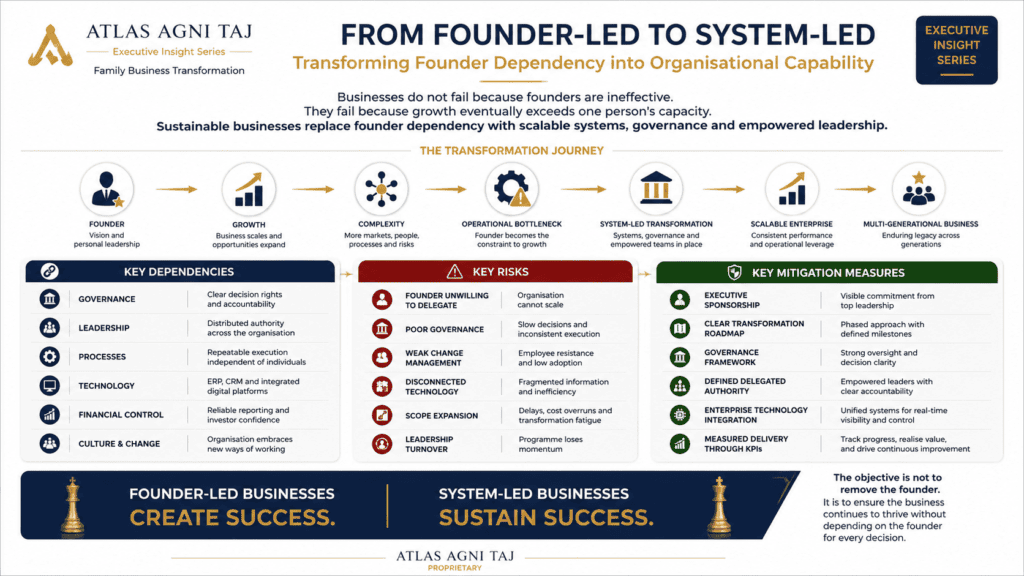
Founder-Led to System-Led Business Transformation How family enterprises transition from personal leadership to institutional strength — and why the timing of that shift determines who survives to the next generation. The Inflexion Point There comes a precise moment in the life of almost every successful family business when its founder is confronted with a question that cannot be deferred indefinitely: can this enterprise continue to operate as it always has, or has it reached the point where its very operating model must change? This moment rarely announces itself through a single event. It arrives, instead, through the accumulation of signals. The business has grown to a scale at which the founder can no longer personally know every customer, every vendor, and every material decision. The founder is ageing, or is simply less available than the business now requires. A new generation of leadership is entering the enterprise, bringing with it different assumptions about how authority should be exercised. Market conditions have become more complex than founder intuition, however finely honed, can reliably navigate. The business is expanding into adjacent markets or sectors that sit outside the founder’s personal domain of expertise. Regulatory and compliance obligations have grown too intricate to be managed informally. Talented employees are leaving because they see no clarity of decision rights and no credible path to advancement. Or the business has reached a size at which further growth requires leverage, and lenders are now insisting on formalised governance and controls as a precondition of capital. When several of these conditions converge, as they invariably do, the organisation faces a choice that is not merely operational but existential: remain founder-led, or transform into a system-led enterprise. This is not a cosmetic adjustment to an organisational chart. It is a fundamental re-engineering of how the business thinks, decides, and executes at every level. The Founder-Led Model: Its Genuine Strengths To understand why this transformation is necessary, one must first give full credit to what a founder-led model achieves — because it achieves a great deal, and any credible transformation strategy must preserve, rather than discard, its genuine advantages. Speed. When one individual holds both authority and accountability, decisions that would occupy a committee for weeks can be resolved in a single conversation. This is not a minor efficiency; in competitive markets, speed is frequently the difference between capturing an opportunity and watching a competitor take it. Agility. The founder can reorient the enterprise the moment new information emerges. There are no committees to persuade, no governance layers to traverse. The founder observes, and the organisation pivots. Operational efficiency. Founder-led businesses tend to carry minimal bureaucracy. There is no duplicated oversight, no cascading layers of approval. The founder holds an information advantage and can allocate resources with very little overhead. Autonomy. The founder answers to no board, no investor committee, no external stakeholder. Strategic direction, capital allocation, and pace of change remain entirely within the founder’s discretion — a freedom that is, for many entrepreneurs, the very reason they built the business in the first place. Alignment. Because the founder built the enterprise personally and retains full decision authority, intent and execution are perfectly aligned. What the founder wants is, quite simply, what the organisation does. The Founder-Led Model: Its Structural Limitations The same characteristics that make the founder-led model powerful at one stage of growth become its constraints at the next. Scale. Beyond a certain point, no single individual can hold the full picture. Customer relationships exceed what one person can personally maintain. Supply chains become too intricate to track informally. Market dynamics become too multifaceted for any one perspective. The founder’s personal bandwidth becomes the organisation’s binding constraint. Complexity. As the enterprise expands into new sectors, the founder frequently lacks domain expertise in those areas. A founder who built a formidable retail distribution business may have no comparable insight into healthcare operations or financial services regulation. The generalist instinct that served brilliantly at smaller scale becomes a liability at larger scale. Continuity. A founder-led operation is structurally brittle, because it depends entirely on the presence and capability of one individual. Should the founder become unavailable — through illness, accident, ageing, or death — the business often lacks the infrastructure to continue functioning without severe disruption. Access to capital. Lenders and institutional investors are, understandably, uneasy about founder-dependent operations, because economic value is concentrated in a single person. Any investor is effectively purchasing an option on the founder’s continued availability, and few are willing to price that risk generously. Favourable debt terms and equity valuations become correspondingly harder to secure. Talent attraction and retention. Highly capable professionals are frequently reluctant to commit their careers to organisations in which all authority sits with one leader. They see limited autonomy, unclear paths to advancement, and little scope to build something of their own within the enterprise. The strongest talent, in time, migrates to more structured environments. Formal governance. Banks, government entities, and large enterprise customers increasingly require demonstrable evidence of formal governance, internal controls, and operational transparency before they will extend credit, licences, or contracts. A founder-led organisation can meet this requirement only by building the very structures that, by definition, move it away from pure founder-led operation. Scalability of the business model itself. Certain opportunities — entering a new market, acquiring a competitor, launching a new business line — demand more capital, more specialised expertise, and more organisational capacity than any founder can personally direct. Only a system-led organisation is structurally capable of pursuing them. The System-Led Paradigm: Structure, Process, and Distributed Authority A system-led organisation operates on a fundamentally different set of principles. Decision Authority is Distributed Rather than being concentrated in the founder, authority is allocated across defined organisational roles. A Chief Financial Officer holds authority over financial decisions within agreed parameters. An operations director holds authority over supply chain decisions. A regional or store-level manager holds authority over local decisions. The founder’s role shifts from making every decision to approving certain categories of decision and