Enterprise AI Strategy: Why Institutional Intelligence Will Define the Next Decade of Corporate Competitiveness
For much of the past decade, boardroom conversations regarding Artificial Intelligence have revolved around a single, deceptively straightforward question: how do we adopt AI at scale? Enterprises across every sector have committed substantial capital to generative platforms, machine learning capabilities, intelligent automation and conversational assistants, all in pursuit of productivity, efficiency and improved competitive positioning. The prevailing emphasis has been upon experimentation, rapid deployment and the identification of practical use cases capable of demonstrating measurable business value within a compressed strategic timeframe.
That chapter of the enterprise AI journey is now drawing to a close.
Executive teams at the leading edge of digital transformation are beginning to ask a materially more sophisticated question — one with profound implications for corporate strategy, governance, valuation and long-term competitiveness.
Who owns our organisation’s AI brain?
At first hearing, the question can sound philosophical, even abstract. In practice, it may prove to be among the most commercially consequential issues confronting the modern enterprise. Whoever controls the answer will, in the years immediately ahead, control a category of asset that has not previously existed on the corporate balance sheet.
Over the past three decades, organisations have invested billions in constructing the digital scaffolding of the modern enterprise. Enterprise Resource Planning systems reshaped finance, procurement and operations. Customer Relationship Management platforms have redefined the way commercial relationships are cultivated and managed. Data warehousing and business intelligence unlocked new analytical capabilities. Cloud computing subsequently rewrote the rules of scalability, resilience and time-to-market. Each of these waves conferred competitive advantage — for a period — before eventually maturing into a foundational commodity available to all serious market participants.
Artificial Intelligence represents something fundamentally different.
Unlike previous generations of enterprise technology, AI does not merely process information or automate a predefined set of tasks. It learns organisational behaviour. It observes patterns in decision-making. It develops an appreciation of the relationships among data, documents, policies, procedures and precedents. Most significantly, it accumulates — session by session, project by project, decision by decision — a coherent representation of institutional knowledge.
Every proposal is reviewed. Every engineering design is approved. Every procurement negotiation concluded. Every risk assessment is recorded. Every financial model is refined. Every governance decision is reasoned through. Every customer interaction is resolved. Every operational procedure is executed. Collectively, these activities begin to constitute something that has never previously existed within the enterprise: a continuously evolving digital representation of institutional intelligence.
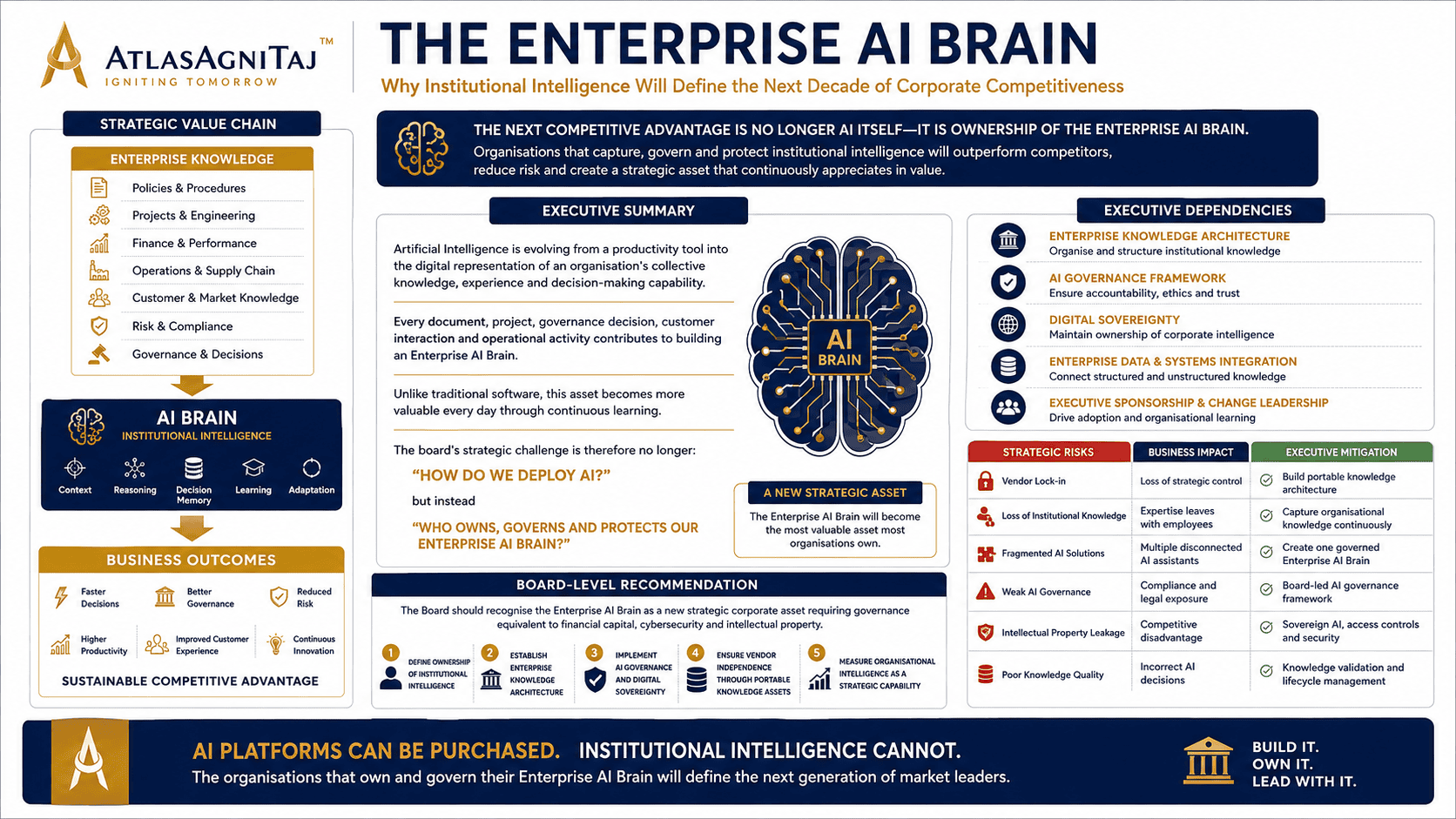
That is the Enterprise AI Brain. And it will, in remarkably short order, become the most valuable asset most organisations own.
The maturing executive dialogue around AI reflects this shift. Where boards once concerned themselves principally with adoption metrics and pilot outcomes, they are now increasingly focused upon accountability, ownership and long-term strategic control. The vocabulary is changing accordingly. Terms such as knowledge architecture, institutional intelligence, AI sovereignty, and cognitive continuity are entering executive discussions with increasing regularity. This is not a matter of fashion. It is the natural consequence of enterprises recognising that the next horizon of AI value creation lies not in the platforms themselves, but in what those platforms come to know.
From the Data Economy to the Intelligence Economy
For more than twenty years, the business community has repeated a familiar refrain: data is the new oil. The analogy served its purpose. Data fuelled the digital economy in much the same way that hydrocarbons fuelled industrialisation. Organisations invested heavily in the collection, storage and analysis of information, in the reasonable expectation that deeper insight would translate into superior commercial performance.
Whole disciplines emerged around this proposition. Data governance became a formal function. Chief Data Officers took their place within the executive suite. Data lakes, master data management, predictive analytics and enterprise reporting became strategic priorities. Substantial value was created — much of it durable, well documented and rightly celebrated.
Artificial Intelligence, however, is quietly redefining the economics of information itself.
Data, in isolation, rarely creates enduring competitive advantage. Thousands of organisations may possess broadly similar customer demographics, financial ledgers, operational metrics or market data. Yet enterprises operating from comparable datasets consistently deliver dramatically different results. The reason is straightforward: competitive advantage has never resided within information alone. It resides within interpretation. Within judgement. Within accumulated experience. Within institutional memory. Within context.
The difference between an outstanding organisation and an average one is rarely a question of what it knows. It is almost always a question of how it applies what it knows.
This distinction signals the transition from the Data Economy to what will soon be recognised as the Intelligence Economy. Institutional intelligence encompasses every lesson learned across years of operation; the reasoning behind strategic decisions; the criteria applied when selecting suppliers; the regulatory interpretations refined through practical experience; the engineering principles matured across multiple project lifecycles; and the commercial negotiation strategies developed through decades of customer engagement. Above all, institutional intelligence records why decisions were made — not simply what was decided.
Artificial Intelligence is uniquely capable of preserving, connecting, and continuously enhancing this form of knowledge in ways no previous technology could. The executive implication is significant: leaders should begin thinking rather less about managing data and rather more about stewarding organisational intelligence. The distinction may appear subtle. In reality, it alters almost everything about how competitive value is created, defended and sustained.
Understanding the Enterprise AI Brain
When many executives encounter the term “AI”, their first reference points remain chatbots, virtual assistants or generative content tools. Such framings materially underestimate what enterprise AI is becoming.
The organisational AI Brain should not be regarded as another application or platform. It is more accurately understood as a continuously evolving knowledge ecosystem — a digital counterpart to the enterprise’s collective reasoning capacity. Just as the human brain integrates memory, reasoning, experience and learning into a unified faculty, the Enterprise AI Brain integrates information from across the organisation to produce contextual understanding.
It brings together the structured and the unstructured: policies, contracts, standard operating procedures, project documentation, financial records, architectural standards, customer correspondence, risk registers, audit findings, lessons learned, governance decisions, technical documentation, commercial playbooks, training materials, market intelligence and research. Rather than treating these resources as isolated repositories, AI establishes meaningful relationships between them. Over time, it begins to comprehend how they interact — how a procurement clause influences a delivery risk, how a governance decision constrains an architectural choice, how a customer commitment shapes a commercial exposure.
The consequence is that AI moves beyond information retrieval and into intelligent reasoning. Instead of merely locating a procurement policy, it understands why the policy exists in its present form. Instead of identifying previous engineering designs, it recognises which architectural decisions delivered successful outcomes, and why. Instead of retrieving historical project documentation, it identifies recurring delivery risks and proposes preventative actions grounded in the organisation’s own operational history.
The AI Brain therefore evolves into an institutional memory capable of supporting materially better decision-making across every business function. Its value compounds continuously. Every project completed enriches it. Every governance decision strengthens it. Every successful transformation programme improves its judgement. Every regulatory engagement extends its comprehension. Every commercial negotiation refines its instincts.
Where conventional enterprise software typically depreciates over its useful life, the Enterprise AI Brain appreciates through continuous learning. That single characteristic marks it out as one of the most strategically significant assets an organisation will develop during the coming decade — and one which, unlike almost any other, becomes more valuable the longer it is properly stewarded.
Institutional Intelligence: The Last Sustainable Competitive Advantage
Enterprise technology has become progressively democratised. Cloud infrastructure can be provisioned within hours. Foundation models are globally accessible. Advanced analytics platforms require comparatively little implementation effort. Automation technologies are readily available to competitors, challengers and new entrants alike. The unavoidable conclusion is that pure technological differentiation continues to erode and will continue to do so.
Institutional intelligence, by contrast, cannot be purchased. It cannot be downloaded, licensed or replicated by procuring the latest AI platform. Every organisation cultivates unique expertise across years of operational experience. That expertise is embedded within the countless decisions made every day by employees across every department. It reflects organisational culture, commercial philosophy, risk appetite, customer relationships, technical innovation, regulatory understanding, supplier engagement and operational resilience. Taken together, these intangible qualities constitute the organisation’s intellectual identity — the corporate equivalent of tacit knowledge, previously locked within the minds of experienced individuals and rarely captured in any deliberate or transferable form.
Artificial Intelligence provides the first realistic opportunity to capture this knowledge systematically before it disappears due to workforce turnover, retirement, or organisational change. For many enterprises, that opportunity is not merely operational; it is generational. Decades of intellectual capital, painstakingly assembled but never previously codified, can now be preserved, transmitted and refined.
The strategic implications are considerable. Organisations that successfully capture institutional intelligence will make faster, more consistent decisions, deliver more predictable customer experiences, reduce operational risk, accelerate innovation, improve regulatory compliance, enhance organisational resilience, and strengthen competitive differentiation. Those that fail to do so will continue to lose irreplaceable expertise every time an experienced colleague departs, retires or moves on — an attritional loss that has quietly cost the enterprise sector far more than it has ever formally acknowledged.
Designing an Enterprise Knowledge Architecture
If institutional intelligence is becoming a strategic asset, it demands an equally strategic framework for its stewardship. This is where Enterprise Knowledge Architecture becomes indispensable.
Enterprise Architecture has traditionally concerned itself with systems, applications, technology infrastructure and information flows. Knowledge Architecture materially extends this discipline. It addresses a distinct and more consequential set of questions. Where does critical organisational knowledge actually reside? Who owns it? How is it governed? How is expertise validated? How should AI access sensitive material? How is knowledge quality assured and improved over time? How are conflicting sources reconciled? How is organisational reasoning preserved long after the decisions themselves have been made and their original authors have moved on?
Without deliberate architectural planning, enterprise AI initiatives almost invariably fragment. Departments deploy isolated knowledge repositories. Multiple AI assistants evolve independently across business units. Governance models diverge. Information duplication proliferates. Knowledge quality gradually deteriorates. In due course, the organisation finds itself operating not one AI Brain but several disconnected fragments — each incomplete, each subtly inconsistent, and each interpreting the enterprise differently.
The consequences will be familiar to anyone who has observed uncoordinated digital transformation programmes: inconsistent decision-making, avoidable operational risk and diminished strategic value from otherwise substantial investment. Knowledge Architecture, therefore, becomes at least as important as Technology Architecture. In many enterprises, it may ultimately prove more important still.
The organisations that recognise this early will design their knowledge architecture with the same discipline they have historically applied to their financial control frameworks or their cybersecurity postures — as a matter of enduring corporate hygiene rather than optional technical enhancement.
Digital Sovereignty and the New Governance Imperative
As enterprises increasingly embed proprietary knowledge within AI platforms, a new strategic challenge is coming sharply into focus: ownership.
Executives have historically focused on where their data resides. The more consequential question of the coming decade will concern where organisational intelligence resides. If proprietary expertise becomes increasingly embedded within third-party AI ecosystems — over which the enterprise exercises limited control — organisations may gradually surrender authority over one of their most valuable competitive assets, often without recognising that a transfer has occurred.
This concern extends well beyond cybersecurity. It encompasses commercial independence, strategic flexibility, regulatory compliance, national sovereignty, operational resilience and future innovation capacity. The issue is particularly acute for heavily regulated sectors: financial services, healthcare, government, defence, telecommunications, utilities and critical national infrastructure. In such environments, proprietary knowledge must remain subject to appropriate governance, transparency and accountability at all times.
Digital sovereignty therefore extends beyond the protection of information. It requires the protection of institutional reasoning. Future AI governance frameworks will need to address a new set of questions with corresponding rigour. Who owns organisational knowledge as it is codified within AI systems? How is enterprise reasoning validated and periodically re-examined? Can AI-generated decisions be audited to the standards regulators, boards, and courts will increasingly expect? Can institutional intelligence migrate between platforms as technology evolves? What safeguards prevent the leakage of intellectual property through model interactions? How are knowledge assets classified, and by whom? Who authorises the continuous learning that shapes the AI Brain’s future judgement?
These questions will not be answered by technology teams alone. They will require boards, audit committees, general counsel, chief risk officers and executive management collectively to develop a materially deeper understanding of how enterprise AI creates — and can inadvertently forfeit — value.
Regulatory expectation is already beginning to catch up with commercial reality. Across the European Union, the United Kingdom, the Gulf and much of the Asia-Pacific region, regulators are signalling an unmistakable intent to hold enterprises accountable not only for the outputs of their AI systems but for the reasoning, provenance and control frameworks that surround them. Sovereign AI initiatives, national data localisation requirements, and sector-specific supervisory guidance are converging, taken together, upon a shared principle: that institutional intelligence is a matter of national and commercial consequence, and that its governance can no longer be delegated exclusively to technology providers. Enterprises that anticipate this direction of travel — rather than react to it — will find themselves in a materially stronger position, both commercially and reputationally.
Reducing Vendor Dependency
Among the least discussed strategic risks in enterprise AI is dependency upon technology vendors. Selecting an AI platform is often approached principally as a procurement exercise. It should be understood as a long-term strategic commitment of the highest order.
As AI systems accumulate organisational knowledge, changing providers becomes progressively more complex. Unlike replacing conventional software — where interfaces, integrations and data can, with sufficient effort, be reproduced — migrating an Enterprise AI Brain involves transferring years of accumulated understanding. Decision logic. Operational knowledge. Institutional memory. Governance history. Commercial intelligence. The switching cost is measured not merely by implementation effort but by cumulative organisational learning that has been quietly transferred to a party outside the enterprise.
Executives should therefore draw a clear and enduring distinction between purchasing AI capabilities and surrendering ownership of institutional intelligence. The strategic objective should never be dependence upon a particular model, platform or provider. It should be the retention of the knowledge layer that genuinely differentiates the enterprise. This layer would remain valuable irrespective of which underlying model is in favour at any given moment.
Technology providers will continue to evolve. Foundation models will continue to improve. Infrastructure platforms will continue to change hands, converge, diverge and reinvent themselves. Institutional intelligence, by contrast, should remain firmly under enterprise control, be portable across providers, and be preserved as a first-class corporate asset. That principle will become central to any serious AI strategy conceived in the years ahead.
The Future Executive Agenda
Artificial Intelligence is quietly redefining the nature of executive leadership itself. Tomorrow’s leaders will no longer merely oversee technology transformation. They will become the custodians of organisational intelligence — accountable, in ways previous generations have not been, for the preservation and productive deployment of institutional knowledge across the enterprise.
Board discussions will increasingly incorporate a new class of questions. How effectively are we preserving our institutional knowledge? How resilient is our AI governance framework under external scrutiny? Who owns our AI Brain, in fact as well as in principle? How dependent have we become upon external platforms, and what would it cost us to change course? How are we protecting proprietary expertise from unintended disclosure through model interactions? How should we measure, report and defend the value of organisational intelligence? How do we ensure that our AI reflects our corporate values, regulatory obligations, and long-term commercial interests?
These are not technology questions. They are strategic leadership questions of the first order. The organisations that answer them thoughtfully — early, and with appropriate ambition — will establish a form of competitive advantage that is exceptionally difficult to erode. Those who defer these questions will discover, in due course, that the answers have quietly been made on their behalf.
Conclusion
Every significant technological revolution has ultimately reshaped the very definition of enterprise value. Industrialisation rewarded manufacturing capability. The digital revolution rewarded information. The cloud era rewarded agility. The Artificial Intelligence era will reward institutional intelligence.
This represents rather more than another phase of digital transformation. It signals the emergence of an entirely new strategic asset class. An organisation’s AI Brain will increasingly become the repository of its collective expertise, operational memory, commercial judgement and decision-making capability. Unlike software applications, this asset grows more valuable with every interaction. Unlike physical infrastructure, it appreciates through continuous learning. Unlike traditional intellectual property, it evolves dynamically alongside the organisation it serves.
The enterprises that recognise this transition early will invest not merely in AI platforms, but in knowledge architecture, governance frameworks, digital sovereignty and institutional learning. They will understand that technology is becoming increasingly commoditised while organisational intelligence is becoming increasingly scarce. They will protect that intelligence with the same diligence they apply to financial capital, intellectual property and strategic infrastructure.
Most importantly, they will recognise that the future competitive landscape will not be defined by which organisation purchased the most advanced AI platform. It will be defined by which organisation successfully built, governed and retained ownership of its own AI Brain.
In the decade ahead, competitive advantage will no longer be measured solely by data, infrastructure or computational power. It will be measured by the enterprise’s ability to transform knowledge into enduring institutional intelligence — and to protect that intelligence as the foundational asset of a new commercial era.
The organisations that master this transition will not simply adopt Artificial Intelligence. They will redefine what it means to compete in an economy where intelligence itself has become the most durable form of advantage.

#ArtificialIntelligence #EnterpriseAI #InstitutionalIntelligence #DigitalTransformation #AIStrategy #DigitalSovereignty #ExecutiveLeadership #BoardLeadership #KnowledgeManagement #EnterpriseArchitecture #AIGovernance #Innovation #BusinessTransformation #FutureOfWork #TechnologyLeadership