Founder-Led to System-Led Business Transformation
How family enterprises transition from personal leadership to institutional strength — and why the timing of that shift determines who survives to the next generation.
The Inflexion Point
There comes a precise moment in the life of almost every successful family business when its founder is confronted with a question that cannot be deferred indefinitely: can this enterprise continue to operate as it always has, or has it reached the point where its very operating model must change?
This moment rarely announces itself through a single event. It arrives, instead, through the accumulation of signals. The business has grown to a scale at which the founder can no longer personally know every customer, every vendor, and every material decision. The founder is ageing, or is simply less available than the business now requires. A new generation of leadership is entering the enterprise, bringing with it different assumptions about how authority should be exercised. Market conditions have become more complex than founder intuition, however finely honed, can reliably navigate. The business is expanding into adjacent markets or sectors that sit outside the founder’s personal domain of expertise. Regulatory and compliance obligations have grown too intricate to be managed informally. Talented employees are leaving because they see no clarity of decision rights and no credible path to advancement. Or the business has reached a size at which further growth requires leverage, and lenders are now insisting on formalised governance and controls as a precondition of capital.
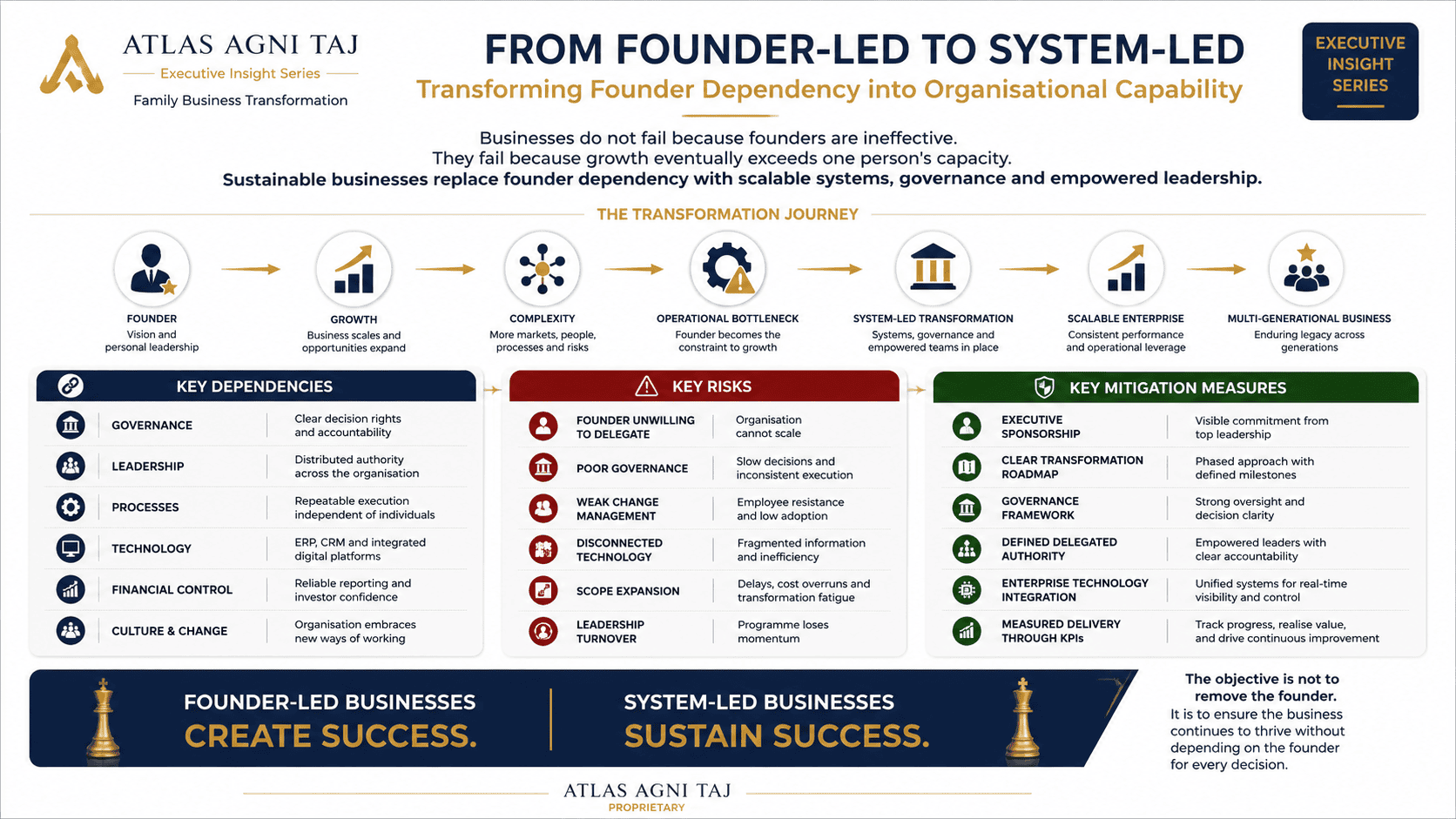
When several of these conditions converge, as they invariably do, the organisation faces a choice that is not merely operational but existential: remain founder-led, or transform into a system-led enterprise. This is not a cosmetic adjustment to an organisational chart. It is a fundamental re-engineering of how the business thinks, decides, and executes at every level.
The Founder-Led Model: Its Genuine Strengths
To understand why this transformation is necessary, one must first give full credit to what a founder-led model achieves — because it achieves a great deal, and any credible transformation strategy must preserve, rather than discard, its genuine advantages.
Speed. When one individual holds both authority and accountability, decisions that would occupy a committee for weeks can be resolved in a single conversation. This is not a minor efficiency; in competitive markets, speed is frequently the difference between capturing an opportunity and watching a competitor take it.
Agility. The founder can reorient the enterprise the moment new information emerges. There are no committees to persuade, no governance layers to traverse. The founder observes, and the organisation pivots.
Operational efficiency. Founder-led businesses tend to carry minimal bureaucracy. There is no duplicated oversight, no cascading layers of approval. The founder holds an information advantage and can allocate resources with very little overhead.
Autonomy. The founder answers to no board, no investor committee, no external stakeholder. Strategic direction, capital allocation, and pace of change remain entirely within the founder’s discretion — a freedom that is, for many entrepreneurs, the very reason they built the business in the first place.
Alignment. Because the founder built the enterprise personally and retains full decision authority, intent and execution are perfectly aligned. What the founder wants is, quite simply, what the organisation does.
The Founder-Led Model: Its Structural Limitations
The same characteristics that make the founder-led model powerful at one stage of growth become its constraints at the next.
Scale. Beyond a certain point, no single individual can hold the full picture. Customer relationships exceed what one person can personally maintain. Supply chains become too intricate to track informally. Market dynamics become too multifaceted for any one perspective. The founder’s personal bandwidth becomes the organisation’s binding constraint.
Complexity. As the enterprise expands into new sectors, the founder frequently lacks domain expertise in those areas. A founder who built a formidable retail distribution business may have no comparable insight into healthcare operations or financial services regulation. The generalist instinct that served brilliantly at smaller scale becomes a liability at larger scale.
Continuity. A founder-led operation is structurally brittle, because it depends entirely on the presence and capability of one individual. Should the founder become unavailable — through illness, accident, ageing, or death — the business often lacks the infrastructure to continue functioning without severe disruption.
Access to capital. Lenders and institutional investors are, understandably, uneasy about founder-dependent operations, because economic value is concentrated in a single person. Any investor is effectively purchasing an option on the founder’s continued availability, and few are willing to price that risk generously. Favourable debt terms and equity valuations become correspondingly harder to secure.
Talent attraction and retention. Highly capable professionals are frequently reluctant to commit their careers to organisations in which all authority sits with one leader. They see limited autonomy, unclear paths to advancement, and little scope to build something of their own within the enterprise. The strongest talent, in time, migrates to more structured environments.
Formal governance. Banks, government entities, and large enterprise customers increasingly require demonstrable evidence of formal governance, internal controls, and operational transparency before they will extend credit, licences, or contracts. A founder-led organisation can meet this requirement only by building the very structures that, by definition, move it away from pure founder-led operation.
Scalability of the business model itself. Certain opportunities — entering a new market, acquiring a competitor, launching a new business line — demand more capital, more specialised expertise, and more organisational capacity than any founder can personally direct. Only a system-led organisation is structurally capable of pursuing them.
The System-Led Paradigm: Structure, Process, and Distributed Authority
A system-led organisation operates on a fundamentally different set of principles.
Decision Authority is Distributed
Rather than being concentrated in the founder, authority is allocated across defined organisational roles. A Chief Financial Officer holds authority over financial decisions within agreed parameters. An operations director holds authority over supply chain decisions. A regional or store-level manager holds authority over local decisions. The founder’s role shifts from making every decision to approving certain categories of decision and setting the parameters within which others decide.
This distribution accelerates decision-making, because approvals no longer bottleneck at the top; it brings specialist expertise to bear on specialist questions; it allows the organisation to continue functioning in the founder’s absence; and it introduces multiple perspectives into important judgements. Its cost is real: the founder relinquishes personal control over the great majority of day-to-day decisions.
Process Replaces Intuition
In founder-led organisations, whatever process exists tends to serve the founder’s intuition. In system-led organisations, process exists to enable consistent, high-quality decision-making across the enterprise, including — crucially — in the founder’s absence.
- Procurement moves from personal negotiation to a managed function with competitive contracts and transparent pricing.
- Investment decisions move from instinct to a capital allocation process with defined evaluation criteria, rigorous due diligence, and systematic risk assessment.
- Customer relationships move from founder stewardship to account teams operating within a structured customer management process.
- Financial management moves from informal understanding to a disciplined budgeting cycle, with capital allocated against ROI expectations and variance formally analysed.
The benefit is consistency and scalability. The cost is that decisions inevitably take longer, and may occasionally lack the founder’s intuitive insight.
Organisational Layers Enable Specialisation
A system-led organisation typically carries more layers than its founder-led predecessor: senior leadership setting strategy and allocating capital; middle management translating strategy into execution; and operational staff delivering the product or service itself. This layering improves the quality of specialist decision-making, creates genuine career paths for talented employees, clarifies authority and accountability, and allows the organisation to execute without founder involvement in every matter. The cost is that additional layers slow decision-making and add overhead.
Transparency and Accountability Replace Personal Trust
In a founder-led enterprise, accountability flows from personal trust — the founder trusts key lieutenants to deliver, and applies pressure or replaces them if they do not. In a system-led enterprise, accountability flows from transparent metrics, formal performance management, and structured consequences. Employees operate against clear KPIs; performance is visibly tracked; compensation and advancement are tied to measurable outcomes; underperformance triggers a defined management process rather than a personal conversation. The benefit is consistency and fairness across the organisation. The cost is a measure of reduced personal autonomy and increased scrutiny for everyone, including senior leaders.
Data and Metrics Replace Founder Intuition
Founder-led businesses often operate without formal reporting; the founder simply senses whether the business is performing well, based on personal observation and informal conversation. System-led organisations implement formal dashboards tracking revenue, margin, customer acquisition, employee turnover, and operational efficiency, with data visible across the enterprise and decisions grounded in that data. The benefit is decision-making informed by comprehensive, current information. The cost is a genuine risk of becoming data-obsessed and missing the nuanced, qualitative signals that formal metrics do not capture.
The Transformation Domains: Where the Shift Actually Happens
The move from founder-led to system-led is never a single change. It is a portfolio of interdependent transformations that must, in practice, be pursued in parallel.
Financial Management
Founder-led businesses often lack standardised financial reporting; the founder simply knows, intuitively, what the business is worth and what its margins are. System-led organisations implement a consistent chart of accounts across business units, standardised month-end close processes, consolidated financial statements, detailed profit-and-loss reporting by unit and geography, rigorous cash flow forecasting, and disciplined budget-versus-actual variance analysis. This typically requires upgrading accounting systems, hiring professional accountants and controllers, establishing formal closing calendars, building external audit relationships, and implementing internal controls against fraud and error. The benefit is financial transparency that unlocks access to debt and equity capital. The cost is that implementation is expensive and, for a period, operationally disruptive.
Supply Chain and Procurement
Founder-led businesses often rely on longstanding vendor relationships, personally negotiated by the founder over years or decades. System-led organisations introduce centralised procurement, competitive bidding for major contracts, formal vendor performance scorecards, supply chain visibility tools, inventory management systems, and logistics optimisation. The benefit is typically a material reduction in procurement cost — often in the order of ten to twenty per cent — alongside improved supply chain resilience. The cost is that long-standing vendor relationships may be disrupted, and the founder may experience this, quite genuinely, as a form of betrayal.
Customer Relationship Management
Founder-led businesses often depend on the founder’s personal relationships with key accounts. System-led organisations implement CRM platforms, formal customer segmentation, account team structures with defined responsibilities, customer scorecards, and automated communication and touchpoint management. The benefit is continuity of customer relationships independent of any one individual, and greater capacity for cross-selling and account expansion. The cost is that the founder’s personal relationships become less central to the business — which can feel, to the founder, like a loss of status or influence.
Human Resources and Organisational Development
Founder-led businesses often lack formal HR infrastructure: compensation set at the founder’s discretion, career paths left undefined, performance management conducted informally. System-led organisations implement formal compensation structures and equity frameworks, performance management systems, defined career paths, structured training and development, succession planning, and organisational design aligned deliberately with strategy. The benefit is the ability to attract and retain superior talent at scale. The cost is that compensation becomes less dependent on the founder’s personal favour, and employees experience some loss of informal latitude.
Strategic Planning and Capital Allocation
Founder-led businesses often lack a formal planning process; strategy exists implicitly, in the founder’s mind, and capital is allocated ad hoc against the founder’s current priorities. System-led organisations establish formal, typically annual or biennial, strategic planning cycles; align business unit and functional strategies; build multi-year capital plans and investment evaluation frameworks; institute risk management processes; and establish board governance. The benefit is more consistent, better-informed capital allocation, and greater confidence among external stakeholders in the business’s direction. The cost is that the founder’s autonomy over capital decisions becomes constrained by investment frameworks and board oversight.
Information Technology and Digital Infrastructure
Founder-led businesses frequently operate on legacy or fragmented systems, with information scattered across platforms that do not communicate with one another. System-led organisations implement integrated ERP platforms, data warehouses and business intelligence tools, cybersecurity frameworks, digital platforms for customer and supplier interaction, and automation of manual processes. The benefit is efficiency, error reduction, and genuinely data-driven decision-making. The cost is that implementation is lengthy, expensive, and often met with staff resistance, since new systems inevitably disrupt established habits.
The Execution Challenge: Why Transformation Initiatives Fail
The shift from founder-led to system-led ranks among the most demanding organisational transformations precisely because it requires simultaneous change across multiple domains while the business continues to trade. Most transformation initiatives, in practice, fall materially short of their stated objectives — and the reasons are consistent and well documented.
Founder resistance. The founder may support transformation intellectually while resisting, emotionally, the loss of control it entails — and may, consciously or otherwise, undermine initiatives that constrain founder discretion.
Incomplete commitment. Transformation is resource-intensive. Where the founder and leadership team do not commit adequate budget, time, and people, initiatives stall well short of delivering value.
Process resistance. Employees accustomed to founder-led operation frequently experience new processes as constraining, and revert to informal habits unless leadership actively manages that resistance.
System integration failure. New systems are too often implemented in isolation — customer data sitting in a CRM disconnected from the finance system, procurement data disconnected from the ERP — creating new silos rather than the transparency the transformation was meant to deliver.
Scope creep. Transformation programmes expand beyond their original mandate as new needs surface; without disciplined scope control, they grow too large and too complex to deliver.
Insufficient training and change management. New systems and processes demand sustained training and change management. Where organisations underestimate this effort, adoption lags and the anticipated value is never realised.
Leadership turnover. These are typically two-to-four-year efforts. The departure of key leaders — founder, CEO, or transformation sponsors — during the programme routinely stalls momentum that is difficult to recover.
The Transition Timeline: What the Shift Actually Requires
A realistic timeline for a complete shift from founder-led to system-led typically spans three to five years.
Year One — Foundation and Quick Wins. Establishing governance structures (board, executive committee); implementing basic financial controls and reporting; beginning the strategic planning process; launching key transformational initiatives such as ERP and CRM; building change management capability; and securing early, visible wins through cost reduction and process simplification.
Years Two to Three — Core Implementation. Deploying major systems (ERP, CRM, HRIS); establishing formal business unit governance and accountability; completing supply chain transformation; professionalising management structures; implementing performance management systems; and developing the next generation of leaders.
Years Three to Five — Embedding and Optimisation. Achieving full adoption of new systems and processes; maturing governance and decision-making structures; pursuing continuous improvement of operational processes; formalising succession planning for the founder and CEO; and enabling strategic expansion on the back of newly built capabilities.
This timeline is not universal. Some organisations complete the transformation in as little as two to three years; others require five to seven. The determining factors are the organisation’s starting size, its starting point, and — above all — the consistency of its execution.
The Founder’s Evolving Role: From Operator to Strategic Architect
As the organisation shifts from founder-led to system-led, the founder’s own role changes fundamentally. In a founder-led enterprise, the founder is the operator — making decisions, directing staff, managing customer relationships, negotiating with vendors. The founder, in a real sense, is the business. In a system-led enterprise, the founder becomes the strategic leader: setting direction, establishing governance, appointing key executives, and making capital allocation decisions — while no longer making day-to-day operational calls.
This transition is genuinely difficult, psychologically, for many founders, whose identity is often inseparable from the business they built. The shift from “I do” to “I oversee” can feel, initially, like a loss of purpose. The most successful transitions are those in which the founder discovers new sources of meaning and achievement in strategic leadership itself — becoming the architect of the organisation, rather than its day-to-day operator.
Conclusion: A Necessary Transformation
The shift from founder-led to system-led is not optional for any business seeking to scale beyond a certain point. It is a necessary transformation, and the businesses that execute it successfully tend to share seven characteristics:
- The founder genuinely understands that the transformation is both necessary and strategically beneficial.
- The founder retains clear authority over strategic direction while deliberately delegating operational authority.
- Leadership implements a comprehensive, multi-year transformation programme across several domains simultaneously.
- Adequate resources are committed to the effort.
- Change management and employee engagement are treated as critical success factors rather than afterthoughts.
- Progress is measured against explicit metrics and timelines.
- The founder’s post-transformation role and authority are explicitly defined from the outset.
Those that fail tend to share the opposite pattern: they avoid the transformation until crisis forces their hand, or they attempt a partial implementation without the consistency and commitment it demands.
For any family business leader assessing whether this transformation is necessary: if the business is growing, if succession is on the horizon, if external capital is being sought, or if multi-generational longevity is the ambition, the answer is unambiguous. The future of the enterprise depends on making this shift. The only real question is whether it is made intentionally and strategically, or under duress, when circumstances leave no alternative.
How Atlas Agni Taj Can Help
Atlas Agni Taj advises family businesses and founder-led enterprises across the UAE and wider GCC through precisely this transition, bringing over three decades of enterprise transformation, governance, and technology delivery experience to bear on the specific challenge of moving from founder-led to system-led operation. Our support typically spans:
- Diagnostic assessment of founder-dependency risk and readiness for system-led transition, benchmarked against comparable regional and international businesses.
- Design and implementation of governance structures, including board formation, executive committee design, and delegated authority frameworks that preserve founder oversight while enabling distributed decision-making.
- Financial, ERP, and technology transformation planning — including system selection, implementation governance, and data migration strategy across SAP, Oracle, Microsoft Dynamics, and comparable platforms.
- Strategic workforce, HR, and succession planning support, including compensation frameworks, performance management design, and next-generation leadership development.
- Multi-year transformation programme design and delivery oversight, including risk registers, milestone tracking, and change management to reduce the execution failure modes outlined above.
- Founder advisory support, helping principals navigate the personal and organisational transition from operator to strategic architect with clarity and confidence.
Family businesses considering this transition are welcome to contact Atlas Agni Taj for an initial confidential discussion.
Atlas Agni Taj Proprietary
#FounderLed #FamilyBusiness #BusinessTransformation #CorporateGovernance #ExecutiveLeadership #GCC #UAE