Agentic AI Has Moved From Demonstrations to Enterprise Delivery
The Shift From Spectacle to Substance
Agentic AI has entered a new phase. The past two years produced an extraordinary volume of demonstrations, prototypes and controlled experiments, most of which succeeded in showing what the technology could do in principle. That phase is now closing. Boards, chief executives and regulators are no longer asking whether autonomous agents can perform impressive tasks in isolation. They are asking whether these agents can be deployed inside operating enterprises, at scale, under regulatory scrutiny, and with clear lines of accountability. The distance between those two questions is considerable, and it is where the current wave of enterprise transformation will succeed or falter.
The recent Google Cloud study that reported eighty-three per cent of surveyed information technology leaders believe their infrastructure requires improvement to capture the agentic-AI opportunity should not be read as a technical footnote. It is a strategic signal. It tells us that even in organisations that have committed to AI ambitions publicly, the underlying platforms, data foundations and control environments are not yet ready to carry autonomous decision-making at production scale. This is not a criticism of those organisations. It is the natural consequence of a technology cycle that has moved faster than most enterprise architectures were designed to accommodate.
The organisations that will lead the next phase will not be those with the most sophisticated model access or the largest experimentation budgets. They will be those that treat agentic AI as an operating model challenge first and a technology deployment second. That reframing changes what leadership must do, what programmes must fund, and what governance forums must own.
Understanding What an Enterprise Agent Actually Requires
An agent operating inside a large organisation is not a chatbot with additional functionality. It is a semi-autonomous actor with the ability to read enterprise data, invoke transactional systems, initiate workflows, and, in more mature configurations, take decisions that commit the organisation to financial, operational or contractual outcomes. To perform that role, the agent requires connectivity to enterprise resource planning platforms, customer relationship systems, human capital records, financial ledgers, cloud services, document repositories and, frequently, third-party systems belonging to suppliers, regulators or partners.
Each of those connections is a decision. Each decision touches identity, entitlement, data classification, audit, retention, regulatory reporting and commercial contract. In a well-run enterprise, the sum of those decisions is not a technical integration exercise. It is a governance construct that must be designed deliberately, approved by accountable executives, and monitored by functions that understand the risks being taken.
When agents are deployed without that construct in place, the consequences are predictable. Data leaks across boundaries that were previously controlled. Decisions are taken by non-human actors whose reasoning cannot be reconstructed after the fact. Audit trails fragment across model providers, orchestration layers and business systems. And when something fails, accountability becomes ambiguous, because no executive was ever formally assigned ownership of the agent as an operational asset.
The Five Questions Every Board Should Be Asking
Any senior leadership team preparing to industrialise agentic AI should be able to answer five questions with clarity. If the answers are absent, incomplete or contradictory across functions, the organisation is not ready to move beyond the pilot stage, regardless of how many demonstrations have been delivered.
Who authorises the agent? This is a question of executive sponsorship and formal accountability. Every agent operating in the enterprise should have a named business owner who has approved its scope, its data access, its decision authority and its operating parameters. The absence of a named owner is a governance failure, not a documentation gap.
What data can it access? Agents inherit the entitlements of the systems they connect to. Without deliberate design, they will often inherit more than they need, more than the organisation would authorise a human employee to hold, and more than data protection regulation permits. Entitlement design for agents must be built on least-privilege principles, with time-bound and purpose-bound access rather than standing rights.
How are its decisions monitored? Monitoring an agent is fundamentally different from monitoring a deterministic system. The organisation must be able to observe not only what the agent did but why it did so, what alternatives it considered, and what evidence it relied upon. That capability requires investment in observability, decision logging and explainability tooling that most enterprises have not yet made.
What happens when it fails? Failure modes for agents are not limited to unavailability. They include hallucination, reasoning drift, adversarial manipulation, silent degradation and cascading errors across dependent agents. Each failure mode requires a defined containment, escalation and remediation protocol, embedded in the operational runbook and rehearsed by the teams that will respond.
Who remains accountable for the business outcome? This is the question that boards must answer explicitly, and it must not be delegated to the technology function alone. Accountability for outcomes generated by autonomous systems rests with the executives who commissioned them. That accountability cannot be transferred to a vendor, a model provider or an internal engineering team. Regulators in financial services, healthcare and government have already made this position clear, and other sectors will follow.
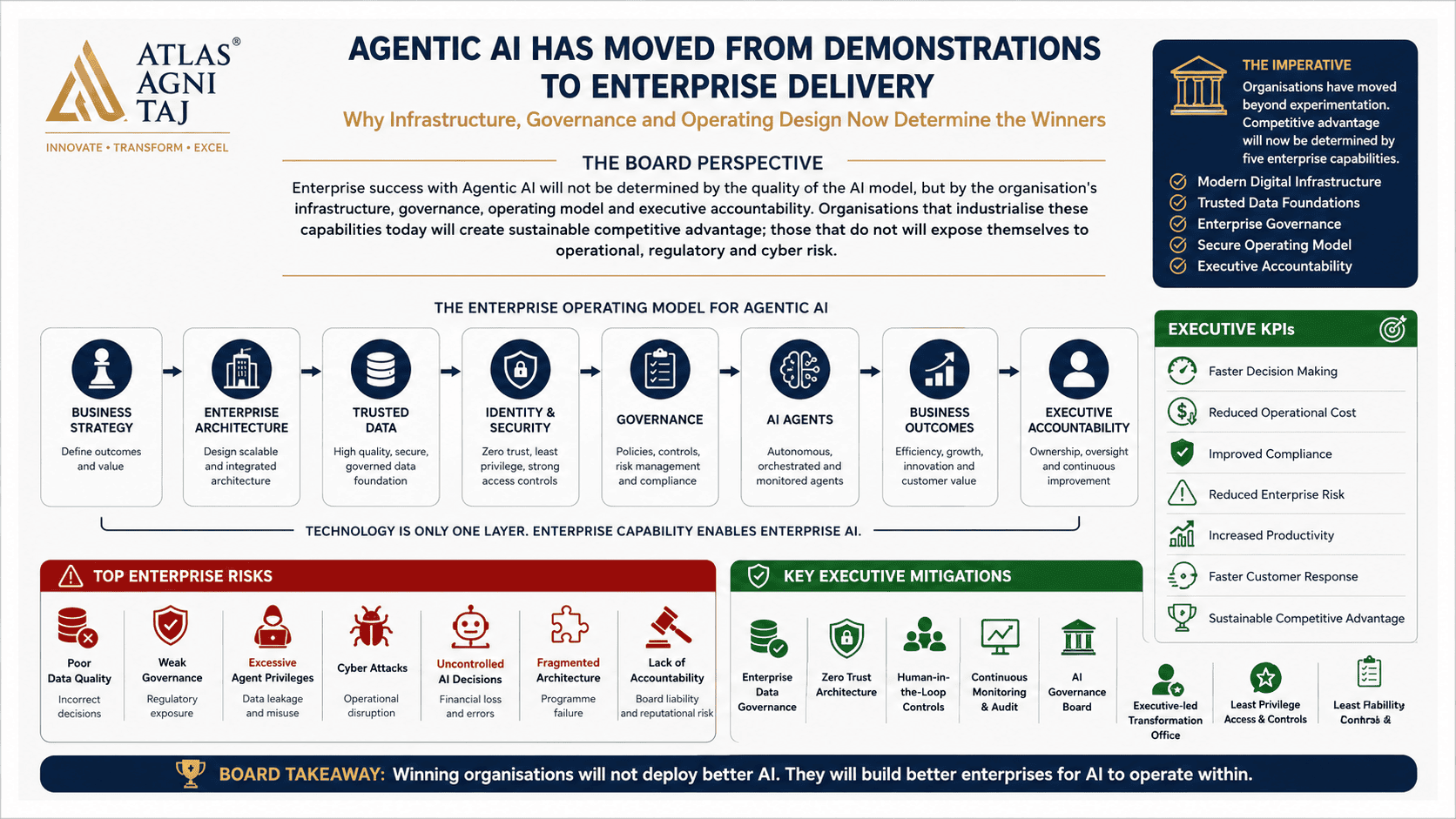
The Enterprise Operating Model for Agentic AI
Organisations that succeed with agentic AI will not deploy isolated agents into disconnected departmental use cases. They will establish an enterprise operating model that spans architecture, identity, security, data, governance, integration and value measurement. That operating model is not a document. It is a set of standing capabilities, forums and controls that determine how agents are commissioned, run, monitored and retired across the enterprise.
Architecture
The architecture layer defines the reference patterns through which agents interact with enterprise systems. It answers questions such as which orchestration platforms are approved, how agents are packaged for deployment, how they interact with core transactional systems, and how they are separated from one another when their decision boundaries could otherwise collide. Without a reference architecture, every department will invent its own, and the enterprise will accumulate technical debt at a rate that no future rationalisation programme can absorb.
Identity and Access
Agents require identity. In a mature deployment, every agent has a unique machine identity, distinct from any human user, with entitlements that are explicitly granted, logged and periodically reviewed. The organisation must extend its identity and access management framework to treat agents as first-class actors, subject to the same joiner, mover and leaver disciplines applied to human employees, and often to stricter controls given the speed at which agents can act.
Security
Cybersecurity for agentic systems introduces threat classes that traditional controls do not fully address. Prompt injection, model exfiltration, indirect data poisoning through connected sources, and adversarial manipulation of tool interfaces are real and rising risks. Chief information security officers must extend their threat models to cover these vectors, and the security operations centre must acquire the telemetry, detection logic and response playbooks needed to act on them.
Data
Agentic AI does not create the enterprise data problem, but it exposes it with unusual clarity. Agents are only as reliable as the data they consume, and organisations that have deferred investment in data quality, master data management and lineage will find that their agents amplify existing deficiencies rather than compensate for them. The data function is therefore not a supporting service to agentic AI. It is a determinant of whether the programme delivers value or introduces liability.
Governance
Governance for agentic AI must be established at the enterprise level, with clear articulation between the board, the executive committee, the technology and risk functions, and the operational owners of individual agents. A standing forum, chaired at executive level, should approve new agent deployments, review the performance of existing agents, and decide when agents should be retired or restricted. Governance is not a brake on adoption. It is the mechanism through which adoption becomes defensible.
Integration
Integration is where most agentic AI programmes discover the true cost of their ambitions. Connecting an agent to an ERP platform, a customer data platform or a regulated transactional system is rarely a matter of exposing an interface. It typically requires the modernisation of that interface, the introduction of policy enforcement layers, and the redesign of downstream processes to accommodate non-human initiators. Enterprises that treat integration as a residual activity, funded after the model work is complete, consistently underestimate the schedule and cost of production deployment.
Value Measurement
The final component of the operating model is value measurement. Agentic AI programmes should be governed against defined business outcomes, not activity metrics. The relevant questions are whether cycle times have been reduced, whether cost has been taken out of the operating base, whether revenue has been created that would not otherwise have existed, and whether risk has been reduced in a measurable way. Programmes that cannot answer those questions, or that answer them in vague or self-serving terms, will not survive the next budget cycle.
The Real Opportunity Is Process Redesign, Not Task Automation
The most common error in early agentic AI programmes is to apply autonomous agents to existing tasks in their existing form. This produces incremental gains and rarely justifies the investment. The strategic opportunity is quite different. It is to redesign end-to-end processes on the assumption that autonomous agents will participate in them, and to rebuild the process, the controls and the human decision points around that new reality.
Consider a procurement process in a large diversified enterprise. In its current form it may involve requisition, sourcing, negotiation, contract creation, purchase order issuance, goods receipt, invoice matching and payment. Each step involves multiple systems, multiple approvers and considerable delay. A conservative deployment of agentic AI would introduce an agent into invoice matching, reducing cycle time by a modest percentage. A transformative deployment would redesign the entire process on the assumption that sourcing, negotiation drafting, contract preparation and matching are performed by agents under human supervision, with humans intervening at defined decision points where judgement, relationship or regulatory obligation requires it. The transformative deployment does not automate the existing process. It replaces it with a new one that could not have existed without autonomous agents.
This distinction is not academic. It determines whether the enterprise captures a small efficiency dividend or a structural advantage over competitors. It also determines the shape of the transformation programme, because process redesign requires the involvement of business leaders, operational specialists, risk officers and process architects, not only technologists.
Human Accountability in an Autonomous World
One of the more consequential debates in the agentic AI conversation concerns human accountability. Some commentators have argued that as agents become more capable, the human role will diminish and that organisations should prepare for a substantial reduction in supervisory intervention. This view is unhelpful, and boards should not entertain it in its unqualified form. Accountability is not a function of task performance. It is a function of legal, regulatory and ethical responsibility, and it remains with humans regardless of how capable the agents become.
The practical implication is that operating models must be designed with human accountability preserved at the points where it matters. This means that certain decisions must remain in human hands, that certain outputs must be reviewed before they are acted upon, and that certain thresholds must trigger escalation to named executives. Designing those checkpoints is not a limitation on the technology. It is what makes the technology deployable in institutions that answer to regulators, shareholders, customers and society.
The organisations that will build durable competitive advantage from agentic AI are those that treat human judgement not as a legacy constraint but as a strategic asset. They will invest in the training, decision support and organisational design required to make human oversight effective, rather than treating it as a residual activity to be minimised.
Sector Perspectives: Where the Stakes Are Highest
The general principles set out above apply across industries, but the specific implications vary significantly by sector. Boards operating in regulated or safety-critical industries should not assume that the pattern of adoption emerging in less constrained sectors will translate directly to their own environments. The following observations, drawn from work with financial institutions, government entities, industrial operators and diversified conglomerates, illustrate where the strategic questions differ in substance rather than in emphasis.
Financial Services
For banks, insurers and asset managers, the introduction of autonomous agents into customer-facing and transactional processes will proceed under active regulatory attention. Supervisors have already indicated that model risk management frameworks must be extended to cover generative and agentic systems, that explainability standards are non-negotiable in credit and claims decisions, and that firms remain fully accountable for outcomes generated by third-party models. Financial institutions that have invested in mature model risk functions will find themselves better placed to move quickly, because the governance scaffolding required for agentic AI is largely an extension of the disciplines they already operate. Institutions without that foundation will need to build it before their programmes can scale.
Government and Sovereign Entities
Government organisations face a distinctive combination of ambition and constraint. Ministerial commitments to artificial intelligence leadership create real pressure to demonstrate progress, while procurement, sovereignty and public accountability requirements impose disciplines that private-sector organisations do not always face in the same form. The most successful public-sector programmes are those that have paired ambitious use case selection with disciplined attention to sovereign data handling, national infrastructure resilience and transparent governance. The presence of a clear operating model, published where appropriate, is itself a source of public confidence and should not be treated as an internal artefact.
Industrial and Infrastructure Operators
For operators of critical infrastructure, whether in energy, utilities, transport or heavy industry, the safety implications of autonomous decision-making are more direct and more consequential than in most other sectors. Agents interacting with operational technology environments, industrial control systems or safety-critical processes must be subject to controls that go beyond those appropriate for administrative use cases. Segregation of information technology and operational technology environments, deterministic override capabilities, and rigorous change control disciplines are not optional additions. They are the conditions under which agentic AI can be introduced at all.
Diversified Groups and Family Enterprises
Diversified groups, particularly the large family enterprises that are so prominent in the Gulf region, face a strategic question of a different order. Because their operating businesses often span sectors with very different maturity levels, control expectations and cultural characteristics, a single group-wide agentic AI approach rarely fits. The more effective pattern is a federated model, in which the group establishes common standards for architecture, identity, security and governance, while allowing each operating business to develop its own use cases within those standards. The group centre becomes the guardian of the operating model, not the delivery arm for individual agents.
The UAE and GCC Context
The United Arab Emirates and the wider Gulf Cooperation Council region occupy a distinctive position in the agentic AI landscape. Government-led ambition, sovereign investment in artificial intelligence capability, and the presence of well-capitalised enterprises willing to make early commitments have created an environment in which agentic AI can move from concept to production with unusual speed. That speed is an advantage, but it also concentrates the risks discussed above.
Regional enterprises, whether family conglomerates, government-related entities, financial institutions or infrastructure operators, share a common characteristic. Their operating models have often been built around personal accountability, long-standing relationships and centralised decision-making. Introducing autonomous agents into that culture requires more than the deployment of technology. It requires a deliberate conversation about which decisions the organisation is prepared to delegate, which it is not, and how the boundary is to be governed. Leaders who initiate that conversation early will find their organisations ready when the technology matures. Those who defer it will find themselves reacting to incidents rather than shaping strategy.
The regulatory environment is also evolving quickly. Central banks, data protection authorities and sector regulators across the region are actively developing positions on the use of autonomous systems in regulated activities. Enterprises that engage constructively with those regulators, share their approach to governance, and demonstrate a mature control environment will find themselves in a stronger position than those that treat regulation as an obstacle to be minimised.
Treating Agentic AI as a Transformation Programme
The final and perhaps most important reframing is this. Agentic AI is not another technology pilot. It is a transformation programme, and it should be resourced, governed and measured as one. That means a named executive sponsor at board or executive committee level. It means a programme director with authority across business, technology and risk functions. It means a defined scope, measurable outcomes and a stage-gated approach that allows the organisation to learn as it progresses. And it means a budget that reflects the true cost of production deployment, including integration, data remediation, control uplift and organisational change.
Programmes that are funded as technology experiments and governed as innovation activities will struggle to cross the boundary into production. Programmes that are established with the discipline of an enterprise transformation will move faster, deliver more, and expose the organisation to lower risk. The choice between these two postures is being made, implicitly or explicitly, in boardrooms across every major sector. It deserves to be made deliberately.
The organisations that succeed will be those that connect ambition to architecture, and architecture to accountability. They will treat agentic AI not as a departmental experiment but as a redefinition of how the enterprise operates. They will invest in the operating model as much as in the technology. And they will preserve human accountability as a source of strategic strength rather than a compliance obligation.
That is the work of the coming period. It is not glamorous, and it will not produce viral demonstrations. But it is the work that determines whether agentic AI becomes a durable source of enterprise value or another cycle of unfulfilled expectation. The leaders who lean into this work now will define the next generation of institutional performance.
A Question for Fellow Leaders
How is your organisation preparing its architecture, its governance and its operating model for the arrival of enterprise AI agents? The answer to that question, more than any technology decision, will determine what your enterprise looks like three years from now.
#AgenticAI #EnterpriseAI #DigitalTransformation #CIO #TechnologyLeadership #AIGovernance #EnterpriseArchitecture