
Why Private Equity Loves UAE and GCC Family Businesses
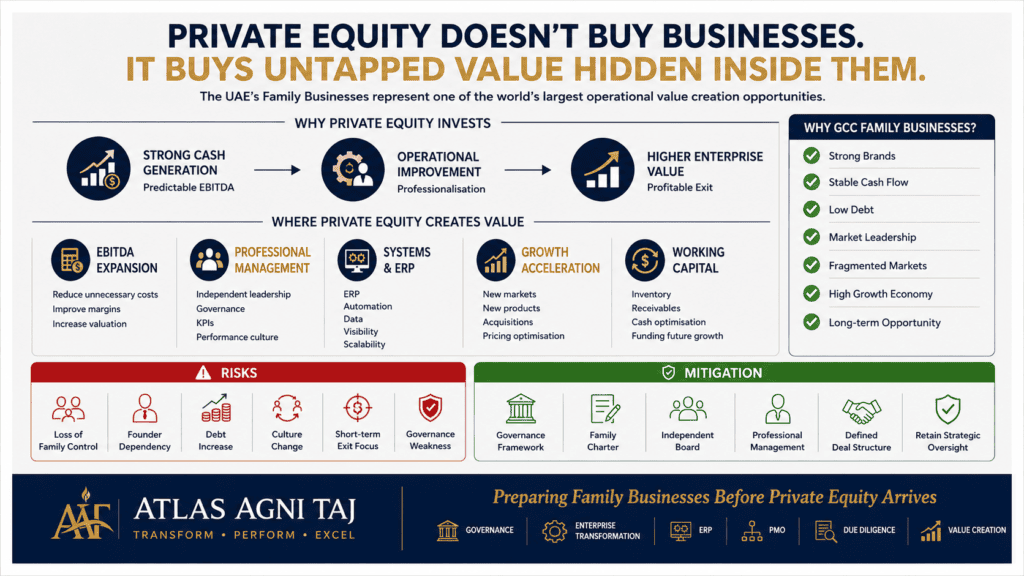
Why Private Equity Loves UAE and GCC Family Businesses If you have observed the Gulf private equity market over the past decade, you will have witnessed a deliberate and structural shift in capital deployment. Private equity firms that once chased technology start-ups and infrastructure megaprojects have quietly, and systematically, redirected their attention toward a very different class of asset: established family businesses. This is not a passing trend, nor is it opportunistic. It reflects a considered investment thesis, and it is reshaping the ownership landscape of the region’s most significant commercial enterprises. For family business owners across the UAE and wider GCC, understanding why private equity finds them so attractive — and where the fundamental tensions lie — is no longer optional. It is a strategic imperative. The question confronting most family enterprises today is not whether private equity will approach them. Increasingly, it will. The question is whether the family is prepared to engage from a position of clarity, governance readiness, and negotiating strength, rather than reacting to an unsolicited approach. The Thesis: Hidden Value in Established Platforms The private equity thesis on GCC family businesses is disarmingly simple. These enterprises are not glamorous. They do not carry the narrative appeal of technology disruption or the exit multiples associated with venture-backed growth stories. Yet they possess something considerably more durable: consistent cash generation, entrenched market positions, meaningful operational underoptimisation, and substantial headroom for expansion — all within one of the most stable and capital-rich economies in the emerging-market universe. What sophisticated investors have recognised, and what many founders have not fully internalised, is that family businesses in the region were built to generate wealth, not to maximise economic return or operational efficiency. The founding generation’s priority was rarely to optimise the cost base, unlock cross-business synergies, or install institutional-grade management practices. Their priority was to generate reliable cash flow and to preserve family control across generations. This combination — strong commercial fundamentals sitting beneath a governance structure optimised for personal and family wealth rather than economic efficiency — is, from a private equity perspective, an unusually attractive proposition. It represents a platform where value can be created not by inventing new markets, but by professionalising what already exists. The Value-Creation Equation: Where Private Equity Sees Opportunity Private equity value creation in this context is not a complex model, though its execution demands considerable operational discipline. It operates across several distinct dimensions, each of which is worth understanding in its own right. Cost Optimisation and EBITDA Expansion Many family businesses, particularly in distribution, retail, logistics, and manufacturing, carry cost structures that would be considered inefficient by institutional standards. Vendor relationships are frequently longstanding rather than competitively tendered. Procurement is rarely centralised, with purchasing conducted independently across business units, forgoing scale economies. Staffing levels often reflect historical hiring patterns and founder preference rather than optimal headcount, while facilities are sometimes maintained at a standard driven by prestige rather than necessity. A private equity acquirer typically identifies cost-reduction opportunities in the order of fifteen to thirty per cent of the operating cost base. For a business generating one hundred million US dollars in EBITDA, this can represent fifteen to thirty million dollars in annual cost reduction — achieved not by diminishing service quality, but through: The appeal of this lever, from an investor’s perspective, is that it creates financial value without requiring a single additional unit of revenue growth. It is value creation from operational discipline alone — the most predictable and least risky form of value engineering available to a private equity sponsor. Structural Reorganisation and Systems Implementation Many family enterprises continue to operate on manual, fragmented, or incomplete operational systems. This is rarely a problem at a modest scale; it becomes a material constraint once the business has outgrown its infrastructure. Common opportunities include implementing integrated enterprise resource planning systems where fragmented legacy systems previously existed, standardising financial reporting and consolidation across entities, establishing supply chain visibility where opacity once prevailed, and introducing data-driven decision-making in place of intuition-led judgement. These implementations are capital-intensive and operationally disruptive, which is precisely why a founder often resists them — they introduce near-term cost without an immediately visible revenue benefit. A private equity investor, by contrast, recognises that this infrastructure is the platform on which future growth and operating leverage depend. Revenue Growth Acceleration Beyond cost discipline, private equity sponsors typically pursue deliberate strategies to accelerate top-line growth: expanding geographic footprint on the back of an established platform, adding new customer segments, cross-selling across the units of a wider conglomerate, entering adjacent markets, and pursuing pricing optimisation — often raising prices in markets where the business already holds a dominant position. Critically, sponsors are prepared to fund organic growth that a financially conservative founder may have resisted, treating short-term financial metrics as secondary to medium-term value creation. Operational Leverage Through Professionalisation Family businesses frequently lack institutional management structures, with decisions concentrated among family members who may have limited formal commercial training. Private equity sponsors typically introduce professional management, often at C-suite level, to instil disciplined operational practice. This professionalisation improves the quality and consistency of decision-making, introduces performance-based incentive structures, reduces the influence of personal bias in commercial decisions, and establishes organisational transparency and accountability for operating metrics. Working Capital Optimisation Many family enterprises manage working capital conservatively, maintaining substantial cash buffers and extended payables cycles as a matter of prudence. Private equity investors typically optimise this position by accelerating receivables collection, refining payables cycles, right-sizing inventory holdings, and redeploying the resulting freed-up cash into further value-creation initiatives. Add-On Acquisitions and Consolidation Perhaps the most powerful lever available to a private equity sponsor is the acquisition of smaller competitors and their consolidation into the existing platform. A fragmented industry can, in relatively short order, become a consolidated platform commanding combined purchasing power, shared infrastructure, and materially expanded market reach — a transformation that is difficult for a single family enterprise to execute independently, but straightforward for a well-capitalised sponsor. The Attractive Profile:
Why Family Business Succession Fails: The GCC Transition Challenge
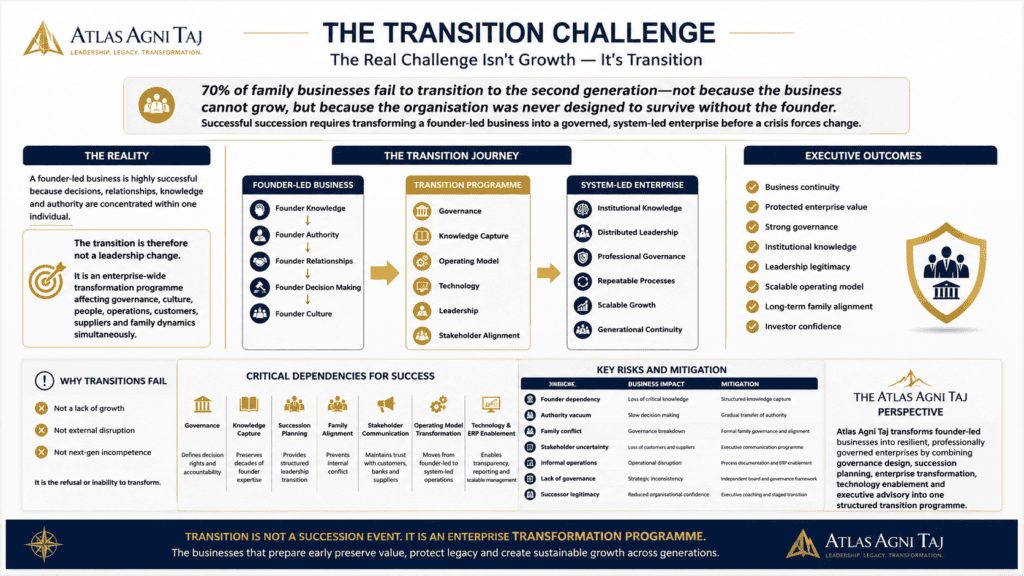
The Real Challenge Isn’t Growth — It’s Transition Why Family Businesses Fail at the Moment of Succession — and What GCC Leaders Can Do Differently There is a paradox at the heart of family business dynamics that few outsiders truly understand, and that even seasoned insiders are often reluctant to name: the moment of greatest strength is frequently the moment of greatest vulnerability. A founder who has built a formidable enterprise stands, at the very peak of that achievement, on the threshold of the single event most likely to unravel it. A first-generation founder builds a family business through sheer force of will, entrepreneurial instinct, precise market timing, and relentless personal execution. The business becomes profitable. It becomes dominant in its category. It weathers economic cycles, competitive incursions, and periods of genuine crisis. Cash flows are strong and dependable. Operations are understood intimately by the founder — not because they have been documented, but because they exist, in granular and largely unwritten form, in the founder’s own mind. Then the founder confronts the inevitable: ageing, retirement, ill health, or simply the private wish to step back and enjoy the fruits of a life’s work. What happens in the months and years that follow determines whether the enterprise thrives into a second and third generation, or begins a slow drift into paralysis, dilution, or outright failure. The statistics are unambiguous and sobering. Approximately seventy per cent of family businesses do not successfully transition to the second generation. Of those that do, only around ten per cent survive intact to the third. Across the Middle East specifically, the picture is more acute still: a meaningful proportion of enterprises fold entirely upon the founder’s death or departure, taking decades of accumulated value with them. The prevailing explanation offered by external observers — bankers, advisors, commentators — is that these failures reflect a lack of growth capacity, unexpected market disruption, or incompetence on the part of the next generation. This explanation is comfortable. It is also, in the overwhelming majority of cases, wrong. The real reason most family business transitions fail has very little to do with growth. It has everything to do with transformation — and specifically, with the refusal or inability to recognise that succession is not an event but a systemic re-engineering of the enterprise. The Founder-Led Model: Elegant in Success, Brittle in Succession To understand why transition proves so difficult, it is necessary first to understand the operating model that successful first-generation family businesses have, often unconsciously, constructed. This model rests on a small number of interlocking principles, each of which is a source of tremendous strength during the founder’s tenure and a source of tremendous fragility the moment that tenure ends. Founder as chief executive and chairman: the founder is not simply the leader of the enterprise; in every meaningful sense, the founder is the enterprise. Strategic direction, major capital allocation, principal client relationships, key vendor negotiations, and cultural authority all originate from, and return to, a single individual. The organisational structure exists to execute the founder’s intent, not to operate as an independent system. Information as personal possession: critical business knowledge — customer relationships, supplier terms, pricing logic, capital structure, expansion plans, and competitive positioning — resides in the founder’s memory rather than in documented systems of record. The founder holds an information advantage that would be extraordinarily costly, and in some cases practically impossible, to transfer wholesale to another individual. Decision authority as concentrated power: authority is not distributed through formal governance; it is concentrated in one person. Decisions are made quickly precisely because there is only one decision-maker, and disagreement resolves quickly because that individual holds final authority. Culture as an extension of personality: the organisation’s culture mirrors the founder’s own values, work ethic, risk appetite, and interpersonal style. Loyalty, in this model, is personal rather than institutional: employees work for the founder, not for the organisation as an abstract entity. Success measured through intuition, not instrumentation: rather than formal key performance indicators, dashboards, and management information, success is measured through the founder’s own accumulated feel for the business — an intuitive sense of whether things are going well, whether an opportunity is emerging, or whether a market is beginning to shift beneath the surface. Capital allocation as personal discretion: how cash is deployed — reinvested into operations, directed into new ventures, distributed to family members, or allocated to personal holdings — is entirely the founder’s call, frequently exercised informally and without recourse to a board. This model is, without question, extraordinarily efficient. It minimises overhead, eliminates layers of bureaucratic decision-making, and enables the kind of rapid, decisive response to market opportunity that has been the genuine engine of growth for countless GCC family enterprises. It is also, by its very design, entirely dependent on the continued presence and active decision-making of a single individual. And that dependency is precisely what makes the model brittle the instant succession becomes real rather than theoretical. The Transition Trap: What Actually Changes When a founder steps back and a successor assumes control, what appears on the surface to be a simple handover — “the founder retires, the next generation takes over” — in fact triggers systemic change across virtually every dimension of how the business functions. Executives who treat this as an administrative event, rather than a structural transformation, are rarely prepared for what follows. Knowledge transfer failure: the incoming successor discovers that the information they believed they had absorbed over years of proximity to the founder is, in practice, incomplete. They understand the parts of the business in which they worked directly, but lack critical context on major client relationships, vendor negotiation history, supplier dependencies, historical capital decisions, and competitive positioning that was never explicitly articulated because it never needed to be. The successor must now reconstruct this knowledge in real time, while simultaneously running the business. Authority vacuum: the organisation has been trained, over years or decades, to defer to the founder on consequential decisions. The
The UAE Economy Is Built on Family Businesses: The Hidden Growth Engine
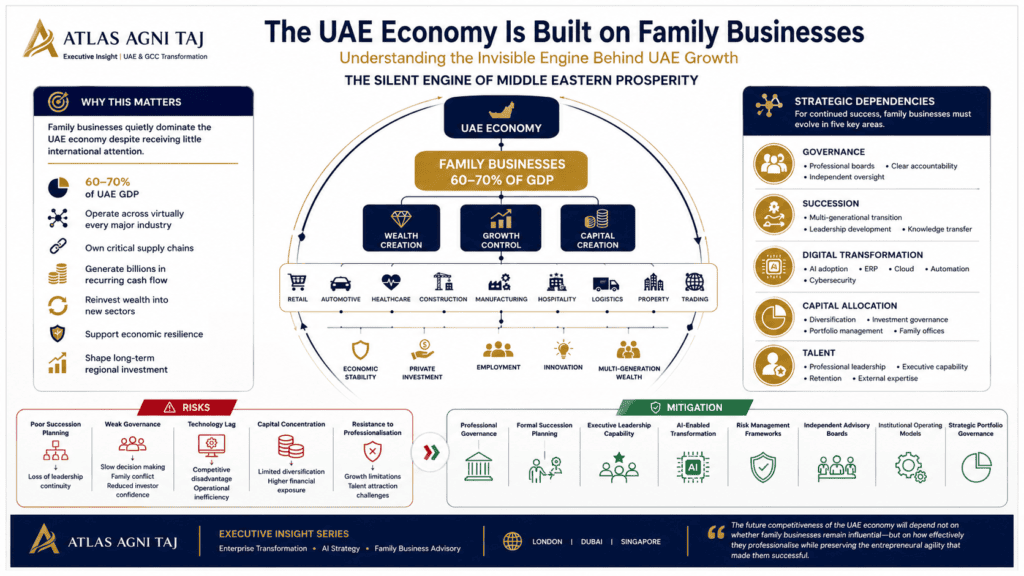
Executive Insight | UAE & GCC Transformation The UAE Economy Is Built on Family Businesses: The Hidden Engine of Growth When global investors, strategy consultants and policy analysts discuss the UAE economy, the narrative that emerges is familiar and, frankly, incomplete. Sovereign wealth fund returns are cited with pride, the rise of technology start-ups is celebrated, infrastructure megaprojects are marvelled at, and foreign direct investment flows are tracked with near-religious precision. International media covers each new development with enthusiasm — another tower, another free zone, another multi-billion-dirham initiative. Yet this framing overlooks the forest for the trees. The true economic engine of the United Arab Emirates — the one generating consistent cash flow, employing hundreds of thousands, dominating entire supply chains, and quietly accumulating more wealth than any single government programme — operates almost entirely outside the international spotlight. It is family-owned. The figures tell a story that most observers have either overlooked or fundamentally misread. Family businesses are estimated to contribute between sixty and seventy per cent of UAE GDP. This is not a reference to listed companies on the DFM or ADX, nor to the multinationals clustered in the free zones, nor to government-backed megaprojects. It refers to family-owned enterprises — many unlisted, privately held and operationally discreet — which form the foundation upon which the modern UAE economy rests. This is not a rhetorical flourish. It is economic reality. The Scale and Scope of Family Business Dominance To appreciate the true magnitude of family business influence in the UAE, one must move beyond GDP percentages and examine the underlying architecture of economic activity. Consider retail. The dominant retailers in the UAE are family-owned. Al-Futtaim Group, one of the region’s most significant conglomerates, controls multiple retail banners spanning fashion, electronics and lifestyle categories. Majid Al Futtaim operates one of the Middle East’s largest shopping mall networks. Al Ghurair Group maintains an extensive footprint across trading, distribution and retail. These are not niche participants — they are the ecosystem operators that determine how consumers shop, which products they access, and at what price point. International names such as Carrefour maintain a meaningful presence, but they operate within an ecosystem designed and governed by family enterprises. Turn to construction and real estate development. The major developers and contractors across the Emirates carry family names. Emaar has gone public and evolved into a professional corporation, yet the founding family retains substantial influence. RAK Ceramics traces its origins to a family enterprise. The pattern repeats across hospitality, healthcare and logistics. Logistics and distribution — unglamorous yet economically indispensable — remain almost entirely family-owned. The groups that own warehousing, manage port operations, run trucking fleets and control the supply chain infrastructure moving goods across the UAE and the wider GCC are, overwhelmingly, family enterprises. Without them, the retail and manufacturing ecosystem would not function. Healthcare is a further sector in which family businesses have built considerable empires. Private hospital networks, diagnostic centres, pharmaceutical distribution and medical device representation are family-owned operations that, collectively, generate billions in annual revenue. Financial services, too, feature prominent family enterprises. Certain insurance brokerage networks, private equity operations and investment vehicles remain family-controlled. While conventional banking is more regulated and institutional in character, a substantial proportion of private wealth management and alternative finance flows through family office structures. The picture becomes even more compelling when the aperture is widened. Among the top one hundred enterprises in the UAE by revenue, the majority carry family ownership — a concentration that becomes still more pronounced when government entities are excluded from the analysis. Public listings represent only a minority of actual economic activity. The Misclassification Problem Part of why family businesses remain so invisible in mainstream economic discourse is a classification problem. When researchers, analysts and consultants measure “the economy”, they typically focus on entities meeting specific criteria: stock exchange listings, government-backed corporations, multinational operations, formal special purpose vehicles, or regulated financial institutions. Family businesses — particularly those that are entirely private, geographically concentrated and operationally discreet — fall through the cracks of standard measurement frameworks. Moreover, many family conglomerates deliberately avoid the spotlight. They do not issue press releases regarding expansion plans. They do not court analyst coverage. They do not participate in earnings calls or investor presentations. Governance operates through family boards, frequently with minimal external disclosure. Financial statements, where audited at all, may remain private. Succession plans, strategic pivots and operational challenges are addressed in family meetings rather than shareholder forums. This invisibility is not accidental. For decades, the prevailing view among more conservative family business owners was that opacity conferred protection — protection from government scrutiny, from competitor intelligence, from family disputes becoming a matter of public record, and from the regulatory attention that accompanies scale and formality. Yet this invisibility carries a cost: family businesses are systemically underestimated within narratives concerning the UAE economy. The Sectors Where Family Business Dominance Is Absolute To move from the abstract to the concrete, it is instructive to examine specific sectors in which family business control is not merely significant but essentially complete. The pattern across sectors is consistent: wherever there is consumer access, supply chain control, market penetration or established customer relationships, family businesses operate at scale. The Multi-Generational Wealth Accumulation Model What renders UAE family businesses particularly significant — and worthy of serious study — is that many have successfully accumulated and retained wealth across multiple generations. This is exceptionally rare by international standards. Globally, approximately seventy per cent of family businesses fail to survive the transition from founder to second generation, and fewer than ten per cent reach the third generation. Yet the UAE has produced numerous family conglomerates that have not merely survived but thrived across three, four, and in some instances five generations. Al-Futtaim Group, for example, traces its origins to the early twentieth century, evolving from a trading house into a diversified conglomerate spanning retail, automotive, real estate and industrial sectors. Al Ghurair Group similarly represents multi-generational wealth preservation and expansion, while groups
THE NEW TRANSFORMATION PMO
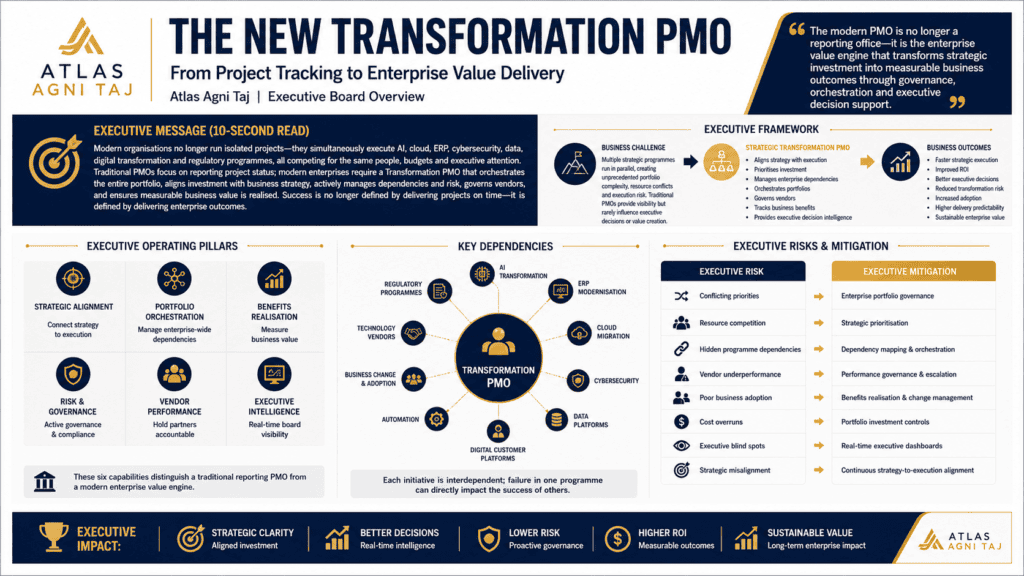
THE NEW TRANSFORMATION PMO From Project Tracking to Enterprise Value Delivery The New Transformation PMO: From Project Tracking to Value Delivery If you sit in the CIO, CTO, or transformation leadership chair today, you are confronting a reality your predecessors rarely faced: the simultaneous, parallel execution of multiple transformations that, in earlier eras, would have unfolded one after another. Your organisation is very likely running, at this very moment: artificial intelligence adoption and capability building; ERP modernisation; cloud migration across hundreds of applications; cybersecurity hardening and operational resilience; enterprise data platform development; digital channel transformation; regulatory compliance uplift; and cost optimisation. All concurrently. All competing for the same scarce engineering talent, the same budget envelope, the same executive attention, and the same vendor capacity. Each carries genuine organisational risk, and each is being asked to prove its worth in a climate of tightening scrutiny on technology spend. The traditional Programme Management Office — built for a simpler, sequential era — was never designed for this level of concurrency. It produces status reports that gather dust rather than provoke action. It flags risks that stakeholders have already, tacitly, accepted. It tracks milestones that feel steadily more disconnected from the business outcomes leadership actually cares about. Too often, it optimises for schedule and budget adherence while the transformation itself delivers marginal value, achieves weak adoption, or quietly introduces new operational risk that nobody is measuring. The organisations genuinely winning at transformation — the ones converting investment into measurable business value — operate a fundamentally different model. Their PMO is not a reporting office. It is an enterprise value engine. This article sets out what that distinction means in practice, why it now matters more than ever for GCC and international enterprises alike, and how technology leaders can build it. Why Project Tracking Alone Is No Longer Enough Traditional PMOs took shape in the 1990s and 2000s, when enterprises executed projects in sequence. Build the ERP system. Then migrate to the cloud. Then deploy the data warehouse. Each initiative carried a clear scope, a defined end date, and measurable success criteria. A PMO focused on tracking progress, escalating risk, and controlling scope was, in that world, genuinely valuable. That world no longer exists. Modern transformation is not sequential — it is parallel, continuous, and deeply interdependent. A bank cannot pause one digital platform to complete another. An enterprise cannot modernise its ERP estate in isolation from its cloud strategy, its data infrastructure, or its cybersecurity posture. The dependencies are too intricate, the pace of change too rapid, and the organisational risk too significant to allow for isolated, sequential thinking. When a traditional PMO restricts itself to schedule and budget tracking in this environment, it quietly becomes a bureaucratic cost centre. It produces documentation that nobody acts upon. It escalates issues at a cadence too slow for timely decision-making. Worse still, it frequently optimises for completion metrics — on-time delivery, budget variance — without ever asking the harder question: is the finished initiative actually being adopted, generating business outcomes, or delivering the benefits promised to the board and to investors? Genuine value delivery demands a PMO operating across three distinct planes simultaneously: strategically, by aligning transformation activity to enterprise objectives; operationally, by managing execution, reducing friction, and coordinating delivery across interdependent workstreams; and financially, by tracking benefits realisation and return on investment with the same rigour applied to schedule and cost. A PMO performing only one or two of these functions is structurally incomplete, and will underperform regardless of the calibre of the people within it. Connecting Strategy to Execution: The Critical Role The single most important function of a modern PMO is to close the gap between enterprise strategy and programme execution. This sounds self-evident, yet in practice it is remarkably rare. Most organisations maintain strategy and execution in entirely separate domains. The board approves a digital transformation strategy. Finance approves a portfolio of projects. Operations manages delivery. Three years later, delivered execution bears little resemblance to the original strategic intent, and few in the organisation can explain precisely why. A value-delivery PMO changes this dynamic decisively. It begins by translating strategic ambition into operational specificity. What does “becoming a digital-first organisation” actually mean in terms of architecture, capability, investment, and risk appetite? What outcomes should the business realistically expect from each major programme? What trade-offs is leadership genuinely willing to accept? Which measures will confirm success? What dependencies exist across the portfolio? Once strategy has been translated into measurable objectives, the PMO ensures every programme remains aligned to those outcomes. This demands a sophisticated portfolio management capability — understanding not merely what each programme does, but how it contributes to strategic goals, how it interacts with adjacent programmes, which shared capabilities it depends upon, and where critical sequencing must be respected. It also requires the PMO to assume an active, not passive, role in governance. Too many PMOs remain silent observers, content to report status upward. A value-delivery PMO actively shapes decisions. When two programmes compete for scarce engineering resource, the PMO helps leadership adjudicate based on strategic priority and risk exposure. When a vendor underperforms and jeopardises adjacent initiatives, the PMO escalates promptly and proposes concrete remediation. When benefits stall because the business has not adopted a new platform, the PMO identifies the barrier and drives corrective action — rather than simply noting the shortfall in a monthly report. Portfolio Complexity: The New Normal Portfolio complexity across modern enterprises has reached levels without recent precedent. Consider a representative scenario now facing many GCC and international organisations: None of these run sequentially. They overlap. They compete for the same resources. They generate dependencies capable of derailing one another if left unmanaged. Traditional project management approaches simply fail at this scale — one cannot schedule twenty parallel programmes as a single waterfall plan, nor manage cross-cutting dependencies through meeting coordination alone. What is required is intelligent portfolio orchestration: a single source of truth describing what is planned, what is in flight, what
Sovereign AI Is Changing the GCC Cloud Strategy Conversation
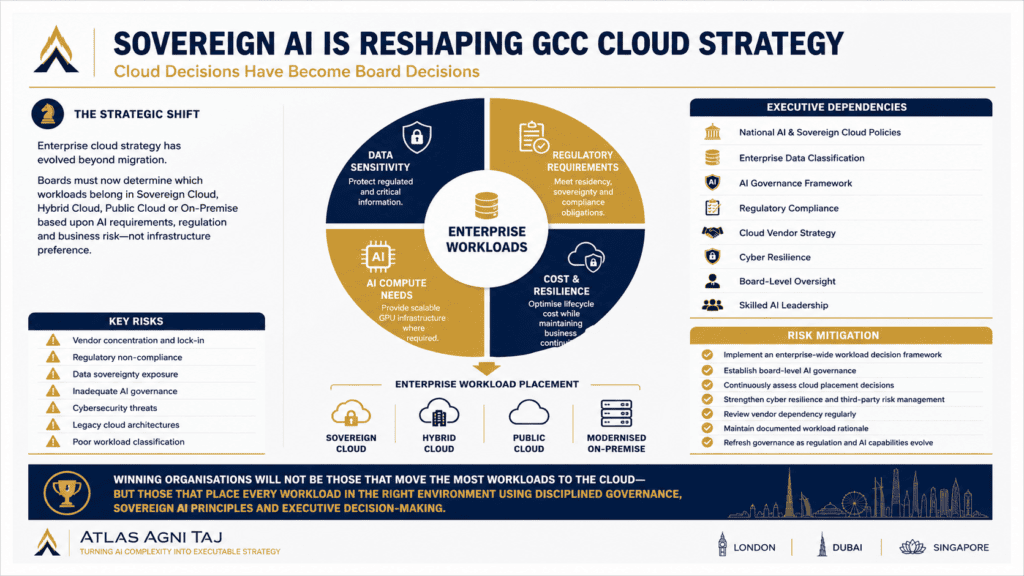
Sovereign AI Is Changing the GCC Cloud Conversation For much of the past decade, the cloud conversation across the Gulf Cooperation Council followed a familiar script. Migration was the goal, the public hyperscalers were the destination, and the principal measures of success were speed, cost reduction and the retirement of ageing data centres. That script is now being rewritten. The catalyst is not cloud computing in the abstract; it is artificial intelligence, and specifically the emergence of sovereign AI as a strategic priority for governments and regulated enterprises across the region. Momentum in the market makes this shift difficult to ignore. The UAE has articulated clear sovereign cloud ambitions at national level, and hyperscaler investment in AI-scale infrastructure across the country is accelerating rapidly, as set out below. For technology and business leaders across the GCC, this is not simply an infrastructure story. It is a signal that the fundamentals of enterprise cloud strategy are changing, and that the organisations best placed to benefit will be those with the governance discipline to make sharper, more differentiated workload decisions. The Shift Underway: From Hosting Question to Sovereignty Question The traditional cloud business case was, in essence, a hosting question. Could an application run more reliably, more cheaply, or more flexibly outside the enterprise’s own data centre? For most workloads, the answer was yes, and cloud migration became a default assumption in technology strategy across banking, government, energy, healthcare, and telecommunications in the region. Artificial intelligence changes the calculus in three important ways. First, it introduces a new and much larger appetite for compute. Training and running large models, whether foundation models, domain-specific models, or fine-tuned enterprise variants, requires access to advanced GPU infrastructure at a scale that many organisations neither own nor can economically build themselves. This drives dependency on a small number of specialised providers and platforms, concentrating both opportunity and risk. Second, AI dramatically increases the sensitivity of the data in motion. Where a traditional application might process transactional records, an AI system frequently ingests, aggregates, and learns from far richer pools of personal, operational, and sometimes classified information. Data residency, data sovereignty, and control over how a model is trained and where its outputs are stored move from compliance footnotes to board-level risk items. Third, AI heightens the strategic importance of vendor relationships. A small number of global hyperscalers and their regional partners now sit close to the centre of national digital infrastructure strategy. Governments and regulated sectors across the GCC understand this, which is precisely why sovereign cloud and sovereign AI have become explicit policy priorities rather than technical preferences. The result is that the binary question of the past decade, “should we move to cloud”, has been replaced by a more nuanced and more consequential one: which workloads require sovereignty, which require scale, and which require cost discipline. Answering that question well, consistently, and defensibly is now a core executive leadership responsibility, not a technical delegation. Why the Timing Matters Three forces are converging in the GCC at the same moment, and each amplifies the others. The first is national policy. The UAE, alongside its regional peers, has set out an explicit ambition to build sovereign digital and AI infrastructure as a pillar of long-term economic competitiveness, rather than treating cloud purely as a cost-optimisation lever. Government entities and regulated industries are increasingly required, whether through policy, regulation, or contractual obligation, to demonstrate a clear rationale for where sensitive workloads sit. The second is hyperscaler investment. Global technology providers are committing multi-billion-dollar sums to build regional capacity precisely because they recognise this policy direction and the scale of enterprise demand it will generate. Microsoft and Abu Dhabi’s G42 have confirmed a further 200-megawatt expansion of data centre capacity in the UAE, delivered through G42’s subsidiary Khazna Data Centers, with initial capacity expected to come online before the end of 2026. This sits within a wider USD 15.2 billion Microsoft investment commitment in the UAE through 2029, alongside an earlier USD 1.5 billion Microsoft equity stake in G42. This is not experimental investment; it is infrastructure being built to serve a demand curve that regional boards are only beginning to fully appreciate. The third is enterprise readiness, or in many cases, the lack of it. Many organisations across the GCC still carry cloud estates that were built primarily around cost and speed rather than sovereignty, resilience, or AI readiness. Workloads were migrated in bulk during earlier transformation waves, often without the granular decision discipline that AI-era requirements now demand. The gap between where infrastructure investment is heading and where enterprise architecture currently stands is precisely where executive leadership needs to focus. From Infrastructure Discussion to Business Architecture Discussion The most important reframing for boards and executive committees is this: cloud strategy in the AI era is no longer an infrastructure discussion. It is a business architecture discussion, with direct implications for risk, cost, resilience, regulatory standing, and competitive positioning. This reframing matters because it changes who needs to be in the room when cloud and AI infrastructure decisions are made. A decision that used to sit largely within the technology function now carries direct relevance for the chief risk officer, the chief financial officer, the general counsel, the chief information security officer, and, in regulated sectors, the board’s risk and audit committees. Treating this purely as a technology procurement exercise significantly understates its strategic weight. Boards that grasp this early will be better positioned to ask sharper questions of their executive teams: where does our most sensitive data currently reside, and why? What is our actual exposure to a small number of cloud and AI vendors? Do we have a documented, defensible rationale for every category of workload, or have decisions simply accumulated over successive migration projects? Can we demonstrate, to a regulator or an auditor, the logic behind our cloud and AI architecture choices? Organisations that cannot answer these questions with confidence are exposed, not necessarily today, but as scrutiny of AI governance, data sovereignty,
AI-NATIVE GOVERNMENT NEEDS PROGRAMME DISCIPLINE
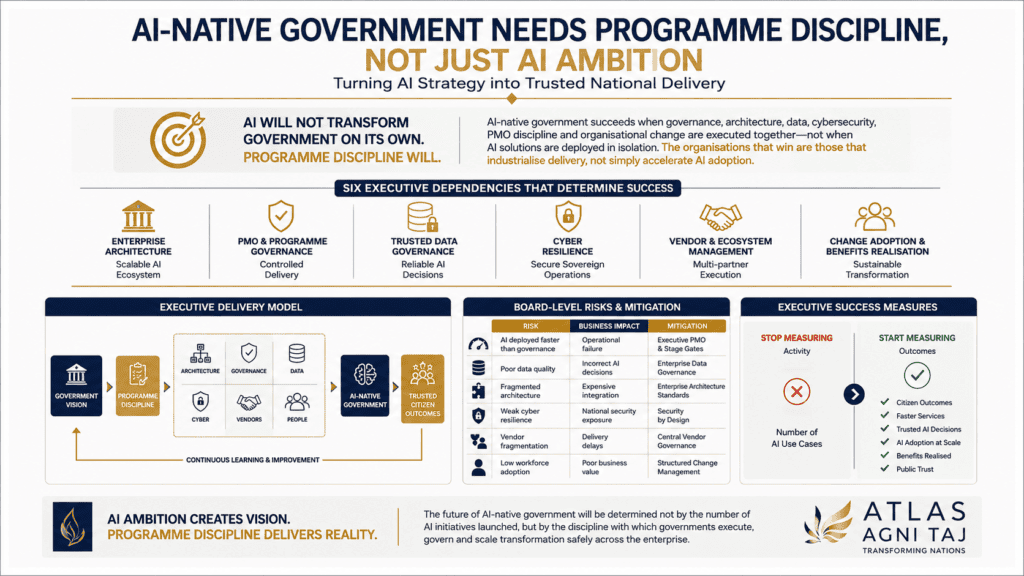
NOT JUST AI AMBITION AI-Native Government Needs Programme Discipline, Not Just AI Ambition The Gulf is entering a new phase of public-sector transformation. Abu Dhabi’s Government Digital Strategy 2025–2027 sets out an ambition that would have seemed extraordinary only a few years ago: full process digitisation across government entities, one hundred per cent sovereign cloud adoption, more than two hundred artificial intelligence solutions deployed at scale, and a unified enterprise resource planning platform spanning multiple government departments. This is not a research agenda or a set of pilot projects confined to innovation labs. It is a live delivery, governance and operating-model challenge, unfolding in real time, with real budgets, real citizens and real consequences for failure. For technology and transformation leaders across the UAE and the wider Gulf Cooperation Council, this shift from digital government to AI-native government is the defining executive challenge of the decade. Yet in my experience advising and delivering large-scale transformation programmes across the region, the conversation in most boardrooms remains fixated on ambition — on the number of AI use cases announced, the scale of investment committed, and the speed with which new capabilities can be unveiled. Far less attention is given to the harder, less glamorous question that ultimately determines success or failure: can the organisation actually deliver this safely, reliably and at scale? This article sets out why AI-native government will be won or lost not on the strength of AI ambition, but on the strength of programme discipline — and what that discipline must look like in practice. From Digital Government to AI-Native Government The maturity journey that Gulf governments are now navigating can be understood as a five-stage progression. The first stage, digital services, is largely complete across the UAE: citizens and businesses can transact with government online, forms have been digitised, and channels have been consolidated. The second stage, integrated data, is where many entities currently sit — building the data platforms, master data structures and interoperability layers that allow information to move across departmental boundaries rather than remaining trapped in siloed systems. The third stage, sovereign cloud, is advancing rapidly, driven by national policy commitments to host critical government workloads within sovereign infrastructure for reasons of security, resilience and data residency. The fourth stage, AI-enabled operations, sees artificial intelligence embedded into live operational processes — case management, service triage, fraud detection, resource allocation and citizen engagement. The fifth and final stage, AI-native government, is one in which artificial intelligence is not a bolt-on capability but a structural feature of how government operates: decision support, service delivery and policy formulation are all shaped by continuously learning systems operating on trusted, governed data. The distance between stage four and stage five is where most transformation programmes falter. It is one matter to deploy an AI solution within a controlled pilot. It is an entirely different matter to operate two hundred such solutions simultaneously, across multiple departments, with the reliability, auditability and safety that citizens and regulators rightly expect of government services. That distance is not closed by better algorithms. It is closed by disciplined programme management. The Real Challenge Is Not Choosing the Right AI Tools Every transformation leader I speak with in the region is, understandably, focused on selecting the right AI platforms, the right large language models, and the right vendors. These are important decisions. But they are not the decisions that determine whether AI-native government succeeds. The real challenge sits one level below the technology choice, in questions that are far less visible from the boardroom but far more consequential in practice: None of these questions can be answered by procurement alone. They require the discipline of programme management: clear ownership, sequenced delivery, risk management, benefits tracking and rigorous change control. This is the uncomfortable truth that ambition-led transformation narratives tend to avoid — the hardest part of AI-native government is not intelligence. It is operational readiness. Why Ambition Without Discipline Fails Across more than three decades leading enterprise technology and transformation programmes — spanning aviation, banking, healthcare, financial services and, more recently, sovereign infrastructure and government-adjacent programmes in the UAE — I have observed a consistent pattern. Transformation initiatives succeed or fail based on one factor above all others: whether leadership treats the initiative as a programme of business change, or merely as an IT installation. When AI is treated as an IT installation, the organisation focuses on system deployment, technical integration and go-live dates. Governance is retrofitted after the fact. Business process owners are consulted late, if at all. Change management is reduced to a training session delivered in the final weeks before launch. The result is a technically functioning system that the organisation does not trust, does not fully understand, and often works around rather than through. When AI is treated as a programme of business change, the sequence is reversed. Process redesign precedes automation. Data governance is established before data is put to work. Cybersecurity and resilience requirements are embedded into architecture from the outset, not layered on afterwards. Change adoption is planned as a multi-month workstream with its own budget, milestones and accountable owner, running in parallel with technical delivery rather than following it. Governance is designed to move at the speed of delivery, with clear escalation paths and decision rights, rather than acting as a compliance checkpoint that slows everything down. The difference between these two approaches is not subtle. It is the difference between an AI pilot that never scales and an AI-native operating model that genuinely transforms public service delivery. The Six Pillars of Programme Discipline Having led and advised on large-scale transformation across both private and public sector contexts, I would suggest that AI-native government rests on six pillars of disciplined delivery. Each is necessary; none alone is sufficient. First, architecture. AI-native operations require an enterprise architecture that has been deliberately designed to support scale — common data models, published APIs, clear system-of-record definitions, and integration standards that prevent the proliferation of point-to-point connections. Architecture decisions made in
Digital Transformation Through Intelligent Automation
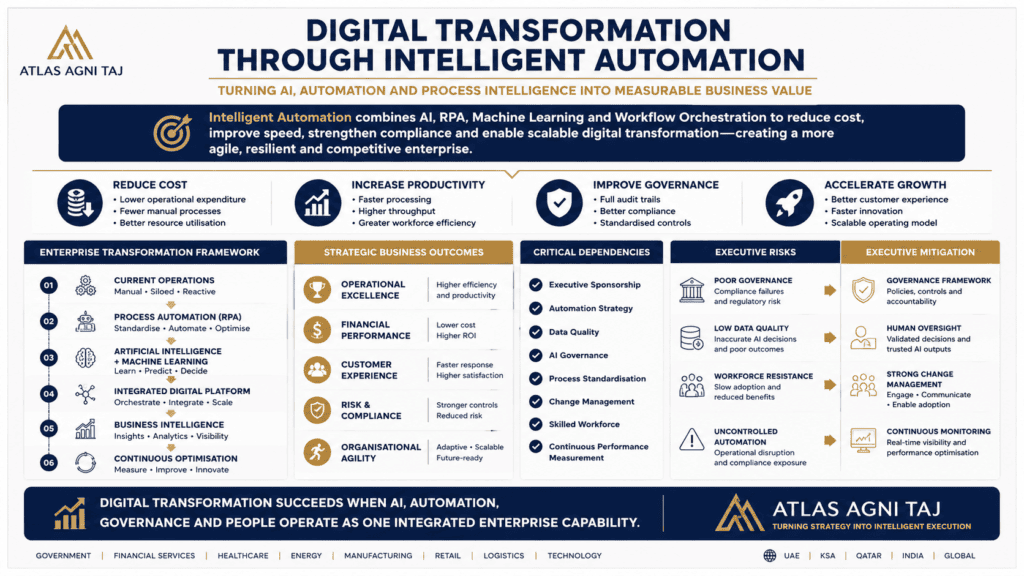
Driving Efficiency and Business Agility in the Modern Enterprise Digital Transformation Through Intelligent Automation: Driving Efficiency and Business Agility The enterprise landscape is undergoing a fundamental shift. Digital transformation has moved beyond the confines of the technology function to become a board-level imperative, and at the heart of this shift lies intelligent automation: the convergence of robotic process automation, artificial intelligence, machine learning, and workflow orchestration that is reshaping how organisations operate, compete, and serve their customers. Unlike traditional automation, which follows fixed rules and static scripts, intelligent automation adapts, learns, and scales. It changes not only how work gets done, but why and when it happens. For organisations across the GCC and beyond, this represents an opportunity to unlock efficiency, accelerate business model evolution, and build the agility required to compete in a digital-first economy. This article sets out how leading organisations are deploying intelligent automation to achieve measurable business outcomes, the strategic disciplines that underpin successful transformation, and the governance frameworks required to scale automation safely and sustainably across the enterprise. Part One: The Case for Intelligent Automation Why Now The last five years have compressed digital transformation timelines that would previously have spanned a decade. Three forces have converged to create a genuine inflection point for boards and executive committees. The first is economic pressure and operational resilience. Organisations across the region face intensifying cost pressure, persistent talent shortages in specialist technical roles, and margin compression that makes indiscriminate headcount growth unsustainable. At the same time, regulatory complexity continues to rise, with KYC and AML obligations, data localisation mandates, and governance frameworks all demanding that organisations achieve more with finite resources. Intelligent automation addresses this directly by handling repetitive, rules-based work at scale without adding headcount: a financial institution can process KYC documentation in minutes rather than days, a healthcare provider can automate insurance verification, and a government entity can accelerate permit processing. Efficiency gains of forty to seventy per cent in cycle time, and thirty to fifty per cent in cost per transaction, are now routinely achievable. The second force is technology maturity and accessibility. Five years ago, intelligent automation was largely the preserve of global technology leaders with substantial capital to deploy. Today, cloud-native platforms, pre-built process templates, and low-code and no-code development tools have democratised access considerably. Organisations no longer need to build automation capability from first principles; they can configure, integrate, and deploy. This is particularly significant across the GCC, where many organisations have pursued digital transformation without the deep technical talent pools available in more mature technology markets. Modern platforms now allow business analysts, rather than specialist developers, to design and deploy automation, materially accelerating time to value and lowering the barrier to entry. The third force is the maturing of artificial intelligence and machine learning capability, alongside growing data availability. Early automation initiatives were rules-based in the truest sense: a defined condition triggered a defined action. Modern intelligent automation combines classical process automation with machine learning models capable of classifying documents, extracting data, predicting outcomes, and optimising routing decisions. Organisations across the GCC with substantial historical business data, whether financial transactions, customer interactions, or operational records, hold a significant and often underused asset. That data can be harnessed to drive automation that is not merely efficient, but genuinely intelligent and adaptive. The Business Case: Real-World Outcomes The commercial case for intelligent automation is compelling and increasingly well documented across sectors. A regional bank implementing intelligent automation across its mortgage origination process reduced processing time from twenty-one days to three, automating document verification, data validation, compliance checking, and funding coordination, while redeploying staff into customer-facing roles and complex exception handling. The result was forty per cent higher processing volume achieved with twenty-five per cent fewer full-time staff. A multinational pharmaceutical company automated its invoice-to-pay process across forty-seven global entities, covering invoice receipt, three-way matching, exception flagging, and payment processing, reducing days payable outstanding by eight days while improving both supplier satisfaction and payment accuracy. A GCC government entity implemented intelligent document processing for permit applications, extracting information from unstructured submissions, validating against multiple databases, and routing to appropriate approvers, cutting processing time from forty-five days to five and lifting citizen satisfaction scores by thirty per cent, without additional budget. A large regional retailer automated inventory reconciliation, demand forecasting, and replenishment ordering across point-of-sale, warehouse, supplier, and market data systems, reducing stockouts by thirty-five per cent and inventory carrying costs by eighteen per cent. These outcomes are not theoretical; they are consistent across sector and geography. The recurring pattern shows cycle time reductions of sixty to eighty per cent, transaction cost reductions of forty to sixty per cent, error and rework reductions of twenty-five to forty per cent, throughput increases of fifty to two hundred per cent without proportional cost growth, and materially stronger, consistently applied compliance and audit trails. Part Two: Understanding the Architecture of Intelligent Automation Intelligent automation is not a single technology but an orchestrated ecosystem, and understanding its components is essential to sound strategy and disciplined implementation. Robotic Process Automation: The Foundation Robotic process automation remains the foundation. RPA bots mimic human interaction with computer systems, logging in, navigating interfaces, entering and validating data, and copying files. Unlike middleware or API-based integration, RPA is non-invasive, working with systems as they exist without requiring integration development or legacy modification. This is particularly valuable across the GCC, where many organisations operate complex landscapes of legacy systems, some decades old, heavily customised, or with limited vendor support. RPA allows organisations to automate across these fragmented landscapes without system-level change, and is best applied to high-volume, rules-based, repetitive work where processes are stable and rules well defined. Artificial Intelligence and Machine Learning: The Intelligence Layer Robotic process automation combined with artificial intelligence produces intelligent automation. While RPA handles execution, AI and machine learning add the intelligence layer: classification, extraction, prediction, and optimisation of routing decisions. For organisations with substantial unstructured data, whether customer correspondence, supplier invoices, feedback, or applicant documents, machine learning-powered document intelligence and natural language processing unlock considerable value, allowing what previously required manual review to be classified, extracted, and routed automatically. Computer vision adds a further dimension for organisations handling physical documents, inspection reports, or visual data, extracting information, identifying defects, and detecting fraud. Integration, Orchestration, and Governance Intelligent automation operates across multiple systems, and effective orchestration requires integration platforms connecting RPA, AI and ML models,
Agentic AI Needs Governance Before Autonomy: Why Enterprises Must Act Now
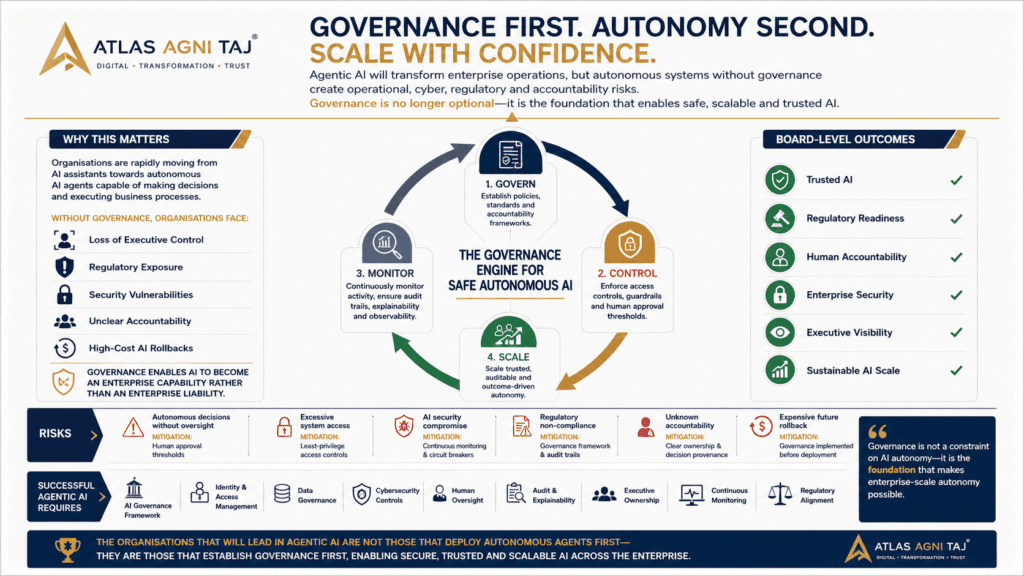
A perspective for CIOs, CDOs and boards navigating the shift from AI assistance to AI autonomy This is not a theoretical concern reserved for academic risk committees. Industry research increasingly points to a sobering scenario: enterprises that deploy autonomous agents today without robust access control, accountability, and oversight mechanisms may be forced to significantly constrain or unwind that autonomy within the next two to three years. For CIOs, CDOs, and enterprise technology leaders, the message is unambiguous. The window to establish governance is now, before autonomy becomes the operating default and before control becomes prohibitively expensive to retrofit. The promise of agentic AI is compelling. Autonomous agents that set goals, take actions, and iterate with minimal human intervention offer enterprises the prospect of step-change productivity gains across procurement, finance, customer operations and supply chain management. Boards are asking their technology leadership how quickly this capability can be deployed. Vendors are racing to answer. Yet beneath the enthusiasm lies a critical oversight that threatens to unwind years of digital transformation investment: most organisations are building autonomous AI capability without the governance architecture required to operate it safely, defensibly, and at scale. The Urgency: Why This Moment Is Different Agentic AI has crossed a threshold that distinguishes it from the generative AI wave that preceded it. Traditional AI systems, including most generative tools deployed over the past three years, require explicit human prompting and review at each material step. A human asks a question; the system responds; a human decides what to do with that response. Agentic AI removes that checkpoint by design. It is built to set sub-goals, select tools, execute actions across systems, and iterate on outcomes without waiting for human sign-off between steps. This is precisely what makes it valuable, and precisely what makes it dangerous in the absence of governance. Three converging pressures explain why this has become an urgent enterprise issue rather than a distant one. Pressure One: Rapid Adoption Without Institutional Precedent Organisations are embedding autonomous agents directly into business-critical processes: procurement approvals, financial reconciliation, customer service resolution, and supply chain rebalancing. The pace of deployment is outstripping the maturity of governance practice by a wide margin. Where earlier generations of enterprise AI moved from pilot to production over a period of years, allowing governance functions time to catch up, agentic AI is compressing that cycle into months. Many organisations now operating agents in live business processes have not yet completed a single formal governance review of what those agents are authorised to do. Pressure Two: Interconnected Risk Domains CIO priority research over the past eighteen months has converged on a single insight: the operationalisation of AI, cybersecurity, and data governance can no longer be treated as separate disciplines. An autonomous agent that operates across systems is simultaneously a productivity tool, a potential cybersecurity attack surface, and a possible vector for data governance failure. A compromised or poorly scoped agent can execute consequential decisions across multiple systems with minimal human oversight. A data governance gap that would once have been contained to a single report or dashboard becomes materially amplified when an agent acts autonomously on data that should have been access-restricted in the first place. Governance of agentic AI is therefore not an IT sub-topic; it sits at the intersection of three risk domains that most enterprises still manage in separate silos, with separate owners and separate reporting lines. Pressure Three: The Accountability Vacuum Traditional AI, and indeed traditional enterprise software, tends to preserve a legible decision trail. A model scores a credit application; a human underwriter approves or declines it; responsibility is clear. Agentic AI disrupts this clarity. An autonomous agent may decide, on its own initiative, to modify a supplier contract, reprioritise operational resources, or escalate a customer complaint to a different resolution path. When the outcome is unfavourable, the question of who is accountable becomes genuinely difficult to answer. Is it the team that built the agent, the function that deployed it, the vendor whose model underlies it, or the executive who signed off the use case at a high level without visibility into its granular behaviour? Without governance that assigns accountability before deployment, enterprises risk creating systems they can neither explain, debug, nor defend when regulators, auditors, or customers ask hard questions. The 2027 Rollback Risk Analyst commentary now points to a scenario worth taking seriously at board level: a meaningful proportion of enterprises deploying autonomous agents today without adequate governance will, within the next two to three years, face a stark choice. They will either significantly constrain the autonomy they have granted, or discontinue the affected agents altogether. Neither outcome is cost-free. A forced rollback of this kind typically involves reworking business processes that were redesigned around autonomous operation, rebuilding human-in-the-loop decision points that were deliberately removed to capture efficiency, recovering institutional knowledge that atrophied while the agent operated unsupervised, and managing the frustration of stakeholders who were promised efficiency gains that are now being clawed back. This is the governance debt scenario, and it is avoidable. The enterprises that will not face it are those establishing governance frameworks early, before agents become deeply embedded in day-to-day operations, before stakeholder expectations calcify around autonomous decision-making, and before the technical debt of ungoverned systems becomes structurally difficult to unwind. The 2027 horizon is not a prediction of inevitable failure; it is a warning attached to a specific and avoidable failure mode: deploying autonomy faster than an organisation builds the capability to govern it. The Governance Imperative: Three Pillars Effective agentic AI governance is best understood as resting on three interlocking pillars. Weakness in any one undermines the other two. Pillar One: Access Control and Guardrails Pillar Two: Accountability and Auditability Pillar Three: Governance Process and Oversight The CIO Perspective: Three Leadership Imperatives For CIOs and technology leaders, agentic AI governance sits at an uncomfortable intersection of technical capability, business risk appetite, and organisational control. Three imperatives stand out for leaders navigating this terrain. First, own governance ahead of business-led deployment. Where CIOs wait for business units to deploy autonomous agents independently and only then attempt to impose governance retrospectively, the cost of retrofit is typically prohibitive, both financially and politically. Governance frameworks need to be in place before agents are trained and operationalised, not layered on afterwards. Second, integrate AI governance into existing
The Foundation of AI in an Organisation: A Readiness Framework
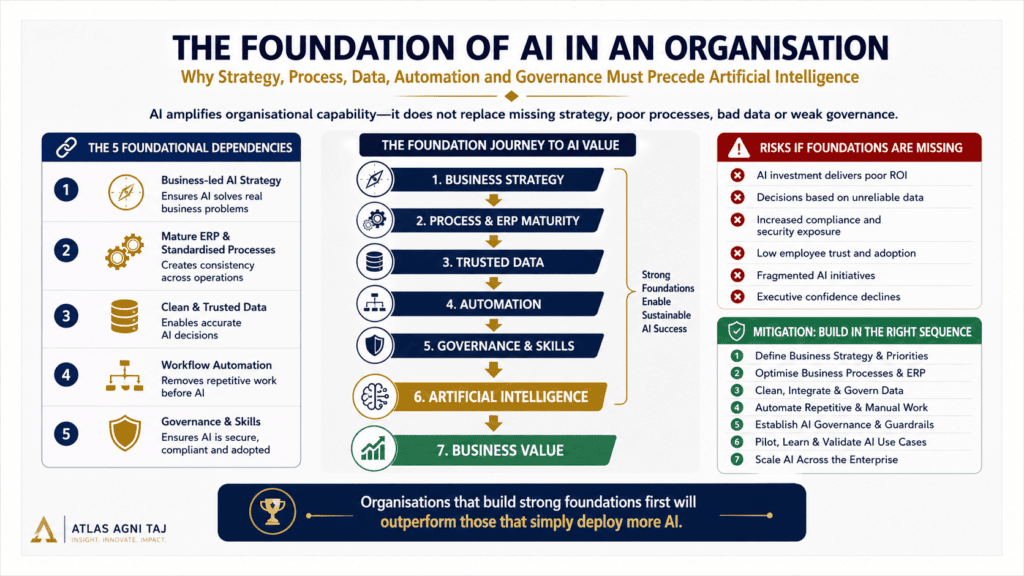
THE FOUNDATION OF AI IN AN ORGANISATION Why Strategy, Process, Data, Automation and Governance Must Precede Artificial Intelligence A Perspective for Boards, C-Suite Leaders and Transformation Executives The Foundation of AI transformation strategy in an Organisation Artificial intelligence has become one of the most consequential — and most frequently misunderstood — strategic priorities confronting boards and executive committees today. In almost every organisation, leaders are asking urgent questions: where should we automate, how can AI enhance productivity, what cost efficiencies are achievable, and how might AI sharpen decision-making and elevate customer experience. These are the right questions. Yet the organisations that ultimately succeed with artificial intelligence are rarely those that move fastest into pilots, copilots or agentic experiments. They are the organisations that first and honestly answer a more fundamental question: is our organisation genuinely ready for artificial intelligence? The uncomfortable truth is that AI does not succeed in isolation. Its success depends entirely upon the maturity of an organisation’s strategy, its business processes, its integrated systems, its data architecture, its automation capability, its governance discipline, and — above all — its people. In the absence of these foundations, AI becomes an expensive experiment: an initiative that generates initial enthusiasm and consumes budget, yet fails to deliver durable, measurable business value. This article sets out the five critical foundations that every organisation must establish before committing to a serious programme of AI adoption at scale. These are not optional refinements. They are prerequisites that determine whether artificial intelligence becomes a genuine lever of transformation, or merely another costly technology distraction. The AI Readiness Challenge: Why Foundations Matter Boardrooms across every sector are currently experiencing what might fairly be described as “AI fever.” Executives read daily of breakthrough applications of generative AI, large language models and autonomous agents. Competitors announce bold AI initiatives. Investors ask pointed questions about innovation readiness. Internal technology teams press to experiment with the latest tools and capabilities. The predictable consequence is a wave of AI pilots launched without adequate preparation: chatbots that frustrate rather than assist customers, forecasting models trained on incomplete or unreliable data, recommendation engines that users quickly learn to ignore, dashboards that decision-makers distrust, and automation initiatives that expose legacy processes so fundamentally broken that no amount of artificial intelligence can repair them. The common thread running through these failures is rarely the underlying technology. Modern AI platforms — whether cloud-based machine learning services, large language models, or specialised domain models — are remarkably capable. Failure occurs because organisations attempt to apply advanced techniques before establishing the foundational capabilities upon which any AI initiative ultimately depends. AI is only as durable, valuable and reliable as the organisational foundation upon which it rests. Consider the familiar analogy of constructing a skyscraper on unstable ground. The architectural design may be magnificent, the materials world-class, and the engineering flawless — yet without solid bedrock, the structure will inevitably fail. Artificial intelligence behaves no differently. Foundation One — A Clear AI Strategy and Compelling Business-Led Use Cases The first and most critical foundation is clarity of purpose and strategic alignment. Artificial intelligence should never be deployed because it is fashionable, because competitors are exploring it, or simply because the technology is available. It should be deployed purposefully, to solve genuine business problems, remove critical inefficiencies, or generate measurable, quantifiable value. This distinction — between technology-driven and business-driven AI — ultimately determines whether AI becomes transformational or remains experimental. The Strategic Compass A well-articulated AI strategy provides the compass that guides investment and resourcing decisions. It should answer several essential questions with rigour: The most successful AI initiatives, across industries and geographies, share a common characteristic: they are business-led rather than technology-led. The strongest organisations identify the desired business outcome first, understand the pain or opportunity in depth, and only then examine whether and how AI can meaningfully contribute. High-Impact Use Case Categories Experience across sectors points consistently to several categories of AI application that deliver tangible value when properly implemented: enhanced demand forecasting within supply chain and planning functions, often improving forecast accuracy materially while easing working-capital pressure; intelligent procure-to-pay automation, extending beyond simple robotic process automation into genuine three-way matching and exception detection; customer service intelligence that routes enquiries to the right agent and equips them with real-time guidance; fraud detection and anomaly identification using models that adapt continuously to emerging risk; intelligent procurement and sourcing analytics that surface maverick spend and consolidation opportunities; automated project status and risk reporting that removes manual compilation; contract analysis that extracts obligations and flags compliance exposure across large document sets; workforce planning that identifies skills gaps and attrition risk; and IT service management that accelerates incident resolution. Each of these use cases shares a defining feature: a clear, quantifiable business outcome sits at its centre, with artificial intelligence serving that outcome rather than the reverse. Foundation Two — A Well-Implemented ERP System as the Digital Operating Backbone For most organisations, the enterprise resource planning system represents far more than a software platform. It is the operational backbone that integrates and standardises finance and the general ledger, procurement and vendor management, supply chain and logistics, human resources and payroll, project delivery, asset management, manufacturing, sales and customer management, and consolidated reporting and analytics. Why ERP Maturity Is a Non-Negotiable AI Dependency Artificial intelligence depends critically upon reliable processes and seamlessly connected workflows. Where core business processes remain unstandardised, inconsistently implemented across locations, or poorly adopted by users, AI will inevitably struggle to deliver value. When processes are broken or inconsistent, AI amplifies that complexity rather than resolving it: a model trained on inconsistent data produces inconsistent outputs, and a forecasting engine dependent on manual data entry inherits every error embedded in that manual work. A well-implemented ERP system, by contrast, provides precisely the operational foundation AI requires: standardised processes across all locations and business units; clear approval workflows and accountability; common master data spanning customers, suppliers and the chart of accounts; fully integrated, system-to-system transactions; defined roles and segregation of duties; and enhanced visibility and transparency into organisational performance. AI cannot reverse-engineer or repair a fundamentally broken process — it can only make a well-designed process faster, smarter and more scalable. Organisations that have not yet achieved basic ERP maturity — those operating heavily customised systems, inconsistent adoption across geographies, poor data quality, or incomplete integration — are, put simply, not yet ready for AI. Such organisations should first invest in ERP optimisation, process standardisation and operational discipline before expecting artificial intelligence to deliver meaningful results. Foundation Three — Clean, Trusted
Sovereign Cloud and Data Sovereignty: The UAE’s Digital Advantage
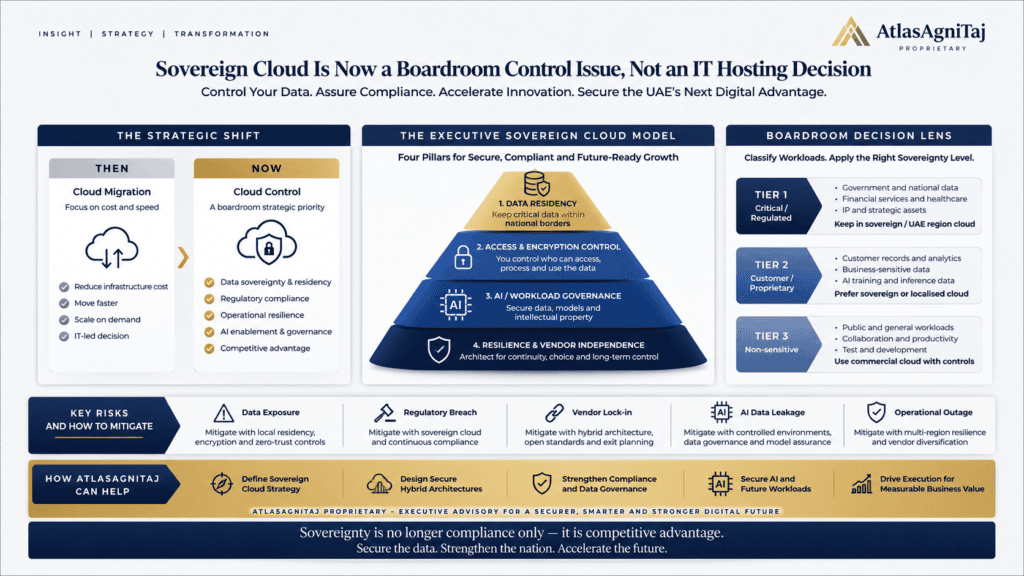
SOVEREIGN CLOUD, DATA SOVEREIGNTY AND THE UAE’S NEXT DIGITAL ADVANTAGE A Boardroom Perspective on Control, Compliance and Competitive Advantage in the GCC Cloud Strategy Has Grown Up For much of the last decade, cloud strategy in the Gulf was a conversation about speed and cost. Migrate the workload, retire the data centre, reduce capital expenditure, and move faster than a traditional build would allow. It was a simple and persuasive narrative, and it drove a rapid expansion of cloud adoption across the region. That conversation has now matured into something more consequential. Cost and velocity have not disappeared as considerations, but they have been overtaken by a harder set of questions that boards, regulators and chief executives are asking with increasing frequency. Where does our data actually reside? Who, in practice, can access it? Can we demonstrate compliance while relying on infrastructure we do not own? What is our exposure if a key supplier relationship deteriorates or fails? How do we retain control of the assets that matter most — intellectual property, customer records, financial data and, increasingly, artificial intelligence models trained on all of it? This shift reflects the convergence of several forces at once: growing regulatory confidence and sophistication, ambitious national digital strategies, sustained investment in sovereign technology capability, the rapid rise of artificial intelligence and its appetite for secure data and compute, and a sharper awareness — shaped by recent geopolitical events — that cloud infrastructure is not a neutral utility. It is a strategic control point. For CIOs, CTOs and senior technology leaders, this is both a challenge and an opening. The challenge lies in navigating a genuinely more complex landscape of compliance obligations, vendor relationships and architectural trade-offs. The opening lies in leading a new phase of transformation — one that reconciles innovation with control, growth with security, and global capability with local sovereignty. Why Cloud Has Become a Boardroom Matter In the early years of cloud adoption, the decision to migrate typically sat within the technology function. Today, cloud architecture sits squarely on the board agenda, and rightly so, because it now touches almost every dimension of an organisation’s strategic position. Regulatory compliance and data governance. The UAE’s regulatory environment has matured considerably. Data localisation expectations, sector-specific rules across banking, healthcare and government, and an evolving national data strategy all assume that technology leaders know precisely where data sits, how it is processed and who can reach it. An architecture that breaches these principles — even unintentionally — creates legal and reputational exposure that extends well beyond the technology function. Operational resilience. Recent global disruptions have sharpened the focus on continuity. Architectures dependent on a single provider, a single region, or infrastructure ultimately controlled by a foreign entity carry concentration risk. Regulators in banking and government are scrutinising these dependencies closely. True resilience now demands architectural redundancy and vendor independence, not merely backup and recovery procedures. National strategy and competitive positioning. The UAE has been explicit that data is a strategic national asset. Its AI strategy, its digital economy agenda and its investment in sovereign cloud platforms all rest on this premise. For enterprises operating in the region, aligning cloud strategy with national priorities brings regulatory goodwill, access to government-led initiatives, and a stronger position from which to participate in public sector technology programmes. AI enablement and model governance. Artificial intelligence is data-hungry and computationally intensive, and it raises pointed questions of control. Where is training data processed? Who can see the outputs of a model hosted on infrastructure the organisation does not own? What happens to information passing through third-party APIs woven into the AI stack? These questions cannot be answered credibly without a clear view of the underlying cloud architecture. Cybersecurity posture. Cloud is not inherently less secure than on-premises infrastructure, but the attack surface, the shared-responsibility model and the visibility available to the organisation are all materially different. In a region increasingly targeted by sophisticated actors, understanding cloud security posture — technical controls, vendor vetting and incident response capability alike — is no longer discretionary. Business agility. None of this diminishes the case for speed. Cloud remains a genuine accelerant of business outcomes. But it must be controlled acceleration. An architecture that trades sovereignty for velocity accumulates hidden debt that surfaces later, usually at the least convenient moment. The organisations succeeding in the GCC are those achieving both cloud speed and cloud control. When cloud decisions influence compliance, resilience, national alignment, AI capability, security and commercial velocity simultaneously, they are, by definition, strategic decisions. They belong in the boardroom and in conversations with regulators, not solely within the technology function. Data Residency Is the Starting Point, Not the Destination Many organisations still equate data sovereignty with data residency alone — the requirement that data physically resides within a defined geography, typically the UAE for enterprises operating here. Residency matters, and it is usually the first question a regulator will ask. But it is only one dimension of a considerably broader picture. Genuine sovereignty spans several interlocking dimensions: Organisations pursuing genuine sovereignty do not treat residency as a box to be ticked and set aside. They work through each of these dimensions methodically and design accordingly. It is a more demanding approach than simply selecting an in-country provider, but it is also considerably more robust. The Rise of Sovereign Financial and Government Cloud Platforms The clearest expression of this shift is the emergence of sovereign cloud platforms purpose-built for regulated sectors. The UAE Central Bank’s sovereign financial cloud initiative is a good illustration: not a rebadged hyperscaler offering, but infrastructure designed from first principles around the needs of financial institutions — UAE-based residency, governance aligned with financial regulation, security architecture appropriate to banking, and mechanisms that allow both regulators and institutions to audit what is actually happening within the environment. Comparable initiatives are underway elsewhere in the Gulf. Saudi Arabia continues to invest heavily in sovereign cloud and data centre capacity, while other Emirates and neighbouring states are evaluating or constructing national cloud platforms of their own. These are not anti-cloud measures. They are pro-control measures, reflecting a deliberate decision that the most critical categories of digital infrastructure should be built and operated in a way that keeps control firmly in the hands of the nation and its regulated institutions. For enterprises, this brings both an obligation and an opportunity: the obligation to understand which sectors or workloads must migrate to