Most AI Strategies Will Fail Because Infrastructure Was Never Designed for Autonomous AI
Enterprise AI Has an Infrastructure Problem Nobody Is Talking About
For the better part of three years, boardrooms across the Gulf and beyond have been consumed by a single question: which large language model should we adopt? Which foundation model, which hyperscaler, which partner ecosystem? The debate has been intense, well-funded, and, as it turns out, almost entirely misdirected.
The uncomfortable truth is that model quality is no longer the binding constraint. Frontier models have become commodity-adjacent, capable of reasoning, coding, planning and orchestrating tools to a standard that most enterprises will not fully exploit for years. The binding constraint is the enterprise itself: the network fabric that was never designed for agent-to-agent traffic; the data platforms that were built for overnight batch analytics rather than sub-second retrieval; the identity systems that assume human users at every interaction; and the API estates that are undocumented, ungoverned, and manifestly unfit for machine consumption.
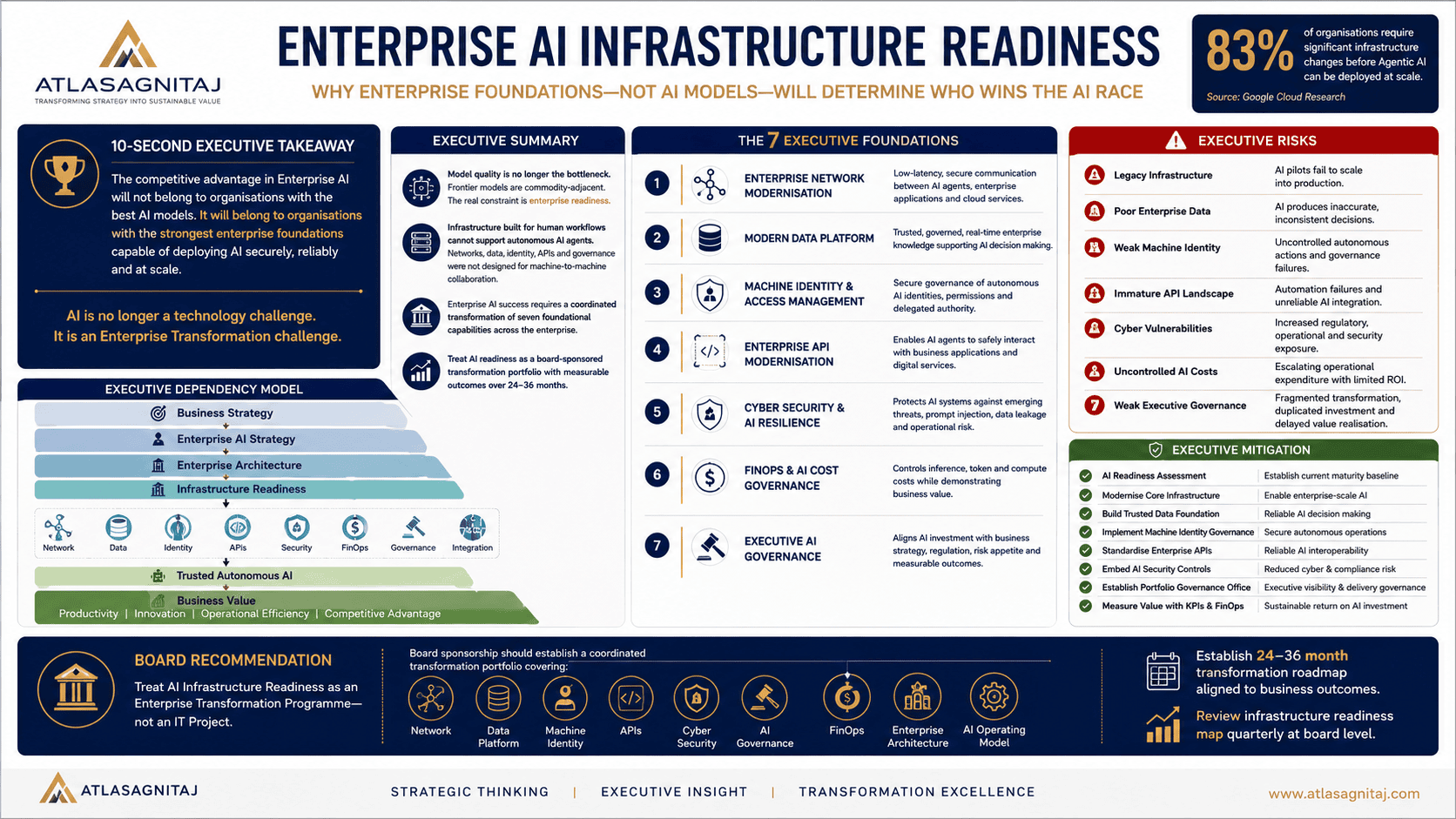
Google Cloud’s recent research puts a hard number on this discomfort. Eighty-three per cent of organisations report that their existing infrastructure requires major changes before agentic AI can be deployed at scale. That figure, on its own, should reset every AI strategy currently sitting in front of a board. The bottleneck has moved. Most executive teams have not.
The Silent Shift From Model Risk to Enterprise Risk
The last eighteen months have marked a quiet inflexion point in enterprise AI. The centre of gravity has moved decisively from experimentation to deployment, from demonstrations to dependable production, and from single-turn chat interfaces to persistent, tool-using agents that act on behalf of the business. This shift has exposed a set of assumptions that have gone unchallenged since the era of packaged ERP: that the enterprise data estate is broadly fit for purpose; that the network is a passive utility; that identity is a solved problem; and that the API estate can be governed through documentation and goodwill.
None of these assumptions survives contact with production-grade agentic systems. A single autonomous agent tasked with, for example, closing a customer complaint will interrogate half a dozen systems of record, invoke multiple APIs, cross regulatory boundaries, generate reasoned action, and require a defensible audit trail. Multiply that by the thousands of concurrent agent invocations that a large enterprise will run once the paradigm takes hold, and the picture changes entirely. What was tolerable friction for a human user becomes catastrophic latency for an agent. What was acceptable data staleness for a dashboard becomes actionable misinformation for an automated decision. What was benign identity ambiguity becomes an unbounded failure of governance.
This is why the honest conversation with the board is no longer about which model to license. It is about whether the enterprise itself is architected to host autonomous intelligence at all. In the majority of cases assessed across regional and global markets, the answer is a qualified no. The path forward is neither cheap nor short, but it is knowable, and the organisations that address it first will convert AI ambition into durable competitive advantage. The remainder will spend the next two years debugging pilots.
“The bottleneck has moved from model quality to enterprise readiness. Most executive teams have not.”
Networks Were Not Designed for Agents Talking to Agents
Enterprise networks have been optimised over three decades for two dominant traffic patterns: users reaching applications and applications reaching databases. Firewalls, proxies, load balancers, and identity gateways were tuned accordingly. Agentic AI does not respect this topology. The dominant new pattern is east-west: agents calling other agents, agents invoking tools, agents retrieving from vector stores, and agents crossing what were formerly hard boundaries between systems, business units and, increasingly, jurisdictions.
Three consequences follow immediately. First, latency becomes a first-order business variable. When a customer-facing agent must call an inference endpoint, retrieve context from a vector database, reconcile against a system of record, and return a coherent answer within a two-second envelope, network hops that were previously invisible become material—second, private connectivity moves from optional to foundational. Public-internet paths between model providers, enterprise data, and downstream systems introduce cost, jitter, and regulatory exposure that no serious agentic deployment can absorb. Direct interconnects, private endpoints, and sovereign landing zones are no longer procurement conversations; they are architectural preconditions. Third, the emerging protocols for agent interoperability, of which the Model Context Protocol is the most visible example, presuppose a network capable of secure, low-latency, mutually authenticated machine-to-machine traffic at scale. Most enterprise networks are not.
For chief information officers in the Gulf, this has a particular resonance. Data residency requirements, sovereign cloud commitments, and the pace of national AI strategies mean that network architecture is now a matter of both regulatory alignment and competitive positioning. The organisations that treat this as a network engineering exercise will underdeliver. The organisations that treat it as an enterprise architecture programme, sequenced against a broader modernisation portfolio, will succeed.
A further, often underestimated, complication is the interaction between agentic traffic and the observability estate. Traditional network monitoring, application performance management, and log aggregation platforms were sized and priced for human-mediated activity. Autonomous agents, particularly those operating in multi-step reasoning loops, generate telemetry at volumes that stress both the cost model and the operational competence of the existing tooling. The observability platform must be reconsidered alongside the network itself, not as an afterthought once the first bill arrives.
The Data Platform Assumption That Will Not Hold
For twenty years, the enterprise data conversation has orbited around one artefact: the warehouse. Whether cloud-native, hybrid, or lakehouse in flavour, the underlying assumption has been that data is analysed periodically, by humans, for decisions taken at a human tempo. Agentic AI shatters that assumption. Agents require fresh, structured and unstructured data, retrievable at sub-second latency, with provenance and lineage attached, in formats optimised for both vector search and relational queries.
This has three practical implications for the modern data platform. The first is that retrieval-augmented generation is now a first-class citizen of the data estate. Vector stores, hybrid search indices, and semantic layers must be integrated with, not bolted on to, the platform. The second is that data contracts, freshness guarantees, and lineage metadata cease to be governance niceties and become operational necessities. An agent that acts on stale or unattested data will produce decisions that are, at best, embarrassing and, at worst, actionable. The third is that unstructured data, contracts, correspondence, engineering drawings, and meeting transcripts are no longer a residual class of information. It is the primary substrate on which agents reason, and it must be treated with the same discipline that has historically been reserved for the general ledger.
The organisations that have invested heavily in data platform modernisation over the past five years are, on paper, better placed. In practice, many have discovered that the modernisation was aimed at analytics dashboards rather than machine consumption. The next wave of investment is not a repeat of the last; it is a reorientation of the platform toward retrieval, freshness, and semantic accessibility. This is a substantial programme in its own right, and it belongs on the same executive dossier as the AI strategy itself.
Identity Is the Governance Layer Nobody Built
If there is a single control plane on which the credibility of agentic AI will rest, it is identity. And in most enterprises, it is the least prepared. Identity systems have been designed around a human user population: employees, contractors, partners, customers. The tooling, from single sign-on to conditional access to privileged access management, assumes a person at the endpoint. Autonomous agents dismantle that assumption.
A production agent is a non-human identity, invoked under delegated authority, operating across multiple systems, and often acting on behalf of a human whose consent may or may not be explicit. Each of those characteristics generates a governance question that most enterprises have not answered. Who authorised the agent? Under what scope? For how long? Against which data? With what right of revocation? How is the action logged in a manner that satisfies both internal audit and external regulators? These are not theoretical questions. They will be asked, in earnest, by the first regulator to encounter an agentic decision that harmed a customer.
The remedy is a deliberate identity architecture for machines. Service accounts, as they have been managed for the past decade, will not suffice. What is required is a first-class treatment of non-human identity, with lifecycle management, scoped credentials, ephemeral tokens, and behavioural monitoring, integrated with the same identity fabric that governs human access. Several of the leading identity vendors have begun to articulate this space, but the discipline lags the ambition. In regulated sectors such as financial services, healthcare, government, and sovereign infrastructure, this gap will be closed either by deliberate architecture or by supervisory intervention. The former is materially cheaper.
“An autonomous agent is a non-human identity acting under delegated authority. Most enterprises have not built the governance to match.”
APIs Are Now the User Interface
For most of the digital era, the API has been an implementation detail: an integration mechanism between systems, largely invisible to the business and only intermittently governed. That era is ending. In an agentic enterprise, the API is the user interface. It is the surface through which autonomous systems perceive and act on the business. The quality, discoverability, contractual precision, and behavioural predictability of the API estate now determine what agents can do, how safely they can do it, and at what cost.
The state of the average enterprise API estate is not encouraging. Documentation is inconsistent, versioning is uneven, contracts are frequently violated by the systems that publish them, and discoverability is often a matter of tribal knowledge. This was tolerable when human developers were the primary consumers, since a determined engineer could reverse-engineer or ask a colleague. It is not tolerable when the consumer is an agent that must reason about which API to call and with what parameters to achieve an objective. The agent will fail, silently or spectacularly, and the failure will be attributed to the AI when the root cause lies in the estate.
The corrective programme has several components: a machine-readable catalogue of enterprise APIs, enforced contract testing, strong version discipline, semantic descriptions suitable for agent consumption, and a governance model that treats the API estate as a strategic asset rather than a technical residue. This is closely related to the emerging conversation around tool interfaces and protocols such as MCP, but it is broader. It is, in effect, the redesign of the enterprise’s external and internal surface for a new class of consumer.
Security in an Agentic World
The security implications of autonomous AI are the subject of a rapidly maturing body of practice, but three points warrant particular attention from executives. First, the attack surface has expanded in an unintuitive way. An agent that reads external content, invokes tools, and takes action is a new class of asset with a new class of vulnerabilities: prompt injection, tool misuse, context poisoning, and data exfiltration through legitimate but unintended pathways. Traditional application security methodologies address these only partially.
Second, the blast radius of an agent is a function of its scope of authority, and scope of authority is a design decision. An agent granted broad access to systems of record and empowered to act autonomously poses an operational risk with no direct analogue in prior enterprise IT. The corrective is deliberate: least-privilege by default, strong scoping of tool access, human-in-the-loop checkpoints for consequential actions, and continuous behavioural monitoring. These controls are not exotic, but they must be engineered from the outset. Retrofitting them after an incident is materially harder than designing for them from the first sprint.
Third, and most consequentially for the board, the security posture of an agentic enterprise is inseparable from its cyber resilience posture. Detection, response, and recovery must be extended to encompass autonomous decisions, machine-mediated actions, and reversible outcomes. Cyber resilience, so often treated as a compliance line item, becomes a first-order strategic capability in the agentic era. The organisations that have invested seriously in resilience over the past five years will find themselves with a significant head start; those that have not will find their AI ambitions constrained by controls they cannot yet demonstrate.
FinOps and the Economics of the Token
The economics of autonomous AI have a property that is unfamiliar to most finance functions: cost scales with usage more like variable telecommunications spend than fixed software licensing. Every token consumed by every agent, every retrieval against every vector store, every inference call and every tool invocation incurs a marginal cost. In production, at scale, these marginal costs compound rapidly. The chief financial officers who have not yet noticed this will notice imminently.
The discipline that addresses this is FinOps, but the FinOps of the agentic era is materially more sophisticated than the cloud FinOps of the past decade. It must account for token consumption by agent, use case, business unit, and outcome. It must attribute cost to value in a manner that supports investment prioritisation. It must forecast consumption against business drivers, not against infrastructure baselines. And it must provide the finance function with the confidence to underwrite an operating model in which unit economics are dynamic and directly linked to autonomous decision-making.
For chief financial officers and chief information officers alike, this is a shared agenda. It is also an area in which discipline pays off disproportionately early. The organisations that instrument their agents for cost from day one will build a data set that supports both optimisation and strategic pricing. The organisations that do not will discover, roughly nine months into production, that their AI programme has an unexplained operating cost that no one can either predict or defend.
Treating This as a Transformation Programme, Not an IT Project
The pattern that emerges from these seven domains is unambiguous. What is required is not an AI project, nor even an AI programme in the narrow sense. It is a coordinated transformation of the enterprise’s technical and governance foundations, sequenced to align with the specific business outcomes the AI strategy is intended to deliver. This is the domain of enterprise architecture, portfolio governance, and programme delivery, disciplines that have too often been sidelined in the enthusiasm of the last two years.
The correct executive posture is to treat AI readiness as a portfolio of interdependent programmes: network modernisation, data platform reorientation, identity re-architecture, API estate remediation, security uplift, FinOps instrumentation, and the AI capability itself. These programmes have dependencies, sequencing constraints, and shared governance requirements. They are, in the language of transformation practice, a portfolio, and they require portfolio-level oversight, capital allocation, and delivery discipline. The chief transformation officer, chief information officer, and chief technology officer collectively own this agenda. Still, it will not be delivered without the explicit sponsorship of the chief executive and the board.
In the Gulf region in particular, where national AI strategies, sovereign cloud commitments, and family-office capital are converging on the same window of opportunity, the premium on disciplined delivery is exceptional. The organisations that treat AI infrastructure readiness as a genuine transformation portfolio, rather than a series of tactical experiments, will convert the current moment into a decade of advantage. Those that do not will find themselves, in eighteen to twenty-four months, explaining to their boards why a well-funded AI strategy has produced a portfolio of stalled pilots and a growing bill for infrastructure they never planned to modernise.
The Executive Agenda for the Next Two Quarters
For chief executives and boards contending with these realities, the practical agenda for the next two quarters is reasonably clear. Commission an honest, independent assessment of the current infrastructure against agentic AI requirements, covering network, data, identity, API, security, and FinOps. Establish a portfolio-level governance forum that owns the coordinated remediation, chaired at the executive level. Sequence the modernisation against the specific AI use cases that will deliver the earliest defensible value, rather than against a generic technology roadmap—instrument every agent, from the first pilot, for cost, quality, and behavioural monitoring. And, critically, communicate to the board that AI readiness is a two- to three-year enterprise transformation, not a nine-month IT initiative.
The organisations that internalise this will still spend meaningfully on models, platforms, and partners; they will spend more effectively, and on the right things. The organisations that do not will spend the next two years discovering, in public, what the eighty-three per cent already know: that the AI conversation is no longer about the model. It is, and always was, about the enterprise.
A useful discipline for the first ninety days is to insist on a single, board-visible artefact: an infrastructure readiness map, scored honestly against the seven domains discussed above, with an owner assigned to each and a delivery cadence attached. This is not a maturity model exercise and not a consulting deliverable. It is the executive team’s working document for the next twenty-four months, refreshed quarterly, and reviewed at the same seniority as the financial forecast. In organisations where this discipline has been introduced, the effect has been immediate: the AI conversation shifts from vendor selection to enterprise engineering, and the capital allocation decisions that follow are materially better informed.
None of this diminishes the ambition of the AI agenda. On the contrary, it protects it. The most valuable use cases, whether in customer operations, risk, engineering, or knowledge work, will only be realised on foundations that are engineered to support them. The most damaging outcome, for reputation and for balance sheet alike, is an ambitious AI programme delivered onto an unmodernised estate, producing outcomes that are neither defensible to the regulator nor economic for the shareholder. That is a preventable failure. Prevention begins with an honest infrastructure conversation, held at the level at which the AI ambition itself has been set.
The question for the board is no longer whether to adopt AI. The question is whether the enterprise itself has been re-architected to make that adoption a durable source of value or a source of enduring embarrassment. The window in which that choice remains available is narrower than the pace of the conversation suggests.
#EnterpriseAI
#EnterpriseAI #AgenticAI #DigitalTransformation #CIO #EnterpriseArchitecture
#AIStrategy #CloudInfrastructure #FinOps #Cybersecurity #DataStrategy #TechLeadership #BoardroomAI#
#AIGovernance #SovereignCloud #IdentityManagement #ProgrammeDelivery #Transformation