Business Transformation: The Cost of Doing Nothing
There is a particular comfort that accompanies decades of commercial success. Markets have been generous. Cash flows are healthy. Customers are loyal. Employees have long tenure. Suppliers understand how the business works. The regulatory environment feels settled. The enterprise has thrived by doing, consistently and diligently, what it has always done.
That comfort conceals a dangerous assumption: that continued success requires nothing more than the continuation of current practice. It is an understandable conclusion. It is also, for a great many organisations across the Gulf, a potentially catastrophic one.
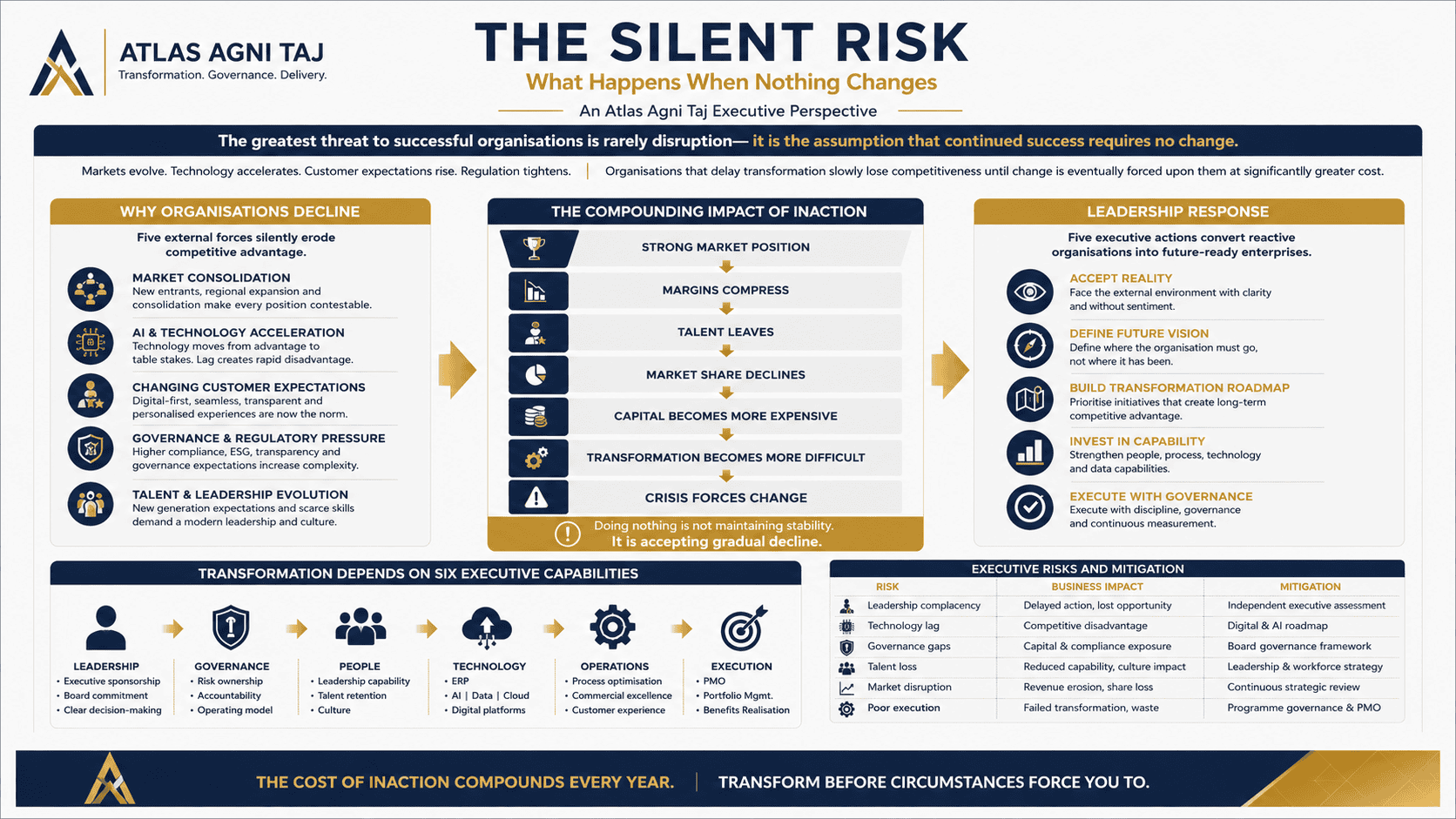
The external environment in which businesses operate is not static. Markets are consolidating. Competition is intensifying. Technology is displacing established models. Customer expectations are evolving. Regulatory frameworks are becoming more exacting. Labour markets are shifting. Generational expectations inside the organisation are changing. The very stability that produced yesterday’s success is, increasingly, the source of tomorrow’s decline.
The Risk Landscape: What Is Actually Changing
To understand the silent risk of inaction, leadership must examine, unsentimentally, the forces reshaping the operating environment.
Market Consolidation and New Competition
For decades, many established businesses operated within a stable, predictable competitive order. The leading players remained the leading players. New entrants arrived rarely, and with difficulty. Margins were durable.
That order is dissolving. Global multinationals are now comfortable operating directly in regional markets, entering through acquisition, partnership, or direct investment. Technology-enabled competitors are disintermediating traditional distribution and retail models. Regional players from adjacent markets are expanding across borders with modern operating models and leaner cost structures. Within the region itself, consolidation is producing larger, more sophisticated competitors with specialised functions and greater operational discipline.
The consequence is straightforward and uncomfortable: a secure market position, however long-held, is becoming a contestable one. An organisation that assumes it will retain its position through existing approaches alone is operating from a flawed premise.
It is worth noting that consolidation does not only threaten smaller organisations. Mid-market and even large regional incumbents have discovered that scale built decades ago does not automatically translate into scale advantage today, particularly where a newer entrant carries lower overhead, a leaner technology stack, and no legacy structure to defend. Incumbency, in this environment, is a starting position rather than a guarantee.
Changing Customer Expectations
Customer expectations are evolving in ways that many established organisations have not fully absorbed. A newer generation of customers, frequently younger, internationally educated, and accustomed to global consumer standards, expects seamless omnichannel experience, responsive multi-channel service, transparency over data use, credible sustainability practice, and personalisation grounded in purchase history.
Organisations that built their reputation on personal relationship and in-person service often lag in digital capability. A retail business that was world-class in the physical store may be structurally unprepared for e-commerce competition. Business-to-business relationships are subject to the same pressure: corporate customers increasingly expect platform integration, real-time supply chain visibility, and data-led reporting rather than relationship-based ordering.
Loyalty today attaches to organisations that meet evolving expectations, not to the manner in which business has traditionally been conducted. An organisation that disregards this shift will cede share to more responsive rivals.
Technological Disruption
The pace of technological change continues to accelerate. Capabilities that were speculative a decade ago are now affordable and, in many sectors, table stakes: artificial intelligence and machine learning automating tasks once thought to require human judgement; cloud computing placing enterprise-grade software within reach of mid-sized organisations; advanced analytics enabling visibility and optimisation previously unattainable; mobile technology enabling direct customer engagement that bypasses traditional channels.
An organisation without modern data and enterprise resource planning visibility into its own cost base will lose the margin contest to a competitor operating with real-time production and commercial analytics. Technology, in this environment, is not a discretionary enhancement. It is a condition of continued competitiveness.
The risk is compounded by the fact that technology adoption is rarely a single project. It is a capability that must be continuously renewed. An organisation that completed a technology implementation a decade ago and has not meaningfully revisited its architecture since is, in practical terms, further behind today than it was when the original system went live, because the pace of change around it has accelerated while its own foundation has remained static.
Regulatory and Compliance Evolution
Regulatory expectations across the GCC are tightening, moving deliberately toward formalisation, transparency, and international standards of governance.
- Corporate governance codes increasingly require independent board representation, disclosed executive remuneration, and formalised risk management.
- Environmental, social, and governance expectations are now a precondition for institutional capital and international partnership, not a reputational nicety.
- Tax authorities are tightening rules on transfer pricing and intercompany arrangements that were acceptable practice only a few years ago.
- Data protection regulation, informed by international standards, is placing new obligations on the handling of customer and employee data.
- Labour regulation concerning working hours, wage standards, and workplace safety is being enforced with increasing rigour.
An organisation that assumes regulatory requirements will remain static is making a costly miscalculation. Compliance is a moving target, and the cost of falling behind it continues to rise.
The Talent Market
The labour market is undergoing a structural shift with particular consequences for traditionally managed organisations. Younger professionals expect clear advancement paths, meritocratic progression, market-based compensation, transparent performance feedback, and a defined sense of organisational purpose.
Organisations that have historically retained staff through personal relationship, informal progression, and proximity to ownership are discovering that this model no longer holds. The strongest talent is choosing professional organisations with credible career architecture over informally managed alternatives. Institutional knowledge, once retained through loyalty, is now walking out of the door, and the cost of replacing it, in recruitment, training, and compensation, is materially higher than in previous decades.
There is a second-order effect that leadership frequently underestimates. As stronger performers depart, the organisation’s centre of gravity shifts toward those who are comfortable with informal, relationship-based management, precisely the profile least equipped to lead a professionalisation effort. The talent gap therefore tends to widen at the moment it becomes most critical to close, unless leadership intervenes deliberately and early.
Demographic and Generational Shifts
The founding generation of many established businesses is ageing, and leadership transition is, for a great many organisations, no longer a future consideration but a present one. The incoming generation, frequently educated internationally and exposed to multinational or start-up environments, expects professional management, formal governance, and strategic clarity, rather than a structure built entirely around a single individual’s discretion.
Broader demographic and policy shifts, including a firmer national employment agenda across the region, are simultaneously reshaping workforce composition. Organisations built around a particular staffing model may find regulatory and policy expectations moving faster than their own structures can accommodate.
The Evolving Cost of Capital
The sources and terms of growth capital are also changing. Bank lenders, once comfortable extending credit against founder guarantees and historical cash flow, are increasingly requiring formal governance, professional management, and transparent reporting as conditions of lending. Private equity, impact investors, and institutional lenders are entering the market, but on the condition of demonstrable professionalisation.
An organisation that remains dependent on a single individual’s judgement will find capital more expensive and less available. One that professionalises will secure a materially lower cost of capital and a wider set of financing options.
This shift matters most at precisely the moment capital is needed for transformation itself. Organisations frequently discover, when they finally seek financing for the technology, talent, or expansion investment that transformation requires, that the very governance gaps they had tolerated for years are now the principal obstacle to securing the capital needed to close them.
The Erosion Cycle: How Success Becomes Vulnerability
Understanding these forces individually is useful. Understanding how they compound into a single erosion cycle is essential.
Stage One: Early Vulnerability
An organisation that disregards shifting market conditions, customer expectations, or technological change begins to lose competitive position gradually. Market share erodes. Margins compress. Leadership responds, reasonably, by tightening operations and reducing cost. These responses, however sensible, do not address the structural nature of the change under way.
Stage Two: Financial Stress
As share and margin continue to erode, financial performance deteriorates. Leadership typically responds by increasing personal involvement, drawing previously delegated decisions back to the centre. This provides temporary relief but does not resolve the underlying competitive problem, and it frequently accelerates the departure of capable people who are frustrated by a return to informal, centralised decision-making.
Financial stress at this stage is rarely visible in the headline numbers alone. It shows first in working capital discipline, in the terms lenders begin to attach to renewed facilities, and in the growing gap between board-level optimism and the more cautious assessment of those closer to day-to-day operations. Leadership that reads only the headline figures often misses the earlier, more actionable warning signs.
Stage Three: Succession Crisis
By the time leadership is prepared to step back, whether through age or choice, the organisation is often in a precarious position: under competitive pressure, under financial stress, and depleted of talent, with none of the infrastructure required to address these challenges. The successor inherits a narrow set of unattractive options: cost-cutting that perpetuates the problem, a high-risk rapid transformation, or managing the business for cash while accepting decline.
Stage Four: Decline or Crisis-Forced Transformation
Left unaddressed, the trajectory eventually produces a forcing event, a covenant breach, the loss of a major customer, a failed technology implementation, or an abrupt leadership departure. By this point, the available options are markedly more limited and considerably more expensive than they would have been had proactive transformation begun years earlier.
The Opportunity Cost of Inaction
The most underappreciated dimension of inaction is the value that could have been created, and was not. Leadership tends to measure risk in terms of what could be lost through action, an implementation that disrupts operations, an investment that does not pay back on schedule, a governance change that unsettles long-serving staff. Rarely is the same rigour applied to what is being forfeited through inaction, yet that forfeited value is frequently the larger number.
Consider an established regional business generating $500 million in annual revenue at a healthy 15% EBITDA margin, structurally unchanged for two decades. Had that organisation undertaken proactive transformation fifteen years earlier, the outcome could plausibly have looked very different.
- Digital transformation would have captured the omnichannel and e-commerce growth that competitors instead secured.
- Supply chain modernisation could reasonably have reduced procurement costs by 15 to 20 percent, equivalent to $45 to $60 million in additional annual cash flow.
- Investment in talent and organisational development would have retained stronger people and enabled expansion into adjacent categories.
- Professional governance and management would have supported expansion into additional GCC markets, potentially tripling revenue over the period.
On a plausible trajectory, that organisation could today be a $1.2 to $1.5 billion enterprise, with EBITDA margins above 18%, operating across multiple markets under professional governance. Instead, it remains a $500 million operation, contending with margin compression, share loss, and an unresolved succession question.
This is not a theoretical exercise. It is the lived reality confronting a substantial number of established GCC organisations today.
The Strategic Imperative
The uncomfortable conclusion that every senior leader must confront is this: stability is not, in itself, a viable long-term strategy. Markets, technology, customer expectation, and competitive intensity are all moving faster than at any previous point. An organisation that assumes it can remain unchanged and retain its position is operating from a false premise.
Transformation is not optional.
For any organisation seeking durable, multi-generational relevance, transformation is a present imperative rather than a future consideration. An organisation that does not transform will progressively lose competitive position, margin, market share, and its attractiveness to the next generation of leadership.
The window for proactive transformation is closing.
The optimal moment to transform is while the business is healthy: when leadership has the time and capital to invest properly, and when the workforce remains optimistic and open to change. As market pressure builds and performance deteriorates, that window narrows. Transformation undertaken later is invariably more expensive, more disruptive, and considerably riskier.
Waiting for a crisis is a losing strategy.
Some leaders delay transformation on the assumption that circumstances will resolve themselves through incremental adjustment. By the time a crisis forces the issue, the organisation is frequently in such a diminished position that transformation is either impossible or delivers a materially smaller outcome than it would have years earlier.
The Path Forward
For leadership that recognises the imperative, the transformation process begins with five deliberate steps.
Step One: Acknowledge Reality
The process begins with an honest, unsentimental assessment of competitive position, market trajectory, and the specific threats facing the organisation. This is genuinely difficult, given the years of investment and personal identification many leaders have with the current model. An external, objective perspective, from a board advisor, independent consultant, or trusted peer, is invaluable in enabling that acknowledgement without it registering as personal criticism.
Step Two: Define Strategic Vision
Rather than reacting to threats individually, effective leadership defines, with clarity, where the organisation needs to be in five to ten years, and what capabilities it must build to get there. That vision must be ambitious enough to justify the disruption of change, and credible enough to command organisational belief.
Step Three: Develop a Transformation Roadmap
A multi-year roadmap should set out the specific initiatives required to move from the current state to the future vision, addressing market positioning, operational capability, governance, management structure, and talent.
Step Four: Commit Resources and Leadership
Transformation carries a real cost, in systems, external expertise, training, and management attention. Leadership must commit resources visibly, in a manner that signals to the organisation that transformation is a genuine priority rather than a stated one.
Step Five: Manage for Results
Progress must be measured against explicit metrics and timelines, with clear accountability and sustained momentum through the inevitable obstacles that arise during any significant change programme.
How Atlas Agni Taj Can Help
Atlas Agni Taj works with owners and senior leadership of established GCC organisations to convert this analysis into an executable transformation programme, rather than leaving it as a well-argued diagnosis.
- Independent strategic diagnostics that assess competitive exposure, operational maturity, and governance readiness, providing leadership with the external, objective view that Step One requires.
- Governance and operating model design, including board structure, delegation of authority, and professional management frameworks that satisfy both lenders and the next generation of leadership.
- Technology and ERP-led transformation roadmaps, spanning cloud migration, data and analytics capability, and AI readiness, sequenced against realistic budgets and capacity.
- Programme and portfolio delivery leadership, providing the senior programme direction and governance discipline required to convert a roadmap into delivered outcomes, on time and within budget.
- Succession and next-generation advisory, structuring the transition of leadership and capital in a way that preserves the founder’s legacy while equipping successors with a professionally governed organisation.
The role of Atlas Agni Taj is not to tell leadership what it already suspects. It is to provide the external clarity, structure, and delivery capability required to act on that judgement while the window for proactive transformation remains open. Engagements are structured to be pragmatic and outcome-focused, calibrated to the organisation’s actual capacity for change, rather than imposing a generic transformation template that ignores the realities of a founder-led or family-governed enterprise.
Conclusion: The Cost of Doing Nothing
The silent risk facing established businesses is rarely a dramatic failure. It is a slow decline: the gradual erosion of competitive position, margin, and market share that occurs when an organisation assumes that past success guarantees future success.
The decline is silent precisely because it does not announce itself. Organisations can operate for years in gentle decline without a visible crisis. Income continues. The business remains profitable. The erosion is invisible to those not looking closely for it.
Yet across a ten to twenty-year period, the cumulative effect is substantial. A market leader becomes a challenger. A growing enterprise becomes a stagnant one. An employer of choice becomes a difficult place to build a career. An organisation with genuine expansion opportunities finds that competitors reached them first.
For every senior leader, the question is no longer whether change is necessary. External forces have already answered that question. The remaining question is whether that change will be led proactively, while resources, time, and options remain available, or forced later, at higher cost and greater risk.
The choice remains with leadership. The cost of inaction, however, compounds with every year it is deferred.
Atlas Agni Taj — Proprietary
London • Dubai • Singapore | atlasagnitaj.com
#FamilyBusiness #Transformation #Governance #GCC #BusinessStrategy #Leadership