AI Literacy: The New Mandatory Business Skill
Why every organisation must now treat artificial intelligence fluency with the same discipline once reserved for email, spreadsheets and collaboration platforms.
There was a time, not so long ago, when the ability to send a professional email, structure a spreadsheet or navigate a shared collaboration platform was considered a specialist competency. Organisations invested materially in training programmes to build these skills across every level of the workforce. Today, we would not dream of hiring an executive, a manager or a graduate who could not perform these tasks with fluency. They are simply the baseline expectations of modern professional life.
Artificial intelligence now stands at precisely this inflection point. The technology is no longer an experimental capability confined to research laboratories or specialist digital teams. It is embedded in the tools our employees use every day, in the decisions our customers expect us to make faster and more accurately, and in the competitive positioning of every serious enterprise. And yet the majority of organisations have not yet formalised AI literacy as a mandatory workforce competency. That must change, and it must change now.
The organisations that will define the next decade are not necessarily those with the largest technology budgets or the most sophisticated model deployments. They are the ones building genuine AI confidence across their entire workforce, systematically, deliberately, and with the same rigour once applied to digital transformation programmes of previous generations. AI literacy is no longer an information technology initiative. It is a core business skill, and it belongs at the very centre of the organisational learning agenda.
The Historical Parallel and Why It Matters
To understand the scale of the opportunity in front of us, it is instructive to recall how earlier waves of workplace technology were absorbed into everyday practice. When electronic mail first arrived in the corporate environment, it was treated with suspicion, delegated to technical teams, and used sparingly. It took a deliberate programme of user education, executive sponsorship and cultural reinforcement to move email from a novelty to an indispensable tool of professional communication.
The same trajectory played out with spreadsheets, which transformed from an accountant’s curiosity into the analytical backbone of virtually every commercial function. Collaboration platforms, video conferencing and cloud-based document management followed the same arc. In each case, the organisations that moved decisively to build workforce fluency captured disproportionate value. Those that hesitated found themselves managing legacy behaviours long after their competitors had moved on.
Artificial intelligence differs from these earlier waves in one critical respect. The technology is advancing faster than any prior enterprise capability, and the gap between organisations that build fluency early and those that defer will be considerably more damaging than any previous digital divide. AI is not a tool that employees will learn to use over the course of a career. It is a rapidly evolving capability that must be understood, adopted and continuously refreshed as part of the ordinary rhythm of professional development.
Why This Moment Is Different
There are three features of the current moment that make the case for mandatory AI literacy particularly urgent. The first is the pervasiveness of the technology. Generative AI has arrived not through a single vendor or channel but through the entire ecosystem of enterprise software. Every major productivity suite, every leading customer relationship management platform, every collaboration tool and virtually every specialist application is being embedded with AI capability. Employees will encounter AI whether or not their organisations have prepared them for it.
The second is the asymmetric nature of the risks and rewards. An employee who understands how to use AI thoughtfully can generate remarkable productivity gains, sometimes measured in multiples rather than percentages. An employee who uses AI without understanding its limitations can just as easily introduce material risks, from inadvertent disclosure of confidential information to the propagation of inaccurate outputs into consequential business decisions. The distribution of outcomes is highly uneven, and it is almost entirely determined by the quality of user understanding.
The third feature is the regulatory and governance environment now taking shape. Jurisdictions across Europe, the Middle East, Asia and North America are moving rapidly to codify obligations around AI use in the workplace. Boards and audit committees are asking searching questions about AI governance, model provenance, data handling and human oversight. An organisation that cannot demonstrate a baseline of AI literacy across its workforce will struggle to satisfy regulators, insurers, investors and, increasingly, its own customers.
The Five Pillars of Organisational AI Literacy
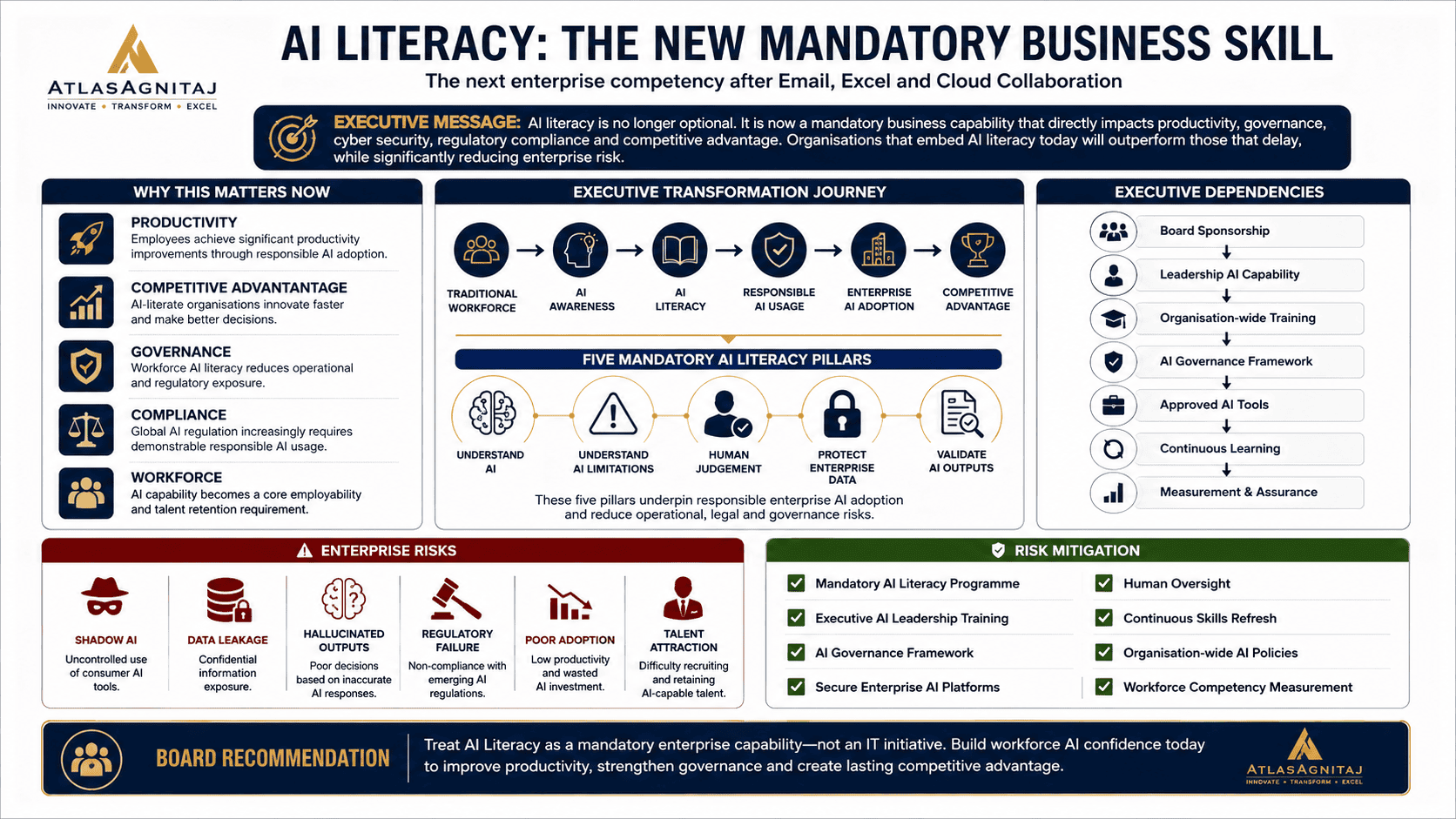
A credible AI literacy programme rests on five foundational pillars. Each is necessary. None is sufficient on its own.
Understanding What AI Can Do
Every employee, regardless of function or seniority, should possess a working understanding of the tasks at which contemporary AI systems genuinely excel. These include summarisation of long documents, extraction of structured information from unstructured content, drafting of first-pass written material, pattern recognition across large datasets, language translation, ideation and the generation of code or analytical logic. When employees understand where AI adds real value, they can redirect their effort towards higher-order activities and use the technology as a genuine force multiplier.
Understanding What AI Cannot Do
Equally important is a candid appreciation of the current limitations. AI systems do not reason in the way humans reason. They do not possess judgement, ethics, contextual understanding of an organisation’s history, or accountability for outcomes. They can be confidently wrong, particularly on matters requiring specialist expertise, current information or subtle interpretation. Employees who understand these boundaries are far less likely to over-rely on AI outputs or to defer inappropriately to a machine on decisions that require human deliberation.
Recognising Where Human Judgement Remains Essential
There are categories of decision where human judgement is not merely useful but indispensable. These include decisions involving significant financial exposure, decisions affecting employees, decisions with regulatory or legal consequence, decisions involving customer relationships of material value, and decisions that will shape the culture or strategic direction of the organisation. AI can inform these decisions, accelerate the analysis that precedes them, and stress-test the reasoning that supports them. It should not, and cannot, replace the human accountable for making them.
Protecting Confidential Information
The single most common governance failure in early AI adoption is the inadvertent disclosure of sensitive information into public or inadequately secured AI systems. Employees paste client data, commercial contracts, personal information or intellectual property into consumer-grade tools without appreciating that the information may be logged, retained or used to train future model versions. A basic literacy programme must equip every employee to distinguish between sanctioned enterprise AI environments and unsanctioned public tools, to classify the information they intend to share, and to apply appropriate handling standards. This is not a nice-to-have. It is a fiduciary obligation.
Identifying Inaccurate AI Responses
AI systems will produce inaccurate outputs. They will fabricate references, misattribute quotations, invent data points, and reach conclusions unsupported by the underlying material. The skill of critical evaluation, of asking whether an AI response is grounded, verifiable and coherent, must become as instinctive as the professional habit of proofreading a document before it leaves one’s desk. Employees who can identify and challenge a hallucinated output are the organisation’s first and most effective line of defence against the propagation of misinformation into business processes.
The Cost of Inaction
Executive teams occasionally view mandatory AI training as a discretionary investment, a nice-to-have that can be deferred in favour of more immediate priorities. This view underestimates the compounding cost of inaction. Consider what happens in an organisation that defers AI literacy for even twelve months. Employees, being resourceful, will adopt AI tools regardless of whether the organisation sanctions them. They will use consumer-grade services with personal accounts. They will paste confidential material into environments the organisation cannot see. They will build local shortcuts that embed AI dependencies into critical processes without documentation or oversight.
By the time the organisation finally addresses AI literacy formally, it will not be starting from a blank slate. It will be attempting to remediate a shadow AI estate that has already taken root, with all the associated risks of data exposure, inconsistent quality, unmanaged dependencies and cultural resistance to formalisation. The cost of catching up is invariably higher than the cost of leading. The organisations that are moving decisively on AI literacy today are not doing so because they have solved every question about the technology. They are doing so because they understand that the alternative is far more expensive.
There is also a talent dimension that deserves particular attention. The most capable professionals, at every level from graduate entry to senior leadership, increasingly evaluate prospective employers on the basis of AI maturity. They want to work in environments where the technology is embraced thoughtfully, where they will be equipped to build fluency, and where their careers will not be diminished by working with outdated tooling. Organisations that fail to invest in AI literacy will find themselves losing the war for talent long before they lose the war for customers.
Building the AI-Literate Organisation: A Practical Framework
Executive leaders often ask what a credible AI literacy programme actually looks like in practice. The elements are not exotic, but they must be delivered with discipline and executive sponsorship.
- A universal baseline module for every employee, covering the five pillars described above, delivered as part of induction and refreshed annually. This is the minimum non-negotiable standard.
- Role-specific extensions for functions with elevated exposure, including legal, human resources, finance, procurement, customer service and any function handling regulated data. These extensions address the particular risks and opportunities of each domain.
- A leadership curriculum for executives and senior managers, focused less on the technical mechanics of AI and more on the strategic, governance and cultural dimensions of leading an AI-enabled organisation.
- A community of practice, formal or informal, in which employees can share prompts, techniques, lessons learned and cautionary tales. Peer-to-peer learning consistently outperforms formal instruction in the adoption phase of any new capability.
- A clear governance framework specifying which AI tools are sanctioned for which purposes, how data is to be classified and handled, how outputs are to be reviewed, and how incidents are to be reported and remediated.
- An ongoing assessment mechanism to measure AI literacy across the workforce, identify gaps, and target further investment where it is most needed. What is not measured is not managed.
The programme should be sponsored at board level, owned by an accountable executive, and supported by measurable indicators tied to real business outcomes. It should not be delegated to the training function alone. AI literacy is a strategic capability, not a compliance exercise, and it deserves to be treated as such.
It is also worth acknowledging the human dimension of this transition. Employees at every level are experiencing a degree of professional uncertainty as artificial intelligence reshapes the tasks, roles and career paths that have defined their working lives. A well-designed AI literacy programme addresses this uncertainty directly, rather than allowing it to fester into disengagement or anxiety. It signals to the workforce that the organisation is investing in them, that their futures matter, and that the arrival of AI is an opportunity to be shared rather than a threat to be endured. That signal, delivered credibly and consistently by the leadership team, is worth as much as any technical curriculum the programme contains.
The Leadership Accountability
Perhaps the most underappreciated dimension of organisational AI literacy is the responsibility of the leadership team itself. Executives who cannot describe, in their own words, what their organisation’s AI strategy is, which tools have been sanctioned, what the principal risks are and how the workforce is being equipped to use the technology responsibly are not in a position to lead their organisations through this transition. The credibility of any AI literacy programme rests on the visible fluency of those at the top of the organisation.
This does not require every executive to become a technical expert. It requires them to invest personally in their own AI understanding, to use the tools themselves in their day-to-day work, and to speak about AI with the confidence and specificity that comes from genuine engagement rather than briefing notes. When employees observe that their leaders are learning alongside them, experimenting openly, and treating AI as a shared enterprise rather than a directive from above, the cultural conditions for successful adoption are established.
The organisations getting this right are treating AI literacy in the leadership team not as a delegation to the Chief Information Officer or the Chief Technology Officer, but as a shared accountability of the entire executive team. The Chief Executive, the Chief Financial Officer, the Chief Human Resources Officer, the Chief Legal Officer and the Chief Marketing Officer all have direct stakes in how AI is used in their respective domains, and all should be publicly literate in the technology.
How Atlas Agni Taj Can Help
Building organisational AI literacy at pace and at scale is not a task that most enterprises can, or should, undertake in isolation. It sits at the intersection of strategy, governance, operating model design, learning and development, and change management, and it requires an integrated view that few internal functions are structured to provide on their own. This is precisely the terrain on which Atlas Agni Taj was established to advise.
Atlas Agni Taj is a boutique transformation advisory firm operating across London, Dubai and Singapore, working with boards and executive committees to translate ambitious digital and AI agendas into disciplined delivery. Our practitioners bring several decades of senior enterprise experience in large-scale technology, ERP and cloud programmes, sovereign and regulated infrastructure delivery, and the governance frameworks that make transformation stick. We do not sell technology, and we are not aligned to any particular vendor. Our value to clients is independent advice, sharpened by first-hand accountability for outcomes at the top of major organisations.
For organisations committed to building genuine AI fluency across the workforce, we offer a coordinated set of services designed to move the enterprise from ambition to embedded capability.
- AI Readiness Diagnostic — a structured executive assessment of your current AI maturity, covering strategy, governance, tooling, data foundations, workforce literacy and cultural readiness, with a clear prioritised roadmap for the next twelve to twenty-four months.
- AI Literacy Programme Design — a bespoke curriculum architecture built around the five pillars of AI literacy, tailored to your industry, regulatory context and workforce composition, and integrated with your existing learning and development infrastructure rather than bolted on to it.
- Executive and Board Enablement — private, high-fidelity sessions for boards, executive committees and senior leadership teams, designed to build the strategic fluency required to lead an AI-enabled organisation with credibility and confidence.
- AI Governance and Policy Framework — the tangible artefacts your organisation requires to govern AI use responsibly, including acceptable-use standards, data classification and handling protocols, human-oversight requirements, incident response processes, and board-level reporting mechanisms.
- AI Factory Advisory — for organisations moving beyond literacy into industrialised AI delivery, a proven operating model for standing up an internal AI capability, from platform selection and use-case pipelining through to measurement, scaling and value realisation.
- Programme Assurance and Independent Review — an experienced external perspective on in-flight AI and transformation programmes, providing boards and sponsors with objective assurance on delivery health, risk posture and value trajectory.
Our engagement style is deliberately senior and deliberately concentrated. We work directly with the individuals accountable for outcomes, we favour short and focused engagements over prolonged consultancy arrangements, and we transfer capability into the client organisation rather than creating ongoing dependency. Clients typically engage us at the point of strategic decision, at the point of programme initiation, or when an existing programme requires an independent perspective to reset its trajectory.
For executive teams contemplating how to move their AI literacy agenda from aspiration to reality, we welcome an initial conversation. It costs nothing, commits to nothing, and often clarifies the sequence of decisions that will define the next chapter of your enterprise. You will find us at atlasagnitaj.com, or through the author of this article.
A Question for Every Board and Executive Team
So we return to the question with which we began. Should AI awareness training become mandatory across every organisation? The answer, on any honest reading of the evidence, is yes. And it should be mandatory not as a defensive measure to satisfy regulators, though it will do that, and not merely as a productivity intervention, though the returns are compelling, but as a fundamental investment in the future capability of the enterprise.
The organisations that will thrive over the next decade will be those in which every employee, from the most junior to the most senior, possesses a working fluency in artificial intelligence. They will be organisations in which AI is discussed with the same everyday familiarity as email once was. They will be organisations in which the risks are understood, the opportunities are pursued, and the confidence to experiment responsibly is distributed broadly rather than concentrated in a handful of specialists.
Building that kind of organisation is not the work of a single training programme or a single financial year. It is a sustained leadership commitment, executed with discipline, measured with rigour, and refreshed continuously as the technology evolves. But it starts with a clear and unambiguous decision at the top of the enterprise: that AI literacy is a mandatory business skill, that it will be treated as such, and that no employee, at any level, will be left behind as the organisation moves forward.
The organisations that make that decision today will be the ones defining the standards of their industries tomorrow. The organisations that defer it will be spending the next decade catching up with those that did not.
For boards and executive committees weighing where to focus their attention in the year ahead, this deserves a place at the top of the agenda. It is not the most technically complex initiative on the strategic roadmap, and it does not require heroic investment. What it requires is clarity of intent, executive sponsorship, and the discipline to see the programme through to genuine adoption rather than symbolic launch. The prize is a workforce that is more confident, more productive, more resilient and better equipped to serve the customers and stakeholders on whom the enterprise ultimately depends. In an era of extraordinary technological change, that is a foundation worth building, and worth building now.
#AILiteracy #Leadership #DigitalTransformation #AIReadiness #ExecutiveLeadership #WorkforceDevelopment #AIGovernance #BusinessInnovation #FutureOfWork #AtlasAgniTaj