Why the return on artificial intelligence depends less on the technology you procure and more on the workforce you develop.
Across the boardrooms of the Gulf, Europe and beyond, artificial intelligence has firmly established itself as a strategic priority. Enterprise licences have been signed. Copilots have been rolled out. Foundation models have been embedded into productivity suites, customer service platforms, engineering workbenches and analytics stacks. On the surface, the enterprise appears to have moved decisively from experimentation into deployment.
And yet, a growing body of evidence from Chief Executives, Chief Information Officers and Chief People Officers points to an uncomfortable truth. Purchasing AI is now the easy part. The far greater challenge, and the one that determines whether the investment ultimately delivers value, is the development of the human capability required to use it well.
The distinction is not academic. It is the difference between a technology programme that becomes a source of measurable productivity, competitive differentiation and cultural renewal, and one that quietly joins the long history of enterprise software investments that were procured with conviction, deployed with fanfare, and adopted with indifference.
The Capability Gap Behind the Adoption Curve
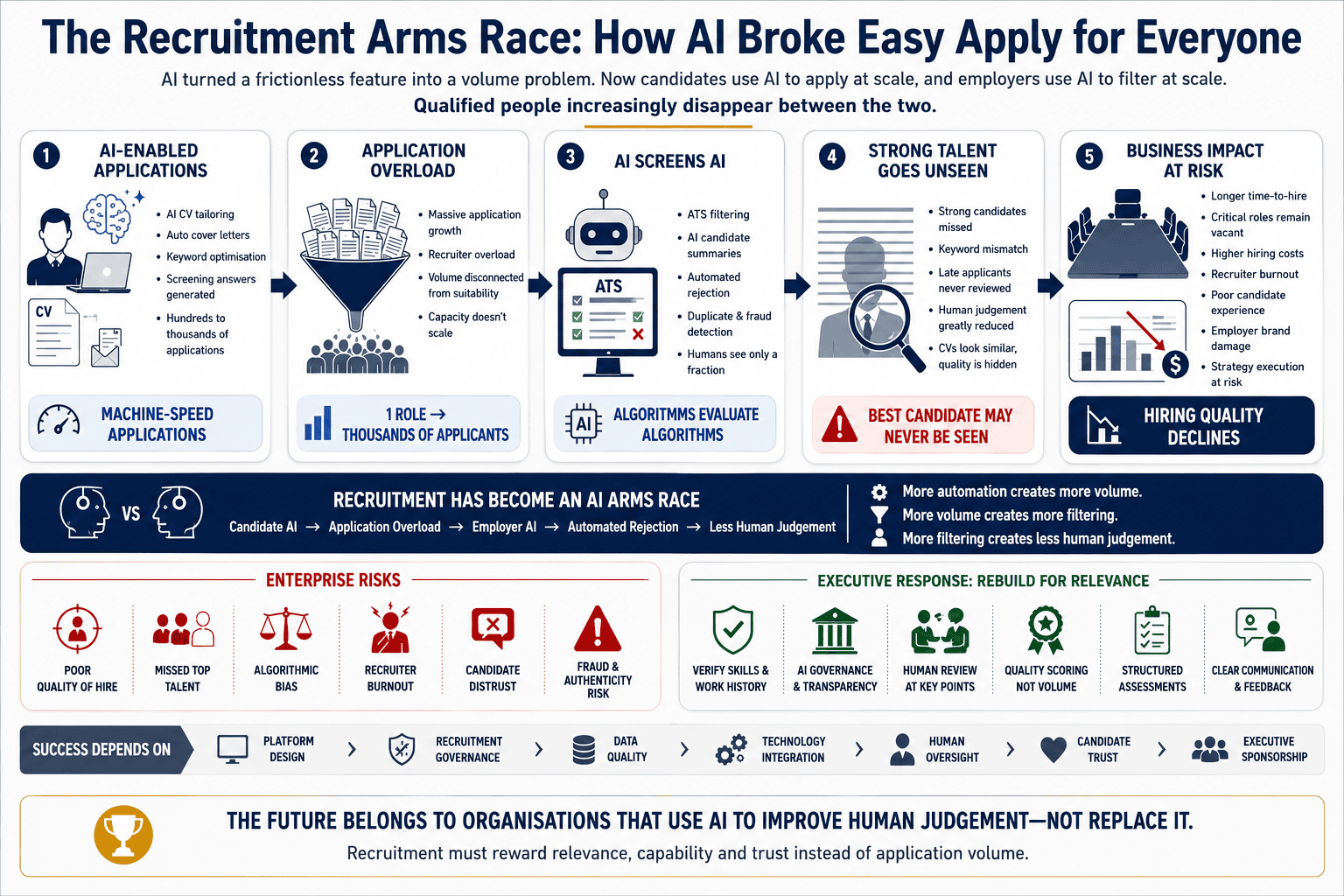
The prevailing narrative around AI adoption tends to celebrate rapid enterprise deployment. Licence counts, platform integrations and pilot volumes are reported as evidence of progress. These metrics matter, but they are input measures. They tell us what an organisation has bought. They tell us very little about what it has become capable of doing.
Independent research from major consultancies and academic institutions consistently identifies the same pattern. A substantial proportion of employees who have been given access to generative AI tools use them infrequently, superficially, or not at all. Where usage does exist, it is often confined to a small cohort of enthusiasts. The wider workforce remains hesitant, uncertain of the boundaries, unsure of the risks, and unclear about how the technology relates to the work they are paid to perform.
This is not a failure of the technology. It is a failure of enablement. It is the return, in a new form, of a phenomenon that senior leaders will recognise from earlier technology cycles. Enterprise resource planning systems, customer relationship management platforms, collaboration suites and cloud infrastructure have each, in their time, produced their own version of the same story. The tools were deployed. The workflows were not redesigned. The people were not equipped. The value did not fully materialise.
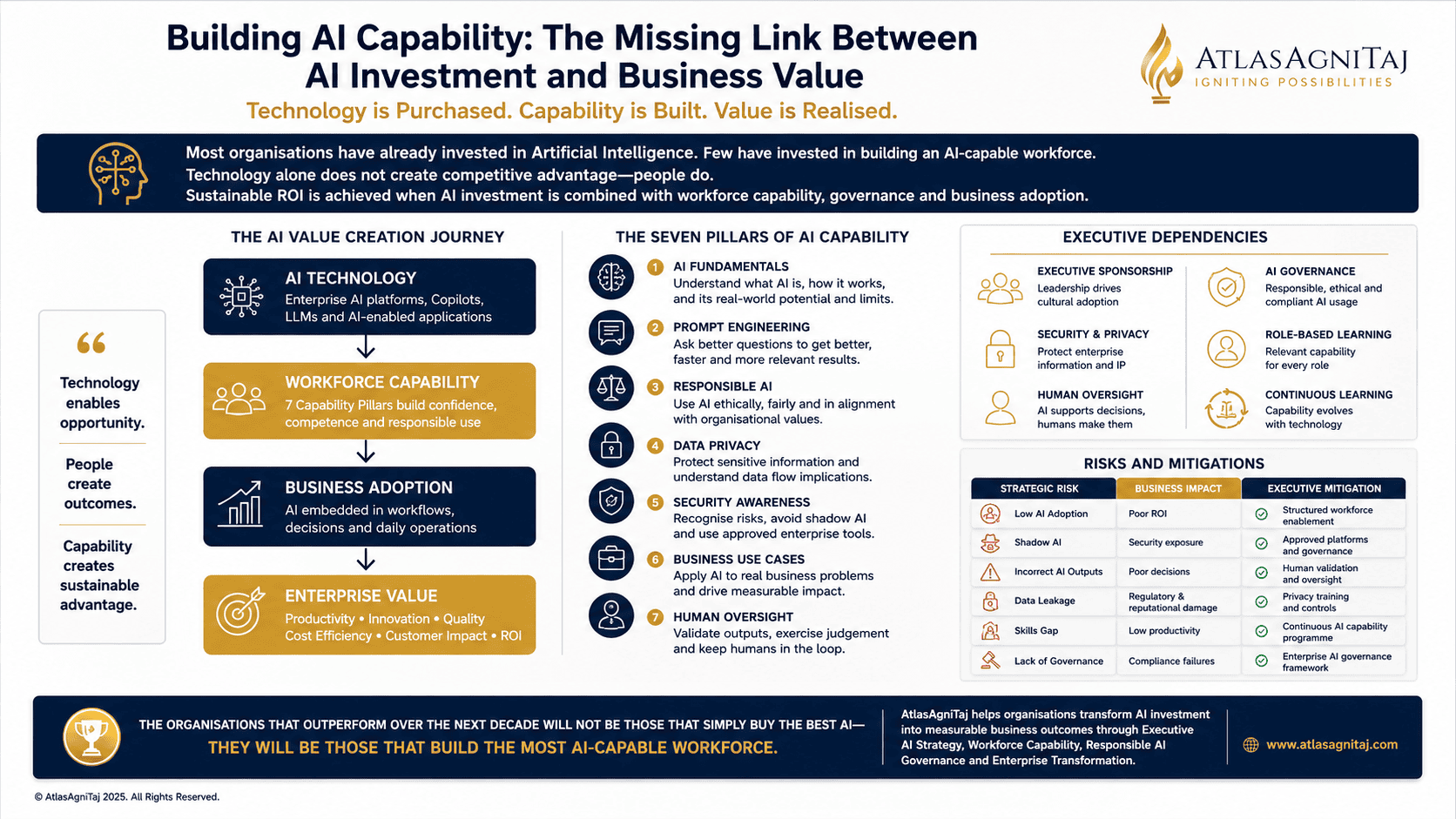
Technology alone does not create business value. People do.
Why Technology Alone Cannot Deliver the Return
It is tempting, particularly in the current moment, to assume that AI is different. The interfaces are conversational. The learning curve appears gentle. Anyone who can write an email can, in principle, write a prompt. On that basis, some executive teams have concluded that formal enablement is unnecessary. The workforce, it is assumed, will discover the value on its own.
The evidence does not support that assumption. Writing a prompt is not the same as writing a good prompt. Receiving an output is not the same as knowing whether to trust it. Recognising an opportunity for automation is not the same as understanding where automation is appropriate, where it introduces risk, and where human judgement must remain sovereign. These distinctions are learned. They are not intuitive.
Moreover, the risks associated with unstructured adoption are real and material. Confidential information has been pasted into public models by well-meaning employees who did not appreciate the data flow implications. Fabricated citations have appeared in client-facing reports because no one taught the author to verify. Regulated advice has been given by unregulated interfaces. Shadow AI, the use of unsanctioned tools on unsanctioned devices, has emerged as one of the fastest-growing categories of information security concern.
The organisations that have avoided these outcomes have not done so by accident. They have invested, deliberately and systematically, in building the capability of their people to use AI safely, effectively and in a manner aligned with the values and obligations of the enterprise.
The Seven Pillars of an AI-Ready Workforce
Effective AI enablement is not a single training course. It is a curriculum, layered and role-appropriate, that equips every employee with a working understanding of seven interconnected disciplines. Each pillar reinforces the others. Weakness in any one of them undermines the whole.
1. AI Fundamentals
Every employee, from the graduate analyst to the executive director, benefits from a working understanding of what artificial intelligence is, how modern models are constructed, what they can and cannot do, and where their limitations lie. This is not a technical deep dive. It is the vocabulary and the mental model that enables informed conversation, sensible expectation-setting and defensible decision-making. Without this foundation, the workforce is left to construct its own mythology about the technology, which is invariably a mixture of overestimation, underestimation and misunderstanding.
2. Prompt Writing and Interaction Design
The quality of an AI output is, in large measure, a function of the quality of the input. Effective prompt writing is a skill. It combines clarity of intent, structured thinking, contextual framing and iterative refinement. Employees who master it produce work in a fraction of the time and to a higher standard than those who do not. Employees who do not master it often conclude that the technology itself is deficient, when in reality they have not yet learned how to instruct it.
3. Responsible AI
AI systems can reproduce and amplify bias. They can generate outputs that are plausible but false. They can be applied to decisions where their use is inappropriate or unlawful. Every employee who interacts with these systems has a role to play in identifying and mitigating these risks. Responsible AI is not the exclusive concern of the ethics committee. It is a daily practice embedded in the choices individual employees make about what to ask, what to accept and what to escalate.
4. Data Privacy
Personal data, commercially sensitive information, client confidential material and regulated content each carry specific legal and contractual obligations. Employees must understand which categories of data may be shared with which systems, under which contractual arrangements, and in which jurisdictions. This understanding is not optional. In the United Arab Emirates, the United Kingdom, the European Union and every major regulated economy, the consequences of getting it wrong are significant. Fines are the least of them. Reputational damage endures far longer.
5. Security Awareness
AI has expanded the surface area of information security in ways that traditional training programmes have not yet caught up with. Prompt injection, model manipulation, credential exposure through conversational interfaces, and the exfiltration of intellectual property through inadvertent disclosure are all live risks. Every employee is a node in the enterprise security architecture. Every employee must understand the specific ways in which AI systems change that architecture.
6. Business Use Cases
Generic training produces generic outcomes. To be genuinely useful, enablement must be grounded in the actual work of the actual business. A treasury analyst does not need the same use case portfolio as a marketing manager. A design engineer does not learn from examples drawn from human resources. Effective programmes translate the underlying capabilities of AI into the specific vocabulary, workflows and deliverables of each function, so that every learner can see, immediately and concretely, how the technology applies to what they are paid to do.
7. Human Oversight
For the foreseeable future, the appropriate relationship between AI and enterprise work is one of augmented judgement, not replaced judgement. Employees must understand where the human must remain in the loop, where accountability sits, where sign-off is required, and where a machine output should be treated as a draft rather than a decision. Human oversight is the mechanism by which AI becomes an accelerator of good work rather than an automator of poor work.
The Cost of Under-Investment
The cost of failing to invest in AI capability is rarely captured in a single line on a management report. It accumulates, quietly and diffusely, across a number of dimensions. Productivity gains that were expected in the business case do not appear. Employees revert to familiar tools and familiar workflows. The licences are paid for, but the value is not extracted.
At the same time, the risks accumulate. Regulators in the Gulf, in Europe and in the United States have all signalled clearly that the responsibility for AI outcomes rests with the deploying organisation, not with the model provider. An enterprise that has not equipped its people to use AI responsibly is an enterprise that has accepted, whether it realises it or not, a material and rising exposure.
The reputational dimension is equally significant. In markets where trust is the ultimate currency, whether in financial services, professional services, healthcare or the public sector, a single incident of AI misuse can undo years of brand building. The most senior leaders understand this. They also understand that the mitigation is not a policy document. It is a capable workforce.
There is, finally, a talent dimension that boards are only beginning to appreciate. The most capable professionals, particularly younger cohorts, are increasingly choosing employers on the basis of the technology environment they will work within and the development they will receive. An organisation that provides AI tools without AI capability development sends a clear signal about the seriousness of its investment in its people. The best talent is listening carefully to that signal.
These costs rarely present themselves at a single moment of reckoning. They emerge instead across quarterly reviews, in the widening gap between the business case that was approved and the value that is being realised, in the audit findings that accumulate without being closed, and in the departure of the individuals whose contribution was hardest to replace. By the time the pattern is visible in the aggregate, the ground that has been lost is difficult to recover. The organisations that recognise this early, and act on it deliberately, secure a compounding advantage that those who delay will struggle to overtake.
What Effective AI Enablement Looks Like
The organisations that are extracting the greatest value from AI share a number of characteristics in how they approach enablement. Their programmes are role-based rather than uniform, recognising that the AI needs of a legal counsel differ materially from those of a supply chain planner. Their content is refreshed continuously, because the technology itself is moving quickly and a curriculum written twelve months ago is already partially obsolete.
They begin at the top. Executive teams are trained first, both to model the behaviour they wish to see and to develop the fluency required to sponsor the programme credibly. They embed measurement, tracking not merely completion of training but demonstrable change in behaviour, output quality and business outcome. They create safe environments for experimentation, in which employees can practise with real tools on real problems without fear of embarrassment or reprisal.
They pair formal learning with communities of practice, so that the learning does not stop when the module ends. And they treat AI enablement not as a project with a defined end date but as an enduring capability of the enterprise, resourced and governed accordingly.
It is also worth noting what these programmes are not. They are not e-learning modules despatched to the workforce by electronic mail with a completion deadline. They are not one-off town halls delivered by an external speaker who departs the same afternoon. They are not policy documents distributed for acknowledgement. Each of these interventions has its place, but none of them, individually or in combination, constitutes capability development. Capability is built through structured learning, deliberate practice, applied problem-solving and continuous reinforcement. There is no compressed substitute for that process, and executive teams that attempt to find one typically discover that the shortcut is more expensive than the route it was intended to bypass.
The return on AI investment depends as much on capability development as it does on technology investment.
How Atlas Agni Taj Supports the Journey
Atlas Agni Taj is a boutique transformation advisory firm with a specific focus on helping enterprises translate ambitious technology investments into measurable business outcomes. Our practice is built on decades of senior operating experience in the sectors where the stakes are highest, including financial services, aviation, healthcare, government and diversified conglomerates across the Gulf, the United Kingdom and Asia.
Our AI enablement offering has been designed specifically to close the gap between AI procurement and AI capability. It is grounded in three principles. First, that enablement must be executive-sponsored and executive-experienced, because a workforce takes its cues from its leadership. Second, that content must be role-relevant, tied to the actual workflows of the actual functions, rather than the generic examples that populate most off-the-shelf offerings. Third, that governance and enablement must be developed in parallel, so that the policies employees are asked to follow are the same policies they are being trained to internalise.
The flagship of our offering is the Atlas Agni Taj AI Masterclass, a structured programme delivered in modular form to executive audiences and their extended teams. It covers the seven pillars described above, calibrated to the sector and the strategic priorities of the client. It is complemented by executive briefings for boards and senior leadership teams, by workforce assessments that establish a baseline of capability before investment is made, and by bespoke curriculum design for organisations whose needs extend beyond the standard programme.
Alongside the enablement work, we advise on the wider architecture of responsible AI adoption. This includes the design of governance frameworks, the definition of acceptable use, the establishment of human oversight protocols, and the integration of AI capability development into existing learning and development infrastructure. Our objective is not to sell training. Our objective is to help our clients build an enduring, defensible and productive AI-ready enterprise.
The Equation That Executives Must Confront
The return on any technology investment is the product of two factors. The first is the quality of the technology itself. The second is the capability of the people who use it. When the first factor is high and the second is low, the return converges towards zero. This is the mathematical reality that too many AI programmes are currently ignoring.
Technology depreciates from the moment it is installed. Capability compounds from the moment it is developed. Every currency unit invested in helping employees understand how to use AI well, how to use it safely, how to use it responsibly, and how to integrate it into the specific work of the specific business, generates a return that continues long after the current generation of tools has been superseded by the next.
The most consequential question facing executive teams is therefore not which AI platform to buy. That question has, in most organisations, already been answered. The consequential question is how the workforce will be developed to justify the answer that has been given. The organisations that address this question with the same seriousness they applied to the procurement decision will define the next decade of competitive advantage. Those that do not will spend the same decade wondering why the promised returns never quite arrived.
Buying AI is easy. Building AI capability is the real challenge. And it is the challenge on which everything else now depends.
How is your organisation helping its people become AI-ready?
#AI #Learning #Leadership #Transformation #FutureSkills #BusinessStrategy #DigitalWorkplace #AIReadiness #AtlasAgniTaj