
The Recruitment Arms Race: How AI Broke Easy Apply for Everyone
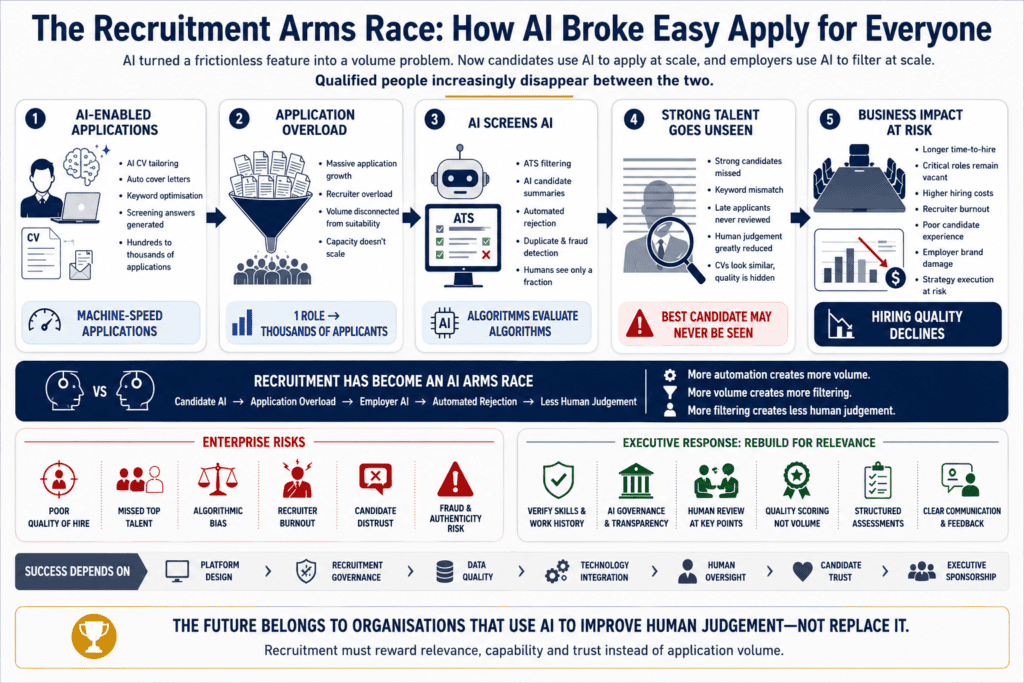
Why the recruitment model built for a different era can no longer withstand the weight of artificial intelligence Imagine posting a single vacancy on LinkedIn on a Monday morning. By Tuesday, you have received 1,800 applications. By Wednesday, the figure has passed 4,000. To the untrained eye, this might look like extraordinary engagement, a sign that the role, the brand, and the market have all aligned perfectly. In reality, it is nothing of the sort. The uncomfortable truth is that most hiring managers and recruiters will never read more than a fraction of those applications. Somewhere in that pile sit genuinely outstanding candidates who will receive an automated rejection within seconds, or, more likely, hear nothing at all. Easy Apply, the feature that once promised to remove friction from job hunting, has quietly become a numbers game, and artificial intelligence has just made that game unwinnable. A single candidate equipped with the right tools can now apply for several hundred roles before lunchtime. This is not a marginal shift in behaviour. It represents a structural strain on a system that was never designed to withstand this scale of automated demand. What we are witnessing is not simply a change in how people apply for jobs; it is the exposure of a recruitment infrastructure that has been quietly under pressure for some time, with AI acting as the catalyst rather than the cause. This matters well beyond the confines of any single HR department. Talent acquisition sits at the heart of an organisation’s ability to execute its strategy. If the mechanism by which an organisation identifies and attracts capability is compromised, every downstream ambition, from digital transformation to market expansion, is quietly put at risk. Boards and executive committees that scrutinise capital allocation with great rigour rarely apply the same rigour to the health of the recruitment funnel, and that oversight gap is becoming increasingly costly. How Easy Apply Used to Work It is worth remembering why Easy Apply was introduced in the first place, because the feature solved a genuine and widely felt problem. Before its arrival, applying for a role typically meant creating a new account on an unfamiliar careers portal, uploading a CV that had already been uploaded dozens of times elsewhere, and manually re-entering the same personal and professional details across page after page of forms. A single application could easily consume twenty to thirty minutes, and a determined jobseeker applying to fifteen or twenty roles a week was investing several hours purely on administrative repetition rather than on demonstrating genuine fit. Easy Apply changed that dynamic almost overnight. With a LinkedIn profile already populated, candidates could submit an application in a matter of clicks. Friction fell away. For jobseekers juggling existing employment, caring responsibilities, or simply the emotional toll of a prolonged search, this was an unambiguous improvement. For employers, it widened the top of the funnel and made LinkedIn the default channel for active job search across most professional sectors. For a period, the system worked broadly as intended. Recruiters received a manageable volume of applications, still weighted towards genuinely interested and reasonably well-matched candidates, because the effort required to apply, while reduced, was not eliminated. That equilibrium has now been disrupted, and the disruption has a name: generative artificial intelligence. It is important to be precise about what has actually broken. The technology underpinning Easy Apply has not changed materially. What has changed is the behaviour on the other side of the interface. A system calibrated for a world of moderate, largely manual effort per application is now absorbing demand generated at machine speed, and it is doing so without any corresponding adjustment to its underlying assumptions. This is, in essence, a capacity problem dressed up as a technology problem, and the distinction matters enormously for how organisations choose to respond. AI Changed Everything Today’s jobseekers are not applying with a single, static CV. They are deploying AI systems that rewrite CVs in seconds, tailor resumes automatically to match the language of each job description, generate bespoke cover letters, answer application screening questions, and optimise keyword density to satisfy applicant tracking systems. Some tools go further still, operating autonomously overnight and submitting applications while the candidate sleeps. The scale this enables is difficult to overstate. Where a diligent jobseeker once applied for perhaps ten or fifteen roles in a week, a single individual using modern AI tooling can now realistically submit one hundred, three hundred, or in extreme cases more than a thousand applications in the same period. Multiply that by the number of active candidates in any given market, and the mathematics of recruitment have changed beyond recognition. Volume has decoupled entirely from intent, and intent has decoupled from suitability. This is not a criticism of candidates for using the tools available to them. Rational actors respond to the incentives in front of them, and when the platform rewards volume, volume is precisely what the platform receives. The issue lies not with individual behaviour but with a system architecture that was never built to differentiate between one hundred applications from one genuinely interested candidate and one hundred applications from one hundred distinct individuals. The Pressure on HR The consequences for recruitment and human resources functions have been immediate and significant. Talent acquisition teams that were already stretched now find themselves managing volumes that make comprehensive human review of every application genuinely difficult. Alongside evaluating talent, recruiters must increasingly spend time filtering noise, identifying duplicate submissions, checking whether a CV was generated wholesale by AI, and looking for evidence of genuine, demonstrable experience. There is a notable irony at the heart of this shift. The more that candidates rely on AI to apply, the more recruiters rely on AI to filter. Artificial intelligence is, in a very real sense, screening artificial intelligence, and human judgement is being pushed further towards the margins of a process it was always meant to anchor. This is a governance failure as much as an operational one. Organisations
BUSINESS MODEL INNOVATION
Adapting to Shifting Customer Needs and Market Realities A Boardroom Perspective for Enterprise Leaders Across the UAE and GCC Every generation of executives believes it is operating in exceptional times. Yet the evidence facing leadership teams today suggests something structurally different is underway. The half-life of competitive advantage is contracting. Industries once regarded as immovable—retail, automotive, financial services, hospitality—now face credible challenge from entrants whose business models bear little resemblance to the incumbents they threaten. For senior executives across the UAE and the wider Gulf, the question is no longer whether business model innovation belongs on the strategic agenda. It is whether the organisation is capable of executing it before the market forces the issue. This article sets out why business model innovation has moved from competitive differentiator to existential necessity, what distinguishes it from operational improvement, the structural forces driving the shift, the practical obstacles that derail even well-intentioned transformation efforts, and a phased framework for leaders who intend to act deliberately rather than reactively. Operational Excellence Is Necessary. It Is No Longer Sufficient. There remains, in many boardrooms, a persistent conflation between operational excellence and business model innovation. The two are not interchangeable, and the distinction carries consequences. Operational excellence is the discipline of doing the same thing better: tightening margins, reducing defects, accelerating delivery, improving service levels within an existing model. It is essential. It is also, on its own, no longer a defensible strategy. Business model innovation asks a different, more uncomfortable set of questions. Should we be doing this at all? Should we be serving a different customer? Is there a fundamentally different way to create and capture value in this market? A manufacturer that perfects its production line while ignoring a shift in what customers actually value will, in time, find itself efficiently producing something the market no longer wants. Meanwhile, a competitor that has correctly diagnosed the underlying customer need—and redesigned its model around it—captures the growth. Leadership teams that conflate the two often discover the gap only when it is too late to close cheaply. The first responsibility of senior executives, therefore, is to be explicit, internally, about which conversation the organisation is actually having: an efficiency conversation, or a reinvention conversation. They require different governance, different capital treatment, and different timelines. The Compression of the Disruption Cycle What has changed is not merely the presence of disruption—markets have always been disrupted—but its velocity. Cloud infrastructure, artificial intelligence, mobile-first customer engagement, and real-time data analytics were, five years ago, sources of genuine competitive advantage. Today they are table stakes: necessary conditions for participation, not differentiators. The practical implication for enterprise leadership is significant. Innovation cannot remain a periodic strategic exercise, revisited every few years in an offsite. It must be built into the operating rhythm of the organisation—the capacity to sense emerging shifts in customer behaviour, rapidly prototype alternative approaches, and pivot components of the business model with the same discipline applied to quarterly financial planning. Organisations that treat this as episodic will consistently discover they are reacting to disruption rather than anticipating it. The Anatomy of a Business Model Before an organisation can innovate its business model, its leadership must be precise about what a business model actually comprises. In practice, it consists of four interdependent dimensions, and a change in one typically demands re-examination of the others. Value Proposition. What problem is genuinely being solved, for whom, and what makes the solution distinct from available alternatives? This is frequently where organisations are least honest with themselves, having grown comfortable narrating a value proposition that no longer reflects why customers actually buy. Customer Segments. Which customers are being served, and what are their true characteristics, needs, and decision-making behaviours—as distinct from the customer profile the organisation has historically assumed? Revenue Model. How is value monetised? What is the actual unit of transaction, and what pricing architecture underpins it? The shift from transactional to subscription, usage-based, or platform-based monetisation is frequently where the most consequential innovation occurs, because it changes the entire economic relationship with the customer. Value Delivery. What capabilities, partnerships, technology, and operating processes are required to deliver the proposition at scale, and does the organisation currently possess them, or must it build, acquire, or partner for them? Business model innovation typically manifests in one, or a combination, of the following forms: a shift in customer segment, using existing capability to serve a previously unaddressed market; an expansion of the value proposition, broadening the scope of what is solved for the customer; a transformation of the revenue model, most commonly a move toward recurring or usage-based monetisation; a reinvention of value delivery, fundamentally altering the mechanism by which value reaches the customer; or a transition to a platform or ecosystem model, in which the organisation repositions itself from vendor to orchestrator of a broader value network. Leadership teams should resist the temptation to pursue all five simultaneously. The organisations that succeed typically identify the single dimension—or occasionally two—where the greatest latent value is trapped, and commit disproportionate resource to it. Six Structural Forces Reshaping the Model Understanding what is compelling change is a precondition for designing an effective response. Six forces, in combination, are reshaping the viability of established business models. Technology-enabled disruption. Artificial intelligence, cloud infrastructure, and real-time analytics have materially lowered the barriers to market entry. For GCC organisations specifically, this cuts both ways: the same conditions that permit new entrants to scale rapidly also enable incumbents with capital and ambition—both abundant in the region—to move decisively if they choose to. Changing customer expectations. Personalisation, seamless omnichannel experience, and value that extends beyond the core product are no longer differentiators; they are baseline expectations. Organisations that fail to embed them lose share to more adaptive competitors, often without a clear early warning signal. Commoditisation of incumbent advantage. Scale, brand recognition, and distribution reach—historically durable moats—have themselves become commoditised. Competitive advantage increasingly belongs to whichever organisation can innovate its business model faster than rivals can replicate it. Demographic
Navigating Financial Complexity in Uncertain Times
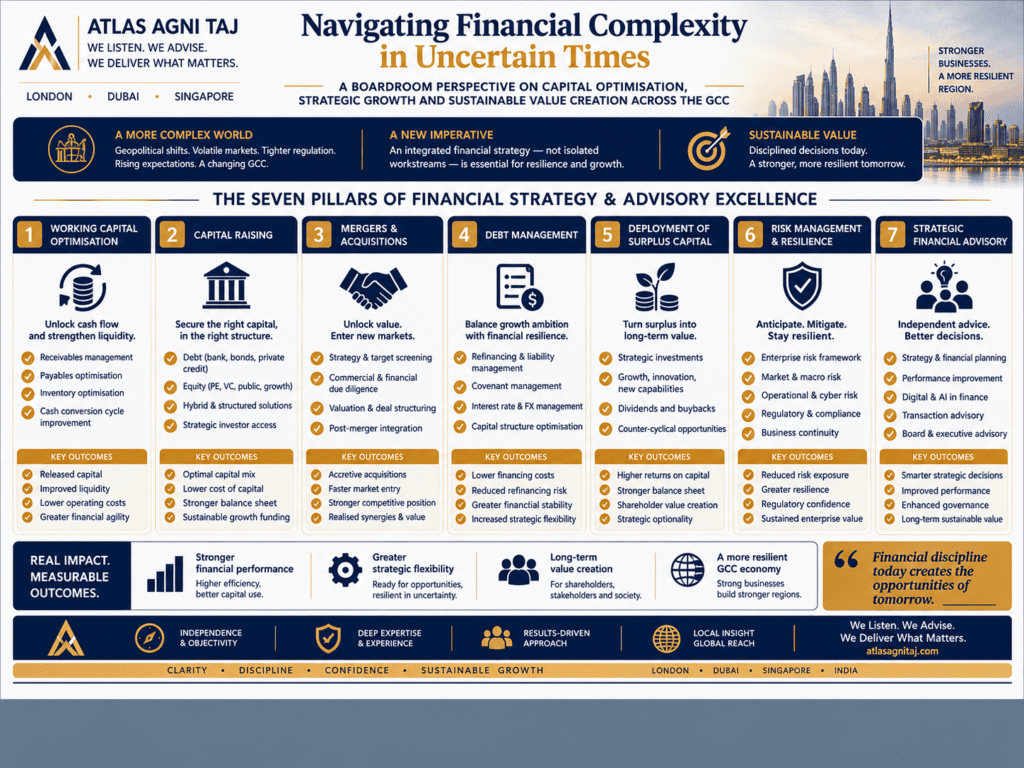
Executive Overview The global operating environment confronting today’s executive leadership teams is one of compounding complexity. Geopolitical instability, volatile interest-rate cycles, tightening regulatory regimes, the imperatives of digital and artificial intelligence transformation, and unrelenting shareholder expectations have converged to create a financial landscape in which yesterday’s playbooks are no longer sufficient. Nowhere is this more pronounced than across the Middle East and the wider GCC, a region distinguished by rapid economic diversification, ambitious national transformation agendas, intensifying competitive dynamics, and a distinctive obligation to balance innovation with regulatory and cultural stewardship. In this environment, resilience and growth are no longer delivered through operational efficiency or tactical cost discipline alone. They demand an integrated financial strategy that addresses, simultaneously, the optimisation of working capital, the architecture of capital structure, the disciplined pursuit of mergers and acquisitions, the strategic management of debt, the deployment of surplus capital, and the protection of enterprise value against an expanding universe of risk. These are not discrete workstreams to be managed in isolation by separate teams operating to separate mandates. They are interconnected dimensions of a single strategic discipline, and organisations that treat them as such consistently outperform those that do not. This article sets out seven interconnected pillars of financial strategy and advisory excellence that, in our experience, distinguish organisations capable of navigating uncertainty with confidence from those left exposed by it. It is intended as a practical reference for chief executives, chief financial officers, boards, and senior finance leaders operating in, or expanding into, the GCC market. 1. Working Capital Optimisation: Unlocking Cash Flow in Uncertain Times Working capital is frequently the most underappreciated lever available to management, and yet it is often the single largest source of unfunded liquidity available to an organisation. In stable conditions it is easy to treat working capital as a housekeeping matter, delegated to finance operations rather than elevated to board-level strategic discussion. In volatile conditions, that neglect becomes expensive. Most organisations lock between fifteen and twenty-five per cent of annual revenue in working capital, a figure that can exceed forty per cent in cyclical or high-growth sectors. Every additional day that capital remains tied up in receivables, payables, or inventory represents cash that cannot be deployed towards growth, debt reduction, research and development, or balance sheet resilience. Conversely, disciplined working capital optimisation can release substantial capital without recourse to external financing, capital expenditure reduction, or compromise to operational performance. Three Dimensions of Discipline — Receivables management: calibrated credit policy, improved billing discipline, dynamic discounting, and automated collections can compress Days Sales Outstanding by five to fifteen days, unlocking substantial cash. — Payables optimisation: strategic extension of Days Payables Outstanding through supply chain financing, reverse factoring, and vendor consolidation, often strengthening supplier relationships in the process. — Inventory optimisation: demand sensing, safety stock recalibration, and category-specific strategies can reduce Days Inventory Outstanding and carrying costs by twenty to thirty per cent without eroding service levels. The cumulative effect can be transformational. A manufacturing organisation generating two billion dollars in annual revenue, operating a sixty-day cash conversion cycle, can release in excess of three hundred million dollars in freed capital simply by compressing that cycle to forty-five days — capital that requires no new financing, no capex reduction, and no operational trade-off. 2. Capital Raising: Securing Growth Funding with Strategic Clarity Growth cannot be financed by ambition alone. Whether an organisation is funding organic expansion, entering adjacent markets, building digital and AI capability, or executing transformational change, the manner in which capital is raised carries multi-year consequences for shareholder value, leverage, governance, and strategic flexibility. Today’s executive teams enjoy an unprecedented breadth of capital sources: traditional bank debt and public equity, venture and growth equity, private credit and structured finance, sovereign wealth and family office capital, ESG-linked instruments, and hybrid structures blending debt and equity characteristics. The optimal architecture reflects an organisation’s risk appetite, growth trajectory, existing liabilities, shareholder composition, and prevailing market conditions — there is no universal formula. Equity capital provides funding without mandatory debt service, but it dilutes existing ownership and introduces new stakeholders with governance expectations. Public listings unlock liquidity and provide acquisition currency, but demand sustained profitability and continuous market disclosure. Private equity brings growth capital and operational expertise, typically alongside defined return expectations and exit horizons. Family offices and sovereign wealth funds increasingly provide more patient capital aligned to long-term value creation, a dynamic of particular relevance across the region. Debt capital provides funding with defined obligations and cost. Well-structured debt enhances equity returns when the cost of capital is lower than the return on incremental capital deployed, yet excessive leverage erodes strategic flexibility and can precipitate covenant breach in a downturn. Within the GCC specifically, organisations benefit from a deep and growing pool of capital through sovereign wealth funds and Islamic finance instruments — Sukuk, Murabaha, and Ijara structures among them — alongside regional investment banks and international capital markets. The organisations that raise capital most effectively are those that integrate these diverse sources into a coherent structure rather than pursuing them opportunistically. 3. M&A Advisory: Buying, Selling and Merging with Confidence Mergers, acquisitions, and combinations represent step-changes in strategic position. Executed with discipline, they accelerate growth, add capability, open new markets, and secure talent, technology, or cost synergy. Executed poorly, they destroy shareholder value, distract leadership, and generate integration chaos that can persist for years. The distinguishing factor is rarely deal enthusiasm; it is the rigour of preparation, evaluation, and integration planning. Buy-Side Discipline Acquisition strategy must begin with absolute clarity of rationale — is the objective market expansion, capability acquisition, competitive consolidation, cost synergy, or portfolio optimisation? Acquisitions pursued without a precise rationale routinely underperform. Diligence must extend well beyond the financial statements to encompass commercial dynamics, customer concentration and retention, technology architecture and technical debt, organisational culture, competitive positioning, regulatory exposure, and integration complexity. Valuation discipline is non-negotiable: the temptation to overpay is the single most common destroyer of acquisition value. Sell-Side Preparation Exit decisions demand clarity of
Cloud Concentration Risk Is Now a Board-Level Resilience Issue
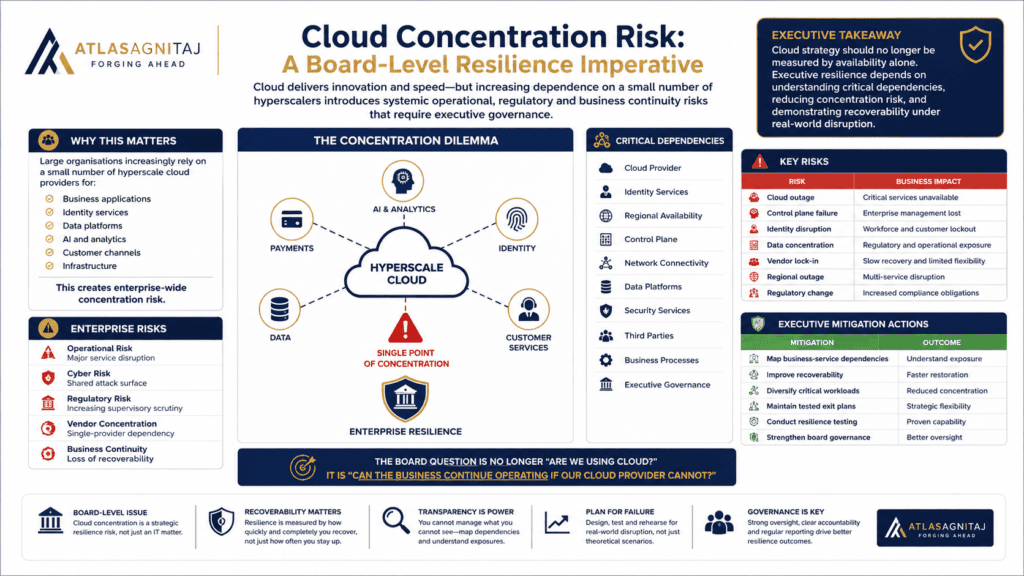
Why resilience, not availability, is the true measure of a modern cloud strategy Cloud computing has transformed enterprise technology over the past decade. It has accelerated product development, expanded the geographic reach of financial services, reduced the friction of experimentation, and enabled organisations to consume advanced capabilities—analytics, machine learning, secure storage, high-performance networking—without the delays and capital outlay of building them internally. For most large enterprises, the direction of travel is now settled: the majority of new workloads are designed for the cloud by default, and legacy estates are being progressively migrated, modernised or retired. Yet the same shift that has delivered these benefits has quietly changed the nature of operational risk. Where once an organisation’s technology risk was distributed across dozens of internal systems, discrete data centres, and independently managed applications, it is now increasingly concentrated in the platforms, services and control planes of a very small number of hyperscale providers. This concentration is not a theoretical concern. It is a structural feature of the market that regulators, boards, auditors and rating agencies are now examining with a level of seriousness that would have seemed disproportionate only three or four years ago. From July 2026, the major cloud providers that support the United Kingdom’s financial sector are subject to direct regulatory oversight as critical third parties. This is a material development. It moves the accountability conversation beyond the individual financial institution and its contractual arrangements with a provider, and places the providers themselves within a formal supervisory perimeter. The change reflects the settled view of the Bank of England, the Prudential Regulation Authority and the Financial Conduct Authority: that the failure, prolonged outage or compromise of a single dominant cloud platform could now produce systemic consequences comparable to those arising from disruption at a major clearing house or systemically important payments infrastructure. Similar considerations are emerging across other jurisdictions. The European Union’s Digital Operational Resilience Act is fully in force, with critical ICT third-party providers designated for oversight. The United States has continued to sharpen expectations around third-party risk management, particularly in banking, insurance and market infrastructure. The United Arab Emirates and other Gulf jurisdictions have adopted increasingly prescriptive requirements on outsourcing, data residency and operational continuity for regulated entities. The direction is unambiguous. Cloud concentration risk is being reframed, globally, as a matter of national and sectoral resilience—not simply a procurement or architecture question to be resolved within the technology function. The changing shape of operational risk The traditional model of operational risk in large financial institutions was built around the assumption that the organisation itself owned, operated and controlled the majority of its critical technology. Disaster recovery frameworks, business continuity plans and testing regimes reflected that assumption. Recovery time objectives were negotiated between the business and the internal IT function. Failover was demonstrated between primary and secondary data centres. Regulatory examinations focused principally on the institution’s own governance, controls and testing evidence. The cloud era has inverted much of this. A modern financial institution may run its retail banking platform, its market data feeds, its collaboration tools, its identity services, its analytics estate and its customer contact infrastructure across services provided by two or three hyperscale platforms. Each of those platforms is, in turn, dependent on its own control planes, its own regional infrastructure, its own supply chain of hardware, connectivity and specialist software, and its own operational staff. When a control plane suffers a degradation, or a regional service loses availability, the effect can propagate rapidly across many customers simultaneously and in ways that individual institutions cannot influence. The result is that resilience has become a shared and layered concept. It depends not only on the choices made by the institution itself, but also on the design, operating discipline and transparency of a small number of providers whose internal workings are largely opaque to their customers. The question boards must now ask is not whether their organisations use the cloud responsibly—almost all do—but whether they truly understand, at a business-service level, the dependencies that their cloud strategy has created and the failure modes they have implicitly accepted. Availability is not the same as recoverability A recurring feature of cloud resilience conversations in board and executive committee settings is the confusion between availability and recoverability. These are not the same. Availability is an operational measure: the proportion of time a service is functioning within defined parameters. It is typically expressed as a percentage in a service-level agreement, and reported in monthly or quarterly service reviews. Recoverability, by contrast, is the ability to restore a service to a defined state following a disruption, within an agreed timeframe, under adverse conditions, and with data integrity intact. It is entirely possible for an organisation to enjoy excellent availability metrics year after year and yet to have limited genuine recoverability in the event of a serious incident. High availability may be delivered through multiple availability zones within a single cloud region. That configuration protects against localised hardware or facility failure, but it does not protect against a regional service outage, a control-plane failure affecting the entire region, an authentication or identity service disruption that renders workloads inaccessible even when they are technically running, or a cyber incident that spreads across the institution’s footprint within a single provider. Stating that an application is “hosted across multiple availability zones” is therefore not, in isolation, a satisfactory resilience narrative. It is a starting point. The relevant board-level questions are more searching. What happens when the region itself is unavailable? What happens when the control plane through which workloads are provisioned and managed is degraded? What happens when the identity provider on which every human and machine login depends is unreachable? What happens when the provider’s customer support and incident response processes are overwhelmed by the very same event affecting the institution? Mapping dependencies at the level of important business services One of the most consequential shifts in the regulatory conversation over recent years has been the move from a technology-centric view of resilience
Agentic AI Has an Infrastructure Problem, Not Just a Model Problem
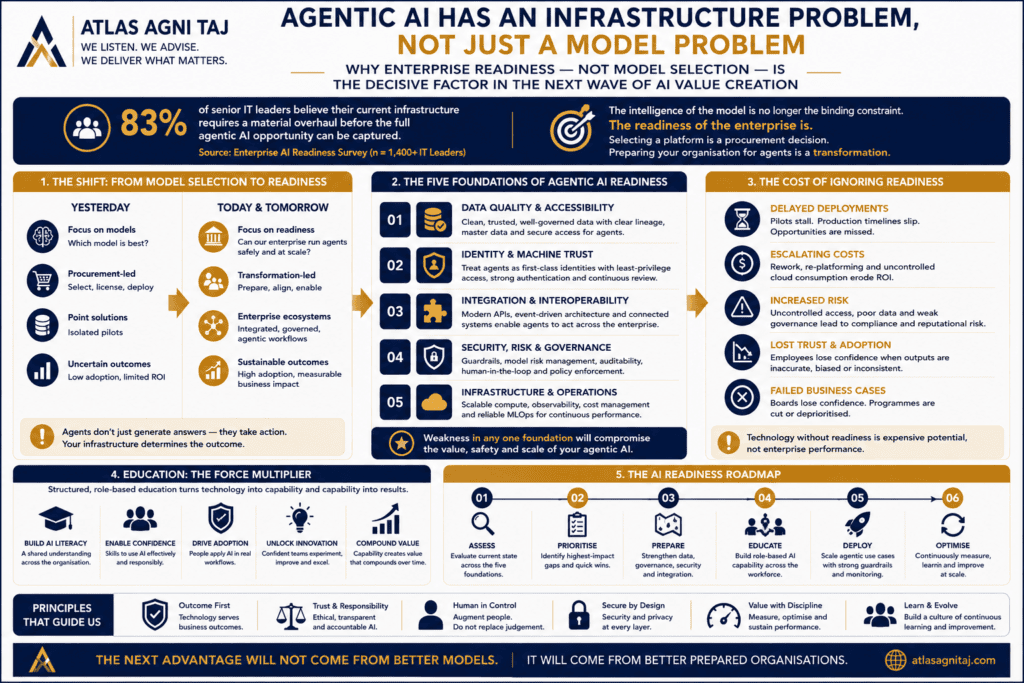
Why enterprise readiness — not model selection — is the decisive factor in the next wave of AI value creation Agentic AI has moved with remarkable speed from research demonstrations to boardroom ambition. In the space of eighteen months, the conversation has shifted from what large language models can generate to what autonomous agents can do. Enterprises across the Gulf, Europe and North America are announcing agentic pilots at pace, and vendors are competing to reframe every product roadmap around agents, orchestration and multi-step reasoning. The direction of travel is unambiguous. What is less widely acknowledged is that most enterprises are not yet ready to operate agentic systems at scale. A recent survey of more than 1,400 senior IT leaders found that eighty-three per cent believe their current infrastructure requires a material overhaul before the full agentic opportunity can be captured. That is not a finding about model quality. It is a finding about foundations — data, identity, integration, capacity, governance and accountability. The intelligence of the model is no longer the binding constraint. The readiness of the enterprise is. This distinction matters, because it changes the nature of the executive conversation, the shape of the investment case and the profile of leadership required to deliver. Selecting an AI platform is a procurement decision. Preparing an organisation to allow software agents to act on its behalf is a transformation programme. Confusing the two is one of the more expensive category errors a leadership team can make, and the cost is beginning to surface in delayed deployments, ballooning cloud bills, unresolved audit findings and stalled business cases. From Model Selection to Enterprise Readiness For the last three years, the dominant question in enterprise AI has been which model to choose. Should the organisation standardise on a frontier foundation model, adopt an open-weight alternative, or maintain a portfolio approach across providers? Which vendor offers the most attractive commercial terms, the strongest sovereignty guarantees, the deepest regional presence? These questions remain relevant, but they have quietly ceased to be the questions that determine outcomes. Agentic AI changes the equation because agents are not passive generators of text or images. They are systems that plan, decide and act. They read from operational data stores, invoke enterprise APIs, execute transactions, update records of consequence and, in some architectures, coordinate with other agents to complete multi-step workflows without direct human intervention at each step. The moment an agent is empowered to act, the surrounding environment — the data it consumes, the identities it assumes, the systems it touches, the controls that constrain it — becomes at least as important as the model that reasons within it. This is why the eighty-three per cent figure should be read carefully. It is not a statement that enterprises need more graphics processing units, although many do. It is a statement that the operating substrate on which agents will run — the composite of data platforms, identity services, integration fabrics, security controls, observability tooling, cost management disciplines and governance structures — is not yet fit for purpose in the majority of large organisations. Fixing that substrate is a multi-year, cross-functional undertaking, and it is where the next phase of value will be won or lost. The Five Foundations Every Board Should Examine Before scaling agentic AI beyond controlled pilots, executive teams should conduct a candid assessment across five foundations. Each is a well-established discipline in its own right. What is new is the way agentic AI amplifies the consequences of weakness in any one of them. 1. Data Quality and Accessibility Agents are only as trustworthy as the data they consume. In many enterprises, critical business data remains fragmented across legacy enterprise resource planning systems, bespoke operational platforms, regional databases, shared drives and unstructured document repositories. Data lineage is often undocumented, master data is inconsistently governed, and definitions of core entities — customer, product, contract, employee — vary between functions. A generative assistant answering questions in a chat window can absorb some of this ambiguity. An autonomous agent taking action cannot. The organisations making the most credible progress are those that have invested in a genuine data foundation: a governed catalogue of authoritative sources, resolved master data domains, documented lineage, well-defined semantic layers, and access patterns that agents can invoke reliably through APIs rather than screen-scraping or unreliable extraction. This is unglamorous work. It rarely features in vendor keynotes. But without it, every agent built on top will inherit the ambiguities of the underlying estate, and the errors will compound rather than average out. 2. Identity, Access and the Question of Machine Trust When an agent acts, it acts under some identity. That identity determines what it can read, what it can change and what it can approve. In most enterprises, identity and access management was designed with human users in mind, supplemented by service accounts for machine-to-machine integration. Agentic AI introduces a third category — non-human actors that behave with a degree of autonomy, whose actions may vary from one execution to the next and whose access requirements may span dozens of systems within a single workflow. The mature response is to treat agent identities as first-class citizens within the identity fabric. That means unique identities per agent, least-privilege access scoped to specific tasks, short-lived credentials, comprehensive logging of every action taken under that identity, and clear delegation patterns when an agent is acting on behalf of a human user. It also means rethinking segregation of duties. If an agent can both initiate a payment and approve it, the traditional control has been silently dissolved. Boards should be asking how their access model has evolved to accommodate autonomous actors, and whether their audit teams have been equipped to test it. 3. Integration with Enterprise Platforms Most enterprise value sits inside systems that were never designed to be driven by an intelligent caller. Core banking platforms, insurance policy administration systems, hospital electronic medical records, government case management platforms, industrial control systems — these are the systems where the transactions
CIOs Must Control the Economics of AI, Cloud and SaaS Together
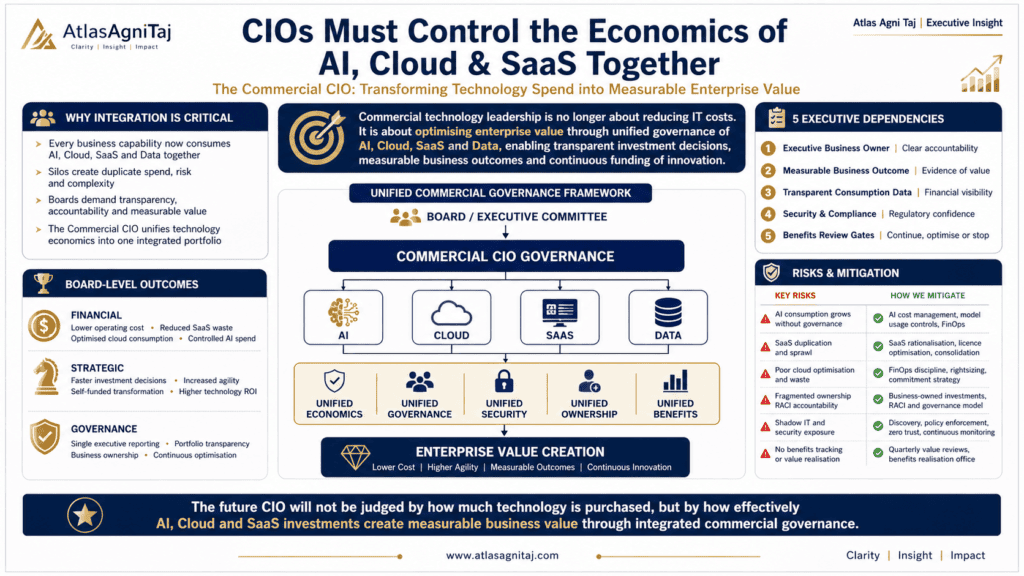
The rise of the commercial CIO — and why integrated technology economics is now a board-level discipline The office of the Chief Information Officer has entered a new commercial era. For much of the past decade, the CIO agenda was defined by digital modernisation, cloud migration and the industrialisation of software delivery. Cost discipline was important, but it was frequently treated as a functional exercise — a matter of contract renegotiation, capacity right-sizing or occasional vendor consolidation. That framing is no longer sufficient. Artificial intelligence has arrived at industrial scale, cloud consumption has continued to expand, and the software-as-a-service estate has quietly become the single largest and least governed portfolio in most enterprises. The CIO is now expected to answer, with precision, a question that few technology leaders have historically been equipped to answer: what does the organisation actually spend on technology, and what does it receive in return? This question is not rhetorical. Boards, chief financial officers, private-equity operating partners and audit committees are asking it directly. In parallel, cybersecurity risk continues to intensify, regulatory scrutiny of data and AI is rising in every major jurisdiction, and shadow IT is no longer a marginal phenomenon but a structural feature of the modern enterprise. Managing these forces in separate silos — one team for cloud, another for SaaS, another for AI, another for security — is no longer credible. The commercial CIO is the executive who brings these disciplines together and demonstrates, with evidence, where technology creates value and where it does not. The convergence problem: why silos are no longer defensible Enterprise technology has evolved into a portfolio of interdependent consumption models. Public cloud platforms are billed by usage. Software-as-a-service is billed by seat, by tier, by transaction or by feature. Artificial intelligence is billed by tokens, by inference volume, by model, by fine-tuning cycle, by vector storage and by supporting compute. Data platforms are billed by ingestion, by query, by storage and by egress. Each of these commercial models has its own vocabulary, its own optimisation levers and its own community of specialists. Historically, that specialisation has been treated as a strength. In practice, it has become a weakness. The reason is straightforward. Business capabilities do not respect these categories. A customer service transformation programme may consume cloud compute, a customer relationship management SaaS platform, a data warehouse, an AI copilot, an integration layer, an observability stack and multiple security tools — all at the same time, all for a single business outcome. If each of these lines of expenditure is governed by a different team, reported to a different committee and measured against a different metric, the enterprise cannot answer the most basic commercial question: is this transformation actually paying back? Worse, decisions taken in one silo routinely create cost, risk or dependency in another. A cloud team may celebrate a workload migration that quietly triggers a substantial data egress charge and a new SaaS licence requirement. A SaaS renewal may lock in unused seats that could have been consolidated with an existing AI-enabled platform. An AI pilot may spin up compute in a region that violates data residency commitments made by the security function. Convergence is not merely a technical observation. It is a commercial imperative. The CIO who continues to organise technology economics as three or four parallel budgets — with three or four parallel governance conversations — will be unable to deliver the transparency that the executive committee now expects. The organisations that resolve this most quickly will treat cloud, SaaS, data and AI as a single integrated portfolio, governed by a single commercial framework and measured against a single set of business outcomes. The AI cost dimension: hidden, distributed and rapidly compounding Artificial intelligence is the newest and most volatile line in the technology budget. It is also the least understood. Executive teams frequently assume that the cost of AI is the licence fee attached to a large language model or a copilot subscription. In reality, the licence fee is often the smallest component. Enterprise AI introduces cost across at least seven distinct categories: model consumption, supporting compute, storage and vector databases, data preparation and pipelines, integration into existing systems, monitoring and observability, and specialist platforms for governance, safety and evaluation. Each of these categories has its own commercial dynamics and its own tendency to grow silently. Model consumption is the most visible cost, but it is also the most difficult to forecast. Token-based pricing means that a single poorly designed prompt template, repeated at scale, can produce a materially different bill from a well-designed equivalent. Retrieval-augmented architectures introduce further variability, because the volume of context passed to a model depends on the quality of the retrieval layer, which depends in turn on the quality of the underlying data. Fine-tuning, evaluation cycles and guardrail testing all consume additional model calls that rarely appear in the original business case. Supporting compute is often invisible until it is not. Inference workloads on GPU infrastructure, whether managed or self-hosted, generate meaningful hourly charges even when idle. Vector databases scale with the volume of embedded content, and the storage cost of embeddings frequently exceeds the storage cost of the source documents. Data pipelines feeding AI systems require orchestration, transformation and observability tooling that would previously have sat under analytics budgets. Integration into transactional systems introduces middleware costs, and the security posture required for AI — including secrets management, prompt injection defences, output filtering and audit logging — introduces further tooling that is rarely priced into the initial proposal. The compounding effect is significant. An AI initiative that is presented to the executive committee as a modest six-figure investment can, within twelve to eighteen months, generate a seven-figure run-rate once all supporting components are accounted for. The CIO who cannot decompose this cost, attribute it to specific business outcomes and evidence the value released is exposed. The CIO who can do so is credible. This is the commercial discipline that boards now expect. The SaaS estate: the
Beyond Ethics and Explainability
Why AI Governance Must Expand Into Operational Resilience An executive perspective on integrating artificial intelligence into the operational resilience frameworks that regulators, boards and customers now expect. For much of the past three years, the conversation about responsible AI has been dominated by four themes: fairness, explainability, privacy and model risk. Boards have been briefed on bias testing, risk committees have debated transparency, and general counsel have refreshed policies to reflect the EU AI Act, the NIST AI Risk Management Framework, and the emerging positions of the UAE and Saudi regulators. All of this is necessary. None of it is sufficient. As artificial intelligence moves from experimentation into the fabric of banking, government services, healthcare, energy and logistics, a different question is beginning to command attention in serious boardrooms: what happens when the AI stops working? When a foundation model provider suffers a multi-hour outage during a peak business period; when a critical agent begins producing plausible but incorrect outputs; when an inference pipeline is quietly compromised; or when a single provider changes its terms of service overnight — is the business still able to operate? The answer, in most organisations today, is that nobody has properly tested it. The governance policies exist. The ethics frameworks are approved. The model inventories are catalogued. But the operational resilience posture around AI — the same discipline that regulators have spent a decade embedding for payments, core banking, cloud and telecommunications — is largely absent, or exists only on paper. That gap will not last. The Central Bank of the UAE’s guidance on Responsible AI adoption in financial institutions makes the direction of travel unambiguous: AI-related risks must be integrated into existing risk management responsibilities, not treated as a parallel discipline. The Prudential Regulation Authority in the United Kingdom, the European Banking Authority and the Monetary Authority of Singapore are moving in a similar direction. Operational resilience regimes — DORA in the European Union, the FCA and PRA policy statements in the United Kingdom, and comparable structures in Abu Dhabi Global Market and Dubai International Financial Centre — will increasingly require institutions to demonstrate that AI dependencies have been identified, tolerated, tested and made recoverable. This article argues that the strongest AI programmes in the region and beyond will be those that combine responsible adoption with demonstrable operational resilience. The executives who understand this intersection — who are equally fluent in the ethics of the model and the continuity of the service — will define the next decade of enterprise AI. The Limits of Governance-Only Thinking There is nothing wrong with the current wave of AI governance activity. Ethics committees, model risk inventories, bias audits, explainability requirements and privacy impact assessments are foundational controls. The difficulty is that they were designed to answer a particular set of questions: is this model appropriate to deploy, is it lawful, is it fair, and can we defend its decisions? These are, in essence, pre-deployment and periodic-review controls. Operational resilience asks a different question entirely. Assuming the model has passed governance and is now in production, what happens when something goes wrong in production? That failure mode is not addressed by any amount of pre-deployment bias testing. A perfectly fair, fully explainable and lawfully deployed model is still catastrophic to a business if it becomes unavailable during peak trading hours, or if it silently degrades in accuracy after an underlying provider updates a model version without notice. The distinction matters, because the two disciplines have different owners, different testing regimes and different executive escalation paths. AI governance typically sits with the Chief Risk Officer, the General Counsel, the Data Protection Officer or a dedicated AI ethics function. Operational resilience typically sits with the Chief Operating Officer, the Head of Business Continuity, the Chief Information Security Officer and — in regulated environments — a designated senior manager with personal accountability under the applicable regime. In most organisations, these two communities do not yet routinely speak to each other about AI. AI is treated as a governance topic; resilience is treated as an infrastructure topic. The result is a blind spot: no one owns the question of whether the business can continue to deliver an important business service when the AI component of that service is unavailable, compromised or unreliable. Closing that blind spot is not a technical exercise. It is an accountability exercise. It requires a deliberate decision at board level that AI dependencies will be treated with the same seriousness as payment rails, cloud infrastructure and third-party data providers — because, increasingly, they are the same class of dependency. What the UAE Central Bank Guidance Actually Signals The Central Bank of the UAE’s Responsible AI guidance, issued to licensed financial institutions, is instructive not only for what it says but for how it is structured. It does not create a parallel AI risk regime. Instead, it explicitly requires institutions to integrate AI-related risks into their existing frameworks for credit, market, operational, cyber, third-party, conduct and compliance risk. The signal is deliberate. Regulators are not asking financial institutions to treat AI as an exotic new category requiring bespoke controls. They are asking institutions to demonstrate that AI risks are being managed with the same rigour, the same escalation paths and the same evidentiary standards as every other material risk on the balance sheet. This has a specific implication for operational resilience. Under existing UAE frameworks — and the equivalent regimes in DIFC and ADGM — institutions are already expected to identify important business services, set impact tolerances, map end-to-end dependencies and test severe-but-plausible scenarios. When AI moves inside an important business service, the same discipline must apply. There is no regulatory carve-out for AI dependencies. There will be no forgiveness at supervisory review for an institution that mapped its payment infrastructure resilience meticulously but never asked what would happen if its fraud detection model, its onboarding assistant or its customer service copilot began returning unreliable outputs. Boards operating in the GCC should read this signal clearly: the
Building an AI-Ready Organisation Starts with Education
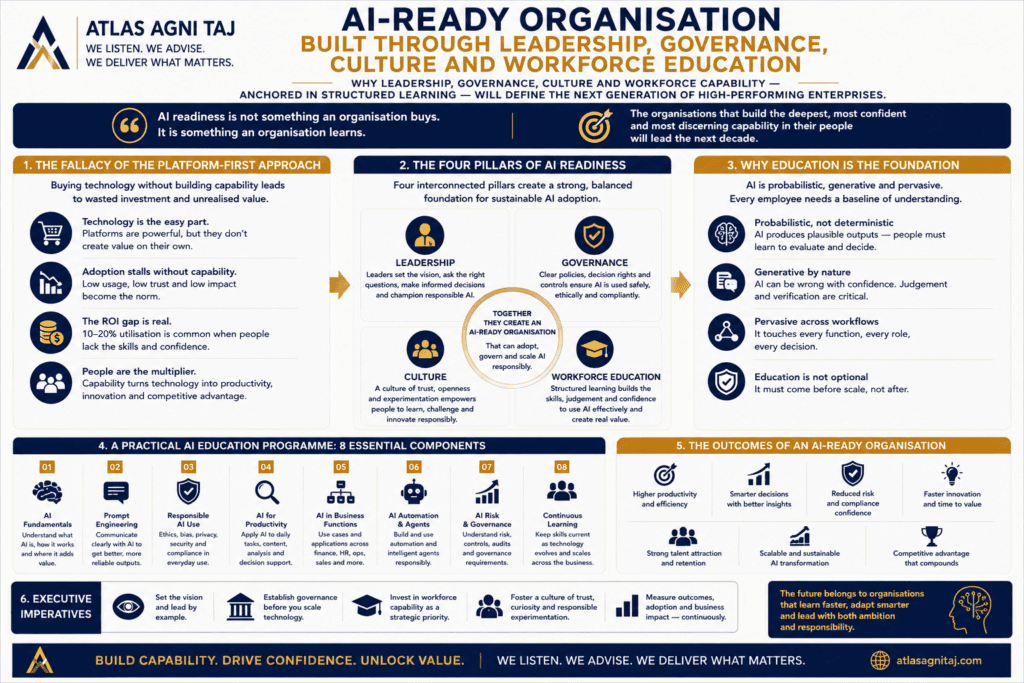
Why leadership, governance, culture and workforce capability — anchored in structured learning — will define the next generation of high-performing enterprises. Across boardrooms in London, Dubai, Riyadh, Singapore and beyond, a single question now dominates the executive agenda: “How do we become AI-ready?” It is asked by chief executives navigating shareholder expectations, by chief information officers modernising legacy estates, by chief human resources officers redesigning the future of work, and by chief risk officers grappling with a new class of technology-driven exposure. It is a question that reflects both ambition and anxiety in equal measure. Yet the answer, contrary to the marketing narratives that saturate our inboxes, is not to be found in the procurement of the latest artificial intelligence platform. Software licences, however sophisticated, do not confer capability. Cloud subscriptions, however elastic, do not confer readiness. A shiny copilot deployed across a workforce that neither understands its limits nor trusts its outputs will deliver disappointment, not transformation. Genuine AI readiness is not a purchase. It is a state of organisational maturity — built deliberately, layer by layer, through the disciplined alignment of leadership intent, governance rigour, cultural openness and, most decisively, workforce capability. The Fallacy of the Platform-First Approach Over the past twenty-four months, many organisations have followed a familiar pattern. A senior sponsor secures budget. A vendor is selected. A platform is deployed. Pilots are launched with fanfare. And then, quietly, adoption stalls. Usage curves flatten. Business cases that once looked compelling are quietly revised. The board asks difficult questions. The programme is rebranded and relaunched, or discreetly wound down. This pattern is not the fault of the technology. It is the predictable consequence of treating artificial intelligence as an IT project rather than a business transformation. Platforms are the easy part. What is far harder — and far more valuable — is the human infrastructure required to translate technological capability into commercial and operational outcomes. The organisations that will lead the next decade are not those that acquired the most powerful models first. They are those that built the deepest, most confident, most discerning capability in their people. Technology is now a commodity. Human judgement, informed by structured understanding of that technology, is the differentiator. The Four Pillars of AI Readiness A credible AI readiness posture rests on four interdependent pillars. Neglect any one and the structure becomes unstable. Leadership. Executives must not only sponsor AI adoption but also understand it sufficiently to challenge it, direct it and, where necessary, restrain it. A board that cannot interrogate an AI business case is a board that cannot govern one. Governance. Clear policies, decision rights, escalation pathways and control frameworks must be in place before deployment, not retrofitted after an incident. This includes model risk management, data governance, ethical review and third-party oversight. Culture. Employees must feel psychologically safe to experiment, to disclose errors, to challenge machine-generated outputs and to advocate for human judgement where it is warranted. A culture of fear will produce a culture of shadow AI usage, and shadow AI is where regulatory and reputational risk quietly accumulate. Workforce capability. The workforce must understand what AI is, what it is not, where it adds value, where it introduces risk and how to work with it responsibly. This is the pillar that carries the weight of the others — and it is built, above all, through education. AI readiness is not something an organisation buys. It is something an organisation learns. Why Education Is the Foundation, Not the Afterthought In most enterprise transformation programmes, training arrives at the end. The system is built, the process is redesigned, and only then does the change management workstream circulate a series of e-learning modules and lunch-and-learn invitations. This sequencing may have been defensible in the era of enterprise resource planning rollouts. In the era of artificial intelligence, it is dangerous. Artificial intelligence is unlike previous waves of technology in three important respects. First, it is probabilistic rather than deterministic — it produces plausible outputs, not guaranteed ones, and users must be equipped to evaluate the difference. Second, it is generative — it can produce content that appears authoritative but is materially incorrect, and the reputational cost of blind acceptance can be severe. Third, it is pervasive — unlike a bounded system, it touches almost every workflow, from customer correspondence to financial analysis to legal drafting to software engineering. These characteristics mean that every employee, not merely the specialists, requires a baseline of understanding. Education is therefore not a downstream activity to be scheduled after go-live. It is the foundation upon which every other element of the AI operating model rests. Deploy the platform without the education, and the organisation will absorb the risk without capturing the value. A Practical AI Education Programme: The Eight Essential Components A well-designed AI education programme is not a single course. It is a structured curriculum, tiered by role and seniority, that builds confidence progressively. In our experience advising boards and executive committees across the Gulf and the United Kingdom, the following eight components represent the minimum viable syllabus for any organisation serious about AI readiness. 1. AI Fundamentals Employees must understand, in accessible terms, what artificial intelligence actually is. This includes the distinction between traditional machine learning, generative models and agentic systems; the concept of training data and its influence on outputs; the meaning of terms such as hallucination, grounding, retrieval and fine-tuning; and the difference between narrow AI and the broader systems that increasingly integrate multiple capabilities. This is not a technical deep dive. It is the vocabulary of an informed workforce. 2. Business Use Cases Abstract knowledge is quickly forgotten. Applied knowledge endures. Every education programme must translate AI concepts into concrete, function-specific use cases: how the finance team can accelerate variance analysis, how the legal team can compress contract review, how the customer service team can improve resolution times, how the marketing team can personalise at scale. When employees see AI through the lens of their own work, adoption ceases
Responsible AI Starts with Educated Employees: Why AI Literacy Matters
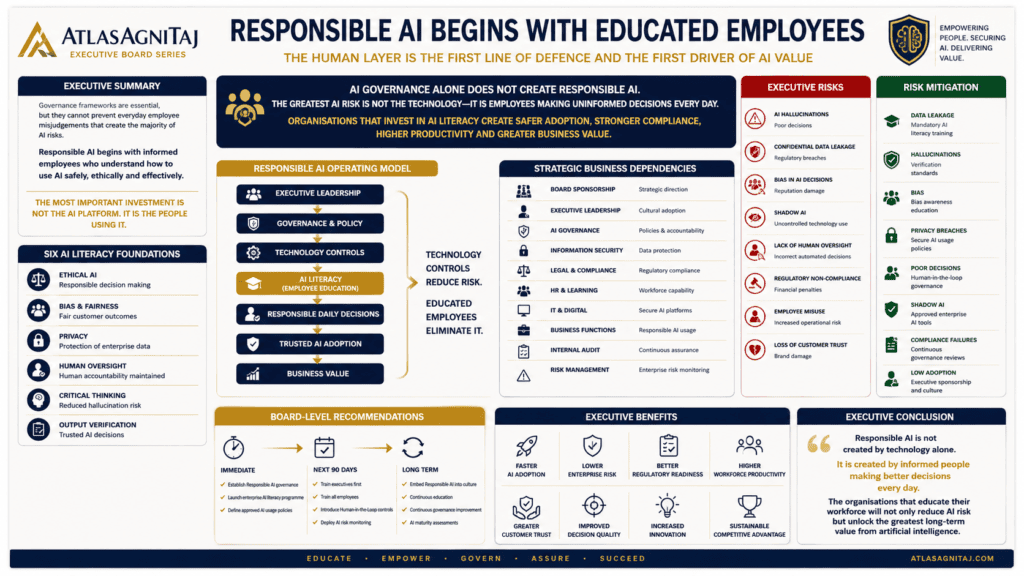
Why the most important control in any AI programme is not a framework, but a workforce that knows what it is doing. Across boardrooms, regulatory forums and industry conferences, the conversation on responsible AI has settled into a familiar vocabulary. We discuss governance frameworks, model risk taxonomies, algorithmic auditing standards, red-teaming protocols, and the growing weight of regulatory instruments such as the European Union’s AI Act, the NIST AI Risk Management Framework, ISO/IEC 42001, and, for those of us operating in the Gulf, the UAE’s National Strategy for Artificial Intelligence 2031 and the emerging guidance from the UAE AI Office. These instruments are indispensable. They define the outer perimeter of what is permissible, articulate lines of accountability, and give assurance functions a defensible basis for enquiry. Responsible AI Starts with Educated Employees Yet as soon as one steps from the framework into the operating enterprise, a quieter and arguably more consequential picture emerges. It is not the framework that misuses artificial intelligence. It is the well‑intentioned analyst who pastes sensitive customer data into a public model to accelerate a management report. It is the marketing manager who publishes an AI‑generated statistic without verifying the underlying source. It is the recruiter who allows a scoring engine to shape a shortlist without understanding the provenance of its training data. It is the finance graduate who trusts a plausible‑sounding hallucination because it is delivered in fluent, confident prose. In every one of these cases, governance was present on paper. Judgement, at the point of use, was absent. The uncomfortable truth is that responsible AI, in practice, begins upstream of the framework. It begins with the individual employee who must decide, in the moment, whether the prompt they are typing is prudent, whether the output they are consuming is credible, and whether the decision they are about to inform ought properly to be made by a human being. That decision is made hundreds of times a day, across every function of the modern enterprise. Unless the judgement behind it is informed, no policy manual, however elegantly drafted, will hold the line. The Limits of Governance Alone There is a persistent temptation, particularly at board level, to treat responsible AI as a matter that can be resolved through structure. A steering committee is convened, a policy is issued, an ethics charter is signed, a risk register is populated, and the organisation reassures itself that its exposure is managed. In regulated industries, this instinct is compounded by a compliance culture that measures maturity through documentation. If the artefacts exist, the risk is understood to be controlled. This posture, however well intentioned, misreads the nature of AI risk. The technology is not confined to a bounded platform under the stewardship of a specialist team. It has diffused into everyday knowledge work through browsers, plug‑ins, native features embedded in productivity suites, mobile applications and unsanctioned personal tools. The average employee now has, within one or two clicks, access to a system capable of drafting communications, summarising confidential documents, generating code, producing images and offering advice with an authority that belies its actual reliability. The perimeter that governance imagines rarely exists in the field. Consequently, the gap between policy and practice widens by the week. Frameworks describe an ideal steady state. Employees, working under commercial pressure and to demanding deadlines, resolve ambiguity in whatever way makes their next task easier. In the absence of understanding, they will assume that anything a corporate‑branded tool produces is safe, that anonymisation is a matter of removing names, that a plausible answer is a correct answer, and that a signed acceptable‑use policy is a substitute for informed judgement. Each of these assumptions is wrong, and each is quietly consequential. Governance without literacy is theatre. It creates the appearance of control while leaving the substance of risk untouched. The organisations that will navigate the next decade of AI adoption successfully are those that recognise this early and invest, deliberately and at scale, in the capability of their people. The Employee as the Decisive Control In every mature discipline of enterprise risk — cyber security, health and safety, anti‑money‑laundering, market conduct — the same lesson has been learned, often at cost. Technology can raise the floor. Policy can define the ceiling. But it is the trained, alert, well‑briefed employee who determines what actually happens in the space between. A phishing email is defeated not by the mail gateway but by the colleague who pauses before clicking. A financial‑crime alert becomes an investigation not because of a rules engine but because a relationship manager asks a question that does not sit on any script. Safety incidents are avoided when a shift supervisor refuses to take a shortcut that the manual technically permits. Artificial intelligence is no different, save that the surface area is larger and the pace of change more relentless. Every employee who uses AI — knowingly or otherwise — is making decisions that affect data security, regulatory compliance, customer trust, brand reputation and, ultimately, business outcomes. The prompts they craft, the outputs they trust, the disclosures they omit, the biases they fail to notice, the confidentiality they inadvertently breach, and the accountability they quietly delegate to a machine all constitute acts of enterprise‑scale consequence. They are not incidental. They are the substance of AI adoption. Recognising this has a clarifying effect on the executive agenda. It moves foundational AI literacy from the periphery of the change programme, where it is often filed as an item under “change management” and delegated to internal communications, to the centre of the risk conversation. It becomes as material as information‑security awareness or anti‑bribery training, and arguably more urgent, because the technology it addresses is expanding into every workflow simultaneously. The Six Pillars of Foundational AI Literacy A well‑designed baseline programme in AI literacy is not a lecture on the history of neural networks, nor a demonstration of prompt techniques. It is a targeted intervention that equips employees to make better decisions in the moments that matter. In
AI Literacy Is Becoming the New Digital Literacy
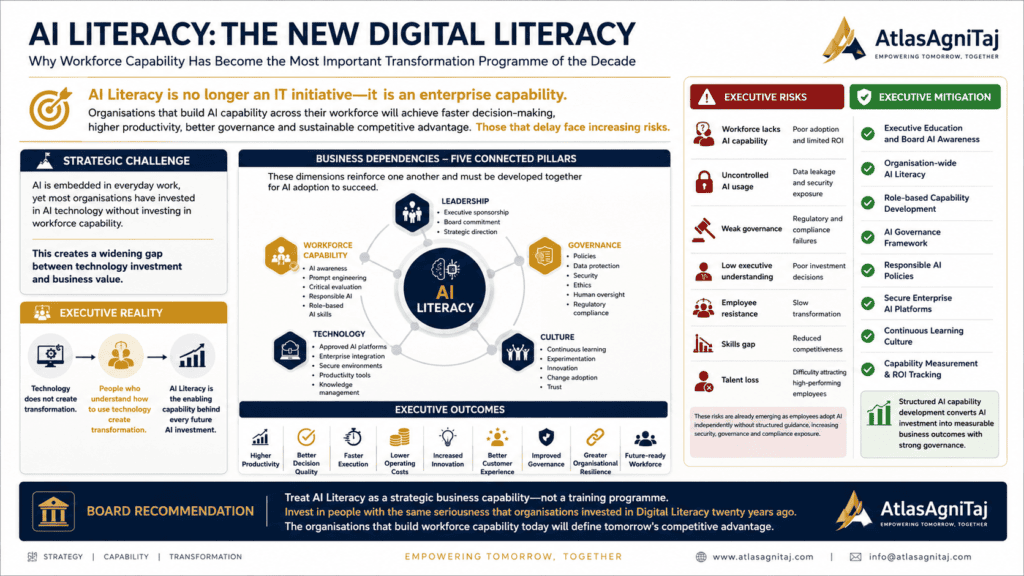
Why the workforce capability agenda has quietly become the most important transformation programme of the decade Twenty years ago, boardrooms across the United Kingdom, Europe and the Gulf were preoccupied with a deceptively simple question: how do we ensure that every employee in the organisation can operate a computer competently? At the time, this felt like a bold undertaking. Organisations invested heavily in structured training programmes covering email etiquette, spreadsheet fundamentals, word processing, presentation software and, later, the emerging discipline of enterprise collaboration. The category was labelled, rather prosaically, “digital literacy”, and it became the invisible foundation on which the entire modern knowledge economy was subsequently built. Today, we find ourselves at an almost identical inflection point. Artificial Intelligence has moved decisively out of the research laboratory and the specialist data science function, and it is now embedded in the everyday tools that colleagues use to draft communications, analyse data, prepare briefings, service customers, manage suppliers and make decisions. Yet the majority of organisations have not yet made the corresponding investment in workforce capability. The result is a widening gulf between the technological potential that has been procured and the human capability required to realise it. This article sets out why AI literacy is rapidly becoming the defining organisational capability of the decade, why the parallels with the digital literacy programmes of the early 2000s are instructive rather than merely rhetorical, and what senior leaders should be doing now to prepare their workforces for a materially different operating environment. The Historical Parallel It is worth pausing to consider quite how transformative the digital literacy investment of the early 2000s proved to be. In the late 1990s, a significant proportion of the British and Gulf workforce had never used a personal computer in a professional context. Correspondence was largely paper based. Data lived in filing cabinets rather than shared drives. Meetings required physical presence, and the collaboration technologies we now take for granted, such as shared calendars, video conferencing and instant messaging, were either non existent or the preserve of a narrow technical elite. The subsequent decade of sustained investment in digital literacy did not simply teach people how to send an email. It rewired the operating rhythm of the modern enterprise. It reduced the cost of coordination, accelerated decision cycles, opened new channels of customer engagement and, ultimately, enabled the emergence of entire new business models. Organisations that invested early and systematically in workforce digital capability captured a durable competitive advantage. Those that treated it as a peripheral IT matter, delegated to the training department and starved of executive attention, spent much of the following decade playing catch up. The current AI moment carries all the same hallmarks. We have a general purpose technology that is genuinely useful across almost every function. We have a supply of capable tools that is expanding faster than most organisations can absorb them. We have a workforce whose everyday productivity, judgement and creativity stand to be materially amplified by these tools. And, once again, we have a leadership community that risks confusing the deployment of technology with the development of the human capability required to use it well. Why AI Literacy Is No Longer Optional Artificial Intelligence is no longer reserved for technical specialists. It is becoming a workplace capability that affects almost every function, from human resources and finance to operations, customer service and project management. A finance analyst who can prompt a generative model to interrogate a variance report will produce sharper insight in a fraction of the time. A human resources business partner who understands the strengths and limitations of AI assisted screening tools will make more equitable hiring decisions. A project director who can deploy AI to summarise steering committee papers, draft communications and stress test risk assumptions will materially raise the quality of programme governance. These are not hypothetical use cases. They are being executed today, at scale, in organisations across the Gulf Cooperation Council, the United Kingdom, Europe and the wider international market. The competitive question facing senior leadership is no longer whether Artificial Intelligence will change the nature of professional work, but how quickly their own workforce will develop the fluency required to participate in that change rather than be displaced by it. Employees who understand AI fundamentals are, in practice, better equipped to: Each of these capabilities is, in isolation, valuable. Taken together, they represent a fundamentally new form of professional competence, and one that will, within a very short horizon, be considered an entry level requirement rather than a differentiator. The Leadership Imperative For senior leaders, AI literacy is not simply a productivity question. It is a leadership question, a governance question and, ultimately, a cultural question. The leaders of the coming decade will be those who can articulate a credible vision for how Artificial Intelligence will reshape their organisation, mobilise investment behind that vision, and, crucially, take the workforce with them. The evidence from earlier waves of enterprise transformation is unambiguous. Programmes fail far more often for cultural and behavioural reasons than for technical ones. Enterprise Resource Planning implementations do not fail because the software does not work; they fail because the workforce has not been equipped, prepared or persuaded to work in the way the new platform requires. Cloud migrations do not stall because the target architecture is unsound; they stall because the operating model, the skills mix and the incentives have not been recalibrated. Artificial Intelligence transformation will follow the same pattern with even greater force, because AI touches not just the tools people use but the very nature of the cognitive work they perform. For leaders, therefore, AI literacy creates more than productivity gains. It builds confidence, reduces resistance to change and supports the successful delivery of transformation programmes that would otherwise founder on cultural inertia. A workforce that understands the technology is a workforce that can meaningfully participate in shaping its adoption. A workforce that does not is a workforce that will, quite reasonably, resist a change that has