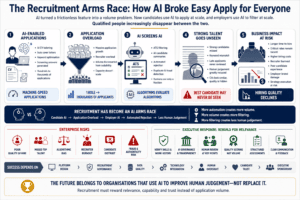
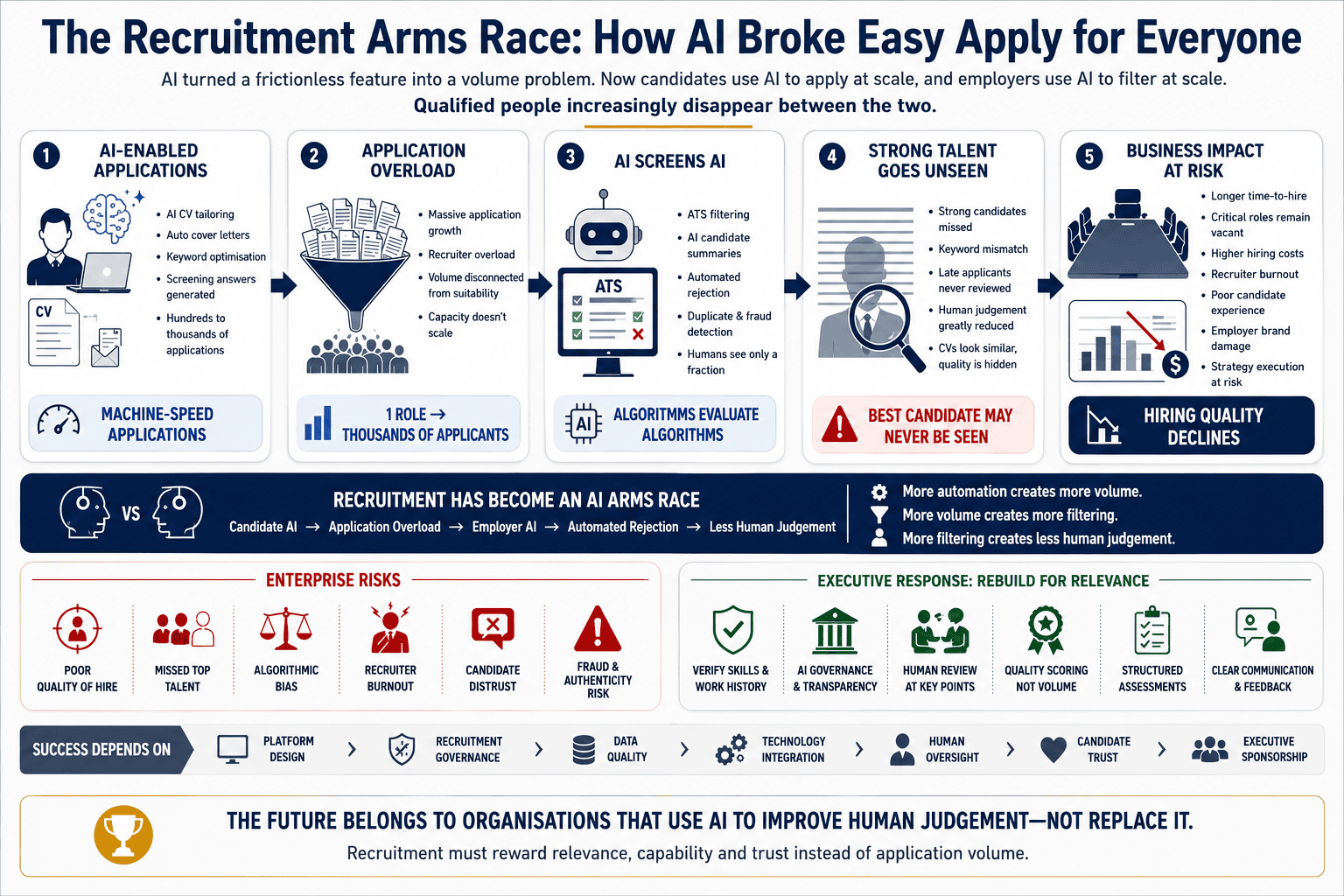
Why the recruitment model built for a different era can no longer withstand the weight of artificial intelligence
Imagine posting a single vacancy on LinkedIn on a Monday morning. By Tuesday, you have received 1,800 applications. By Wednesday, the figure has passed 4,000. To the untrained eye, this might look like extraordinary engagement, a sign that the role, the brand, and the market have all aligned perfectly. In reality, it is nothing of the sort.
The uncomfortable truth is that most hiring managers and recruiters will never read more than a fraction of those applications. Somewhere in that pile sit genuinely outstanding candidates who will receive an automated rejection within seconds, or, more likely, hear nothing at all. Easy Apply, the feature that once promised to remove friction from job hunting, has quietly become a numbers game, and artificial intelligence has just made that game unwinnable.
A single candidate equipped with the right tools can now apply for several hundred roles before lunchtime. This is not a marginal shift in behaviour. It represents a structural strain on a system that was never designed to withstand this scale of automated demand. What we are witnessing is not simply a change in how people apply for jobs; it is the exposure of a recruitment infrastructure that has been quietly under pressure for some time, with AI acting as the catalyst rather than the cause.
This matters well beyond the confines of any single HR department. Talent acquisition sits at the heart of an organisation’s ability to execute its strategy. If the mechanism by which an organisation identifies and attracts capability is compromised, every downstream ambition, from digital transformation to market expansion, is quietly put at risk. Boards and executive committees that scrutinise capital allocation with great rigour rarely apply the same rigour to the health of the recruitment funnel, and that oversight gap is becoming increasingly costly.
How Easy Apply Used to Work
It is worth remembering why Easy Apply was introduced in the first place, because the feature solved a genuine and widely felt problem. Before its arrival, applying for a role typically meant creating a new account on an unfamiliar careers portal, uploading a CV that had already been uploaded dozens of times elsewhere, and manually re-entering the same personal and professional details across page after page of forms. A single application could easily consume twenty to thirty minutes, and a determined jobseeker applying to fifteen or twenty roles a week was investing several hours purely on administrative repetition rather than on demonstrating genuine fit.
Easy Apply changed that dynamic almost overnight. With a LinkedIn profile already populated, candidates could submit an application in a matter of clicks. Friction fell away. For jobseekers juggling existing employment, caring responsibilities, or simply the emotional toll of a prolonged search, this was an unambiguous improvement. For employers, it widened the top of the funnel and made LinkedIn the default channel for active job search across most professional sectors.
For a period, the system worked broadly as intended. Recruiters received a manageable volume of applications, still weighted towards genuinely interested and reasonably well-matched candidates, because the effort required to apply, while reduced, was not eliminated. That equilibrium has now been disrupted, and the disruption has a name: generative artificial intelligence.
It is important to be precise about what has actually broken. The technology underpinning Easy Apply has not changed materially. What has changed is the behaviour on the other side of the interface. A system calibrated for a world of moderate, largely manual effort per application is now absorbing demand generated at machine speed, and it is doing so without any corresponding adjustment to its underlying assumptions. This is, in essence, a capacity problem dressed up as a technology problem, and the distinction matters enormously for how organisations choose to respond.
AI Changed Everything
Today’s jobseekers are not applying with a single, static CV. They are deploying AI systems that rewrite CVs in seconds, tailor resumes automatically to match the language of each job description, generate bespoke cover letters, answer application screening questions, and optimise keyword density to satisfy applicant tracking systems. Some tools go further still, operating autonomously overnight and submitting applications while the candidate sleeps.
The scale this enables is difficult to overstate. Where a diligent jobseeker once applied for perhaps ten or fifteen roles in a week, a single individual using modern AI tooling can now realistically submit one hundred, three hundred, or in extreme cases more than a thousand applications in the same period. Multiply that by the number of active candidates in any given market, and the mathematics of recruitment have changed beyond recognition. Volume has decoupled entirely from intent, and intent has decoupled from suitability.
This is not a criticism of candidates for using the tools available to them. Rational actors respond to the incentives in front of them, and when the platform rewards volume, volume is precisely what the platform receives. The issue lies not with individual behaviour but with a system architecture that was never built to differentiate between one hundred applications from one genuinely interested candidate and one hundred applications from one hundred distinct individuals.
The Pressure on HR
The consequences for recruitment and human resources functions have been immediate and significant. Talent acquisition teams that were already stretched now find themselves managing volumes that make comprehensive human review of every application genuinely difficult. Alongside evaluating talent, recruiters must increasingly spend time filtering noise, identifying duplicate submissions, checking whether a CV was generated wholesale by AI, and looking for evidence of genuine, demonstrable experience.
There is a notable irony at the heart of this shift. The more that candidates rely on AI to apply, the more recruiters rely on AI to filter. Artificial intelligence is, in a very real sense, screening artificial intelligence, and human judgement is being pushed further towards the margins of a process it was always meant to anchor.
This is a governance failure as much as an operational one. Organisations that would never permit an unmonitored algorithm to make final hiring decisions have, almost by default, allowed algorithms to make the far more consequential decision of who is even considered. Executive leadership teams concerned with fairness, diversity, and regulatory exposure would do well to ask how much of their funnel is currently being shaped by systems nobody has formally reviewed or approved for that purpose.
There is also a quieter cost to organisational capability. Recruiters and talent partners are, at their best, skilled professionals with a genuine feel for capability, culture, and potential. Reducing that expertise to a triage function, sifting endless volumes of largely undifferentiated applications, is a poor use of scarce human judgement and a significant driver of attrition within talent acquisition teams themselves. Organisations that fail to address the volume problem are, in effect, burning out precisely the people best placed to solve it.
The Impact on Candidates
It would be easy to frame this purely as an operational headache for HR departments, but the true cost falls disproportionately on candidates, and specifically on strong candidates. Excellent professionals are disappearing from consideration not because they lack the necessary skills or experience, but because they applied a few hours later than a competitor, because an applicant tracking system ranked their CV lower based on imperfect keyword alignment, or because a recruiter, overwhelmed by volume, stopped reviewing applications after the first few hundred had arrived.
This produces a quietly damaging outcome: the best person for a role is not always the person who is interviewed. Increasingly, the best person is simply the one the system never surfaced. For senior professionals with deep, nuanced experience that does not compress neatly into keyword form, this is a particular hazard. A career built across complex, cross-functional transformation work, for example, rarely reduces cleanly to the handful of terms an automated filter is scanning for, and the richness of that experience can be lost entirely before a human ever sees it.
The damage extends beyond any single unsuccessful application. Candidates who invest genuine effort into tailoring their approach, only to be filtered out alongside a thousand low-effort AI submissions, begin to lose confidence in the process itself. Trust, once eroded, is expensive to rebuild, and it rarely returns simply because the volume problem is eventually addressed.
The effect is particularly acute at the senior end of the market. Executives and specialists with three or four decades of cross-sector experience often carry precisely the kind of judgement, pattern recognition, and delivery track record that organisations most need during periods of transformation. Yet, that experience frequently defies neat categorisation into the discrete keyword fields an automated system is scanning for. A career spent leading complex, multi-stakeholder programmes across regulated industries does not always translate cleanly into a title match, and the richness of that background can be discarded before a human being ever has the opportunity to appreciate it.
The Recruitment Arms Race
What has emerged is, in effect, an arms race in which neither side can afford to stand down. Candidates deploy AI to defeat applicant tracking systems. Recruiters deploy AI to defeat the resulting flood of candidates. Candidates refine their prompts to sound more authentic and more targeted. Recruiters refine their filters to catch precisely that kind of refinement. Candidates optimise keyword density. Recruiters increase the sophistication of their automation in response.
At no point in this escalating cycle do the two sides actually communicate with one another in any meaningful sense. The entire interaction has become a contest between algorithms, conducted at a distance, with human beings on both sides increasingly reduced to spectators of a process that is nominally about them but is no longer meaningfully shaped by them. This is, on any serious reflection, an absurd outcome for a function whose stated purpose is to bring the right people together with the right opportunities.
There is a further irony worth noting. Arms races of this kind rarely produce a stable winner; they escalate the cost of participation for everyone involved until the underlying system is forced to change. Recruitment is approaching that point. The organisations and platforms that recognise this early, and that choose to redesign the system rather than continuing to out-automate one another, will be the ones that emerge from this period with functioning talent pipelines intact.
The Hidden Cost
The costs of this arms race are substantial, and they accrue on both sides of the table. For employers, the consequences include materially longer hiring cycles, as teams struggle to process volumes far beyond their design capacity; rising recruiter burnout, as skilled professionals are reduced to administrative triage rather than talent evaluation; a deteriorating candidate experience that damages employer brand at precisely the moment organisations are competing hardest for scarce senior talent; higher effective hiring costs once the additional tooling, headcount, and process time are accounted for; and, most seriously, the ongoing risk of missing genuinely exceptional talent simply because it was never surfaced.
For candidates, the costs are equally real. Application fatigue sets in as the effort-to-outcome ratio collapses. Silence, or what is commonly termed ghosting, has become the default outcome rather than the exception. Frustration compounds with every unanswered application, and trust in the fairness of the process erodes correspondingly. Perhaps most damaging of all, candidates find themselves spending more time submitting applications than they do developing the very skills and experience that would make them genuinely competitive. Everybody loses in this arrangement, and the losses are not evenly distributed towards any productive end.
These costs rarely appear as a single line item on any balance sheet, which is precisely why they are so persistently underestimated. A prolonged vacancy in a critical role, a disengaged recruitment team, a damaged employer reputation among exactly the senior talent pool an organisation most needs to attract: each of these is a genuine business cost, and each traces back, at least in part, to a hiring funnel that has been allowed to become structurally unmanageable.
What Needs to Change
None of this argues for the removal of Easy Apply, nor for a wholesale retreat from the efficiencies that reduced friction has genuinely delivered. The correct response is not elimination but evolution. Platforms, employers, and recruitment functions need to move deliberately towards mechanisms that reward relevance over raw volume.
- AI confidence scoring, giving recruiters a calibrated signal of genuine fit rather than a raw, undifferentiated queue of applications.
- Verified skills, moving beyond self-reported claims towards credentials that can be meaningfully trusted.
- Verified work history, reducing the burden on recruiters to authenticate claims that AI tools can now fabricate convincingly manually.
- AI-generated candidate summaries, surfacing the substance of an application rather than requiring a recruiter to read every line.
- Recruiter AI assistants, deployed transparently and governed properly, to restore proportionality between application volume and review capacity.
- Sensible application limits, reintroducing a degree of friction calibrated to protect quality rather than friction that exists purely by historical accident.
- Quality scoring in place of quantity metrics, realigning platform incentives with the outcomes that employers and candidates actually value.
None of these measures is a silver bullet in isolation, and each carries its own implementation challenges, not least around fairness, transparency, and the risk of simply relocating bias into a new layer of automation rather than removing it. But taken together, they represent a coherent direction of travel: towards a recruitment ecosystem that rewards genuine relevance rather than sheer application volume, and that restores a meaningful role for human judgement at the points in the process where it matters most.
Employers do not need to wait for the platforms to act before making meaningful changes of their own. Clearer, more precise job descriptions reduce the volume of poorly matched applications at source. Structured, criteria-based screening reduces the scope for unconscious bias to creep into decisions made under time pressure. Transparent communication with candidates, even a brief and honest update rather than silence, materially improves the experience for the majority who will not ultimately be successful. None of these changes requires new technology; they require a deliberate decision to treat the hiring process as a core element of organisational reputation rather than an administrative afterthought.
Final Thoughts
Artificial intelligence is not going to slow down, and application volumes will not fall back to the pre-AI levels of their own accord. Organisations that continue to hire in 2026 using processes designed for the recruitment landscape of five years ago will find themselves increasingly overwhelmed, not occasionally but as a permanent operating condition.
The answer is not to resist AI, which would be both futile and counterproductive, but to deploy it with far greater intelligence and intentionality on the employer side of the relationship, while deliberately reintroducing human judgement at the moments in the hiring journey where it delivers the most value. Recruitment should never become a contest of AI against AI, conducted at scale and at speed. At the same time, the people whose careers and whose talent needs actually depend on the outcome are left waiting on the sidelines of a process that was meant to serve them.
Leaders who treat this as a technology problem alone will continue to lose ground. Those who treat it as what it truly is, a governance, design, and trust problem, have an opportunity to build a genuinely better system before the current one collapses entirely under its own weight.
There is a further, quieter opportunity here for organisations willing to act early. In a market where every competitor is drowning in the same undifferentiated volume, the ability to identify and engage genuinely strong candidates quickly, respectfully, and with real human judgement becomes, in itself, a source of competitive advantage. Employer brand is increasingly built not in glossy campaigns but in the lived experience of every candidate who applies, whether or not they are ultimately successful. Organisations that get this right will find themselves attracting a disproportionate share of the very talent that AI-driven volume is currently obscuring from everyone else.
A Question for the Community
I would welcome perspectives from both sides of this equation.
If you sit within HR or talent acquisition: how does the volume of applications you are receiving today compare with the position two years ago, and how has your team adapted its process in response?
If you are a jobseeker: how many applications have you submitted without ever receiving a response, and has that experience changed how you approach your search?
Has Easy Apply become too easy? Or is there a genuinely better way forward for both employers and candidates?
#LinkedIn #Recruitment #HR #Hiring #ArtificialIntelligence #FutureOfWork #EasyApply #TalentAcquisition #Recruiting #Careers #HRTech #GenerativeAI #Leadership #DigitalTransformation