Why the workforce capability agenda has quietly become the most important transformation programme of the decade
Twenty years ago, boardrooms across the United Kingdom, Europe and the Gulf were preoccupied with a deceptively simple question: how do we ensure that every employee in the organisation can operate a computer competently? At the time, this felt like a bold undertaking. Organisations invested heavily in structured training programmes covering email etiquette, spreadsheet fundamentals, word processing, presentation software and, later, the emerging discipline of enterprise collaboration. The category was labelled, rather prosaically, “digital literacy”, and it became the invisible foundation on which the entire modern knowledge economy was subsequently built.
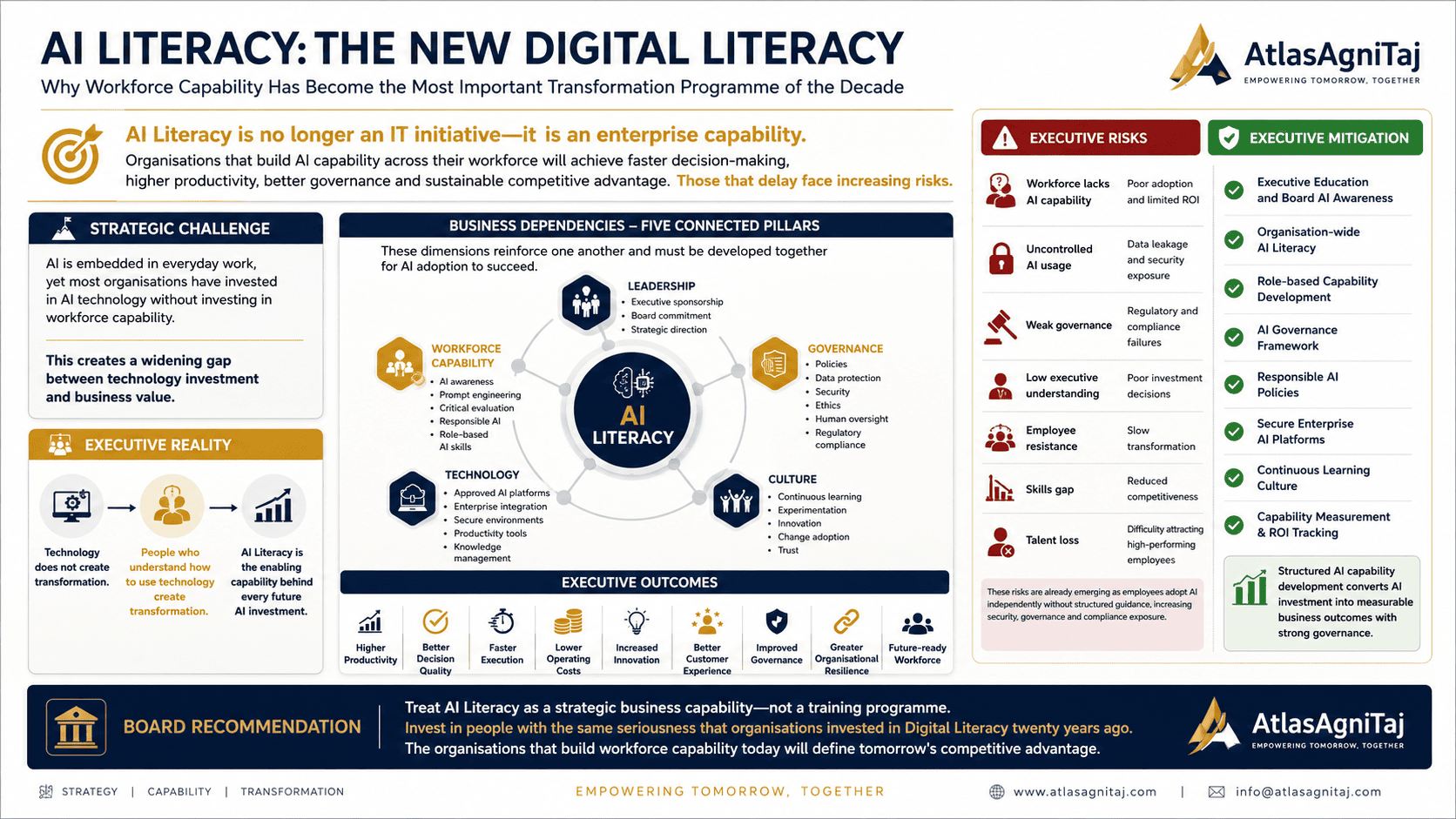
Today, we find ourselves at an almost identical inflection point. Artificial Intelligence has moved decisively out of the research laboratory and the specialist data science function, and it is now embedded in the everyday tools that colleagues use to draft communications, analyse data, prepare briefings, service customers, manage suppliers and make decisions. Yet the majority of organisations have not yet made the corresponding investment in workforce capability. The result is a widening gulf between the technological potential that has been procured and the human capability required to realise it.
This article sets out why AI literacy is rapidly becoming the defining organisational capability of the decade, why the parallels with the digital literacy programmes of the early 2000s are instructive rather than merely rhetorical, and what senior leaders should be doing now to prepare their workforces for a materially different operating environment.
The Historical Parallel
It is worth pausing to consider quite how transformative the digital literacy investment of the early 2000s proved to be. In the late 1990s, a significant proportion of the British and Gulf workforce had never used a personal computer in a professional context. Correspondence was largely paper based. Data lived in filing cabinets rather than shared drives. Meetings required physical presence, and the collaboration technologies we now take for granted, such as shared calendars, video conferencing and instant messaging, were either non existent or the preserve of a narrow technical elite.
The subsequent decade of sustained investment in digital literacy did not simply teach people how to send an email. It rewired the operating rhythm of the modern enterprise. It reduced the cost of coordination, accelerated decision cycles, opened new channels of customer engagement and, ultimately, enabled the emergence of entire new business models. Organisations that invested early and systematically in workforce digital capability captured a durable competitive advantage. Those that treated it as a peripheral IT matter, delegated to the training department and starved of executive attention, spent much of the following decade playing catch up.
The current AI moment carries all the same hallmarks. We have a general purpose technology that is genuinely useful across almost every function. We have a supply of capable tools that is expanding faster than most organisations can absorb them. We have a workforce whose everyday productivity, judgement and creativity stand to be materially amplified by these tools. And, once again, we have a leadership community that risks confusing the deployment of technology with the development of the human capability required to use it well.
Why AI Literacy Is No Longer Optional
Artificial Intelligence is no longer reserved for technical specialists. It is becoming a workplace capability that affects almost every function, from human resources and finance to operations, customer service and project management. A finance analyst who can prompt a generative model to interrogate a variance report will produce sharper insight in a fraction of the time. A human resources business partner who understands the strengths and limitations of AI assisted screening tools will make more equitable hiring decisions. A project director who can deploy AI to summarise steering committee papers, draft communications and stress test risk assumptions will materially raise the quality of programme governance.
These are not hypothetical use cases. They are being executed today, at scale, in organisations across the Gulf Cooperation Council, the United Kingdom, Europe and the wider international market. The competitive question facing senior leadership is no longer whether Artificial Intelligence will change the nature of professional work, but how quickly their own workforce will develop the fluency required to participate in that change rather than be displaced by it.
Employees who understand AI fundamentals are, in practice, better equipped to:
- Work more efficiently, by identifying the tasks and workflows most suited to intelligent automation and applying the appropriate tools with confidence.
- Make better informed decisions, by using AI to surface patterns, generate options and pressure test their own reasoning.
- Evaluate AI generated content critically, recognising the risks of factual inaccuracy, statistical hallucination, source obscurity and inherited bias.
- Protect confidential information, by understanding the data protection, intellectual property and regulatory implications of the prompts they compose and the platforms they use.
- Use AI responsibly, in a manner consistent with organisational values, professional ethics and the emerging regulatory frameworks that govern the technology.
Each of these capabilities is, in isolation, valuable. Taken together, they represent a fundamentally new form of professional competence, and one that will, within a very short horizon, be considered an entry level requirement rather than a differentiator.
The Leadership Imperative
For senior leaders, AI literacy is not simply a productivity question. It is a leadership question, a governance question and, ultimately, a cultural question. The leaders of the coming decade will be those who can articulate a credible vision for how Artificial Intelligence will reshape their organisation, mobilise investment behind that vision, and, crucially, take the workforce with them.
The evidence from earlier waves of enterprise transformation is unambiguous. Programmes fail far more often for cultural and behavioural reasons than for technical ones. Enterprise Resource Planning implementations do not fail because the software does not work; they fail because the workforce has not been equipped, prepared or persuaded to work in the way the new platform requires. Cloud migrations do not stall because the target architecture is unsound; they stall because the operating model, the skills mix and the incentives have not been recalibrated. Artificial Intelligence transformation will follow the same pattern with even greater force, because AI touches not just the tools people use but the very nature of the cognitive work they perform.
For leaders, therefore, AI literacy creates more than productivity gains. It builds confidence, reduces resistance to change and supports the successful delivery of transformation programmes that would otherwise founder on cultural inertia. A workforce that understands the technology is a workforce that can meaningfully participate in shaping its adoption. A workforce that does not is a workforce that will, quite reasonably, resist a change that has been done to it rather than developed with it.
The Risk of Inaction
It is tempting, in the face of a fast moving technology, to adopt a cautious posture and defer significant workforce investment until the landscape stabilises. This instinct is understandable, but it is strategically dangerous.
There are three distinct categories of risk that accompany a wait and see approach. The first is competitive. Organisations whose workforces are AI fluent will operate at materially lower unit cost, higher decision velocity and greater innovation intensity than those whose workforces are not. The gap compounds year on year, and it is exceptionally difficult to close through subsequent effort.
The second is operational. In the absence of structured literacy programmes, employees will use Artificial Intelligence anyway. They will do so with personal accounts, on personal devices, using unsanctioned tools, and they will feed confidential organisational information into platforms whose data handling practices have not been reviewed. This is not a hypothetical concern; it is the current reality in a large proportion of enterprises that have not yet issued clear guidance. The exposure is real, and it is growing.
The third is reputational and regulatory. The European Union, the United Kingdom and several Gulf jurisdictions are moving decisively towards more structured AI governance regimes. Organisations that cannot demonstrate a considered, documented and reasonable approach to how their workforce uses these technologies will face increasing scrutiny from regulators, auditors, boards and, in due course, customers.
A fourth and often overlooked risk is talent related. The most capable professionals, particularly those in the early and mid stages of their careers, are actively evaluating prospective employers on the sophistication of their approach to Artificial Intelligence. An organisation that offers a modern, well governed and capability rich AI environment will attract and retain talent that is otherwise increasingly mobile. An organisation that offers the opposite will find itself, quietly but persistently, losing the very people on whom its future depends.
A Structured Approach to Building AI Literacy
Building AI literacy across an organisation is neither a single training course nor a matter of purchasing an enterprise licence for a generative platform. It is a sustained, layered programme that touches strategy, policy, capability, tooling and culture. The organisations that are getting this right, and there are now enough examples internationally to draw meaningful lessons, tend to approach it along four broad dimensions.
Foundational awareness for the entire workforce
Every employee, from the executive committee to the front line, should possess a common baseline understanding of what Artificial Intelligence is, what it can and cannot do, what its principal risks are and how to use the sanctioned tools in a safe and productive manner. This baseline is best delivered as a structured curriculum, ideally accompanied by scenario based exercises drawn from the organisation’s own operating context.
Role specific fluency for high leverage functions
Certain functions, notably finance, human resources, legal, procurement, marketing, customer service and programme delivery, offer disproportionate value from AI adoption and warrant deeper, function specific capability development. This involves not only tool proficiency but the redesign of workflows, the recalibration of key performance indicators and the reconfiguration of team structures to reflect the new distribution of human and machine effort.
Leadership capability at executive and senior management level
Senior leaders require a different kind of literacy. They need to understand the technology sufficiently to make sound investment decisions, to challenge vendors credibly, to set policy, to evaluate proposals and to have informed conversations with their boards. They do not need to write code, but they do need to reason clearly about strategic implications, ethical trade offs and organisational design.
Governance, policy and assurance
Underpinning all of the above is a governance framework that sets clear expectations regarding acceptable use, data handling, model selection, human oversight, procurement and third party risk. Without this framework, individual capability, however impressive, will not translate into organisational advantage. With it, capability becomes cumulative and compounding.
The Strategic Horizon
As Artificial Intelligence continues to evolve, and the pace of that evolution shows no sign of slowing, organisations that invest in workforce capability today will be materially better positioned to adapt tomorrow. The specific tools will change. The specific models will be superseded. The specific vendors will consolidate, fragment and reconfigure. What will endure is the organisational muscle that has been built around understanding, adopting and governing these technologies.
This is precisely the lesson of the digital literacy era. The organisations that thrived through the two decades that followed were not those that picked the correct spreadsheet package in 2001, or backed the winning collaboration platform in 2007. They were those that built, and then continually renewed, a workforce culture in which technology adoption was expected, supported, resourced and celebrated. The tooling was transient. The capability was permanent.
It is also worth noting that AI literacy, properly delivered, has a compounding cultural effect that goes well beyond the immediate productivity gains. A workforce that has been trusted to engage seriously with a new and consequential technology becomes, in turn, a more confident, more curious and more commercially engaged workforce. The programme itself signals something important to employees about how the organisation views them, and how it intends to invest in their continued relevance. In an era where employee engagement and organisational purpose are increasingly material to commercial performance, this second order benefit should not be underestimated.
AI literacy is no longer optional. It is becoming a core business skill, on a par with financial literacy, commercial acumen and communication competence. Organisations that treat it as such, and that invest with the seriousness of purpose the moment demands, will find themselves not only more productive in the short term, but strategically better positioned for whatever the next decade of technological change ultimately brings.
How Atlas Agni Taj Can Help
Atlas Agni Taj is a boutique transformation advisory practice with offices in London, Dubai and Singapore, working with senior leadership teams across the United Kingdom, the Gulf Cooperation Council and the wider international market. Our practice was founded on the conviction that the most valuable transformation work happens at the intersection of technology, capability and governance, and AI literacy sits squarely at that intersection.
We support organisations through the full arc of the AI capability agenda. This includes the design and delivery of executive briefings and board level education programmes; the development of tiered AI literacy curricula for the wider workforce, tailored to the organisation’s sector, risk appetite and operating context; the design of governance frameworks that align with emerging European Union, United Kingdom and Gulf regulatory expectations; the definition of role specific capability standards for high leverage functions; and the establishment of internal Communities of Practice that sustain capability over time.
We also work with organisations to translate AI literacy investment into demonstrable operational outcomes, including the identification of high value use cases, the design of pilot programmes, the reconfiguration of operating models around augmented workflows and the establishment of measurement frameworks that provide the board with credible evidence of return on investment.
Our approach is deliberately senior, deliberately practical and deliberately independent. We do not resell platforms, we do not accept vendor commissions and we do not deliver generic training. Every engagement is scoped around the specific ambitions, constraints and cultural realities of the client, and every recommendation is designed to be executable by the client’s own leadership team.
For organisations that recognise that AI literacy is the workforce capability question of the decade, and that wish to move beyond ad hoc experimentation to a structured, board endorsed programme of investment, we would welcome the opportunity to have a considered conversation. The technology will continue to advance regardless of the choices any individual organisation makes. The question is whether the workforce will advance with it.
Our client engagements typically begin with a discreet strategic diagnostic, in which we assess the organisation’s current state across capability, governance, tooling and culture, and identify the most credible pathway to a structured programme. From that foundation, we work alongside the client’s executive team to shape the ambition, sequence the investment and deliver the initial waves of capability, always with an unwavering emphasis on transferring ownership to the client organisation itself. Our objective is not to remain indefinitely; it is to accelerate the client through the difficult early phase and leave behind an organisation that is genuinely self sufficient in its AI literacy and adoption journey.
Please visit www.atlasagnitaj.com or contact the practice directly to discuss how we might support your organisation’s AI literacy and transformation agenda.
#AILiteracy #DigitalTransformation #FutureOfWork #Leadership #AtlasAgniTaj