Why enterprise readiness — not model selection — is the decisive factor in the next wave of AI value creation
Agentic AI has moved with remarkable speed from research demonstrations to boardroom ambition. In the space of eighteen months, the conversation has shifted from what large language models can generate to what autonomous agents can do. Enterprises across the Gulf, Europe and North America are announcing agentic pilots at pace, and vendors are competing to reframe every product roadmap around agents, orchestration and multi-step reasoning. The direction of travel is unambiguous.
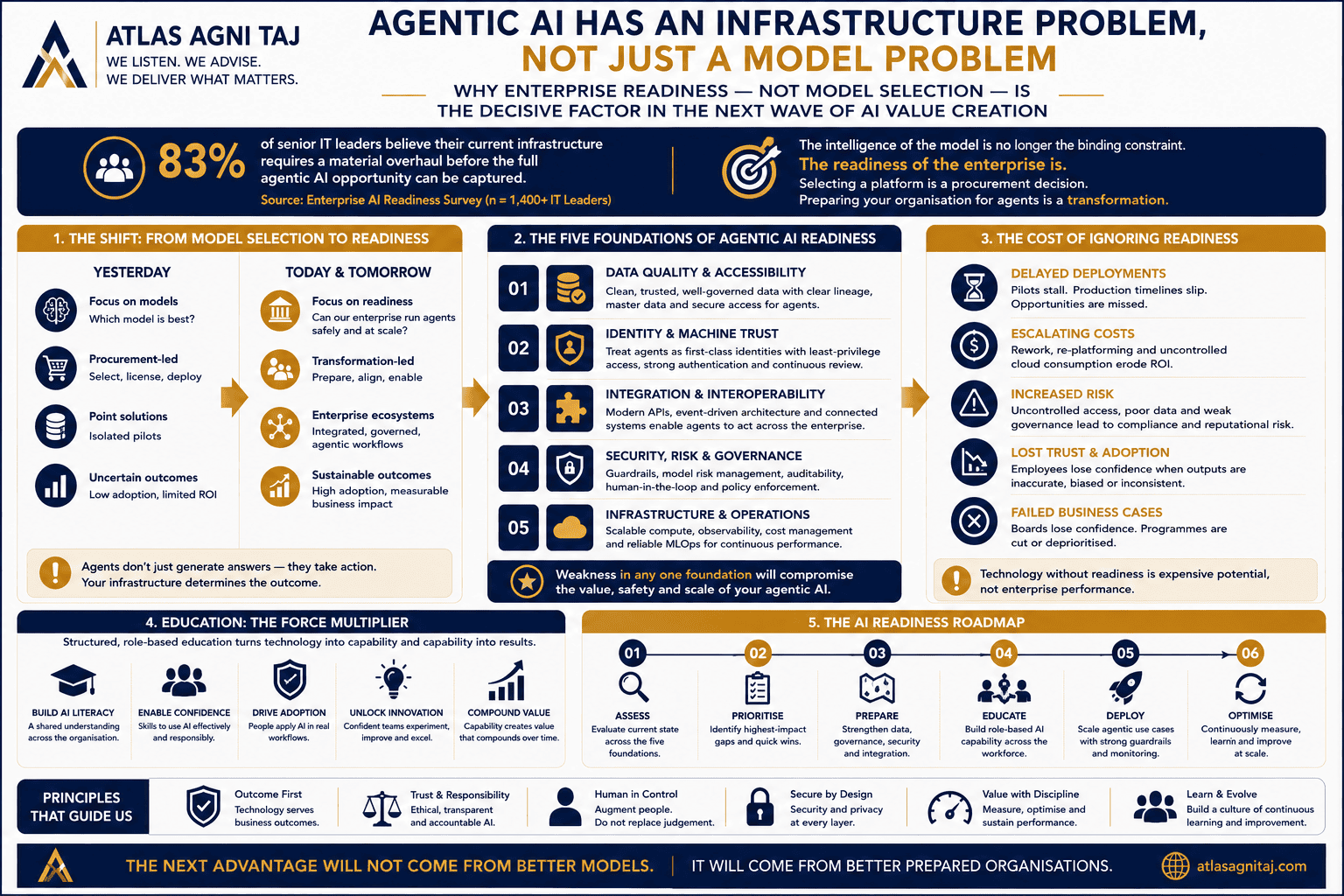
What is less widely acknowledged is that most enterprises are not yet ready to operate agentic systems at scale. A recent survey of more than 1,400 senior IT leaders found that eighty-three per cent believe their current infrastructure requires a material overhaul before the full agentic opportunity can be captured. That is not a finding about model quality. It is a finding about foundations — data, identity, integration, capacity, governance and accountability. The intelligence of the model is no longer the binding constraint. The readiness of the enterprise is.
This distinction matters, because it changes the nature of the executive conversation, the shape of the investment case and the profile of leadership required to deliver. Selecting an AI platform is a procurement decision. Preparing an organisation to allow software agents to act on its behalf is a transformation programme. Confusing the two is one of the more expensive category errors a leadership team can make, and the cost is beginning to surface in delayed deployments, ballooning cloud bills, unresolved audit findings and stalled business cases.
From Model Selection to Enterprise Readiness
For the last three years, the dominant question in enterprise AI has been which model to choose. Should the organisation standardise on a frontier foundation model, adopt an open-weight alternative, or maintain a portfolio approach across providers? Which vendor offers the most attractive commercial terms, the strongest sovereignty guarantees, the deepest regional presence? These questions remain relevant, but they have quietly ceased to be the questions that determine outcomes.
Agentic AI changes the equation because agents are not passive generators of text or images. They are systems that plan, decide and act. They read from operational data stores, invoke enterprise APIs, execute transactions, update records of consequence and, in some architectures, coordinate with other agents to complete multi-step workflows without direct human intervention at each step. The moment an agent is empowered to act, the surrounding environment — the data it consumes, the identities it assumes, the systems it touches, the controls that constrain it — becomes at least as important as the model that reasons within it.
This is why the eighty-three per cent figure should be read carefully. It is not a statement that enterprises need more graphics processing units, although many do. It is a statement that the operating substrate on which agents will run — the composite of data platforms, identity services, integration fabrics, security controls, observability tooling, cost management disciplines and governance structures — is not yet fit for purpose in the majority of large organisations. Fixing that substrate is a multi-year, cross-functional undertaking, and it is where the next phase of value will be won or lost.
The Five Foundations Every Board Should Examine
Before scaling agentic AI beyond controlled pilots, executive teams should conduct a candid assessment across five foundations. Each is a well-established discipline in its own right. What is new is the way agentic AI amplifies the consequences of weakness in any one of them.
1. Data Quality and Accessibility
Agents are only as trustworthy as the data they consume. In many enterprises, critical business data remains fragmented across legacy enterprise resource planning systems, bespoke operational platforms, regional databases, shared drives and unstructured document repositories. Data lineage is often undocumented, master data is inconsistently governed, and definitions of core entities — customer, product, contract, employee — vary between functions. A generative assistant answering questions in a chat window can absorb some of this ambiguity. An autonomous agent taking action cannot.
The organisations making the most credible progress are those that have invested in a genuine data foundation: a governed catalogue of authoritative sources, resolved master data domains, documented lineage, well-defined semantic layers, and access patterns that agents can invoke reliably through APIs rather than screen-scraping or unreliable extraction. This is unglamorous work. It rarely features in vendor keynotes. But without it, every agent built on top will inherit the ambiguities of the underlying estate, and the errors will compound rather than average out.
2. Identity, Access and the Question of Machine Trust
When an agent acts, it acts under some identity. That identity determines what it can read, what it can change and what it can approve. In most enterprises, identity and access management was designed with human users in mind, supplemented by service accounts for machine-to-machine integration. Agentic AI introduces a third category — non-human actors that behave with a degree of autonomy, whose actions may vary from one execution to the next and whose access requirements may span dozens of systems within a single workflow.
The mature response is to treat agent identities as first-class citizens within the identity fabric. That means unique identities per agent, least-privilege access scoped to specific tasks, short-lived credentials, comprehensive logging of every action taken under that identity, and clear delegation patterns when an agent is acting on behalf of a human user. It also means rethinking segregation of duties. If an agent can both initiate a payment and approve it, the traditional control has been silently dissolved. Boards should be asking how their access model has evolved to accommodate autonomous actors, and whether their audit teams have been equipped to test it.
3. Integration with Enterprise Platforms
Most enterprise value sits inside systems that were never designed to be driven by an intelligent caller. Core banking platforms, insurance policy administration systems, hospital electronic medical records, government case management platforms, industrial control systems — these are the systems where the transactions of consequence occur. Modern agentic pilots often begin with peripheral use cases precisely because integrating with these platforms is difficult, and the peripheral use cases are where quick wins are found.
Peripheral use cases, however, do not move the strategic needle. The prize is in the core. Reaching it requires disciplined investment in integration: modern application programming interfaces, event streams, message-based architectures, well-governed integration platforms, and, where necessary, targeted modernisation of the underlying systems themselves. Agentic AI is exposing the true cost of decades of integration debt. Some of that debt will need to be repaid before agents can operate where the value actually lies.
4. Cost, Capacity and the Physics of Scale
Agentic workflows are dramatically more computationally expensive than the single-turn generation patterns that dominated earlier enterprise AI usage. An agent that plans, retrieves, reasons, invokes tools, reflects and iterates may consume ten, fifty or a hundred times the tokens of a comparable chat interaction. When such workflows are embedded in high-volume operational processes, the resulting cost curve can be dramatic, and it is often invisible until it appears on a monthly invoice.
This is compounded by real constraints on infrastructure supply. Access to accelerator capacity, particularly in sovereign or in-region deployments, remains uneven. Power and cooling constraints are becoming binding factors in data centre planning, and the energy profile of large-scale agentic operations is a legitimate concern for both boards and regulators. Latency, too, matters more than it did. An agent that must complete a real-time customer interaction cannot afford unpredictable response times from any component in its chain.
Executives should insist on economic modelling before agentic use cases are approved for scale. Unit economics — cost per completed workflow, cost per successful outcome, cost per unit of business value delivered — need to be understood at the pilot stage and stress-tested against realistic production volumes. Where the economics do not work, the answer is often not to abandon the use case but to redesign the workflow, apply smaller models to sub-tasks, cache aggressively, or introduce human checkpoints that materially reduce cost. This is engineering discipline, and it belongs at the centre of the programme, not at the periphery.
5. Human Oversight and Decision Accountability
The final foundation is the most human. When an autonomous system acts and something goes wrong, who is accountable? This is not a rhetorical question. Regulators across the Gulf, Europe and beyond are converging on the view that accountability cannot be delegated to a model. A named human, or a named function within a named legal entity, must remain answerable for the outcomes of automated action. The organisational implication is significant: every agentic workflow needs an accountable owner, a defined risk appetite, an approval envelope, and a monitored kill-switch.
Human oversight, properly designed, is not an obstacle to agentic scale. It is an enabler of it. Well-designed checkpoints allow organisations to grant agents progressively wider latitude as evidence of reliable performance accumulates, in the same way a new employee is entrusted with steadily larger decisions. Poorly designed oversight, by contrast, either strangles the workflow with unnecessary review or leaves the organisation exposed when the agent inevitably encounters a situation outside its training distribution. The design of these checkpoints is a leadership responsibility, not an engineering afterthought.
Governance: Making the Invisible Visible
Beneath these five foundations sits a broader challenge of governance. Agentic AI introduces a class of systems whose behaviour is emergent, whose reasoning is opaque and whose actions may not be fully deterministic even under identical inputs. Traditional IT governance frameworks — designed for systems whose behaviour can be specified, tested and frozen — struggle with these characteristics. Boards are increasingly being asked to approve investments in technologies whose behaviour cannot be exhaustively described in advance.
The response is not to abandon governance. It is to modernise it. Effective agentic governance blends established disciplines — model risk management, operational risk, information security, data protection, change control — with newer capabilities: continuous evaluation of agent behaviour against defined benchmarks, red-teaming of agent decision-making, structured incident review when agents act outside expected bounds, and transparent reporting to the board on both value delivered and adverse events observed.
In regulated sectors — financial services, healthcare, energy, government — this governance overlay is not optional. It is a licence-to-operate concern. In less regulated sectors, it is a reputation and resilience concern. In both, the organisations that build governance into the design of their agentic programmes from the outset will move faster than those that treat governance as a compliance retrofit.
The Operating Model Question
Perhaps the most consequential shift, and the one least discussed in technical forums, is the operating model implication. Agentic AI does not sit tidily within any existing organisational box. It touches the technology function, but it is not solely a technology matter. It touches operations, because it changes how work is performed. It touches human resources, because it changes the shape of roles. It touches risk, legal and compliance, because it changes the nature of accountability. It touches finance, because its cost profile is unlike either traditional software or traditional labour.
Enterprises that succeed with agentic AI at scale will be those that make deliberate choices about where the capability sits, who owns it, how it is funded, and how value is measured. A centralised model risks becoming a bottleneck. A fully federated model risks fragmentation, duplication and loss of leverage on foundational investments. The pragmatic answer for most large enterprises is a hub-and-spoke pattern: a central platform team responsible for the shared foundations — data, identity, integration, evaluation, governance — and federated delivery teams close to the business, empowered to build and operate agents within a common framework.
Choosing this shape is a leadership act. It cannot be delegated to a working group. Boards and executive committees should be actively involved in setting the operating model for enterprise AI, because it will shape the flow of investment and the distribution of accountability for years to come.
Alongside structure, funding models require particular attention. Traditional project-based funding, where a business case is approved once and delivered over a fixed period, sits uneasily with agentic AI. The technology is evolving too rapidly, and the value profile of individual use cases is too uncertain, for a single approval to remain meaningful across a multi-year horizon. More effective are product-oriented funding models, in which persistent teams are funded to operate defined agentic capabilities against measured business outcomes, with periodic reappraisal of scope and investment. This is a familiar pattern from mature digital operating models, and it applies to agentic AI with even greater force.
The Sovereignty and Regulatory Dimension
For organisations in the Gulf, and increasingly across other regulated jurisdictions, there is a further layer to consider. Agentic AI does not respect the neat lines that data protection regimes, sectoral regulators and national sovereignty frameworks have drawn. An agent that reads customer data in one jurisdiction, reasons via a model hosted in another and executes a transaction in a third has created a cross-border processing chain that most compliance frameworks were not designed to interpret. Regulators are catching up quickly, and the direction of travel is towards clearer expectations around data residency, model hosting, algorithmic accountability and the auditability of automated decisions.
Enterprises operating in the United Arab Emirates, Saudi Arabia and the wider Gulf region are already navigating an evolving framework in which sovereign cloud, regional hosting and controlled data flows are becoming baseline expectations rather than premium options. This has direct implications for agentic architecture. Model selection, hosting location, integration paths and logging arrangements need to be designed with sovereignty in view from day one, not retrofitted when a regulator asks pointed questions. Organisations that treat this as an architectural constraint to be embraced, rather than a compliance burden to be minimised, will find themselves better positioned commercially as well as legally.
Avoiding the Next Generation of Shadow Systems
A quieter risk deserves executive attention. In the absence of clear enterprise foundations, business units will build their own agentic solutions using whatever tools are available. Low-code platforms, standalone AI services and consumer-grade automation tools have made it easy to assemble something that looks and feels like an agent in a matter of days. Many of these will be genuinely useful. A material subset will become the shadow systems of the next decade — connected to real data, executing real actions, unmonitored, undocumented and outside any governance framework.
Preventing this outcome does not require heavy-handed prohibition. It requires the enterprise to offer a better alternative. When business teams can access governed data, approved models, evaluated tools and clear guardrails through a well-supported internal platform, the incentive to build unmanaged shadow agents diminishes. When they cannot, no policy statement will hold the line indefinitely. The lesson from a generation of shadow spreadsheets, shadow databases and shadow cloud is that shadow AI will follow the same pattern if the enterprise does not provide a credible sanctioned path.
A Board-Level Agenda for the Next Twelve Months
For chief executives, chairs and board committees seeking a practical agenda, the following five questions offer a useful starting point. They are deliberately framed to draw out readiness rather than ambition.
- Where is our authoritative data, how is it governed, and can our agentic systems access it reliably through modern interfaces rather than fragile extraction?
- How have we extended our identity and access model to accommodate non-human actors, and how are the actions of those actors logged, monitored and reviewed?
- What is the state of our integration with the systems where value actually sits, and what modernisation is required before agentic workflows can reach those systems safely?
- What is the unit economics of our most important agentic workflows at production scale, and have we stress-tested them against realistic volumes and infrastructure constraints?
- Who is accountable, by name and role, for the outcomes of each agentic workflow in production, and what oversight arrangements are in place to support that accountability?
These are not technical questions. They are governance questions with technical dimensions, and they are properly the province of the board. Executives who can answer them clearly are in a materially stronger position than those who cannot, regardless of which model or platform their organisation has selected.
The Leadership Reframe
The most important shift for technology leaders is the reframing of what agentic AI actually is. It is not a product to be purchased. It is not a workstream within the digital function. It is a mode of operating that gradually spreads across the enterprise, changing how work is performed, how decisions are taken and how accountability is distributed. Treated as such, it demands the disciplines of enterprise transformation: clarity of vision, sequenced investment, architectural coherence, credible governance, engaged sponsorship and disciplined delivery.
The organisations that will lead the next decade are not those with the largest inventory of pilots or the most fashionable model partnerships. They are those that have built the foundations — architectural, operational and cultural — on which agentic systems can be trusted to act. That work is quieter, harder and less photogenic than a launch announcement. It is also the work that will determine which enterprises capture durable value from agentic AI, and which spend the next five years explaining why their ambitions did not translate into results.
The question for every executive team is not which model to adopt. It is whether the enterprise is architecturally and operationally ready to allow AI systems to act on its behalf, at scale, safely and economically. Those who can answer that question with confidence will find the model choices resolve themselves. Those who cannot will find that no model, however capable, will compensate for foundations that were never built.
How Atlas Agni Taj Can Help
Atlas Agni Taj is a boutique transformation advisory firm with offices in London, Dubai and Singapore. We work with boards, chief executives and technology leaders across the Gulf, Europe and Asia to translate agentic AI ambition into architecturally coherent, operationally deliverable and commercially defensible programmes. Our work is built on more than three decades of enterprise transformation experience across banking, government, healthcare, aviation, energy and diversified conglomerates, with a particular depth in regulated environments and sovereign infrastructure contexts.
Where organisations are moving from isolated pilots to enterprise-scale agentic deployment, we help leadership teams answer the difficult questions rather than avoid them. Our engagements typically address one or more of the five foundations described in this article, and we structure our work to fit around the pace and shape of each client’s existing programme rather than imposing a template method.
Advisory Areas
- Agentic AI readiness assessment — an independent, board-ready diagnostic across data, identity, integration, cost, governance and operating model, benchmarked against comparable enterprises and calibrated to sector-specific regulatory expectations.
- Architecture and target operating model design — pragmatic blueprints for the data foundation, integration fabric, identity model, evaluation platform and governance overlay required to operate agents safely at scale.
- Programme governance and delivery assurance — PMO design, portfolio structuring, sponsor coaching and independent assurance for enterprise AI programmes, drawing on established disciplines from large-scale ERP, cloud and sovereign infrastructure delivery.
- Sovereign and regulated deployment strategy — advisory on data residency, model hosting, cross-border processing and audit-readiness for organisations operating in the UAE, wider Gulf and other regulated jurisdictions.
- Executive and board enablement — private briefings, tailored workshops and interim leadership support to equip chairs, chief executives and executive committees to steward agentic AI investments with confidence.
Every engagement is led personally by senior practitioners who have delivered transformation programmes at scale, not by junior consultants working from a playbook. We believe that the next decade of enterprise value will be captured by organisations whose foundations are built with intent, and we exist to help our clients build those foundations well.
For a confidential conversation about your organisation’s agentic AI readiness, or to explore how our advisory services might support an ongoing programme, please visit atlasagnitaj.com or contact us directly through LinkedIn.
#AgenticAI #EnterpriseAI #DigitalTransformation #TechnologyLeadership #AIInfrastructure #DataStrategy #CIO #AIGovernance #EnterpriseArchitecture #BoardLeadership
Atlas Agni Taj — Transformation advisory for the age of intelligent systems.