The rise of the commercial CIO — and why integrated technology economics is now a board-level discipline
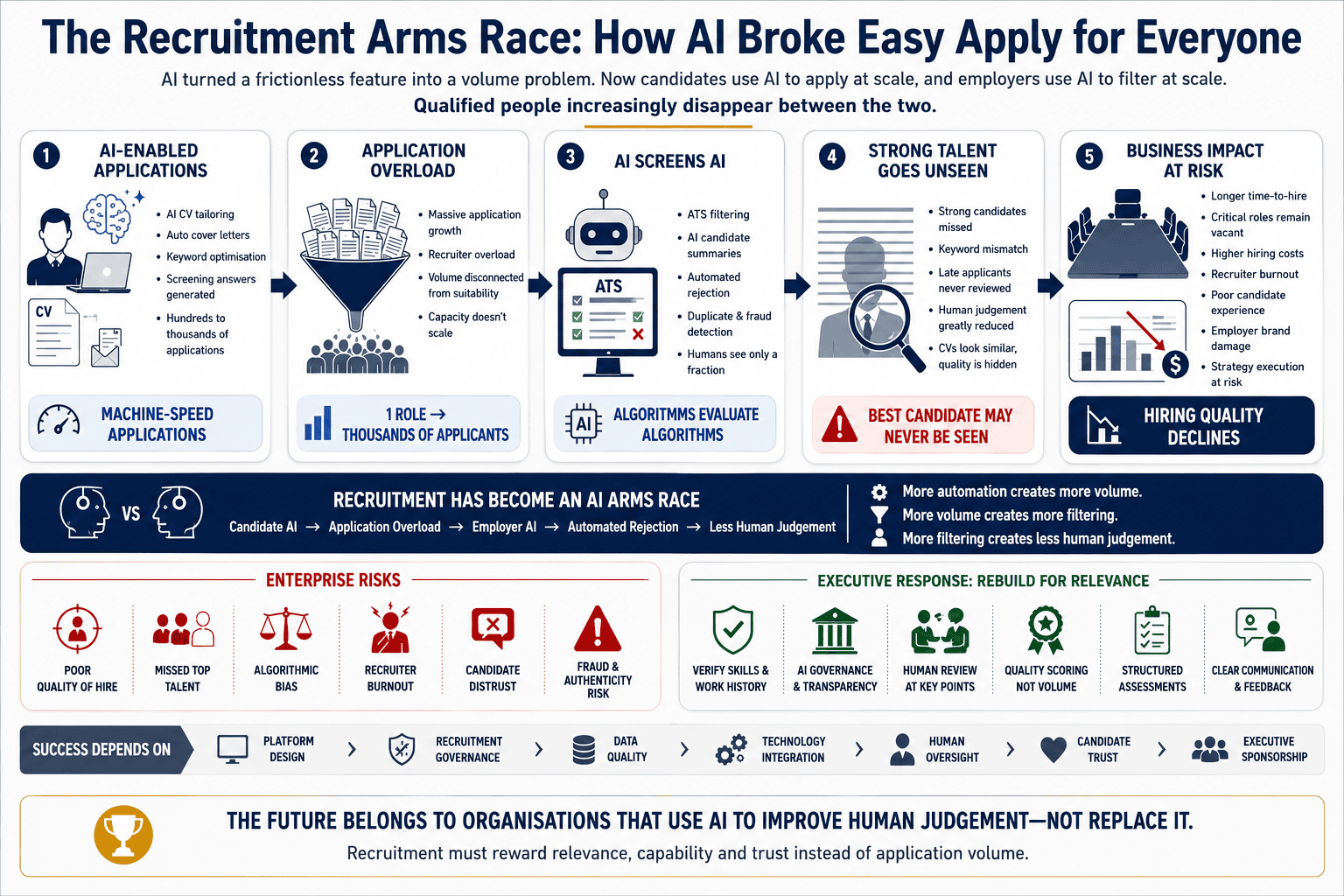
The office of the Chief Information Officer has entered a new commercial era. For much of the past decade, the CIO agenda was defined by digital modernisation, cloud migration and the industrialisation of software delivery. Cost discipline was important, but it was frequently treated as a functional exercise — a matter of contract renegotiation, capacity right-sizing or occasional vendor consolidation. That framing is no longer sufficient. Artificial intelligence has arrived at industrial scale, cloud consumption has continued to expand, and the software-as-a-service estate has quietly become the single largest and least governed portfolio in most enterprises. The CIO is now expected to answer, with precision, a question that few technology leaders have historically been equipped to answer: what does the organisation actually spend on technology, and what does it receive in return?
This question is not rhetorical. Boards, chief financial officers, private-equity operating partners and audit committees are asking it directly. In parallel, cybersecurity risk continues to intensify, regulatory scrutiny of data and AI is rising in every major jurisdiction, and shadow IT is no longer a marginal phenomenon but a structural feature of the modern enterprise. Managing these forces in separate silos — one team for cloud, another for SaaS, another for AI, another for security — is no longer credible. The commercial CIO is the executive who brings these disciplines together and demonstrates, with evidence, where technology creates value and where it does not.
The convergence problem: why silos are no longer defensible
Enterprise technology has evolved into a portfolio of interdependent consumption models. Public cloud platforms are billed by usage. Software-as-a-service is billed by seat, by tier, by transaction or by feature. Artificial intelligence is billed by tokens, by inference volume, by model, by fine-tuning cycle, by vector storage and by supporting compute. Data platforms are billed by ingestion, by query, by storage and by egress. Each of these commercial models has its own vocabulary, its own optimisation levers and its own community of specialists. Historically, that specialisation has been treated as a strength. In practice, it has become a weakness.
The reason is straightforward. Business capabilities do not respect these categories. A customer service transformation programme may consume cloud compute, a customer relationship management SaaS platform, a data warehouse, an AI copilot, an integration layer, an observability stack and multiple security tools — all at the same time, all for a single business outcome. If each of these lines of expenditure is governed by a different team, reported to a different committee and measured against a different metric, the enterprise cannot answer the most basic commercial question: is this transformation actually paying back? Worse, decisions taken in one silo routinely create cost, risk or dependency in another. A cloud team may celebrate a workload migration that quietly triggers a substantial data egress charge and a new SaaS licence requirement. A SaaS renewal may lock in unused seats that could have been consolidated with an existing AI-enabled platform. An AI pilot may spin up compute in a region that violates data residency commitments made by the security function.
Convergence is not merely a technical observation. It is a commercial imperative. The CIO who continues to organise technology economics as three or four parallel budgets — with three or four parallel governance conversations — will be unable to deliver the transparency that the executive committee now expects. The organisations that resolve this most quickly will treat cloud, SaaS, data and AI as a single integrated portfolio, governed by a single commercial framework and measured against a single set of business outcomes.
The AI cost dimension: hidden, distributed and rapidly compounding
Artificial intelligence is the newest and most volatile line in the technology budget. It is also the least understood. Executive teams frequently assume that the cost of AI is the licence fee attached to a large language model or a copilot subscription. In reality, the licence fee is often the smallest component. Enterprise AI introduces cost across at least seven distinct categories: model consumption, supporting compute, storage and vector databases, data preparation and pipelines, integration into existing systems, monitoring and observability, and specialist platforms for governance, safety and evaluation. Each of these categories has its own commercial dynamics and its own tendency to grow silently.
Model consumption is the most visible cost, but it is also the most difficult to forecast. Token-based pricing means that a single poorly designed prompt template, repeated at scale, can produce a materially different bill from a well-designed equivalent. Retrieval-augmented architectures introduce further variability, because the volume of context passed to a model depends on the quality of the retrieval layer, which depends in turn on the quality of the underlying data. Fine-tuning, evaluation cycles and guardrail testing all consume additional model calls that rarely appear in the original business case.
Supporting compute is often invisible until it is not. Inference workloads on GPU infrastructure, whether managed or self-hosted, generate meaningful hourly charges even when idle. Vector databases scale with the volume of embedded content, and the storage cost of embeddings frequently exceeds the storage cost of the source documents. Data pipelines feeding AI systems require orchestration, transformation and observability tooling that would previously have sat under analytics budgets. Integration into transactional systems introduces middleware costs, and the security posture required for AI — including secrets management, prompt injection defences, output filtering and audit logging — introduces further tooling that is rarely priced into the initial proposal.
The compounding effect is significant. An AI initiative that is presented to the executive committee as a modest six-figure investment can, within twelve to eighteen months, generate a seven-figure run-rate once all supporting components are accounted for. The CIO who cannot decompose this cost, attribute it to specific business outcomes and evidence the value released is exposed. The CIO who can do so is credible. This is the commercial discipline that boards now expect.
The SaaS estate: the largest ungoverned portfolio in the enterprise
If artificial intelligence is the most volatile line in the technology budget, software-as-a-service is the most neglected. In many organisations the SaaS estate has grown organically over a decade, driven by individual functional purchases, mergers and acquisitions, departmental innovation budgets and the deliberate design of vendors who have made procurement frictionless. The result, in a typical large enterprise, is a portfolio of several hundred SaaS applications, of which a material proportion are duplicative, under-utilised or entirely dormant.
The commercial consequences are substantial. Overlapping licences are paid for indefinitely because no single owner has the mandate to consolidate. Seat counts remain inflated long after employees have left the organisation or moved to other tools. Enterprise agreements are renewed on autopilot because the renewal window arrives before a proper utilisation review can be completed. Feature tiers are upgraded to unlock a single capability that could have been delivered by an existing platform. Data flows between applications create integration costs and security exposure that are rarely quantified. And shadow IT — the purchase of software on corporate credit cards, outside the formal procurement process — continues to introduce new applications faster than the central technology function can catalogue them.
The security implications compound the commercial ones. Every ungoverned SaaS application is a potential data exfiltration route, a potential compliance breach and a potential entry point for social engineering. When these applications hold customer data, employee data or intellectual property, the risk is not theoretical. Regulatory frameworks in the United Kingdom, the European Union, the Gulf Cooperation Council and elsewhere are increasingly explicit about the obligation to know where data resides and who has access to it. A SaaS estate that cannot be enumerated cannot be defended.
Application rationalisation is therefore both a cost discipline and a security discipline. It is not a one-off exercise but a continuous capability. The organisations that manage this well maintain a live application catalogue, a defined ownership model for every application, a utilisation baseline that is refreshed at least quarterly, and a governance forum at which redundant applications are actively decommissioned rather than passively renewed. This is unglamorous work. It is also, in most enterprises, the single largest source of releasable technology funding.
Cloud economics: from migration to sustained optimisation
Public cloud adoption is now a mature discipline in most large enterprises. Migration programmes have been completed, hybrid architectures have stabilised and multi-cloud strategies have moved from ambition to reality. What has not yet matured, in many organisations, is the ongoing commercial management of cloud consumption. The migration business case was typically built on assumptions about workload behaviour, reserved capacity and architectural discipline that have not survived contact with reality. Consumption has grown, in some cases dramatically, and the mechanisms designed to control it have not kept pace.
The most common weaknesses are well documented. Untagged resources cannot be attributed to a business owner and therefore cannot be challenged. Development and test environments run at production scale because no one has been made accountable for right-sizing them. Reserved instances and savings plans expire without renewal, or are renewed at the wrong commitment level. Data transfer charges accumulate silently across regions and providers. Storage tiers are not aligned with data lifecycle policies. Container platforms scale generously by default and are rarely tuned downwards. And architectural patterns that were appropriate for on-premises hardware are replicated in the cloud, producing an environment that is more expensive to operate than the one it replaced.
Sustained cloud optimisation is not a single project. It is a permanent capability, supported by a defined operating model, a set of policies enforced through platform engineering, and a commercial dialogue with business owners about the value of the workloads they sponsor. The financial operations discipline, commonly referred to as FinOps, provides a widely adopted framework for this capability, but the framework alone is not sufficient. It must be embedded in the way the enterprise governs technology decisions, from initial business case through architectural review, procurement, deployment, operation and eventual decommissioning. Without that embedding, cloud economics revert to the pattern of unchecked growth that produced the original problem.
The commercial CIO is not the executive who spends the least. It is the executive who can demonstrate where technology investment creates value — and where it does not.
An integrated commercial framework for cloud, SaaS, data and AI
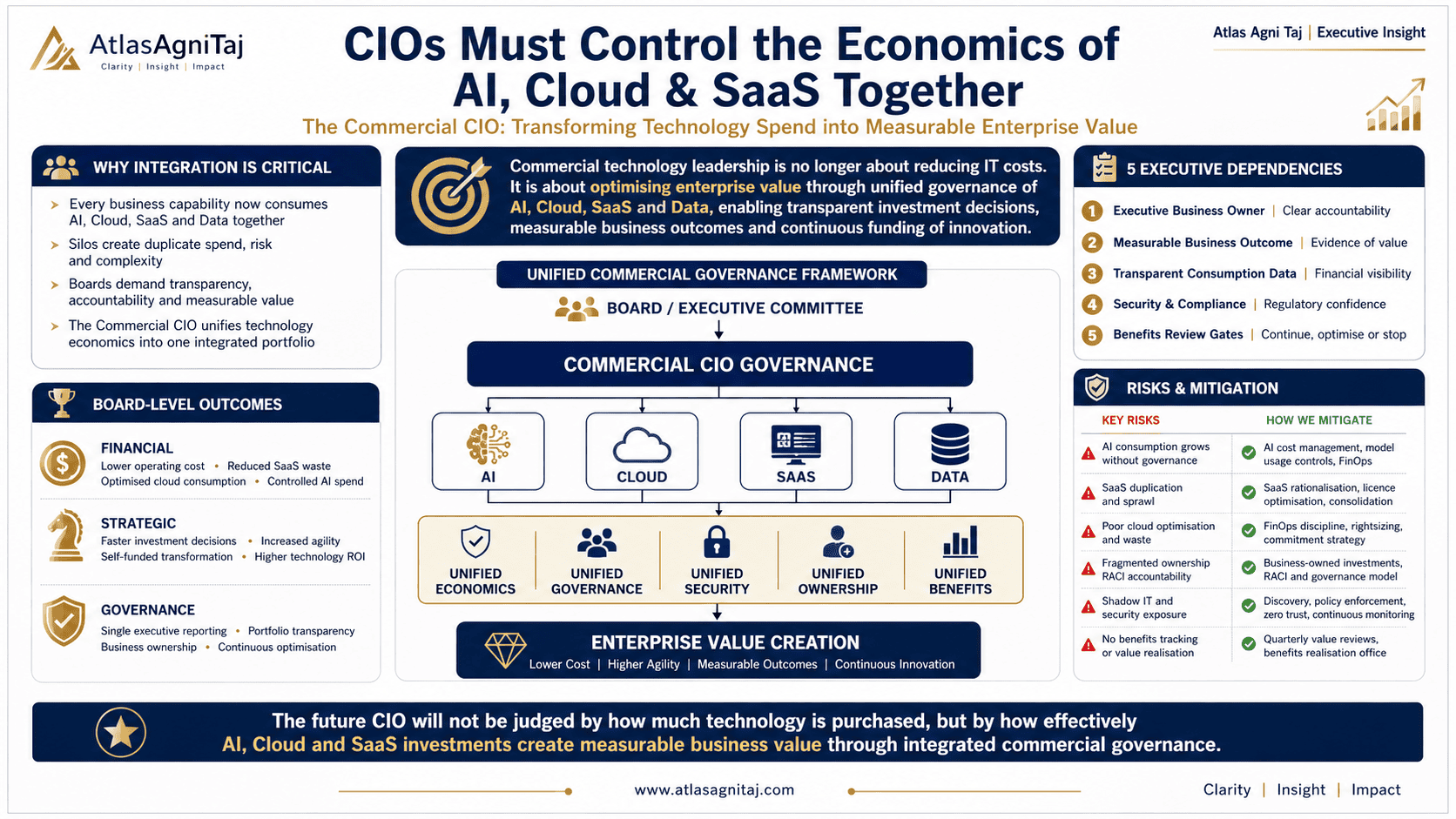
The response to convergence is a single commercial framework that governs all four domains. Such a framework does not require the dissolution of specialist teams. It requires the introduction of a common language, a common set of metrics and a common cadence of governance. In practice, this means five commitments that apply to every major technology investment, regardless of whether that investment sits in cloud, SaaS, data or AI.
The first commitment is a clear business owner. Every material technology investment must be sponsored by a named executive outside the technology function who is accountable for the outcome, not merely the delivery. This owner authorises the investment, approves scope changes, reviews consumption data and, ultimately, decides whether the investment continues. Without a named owner, no investment should proceed.
The second commitment is a measurable outcome. Every investment must be linked to a specific business result — a revenue effect, a cost effect, a risk effect, a customer effect or a regulatory effect — that can be observed, measured and reported. Aspirational outcomes such as “improved agility” or “enhanced innovation” are not acceptable substitutes. Where an outcome cannot be measured, the investment should be reframed until it can.
The third commitment is transparent consumption data. Every investment must produce consumption data that is visible to the business owner, the finance function and the technology function in a common format and on a common cadence. This includes cloud consumption, SaaS licence utilisation, AI token and compute consumption, data platform usage and the associated security and observability costs. Consumption data is the raw material of commercial governance; where it is not transparent, governance is impossible.
The fourth commitment is defined security and compliance controls. Every investment must operate within an explicit control framework that addresses data classification, access management, regulatory obligation, third-party risk and incident response. These controls are not a separate workstream to be resolved after go-live. They are a precondition of the investment proceeding.
The fifth commitment is an agreed decision point. Every investment must have a defined moment — typically at ninety days, one hundred and eighty days or twelve months — at which the business owner, the finance function and the technology function jointly review the evidence and decide whether to scale, redesign, sustain or stop the initiative. The absence of such a decision point is the single most common reason that low-value technology investments continue to consume budget long after their business case has evaporated.
Governance, ownership and benefits realisation
The five commitments above are only as effective as the governance apparatus that enforces them. In most enterprises this apparatus already exists in some form, but it is fragmented across multiple committees, each with a partial view. A modern technology investment committee — sometimes described as a value realisation board, sometimes as a portfolio council — brings together the CIO, the chief financial officer, the chief information security officer, the chief data officer where one exists, and the senior business executives who sponsor major technology investments. This forum reviews the full technology portfolio on a consistent cadence, challenges investments that are not delivering, approves the release of funding that has been freed by optimisation and directs that funding towards strategic priorities.
Benefits realisation is the discipline that distinguishes a credible commercial function from a nominal one. It is easy to approve a business case; it is much harder to return to that business case eighteen months later and evidence whether the promised benefits have materialised. Benefits realisation requires that the metrics agreed at the point of investment are actually captured, that the responsible executive is held to account for them, and that the results — positive or negative — are reported transparently to the executive committee and the board. In organisations where this discipline is embedded, the quality of business cases improves rapidly, because sponsors know they will be measured against their own commitments. In organisations where it is absent, business cases drift towards optimism and the enterprise steadily accumulates unrealised expectations.
Ownership sits at the centre of this discipline. The CIO cannot own the business outcomes of technology investments; those outcomes must be owned by the business executives who commissioned them. What the CIO owns is the platform, the governance framework, the consumption transparency, the security posture and the commercial dialogue that makes credible ownership possible. This distinction is critical. A CIO who accepts accountability for outcomes that only the business can deliver will, over time, be blamed for failures that are not their responsibility. A CIO who declines to build the framework that enables business accountability will, over time, be viewed as a cost centre rather than a commercial partner. The commercial CIO is the executive who insists on both — a clear ownership model and the transparent infrastructure that makes ownership possible.
Cost optimisation as a strategic instrument, not a defensive reflex
There is a persistent tendency, particularly in periods of economic pressure, to treat cost optimisation as an indiscriminate exercise in budget reduction. Every line is cut by a defined percentage. Every renewal is challenged. Every project is deferred. This approach produces short-term relief and long-term damage. It weakens the platforms on which future growth depends, it demotivates the technology workforce, and it typically fails to distinguish between investment that creates value and investment that does not. Within eighteen months, the deferred projects return, the weakened platforms require emergency remediation, and the enterprise has spent more than it saved.
A more sophisticated approach treats cost optimisation as a portfolio discipline. The objective is not to spend less; it is to spend better. In practical terms, this means identifying the technology investments that are not producing value, releasing the funding tied up in those investments, and redirecting that funding towards initiatives that support the strategic agenda. Done well, this is a continuous process rather than a periodic crisis response. It generates a steady flow of internally funded transformation capacity, which reduces the enterprise’s dependence on external funding and improves the credibility of the technology function with the executive committee and the board.
The organisations that manage this best treat the optimisation cycle as an integral part of their planning process. Every annual budget begins with a review of the existing portfolio, a challenge to underperforming investments, and a redirection of released funding towards the priorities agreed with the board. This produces a technology budget that grows more slowly than the surface figures suggest, because a proportion of each year’s spending is funded from the previous year’s optimisation. Over time, this compounds into a substantial competitive advantage.
The mandate of the commercial CIO
The commercial CIO operates at the intersection of technology, finance and business strategy. This is a different role from the technical CIO of the past, who was primarily concerned with delivery, reliability and modernisation. The commercial CIO retains all of those responsibilities but adds a further one: the demonstration, in the language of the executive committee and the board, of the value that technology investment creates.
This mandate has several implications for how the technology function is organised. It requires senior technology leaders who are comfortable with commercial concepts — unit economics, contribution margin, capital allocation, portfolio management — and who can engage credibly with finance and business counterparts. It requires an operating model in which vendor management, cloud economics, licence management, data economics and AI economics are treated as parts of a single commercial function, rather than as isolated specialisms. It requires investment in the tooling and data infrastructure that make consumption transparent and benefits measurable. And it requires a cultural shift in which technology decisions are consistently framed as commercial decisions with technical dimensions, rather than technical decisions with commercial consequences.
This shift is not cosmetic. It changes how the CIO is perceived, how the technology function is funded and how technology decisions are made. It positions the CIO as a peer to the chief financial officer and the chief operating officer, rather than as a functional lead reporting into them. And it establishes technology as a source of value creation, rather than a source of cost to be managed.
How Atlas Agni Taj can help
Atlas Agni Taj is a boutique transformation advisory firm with offices in London, Dubai and Singapore. We work with chief executives, chief financial officers, chief information officers, private-equity operating partners and boards to bring commercial discipline to the economics of cloud, SaaS, data and artificial intelligence. Our proposition is grounded in decades of hands-on programme leadership across regulated industries, sovereign infrastructure, financial services, diversified groups and family businesses in the United Kingdom, the Gulf Cooperation Council and Asia.
Our approach begins with a rapid diagnostic of the technology portfolio. We produce a transparent view of what the enterprise spends across every consumption model, we identify where value is being created and where it is not, and we quantify the funding that can be released through disciplined rationalisation and optimisation. This diagnostic is delivered in weeks, not months, and it produces an executive-ready evidence base that boards and executive committees can act on immediately.
We then support the enterprise in establishing the operating model, the governance forums, the ownership discipline and the benefits realisation framework that sustain commercial control over time. Our engagements typically include the design of the technology investment committee, the definition of the five commercial commitments described in this article, the implementation of consumption transparency across cloud, SaaS and AI, and the redirection of released funding towards the strategic priorities agreed with the board. Where required, we provide interim executive leadership — chief information officer, chief technology officer, programme director or portfolio director — to accelerate delivery and coach the internal team into a sustainable operating rhythm.
Our clients value three characteristics in particular: the seniority of the practitioners who lead each engagement, the practical evidence base we build rather than the theoretical frameworks we describe, and the demonstrable financial outcomes we deliver. If the questions raised in this article resonate with the position your organisation is in — the fragmented economics of cloud, SaaS, data and AI; the growing pressure from the board for evidence of value; the accumulation of legacy applications and unused licences; the emerging cost profile of enterprise AI — we would welcome a confidential conversation. Further information is available at atlasagnitaj.com.
A closing challenge
The next chapter of the CIO agenda will not be written by the executive who commissions the largest technology programme, nor by the executive who spends the least. It will be written by the executive who can stand in front of the board and demonstrate, with evidence, where technology investment creates value — and where it does not. That is the mandate of the commercial CIO. It is a mandate that requires integrated economics across cloud, software-as-a-service, data and artificial intelligence. It is a mandate that requires disciplined governance, transparent consumption data and honest benefits realisation. And it is a mandate that, done well, positions the CIO not as a manager of cost but as a creator of enterprise value.
The question is no longer whether the organisation can afford to invest in this discipline. The question is whether it can afford not to.
#CIO #ITCostOptimisation #FinOps #AITransformation #CloudComputing #SaaSGovernance #VendorManagement #BusinessValue #TechnologyStrategy #AtlasAgniTaj