
Why AI Business Training Remains One of the Smartest Investments an Organisation Can Make
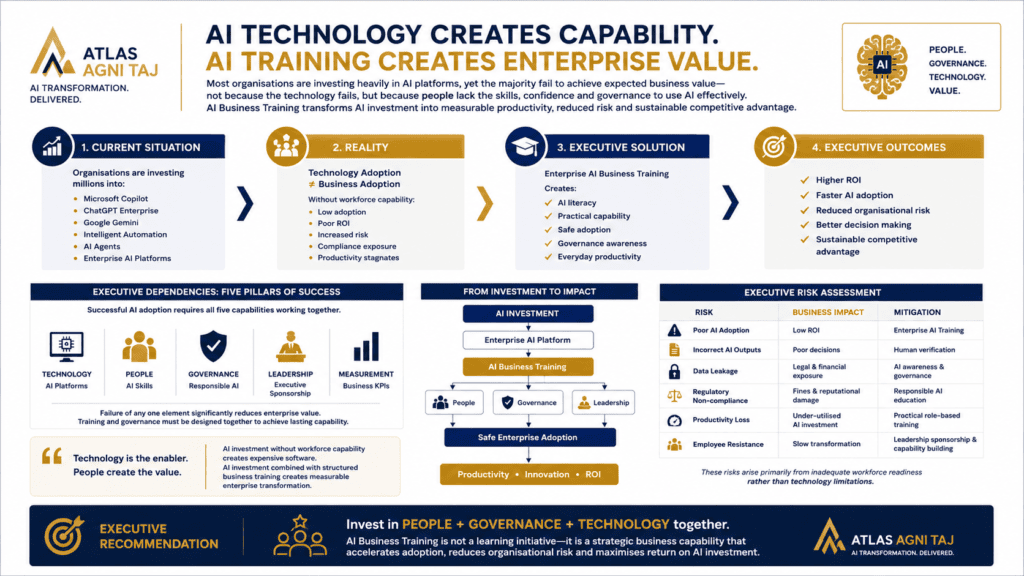
An executive perspective on turning artificial intelligence investment into measurable enterprise capability Artificial intelligence has become one of the most consequential business topics of the decade. Boards are commissioning strategies, executive committees are approving capital, and functional leaders across every industry are procuring platforms, copilots, automation engines and intelligent assistants in the expectation of material gains in productivity, customer experience and operational efficiency. Very few enterprise conversations now conclude without a reference to AI, and very few strategic plans omit it entirely. AI Business Training: The Smartest Investment for Enterprise AI Success Yet beneath the enthusiasm, a common and quietly serious challenge is emerging across boardrooms in the United Kingdom, the Gulf and beyond. The technology has arrived considerably faster than the understanding of the people expected to use it. While executives debate model selection, sovereign hosting and enterprise licensing, a significant proportion of the workforce remains uncertain about what artificial intelligence actually is, how it functions in practical terms, when it is appropriate to use, and — perhaps most importantly — which risks and pitfalls to avoid. This is not a peripheral concern. It sits at the very heart of whether an organisation will realise the returns it has forecast on its AI investments. It is precisely why foundational AI business training, delivered thoughtfully and at scale, remains one of the most disciplined and highest-yielding investments a leadership team can authorise today. The market context reinforces the point. Investment in enterprise AI has accelerated markedly over the past two years, with corporate spend on generative AI, agentic platforms and intelligent automation reaching levels that would have seemed improbable at the start of the decade. Yet independent studies from leading advisory firms consistently indicate that a majority of AI pilots fail to reach production, and that a still larger proportion of those which do reach production fail to deliver the value originally forecast in the business case. The most common cause is not model performance or technical integration. It is the readiness of the workforce to adopt, question and apply the tools that have been provided. AI adoption is fundamentally about people, not platforms Enterprise transformation programmes rarely fail because the technology does not work. They falter because the people expected to adopt the technology are not sufficiently prepared, informed or confident to use it well. Three decades of experience delivering large-scale change programmes across financial services, healthcare, aviation, manufacturing and government points to a consistent conclusion: technology implementation is the more tractable half of transformation. Helping colleagues understand, trust and confidently deploy new capability is where organisations either succeed conclusively or stall expensively. Artificial intelligence intensifies this dynamic considerably. Unlike a new enterprise resource planning system or a customer relationship management platform, generative AI is not a discrete tool bounded by a defined process. It is a general-purpose capability that reshapes how work itself is conceived, drafted, reviewed and delivered. Its value emerges only when employees at every level integrate it into everyday judgement and everyday output. That integration cannot be mandated by policy. It has to be enabled through education. Employees do not require deep technical expertise in transformer architectures, tokenisation or retrieval-augmented generation. What they require is practical, applied knowledge that connects the technology to the reality of their working day. In particular, a well-designed AI literacy programme should ensure that every colleague, regardless of function or seniority, is able to explain and act upon the following: When these foundations are in place, AI ceases to be an intimidating novelty confined to the technology function. It becomes a familiar, trusted instrument in the everyday toolkit of the wider organisation. Reducing organisational risk through informed adoption The absence of basic AI awareness is not a neutral condition. It actively exposes organisations to categories of risk that are commercially, legally and reputationally material. Regulators across the United Kingdom, the European Union, the United Arab Emirates and the wider Gulf Cooperation Council region are moving swiftly to codify expectations, and enforcement activity is beginning to follow. Executive teams that treat AI literacy as optional are, in effect, accepting these exposures on behalf of their shareholders, customers and colleagues. The most frequently observed risks include the following: Structured AI training gives employees the vocabulary and the mental models to recognise these risks before they become incidents. It also equips first-line managers to spot early warning signs among their teams and to intervene proportionately. In practice, an hour of well-designed training frequently prevents the sort of incident that would otherwise consume weeks of remediation, legal review and executive attention. The regulatory dimension is worth underscoring. In the United Arab Emirates, the establishment of dedicated AI governance authorities and the appointment of ministerial responsibility for artificial intelligence have signalled a clear expectation that organisations operating in the country will demonstrate mature, evidenced AI practices. In the United Kingdom, sectoral regulators — including the Financial Conduct Authority, the Prudential Regulation Authority, the Information Commissioner’s Office and the Competition and Markets Authority — have collectively articulated principles-based expectations that place a substantial burden of proof on regulated firms. In the European Union, the AI Act introduces classification, documentation and monitoring obligations that will influence the design of enterprise AI programmes for the foreseeable future. In every case, the ability to evidence that colleagues have been trained, that acceptable-use standards are understood, and that oversight is operating as designed will be a material factor in supervisory conversations. Improving business value and return on AI investment The commercial case for AI literacy is at least as compelling as the risk case. Organisations that invest in developing the AI fluency of their workforce consistently achieve stronger, faster and more durable returns on the platforms they have licensed. The pattern is straightforward. Licences and platforms represent fixed cost. The value they generate is directly proportional to the depth and quality of their day-to-day use. A copilot licence used casually by an untrained employee generates a fraction of the value produced by the same licence in the hands of
The Most Valuable AI Investment May Not Be Another AI Platform
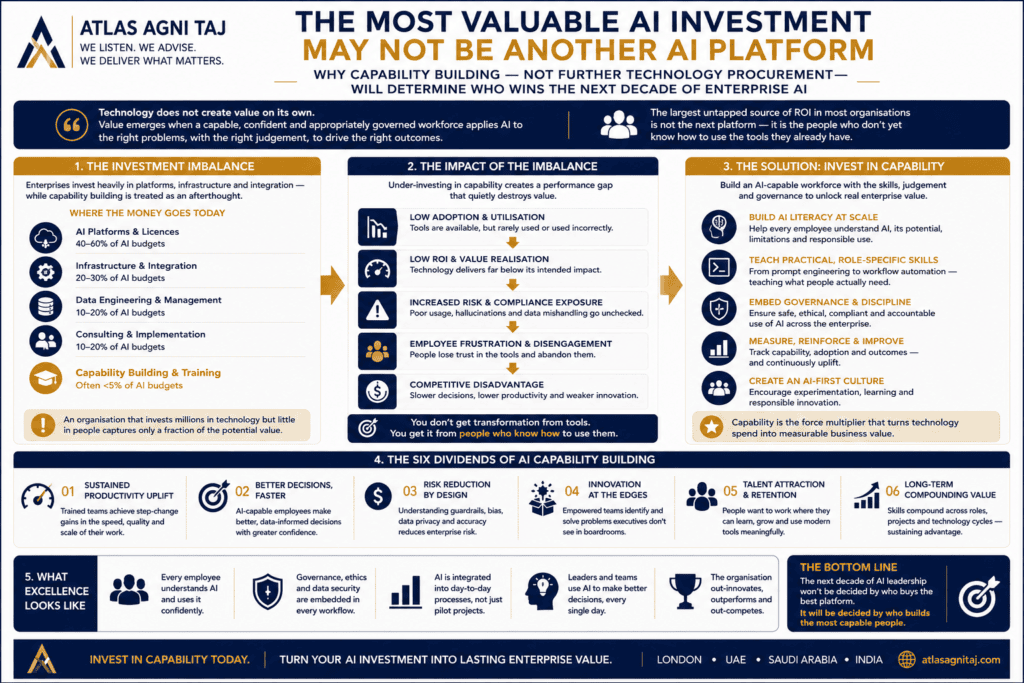
Why AI capability building — not further technology procurement — will determine who wins the next decade of enterprise AI By Atlas Agni Taj | Executive Perspectives on Transformation, Governance and Enterprise AI Across boardrooms in London, Dubai, Riyadh, Singapore and New York, a familiar pattern is unfolding. Executive teams are approving significant capital allocations for artificial intelligence platforms, negotiating enterprise-wide licences for large language models, and commissioning bespoke pilots at a pace few technology cycles have ever witnessed. The strategic urgency is understandable. The narrative is compelling. And yet, for all the sophistication of these procurement decisions, one question is consistently under-examined at the executive table. Have we equipped our people to use this technology effectively — with judgement, confidence, and appropriate discipline? It is a deceptively simple question, and it carries far greater strategic weight than most enterprise AI programmes are prepared to acknowledge. Technology, however advanced, does not create value on its own. Value emerges when a capable, confident, and appropriately governed workforce applies that technology to the specific problems, workflows, decisions, and customer outcomes that define an organisation’s competitive position. In the absence of that capability, even the most impressive platform becomes an expensive under-performer. The uncomfortable truth is this. The largest source of untapped return on AI investment in most organisations today is not the next platform on the roadmap. It is the several thousand employees who have been granted access to AI tools they do not yet know how to use with precision, scepticism, or strategic intent. Closing that gap is now, in our considered view, the most consequential decision an executive team can take. The Investment Imbalance No One Wants to Discuss Enterprise AI budgets, when examined at close quarters, tend to reveal a striking imbalance. Platform licences, cloud infrastructure, systems integration, data engineering, and consultancy fees for technology deployment typically absorb the overwhelming majority of allocated capital. Capability building — the deliberate, structured effort to make an entire workforce fluent in AI — is frequently treated as a supplementary line item. It is delegated to Learning and Development, funded at a fraction of its strategic weight, and measured, if at all, in course completion rates rather than business outcomes. This imbalance is not merely a budgetary curiosity. It is a strategic risk of the first order. An organisation that commits tens of millions to a sophisticated AI platform, but invests only marginally in the human capability required to exploit it, is effectively purchasing potential rather than performance. The gap between what the technology can theoretically do and what the workforce can realistically extract from it is precisely where strategic value quietly disappears. In our engagements across the GCC and Europe, we routinely observe deployed platforms operating at a small fraction of their productive capacity because the people expected to use them have received little more than a webinar and a policy document. Boards and executive committees would rarely tolerate a capital project delivering ten to twenty per cent of its designed output. Yet this is precisely the pattern that AI capability neglect creates, and it is largely invisible in conventional reporting because the technology is deployed, the licences are consumed, and the dashboard shows green. Capability as the Compounding Asset Technology is a depreciating asset. Capability is a compounding one. This distinction, though it may sound like a rhetorical flourish, is one of the most important lenses through which executive teams should evaluate their AI strategy. The platforms and models procured today will, in all likelihood, be superseded within eighteen to twenty-four months. Vendors will change. Interfaces will evolve. Underlying architectures will shift as new paradigms — agentic workflows, multimodal reasoning, sovereign and private models, on-device inference — move from novelty to mainstream. Any organisation that has anchored its strategy exclusively to a specific technology stack will find itself repeatedly re-tooling, re-procuring, and re-training from a low baseline. A workforce that genuinely understands how to reason with AI, prompt it effectively, verify its outputs, integrate it into decision-making, and apply appropriate governance retains its value regardless of which platform sits beneath its fingertips next quarter or next year. Human capability is portable, transferable, and cumulative. It compounds across roles, projects, and technology cycles. It survives vendor rationalisation, contract renegotiation, and architectural pivots. It is, in strategic terms, the most durable form of AI investment an organisation can make. Technology depreciates. Capability compounds. The organisations that internalise this distinction will out-perform those that do not. The Six Dividends of AI Capability Building When structured, executive-grade AI training is implemented across an enterprise, six distinct dividends begin to accrue. Each is measurable. Each contributes independently to enterprise value. Together, they represent the most compelling business case for capability-first AI investment. 1. Sustained Productivity Uplift The most immediate and visible dividend is productivity. A trained workforce completes analytical tasks, drafting assignments, research work, and routine synthesis in a fraction of the previous time. However, the productivity gains realised by trained users are not incremental — they are step-change. Independent studies and our own client observations consistently indicate that trained knowledge workers achieve productivity uplifts materially higher than their untrained peers, particularly on tasks involving research, drafting, analysis, and structured decision-making. Untrained users, by contrast, often extract only cosmetic time savings while introducing new sources of error. 2. Higher Adoption Across the Enterprise AI platforms do not fail because they are technically inadequate. They fail because they are under-adopted. Employees who lack confidence with a new tool either avoid it altogether or use it superficially. Structured training addresses the twin barriers of unfamiliarity and apprehension, converting sceptical users into confident practitioners. Adoption ceases to be a metric that leaders chase and becomes a natural consequence of competence. 3. Materially Reduced Risk The regulatory and reputational risks associated with AI misuse — data leakage, hallucinated outputs presented as fact, confidential information disclosed to third-party models, biased decisions, and unattributed reliance on AI-generated content — are almost entirely a function of user awareness. A workforce that has
AI Literacy: The Key to Effective Responsible AI Governance
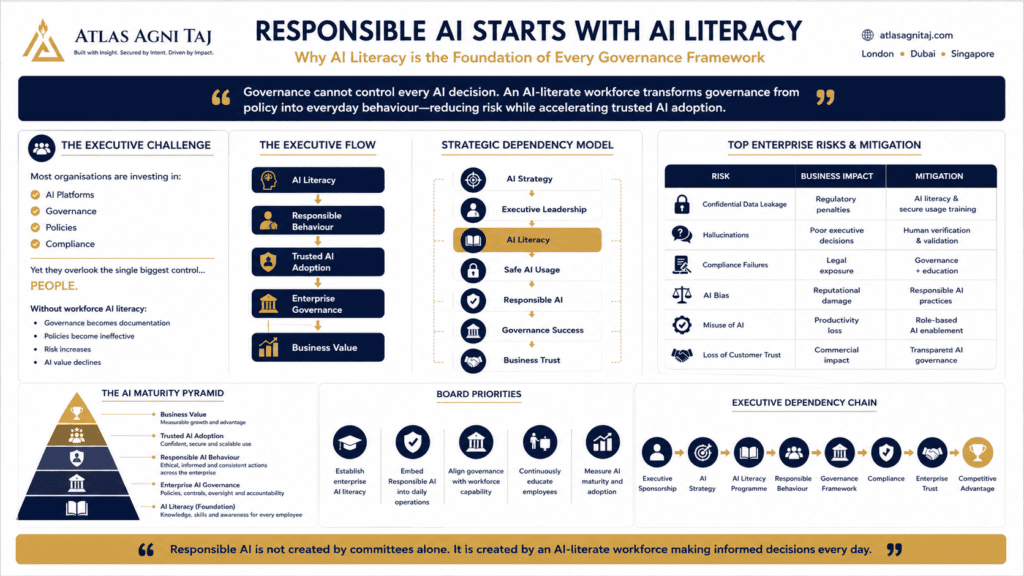
Why AI literacy is the foundation on which every governance framework must be built A perspective by Atlas Agni Taj The conversation about responsible artificial intelligence has, quite understandably, been dominated by boardroom concerns: governance frameworks, ethical charters, oversight committees, model risk registers and increasingly rigorous security controls. These instruments matter. They provide the scaffolding on which organisations defend their reputations, satisfy regulators, and demonstrate seriousness to shareholders, customers and employees. In sectors bound by supervisory expectation, from financial services to healthcare to critical national infrastructure, a documented governance posture is no longer optional; it is a licence to operate. And yet, in the rush to codify AI accountability at the strategic level, an uncomfortable truth is too often overlooked. Responsible AI does not begin in the committee room. It begins at the desk of every employee who opens a chat window, uploads a document, or trusts an algorithmic recommendation. Governance without literacy is a locked front door on a house whose windows are all open. If the enterprise is to translate policy into practice, it must invest in the human beings whose everyday choices will determine whether artificial intelligence becomes a genuine competitive advantage or a source of avoidable regret. The gap between governance and behavior Every major operational failure of the last two decades, from mis-selling scandals to catastrophic data breaches, has followed a similar pattern. Policies existed. Committees met. Controls were documented. And yet, at the point of execution, someone made a decision, or a series of small decisions, that the framework had not adequately anticipated. Artificial intelligence introduces this familiar dynamic at a new order of magnitude. The difference is that AI tools are now embedded in the daily workflow of finance clerks, marketing coordinators, human resources administrators, legal reviewers, engineers and executive assistants. Adoption is horizontal and it is fast. The result is that the surface area of decision-making has expanded dramatically. Where once a compliance officer might review a batch of outbound communications, today those communications may be drafted, translated, summarised and personalised by an AI model in seconds. Where once a data analyst carefully considered which datasets to combine, today an employee may paste a spreadsheet into a chatbot without a moment’s thought. The governance committee, meeting quarterly, cannot possibly inspect every prompt, every output, every judgement made at the edge of the organisation. It can only set the rules. Whether those rules are honoured, and whether the spirit behind them is understood, depends entirely on the literacy of the workforce. The everyday risks of an AI-illiterate organisation Consider what can go wrong when adoption outpaces understanding. The first and most immediate risk is the inadvertent disclosure of confidential information. When employees paste sensitive material into a public model interface, whether customer records, unpublished financial results, contract drafts or personally identifiable data, they are often unaware that the content may leave the corporate perimeter. Some are equally unaware that even where enterprise tenancy protects data from external training, internal audit trails and cross-departmental visibility may still surface material that should not have been shared. The employee did not intend to breach; they simply did not know. The second risk is the uncritical acceptance of incorrect outputs. Large language models are extraordinarily fluent, which is precisely what makes them dangerous in the hands of a user who mistakes fluency for accuracy. Confident, well-structured, grammatically pristine text is not the same as verified fact. Employees who have never been taught to interrogate an AI-generated citation, to sense-check a fabricated statistic, or to notice the subtle drift from source material into invention will, in good faith, embed errors into client deliverables, board papers, medical notes, legal advice and engineering specifications. The consequences range from professional embarrassment to material harm. The third risk is compliance exposure. Regulatory regimes across jurisdictions, from the European Union’s AI Act to the emerging frameworks across the Gulf Cooperation Council, from sector-specific supervisory expectations in financial services to data protection statutes globally, all place obligations on how AI is used, documented and disclosed. An employee who uses an unapproved tool for a regulated purpose, who fails to record the provenance of an AI-assisted decision, or who omits a required disclosure to a customer or counterparty, exposes the organisation to enforcement action. Ignorance is not a defence recognised by any regulator. The fourth risk is the amplification of bias. AI systems reflect the data on which they were trained and the prompts through which they are invoked. An employee who does not understand this dynamic may reinforce existing patterns of exclusion in hiring shortlists, credit assessments, customer segmentation, performance reviews and promotion decisions. Bias is rarely introduced maliciously; it is introduced through inattention. Without literacy, inattention is the default. The fifth risk is the misuse of the tools themselves. Employees may deploy AI for tasks it cannot reliably perform, delegate judgement that should remain human, or fail to deploy it where it would create genuine value. The organisation ends up with an AI estate that is simultaneously overstretched and underused, generating risk where it should not be trusted and forfeiting productivity where it should have been embraced. A sixth, and increasingly consequential, risk sits at the intersection of the previous five: reputational and third-party exposure. Clients, counterparties and regulators are asking sharper questions than ever about how AI is used in the delivery of professional services, in the handling of their data, and in the decisions that affect them. An organisation whose workforce cannot articulate, credibly and consistently, how it uses artificial intelligence, is an organisation whose commercial relationships will come under strain. In an environment where trust is a strategic asset, the inability to answer a straightforward due-diligence questionnaire, or to demonstrate that employees have been properly prepared for the tools on their desks, is no longer an operational nuisance. It is a live commercial risk that will be priced into contracts, renewals and partnerships. Why top-down governance cannot compensate Faced with these risks, the instinctive response of many boards has