Why AI Governance Must Expand Into Operational Resilience
An executive perspective on integrating artificial intelligence into the operational resilience frameworks that regulators, boards and customers now expect.
For much of the past three years, the conversation about responsible AI has been dominated by four themes: fairness, explainability, privacy and model risk. Boards have been briefed on bias testing, risk committees have debated transparency, and general counsel have refreshed policies to reflect the EU AI Act, the NIST AI Risk Management Framework, and the emerging positions of the UAE and Saudi regulators. All of this is necessary. None of it is sufficient.
As artificial intelligence moves from experimentation into the fabric of banking, government services, healthcare, energy and logistics, a different question is beginning to command attention in serious boardrooms: what happens when the AI stops working? When a foundation model provider suffers a multi-hour outage during a peak business period; when a critical agent begins producing plausible but incorrect outputs; when an inference pipeline is quietly compromised; or when a single provider changes its terms of service overnight — is the business still able to operate?
The answer, in most organisations today, is that nobody has properly tested it. The governance policies exist. The ethics frameworks are approved. The model inventories are catalogued. But the operational resilience posture around AI — the same discipline that regulators have spent a decade embedding for payments, core banking, cloud and telecommunications — is largely absent, or exists only on paper.
That gap will not last. The Central Bank of the UAE’s guidance on Responsible AI adoption in financial institutions makes the direction of travel unambiguous: AI-related risks must be integrated into existing risk management responsibilities, not treated as a parallel discipline. The Prudential Regulation Authority in the United Kingdom, the European Banking Authority and the Monetary Authority of Singapore are moving in a similar direction. Operational resilience regimes — DORA in the European Union, the FCA and PRA policy statements in the United Kingdom, and comparable structures in Abu Dhabi Global Market and Dubai International Financial Centre — will increasingly require institutions to demonstrate that AI dependencies have been identified, tolerated, tested and made recoverable.
This article argues that the strongest AI programmes in the region and beyond will be those that combine responsible adoption with demonstrable operational resilience. The executives who understand this intersection — who are equally fluent in the ethics of the model and the continuity of the service — will define the next decade of enterprise AI.
The Limits of Governance-Only Thinking
There is nothing wrong with the current wave of AI governance activity. Ethics committees, model risk inventories, bias audits, explainability requirements and privacy impact assessments are foundational controls. The difficulty is that they were designed to answer a particular set of questions: is this model appropriate to deploy, is it lawful, is it fair, and can we defend its decisions? These are, in essence, pre-deployment and periodic-review controls.
Operational resilience asks a different question entirely. Assuming the model has passed governance and is now in production, what happens when something goes wrong in production? That failure mode is not addressed by any amount of pre-deployment bias testing. A perfectly fair, fully explainable and lawfully deployed model is still catastrophic to a business if it becomes unavailable during peak trading hours, or if it silently degrades in accuracy after an underlying provider updates a model version without notice.
The distinction matters, because the two disciplines have different owners, different testing regimes and different executive escalation paths. AI governance typically sits with the Chief Risk Officer, the General Counsel, the Data Protection Officer or a dedicated AI ethics function. Operational resilience typically sits with the Chief Operating Officer, the Head of Business Continuity, the Chief Information Security Officer and — in regulated environments — a designated senior manager with personal accountability under the applicable regime.
In most organisations, these two communities do not yet routinely speak to each other about AI. AI is treated as a governance topic; resilience is treated as an infrastructure topic. The result is a blind spot: no one owns the question of whether the business can continue to deliver an important business service when the AI component of that service is unavailable, compromised or unreliable.
Closing that blind spot is not a technical exercise. It is an accountability exercise. It requires a deliberate decision at board level that AI dependencies will be treated with the same seriousness as payment rails, cloud infrastructure and third-party data providers — because, increasingly, they are the same class of dependency.
What the UAE Central Bank Guidance Actually Signals
The Central Bank of the UAE’s Responsible AI guidance, issued to licensed financial institutions, is instructive not only for what it says but for how it is structured. It does not create a parallel AI risk regime. Instead, it explicitly requires institutions to integrate AI-related risks into their existing frameworks for credit, market, operational, cyber, third-party, conduct and compliance risk.
The signal is deliberate. Regulators are not asking financial institutions to treat AI as an exotic new category requiring bespoke controls. They are asking institutions to demonstrate that AI risks are being managed with the same rigour, the same escalation paths and the same evidentiary standards as every other material risk on the balance sheet.
This has a specific implication for operational resilience. Under existing UAE frameworks — and the equivalent regimes in DIFC and ADGM — institutions are already expected to identify important business services, set impact tolerances, map end-to-end dependencies and test severe-but-plausible scenarios. When AI moves inside an important business service, the same discipline must apply. There is no regulatory carve-out for AI dependencies. There will be no forgiveness at supervisory review for an institution that mapped its payment infrastructure resilience meticulously but never asked what would happen if its fraud detection model, its onboarding assistant or its customer service copilot began returning unreliable outputs.
Boards operating in the GCC should read this signal clearly: the regulatory expectation is not that AI will be governed separately, but that AI will be absorbed into the resilience discipline that already exists, and evidenced accordingly.
What AI Operational Resilience Actually Means
Operational resilience, in its regulatory sense, is the ability of an organisation to prevent, adapt to, respond to, recover from and learn from operational disruptions to important business services. Applied to artificial intelligence, this discipline resolves into six practical questions that every board and executive committee should be able to answer without hesitation.
The first is dependency identification. Which business services depend on AI, and how critical are those dependencies? An organisation may have deployed generative AI in dozens of workflows, but only a subset of those workflows sit inside an important business service — the kind whose disruption would cause intolerable harm to customers, markets or the firm itself. Identifying that subset is the necessary starting point. Everything else follows from it.
The second is impact tolerance. What is the maximum acceptable level of disruption — expressed in time, in volume, in customer impact or in financial loss — that the organisation is willing to accept before regulatory or reputational consequences become unacceptable? AI dependencies must be assessed against these tolerances, not against a separate AI-only threshold.
The third is credible failure modes. For AI systems these extend well beyond simple availability outages. They include model degradation, in which the model continues to run but its accuracy has drifted; silent failure, in which the model returns confident but incorrect outputs; data poisoning and prompt injection against agentic systems; provider-side policy or version changes that break integrations without notice; and concentration risk, in which multiple critical services depend on the same underlying foundation model or provider.
The fourth is fallback. Can the process continue without the model, either through a rules-based alternative, a simpler statistical approach, a human-in-the-loop workflow or a graceful degradation to a reduced service? Fallbacks must be maintained in a genuinely operable state, not merely documented, and staff must be trained to activate them under time pressure.
The fifth is switchability. If the primary provider becomes unavailable — whether through outage, sanction, contractual termination or commercial dispute — can the organisation transition to an alternative provider within an acceptable timeframe? This is not a hypothetical concern. Recent years have already produced multiple examples of enterprises scrambling to re-platform when a foundation model provider changed terms, deprecated a model version or suffered a sustained incident.
The sixth is detection. Can the organisation detect failure quickly enough to invoke its response? Model monitoring, drift detection, human review sampling and independent challenge are all part of the answer. Without them, resilience plans exist only on paper, and the first indication of trouble is a customer complaint or a regulatory letter.
Critical AI Dependencies — The Mapping Exercise
The single most valuable exercise a board can commission over the next twelve months is a formal mapping of the organisation’s critical AI dependencies. This is not the same as an AI model inventory, although the inventory is a prerequisite. A dependency map extends outwards from each important business service to the AI components embedded within it, and then further outwards to the underlying providers, data sources, infrastructure, agentic tools and human oversight points on which those components rely.
A properly constructed AI dependency map answers questions that a governance-only inventory cannot. Which important business services would be materially impaired if a specific foundation model provider suffered a twenty-four hour outage? How many of our AI-enabled processes ultimately depend on the same two or three commercial providers? Where do we have unmanaged shadow AI use — employees using consumer AI services in ways that create undocumented dependencies on infrastructure the organisation does not control? Which of our agentic systems have autonomous access to systems of record, and what is the blast radius if such an agent is compromised or coerced?
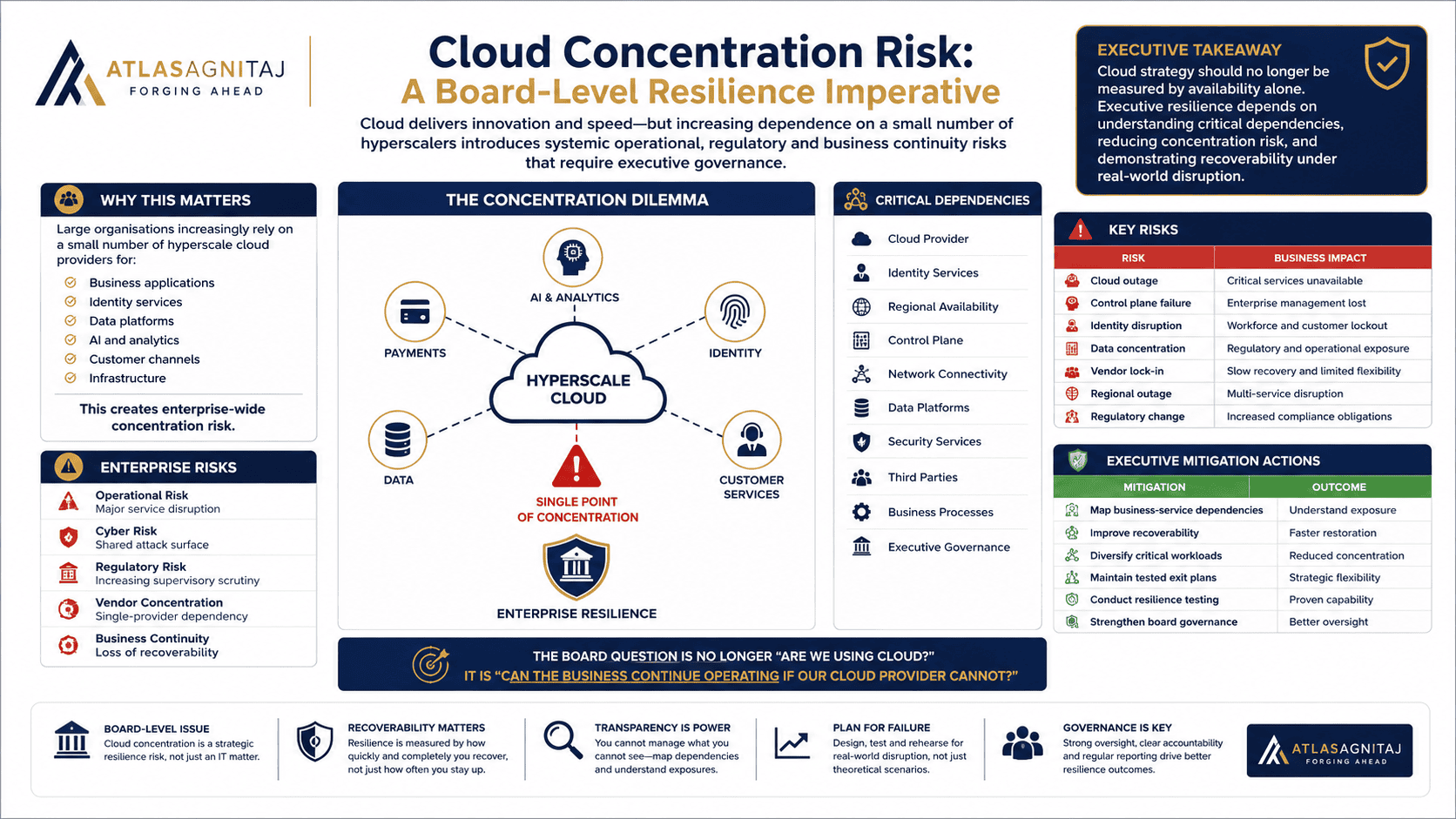
Provider concentration deserves particular attention. It is unusual, at the time of writing, for an enterprise AI portfolio to depend on more than a small number of foundation model providers. That concentration is a systemic risk in a way that most executives have not yet internalised. When the same handful of providers underpin the majority of the productivity, customer service and analytical AI in an organisation, the failure of any one of them ceases to be a vendor incident and becomes a business continuity event.
The map itself should be maintained as a living artefact, reviewed at least annually and refreshed on every material change to the AI portfolio, with named accountable executives for each critical dependency. Static point-in-time assessments are worse than useless in a landscape that is changing at this pace.
Impact Tolerances and Failure Scenarios
Setting impact tolerances for AI-dependent services is where the discipline becomes uncomfortable — and therefore where it becomes valuable. Tolerances force the organisation to state, in advance and in specific terms, how long an important business service can operate in a degraded or fallback mode before regulatory, customer or financial harm becomes unacceptable.
For AI dependencies, these conversations reveal important truths. A customer service function that has been re-engineered around a generative AI copilot may look highly efficient in steady state, but if the tolerance is four hours and the residual manual capacity is only fifteen per cent of normal throughput, the resilience posture is inadequate regardless of how impressive the copilot appears in ordinary conditions. A credit decisioning workflow that relies on an AI model for eighty per cent of automated approvals may be profitable in normal times, but if the tolerance requires the manual underwriting team to absorb the residual workload during an outage, that team must actually exist, and its members must retain the skill to underwrite without algorithmic assistance.
Once tolerances are set, credible failure scenarios must be designed and tested. The scenarios that matter for AI are not identical to those for traditional infrastructure. Severe-but-plausible AI scenarios include a multi-day outage at a foundation model provider during a peak business period; a silent model degradation detected only after several days of production use; a prompt injection attack against a customer-facing agent that causes the agent to leak information or execute unauthorised actions; a sudden change in provider terms of service that requires immediate re-platforming; a supply-chain compromise in an open-weights model or a fine-tuning dataset; and a regulatory intervention that prohibits the use of a specific model class with limited notice.
These scenarios must be tested rather than merely documented. Testing means live simulation exercises involving the executive teams who would actually be accountable during a real event — the Chief Operating Officer, the Chief Information Security Officer, the Chief Risk Officer, the General Counsel, communications leadership and, where relevant, the senior manager holding regulatory accountability. Board members should attend at least annually as observers, both to build their own literacy and to signal the seriousness of the exercise to the wider organisation.
The Human Layer — Recognising Unreliable Outputs
An underappreciated component of AI operational resilience is the ability of employees and, in some cases, customers to recognise when an AI-generated output is unreliable and to escalate appropriately. Technology controls are necessary but not sufficient; the ultimate line of defence in most AI deployments is a human being who notices that something is wrong.
That capacity is not automatic. It requires deliberate investment in training, in the design of the human-machine interface, in escalation pathways, and in a workplace culture that rewards challenge rather than passive acceptance of AI outputs. Organisations that have deployed AI copilots at scale are already learning that productivity gains can be silently offset by the reintroduction of errors that experienced staff would previously have caught with ease.
In regulated environments the stakes are higher. A relationship manager who acts on an AI-drafted client recommendation without applying independent judgement; an analyst who copies AI-generated figures into a board paper without verification; an operations officer who accepts an AI-generated exception rationale without challenge — each represents a control failure that no amount of upstream governance can prevent.
The resilience question here is specific. Has the organisation trained its people to treat AI outputs as advice to be validated rather than instructions to be executed? Are workflows designed so that verification is the path of least resistance rather than an optional additional step? Are there independent challenge functions — second line, internal audit, external audit — with the technical capability to interrogate AI-driven decisions in a meaningful way?
Boards should ask for evidence rather than assurances. Sample-based independent review of AI-influenced decisions, red-team exercises in which AI outputs are deliberately corrupted to test whether staff detect the corruption, and post-incident analyses of near-misses all provide the kind of evidence that stands up to supervisory scrutiny.
Third-Party AI and Incident Response
Most artificial intelligence in enterprise use today is third-party AI. It is delivered through the application programming interfaces of foundation model providers, embedded in software-as-a-service applications, wrapped in copilots licensed from platform vendors, or accessed through cloud-native inference services. This has a specific implication for incident response.
Incident response exercises that assume the organisation controls all the levers to a resolution are inadequate for third-party AI. When a foundation model provider is the source of an incident — an outage, a data exposure, a model behaviour change — the affected organisation has limited direct control. Its response must therefore focus on containment, customer and regulator communication, fallback activation and coordinated remediation with the provider.
That coordination must be pre-agreed. Contractual arrangements with material AI providers should include incident notification obligations, root cause analysis commitments, service-level agreements that reflect the actual criticality of the dependency, and clear escalation paths to named individuals within the provider organisation. Where such arrangements do not exist — and in most enterprise AI contracts today they do not — they should be renegotiated as a matter of priority.
Third-party AI providers should also be included in the organisation’s own incident response exercises. Tabletop scenarios that model a provider-side incident, with the provider’s incident response representatives participating where possible, produce a materially different quality of preparedness than internal-only exercises. The alternative — meeting the provider’s incident manager for the first time during an actual incident — is unacceptable in a regulated context, and no board that has thought carefully about the topic will permit it to persist.
Board Expectations and Executive Accountability
Boards are beginning to ask sharper questions about artificial intelligence. The questions of eighteen months ago — are we doing enough AI, are we falling behind our competitors, when will we see productivity gains — are being replaced by questions of a different character. Where are our AI dependencies? What happens if they fail? Who is accountable? What have we tested? What did the test reveal?
This shift is being reinforced by regulators, by insurers, by rating agencies and, increasingly, by institutional investors. It will be further reinforced by the first significant AI-related operational incidents to reach the public domain, which — given the pace of enterprise adoption — cannot be far away. Prudent boards are choosing to prepare in advance of that event rather than in the wake of it.
Executives who wish to be credible in front of boards on this topic must be able to answer six questions without prevarication. Which of our important business services depend on AI? What is our impact tolerance for each of them? What are the credible failure modes? What fallbacks exist and have they been tested in earnest? Who owns each critical AI dependency at named individual level? When did we last exercise a severe-but-plausible AI failure scenario, and what did we learn from it?
Answers along the lines of “we have an AI governance policy” or “we have an AI ethics committee” do not address these questions. They address a different set of questions, however important. The organisations that will emerge as trusted AI operators in the UAE and the wider region will be those whose executive teams can move fluently between the governance conversation and the resilience conversation, and demonstrate that both are being taken seriously at the same time.
Under senior manager regimes and comparable regulatory constructs, individual accountability for AI-related resilience will increasingly be personal. This is not a delegable topic, and the executives who understand that early will be materially better placed than those who do not.
Building the Integrated Framework
Bringing AI inside the operational resilience framework is not a discrete project with a defined end. It is a permanent adjustment to how the organisation manages an increasingly consequential class of dependency. That said, there is a sensible sequence of work that a serious organisation can undertake over a twelve to eighteen-month horizon.
The first phase is discovery and mapping. Establish a comprehensive inventory of AI usage across the organisation, including shadow AI. Identify the important business services that depend on AI. Map the underlying providers, models, data sources, agentic tools and human oversight points. Assess provider concentration and single-point-of-failure risk.
The second phase is tolerance setting and gap analysis. For each AI-dependent important business service, set impact tolerances in specific measurable terms. Compare the current resilience posture — fallbacks, monitoring, provider arrangements, human oversight — against those tolerances. Identify the gaps in specific terms, with named accountable executives for closure.
The third phase is remediation. Close the identified gaps by building genuine fallbacks, negotiating stronger third-party arrangements, investing in monitoring and drift detection, training staff to recognise unreliable outputs, and diversifying provider concentration where the criticality of the dependency justifies the cost.
The fourth phase is testing. Run severe-but-plausible AI failure scenarios involving the executive teams that would be accountable in a real event. Capture lessons learned in a form that survives the exercise and feeds into the next remediation cycle.
The fifth phase is embedding. Make AI resilience a standing item in operational risk committees, in board risk reporting, in internal audit plans and in third-party governance forums. Ensure that new AI deployments are subject to resilience assessment as part of the deployment decision, not as an afterthought imposed once the technology is already in production.
None of this requires a new department or a new discipline. It requires the discipline that already exists to be applied to a new class of dependency — consistently, with executive weight behind it, and with the same evidentiary rigour that regulators already expect for every other important business service.
Closing Reflection
Responsible artificial intelligence is not only about whether a model is fair, explainable and compliant. It is also — and increasingly — about whether the business can continue operating when the AI service is unavailable, compromised or producing unreliable results. Both dimensions matter. Neither is optional. Together they define what serious AI operation looks like in a regulated environment.
The UAE and the wider GCC region are in a rare position. The scale of AI ambition here — sovereign compute, national AI strategies, government AI platforms and financial services innovation — is at or near the global frontier. So too are the regulatory expectations. Institutions that operate here have both the opportunity and the obligation to lead by example: to demonstrate that responsible adoption and demonstrable operational resilience can be delivered together, not as competing priorities but as two halves of the same executive discipline.
The strongest AI programmes will not be those that innovate the fastest. They will be those that innovate fastest while remaining controlled, monitored, recoverable and replaceable — and that can prove it to a supervisor, an auditor, a board, a customer and a regulator with equal confidence.
The question executives should be asking their teams this quarter is not whether the AI governance policy is up to date. It is a simpler and sharper question. Has your organisation tested what happens when a critical AI service stops working? If the answer is no, or the answer is qualified, that is the work.
How Atlas Agni Taj Can Help
Atlas Agni Taj advises boards and executive teams operating at the intersection of artificial intelligence, cybersecurity, regulated delivery and operational resilience. The firm was established to serve senior clients who require discreet, experienced counsel on the transformation topics that will define the next cycle of enterprise value in the UAE and the wider region.
Our engagement model is designed around the questions this article poses. We support clients across four service lines directly relevant to AI operational resilience: strategic assessment of the current AI resilience posture against regulatory expectations in the UAE, DIFC, ADGM and comparable jurisdictions; mapping of critical AI dependencies and the setting of impact tolerances for AI-dependent important business services; design and facilitation of severe-but-plausible AI failure scenarios, involving executive teams and third-party providers where appropriate; and integration of AI risk into existing operational resilience, third-party governance and incident-response frameworks, so that the AI dimension becomes indistinguishable in rigour from the frameworks that already exist for payments, cloud and core operations.
Our work is deliberately senior, discreet and outcome-oriented. We do not provide standardised methodologies dressed up as advisory. Every engagement is scoped to the specific regulatory environment, board expectations and important business services of the client organisation, and delivered by practitioners with genuine executive-level experience in banking, government, sovereign infrastructure and regulated enterprise delivery.
For a confidential discussion of how Atlas Agni Taj might support your AI operational resilience agenda, please contact the firm through atlasagnitaj.com.
#AIGovernance #OperationalResilience #ResponsibleAI #Cybersecurity #DigitalTrust #RiskManagement #FinancialServices