THE FOUNDATION OF AI IN AN ORGANISATION
Why Strategy, Process, Data, Automation and Governance Must Precede Artificial Intelligence
A Perspective for Boards, C-Suite Leaders and Transformation Executives
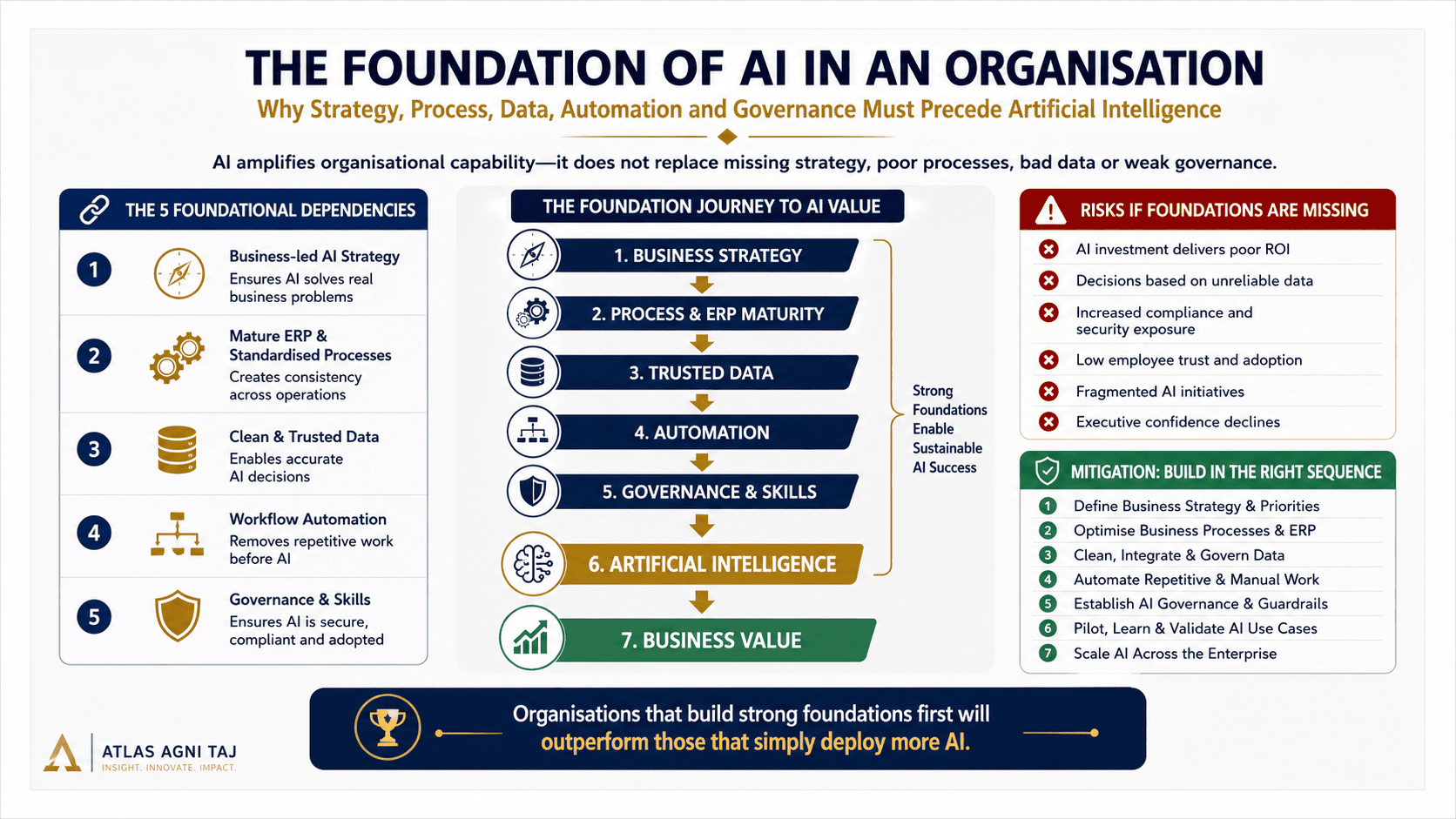
The Foundation of AI transformation strategy in an Organisation
Artificial intelligence has become one of the most consequential — and most frequently misunderstood — strategic priorities confronting boards and executive committees today. In almost every organisation, leaders are asking urgent questions: where should we automate, how can AI enhance productivity, what cost efficiencies are achievable, and how might AI sharpen decision-making and elevate customer experience.
These are the right questions. Yet the organisations that ultimately succeed with artificial intelligence are rarely those that move fastest into pilots, copilots or agentic experiments. They are the organisations that first and honestly answer a more fundamental question: is our organisation genuinely ready for artificial intelligence?
The uncomfortable truth is that AI does not succeed in isolation. Its success depends entirely upon the maturity of an organisation’s strategy, its business processes, its integrated systems, its data architecture, its automation capability, its governance discipline, and — above all — its people. In the absence of these foundations, AI becomes an expensive experiment: an initiative that generates initial enthusiasm and consumes budget, yet fails to deliver durable, measurable business value.
This article sets out the five critical foundations that every organisation must establish before committing to a serious programme of AI adoption at scale. These are not optional refinements. They are prerequisites that determine whether artificial intelligence becomes a genuine lever of transformation, or merely another costly technology distraction.
The AI Readiness Challenge: Why Foundations Matter
Boardrooms across every sector are currently experiencing what might fairly be described as “AI fever.” Executives read daily of breakthrough applications of generative AI, large language models and autonomous agents. Competitors announce bold AI initiatives. Investors ask pointed questions about innovation readiness. Internal technology teams press to experiment with the latest tools and capabilities.
The predictable consequence is a wave of AI pilots launched without adequate preparation: chatbots that frustrate rather than assist customers, forecasting models trained on incomplete or unreliable data, recommendation engines that users quickly learn to ignore, dashboards that decision-makers distrust, and automation initiatives that expose legacy processes so fundamentally broken that no amount of artificial intelligence can repair them.
The common thread running through these failures is rarely the underlying technology. Modern AI platforms — whether cloud-based machine learning services, large language models, or specialised domain models — are remarkably capable. Failure occurs because organisations attempt to apply advanced techniques before establishing the foundational capabilities upon which any AI initiative ultimately depends.
AI is only as durable, valuable and reliable as the organisational foundation upon which it rests.
Consider the familiar analogy of constructing a skyscraper on unstable ground. The architectural design may be magnificent, the materials world-class, and the engineering flawless — yet without solid bedrock, the structure will inevitably fail. Artificial intelligence behaves no differently.
Foundation One — A Clear AI Strategy and Compelling Business-Led Use Cases
The first and most critical foundation is clarity of purpose and strategic alignment. Artificial intelligence should never be deployed because it is fashionable, because competitors are exploring it, or simply because the technology is available. It should be deployed purposefully, to solve genuine business problems, remove critical inefficiencies, or generate measurable, quantifiable value. This distinction — between technology-driven and business-driven AI — ultimately determines whether AI becomes transformational or remains experimental.
The Strategic Compass
A well-articulated AI strategy provides the compass that guides investment and resourcing decisions. It should answer several essential questions with rigour:
- Productivity: Which business areas would benefit most from improved throughput or accelerated processing?
- Effort reduction: Where can AI meaningfully reduce manual effort, human intervention and repetitive work?
- Decision quality: How might AI enhance the speed, consistency and quality of decision-making?
- Risk mitigation: Where can AI reduce operational, financial, compliance or cybersecurity exposure?
- Customer experience: Can AI improve personalisation, responsiveness and satisfaction?
- Employee experience: Where might AI reduce administrative burden and accelerate career development?
- Competitive advantage: Where might AI create genuine, defensible, durable differentiation?
The most successful AI initiatives, across industries and geographies, share a common characteristic: they are business-led rather than technology-led. The strongest organisations identify the desired business outcome first, understand the pain or opportunity in depth, and only then examine whether and how AI can meaningfully contribute.
High-Impact Use Case Categories
Experience across sectors points consistently to several categories of AI application that deliver tangible value when properly implemented: enhanced demand forecasting within supply chain and planning functions, often improving forecast accuracy materially while easing working-capital pressure; intelligent procure-to-pay automation, extending beyond simple robotic process automation into genuine three-way matching and exception detection; customer service intelligence that routes enquiries to the right agent and equips them with real-time guidance; fraud detection and anomaly identification using models that adapt continuously to emerging risk; intelligent procurement and sourcing analytics that surface maverick spend and consolidation opportunities; automated project status and risk reporting that removes manual compilation; contract analysis that extracts obligations and flags compliance exposure across large document sets; workforce planning that identifies skills gaps and attrition risk; and IT service management that accelerates incident resolution.
Each of these use cases shares a defining feature: a clear, quantifiable business outcome sits at its centre, with artificial intelligence serving that outcome rather than the reverse.
Foundation Two — A Well-Implemented ERP System as the Digital Operating Backbone
For most organisations, the enterprise resource planning system represents far more than a software platform. It is the operational backbone that integrates and standardises finance and the general ledger, procurement and vendor management, supply chain and logistics, human resources and payroll, project delivery, asset management, manufacturing, sales and customer management, and consolidated reporting and analytics.
Why ERP Maturity Is a Non-Negotiable AI Dependency
Artificial intelligence depends critically upon reliable processes and seamlessly connected workflows. Where core business processes remain unstandardised, inconsistently implemented across locations, or poorly adopted by users, AI will inevitably struggle to deliver value. When processes are broken or inconsistent, AI amplifies that complexity rather than resolving it: a model trained on inconsistent data produces inconsistent outputs, and a forecasting engine dependent on manual data entry inherits every error embedded in that manual work.
A well-implemented ERP system, by contrast, provides precisely the operational foundation AI requires: standardised processes across all locations and business units; clear approval workflows and accountability; common master data spanning customers, suppliers and the chart of accounts; fully integrated, system-to-system transactions; defined roles and segregation of duties; and enhanced visibility and transparency into organisational performance.
AI cannot reverse-engineer or repair a fundamentally broken process — it can only make a well-designed process faster, smarter and more scalable.
Organisations that have not yet achieved basic ERP maturity — those operating heavily customised systems, inconsistent adoption across geographies, poor data quality, or incomplete integration — are, put simply, not yet ready for AI. Such organisations should first invest in ERP optimisation, process standardisation and operational discipline before expecting artificial intelligence to deliver meaningful results.
Foundation Three — Clean, Trusted and Well-Governed Data
An essential and frequently underestimated truth in the world of artificial intelligence is this: AI is only as good as the data that powers it. Where ERP data is inaccurate, duplicated, incomplete or poorly governed, AI outputs will inevitably be unreliable, misleading, and at times damaging to business decisions.
Poor data quality cascades through the entire AI pipeline: recommendations that users quickly learn to disregard; predictions that inherit the weaknesses of historical data; dashboards that mislead rather than inform; a steady erosion of business confidence not only in a specific application but in AI systems more broadly; and, ultimately, wasted investment in sophisticated platforms that never realise their promised return.
Characteristics of Trustworthy Data
Clean ERP data exhibits several consistent characteristics: consolidated and deduplicated customer master data; reliable, non-duplicated supplier records; a consistent, standardised chart of accounts across all locations; current and accurate employee data, with organisational hierarchies correctly reflected; correct product and item masters; standard, properly coded cost and profit centres; accurate project and programme structures; reliable inventory and asset records; and a complete, consistent transaction history that supports genuine trend analysis and forecasting.
Governance as the Foundation of Quality
Data governance — the framework of policies, procedures, roles and accountabilities that manages data across its lifecycle — is equally critical. Organisations must be able to answer, with confidence, a demanding set of governance questions: who owns each data domain and is accountable for its accuracy; who approves changes to master data; who manages data quality on an ongoing basis and how issues are escalated; what standards govern data creation and validation; how duplicate records are identified and resolved; how sensitive and personal data is protected in line with applicable privacy regulation; how data quality is measured and monitored; and how changes to master data are tracked and audited.
Organisations that neglect clear data governance — even where intentions and initial data entry are sound — will inevitably experience quality degradation as employees depart, priorities shift and processes evolve. Artificial intelligence will succeed only where it is built upon trusted data; absent that trust, adoption will remain shallow and impact will remain marginal, regardless of algorithmic sophistication.
Foundation Four — Foundational Automation and RPA Before Advanced AI
A pervasive misconception across many organisations is the belief that sophisticated artificial intelligence represents the solution to every business problem. The reality is considerably more pragmatic. Many organisations continue to operate repetitive, rules-based tasks that can be resolved effectively through workflow automation, system integration, robotic process automation, or improved ERP configuration — without recourse to advanced AI at all.
Before applying artificial intelligence to any business problem, leadership teams should work through a disciplined diagnostic sequence: can the process first be standardised; can it be automated using native ERP workflow capability; can system integration and APIs resolve the challenge; can robotic process automation remove manual effort; and, only once these questions have been exhausted, does the problem genuinely require sophisticated artificial intelligence.
Where Automation Delivers Rapid Value
Robotic process automation and workflow tools consistently deliver rapid value in areas such as invoice processing and payment matching; systematic data entry and form completion; automated report generation and distribution; employee onboarding steps; vendor creation and validation checks; bank reconciliation and exception reporting; system-to-system data synchronisation; intelligent ticket routing; and automated approval reminders and escalation.
The Strategic Sequence: Automate, Then Apply Intelligence
The governing principle is straightforward and well-proven: automate the repetitive and rules-based work first, then apply artificial intelligence to the intelligent, complex and judgement-based work — pattern recognition and anomaly detection, predictive modelling and forecasting, intelligent recommendations, natural language interaction, exception handling, and decision support. This sequencing builds organisational confidence through early wins, reduces the complexity of subsequent AI implementations, improves underlying data quality as processes standardise, and establishes a considerably more mature platform for AI to scale upon.
Foundation Five — Governance, Skills and a Scalable Operating Model
Artificial intelligence represents far more than a technological capability; it is fundamentally a governance, risk, compliance, talent and operating-model challenge. Organisations that treat AI purely as a technology initiative — the exclusive preserve of the CTO or Chief Data Officer, disconnected from risk, compliance, business leadership and human resources — inevitably struggle to scale it. Organisations that instead establish comprehensive governance, invest deliberately in skills, and define a clear operating model consistently achieve stronger adoption and better business outcomes.
Governance and Accountability
To scale AI safely and sustainably, organisations must establish clear ownership across a defined set of questions: who has authority to approve new use cases and against what criteria; who is accountable for AI-related risk and its escalation; who owns the underlying data and its quality; who validates outputs before they inform business decisions; who monitors ethical and regulatory compliance; who safeguards security and privacy; and who measures and reports on realised business benefit.
A comprehensive governance framework should address data privacy and regulatory compliance, cybersecurity and information protection, model risk assessment and ongoing performance monitoring, access control and authentication, human oversight and intervention protocols, auditability and logging of AI-driven decisions, third-party and vendor risk management, business accountability for benefits realisation, and responsible AI principles more broadly.
Skills and Capability Development
Different stakeholder groups require distinct but complementary capability. Business teams and process owners must learn to use AI effectively, interpret its outputs with informed scepticism, and recognise its limitations. Technology and data teams require deep expertise across architecture, integration, data quality, security, cloud platforms and AI methodology. Risk, compliance and control functions require fluency in AI-specific audit approaches, bias detection and fairness. Senior leaders, above all, must understand both the transformative opportunity and the genuine limitations of AI, and must accept that foundational investment is not optional — shortcuts inevitably lead to failure.
A Scalable Operating Model
Finally, a well-defined operating model must articulate how ideas progress through the organisation: concept and opportunity identification, with feasibility assessment and prioritisation against business value; controlled pilots with clearly defined success criteria; scaled production deployment with full governance, monitoring and control; and continuous optimisation informed by real-world performance. Without robust governance, AI initiatives become risky. Without adequate skills, adoption remains shallow. Without a defined operating model, AI remains fragmented and confined to isolated experiments rather than enterprise-wide value.
Conclusion: AI Readiness Must Precede AI Ambition
Artificial intelligence has genuine potential to transform how organisations operate, decide, create value, and engage with customers and employees. Yet leaders must resist the temptation to treat AI as a shortcut around weak operational and organisational foundations.
A genuinely successful AI journey rests upon seven interlocking elements:
- A clear, business-led AI strategy and prioritised roadmap, with compelling use cases tied to measurable outcomes.
- A mature, well-implemented ERP backbone providing standardised processes, integrated data and operational visibility.
- Clean, trusted and governed data across all key domains, with unambiguous ownership and quality management.
- Comprehensive automation of repetitive, rules-based work through RPA and workflow automation, applied before advanced AI.
- Strong governance frameworks and clear accountability for AI decisions, risks and benefits realisation.
- The requisite skills and capabilities across business and technology teams, built through structured, sustained investment.
- A scalable operating model that manages the full AI lifecycle, from concept through to continuous optimisation.
The organisations that ultimately succeed with artificial intelligence will not necessarily be those adopting the greatest number of tools, deploying the most use cases, or committing the largest budgets. They will be the organisations that take the deliberate time to build and mature these foundational capabilities — organisations that recognise a simple truth: AI does not create value merely by being present. It creates genuine, sustainable value only when it is connected clearly to strategic objectives, embedded within well-designed processes, powered by trusted data, properly governed, genuinely adopted by leadership and teams, and continuously monitored and improved.
The right question is not “How do we use AI?” — it is “Are we methodically building the foundation for AI to create sustainable value?”
For organisations prepared to answer that question honestly, and to invest appropriately in foundational capability, artificial intelligence will indeed prove transformational. For those who rush ahead without adequate foundations, it will simply become another expensive experiment.
How Atlas Agni Taj Can Help
Atlas Agni Taj is a boutique transformation advisory firm, with a presence across London, Dubai and Singapore, built specifically to help organisations establish these five foundations before — and alongside — their AI ambitions. Our practice is designed around the conviction that sustainable AI value is engineered, not purchased, and that engineering it requires a disciplined, sequenced approach spanning strategy, process, data, automation and governance.
Across each of the five foundations set out in this article, Atlas Agni Taj offers boards and executive teams practical, senior-led support:
- AI Strategy and Use Case Prioritisation: We work with executive teams to define a business-led AI strategy, build a prioritised roadmap of high-impact use cases, and quantify the business case behind each initiative before a single line of code is written.
- ERP Maturity and Process Optimisation: Drawing on deep, hands-on experience across SAP, Oracle and Microsoft Dynamics environments, we assess ERP maturity, standardise core processes across locations, and remediate the operational gaps that quietly undermine AI performance.
- Data Quality and Governance Design: We design and implement pragmatic data governance frameworks — ownership models, quality standards, stewardship structures and monitoring dashboards — that give leaders genuine confidence in the data underpinning every AI output.
- Automation and RPA Roadmapping: We help organisations sequence automation correctly, identifying where RPA, workflow automation or ERP reconfiguration deliver faster, lower-risk value ahead of advanced AI investment.
- AI Governance, Risk and Operating Model Design: We design end-to-end AI governance frameworks, accountability structures and scalable operating models — from concept intake through pilot, production and continuous optimisation — aligned to regulatory expectations across UAE and GCC markets.
- Executive and Board Advisory: Our senior practitioners, with over three decades of transformation leadership across banking, government, healthcare and energy sectors, provide direct advisory support to boards and C-suite leaders navigating the strategic, risk and organisational dimensions of AI adoption.
Whether an organisation is at the very beginning of its AI journey or seeking to course-correct after early experimentation, Atlas Agni Taj brings the practical discipline required to convert AI ambition into measurable, durable business value.
To discuss how Atlas Agni Taj can support your organisation’s AI readiness journey, visit atlasagnitaj.com or connect directly with our team.
#ArtificialIntelligence #DigitalTransformation #ERP #DataGovernance #AIStrategy #AIGovernance #EnterpriseAI #GCC #AtlasAgniTaj #ExecutiveLeadership