Why Private Equity Loves UAE and GCC Family Businesses
If you have observed the Gulf private equity market over the past decade, you will have witnessed a deliberate and structural shift in capital deployment. Private equity firms that once chased technology start-ups and infrastructure megaprojects have quietly, and systematically, redirected their attention toward a very different class of asset: established family businesses. This is not a passing trend, nor is it opportunistic. It reflects a considered investment thesis, and it is reshaping the ownership landscape of the region’s most significant commercial enterprises.
For family business owners across the UAE and wider GCC, understanding why private equity finds them so attractive — and where the fundamental tensions lie — is no longer optional. It is a strategic imperative. The question confronting most family enterprises today is not whether private equity will approach them. Increasingly, it will. The question is whether the family is prepared to engage from a position of clarity, governance readiness, and negotiating strength, rather than reacting to an unsolicited approach.
The Thesis: Hidden Value in Established Platforms
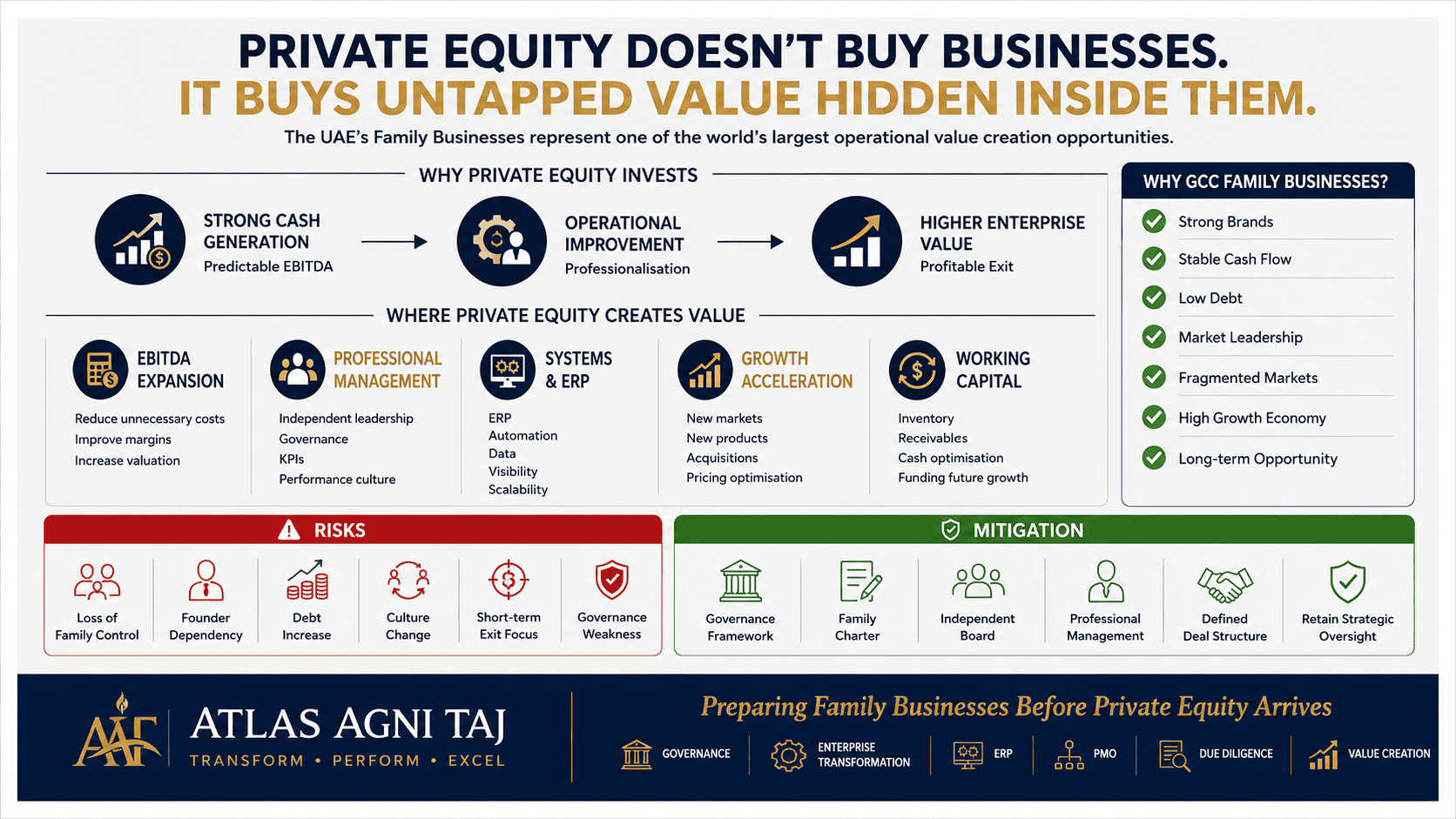
The private equity thesis on GCC family businesses is disarmingly simple. These enterprises are not glamorous. They do not carry the narrative appeal of technology disruption or the exit multiples associated with venture-backed growth stories. Yet they possess something considerably more durable: consistent cash generation, entrenched market positions, meaningful operational underoptimisation, and substantial headroom for expansion — all within one of the most stable and capital-rich economies in the emerging-market universe.
What sophisticated investors have recognised, and what many founders have not fully internalised, is that family businesses in the region were built to generate wealth, not to maximise economic return or operational efficiency. The founding generation’s priority was rarely to optimise the cost base, unlock cross-business synergies, or install institutional-grade management practices. Their priority was to generate reliable cash flow and to preserve family control across generations.
This combination — strong commercial fundamentals sitting beneath a governance structure optimised for personal and family wealth rather than economic efficiency — is, from a private equity perspective, an unusually attractive proposition. It represents a platform where value can be created not by inventing new markets, but by professionalising what already exists.
The Value-Creation Equation: Where Private Equity Sees Opportunity
Private equity value creation in this context is not a complex model, though its execution demands considerable operational discipline. It operates across several distinct dimensions, each of which is worth understanding in its own right.
Cost Optimisation and EBITDA Expansion
Many family businesses, particularly in distribution, retail, logistics, and manufacturing, carry cost structures that would be considered inefficient by institutional standards. Vendor relationships are frequently longstanding rather than competitively tendered. Procurement is rarely centralised, with purchasing conducted independently across business units, forgoing scale economies. Staffing levels often reflect historical hiring patterns and founder preference rather than optimal headcount, while facilities are sometimes maintained at a standard driven by prestige rather than necessity.
A private equity acquirer typically identifies cost-reduction opportunities in the order of fifteen to thirty per cent of the operating cost base. For a business generating one hundred million US dollars in EBITDA, this can represent fifteen to thirty million dollars in annual cost reduction — achieved not by diminishing service quality, but through:
- Standardising procurement across previously siloed business units
- Renegotiating vendor contracts from a position of consolidated purchasing power
- Right-sizing organisational layers that have become redundant over time
- Consolidating duplicate support functions across the group
- Eliminating discretionary and prestige-driven expenditure
- Optimising facilities and logistics networks for genuine operational need
The appeal of this lever, from an investor’s perspective, is that it creates financial value without requiring a single additional unit of revenue growth. It is value creation from operational discipline alone — the most predictable and least risky form of value engineering available to a private equity sponsor.
Structural Reorganisation and Systems Implementation
Many family enterprises continue to operate on manual, fragmented, or incomplete operational systems. This is rarely a problem at a modest scale; it becomes a material constraint once the business has outgrown its infrastructure. Common opportunities include implementing integrated enterprise resource planning systems where fragmented legacy systems previously existed, standardising financial reporting and consolidation across entities, establishing supply chain visibility where opacity once prevailed, and introducing data-driven decision-making in place of intuition-led judgement.
These implementations are capital-intensive and operationally disruptive, which is precisely why a founder often resists them — they introduce near-term cost without an immediately visible revenue benefit. A private equity investor, by contrast, recognises that this infrastructure is the platform on which future growth and operating leverage depend.
Revenue Growth Acceleration
Beyond cost discipline, private equity sponsors typically pursue deliberate strategies to accelerate top-line growth: expanding geographic footprint on the back of an established platform, adding new customer segments, cross-selling across the units of a wider conglomerate, entering adjacent markets, and pursuing pricing optimisation — often raising prices in markets where the business already holds a dominant position. Critically, sponsors are prepared to fund organic growth that a financially conservative founder may have resisted, treating short-term financial metrics as secondary to medium-term value creation.
Operational Leverage Through Professionalisation
Family businesses frequently lack institutional management structures, with decisions concentrated among family members who may have limited formal commercial training. Private equity sponsors typically introduce professional management, often at C-suite level, to instil disciplined operational practice. This professionalisation improves the quality and consistency of decision-making, introduces performance-based incentive structures, reduces the influence of personal bias in commercial decisions, and establishes organisational transparency and accountability for operating metrics.
Working Capital Optimisation
Many family enterprises manage working capital conservatively, maintaining substantial cash buffers and extended payables cycles as a matter of prudence. Private equity investors typically optimise this position by accelerating receivables collection, refining payables cycles, right-sizing inventory holdings, and redeploying the resulting freed-up cash into further value-creation initiatives.
Add-On Acquisitions and Consolidation
Perhaps the most powerful lever available to a private equity sponsor is the acquisition of smaller competitors and their consolidation into the existing platform. A fragmented industry can, in relatively short order, become a consolidated platform commanding combined purchasing power, shared infrastructure, and materially expanded market reach — a transformation that is difficult for a single family enterprise to execute independently, but straightforward for a well-capitalised sponsor.
The Attractive Profile: What Private Equity Looks For
Not every family business represents an equally compelling target. The most attractive profiles tend to share a consistent set of characteristics, and family owners would be well advised to assess their own enterprise against this checklist before any approach is made.
- Strong market position — established brand equity, entrenched customer loyalty, and defensible competitive advantage
- Consistent cash generation — predictable, recurring EBITDA margins valued above headline revenue growth
- Moderate leverage capacity — limited existing debt, providing room for sponsor-led borrowing against strong cash flows
- Experienced management — an existing transition toward professional leadership, reducing founder-dependency risk
- Fragmented competition — an industry structure that offers genuine consolidation upside through add-on acquisitions
- Regulatory stability — operating within a framework that does not expose the investment to abrupt policy risk
- Diversified customer and vendor base — limited dependence on any single counterparty
UAE and wider GCC family businesses operating in retail, distribution, logistics, healthcare, and industrial sectors frequently satisfy the majority of these criteria, which explains the sustained and growing sponsor interest in the region.
The Attraction: Financial Engineering and Exit Strategy
Beyond operational value creation, private equity sponsors are drawn to family businesses by favourable financial dynamics and clearly defined exit pathways. Family enterprises are frequently valued on the basis of what the founder is prepared to accept, rather than on rigorous market comparables. A founder may be entirely satisfied with an eight-to-ten-times EBITDA valuation, motivated by personal liquidity considerations — retirement, diversification, or family dynamics — rather than by a desire to maximise enterprise value. Institutional acquirers, by contrast, scrutinise enterprise value with considerable rigour, and a material gap frequently exists between what a founder will accept and what an informed institutional buyer would be prepared to pay.
Private equity sponsors can typically leverage an acquired platform at four to six times net debt, deploying borrowed capital to partially fund the transaction while preserving equity return potential — a level of leverage capacity that a conservatively financed family business has often never utilised. Sponsors also operate with explicit investment horizons, typically between four and seven years, and a range of exit pathways including public listing, strategic sale, secondary sale to another sponsor, dividend recapitalisation, or the disposal of add-on acquisitions. These optionalities are rarely available to a family owner, who is often confronted with a binary choice between indefinite continuation and an outright sale.
The Tension: Alignment, Speed, and Control
The relationship between private equity and family ownership is, however, inherently fraught, because the two parties are frequently optimising for fundamentally different objectives.
Private equity sponsors operate on a four-to-seven-year investment cycle, with the explicit objective of maximising exit value within that window. Family owners, by contrast, typically view the enterprise as a multi-generational wealth vehicle — a decision optimal for exit value in year five may be entirely suboptimal for the business’s long-term sustainability. A sponsor might, for instance, divest a profitable division that does not align with the platform’s strategic focus, redeploying proceeds into higher-return opportunities elsewhere. The family owner may have wished to retain that same division precisely because it supports family employment or represents a business the founder built personally.
Further tensions consistently emerge around debt tolerance, with sponsors comfortable at four-to-six-times leverage while family owners often resist debt they have spent generations avoiding; around dividend policy, with sponsors typically planning distributions in years two to four ahead of exit while family owners may prefer reinvestment for organic growth; and around operational approach, exit strategy, and strategic direction more broadly. These tensions are not incidental friction to be managed away. They are structural, arising from the fact that private equity and family ownership represent genuinely distinct optimisation functions.
The Deal Structures That Work
Successful private equity investments in family businesses typically employ deal structures explicitly designed to bridge these tensions, rather than assuming they will resolve themselves.
- Founder and family retention — preserving the founder in an advisory capacity or as a significant minority stakeholder, sustaining incentive alignment alongside sponsor capital and expertise
- Earnouts and performance-based consideration — deferring part of the purchase price against the achievement of defined operational or financial milestones
- Multiple classes of shares — preserving family governance or veto rights over specific decisions while the sponsor holds common equity and management control
- Founder continuation agreements — enabling continued operational involvement, typically for two to three years, with clearly defined role expectations and transition milestones
- Management incentive plans — extending equity participation and performance-based incentives to professional managers and key employees aligned with sponsor return targets
Sector Considerations Across the GCC
The attractiveness of any given family business to a private equity sponsor is not uniform across sectors, and family owners benefit from understanding where their industry sits within the current appetite of institutional capital. Retail and consumer distribution businesses, particularly those with exclusive agency agreements or entrenched brand distribution rights, remain a perennial favourite, owing to their predictable cash conversion and the ease with which procurement and logistics can be centralised across a portfolio. Healthcare platforms — clinics, diagnostics networks, and pharmaceutical distribution — attract sustained interest because of favourable demographic tailwinds, regulatory barriers to entry that protect incumbents, and clear consolidation logic across a still-fragmented provider landscape.
Logistics and supply chain businesses benefit from the region’s positioning as a global trade hub, with sponsors particularly drawn to platforms that can be scaled across multiple GCC jurisdictions using a single operating backbone. Industrial and manufacturing businesses present a more mixed picture: those with modern, well-maintained assets and diversified end markets are highly sought after, while those with ageing infrastructure or heavy dependence on a single government contract are viewed more cautiously. Family businesses operating in sectors adjacent to government procurement or subject to periodic regulatory change should expect closer scrutiny and, in some cases, a valuation discount to reflect that uncertainty.
Understanding this sector-specific lens matters because it shapes not only valuation, but also the type of sponsor likely to approach — a global buyout fund, a regional champion, or a family office acting as a strategic consolidator — each of which brings a different appetite for control, timeline, and post-investment involvement of the founding family.
The Middle East Private Equity Ecosystem
The UAE and GCC private equity market has matured considerably over the past decade. International sponsors have deployed increasing amounts of capital into the region, recognising both the family-business opportunity and the access to growth capital available through Gulf sovereign wealth. Regionally headquartered sponsors have, in parallel, developed a deeper understanding of family business dynamics, regulatory environments, and cultural norms, building substantial track records in acquiring and operating such enterprises. A number of prominent family groups have themselves established private equity arms to acquire and professionalise other family businesses.
The result is a genuinely competitive market. A family owner seeking to monetise part or all of their stake now has multiple credible counterparties and can, with the right preparation, run a genuinely competitive process to maximise both valuation and the quality of the eventual partnership.
The Case for Partnership: When It Works
The most successful private equity and family business partnerships share a consistent set of characteristics: clarity, on both sides, regarding the value-creation plan and how it will be executed; genuine family involvement in shaping strategy, rather than strategy being imposed unilaterally; professional management brought in to complement, rather than replace, experienced family managers; alignment on what constitutes success, extending beyond financial return to encompass business sustainability, employee welfare, and stakeholder relationships; clearly defined governance, with explicit board composition and decision-making authority; and an explicit founder transition plan where succession is a live consideration.
Conclusion: The Opportunity and the Risk
For family business owners, private equity investment presents both genuine opportunity and material risk. The opportunity lies in the capital, operational expertise, and proven value-creation frameworks that a sponsor brings — a business growing organically at five to ten per cent under founder leadership might reasonably achieve fifteen to twenty-five per cent growth under sponsor ownership, alongside materially improved operational efficiency and market reach. The risk lies in the fact that sponsor optimisation is directed toward maximising exit value, an objective that may not align with family priorities such as wealth preservation, multi-generational continuity, or business autonomy.
The family enterprises that navigate this successfully share four disciplines: absolute clarity about their own objectives, whether partial exit, full exit, capital deployment, or growth acceleration; rigorous evaluation of prospective sponsor partners for genuine alignment of values and approach, not merely valuation; sustained governance representation and strategic input throughout the investment period; and a shared understanding, from the outset, that the transition is to be managed as a partnership rather than a takeover.
Private equity capital will continue to flow into GCC family businesses because the underlying investment thesis is sound and the market opportunity remains substantial. The question facing family business owners today is not whether private equity will come knocking. Increasingly, it will. The question is whether the family will meet that approach with clarity of objective and within a genuine framework of partnership.
How Atlas Agni Taj Can Help
Atlas Agni Taj advises UAE and GCC family businesses and their boards through precisely this inflection point. Our engagement model is designed to ensure that a family enterprise enters any private equity conversation from a position of preparedness and strength, rather than reacting to an inbound approach on the sponsor’s terms.
- Pre-transaction readiness assessment — an independent, objective review of governance structure, operational maturity, cost base, systems infrastructure, and management depth, benchmarked against the profile institutional sponsors seek
- Value-creation and EBITDA improvement diagnostics — identifying cost optimisation, working capital, and systems opportunities ahead of any transaction, so that value is captured for the family rather than surrendered to the incoming sponsor
- Governance and family charter design — establishing the board structure, decision rights, and family constitution required to negotiate credibly with institutional capital while preserving appropriate family oversight
- ERP, systems, and PMO transformation delivery — designing and mobilising the enterprise systems and programme governance capability that materially improve valuation and post-investment execution confidence
- Sponsor evaluation and deal-structure advisory — supporting families in assessing prospective private equity partners for genuine cultural and strategic alignment, and in structuring earnouts, share classes, and founder continuation arrangements that protect family interests
- Interim and transition leadership — providing seasoned programme and transformation leadership during the critical first eighteen months of sponsor ownership, bridging founder-led operations and institutional management
With over three decades of enterprise transformation, ERP, governance, and programme leadership experience across the UAE and GCC, Atlas Agni Taj brings an independent, execution-focused perspective to family businesses considering their next chapter — ensuring that when private equity does come knocking, the family is negotiating from strength, not necessity.
Atlas Agni Taj — Proprietary. This article and its contents are the intellectual property of Atlas Agni Taj and may not be reproduced without attribution.
#PrivateEquity