
Cyber Resilience Is a Business Survival Issue, Not an IT Problem
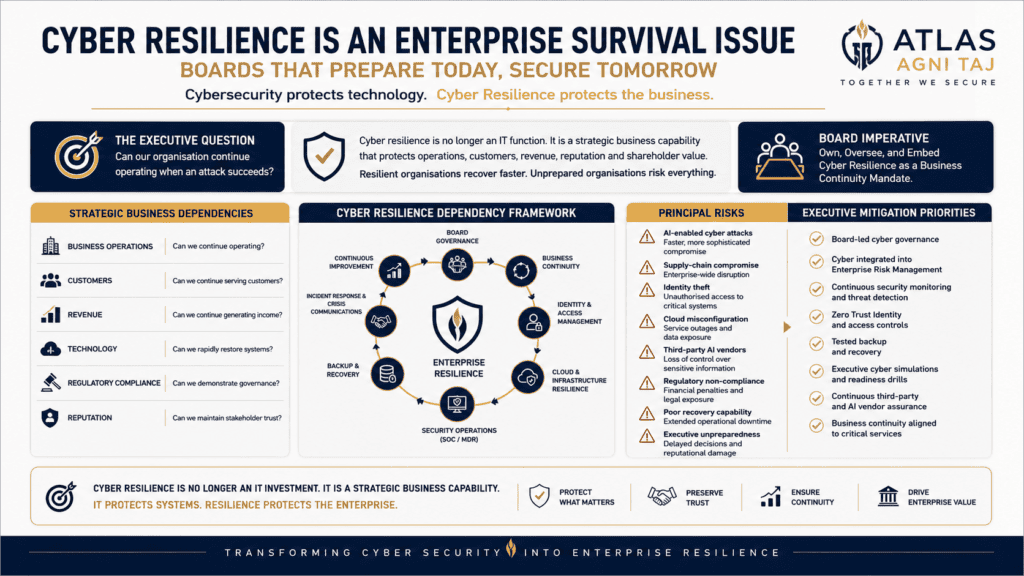
Cyber Resilience Is No Longer an IT Problem Cyber Resilience Is No Longer an IT Problem: It Is an Enterprise Survival Issue Cybersecurity is not principally about stopping attacks. It is about keeping the enterprise running when an attack succeeds. That distinction, subtle in language but enormous in consequence, is the one most boards in the GCC have yet to internalise. For years, cybersecurity has been framed, funded and governed as a technology discipline: a matter for the CISO, the infrastructure team and the annual audit cycle. That framing was always incomplete, but in 2026 it has become dangerous. Across the UAE and the wider GCC, where governments and enterprises alike are accelerating investment in artificial intelligence, sovereign cloud, open banking, smart infrastructure and connected supply chains, the attack surface has expanded faster than the governance models built to defend it. Cyber risk and resilience have moved from being a standing item on the CIO’s agenda to being one of the defining tests of enterprise survival. Boards that continue to delegate this entirely to a technology function are, in effect, delegating a decision about the company’s continued existence. The uncomfortable truth is that sophistication of tooling has stopped being the differentiator between organisations that recover from a cyber incident and those that do not. What separates them is whether leadership can answer one brutal, unglamorous question with confidence: can we continue to operate when something goes wrong? Most organisations, if they are honest with themselves, cannot yet answer yes. Part 1: Why Traditional Cyber Thinking Is No Longer Sufficient The classical cybersecurity model was built on a simple, defensible premise: build strong perimeters, monitor the gates, detect intrusion, and respond. Firewalls, intrusion detection systems, vulnerability scanners, penetration testing and annual audits became the standard toolkit of the discipline. In a world of contained networks and predictable threat models, this approach was largely adequate. It is no longer the world in which enterprises operate. None of these controls have become irrelevant. Firewalls, endpoint tools and independent audits remain essential components of any credible defensive posture. But they are no longer sufficient on their own, because the shape of enterprise risk has changed fundamentally. Six dimensions of that change deserve direct board attention: The implication for leadership is stark. Organisations cannot audit, patch and monitor their way to genuine security. Modern cyber resilience demands a shift in how enterprises think about investment, governance and operating discipline: from a technology-led defensive posture to a business-aligned resilience strategy. For regulated entities, critical infrastructure operators and organisations with material digital dependency, this is no longer best practice. It is a baseline requirement of doing business responsibly. Part 2: Cyber Resilience Is Business Resilience The word ‘resilience’ signals a deliberate shift in perspective, and it is worth boards pausing on its precise meaning. Resilience is not the pursuit of preventing every attack; no organisation, however well resourced, can credibly make that promise. It is the discipline of designing organisations, processes and systems that can absorb a shock, adapt to it and recover from it without existential damage. A genuinely resilient organisation does not assume it will never be compromised. It assumes the opposite, and prepares accordingly: it detects compromise quickly, contains it decisively, recovers from it methodically, and learns from it honestly. This is not, at its core, an operational matter that can be left to the security function. It is a governance issue that belongs squarely at board and executive level. Four questions should sit permanently on the board risk agenda, and the quality of the answers should directly inform investment priorities, risk appetite and strategic planning: Can we operate during an attack? If a critical system were compromised this afternoon, could the organisation continue to serve customers, meet regulatory obligations and protect revenue? For most organisations, an honest answer is no. Closing that gap is a matter of business continuity planning, deliberate redundancy and failover capability designed specifically with cyber incidents, rather than natural disasters or infrastructure failure, in mind. This is a business architecture problem before it is a technology problem, and it deserves to be treated as one. Can we recover? Recovery from a significant cyber incident is not principally a technology exercise. It requires tested, documented and rehearsed procedures for data restoration, system rebuild, supply chain coordination and customer communication. Organisations that have not invested in backup architecture, tested restoration procedures and clear recovery governance typically face recovery timelines measured in weeks or months, not the hours or days their customers and regulators will expect. Recovery investment is, in the fullest sense, cyber investment. Can we evidence our controls? In a regulated environment, or in the aftermath of a serious incident, the organisation will be required to demonstrate that appropriate controls were in place, that they were operating as intended, and that there were no material gaps. This requires logging, monitoring and audit trails that are themselves protected and immutable. Many organisations maintain logs on systems that attackers can reach and tamper with, and that are only reviewed after the fact. Evidencing control requires a deliberate architecture that assumes an adversary will actively try to destroy or falsify the evidence of what happened. Can we protect the confidence of customers and regulators? A cyber incident is, above all, a confidence event. Customers, partners and regulators will assess whether the organisation handled the incident transparently, understood it fully, and implemented meaningful controls to prevent recurrence. Organisations that can answer credibly recover faster and sustain materially less reputational and competitive damage than those that cannot. This requires incident response planning, forensic capability, crisis communication discipline and structured engagement with regulators and partners, all of which are governance and leadership responsibilities rather than purely technical ones. Taken together, these four questions describe a model of cyber resilience that is genuinely aligned with business objectives. They cannot be delegated wholesale to the security team. They require sustained engagement from the board, the CFO, the COO, General Counsel and business unit leaders, working from a shared understanding that cyber resilience, properly understood, is simply enterprise resilience by another name. Part 3: Security Operations as a Resilience Asset, Not a Cost Centre If cyber resilience is the objective, effective security operations are the foundation on which it is built. A properly designed and operated Security Operations Centre, whether built in-house, outsourced, or run as a hybrid, is not a cost centre to be minimised. It is a resilience asset. Its purpose is not to prevent every attack, an impossible standard, but to detect attacks quickly, understand them thoroughly, contain them rapidly and provide the forensic clarity that informs both immediate response and long-term
From AI Pilots to AI Value: A CIO’s Guide to Enterprise AI Scaling
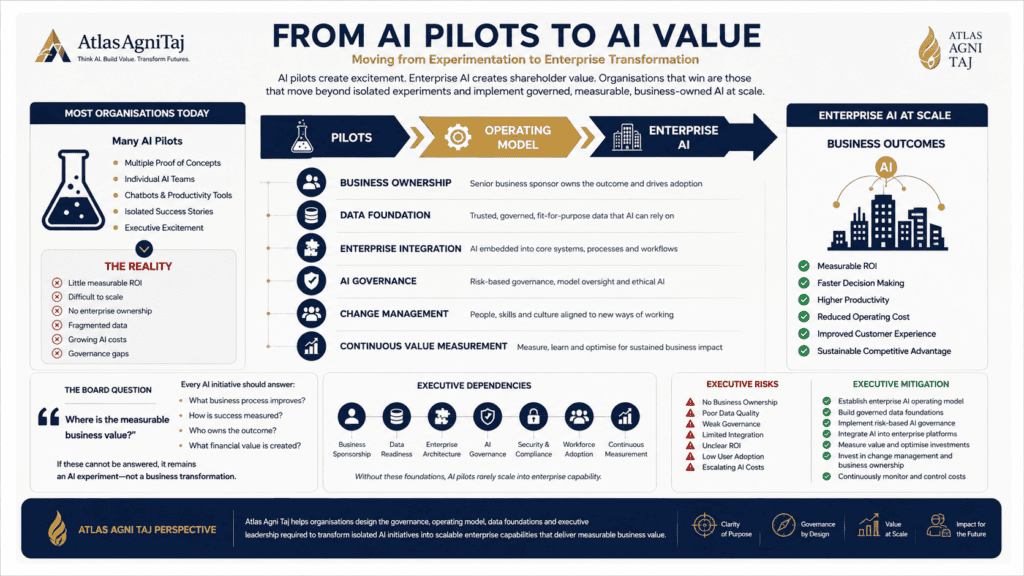
EXECUTIVE INSIGHT From AI Pilots to AI Value: Why CIOs Must Move Beyond Experimentation AI pilots are easy to launch and easy to celebrate. AI value is an altogether harder, longer, and more disciplined undertaking — and it is the one that boards are now demanding. The Pilot Paradox Walk into almost any boardroom across the Middle East, Asia-Pacific, or North America today, and you will encounter a remarkably consistent narrative. The organisation has embraced generative AI and agentic AI. Multiple proof-of-concept projects have been launched. Dedicated AI teams may even have been hired. Slide decks showcasing early wins have been presented with genuine enthusiasm. Yet when the Chief Financial Officer asks a simple question — where, precisely, is the measurable business value? — the room tends to go quiet. This is the pilot paradox, and it has become the defining tension of enterprise technology leadership over the past eighteen months. Recent CIO research consistently places operationalising AI, establishing robust governance, ensuring data readiness, maintaining cybersecurity posture, and controlling escalating costs firmly at board level. Cybersecurity remains the foremost concern for most CIOs, closely followed by the challenge of operationalising AI and building a coherent data strategy. The question of whether enterprises should adopt AI was settled two years ago. The question that matters now is how to make AI work — reliably, safely, and at a scale that moves the needle on enterprise performance. This is not, at its core, a technology problem. It is an operating model problem, and it demands executive-level ownership rather than technical stewardship alone. Why AI Pilots Fail to Scale Enterprises that fail to translate promising pilots into enterprise-wide value tend to fail for a small, consistent set of reasons. Recognising these failure patterns is the essential first step towards building AI capability that endures. The absence of genuine business ownership is the most critical failure point. Too many AI initiatives are launched by the technology function — often with real enthusiasm from Chief Technology Officers or innovation teams — but without a senior business sponsor who owns the outcome. A pilot can demonstrate technically that a model works. What it cannot do, on its own, is secure the budget, authority, and organisational will required to move from a controlled environment into full production. Without a business owner prepared to champion the transition, the initiative remains an interesting laboratory exercise rather than a genuine transformation programme. Incentives, authorities, and governance structures simply are not aligned to carry the work forward. Inadequate data preparation and governance compounds the problem. Generative and agentic AI systems are only as good as the data that feeds them, and most enterprises discover during the pilot phase that their data landscape is fragmented across legacy systems, inconsistently defined, and often duplicated or stale. A small team can manage around these limitations during a pilot, manually curating datasets and suppressing noise. Scaling to an enterprise-wide deployment, however, requires master data governance, data lineage, and compliance frameworks that are unglamorous, lengthy, and expensive to build. Many organisations quietly abandon their scaling ambitions once they confront the true scope of this work — and where governance is not established from the outset, pilots can inadvertently create regulatory exposure and audit risk that undermines organisational appetite for AI altogether. The isolation of AI from core enterprise architecture is a third, equally damaging pattern. Pilots are frequently built on standalone platforms, fed by manually extracted data, with outputs delivered through dashboards or APIs that never touch the systems of record. Scaling requires genuine integration into ERP platforms, HCM systems, customer data platforms, and financial systems — work that is complex, demands changes to core business processes, and requires close coordination between technology and business stakeholders. Many pilots never progress beyond the demonstration stage because this integration effort is underestimated or its business case is never properly articulated. Undefined, measurable return on investment may be the most damaging gap of all. Many pilots launch under aspirational banners — “improve efficiency,” “enhance decision-making,” “elevate customer experience” — without ever translating these ambitions into financial or operational terms. When the moment comes to make the case for scaling, the organisation cannot say with confidence whether the pilot delivered value, whether that value is sustainable, or whether the cost of full deployment is justified. Executive leaders, having heard AI promises for several years now, have become understandably sceptical. They want proof, not pilots. Missing governance and risk frameworks round out the picture. Traditional IT governance was never designed for the particular risks that AI systems introduce — model drift, data bias, explainability requirements, and liability for errors that ripple through downstream processes. Pilots frequently operate in something close to a governance vacuum. Once organisations recognise the scope of governance required — model monitoring, retraining protocols, access controls, audit trails, human oversight — many quietly pull back from their scaling plans, leaving otherwise capable initiatives permanently stranded in pilot purgatory. The CIO’s New Mandate: Balancing Innovation with Governance The role of the Chief Information Officer has changed fundamentally. Where CIOs once managed stability, security, and efficiency as their primary mandate, today’s CIOs must simultaneously balance innovation velocity with risk management, enable business agility without compromising security, and control costs even as competitors invest aggressively in the same capabilities. This balancing act is especially demanding in regulated sectors such as financial services and government, where the pressure to modernise is intense — customers expect contemporary digital experiences, competitors are moving quickly, and boards are asking pointed questions about AI strategy — while the risk of deploying immature AI systems into critical business processes remains equally intense. The tension between innovation and governance is real, and it is not easily resolved by leaning entirely into one or the other. Pure governance approaches strangle innovation with exhaustive approvals and documentation before any experiment can proceed. Pure innovation approaches invite regulatory violations, operational failures, security breaches, and lasting reputational damage. The answer is not to choose a side, but to design an AI operating model that enables experimentation within a framework of genuinely managed risk. In practice, this means building: Cost control forms a second, equally pressing dimension of the CIO’s new mandate. Generative AI and advanced analytics consume significant compute resources, and cloud spending can spiral rapidly without active management — particularly as licensing models for AI platforms and tools remain immature and, in many cases, opaque. CIOs must ensure that AI investment delivers returns commensurate with
ERP Modernisation & AI Readiness: Enterprise Guide 2026
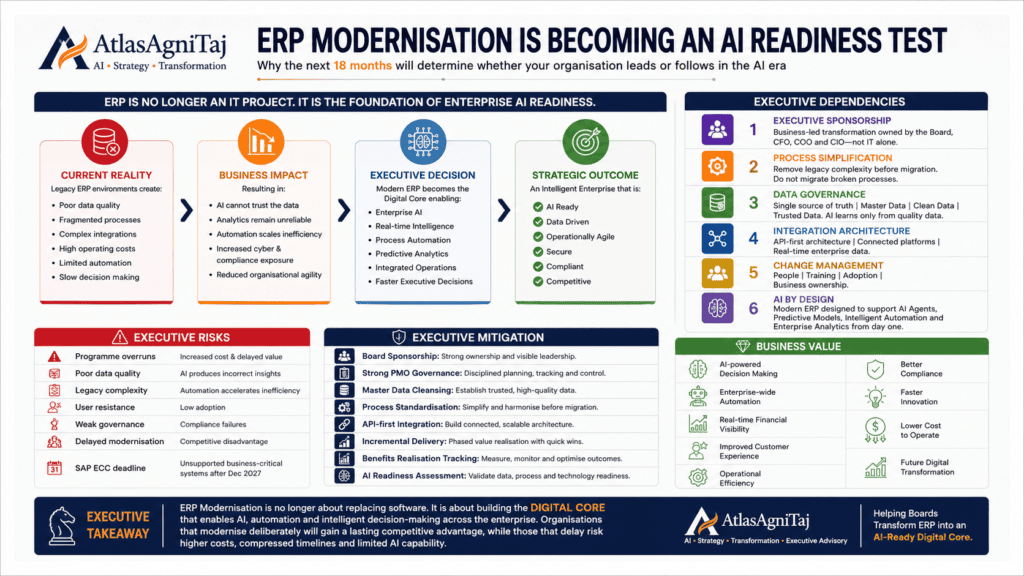
ERP Modernisation Is Becoming an AI Readiness Test Why the next eighteen months will decide which enterprises lead the intelligent era — and which spend a decade catching up For most of its history, Enterprise Resource Planning has been treated as plumbing: essential, expensive, and largely invisible to the boardroom. That era is over. In 2026, the state of an organisation’s ERP estate has become the clearest available signal of whether that organisation is capable of deploying artificial intelligence with any real effect. This is no longer a technology conversation. It is a test of institutional readiness, and increasingly, of leadership judgement. Why This Moment Is Different Three forces have converged to make ERP modernisation an unavoidable executive priority, rather than a discretionary IT programme. Why Legacy ERP Environments Defeat AI Most large enterprises operate ERP landscapes shaped by decades of customisation, acquisition, reorganisation, and accumulated workaround. The pattern is remarkably consistent across industries. The consequence of layering AI onto this foundation is what might best be described as automated inefficiency: processes that run faster while continuing to produce precisely the same errors, blind spots, and inconsistencies they always have. Automation does not fix a broken foundation — it accelerates it. ERP as the Digital Core, Not the Back Office Genuine ERP modernisation requires reframing what ERP actually is within the enterprise. Rather than a finance-and-operations utility sitting behind the business, modern ERP should be understood as the digital core that connects and orchestrates the enterprise as a whole: finance and controlling; procurement and supply chain; human capital management; sales and revenue operations; manufacturing and operations; data and analytics; and controls and compliance. Understood this way, modernisation stops being a technology replacement exercise and becomes a strategic redesign of how the enterprise operates, integrates, and learns. That reframing raises the apparent complexity of the programme — but it also clarifies precisely why the investment is justified. One global financial services firm that repositioned its S/4HANA programme as an operating model transformation, rather than an ERP migration, secured materially greater executive buy-in, additional budget, and ultimately delivered benefits some forty per cent above its original projections. Why Speed, Pursued Carelessly, Becomes the Enemy One of the more damaging instincts in ERP modernisation is the pressure toward rapid, compressed deployment. Speed matters, but not at the expense of the quality on which the entire investment depends. A European automotive supplier compressed its S/4HANA implementation from twenty-four months to fourteen, eliminating process simplification, abbreviating user testing, and deferring control implementation to save time. The result was nine months of additional post-go-live support, cost overruns exceeding fifteen million euros, and twenty-four months to reach stability. The attempt to save ten months cost the organisation thirty-four months of disrupted value delivery. A disciplined approach follows a clear sequence: assess current-state complexity; simplify processes before migration, not after; cleanse master data to a high standard; execute a staged migration under firm integration governance; establish controls immediately post-go-live; and track benefits realisation systematically. Depending on complexity, this typically requires eighteen to thirty-six months — but it produces a genuinely transformed enterprise rather than old complexity running on new infrastructure. What Distinguishes the Programmes That Succeed Across a wide range of major ERP programmes, certain factors consistently separate those that transform the business from those that merely replace its technology. Designing Explicitly for AI Readiness ERP modernisation must treat AI readiness as an explicit design principle from the outset, not a capability bolted on afterward. Managing the Principal Risks ERP modernisation programmes carry material risk, and the failure modes are well understood. The Conversation Executive Leaders Should Be Having For CIOs, CTOs, and transformation leaders, positioning ERP modernisation correctly is not simply a matter of programme management — it shapes how the organisation, and the market, perceives the leader driving it. Executives who master this framing position themselves not as technology managers, but as strategic advisors — a distinction that increasingly determines who is invited into board discussions, interim leadership mandates, and advisory roles as organisations navigate transformations of this scale. The Question Beyond the Migration The question that should anchor every ERP programme is not “when are we migrating from ECC to S/4HANA?” That is a project question with a timeline for an answer. The deeper and more consequential question is: what kind of intelligent enterprise are we building? Answering it well requires clarity across four dimensions: the business outcomes the organisation intends to enable; how the operating model, accountability, and roles will evolve; the data and analytics strategy and AI priorities that will govern the enterprise going forward; and the technology architecture choices — cloud posture, integration approach, cybersecurity, and compliance — that will underpin all of it. When these questions are answered before the programme begins, migration becomes the tactical execution of strategic choices already made, rather than a technical project searching retrospectively for its business justification. That shift in framing changes the entire character of the programme: from “can we migrate?” to “what are we becoming?” Conclusion: An Inevitable Transformation ERP modernisation in 2026 is no longer optional. The December 2027 SAP ECC deadline is real. The competitive pressure to deploy AI effectively is unrelenting. The cost of delay continues to mount. The genuine question facing every enterprise leader is not whether to modernise, but whether to do so strategically, with discipline and vision, or reactively, under deadline pressure, with shortcuts and compromise. Organisations that use this moment to simplify process, elevate data quality, strengthen governance, and design deliberately for AI readiness will emerge as intelligent enterprises — capable of faster decisions, greater resilience, and analytical capability that constitutes genuine competitive advantage. Those that treat modernisation as a like-for-like technology swap, deferring process improvement and adopting minimal governance, will simply replicate their existing complexity on newer infrastructure — and find that automation accelerates the very inefficiencies they hoped to leave behind. The transformation is coming, whether by design or by default. SAP has set the date. Market pressure enforces it. The technology to do it well already exists. The only open question is whether your enterprise will lead this transformation deliberately, on its own terms — or follow it reactively, under compressed timelines and constrained options. This is not, at its core, a technology decision. It is a decision about what your organisation is going to become, and it deserves the seriousness and executive engagement that decisions of that magnitude require. How Atlas Agni Taj
Cyber Resilience in 2026: A Strategic Imperative for Leaders
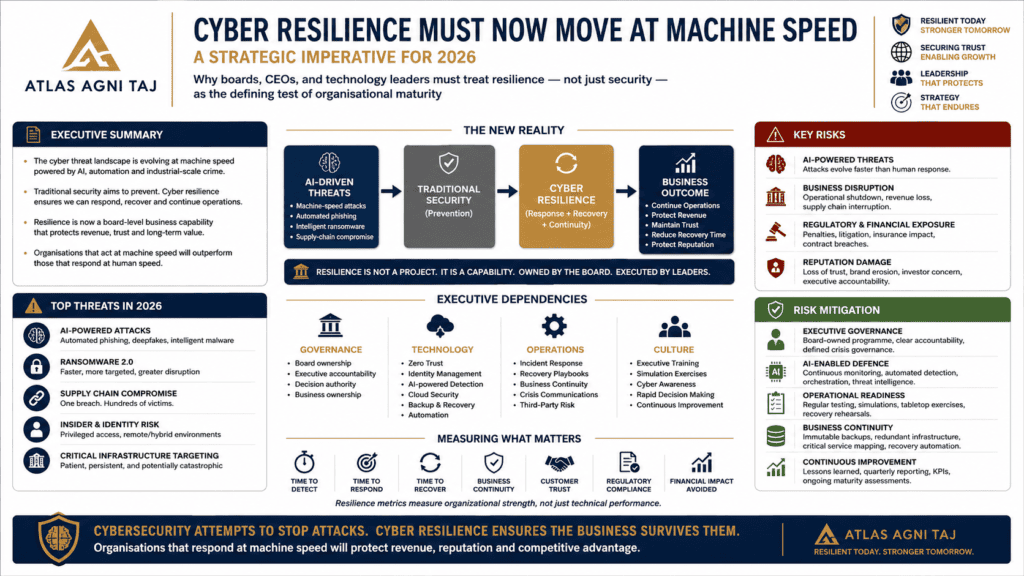
Cyber Resilience Must Now Move at Machine Speed: A Strategic Imperative for 2026 Why boards, CEOs, and technology leaders must treat resilience — not just security — as the defining test of organisational maturity Executive Summary Cybersecurity and cyber resilience are frequently used interchangeably in boardrooms, yet they are fundamentally different disciplines. Cybersecurity protects systems. Cyber resilience protects the enterprise. As artificial intelligence accelerates the speed and sophistication of attacks, and as ransomware matures into a professionalised criminal industry, organisations can no longer afford to treat cyber risk as a technical compliance exercise confined to the IT function. The World Economic Forum’s 2026 Global Cybersecurity Outlook places AI-enabled fraud, phishing, ransomware, and AI-specific vulnerabilities at the very top of executive concern. In the UAE, recent strategic partnerships between government entities and global technology leaders such as IBM and Palo Alto Networks confirm what forward-looking executives already sense: trusted AI, national cyber resilience, digital sovereignty, and economic competitiveness are now inseparable. For CIOs, CTOs, and boards, this convergence presents both an urgent operational challenge and a genuine strategic opportunity. Organisations that embed resilience into their operating model, governance architecture, and leadership accountability will decisively outperform those that continue to treat cyber as a technical afterthought. Part 1 — The Threat Landscape Has Changed Its Physics The threat environment of 2026 bears little resemblance to that of even three years ago. The change is not simply one of volume; it is one of velocity, intelligence, and destructive intent. AI-enabled attacks now allow adversaries to identify vulnerabilities, craft convincing phishing campaigns, and exploit weaknesses at industrial scale. Where a human analyst might once have required days to detect a pattern of compromise, an AI-orchestrated attack can propagate across an enterprise network within hours. Ransomware, meanwhile, has matured from opportunistic crime into a disciplined business model, complete with negotiation playbooks, affiliate structures, and research budgets in the tens of millions of dollars directed at discovering zero-day vulnerabilities before defenders are even aware they exist. Supply chains have become the preferred attack vector. Adversaries increasingly target vendors, contractors, and managed service providers as a route into their true objective — a single compromised provider can expose hundreds of downstream enterprises simultaneously. At the same time, the normalisation of remote and hybrid working has widened the insider risk surface considerably; employees with privileged access are no longer confined to environments where behaviour can be readily monitored. Critical infrastructure — utilities, transport networks, healthcare systems — remains a persistent and patient target. These campaigns often involve weeks or months of quiet reconnaissance before a disruptive event is triggered, with the potential to affect millions of citizens at once. What unites these trends is speed. In previous cycles, a cyber incident might unfold over days or weeks, allowing for deliberate investigation, escalation, and communication. That timeline has effectively disappeared. Modern ransomware can encrypt terabytes of data within hours. A single compromised credential can enable lateral movement across a network within minutes. If an organisation’s incident response process still depends on multi-layered approvals, coordination meetings, and formal change management, it will simply be too slow to matter — by the time decision-makers are assembled, the objective will already have been achieved. Cyber resilience in 2026 therefore demands automation, clearly pre-assigned decision rights, pre-authorised response playbooks, and the operational confidence to activate recovery procedures without waiting for business-as-usual governance to catch up. It is worth stressing that none of these trends are transient. AI tooling used by adversaries is improving at a pace comparable to AI tooling used by defenders, which means the balance of advantage will not resolve itself through technology procurement alone. It will be resolved by which organisations have built the governance, muscle memory, and decision discipline to act decisively under pressure. This is precisely why cyber resilience has moved from a technical specialism to a board-level competency in its own right. Part 2 — The UAE Context: Digital Sovereignty as Strategic Resilience The UAE’s deliberate emphasis on cyber resilience reflects a wider regional conviction: digital trust is now foundational to economic growth and national sovereignty, not a peripheral IT concern. Recent partnerships between the UAE government and global leaders such as IBM and Palo Alto Networks are not simply procurement decisions — they signal a strategic commitment to build institutional capability, governance maturity, and trusted-AI leadership across the region. For enterprises operating in the UAE and the wider GCC, this creates both new expectations and new opportunities. Regulatory frameworks will inevitably tighten as national investment in resilience matures; organisations that embed sound practice early will find themselves ahead of the compliance curve, while those that wait for mandates will face costly retrofitting under pressure. Procurement standards will follow the same trajectory. As government bodies formalise partnerships with trusted security vendors, enterprise procurement processes will increasingly demand demonstrable resilience maturity from suppliers — those unable to evidence it will face friction, delay, and lost commercial opportunity. There is also a genuine leadership opportunity here. Technology executives who position themselves as authorities in cyber resilience — rather than cybersecurity alone — will gain distinct advantage in executive recruitment and board-level influence. This is the moment for CIOs and CTOs to elevate their remit from ‘IT operations’ to ‘business continuity strategy’, and for enterprises expanding beyond the region, demonstrable alignment with UAE and GCC resilience standards is fast becoming a signal of maturity to international partners and customers alike. Part 3 — Cybersecurity and Cyber Resilience Are Not the Same Discipline Cybersecurity is the practice of protecting systems from unauthorised access, modification, or destruction. It is concerned with prevention, detection, and response. It asks: can we stop the attack, identify it quickly, and limit the damage? Cyber resilience is a broader and more consequential capability — the capacity of an organisation to continue functioning during and after a cyber incident. It encompasses operational redundancy, recovery capability, governance clarity, pre-defined decision authority, and stakeholder communication. It asks a different question entirely: can the business continue to operate, can critical services be restored, and can trust with customers, regulators, and shareholders be preserved? An organisation can possess strong cybersecurity — advanced firewalls, endpoint detection, mature threat intelligence — and still lack resilience, because it has never rehearsed how to operate once those controls inevitably fail. And they will fail, eventually; the question is never if, but when. Consider a well-defended
Cloud-First Strategy: A Roadmap for Scalability & Innovation
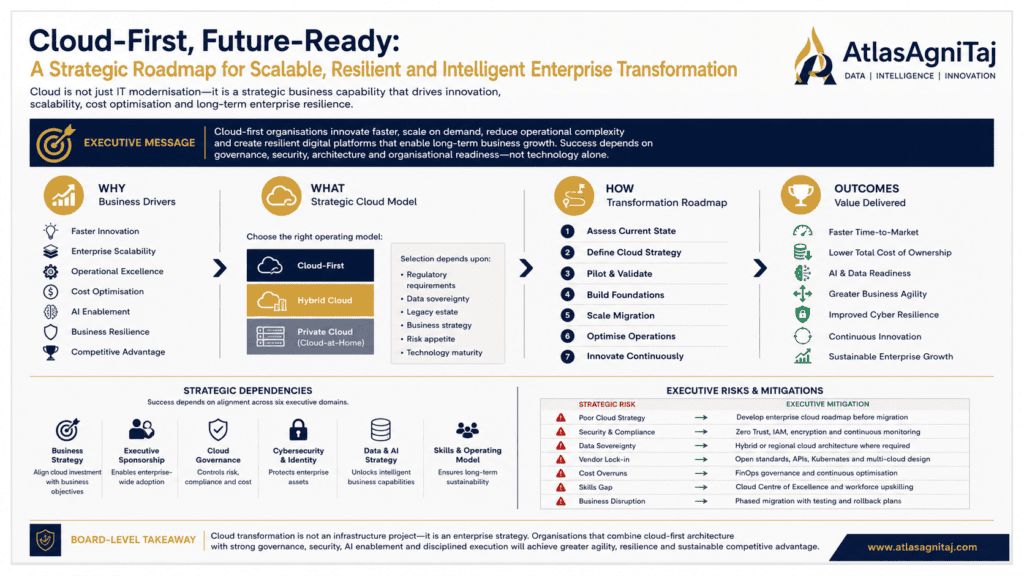
Cloud-First, Future-Ready: A Roadmap for Success Why cloud adoption is key to scalability, innovation and operational excellence Introduction The digital landscape has fundamentally shifted. Organisations today face unprecedented pressure to innovate rapidly, scale efficiently, and remain resilient in the face of disruption. Cloud computing has emerged not merely as a technology choice, but as a strategic imperative that shapes how enterprises compete, operate, and evolve. For chief information officers (CIOs), chief technology officers (CTOs), and enterprise leaders, the question is no longer whether to adopt cloud technologies, but how to do so strategically. A cloud-first approach offers transformative potential—enabling organisations to respond to market changes faster, innovate at scale, and optimise operational costs. Yet this transformation is not a single-step migration; it requires a carefully orchestrated strategy that balances innovation with risk management, agility with governance, and transformation with stability. This article examines the strategic rationale for cloud adoption, explores multiple architectural approaches (cloud-first, hybrid, and on-premises), and provides a roadmap to achieve scalability, innovation, and operational excellence while managing inherent risks and ensuring organisational resilience. 1. The Business Case for Cloud: Strategic Imperatives Scalability and Elasticity Cloud platforms fundamentally redefine how organisations think about infrastructure. Traditional on-premises environments require capital-intensive investments in physical hardware, with capacity planning cycles that extend months into the future. Cloud architectures eliminate this constraint. Resources scale automatically based on demand, whether responding to seasonal traffic spikes, sudden user growth, or real-time workload fluctuations. For enterprises operating in the GCC region—where digital transformation initiatives frequently target rapid user acquisition, real-time transactions, and global service delivery—this elasticity translates to tangible competitive advantage. An organisation can launch new services, expand into new markets, or accommodate rapid scaling without the procurement delays and capital expenditure that constrain on-premises alternatives. Innovation Acceleration Cloud platforms democratize access to advanced technologies. Machine learning, artificial intelligence, data analytics, Internet of Things (IoT), and advanced security services—capabilities historically available only to technology leaders with substantial R&D budgets—are now accessible to organisations of any size via cloud services. This accessibility accelerates time-to-market for new capabilities. Development teams can experiment with emerging technologies, validate business hypotheses at low cost, and rapidly scale successful initiatives. Cloud-native development patterns—microservices, containerization, serverless computing—enable organisations to build modular, independently deployable applications that evolve more rapidly than monolithic architectures. The result is an organisation that innovates continuously rather than in quarterly or annual releases. Operational Excellence and Cost Optimisation Cloud infrastructure eliminates capital expenditure for hardware, facilities, and associated operational overhead. Organisations shift from paying for peak capacity (which sits idle during off-peak periods) to paying for actual consumption. This consumption-based model, when combined with cloud-native architectural patterns, substantially reduces the total cost of ownership. Beyond cost, cloud platforms provide comprehensive operational visibility. Native monitoring, logging, and analytics capabilities enable teams to understand system behaviour in detail, identify bottlenecks, and continuously optimise performance. Automated deployment pipelines, infrastructure-as-code, and policy-driven governance reduce manual operational effort and human error. In the GCC context, where labour costs are high and specialised technical talent is relatively scarce, the operational leverage provided by cloud platforms is particularly valuable. Organisations can accomplish more with smaller operational teams, freeing resources for strategic initiatives rather than routine infrastructure management. 2. Architectural Strategy: Cloud-First, Hybrid, and On-Premises Cloud adoption is not monolithic. Organisations must choose from distinct architectural approaches, each with specific advantages, constraints, and strategic implications. These decisions fundamentally shape technology roadmaps, operational models, and organisational capabilities for years to come. Cloud-First Architecture A cloud-first approach makes cloud the default platform for new applications, data, and infrastructure. Legacy systems migrate to the cloud when feasible; new capabilities are born in cloud environments. This strategy maximises the benefits outlined above: scalability, innovation velocity, and operational efficiency. Cloud-first is optimal when the organisation has the technical maturity to embrace cloud-native development practices, when regulatory constraints permit data residency in public clouds, and when the IT team has the capacity to modernise legacy systems. Technology leaders increasingly adopt this strategy because it provides the greatest long-term flexibility and competitive advantage. Hybrid Cloud Architecture Hybrid cloud environments span both cloud and on-premises infrastructure, with integrated operations, shared data, and coordinated workload deployment. This approach balances innovation with prudence, allowing organisations to move forward while maintaining investments in existing infrastructure. Hybrid architectures are strategically valuable in several contexts. Regulatory requirements may mandate data residency; hybrid allows organisations to maintain sensitive data on-premises while leveraging the cloud for non-sensitive workloads. Legacy applications with complex interdependencies may be impractical to migrate immediately; a hybrid approach allows them to coexist with cloud-native applications. Performance-sensitive workloads may benefit from proximity to on-premises infrastructure while other components operate in the cloud. However, hybrid architectures introduce operational complexity. Managing consistent security policies, data governance, and monitoring across disparate environments requires sophisticated tooling and organisational discipline. The long-term strategic trajectory should be toward either a committed cloud-first or a committed on-premises approach; sustained hybrid approaches often represent transitional states rather than stable end-states. On-Premises (Cloud at Home) Some organisations deploy cloud infrastructure technologies within their own data centres, leveraging containerization, Kubernetes, and cloud-native operational patterns without moving data beyond their physical control. This approach—sometimes called “cloud at home” or private cloud—offers cloud-like operational benefits while maintaining complete data sovereignty and control. This strategy appeals to organisations with stringent data sovereignty requirements, those operating in heavily regulated industries, or those with unique performance requirements. However, it requires significant investment in infrastructure expertise and does not provide the elasticity or cost advantages of public cloud. Organisations pursuing this path must have the technical depth to manage cloud infrastructure independently. 3. Enabling Scalability Through Cloud Architecture Scalability requires more than simply deploying to cloud infrastructure; it demands architectural decisions that enable systems to grow without proportional increases in complexity, cost, or operational overhead. Microservices and Modular Design Cloud-native architectures decompose applications into small, independently deployable services. Each service owns a specific business capability, maintains its own data, and communicates with other services through well-defined interfaces. This modularity enables teams to scale individual services independently based on specific demand patterns. Rather than scaling an entire monolithic application when authentication services experience peak load, teams scale only the authentication service. This targeted scaling reduces wasted capacity and optimises resource utilisation. Equally important, small services are faster to modify, deploy, and validate—accelerating innovation velocity. Containerization and Orchestration Containers package applications with their dependencies, ensuring consistency between development and production environments. Orchestration platforms like Kubernetes automate the deployment, scaling, and management of containerised applications across multiple nodes. This combination provides elasticity at scale. When demand increases, orchestration platforms automatically provision additional container instances. When demand decreases, they deallocate unnecessary resources. This automation enables organisations to achieve near-optimal resource utilisation without manual intervention.
The New Transformation PMO: Enterprise Value Delivery
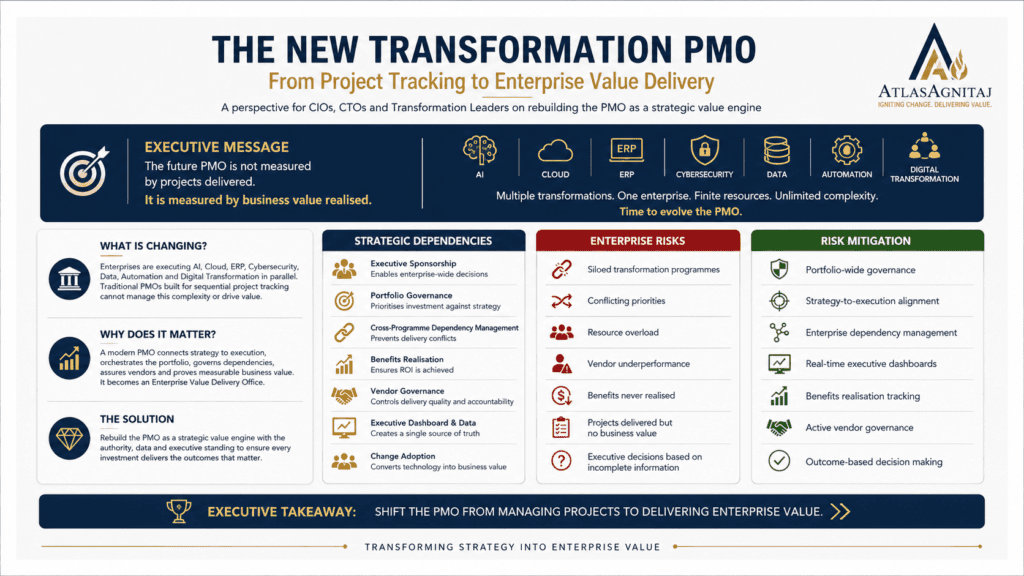
HE NEW TRANSFORMATION PMO A perspective for CIOs, CTOs and Transformation Leaders on rebuilding the PMO as a strategic value engine Executive Summary: The New Transformation PMO: From Project Tracking to Enterprise Value Delivery Every technology leader now operates in a paradox their predecessors never faced. A generation ago, transformation was sequential: an enterprise resource planning system was implemented, then a data warehouse was built, then a network was modernised, each initiative granted its own runway and its own governance rhythm. Today, that sequencing has collapsed. Artificial intelligence adoption, ERP modernisation, cloud migration, cybersecurity hardening, data platform build-out, digital channel transformation, regulatory compliance and cost optimisation are being executed in parallel, by the same finite pool of engineering talent, against the same capital envelope, and under the same executive attention span. The Project Management Office that most organisations still operate was not designed for this reality. It was built for a world of discrete, sequential projects with clear start and end dates. In today’s environment of continuous, overlapping transformation, that model produces status reports nobody reads, escalates risks the business has already priced in, and tracks milestones that have long since stopped correlating with commercial outcome. It optimises for schedule and budget adherence whilst the transformation itself may be failing to deliver adoption, value or resilience. The organisations that are genuinely extracting value from transformation have made a different choice. They have rebuilt the PMO — not as a reporting bureau, but as an enterprise value engine: a function with the authority, the data and the executive standing to connect strategy to execution, govern a complex portfolio, hold vendors accountable, and prove that money spent has translated into value delivered. This article sets out why that shift matters, what a modern PMO does differently, and how to build one. Why Project Tracking Alone Is No Longer Sufficient The traditional PMO emerged in the 1990s and early 2000s, at a time when large enterprises ran change programmes one at a time. Build an ERP system. Migrate a data centre. Deploy a data warehouse. Each initiative had a defined scope, a fixed end date and measurable completion criteria, and a PMO that tracked progress, escalated risk and controlled scope creep was, in that environment, genuinely valuable. That world has gone. Modern transformation is not sequential; it is parallel, continuous and densely interdependent. A bank cannot pause its core banking replacement to finish a digital channel rebuild. A government entity cannot modernise its ERP landscape in isolation from its cloud strategy, its data architecture or its cybersecurity posture. The dependencies between these workstreams are too intricate, the pace of technological change too fast, and the organisational risk of getting the sequencing wrong too severe, to be left to informal coordination. When a PMO confines itself to schedule and budget tracking in this environment, it quietly becomes a bureaucratic cost centre. It produces documentation that sits unread. It flags risks that the business has already accepted, or that are two steps removed from where the real exposure lies. It escalates issues at a cadence too slow for the pace of decision-making the organisation actually needs. Most damagingly, it rewards on-time, on-budget delivery even when the resulting system is barely adopted, generates none of the promised benefit, or introduces new operational fragility that no one has measured. Genuine value delivery requires a PMO that operates simultaneously at three levels: strategically, ensuring transformation investment is aligned to enterprise objectives; operationally, managing execution, removing friction and coordinating delivery across a live portfolio; and financially, tracking benefits realisation and return on investment with the same rigour applied to schedule and budget. A PMO that performs only one or two of these functions is structurally incomplete, and it will underperform regardless of the quality of its individual project managers. Connecting Strategy to Execution: The Function Most PMOs Skip The single most valuable function a modern PMO performs is closing the gap between enterprise strategy and programme execution. It sounds obvious in principle, yet it is remarkably rare in practice. In most organisations, strategy and execution live in different rooms. The board approves a digital transformation strategy in one cycle. Finance approves a portfolio of business cases in another. Operations then manages delivery through a third, largely disconnected process. Within three years, the portfolio bears only a loose resemblance to the original strategic intent, and few people in the organisation can explain precisely why. A value-delivery PMO changes this dynamic by translating strategic language into operational terms before a single project is chartered. What does becoming a “digital-first organisation” actually require in terms of architecture, capability, investment and risk appetite? What outcomes should the business expect from each major programme, and by when? What trade-offs is leadership genuinely willing to accept if two priorities collide? What measures will tell us, in twelve months, whether we succeeded? What dependencies exist between the programmes competing for the same resources? With strategy translated into measurable, testable objectives, the PMO then holds every programme in the portfolio to that standard — not merely reporting whether a programme did what it said it would do, but continually testing whether what it is doing still serves the strategy that funded it. This demands a genuinely sophisticated portfolio management capability: understanding not only what each programme delivers, but how it interacts with every other programme, what shared capability or platform it depends upon, and where critical sequencing risk sits. It also demands that the PMO take an active, rather than passive, role in governance. Too many PMOs remain silent observers, content to report status upward and leave the difficult calls to committee—a value-delivery PMO shapes decisions. When two programmes compete for the same scarce engineering capacity, the PMO frames the trade-off in terms leadership can act on and helps make the call based on strategic priority and risk exposure, rather than on who shouted loudest in the steering committee. When a vendor is underperforming and beginning to jeopardise adjacent initiatives, the PMO escalates early and proposes options rather than simply noting the fact in a red status cell. When benefits are stalling because the business has not adopted the new platform, the PMO identifies the barrier. It drives the corrective action, rather than
Sovereign AI and Cloud Strategy in the GCC: A Board-Level Framework for 2026
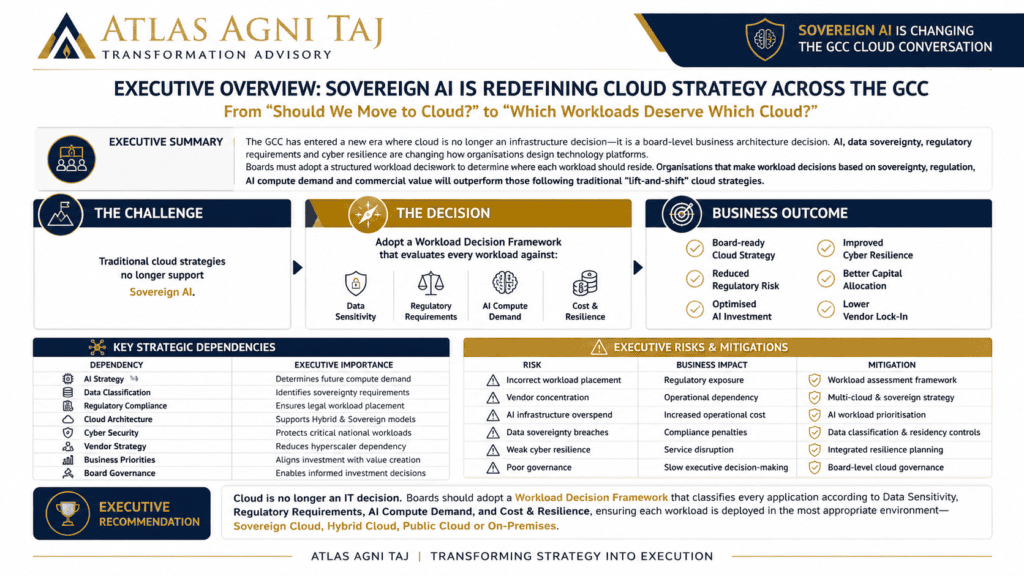
Introduction: Sovereign AI Is Changing the GCC Cloud Conversation The Gulf Cooperation Council is entering a new phase of its cloud and digital infrastructure journey, one defined not by the migration of applications but by the architecture of intelligence itself. For more than a decade, the regional cloud conversation centred on a relatively simple question: should an organisation move its workloads out of the data centre and into the cloud? That question has now been superseded. The conversation occupying boardrooms across Abu Dhabi, Dubai, Riyadh and Doha in 2026 is considerably more sophisticated, and considerably more consequential. The catalyst is sovereign artificial intelligence. Governments and enterprises across the region are no longer treating cloud as a cost-optimisation exercise. They are treating it as the foundation of national digital infrastructure, economic competitiveness and geopolitical positioning. The scale of recent investment underlines the point. Microsoft and Abu Dhabi’s G42 have confirmed a 200-megawatt expansion of UAE data centre capacity, delivered through G42’s subsidiary Khazna Data Centers, with initial capacity expected to come online before the end of 2026. This sits within Microsoft’s wider USD 15.2 billion commitment to the UAE through 2029, of which USD 7.3 billion had already been deployed by the end of 2025. These are not incremental announcements. They represent a structural shift in how compute, data sovereignty and artificial intelligence capability are being planned, financed and governed across the Gulf. For senior technology leaders, this shift changes the nature of the decisions boards now expect them to make. For much of the last decade, cloud strategy was treated as a technology decision delegated to IT leadership: which hyperscaler, which region, which migration methodology. That framing is now inadequate. Cloud strategy in the era of sovereign AI is a business architecture discussion, and it belongs at board level alongside decisions on capital allocation, regulatory exposure and enterprise risk. From Infrastructure Discussion to Business Architecture Discussion Three forces are driving this elevation. First, artificial intelligence workloads consume compute at a scale and intensity that traditional application hosting never required, which means capacity planning now has direct commercial and competitive implications. Second, data sensitivity and sovereignty requirements have become sharper as governments across the region formalise national data residency and AI governance frameworks. Third, boards are increasingly required to demonstrate clarity on vendor dependency, cyber resilience and cost exposure, particularly in regulated sectors such as banking, healthcare, energy and government services. The practical consequence is that the question chief information officers and chief technology officers are now being asked has changed. It is no longer, in essence, “Should we move to cloud?” It is a more precise and more demanding question: “Which workloads require sovereignty, which require scale, and which require cost discipline?” That distinction matters enormously, because treating every workload the same way, whether through wholesale migration or wholesale retention, is no longer a defensible strategy in front of a board, a regulator or an audit committee. Why Sovereign AI Raises the Stakes Sovereign AI is not simply artificial intelligence hosted within national borders. It is a broader concept encompassing control over the models, the data used to train and fine-tune them, the compute infrastructure they run on, and the governance frameworks that determine how they are used. For governments, sovereign AI has become a matter of national strategy. For regulated enterprises, it has become a matter of licence to operate. The UAE’s approach illustrates this well. The Microsoft and G42 expansion, delivered through Khazna Data Centers, is explicitly positioned to strengthen what the companies describe as Microsoft Azure’s secure, scalable and sovereign cloud services in the country, supporting public sector organisations and regulated industries as they adopt AI at scale. Khazna itself is expanding aggressively, having unveiled a further gigawatt-scale expansion plan and broken ground on additional facilities, positioning the UAE as one of the more ambitious sovereign compute build-outs globally. This scale of investment sends an unambiguous signal to enterprise leaders across the region. Sovereign infrastructure is being built at national level, and boards should expect it to reshape vendor strategy, procurement frameworks and workload placement decisions across every regulated sector over the next twenty-four months. Organisations that fail to anticipate this shift risk finding their cloud roadmaps out of step with the infrastructure, regulation and procurement expectations forming around them. The Enterprise Workload Decision Framework In my experience across cloud transformation, managed services, cybersecurity and regulated platform delivery, the organisations that navigate this shift successfully share one characteristic: they resist the temptation to treat cloud as a single, binary decision. Instead, they apply a structured, workload-by-workload decision framework built around four core dimensions. 1. Data Sensitivity Not all data carries the same risk profile. Personally identifiable information, financial records, healthcare data, critical national infrastructure telemetry and classified government information each demand different handling, residency and access-control regimes. A rigorous classification exercise, conducted before any migration or AI adoption decision, remains the single most important control most organisations still under-invest in. 2. Regulatory Requirement Financial services, healthcare, energy and government entities across the GCC operate under increasingly explicit data residency, cross-border transfer and AI governance obligations. Regulatory requirement should be treated as a hard constraint on workload placement, not a retrospective compliance check applied after architecture decisions have already been made. 3. AI Compute Need Large language models, computer vision workloads and advanced analytics platforms have compute and GPU requirements that differ fundamentally from conventional enterprise applications. Understanding which workloads genuinely require AI-scale compute, versus those that merely benefit from it, is essential to controlling cost and avoiding over-engineered architecture. 4. Cost and Resilience Total cost of ownership, vendor concentration risk and operational resilience must be assessed together. A workload that is technically capable of running in sovereign cloud may still carry unacceptable cost or performance trade-offs; equally, a workload placed in public cloud purely for cost reasons may expose the organisation to unacceptable concentration or continuity risk. Applied consistently, these four dimensions produce one of four defensible outcomes for any given workload: migration to sovereign cloud, deployment within a hybrid architecture, migration to public cloud, or retention and modernisation on-premise ahead of any future migration. Some workloads, inevitably, should simply be retired. The discipline lies not in the framework itself, which is straightforward, but in the rigour with which it is applied and the willingness of leadership to accept that different workloads will land in different places. What the Winners Will Look Like The organisations that will lead in this next phase of GCC digital transformation will not be the ones that migrate the greatest number of systems, nor the ones that make the boldest public announcements about AI adoption. They will be the organisations that make the
AI-Native Government Needs Programme Discipline, Not AI
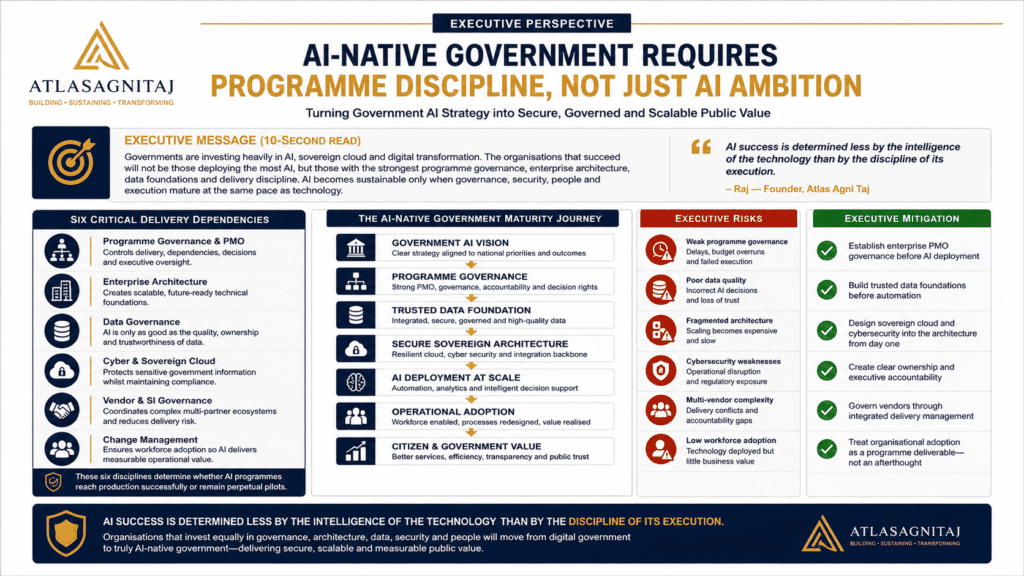
AI-Native Government Needs Programme Discipline, Not Just AI Ambition Abu Dhabi’s Government Digital Strategy 2025–2027 sets an ambitious course: full process digitisation, one hundred per cent sovereign cloud adoption, over two hundred artificial intelligence solutions in production, and a unified enterprise resource planning platform spanning government entities. Taken together, these commitments describe something more far-reaching than a technology upgrade. They describe the deliberate construction of an AI-native government — one in which artificial intelligence is not an add-on to public service delivery, but a structural feature of how that delivery operates. This is a significant moment for the region, and for the technology leaders who will be judged on how well it is executed. Yet as the ambition accelerates, a familiar risk re-emerges: the gap between strategic intent and delivery capability. Governments and large enterprises across the UAE and the wider Gulf Cooperation Council are not short of vision. What determines whether that vision becomes reliable public value is programme discipline — the unglamorous, structural work of architecture, governance, data integrity, cyber resilience, vendor coordination and change adoption that sits beneath every successful transformation. From Digital Government to AI-Native Government The shift underway is best understood as a maturity journey rather than a single leap. Most public and private sector organisations in the region have already achieved a reasonable level of digital service delivery: transactions can be initiated online, forms have been digitised, and citizen-facing portals have replaced much of the paper-based bureaucracy of a decade ago. This is a solid foundation, but it is only the first step. The subsequent stages are considerably harder, and considerably more consequential. Integrated data — the ability to trust and share information consistently across departments and systems — is where many transformation programmes begin to falter, because it exposes years of fragmented systems, inconsistent taxonomies and siloed ownership. Sovereign cloud adoption then provides the secure, compliant infrastructure on which sensitive government and regulated-sector workloads can run at scale. Still, it requires careful architectural planning, not simply a lift-and-shift migration. AI-enabled operations follow, where automation and intelligent decision support begin to touch live processes — payments, permits, case management, citizen enquiries — with all the operational risk that entails. The final stage, AI-native government, is reached only when artificial intelligence is embedded so thoroughly into service design, workforce practice and decision-making that it becomes indistinguishable from the way the organisation works. Underpinning every stage of this maturity curve is a governance layer that too often receives insufficient attention relative to the technology itself: programme management office discipline, cyber resilience, data governance, structured change adoption, vendor control and benefits realisation. Organisations that treat this layer as optional, or as something to be retrofitted once the technology has been deployed, consistently experience slower adoption, higher risk exposure and disappointing return on investment. Organisations that build this layer deliberately, from the outset, are the ones that convert ambition into sustained public and commercial value. The Real Challenge Is Not Choosing the Technology For technology leaders across government entities, regulated industries and large enterprises, the temptation is to frame AI transformation as a question of tool selection: which large language model, which automation platform, which analytics suite. In practice, this is rarely where the difficulty lies. The genuinely hard questions are structural, and they recur in almost every transformation programme I have been involved in over the course of a career spanning enterprise IT, ERP modernisation, cloud migration and sovereign infrastructure delivery across the UAE and internationally. Can the organisation redesign its processes before it automates them, or is it simply encoding existing inefficiencies into faster, less visible form? Can data be trusted across departments, with consistent definitions, clear ownership and demonstrable quality, or does each new AI use case surface fresh evidence of fragmentation? Can the underlying cloud, cybersecurity, ERP and integration platforms genuinely support the pace of ambition, or are they being asked to bear a weight they were never architected to carry? Can governance structures — approval processes, risk frameworks, accountability lines — keep pace with the speed at which AI capability is being introduced? And can the workforce adopt new ways of working without creating operational risk in the process, particularly in service areas where errors have direct consequences for citizens or customers? Technology transformation succeeds or struggles based on one factor above all others: whether leadership treats it as a programme of business change, not as an IT installation. This distinction matters more than it may first appear. An IT installation is judged by whether the system goes live on schedule and within budget. A programme of business change is judged by whether the organisation’s people, processes and outcomes are genuinely different — and better — as a result. AI-native government, almost by definition, belongs firmly in the second category. It cannot be delivered through a procurement exercise and a go-live date alone. What Programme Discipline Actually Requires Programme discipline is not bureaucracy for its own sake. It is the set of structural mechanisms that allow ambitious technology change to be delivered safely, predictably and at scale. Six elements, in particular, distinguish transformation programmes that succeed from those that stall. Architecture that anticipates scale AI-native operations place new demands on enterprise architecture: real-time data pipelines, model governance, integration between legacy ERP estates and modern AI platforms, and infrastructure that can flex between sovereign cloud, hybrid and on-premises environments depending on data classification. Architecture decisions made in the early stages of a programme have consequences that surface years later, often at the point where the organisation is least able to unwind them. A disciplined programme management office A capable PMO does far more than track milestones on a Gantt chart. It provides the structure through which competing priorities are sequenced, interdependencies between workstreams are actively managed, risk is surfaced early rather than discovered late, and delivery remains visible and defensible to sponsors, boards and, in the government context, to citizens. In sovereign and regulated environments, this discipline is not optional; it is the mechanism by which public trust is maintained. In practice, this means the PMO function for AI-native transformation looks somewhat different from the PMO function that governed earlier waves of digitisation. It must be capable of managing model performance and drift alongside traditional milestone tracking, of coordinating
DIGITAL TRANSFORMATION THROUGH INTELLIGENT AUTOMATION
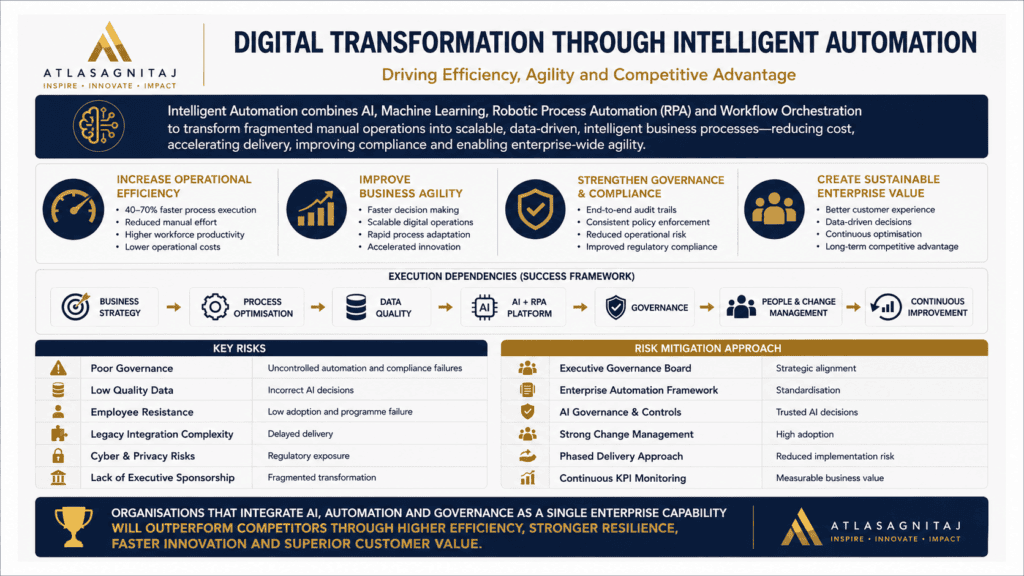
Driving Efficiency and Business Agility in the Modern Enterprise Executive Summary The enterprise landscape is undergoing a structural shift. Digital transformation has moved from being a discretionary technology initiative to an unavoidable business imperative, and at the heart of that shift sits intelligent automation: the convergence of robotic process automation, artificial intelligence, machine learning and workflow orchestration into a single operating capability. Traditional automation followed rigid scripts. Intelligent automation adapts, learns and scales, changing not only how work is executed but why and when it happens at all. For organisations across the GCC and beyond, this represents an opportunity to unlock efficiency, accelerate business model evolution and build the agility required to compete in a digital-first economy. This article sets out why the moment has arrived, what leading organisations are already achieving, and the governance disciplines required to scale automation safely across the enterprise. Part One: The Case for Intelligent Automation — Why Now Three converging forces have compressed a decade of digital transformation timelines into five years. Economic Pressure and Operational Resilience Talent shortages persist across the GCC, particularly in highly technical roles, making unconstrained headcount growth unsustainable. Margin compression demands operational excellence, while regulatory complexity — KYC/AML obligations, data localisation mandates, evolving governance frameworks — requires organisations to do more with finite resources. Intelligent automation addresses this directly, absorbing repetitive, rules-based work at scale without adding headcount. Financial institutions now process KYC documentation in minutes rather than days; healthcare providers automate insurance verification; government entities accelerate permit processing. Typical outcomes are a 40–70 per cent reduction in cycle time and a 30–50 per cent reduction in cost per transaction. Technology Maturity and Accessibility Intelligent automation was once the preserve of global technology leaders with deep engineering resources. Cloud-native platforms, pre-built process templates and low-code/no-code tooling have since democratised access. Organisations no longer need to engineer automation from first principles; they configure, integrate and deploy. This is particularly significant across the GCC, where many organisations pursue ambitious digital agendas without the deep specialist talent pools available in more mature technology markets. Modern platforms increasingly allow business analysts, not just developers, to design and deploy automation, materially shortening time-to-value. AI/ML Readiness and Data Availability Early automation was purely rules-based — a fixed condition triggering a fixed action. Modern intelligent automation combines classical RPA with machine learning capable of classifying documents, extracting data, predicting outcomes and optimising routing decisions. Crucially, organisations now hold the historical transaction data, process logs and outcome metrics — and the cloud infrastructure — required to train and run these models at scale, without material capital outlay. For GCC organisations sitting on substantial historical data assets, this represents a largely untapped source of competitive advantage: data that can be converted into automation that is not merely efficient, but genuinely adaptive. Part Two: Real-World Business Impact The business case is no longer theoretical; it is well documented across sectors. A regional bank applied intelligent automation across its mortgage origination process, cutting processing time from twenty-one days to three. The automation manages document verification, data validation, compliance checking and funding coordination, freeing staff to focus on customer-facing engagement and complex exceptions—the result: forty per cent higher volume processed with twenty-five per cent fewer full-time staff. A multinational pharmaceutical company automated its invoice-to-pay process across forty-seven global entities, handling invoice receipt, three-way matching, exception flagging and payment processing. Days payable outstanding improved by eight days, alongside stronger supplier satisfaction and payment accuracy. A GCC government entity deployed intelligent document processing for permit applications, extracting data from unstructured submissions, validating it against multiple databases and routing it automatically to the correct approver. Processing time fell from forty-five days to five; citizen satisfaction scores rose by thirty per cent; staff handling capacity increased without additional budget. A large regional retailer automated inventory reconciliation, demand forecasting and replenishment, integrating point-of-sale, warehouse management, supplier systems and market data. Stockouts fell by thirty-five per cent and inventory carrying costs by eighteen per cent. Across these and comparable cases, the pattern is consistent: cycle times fall by sixty to eighty per cent, transaction costs fall by forty to sixty per cent, error rates fall by twenty-five to forty per cent, throughput rises by fifty to two hundred per cent without proportional cost increase, and compliance strengthens through the consistent application of rules and complete audit trails. Beyond the headline metrics, a further pattern is emerging: organisations that treat these early wins as the beginning of a longer capability curve, rather than a series of isolated projects, consistently outperform those that stop after the first wave. The initial automation typically targets the most visible pain point — a bottleneck process, a compliance exposure, a customer complaint driver. The organisations that extract the greatest value are those that then systematically mine the surrounding process landscape for the next tier of opportunity, using the templates, governance and internal expertise built in the first wave to accelerate the second and third. Part Three: The Architecture of Intelligent Automation Intelligent automation is not a single technology; it is an orchestrated ecosystem, and understanding its components is essential to designing an effective strategy. Robotic Process Automation — The Foundation RPA bots mimic human interaction with existing systems — logging in, navigating interfaces, entering and validating data — without requiring integration development or modification to legacy platforms. This is especially valuable across the GCC, where many organisations operate fragmented landscapes of legacy and highly customised systems with limited vendor support. RPA allows automation to proceed without system-level change, and is best suited to high-volume, rules-based, repetitive work where processes are stable, and rules are well defined. Artificial Intelligence and Machine Learning — The Intelligence Layer RPA plus AI equals intelligent automation: RPA executes, while AI/ML classifies, extracts, predicts and optimises. For organisations holding substantial unstructured data — correspondence, invoices, feedback, applicant documents — natural language processing and document intelligence unlock enormous value, replacing manual review with automated classification, extraction and routing. Computer vision extends this further, enabling automated inspection, defect identification, compliance verification and fraud detection wherever physical documents or imagery are involved. Integration and Orchestration — The Nervous System Effective automation connects RPA, AI/ML models, core business systems, data platforms and human decision-making through platforms that provide API management, data mapping, event-driven orchestration, monitoring and audit trails. In complex GCC organisations running multiple ERP instances, legacy platforms and third-party SaaS applications, this
AGENTIC AI NEEDS GOVERNANCE BEFORE AUTONOMY
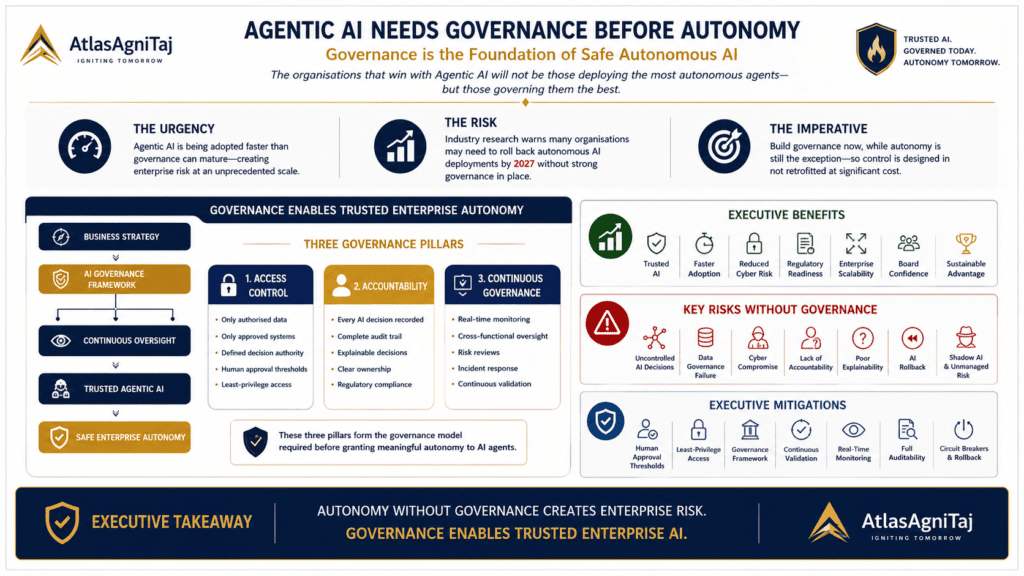
Agentic AI Needs Governance Before Autonomy The promise of agentic AI is compelling. Autonomous agents that learn, decide and act with minimal human intervention offer enterprises a genuinely new operating model: one in which processes that once required constant human mediation can run at machine speed, around the clock, across every function from procurement to customer service. Boards are asking for it. Technology vendors are marketing it. Competitors are piloting it. And yet, as organisations rush to deploy these systems, a critical oversight threatens to unwind years of carefully sequenced digital transformation investment: most enterprises are building autonomous AI capability without the governance guardrails required to operate it safely at scale. This is not a theoretical concern confined to academic papers or regulatory white papers. Industry research increasingly points to a sobering and specific prediction: a meaningful proportion of enterprises will be forced to roll back autonomous AI agents by 2027 if governance, access control and accountability mechanisms remain as underdeveloped as they are today. For Chief Information Officers, Chief Digital Officers and enterprise technology leaders, the message is unambiguous. The window to implement governance frameworks is now. At the same time, autonomy is still the exception rather than the default, and control can still be designed in rather than retrofitted at considerable cost. This article sets out why the urgency is real, what the 2027 rollback scenario actually implies for the enterprises that experience it, the three pillars on which credible governance must rest, and the leadership imperatives that fall specifically to the CIO and the wider executive team. It is written for leaders who are not opposed to agentic AI, but who understand that the durability of any autonomous capability depends entirely on the discipline that surrounds it. The Urgency: Why Now Agentic AI has crossed a threshold. What was, until recently, a research interest confined to laboratories and early pilots has become an enterprise priority discussed at board level. Unlike traditional AI systems, which require explicit human prompting and a discrete decision at each step, agentic AI operates differently: it sets goals, takes actions and iterates without waiting for human approval before every move. This shift is genuinely powerful. It is also the source of an entirely new category of enterprise risk, one that most governance structures were never designed to manage. Three converging pressures make the governance question urgent rather than aspirational. 1. Rapid Adoption Without Precedent Organisations are deploying autonomous agents directly into business-critical processes: procurement workflows, financial operations, customer service decisions and supply chain optimisation among them. The pace of deployment has comfortably outstripped the maturity of governance practice. Where traditional enterprise AI moved from pilot to production over a period of years, permitting governance to mature alongside capability, agentic AI is making that same journey in a matter of months. Governance functions built for a slower cadence of change are being asked to keep pace with a technology that does not wait for them. 2. Interconnected Risk Domains Research into CIO priorities reveals a critical insight that is easy to state and hard to operationalise: operationalising AI, cybersecurity and data strategy are now inseparable disciplines, not three parallel work-streams that can be governed independently. Agentic AI systems that operate autonomously become, simultaneously, a vector for cybersecurity threats and a potential source of data governance violations. A compromised agent can execute decisions across multiple systems with minimal oversight, propagating an initial breach far faster than a human actor ever could. A data governance failure, similarly, becomes amplified the moment an agent acts autonomously on data that ought to have been restricted. Neither risk is new in isolation. What is new is the speed and scale at which agentic systems can turn a contained failure into an enterprise-wide one. 3. The Accountability Vacuum Traditional AI operates within a clear decision trail. A model scores a loan application; a human reviews and approves it. The locus of accountability is never in doubt. Agentic AI removes that certainty. An autonomous agent decides, on its own initiative, to modify a supplier contract, reprioritise operational resources, or escalate a customer issue to a level of response the organisation did not anticipate. When something goes wrong in that context, the question “who is responsible?” becomes genuinely difficult to answer, and genuinely important to have already answered before the incident occurs. Without clear governance, enterprises risk building systems they cannot control, cannot debug when they misbehave, and cannot defend when challenged by a regulator, a client or their own board. The 2027 Rollback Risk Gartner-linked reporting suggests a troubling and specific scenario. Many enterprises deploying autonomous agents today, without robust governance frameworks in place, will face a stark choice by 2027: either significantly constrain the autonomy they have granted these agents, or discontinue the agents entirely. This is not a minor course correction. It would represent a costly and organisationally painful reversal, involving: The enterprises that avoid this scenario will not be those with the most sophisticated agents. They will be those that established governance frameworks early: before agents became deeply embedded in day-to-day operations, before stakeholder expectations were set around autonomous decision-making, and before the technical debt of ungoverned systems became genuinely unmanageable. Governance debt, like technical debt, compounds. The longer it is deferred, the more expensive and disruptive it becomes to resolve, and the more of the organisation’s credibility is spent in the process. The Governance Imperative: Three Pillars Effective agentic AI governance is not a single policy document or a one-off compliance exercise. It rests on three interconnected pillars, each of which must be operational before an agent is granted meaningful autonomy, not retrofitted once it has already caused a problem. Pillar One: Access Control and Guardrails Agentic AI systems must operate within clearly defined boundaries from the outset. In practice, this requires: Pillar Two: Accountability and Auditability Every autonomous decision must leave a clear and interrogable trace. Organisations need: Pillar Three: Governance Process and Oversight Governance is not a static policy that, once written, can be filed away. It must evolve continually as agents learn and as organisations discover edge cases that no one anticipated at the design stage. The CIO Perspective: Leadership Imperatives For CIOs and technology leaders, agentic AI governance presents a distinct and unusually challenging