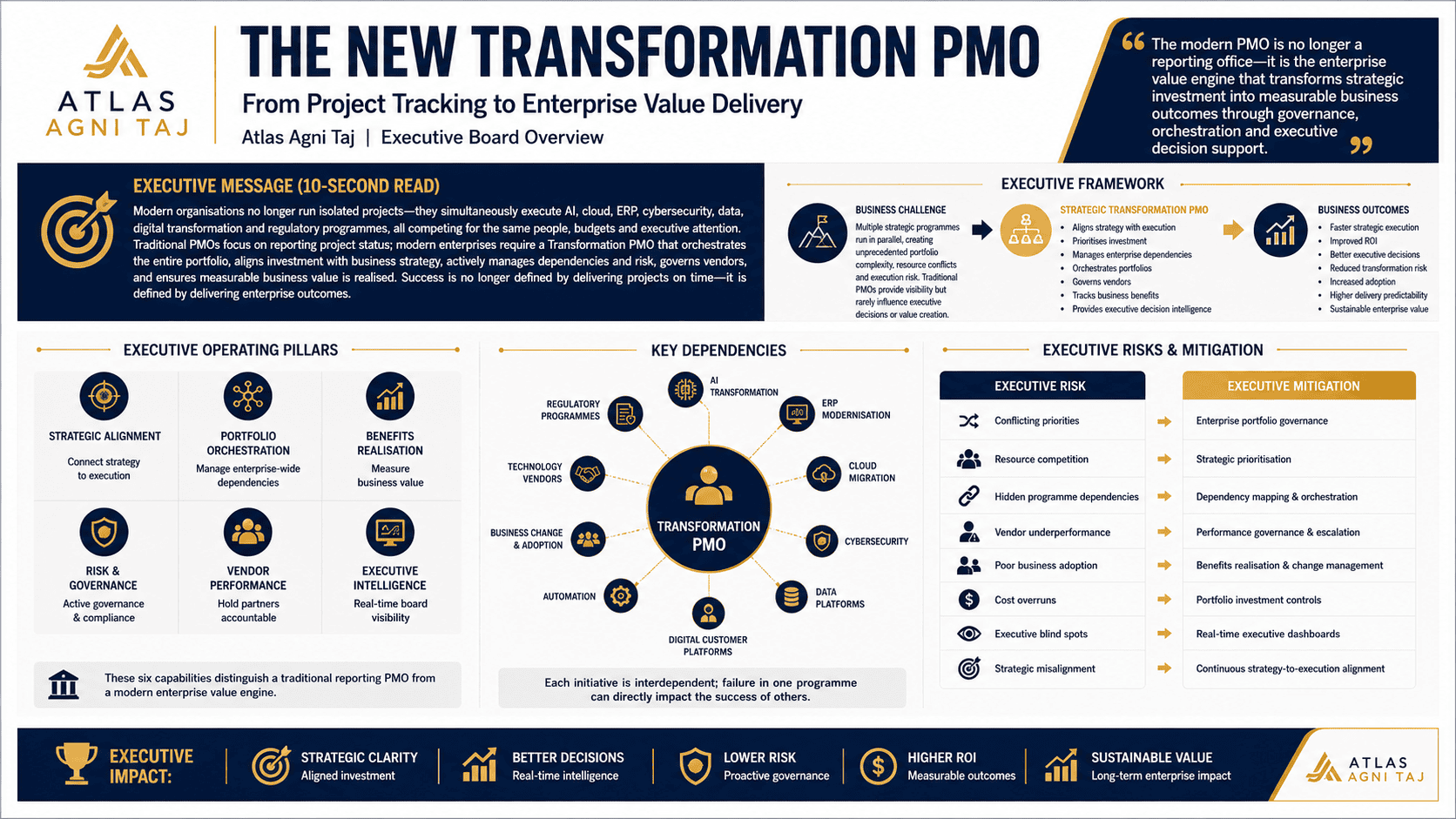
THE NEW TRANSFORMATION PMO
From Project Tracking to Enterprise Value Delivery
The New Transformation PMO: From Project Tracking to Value Delivery
If you sit in the CIO, CTO, or transformation leadership chair today, you are confronting a reality your predecessors rarely faced: the simultaneous, parallel execution of multiple transformations that, in earlier eras, would have unfolded one after another.
Your organisation is very likely running, at this very moment: artificial intelligence adoption and capability building; ERP modernisation; cloud migration across hundreds of applications; cybersecurity hardening and operational resilience; enterprise data platform development; digital channel transformation; regulatory compliance uplift; and cost optimisation. All concurrently. All competing for the same scarce engineering talent, the same budget envelope, the same executive attention, and the same vendor capacity. Each carries genuine organisational risk, and each is being asked to prove its worth in a climate of tightening scrutiny on technology spend.
The traditional Programme Management Office — built for a simpler, sequential era — was never designed for this level of concurrency. It produces status reports that gather dust rather than provoke action. It flags risks that stakeholders have already, tacitly, accepted. It tracks milestones that feel steadily more disconnected from the business outcomes leadership actually cares about. Too often, it optimises for schedule and budget adherence while the transformation itself delivers marginal value, achieves weak adoption, or quietly introduces new operational risk that nobody is measuring.
The organisations genuinely winning at transformation — the ones converting investment into measurable business value — operate a fundamentally different model. Their PMO is not a reporting office. It is an enterprise value engine. This article sets out what that distinction means in practice, why it now matters more than ever for GCC and international enterprises alike, and how technology leaders can build it.
Why Project Tracking Alone Is No Longer Enough
Traditional PMOs took shape in the 1990s and 2000s, when enterprises executed projects in sequence. Build the ERP system. Then migrate to the cloud. Then deploy the data warehouse. Each initiative carried a clear scope, a defined end date, and measurable success criteria. A PMO focused on tracking progress, escalating risk, and controlling scope was, in that world, genuinely valuable.
That world no longer exists. Modern transformation is not sequential — it is parallel, continuous, and deeply interdependent. A bank cannot pause one digital platform to complete another. An enterprise cannot modernise its ERP estate in isolation from its cloud strategy, its data infrastructure, or its cybersecurity posture. The dependencies are too intricate, the pace of change too rapid, and the organisational risk too significant to allow for isolated, sequential thinking.
When a traditional PMO restricts itself to schedule and budget tracking in this environment, it quietly becomes a bureaucratic cost centre. It produces documentation that nobody acts upon. It escalates issues at a cadence too slow for timely decision-making. Worse still, it frequently optimises for completion metrics — on-time delivery, budget variance — without ever asking the harder question: is the finished initiative actually being adopted, generating business outcomes, or delivering the benefits promised to the board and to investors?
Genuine value delivery demands a PMO operating across three distinct planes simultaneously: strategically, by aligning transformation activity to enterprise objectives; operationally, by managing execution, reducing friction, and coordinating delivery across interdependent workstreams; and financially, by tracking benefits realisation and return on investment with the same rigour applied to schedule and cost. A PMO performing only one or two of these functions is structurally incomplete, and will underperform regardless of the calibre of the people within it.
Connecting Strategy to Execution: The Critical Role
The single most important function of a modern PMO is to close the gap between enterprise strategy and programme execution. This sounds self-evident, yet in practice it is remarkably rare. Most organisations maintain strategy and execution in entirely separate domains. The board approves a digital transformation strategy. Finance approves a portfolio of projects. Operations manages delivery. Three years later, delivered execution bears little resemblance to the original strategic intent, and few in the organisation can explain precisely why.
A value-delivery PMO changes this dynamic decisively. It begins by translating strategic ambition into operational specificity. What does “becoming a digital-first organisation” actually mean in terms of architecture, capability, investment, and risk appetite? What outcomes should the business realistically expect from each major programme? What trade-offs is leadership genuinely willing to accept? Which measures will confirm success? What dependencies exist across the portfolio?
Once strategy has been translated into measurable objectives, the PMO ensures every programme remains aligned to those outcomes. This demands a sophisticated portfolio management capability — understanding not merely what each programme does, but how it contributes to strategic goals, how it interacts with adjacent programmes, which shared capabilities it depends upon, and where critical sequencing must be respected.
It also requires the PMO to assume an active, not passive, role in governance. Too many PMOs remain silent observers, content to report status upward. A value-delivery PMO actively shapes decisions. When two programmes compete for scarce engineering resource, the PMO helps leadership adjudicate based on strategic priority and risk exposure. When a vendor underperforms and jeopardises adjacent initiatives, the PMO escalates promptly and proposes concrete remediation. When benefits stall because the business has not adopted a new platform, the PMO identifies the barrier and drives corrective action — rather than simply noting the shortfall in a monthly report.
Portfolio Complexity: The New Normal
Portfolio complexity across modern enterprises has reached levels without recent precedent. Consider a representative scenario now facing many GCC and international organisations:
- Artificial intelligence and machine learning adoption across multiple business units
- A multiyear ERP replacement programme
- Cloud migration affecting two hundred or more applications
- Cybersecurity hardening in response to tightening regulatory expectations
- Customer data platform and MarTech modernisation
- API and integration infrastructure development
- Automation and robotic process automation programmes
- Cost reduction and IT efficiency initiatives
None of these run sequentially. They overlap. They compete for the same resources. They generate dependencies capable of derailing one another if left unmanaged. Traditional project management approaches simply fail at this scale — one cannot schedule twenty parallel programmes as a single waterfall plan, nor manage cross-cutting dependencies through meeting coordination alone.
What is required is intelligent portfolio orchestration: a single source of truth describing what is planned, what is in flight, what has concluded, and where bottlenecks or risk concentrations are emerging. This level of visibility allows leadership to sequence initiatives in ways that maximise strategic value while managing risk; it prevents the common failure mode in which programmes are approved independently, with nobody accountable for the cumulative organisational load; and it supports the difficult prioritisation decisions that must be made on the basis of strategic alignment, resource availability, and expected benefit — not simply on who asked first or shouted loudest.
Vendor and Partner Governance: A Major Source of Failure
A significant proportion of transformation failure originates in weak governance of vendors and partners. Modern transformation programmes depend heavily on external capability: systems integrators, software vendors, managed service providers, niche specialists, and consulting firms. Poor vendor governance remains a primary driver of cost overrun, schedule delay, quality shortfall, and benefit erosion.
Common failure modes include unclear scope definition and change control; weak accountability for partner performance; poor integration of partner delivery into overall programme governance; misaligned incentives between vendor and client; inadequate oversight of vendor subcontractors; and a general failure to manage vendor dependency risk. When a critical partner begins to underperform, too many organisations discover the problem far too late — by which point corrective action becomes expensive, disruptive, or simply impossible within the available time.
A modern PMO takes an active role in vendor governance. In practice, this means establishing clear performance expectations from the outset; conducting regular, transparent reviews of actual performance against those expectations; defining escalation protocols that trigger automatically when performance falls short; actively managing change control to prevent scope creep; and building genuine contingency plans for critical vendor risk. It also means ensuring vendor delivery is fully integrated into overall portfolio governance, so that delays or quality issues are visible immediately rather than surfacing only at the point of crisis.
Additionally, a value-delivery PMO helps reduce structural vendor dependency through intelligent programme design. Rather than allowing an organisation to become locked into a single large systems integrator, it considers how work should be structured to preserve internal capability, maintain competitive options, and retain strategic control. This matters most in large, multiyear transformations, where vendor capability, cost structures, and strategic alignment inevitably shift over time — and where the flexibility to adjust course carries real commercial value.
What the Modern PMO Should Measure
If measurement drives behaviour, then what a PMO chooses to measure defines what the organisation ultimately optimises for. Traditional PMOs measure on-time delivery, budget variance, and schedule adherence. These remain necessary, but they are far from sufficient.
A modern PMO measures across six critical dimensions:
1. Business Value and Benefits Realisation. Are the promised financial and operational benefits actually being delivered? What proportion of expected benefit is being realised within the anticipated timeframe? Where is benefit being lost, and for what reason?
2. User Adoption and Effectiveness. Is the new system, platform, or process genuinely being used by its intended population? What does the adoption curve look like? Where is adoption lagging, and what is the root cause?
3. Risk and Compliance. Has the transformation introduced, or left unmitigated, any material operational, financial, or compliance risk? What is the current state of control across systems undergoing change?
4. Operational Resilience. Has the transformation strengthened operational reliability and resilience, or has it introduced new points of failure? Are availability, performance, and disaster recovery capability meeting the required standard?
5. Cost Optimisation. Beyond the cost of the programme itself, is the resulting solution efficient to run? Are total cost-of-ownership expectations being met in practice, not merely in the original business case?
6. Delivery Predictability. Are estimates reliable? Are programmes delivering on time and on budget? Is the organisation genuinely learning from delivery experience and improving its ability to forecast and execute?
By measuring these six dimensions transparently, a modern PMO keeps the organisation focused on what actually matters: real business value, delivered safely, adopted successfully, and sustained reliably. This represents a marked departure from a traditional focus on input metrics — schedule and budget — which can be satisfied in full even when a programme delivers no business value whatsoever.
These metrics deserve visibility at board level, among executive sponsors, and across programme stakeholders, ideally through a single integrated dashboard updated at least weekly, with clear trend and variance analysis. When any metric moves in the wrong direction, the PMO should escalate immediately and bring forward a proposed course of corrective action — not wait for the next scheduled steering committee.
Building the Modern PMO: A Practical Framework
Building a value-delivery PMO requires deliberate, intentional design. It is not a minor evolution of traditional PMO practice — it is a complete reimagining of what the function does and how it operates. The following framework offers a practical route through that transition.
Foundation: Portfolio Governance Model. Establish a governance model that clearly defines how programmes are proposed and approved; how alignment with strategy is assessed; how trade-off decisions are made; how escalation operates; and precisely which decision rights sit with whom. This model should remain lightweight, but it must be unambiguous and genuinely enforceable — governance that exists only on paper delivers no protection when it is tested.
Infrastructure: Portfolio Management Tools. Implement a portfolio management platform that functions as a genuine single source of truth, capturing programme scope, timeline, budget, and resourcing; cross-programme dependencies; the risk register and associated mitigation plans; benefits definitions and tracking; vendor and partner involvement; and milestone tracking with variance analysis. This platform should feed automated dashboards available to executives in real time, not through a monthly PowerPoint cycle.
Talent: Strategic and Operationally Capable Leaders. Recruit PMO leaders who understand not only project management, but business strategy, technology architecture, finance, and organisational change. The traditional project manager, skilled principally at scheduling, is no longer sufficient for this mandate. Modern PMO leaders must be strategists who understand how technology creates business value, and who are equipped to navigate genuinely complex trade-offs under pressure.
Processes: Active Governance, Not Passive Reporting. Establish governance cadences that are explicitly decision-focused: monthly portfolio steering reviews assessing alignment, resource conflict, and dependency impact; quarterly strategy reviews asking whether programmes remain aligned and whether strategic priorities have shifted; regular vendor governance reviews assessing performance and compliance; and rapid escalation protocols for issues requiring immediate executive intervention.
The Maturity Journey: Getting There From Here
Transforming the PMO function itself does not happen overnight. A realistic maturity progression looks broadly as follows.
Level 1 — Current State (Traditional PMO). Focused on schedule and budget tracking. Project-centric view. Limited visibility into benefits or business outcomes. Vendor management conducted on an ad hoc basis.
Level 2 — Near Term (Enhanced Visibility). Adds a genuine portfolio view. Captures dependency mapping. Introduces a benefits tracking framework. Adds a formal vendor governance process. The PMO becomes markedly more visible to executive leadership.
Level 3 — Medium Term (Active Governance). The PMO takes an active role in trade-off decisions. The portfolio is actively managed for optimisation. Benefits are tracked and genuinely realised. Vendor performance is actively managed. Strategic alignment is regularly assessed and maintained.
Level 4 — Mature State (Strategic Value Engine). The PMO is fully integrated into enterprise strategy and execution. The portfolio is continuously optimised for business value. Benefits realisation forms part of executive KPIs. The vendor ecosystem is managed strategically. PMO leadership is recognised as a critical executive function in its own right.
Most organisations can realistically progress from Level 1 to Level 3 within eighteen to twenty-four months. Level 4 remains an ongoing aspiration — maturity in this domain is never truly complete, and nor should it be, given how quickly the underlying transformation landscape continues to shift.
The key is to start now. Select one or two quick wins — improved dependency visibility, structured benefits tracking, or formalised vendor governance — and demonstrate value quickly. Build credibility with leadership on the back of early, visible results. Then expand progressively, rather than attempting a wholesale redesign in one step.
What Success Looks Like
When a modern, value-delivery PMO is functioning effectively, the following characteristics become visible across the organisation:
- Portfolio visibility. Every executive knows what is planned, what is in flight, what dependencies exist, and where the critical path runs.
- Disciplined prioritisation. New requests are evaluated rigorously against strategy and resource availability. Not everything that could be funded is funded.
- Dependency management. Cross-programme dependencies are visible and actively managed, with mitigation plans in place wherever one programme materially affects another.
- Benefits realisation. Programmes are not considered complete until promised benefits are delivered and sustained. The PMO tracks this with genuine rigour, not as an afterthought.
- Vendor accountability. Partner performance is transparent and measured. When vendors underperform, corrective action follows promptly.
- Adoption and change management. The PMO actively drives adoption of new systems and new ways of working, tracking adoption metrics and acting upon them.
- Risk transparency. Organisational risks arising from transformation are visible, assessed, and mitigated, with the PMO working closely alongside risk and compliance functions.
- Executive engagement. The PMO is regarded as a strategic asset rather than a reporting burden, with its leaders invited into strategy discussions and trade-off decisions as a matter of course.
- Continuous improvement. The organisation learns systematically from each transformation, steadily improving its capability in estimation, planning, and execution.
How Atlas Agni Taj Can Help
Building this capability from a standing start, or repositioning an existing PMO that has drifted into pure reporting, is precisely the work Atlas Agni Taj was founded to lead. Drawing on decades of enterprise transformation leadership across banking, government, healthcare, and regulated infrastructure in the UAE and wider GCC market, Atlas Agni Taj partners with CIOs, CTOs, and transformation leaders to design and operationalise the value-delivery PMO described in this article — not as a theoretical framework, but as a working capability embedded within the organisation.
In practice, this support typically spans several areas:
- PMO diagnostic and target operating model design. An independent assessment of current PMO maturity against the four-level framework above, followed by a pragmatic, sequenced roadmap for closing the gap — calibrated to the organisation’s genuine appetite for change, not a generic best-practice template.
- Portfolio governance architecture. Design of lightweight but enforceable governance models, decision rights, and escalation protocols that translate strategic intent into disciplined portfolio-level decision-making.
- Benefits realisation and value measurement frameworks. Establishment of the six-dimension measurement model — business value, adoption, risk, resilience, cost, and predictability — with executive dashboards that make performance visible in real time rather than in retrospective reporting cycles.
- Vendor and partner governance design. Practical frameworks for performance management, escalation, and dependency risk reduction across systems integrators and technology partners, drawing on direct experience negotiating and managing major sovereign and enterprise technology contracts.
- Interim and fractional PMO leadership. Where organisations need experienced, hands-on leadership to stand up or reset the function quickly, Atlas Agni Taj can provide interim Programme Director or Head of Portfolio Delivery capability while permanent leadership is recruited or upskilled.
- Executive coaching and capability building. Structured support for existing PMO leaders and teams to build the strategic, financial, and architectural fluency that the modern mandate now demands.
Organisations across the UAE and GCC contemplating AI adoption, ERP modernisation, cloud migration, or sovereign infrastructure delivery at scale are welcome to reach out to Atlas Agni Taj to discuss how a value-delivery PMO can be built, or rebuilt, around their specific transformation portfolio.
Conclusion: The PMO as a Strategic Asset
The transformation of the PMO itself is not about refining a project-tracking office. It is about building a strategic asset that helps organisations navigate complexity, align investment with strategy, manage risk, reduce delivery friction, govern vendors effectively, and deliver sustained business value.
It requires a different skill set from the one traditional PMOs demanded: strategic thinking, business acumen, architectural understanding, financial literacy, and change leadership. It requires different authority. A passive PMO that reports status without shaping decisions is unlikely to succeed in this environment. The PMO must be embedded within governance, must have visibility into executive-level trade-off decisions, and must carry sufficient authority to drive change and hold the portfolio accountable.
For technology leaders navigating today’s transformation imperative — AI adoption, modernisation, cloud migration, cybersecurity, data platforms, and regulatory change — the question is no longer whether to invest in PMO capability. The question is whether to invest thoughtfully in a PMO designed for the modern reality, or to persist with yesterday’s model and accept the risk and waste that inevitably accompany it.
The evidence from high-performing enterprises is consistent: the right PMO, designed as a genuine value delivery engine, is one of the most effective investments a technology leader can make. The time to build it is now.
What does your current PMO model look like today? Is it tracking projects, or is it delivering strategic value?
I would welcome your thoughts and experiences in the comments — what has worked well for you, what challenges you continue to face, and what shifts you have observed in PMO practice across your own market.
Atlas Agni Taj Proprietary
#TransformationLeadership