SOVEREIGN CLOUD, DATA SOVEREIGNTY AND THE UAE’S NEXT DIGITAL ADVANTAGE
A Boardroom Perspective on Control, Compliance and Competitive Advantage in the GCC
Cloud Strategy Has Grown Up
For much of the last decade, cloud strategy in the Gulf was a conversation about speed and cost. Migrate the workload, retire the data centre, reduce capital expenditure, and move faster than a traditional build would allow. It was a simple and persuasive narrative, and it drove a rapid expansion of cloud adoption across the region.
That conversation has now matured into something more consequential. Cost and velocity have not disappeared as considerations, but they have been overtaken by a harder set of questions that boards, regulators and chief executives are asking with increasing frequency. Where does our data actually reside? Who, in practice, can access it? Can we demonstrate compliance while relying on infrastructure we do not own? What is our exposure if a key supplier relationship deteriorates or fails? How do we retain control of the assets that matter most — intellectual property, customer records, financial data and, increasingly, artificial intelligence models trained on all of it?
This shift reflects the convergence of several forces at once: growing regulatory confidence and sophistication, ambitious national digital strategies, sustained investment in sovereign technology capability, the rapid rise of artificial intelligence and its appetite for secure data and compute, and a sharper awareness — shaped by recent geopolitical events — that cloud infrastructure is not a neutral utility. It is a strategic control point.
For CIOs, CTOs and senior technology leaders, this is both a challenge and an opening. The challenge lies in navigating a genuinely more complex landscape of compliance obligations, vendor relationships and architectural trade-offs. The opening lies in leading a new phase of transformation — one that reconciles innovation with control, growth with security, and global capability with local sovereignty.
Why Cloud Has Become a Boardroom Matter
In the early years of cloud adoption, the decision to migrate typically sat within the technology function. Today, cloud architecture sits squarely on the board agenda, and rightly so, because it now touches almost every dimension of an organisation’s strategic position.
Regulatory compliance and data governance. The UAE’s regulatory environment has matured considerably. Data localisation expectations, sector-specific rules across banking, healthcare and government, and an evolving national data strategy all assume that technology leaders know precisely where data sits, how it is processed and who can reach it. An architecture that breaches these principles — even unintentionally — creates legal and reputational exposure that extends well beyond the technology function.
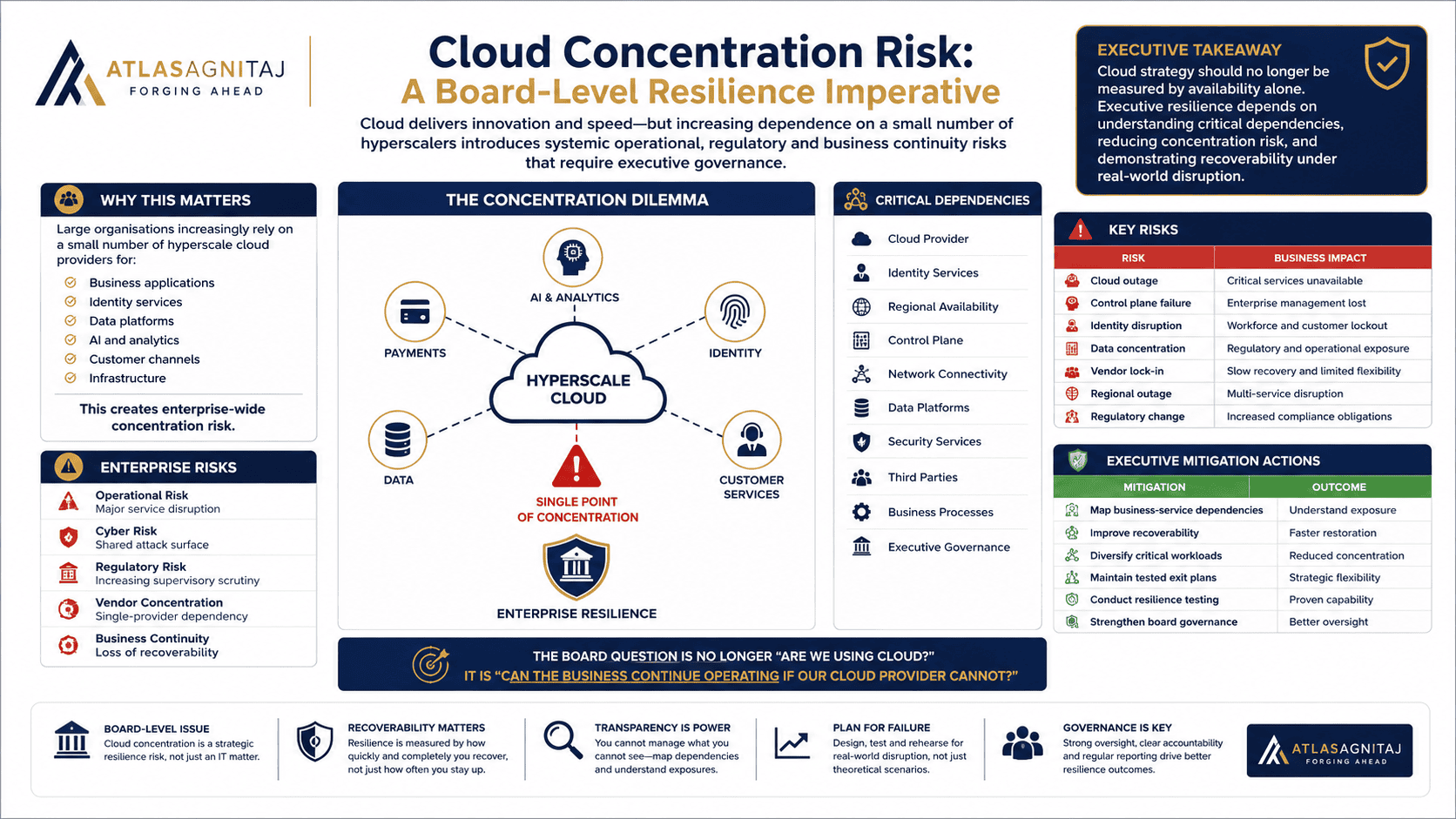
Operational resilience. Recent global disruptions have sharpened the focus on continuity. Architectures dependent on a single provider, a single region, or infrastructure ultimately controlled by a foreign entity carry concentration risk. Regulators in banking and government are scrutinising these dependencies closely. True resilience now demands architectural redundancy and vendor independence, not merely backup and recovery procedures.
National strategy and competitive positioning. The UAE has been explicit that data is a strategic national asset. Its AI strategy, its digital economy agenda and its investment in sovereign cloud platforms all rest on this premise. For enterprises operating in the region, aligning cloud strategy with national priorities brings regulatory goodwill, access to government-led initiatives, and a stronger position from which to participate in public sector technology programmes.
AI enablement and model governance. Artificial intelligence is data-hungry and computationally intensive, and it raises pointed questions of control. Where is training data processed? Who can see the outputs of a model hosted on infrastructure the organisation does not own? What happens to information passing through third-party APIs woven into the AI stack? These questions cannot be answered credibly without a clear view of the underlying cloud architecture.
Cybersecurity posture. Cloud is not inherently less secure than on-premises infrastructure, but the attack surface, the shared-responsibility model and the visibility available to the organisation are all materially different. In a region increasingly targeted by sophisticated actors, understanding cloud security posture — technical controls, vendor vetting and incident response capability alike — is no longer discretionary.
Business agility. None of this diminishes the case for speed. Cloud remains a genuine accelerant of business outcomes. But it must be controlled acceleration. An architecture that trades sovereignty for velocity accumulates hidden debt that surfaces later, usually at the least convenient moment. The organisations succeeding in the GCC are those achieving both cloud speed and cloud control.
When cloud decisions influence compliance, resilience, national alignment, AI capability, security and commercial velocity simultaneously, they are, by definition, strategic decisions. They belong in the boardroom and in conversations with regulators, not solely within the technology function.
Data Residency Is the Starting Point, Not the Destination
Many organisations still equate data sovereignty with data residency alone — the requirement that data physically resides within a defined geography, typically the UAE for enterprises operating here. Residency matters, and it is usually the first question a regulator will ask. But it is only one dimension of a considerably broader picture.
Genuine sovereignty spans several interlocking dimensions:
- Data residency — where information sits at rest. Increasingly a baseline requirement in the UAE, but residency alone does not guarantee control.
- Access control and authentication — who can reach the data, from where, and under what conditions. In many cloud environments, access is governed by a provider’s global identity systems, creating a dependency that leaves the organisation exposed if that system is compromised or insufficiently granular.
- Encryption and key management — the critical question is who holds the keys. Where the provider manages them, it retains the technical ability to decrypt the organisation’s data without its knowledge. Sovereign architectures favour customer-managed keys, establishing a clear boundary between hosting and access.
- Where processing actually happens — encrypted, in-country data processed offshore offers only partial protection, since exposure can occur during computation itself. Sovereign design keeps sensitive processing within controlled or trusted-jurisdiction infrastructure.
- Auditability — the ability to see, independently, who accessed the data, when, and what was done, rather than relying solely on a provider’s own interface and logs.
- Recovery and exit planning — the ability to leave a provider relationship on acceptable terms, extracting data in open formats and avoiding technical or contractual lock-in.
- Privileged access — understanding who, within a provider’s organisation, holds elevated access, and what governs their conduct. A genuinely sovereign environment has no unmonitored backdoor.
- Supply chain dependency — visibility into the hardware vendors, network operators and software suppliers that sit beneath the platform, including ownership structures and any associated geopolitical exposure.
Organisations pursuing genuine sovereignty do not treat residency as a box to be ticked and set aside. They work through each of these dimensions methodically and design accordingly. It is a more demanding approach than simply selecting an in-country provider, but it is also considerably more robust.
The Rise of Sovereign Financial and Government Cloud Platforms
The clearest expression of this shift is the emergence of sovereign cloud platforms purpose-built for regulated sectors. The UAE Central Bank’s sovereign financial cloud initiative is a good illustration: not a rebadged hyperscaler offering, but infrastructure designed from first principles around the needs of financial institutions — UAE-based residency, governance aligned with financial regulation, security architecture appropriate to banking, and mechanisms that allow both regulators and institutions to audit what is actually happening within the environment.
Comparable initiatives are underway elsewhere in the Gulf. Saudi Arabia continues to invest heavily in sovereign cloud and data centre capacity, while other Emirates and neighbouring states are evaluating or constructing national cloud platforms of their own. These are not anti-cloud measures. They are pro-control measures, reflecting a deliberate decision that the most critical categories of digital infrastructure should be built and operated in a way that keeps control firmly in the hands of the nation and its regulated institutions.
For enterprises, this brings both an obligation and an opportunity: the obligation to understand which sectors or workloads must migrate to sovereign platforms, and the opportunity of early positioning in a market still taking shape. Banking and financial services are the obvious constituency — regulated institutions cannot hold customer or transaction data on infrastructure they do not control. Government agencies face equivalent obligations around citizen data and national security information, as do healthcare providers, telecom operators and energy companies managing critical national infrastructure.
The market, however, is broadening beyond these obvious cases. Digital government services, education platforms, e-commerce infrastructure and private enterprises holding sensitive intellectual property are all now evaluating sovereign alternatives — driven partly by regulation, but increasingly by the recognition that control carries commercial value in its own right, supporting continuity, innovation velocity and competitive positioning alike.
For technology leaders, the operative question is no longer whether to adopt cloud. It is which workloads belong where, and why. Some will remain on sovereign infrastructure. Others will run on hyperscaler platforms within specific regions and specific governance frameworks. Many will follow a hybrid path. The right architecture depends on the workload, the regulatory context, the sensitivity of the data and the organisation’s appetite for risk.
Artificial Intelligence Has Made Sovereignty More Urgent, Not Less
The rise of AI has compressed timelines and raised the stakes considerably. This can appear counter-intuitive, since AI is often described as inherently cloud-native and reliant on hyperscaler infrastructure. Yet a closer look at how AI systems function explains why sovereignty has become more, not less, pressing.
Training data tends towards aggregation: the larger and richer the dataset, the more capable the model, which creates a pull towards centralising data wherever compute is most abundant — often outside the region or beyond the organisation’s direct control. For organisations handling regulated data, this alone creates governance difficulty.
Once trained, a model becomes a strategic asset in its own right, encoding patterns derived from proprietary data. Where that model runs on infrastructure controlled by a third party, that party gains visibility into how the model behaves and what it has learned — a serious concern in competitive sectors where model behaviour is closely guarded.
Many AI systems also depend on third-party APIs for language understanding, retrieval or external computation. Each call is a potential point of data leakage; taken together across a large volume of interactions, these calls can expose patterns about the underlying business that the organisation never intended to share. AI frameworks and platforms are, further, frequently optimised for a specific cloud provider, creating a distinct form of vendor lock-in at the AI layer that complicates any future migration.
Regulators, meanwhile, are developing AI governance frameworks across the GCC and will expect organisations to demonstrate auditability and control over their systems — a considerably harder proposition where the underlying infrastructure sits offshore. Advanced AI capability is also increasingly subject to export control and geopolitical sensitivity, meaning that moving models, workloads or data across borders can, in some circumstances, carry legal or national risk.
Taken together, these factors point to a clear conclusion: credible AI governance depends on cloud sovereignty. This does not mean abandoning hyperscaler infrastructure. It means being deliberate about which layers of the AI stack genuinely require direct control, designing for portability from the outset, and reserving sovereign infrastructure for the components where control is non-negotiable, while continuing to draw on hyperscaler capability where it adds value without compromising that control.
A Practical Framework for CIOs
For technology leaders, the question is no longer whether sovereignty matters, but how to operationalise it without sacrificing the pace and innovation the business needs.
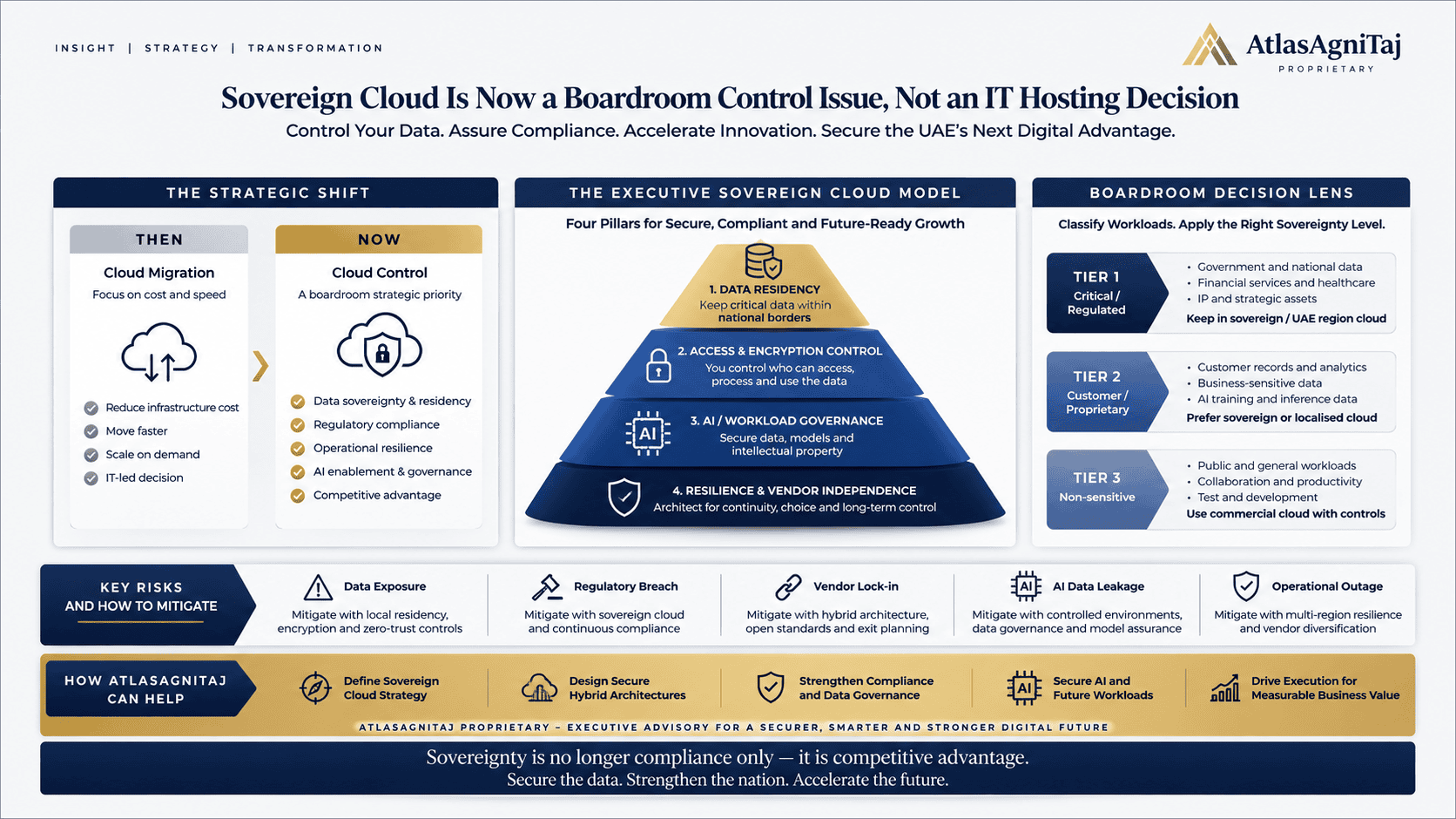
- Classify workloads by sovereignty requirement. A simple three-tier model helps: Tier 1 for regulated data, national security information and strategic intellectual property, held under direct organisational control or firm contractual guarantee; Tier 2 for customer and proprietary data, held within a trusted jurisdiction with strong access governance; and Tier 3 for development environments and non-sensitive workloads, where hyperscaler cloud can be used freely for cost and speed.
- Design a deliberate hybrid architecture. Sovereign infrastructure for Tier 1, regional cloud for Tier 2, hyperscaler cloud for Tier 3 — delivering compliance, resilience against single-provider outages, flexibility to match platform to workload, and stronger negotiating leverage with any single vendor.
- Publish sovereignty requirements as explicit policy. Where must data sit, who may access what, what encryption standards apply, how often are systems audited, and what are the contractual guarantees on ownership, access and exit — documented, not left to informal interpretation.
- Strengthen vendor governance. Assess vendors on ownership, security practice, financial stability, regulatory standing and geopolitical exposure, not price alone. Monitor commitments continuously, and plan exit routes before they are needed.
- Align cloud architecture with cyber resilience. A zero-trust posture, end-to-end encryption with carefully managed keys, segmentation, comprehensive logging, and an incident response plan tailored to cloud environments should be integral to the architecture, not bolted on afterwards.
- Invest in platform engineering. A hybrid, multi-cloud estate is only viable if it is well automated. Investment in internal platform tooling is the only sustainable route to operating at this level of sophistication without losing efficiency.
- Consider the full range of sovereign infrastructure options. Public sovereign cloud, private dedicated infrastructure, or managed sovereign arrangements with contractual guarantees — the right choice depends on workload, budget, capability and regulatory obligation, but hyperscaler cloud should never be assumed to be the only option.
A Path Forward
Cloud sovereignty is not a single decision or a one-off investment. It is a strategic direction pursued progressively, shaped by workload, regulatory context, risk appetite and competitive strategy. A practical path typically follows seven steps: audit the current estate to understand where workloads and data genuinely sit; assess what sovereignty actually requires for each part of the business and why; define a target hybrid architecture; prioritise migration by risk and regulatory urgency rather than convenience; build the platform engineering and automation capability the target architecture demands; establish governance that sustains sovereignty over time rather than treating it as a one-time project; and identify the partners and platforms needed to execute the strategy with confidence.
This is not a short journey, but it is a necessary one. Organisations that navigate it successfully over the coming years will hold a genuine strategic advantage in the GCC — compliant, resilient, in control of their own destiny, and ready for the next wave of digital and AI-led transformation.
Sovereignty Is Competitiveness
Cloud strategy across the GCC has matured well beyond cost and speed. It is now a matter of control, compliance, resilience and competitive advantage — and, increasingly, a matter for the boardroom rather than the server room.
The UAE and the wider GCC are positioning themselves deliberately as leaders in digital transformation, artificial intelligence and financial innovation. That leadership will rest on infrastructure — on cloud platforms that are secure, sovereign and trustworthy. Organisations that build their cloud strategy around these principles will be well placed to participate fully in that future.
Cloud is no longer arriving in the GCC. It is here, and it is strategic. The real question for every technology leader is whether their organisation’s cloud strategy is built to match.
How Atlas Agni Taj Can Help
Atlas Agni Taj works with boards, CIOs and transformation leaders across the UAE and wider GCC to translate cloud sovereignty from a compliance exercise into a genuine strategic asset. Our support typically spans:
- Sovereignty and workload assessment — an independent audit of the current cloud estate, mapping workloads against a practical sovereignty tier model and identifying where residency, access control, encryption and processing arrangements fall short of regulatory or board expectations.
- Target architecture and roadmap design — development of a hybrid, multi-cloud target architecture aligned to sector regulation, national priorities and AI governance requirements, together with a phased, risk-prioritised migration roadmap.
- Vendor and contract governance — structured vendor assessment frameworks, contract and SLA review against sovereignty and exit-planning criteria, and ongoing governance mechanisms that keep vendor accountability current rather than fixed at signing.
- AI and data governance advisory — guidance on model hosting, data flow and third-party API exposure, designed to help organisations demonstrate the auditability and control that GCC regulators increasingly expect of AI systems.
- Programme leadership — interim or advisory-level programme direction for organisations executing sovereign cloud and hybrid infrastructure transformation, drawing on senior delivery experience across banking, government, healthcare and telecom environments in the region.
Organisations considering their next move on cloud sovereignty are welcome to reach out to Atlas Agni Taj for a confidential conversation about their specific position and options.
#SovereignCloud