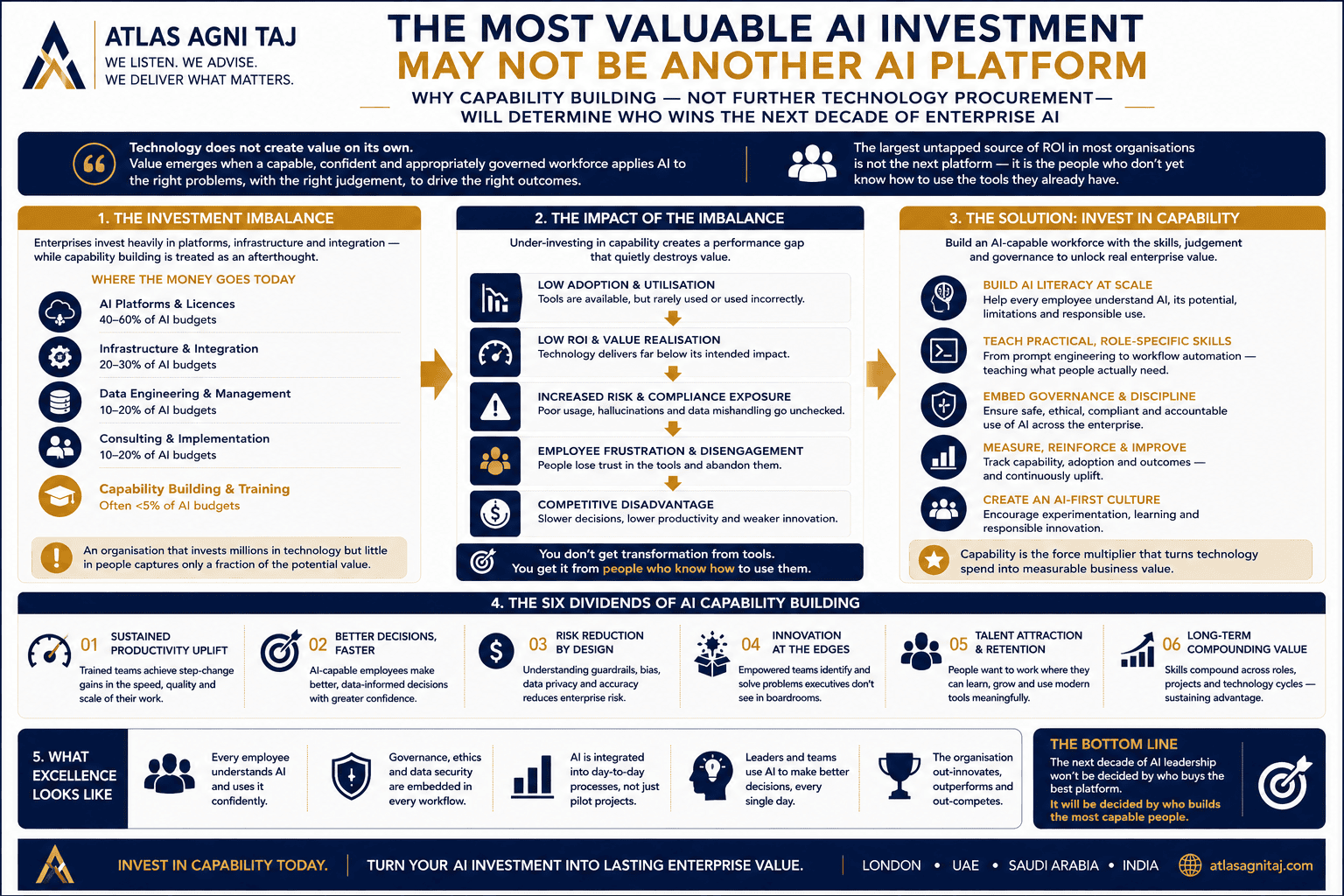
Why AI capability building — not further technology procurement — will determine who wins the next decade of enterprise AI
By Atlas Agni Taj | Executive Perspectives on Transformation, Governance and Enterprise AI
Across boardrooms in London, Dubai, Riyadh, Singapore and New York, a familiar pattern is unfolding. Executive teams are approving significant capital allocations for artificial intelligence platforms, negotiating enterprise-wide licences for large language models, and commissioning bespoke pilots at a pace few technology cycles have ever witnessed. The strategic urgency is understandable. The narrative is compelling. And yet, for all the sophistication of these procurement decisions, one question is consistently under-examined at the executive table.
Have we equipped our people to use this technology effectively — with judgement, confidence, and appropriate discipline?
It is a deceptively simple question, and it carries far greater strategic weight than most enterprise AI programmes are prepared to acknowledge. Technology, however advanced, does not create value on its own. Value emerges when a capable, confident, and appropriately governed workforce applies that technology to the specific problems, workflows, decisions, and customer outcomes that define an organisation’s competitive position. In the absence of that capability, even the most impressive platform becomes an expensive under-performer.
The uncomfortable truth is this. The largest source of untapped return on AI investment in most organisations today is not the next platform on the roadmap. It is the several thousand employees who have been granted access to AI tools they do not yet know how to use with precision, scepticism, or strategic intent. Closing that gap is now, in our considered view, the most consequential decision an executive team can take.
The Investment Imbalance No One Wants to Discuss
Enterprise AI budgets, when examined at close quarters, tend to reveal a striking imbalance. Platform licences, cloud infrastructure, systems integration, data engineering, and consultancy fees for technology deployment typically absorb the overwhelming majority of allocated capital. Capability building — the deliberate, structured effort to make an entire workforce fluent in AI — is frequently treated as a supplementary line item. It is delegated to Learning and Development, funded at a fraction of its strategic weight, and measured, if at all, in course completion rates rather than business outcomes.
This imbalance is not merely a budgetary curiosity. It is a strategic risk of the first order. An organisation that commits tens of millions to a sophisticated AI platform, but invests only marginally in the human capability required to exploit it, is effectively purchasing potential rather than performance. The gap between what the technology can theoretically do and what the workforce can realistically extract from it is precisely where strategic value quietly disappears. In our engagements across the GCC and Europe, we routinely observe deployed platforms operating at a small fraction of their productive capacity because the people expected to use them have received little more than a webinar and a policy document.
Boards and executive committees would rarely tolerate a capital project delivering ten to twenty per cent of its designed output. Yet this is precisely the pattern that AI capability neglect creates, and it is largely invisible in conventional reporting because the technology is deployed, the licences are consumed, and the dashboard shows green.
Capability as the Compounding Asset
Technology is a depreciating asset. Capability is a compounding one. This distinction, though it may sound like a rhetorical flourish, is one of the most important lenses through which executive teams should evaluate their AI strategy.
The platforms and models procured today will, in all likelihood, be superseded within eighteen to twenty-four months. Vendors will change. Interfaces will evolve. Underlying architectures will shift as new paradigms — agentic workflows, multimodal reasoning, sovereign and private models, on-device inference — move from novelty to mainstream. Any organisation that has anchored its strategy exclusively to a specific technology stack will find itself repeatedly re-tooling, re-procuring, and re-training from a low baseline.
A workforce that genuinely understands how to reason with AI, prompt it effectively, verify its outputs, integrate it into decision-making, and apply appropriate governance retains its value regardless of which platform sits beneath its fingertips next quarter or next year. Human capability is portable, transferable, and cumulative. It compounds across roles, projects, and technology cycles. It survives vendor rationalisation, contract renegotiation, and architectural pivots. It is, in strategic terms, the most durable form of AI investment an organisation can make.
Technology depreciates. Capability compounds. The organisations that internalise this distinction will out-perform those that do not.
The Six Dividends of AI Capability Building
When structured, executive-grade AI training is implemented across an enterprise, six distinct dividends begin to accrue. Each is measurable. Each contributes independently to enterprise value. Together, they represent the most compelling business case for capability-first AI investment.
1. Sustained Productivity Uplift
The most immediate and visible dividend is productivity. A trained workforce completes analytical tasks, drafting assignments, research work, and routine synthesis in a fraction of the previous time. However, the productivity gains realised by trained users are not incremental — they are step-change. Independent studies and our own client observations consistently indicate that trained knowledge workers achieve productivity uplifts materially higher than their untrained peers, particularly on tasks involving research, drafting, analysis, and structured decision-making. Untrained users, by contrast, often extract only cosmetic time savings while introducing new sources of error.
2. Higher Adoption Across the Enterprise
AI platforms do not fail because they are technically inadequate. They fail because they are under-adopted. Employees who lack confidence with a new tool either avoid it altogether or use it superficially. Structured training addresses the twin barriers of unfamiliarity and apprehension, converting sceptical users into confident practitioners. Adoption ceases to be a metric that leaders chase and becomes a natural consequence of competence.
3. Materially Reduced Risk
The regulatory and reputational risks associated with AI misuse — data leakage, hallucinated outputs presented as fact, confidential information disclosed to third-party models, biased decisions, and unattributed reliance on AI-generated content — are almost entirely a function of user awareness. A workforce that has been trained in responsible use, data classification, prompt hygiene, output verification, and governance escalation is a workforce that reduces the enterprise risk envelope significantly. Training is, in this respect, one of the most cost-effective risk-mitigation instruments available to any board.
4. Genuine Innovation from the Workforce
Innovation in the AI era will not come exclusively from central technology functions. It will come from the front line — from the finance analyst who reimagines a reconciliation process, the customer-service leader who redesigns a triage workflow, the marketing manager who conceives a personalisation approach previously impossible at scale. But this innovation only emerges when employees possess both the tools and the fluency to see new possibilities. Capability building does not merely make people faster at existing work; it enables them to reimagine that work altogether.
5. Confidence at Every Level of the Organisation
Confidence is an under-appreciated corporate asset. Employees who feel competent with AI engage more fully with transformation initiatives, contribute ideas, challenge poor practice, and support colleagues who are still building fluency. Employees who feel exposed, out of their depth, or professionally threatened tend, understandably, to resist. A structured capability programme signals to the workforce that the organisation has invested in their success, not merely in the technology. That signal has cultural consequences that far exceed the cost of the training itself.
6. Coherent Digital Transformation
Digital transformation programmes have, over the past decade, too often reduced to sequential technology deployments punctuated by change-management campaigns. AI capability building provides the human substrate on which genuine transformation can be built. It ensures that new platforms are absorbed into working practice rather than layered on top of unchanged behaviours. It converts transformation from a series of episodic initiatives into an ongoing organisational disposition — a workforce continually equipped to absorb, evaluate, and apply the next wave of technology.
The Hidden Cost of Neglecting Capability
Executive teams often understand, in principle, that capability matters. What is less well understood is the tangible cost of neglecting it. That cost accrues in four principal forms, each of which is quietly eroding enterprise value in organisations that have deferred capability investment.
The first is the emergence of shadow AI. When employees are not properly equipped through sanctioned channels, they turn to consumer AI tools on personal devices, pasting confidential contracts, customer data, and internal analyses into environments over which the enterprise has no oversight. This is not a hypothetical risk; it is a documented reality across most large organisations. Every unsanctioned interaction represents a potential data leak, an intellectual property exposure, and a compliance breach.
The second is the phenomenon of expensive under-utilisation. Enterprise AI licences procured at scale but used at a low intensity per user represent a direct destruction of value. The technology is paid for, but its productive potential is unrealised. Boards rightly scrutinise underperforming capital assets in every other domain; AI licences deserve the same rigour.
The third is governance failure. Untrained users do not know when to escalate, when to verify, or when to disclose AI involvement in a decision. As regulatory frameworks tighten — the EU AI Act, the UAE’s emerging AI governance architecture, sector-specific guidance in financial services and healthcare — organisations without a trained workforce are exposed to compliance findings, remediation costs, and reputational damage. Governance is only as strong as the awareness of the people expected to observe it.
The fourth is executive disillusionment. When AI initiatives fail to deliver the productivity, quality, and innovation gains promised in the business case, the natural conclusion within the leadership team is that AI has been over-sold. In reality, the technology has almost certainly delivered — but the workforce has not been enabled to receive that value. Disillusioned executives cut budgets, delay further investment, and cede ground to competitors who have made the capability commitment.
Designing a Capability-First AI Strategy
Recognising the importance of capability is one matter. Designing a programme that actually delivers it is another. A credible capability-first AI strategy typically rests on five design principles, each of which distinguishes serious enterprise programmes from generic training initiatives.
First, workforce segmentation. The AI capability needs of a board director differ materially from those of a financial analyst, a customer-service agent, a legal counsel, or a software engineer. Effective programmes segment the workforce by role, seniority, and use-case exposure, then design tailored curricula for each cohort. A single generic course, delivered across the enterprise, is invariably too shallow for those who will use AI intensively and too complex for those who will use it occasionally.
Second, executive fluency first. AI strategy cannot be delegated. Boards, executive committees, and senior leadership teams require a structured programme of their own, focused on governance, strategic implication, competitive positioning, and the leadership dispositions required in an AI-augmented enterprise. Executive fluency sets the tone for the wider programme and prevents the common failure of leaders who authorise AI investment without the vocabulary to interrogate its outcomes.
Third, embedded rather than episodic learning. A single training session, however well-designed, does not build durable capability. Effective programmes embed learning into the flow of work through practical labs, use-case clinics, communities of practice, and structured reinforcement over months rather than days. Learning becomes a feature of the working environment, not an interruption to it.
Fourth, governance literacy at every level. Every employee — irrespective of seniority — should understand the fundamentals of responsible AI use: what may and may not be shared with a model, how to verify outputs, when to disclose AI involvement, and how to escalate concerns. Governance literacy is not a compliance overlay; it is a core capability that protects the enterprise while enabling confident adoption.
Fifth, measurement anchored to business outcomes. Capability programmes should be measured not by course completion but by productivity uplift, adoption depth, risk incident reduction, innovation pipeline contribution, and employee confidence indices. These are the metrics that connect training expenditure to enterprise value and that permit the board to evaluate return on capability investment with the same rigour applied to any other strategic initiative.
A Particular Imperative for the GCC and Wider Region
The argument for capability-first investment applies to any organisation, in any geography, deploying enterprise AI. It carries, however, a particular weight in the Gulf Cooperation Council and the wider MENA region. Governments across the UAE, the Kingdom of Saudi Arabia, Qatar, and beyond have committed to becoming AI-native economies within remarkably short timeframes. National AI strategies, sovereign compute investments, and public-sector AI programmes are proceeding at a pace that few Western jurisdictions match.
In such an environment, the winners will be organisations that combine ambitious technology deployment with an equally ambitious workforce development agenda. Those that treat AI as an infrastructure project alone — procuring platforms, standing up data centres, and signing partnerships — will find themselves outpaced by those that treat AI as a human capability project supported by appropriate infrastructure. The distinction sounds semantic. It is, in practice, decisive.
Family-owned conglomerates, government-related entities, financial institutions, and regulated sectors across the region share a common feature: workforces that are highly capable, culturally diverse, and often deeply loyal — but that have, in many cases, had limited exposure to structured AI capability development. That workforce is one of the region’s most under-leveraged strategic assets. Investing in its AI fluency is, in our view, one of the highest-return decisions available to executive teams operating in this market today.
How Atlas Agni Taj Supports This Agenda
Atlas Agni Taj is a boutique transformation advisory firm with offices in London, Dubai, and Singapore, and a specific focus on the intersection of enterprise AI, governance, and executive capability. Our origins lie in large-scale transformation delivery for governments, regulated financial institutions, aviation, healthcare, and sovereign technology programmes. It is that operator heritage — rather than pure consulting theory — that shapes the way we approach capability building.
Our AI capability practice supports executive teams and boards across four principal areas. First, executive AI fluency programmes for boards, C-suites, and senior leadership cohorts, focused on strategic implication, governance, and confident leadership of AI-augmented enterprises. Second, role-tailored capability curricula for functions such as finance, operations, human capital, legal, marketing, and engineering, designed around the specific decisions and workflows those functions perform. Third, governance literacy and responsible-AI training aligned to emerging regulatory frameworks including the EU AI Act, UAE AI governance, and sector-specific guidance. And fourth, embedded capability delivery — clinics, communities of practice, and use-case labs that transform training into durable behaviour change.
Every engagement is anchored in outcomes: measurable productivity gains, reduced risk incidents, deeper platform adoption, and a workforce that grows more capable with each technology cycle rather than more dependent on the next vendor announcement. We work alongside internal Learning and Development, Technology, Risk, and HR leadership, complementing rather than displacing existing structures, and always with an eye to leaving the organisation stronger than we found it.
The Executive Question
The AI opportunity ahead of enterprise leaders is genuinely historic. But historic opportunities are not seized through procurement alone. They are seized through the disciplined, patient, and well-governed development of human capability — the one asset that will still be creating value five platforms and three architectural paradigms from now.
People remain the most important part of every AI strategy. Technology changes quickly; capability compounds quietly. The organisations that recognise this will define the next decade.
The question we invite executive teams to place formally on their next agenda is therefore not which platform to procure next. It is a rather more consequential one:
Where should our organisation invest first — in new AI technology, or in the AI capability of our people?
It is the answer to that question, more than any procurement decision, that will determine whether an organisation participates in the next wave of enterprise AI as a leader or a laggard.
#AI #BusinessTransformation #Leadership #DigitalSkills #Innovation #FutureOfWork #TechnologyLeadership #AICapability #ExecutiveEducation #AtlasAgniTaj