Driving Efficiency and Business Agility in the Modern Enterprise
—
Executive Summary
The enterprise landscape is undergoing a fundamental shift. Digital transformation is no longer a technology initiative—it is a business imperative. At the heart of this transformation lies intelligent automation: the convergence of robotic process automation (RPA), artificial intelligence, machine learning, and workflow orchestration technologies that reimagine how organisations operate.
Unlike traditional automation, which follows rigid rules and scripts, intelligent automation adapts, learns, and scales. It transforms not just how work gets done, but why and when work gets done. For organisations across the GCC and beyond, intelligent automation unlocks unprecedented efficiency, enables rapid business model evolution, and creates the agility required to compete in a digital-first economy.
This article explores how leading organisations are leveraging intelligent automation to drive measurable business outcomes, the strategic imperatives underpinning successful transformation, and the governance frameworks required to scale automation across the enterprise.
—
Part 1: The Case for Intelligent Automation
Why Now?
The last five years have accelerated digital transformation timelines by a decade. The convergence of three forces has created an inflexion point:
1. Economic Pressure and Operational Resilience
Organisations face unprecedented cost pressure. Talent shortages persist across the GCC region—particularly in highly technical roles—making workforce expansion unsustainable. Margin compression in traditional business models demands operational excellence. Simultaneously, regulatory complexity has increased: KYC/AML requirements, data localisation mandates, and governance frameworks now require organisations to do more with finite resources.
Intelligent automation addresses this directly. It handles repetitive, rules-based work at scale without adding headcount. A financial services organisation can process KYC documents in minutes rather than days. A healthcare provider can automate insurance verification. A government entity can accelerate permit processing. The efficiency gains are often a 40-70% reduction in cycle time and a 30-50% cost reduction per transaction.
2. Technology Maturity and Accessibility
Five years ago, intelligent automation was the domain of global technology leaders and well-funded enterprises. Today, cloud-native automation platforms, pre-built process templates, and low-code/no-code development tools have democratised access. Organisations no longer need to build automation from first principles. They can configure, integrate, and deploy.
This democratisation has particular significance in the GCC, where many organisations have been pursuing digital transformation but lack the deep technical talent pools found in mature tech markets. Modern automation platforms now allow business analysts to design and deploy automation without requiring specialist developers. This dramatically accelerates time-to-value and lowers the barrier to entry.
3. AI/ML Readiness and Data Availability
The third force is the maturation of AI and machine learning capabilities. Early automation initiatives were rules-based: IF this condition, THEN that action. Modern intelligent automation combines classical RPA with machine learning models that can classify documents, extract data, predict outcomes, and optimise routing decisions.
More importantly, organisations now have the data and cloud infrastructure to train these models. Historical transaction data, process logs, and outcome metrics provide the foundation for ML models that improve with use. Cloud platforms provide the computational resources to run inference at scale without significant capital investment.
For organisations across the GCC with substantial historical business data—financial transactions, customer interactions, operational records—this represents a significant untapped asset. That data can be weaponised to drive automation that is not just efficient, but intelligent and adaptive.
The Business Case: Real-World Outcomes
The business case for intelligent automation is compelling and well-documented across industries:
Financial Services: A regional bank implemented intelligent automation across its mortgage origination process, reducing processing time from 21 days to 3 days. The automation handles document verification, data validation, compliance checking, and funding coordination. Staff were redeployed to customer-facing roles and complex exception handling. The bank processed 40% higher volume with 25% fewer FTE.
Healthcare and Life Sciences: A multinational pharmaceutical company automated its invoice-to-pay process across 47 global entities. The automation handles invoice receipt, three-way matching with PO and goods receipt, exception flagging, and payment processing. This single automation reduced days payable outstanding by 8 days while improving supplier satisfaction and payment accuracy.
Government and Public Sector: A GCC government entity implemented intelligent document processing for permit applications. The automation extracts information from unstructured application documents, validates it against multiple databases, cross-checks compliance requirements, and routes it to the appropriate approvers. Processing time reduced from 45 days to 5 days. Citizen satisfaction scores improved 30%. Staff handling capacity increased without adding budget.
Retail and E-Commerce: A large regional retailer automated inventory reconciliation, demand forecasting, and replenishment ordering. The automation integrates POS systems, warehouse management, supplier systems, and market data. It automatically identifies discrepancies, applies predictive models to forecast demand, and generates optimised purchase orders. Stockout incidents reduced 35%. Inventory carrying costs reduced 18%.
These are not theoretical outcomes. They represent measurable impact across diverse sectors and geographies. The patterns are consistent:
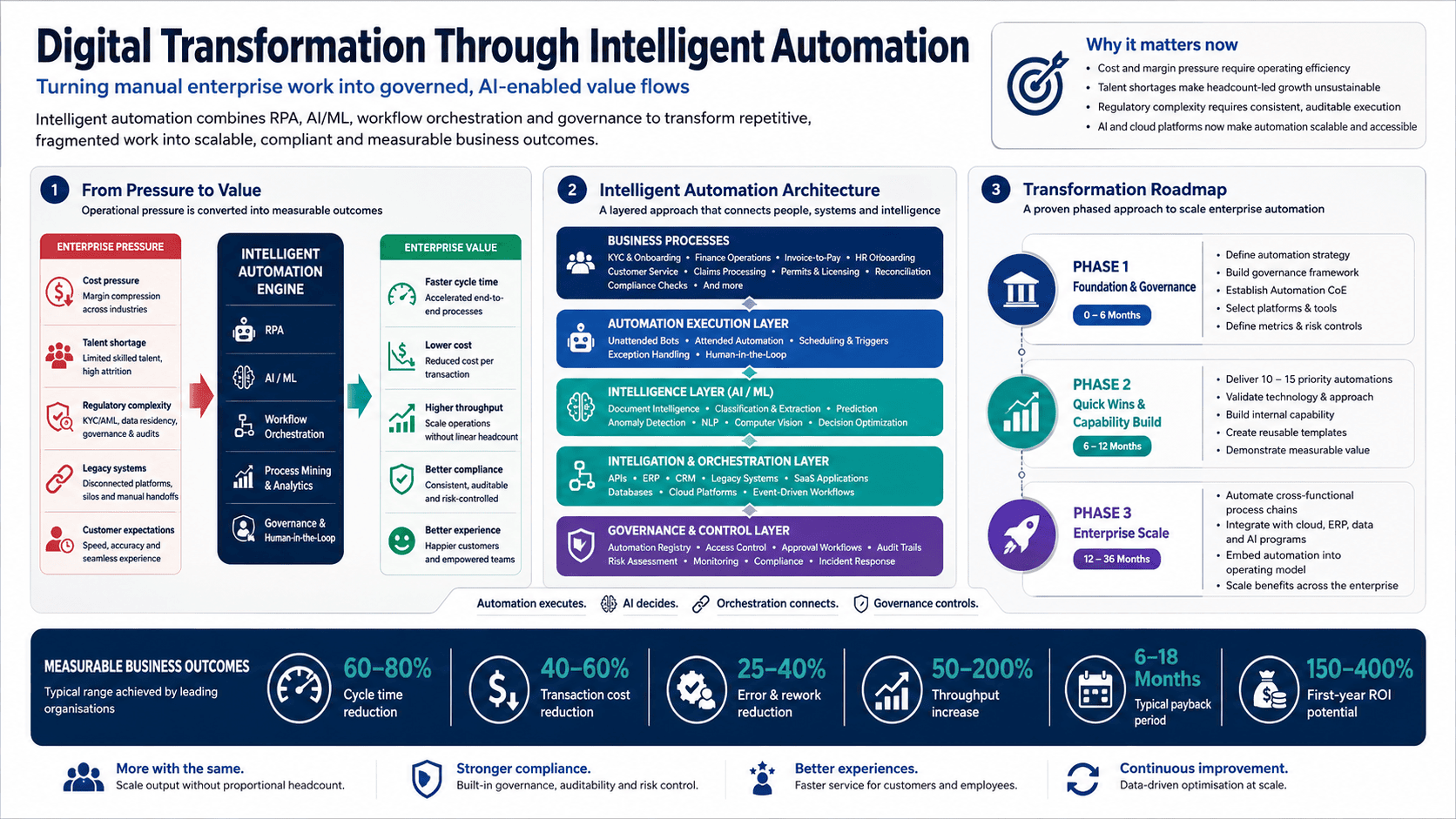
- Cycle Time: 60-80% reduction in process duration
- Cost: 40-60% reduction in transaction cost
- Quality: 25-40% reduction in error rates and rework
- Capacity: 50-200% increase in throughput without proportional cost increase
- Compliance: Consistent application of rules and audit trails
—
Part 2: Understanding Intelligent Automation Architecture
The Technology Stack
Intelligent automation is not a single technology but an orchestrated ecosystem. Understanding the components is essential for effective strategy and implementation.
Robotic Process Automation (RPA) – The Foundation
RPA is the foundational technology. RPA bots are software programs that mimic human interaction with computer systems—logging in, navigating interfaces, entering data, validating information, and copying files. Unlike middleware or API-based integration, RPA is non-invasive: it works with systems as they exist, without requiring integration development or modifications to legacy systems.
This is particularly valuable in the GCC context, where many organisations operate complex landscapes of legacy systems—some built decades ago, some highly customised, some with limited vendor support. Organisations often lack the technical knowledge, budget, or vendor cooperation required to modify these systems. RPA allows organisations to automate processes across these fragmented landscapes without system-level changes.
RPA is best applied to high-volume, rules-based, repetitive work: data entry, validation, copying between systems, calculation of standard formulas, and exception identification. It excels when rules are well-defined and processes are stable.
Artificial Intelligence and Machine Learning – The Intelligence Layer
RPA + AI = Intelligent Automation. While RPA handles execution, AI/ML adds the intelligence layer.
Machine learning excels at classification (which category does this document belong to?), extraction (what is the invoice amount, due date, vendor?), prediction (will this customer default?), and optimisation (what is the best routing decision?).
For organisations with substantial unstructured data—customer emails, supplier invoices, customer feedback, applicant documents—ML-powered document intelligence and natural language processing unlock enormous value. Organisations that previously required manual human review can now automatically classify documents, extract key information, identify anomalies, and route for appropriate action.
Computer vision adds another dimension. For organisations handling physical documents, inspection reports, photographs, or visual data, computer vision models can extract information, identify defects, verify compliance, and detect fraud.
Integration and Orchestration – The Nervous System
Intelligent automation operates across multiple systems. Effective orchestration requires integration platforms that connect RPA, AI/ML models, core business systems, data platforms, and human decision-making.
Modern integration platforms provide:
- API management and connectivity
- Data mapping and transformation
- Event-driven orchestration
- Monitoring, logging, and exception handling
- Governance and audit trails
In complex GCC organisations operating multiple ERP instances, legacy systems, cloud platforms, and third-party SaaS applications, orchestration capabilities are critical. The ability to integrate new automation with existing system landscapes without custom development is a significant enabler.
Governance and Control – The Operating System
Intelligent automation creates new risks and new requirements for governance.
As automation scales across the organisation, concerns emerge: Which processes are automated? Who approved this automation? What are the audit trails? What happens when the automation fails? How do we manage security and compliance?
Effective governance frameworks provide:
- Process inventory and automation registry
- Approval and change management workflows
- Audit and compliance tracking
- Performance monitoring and alerting
- Risk assessment and mitigation
- Documentation and knowledge management
Without robust governance, automation initiatives fragment, create compliance gaps, and become operationally chaotic as they scale.
Design Patterns and Best Practices
Successful intelligent automation follows established design patterns:
The Attended Bot Pattern: Automation that runs with human guidance. A user initiates a process, the bot executes a series of actions, and the user validates and approves the outcome. This pattern is ideal for complex processes where some decisions require human judgment. It combines automation speed with human oversight.
The Unattended Bot Pattern: Fully automated execution without human interaction. The bot handles the entire process end-to-end and triggers alerts only for exceptions. This pattern requires extremely high reliability and clear exception handling procedures. It is ideal for high-volume, low-exception processes.
The Hybrid Intelligent Pattern: Combines RPA, AI/ML, and human decision-making. The automation handles routine work; AI/ML models make scoring or classification decisions for medium-complexity items; and humans focus on complex exceptions. This pattern maximises efficiency while maintaining quality and managing risk.
The Continuous Learning Pattern: Automation that improves over time. Human decisions on exceptions are captured, fed into ML models, and used to retrain classifiers. The automation becomes progressively smarter as it encounters more scenarios. This pattern requires sophisticated feedback loops and data governance.
—
Part 3: Strategic Implementation Framework
Identifying Automation Opportunities
Successful automation initiatives begin with rigorous opportunity identification.
Quantitative Criteria:
- Transaction Volume: High-volume processes (1000+ transactions annually) have superior economics
- Rules Clarity: Processes with clear, documented rules are more automatable
- System Stability: Processes that use stable systems and stable data structures are more reliable to automate
- Manual Effort: A high percentage of manual effort (data entry, copying, validation) indicates a strong automation candidate
- Exception Rate: Lower exception rates mean fewer decisions required, making full automation feasible
Qualitative Criteria:
- Business Priority: Alignment with strategic objectives and transformation roadmap
- Stakeholder Readiness: Business sponsors and process owners committed to transformation
- Risk Profile: Assessment of compliance, security, and operational risk
- Interconnectedness: Impact on dependent processes and downstream workflows
A disciplined opportunity assessment framework ensures organisations focus on high-impact, high-probability opportunities rather than pursuing automation for its own sake.
Phased Implementation Approach
Effective intelligent automation follows a staged, phased approach:
Phase 1: Foundation and Governance
Before executing individual automation projects, establish foundations:
- Define automation strategy and business objectives
- Establish governance framework, policies, and approval processes
- Build an automation centre of excellence (CoE) with core capabilities
- Implement foundational technologies and platforms
- Build capability and knowledge within the organisation
- Establish metrics and measurement frameworks
This phase typically spans 3-6 months and focuses on readiness rather than output. Organisations that rush this phase often discover governance gaps, conflicting standards, and capability shortages later, slowing scaling.
Phase 2: Quick Wins and Capability Building
Execute a series of smaller automation projects (10-15) to:
- Validate the technology platform and vendor selection
- Build organisational capability and confidence
- Generate business value and momentum
- Identify obstacles and refine processes
- Build a library of reusable components and automation templates
This phase focuses on learning and capability building, not maximum volume. Success criteria emphasise time-to-value, quality, and capability development.
Phase 3: Platform Scaling and Enterprise Transformation
Armed with platform experience, proven templates, and internal capability, scale automation across the organisation. Typical scaling initiatives:
- Expand automation across departments and business units
- Automate interconnected process chains rather than isolated processes
- Integrate automation with broader transformation initiatives (cloud migration, system implementations, operating model redesign)
- Establish automation as standard operating procedure for process improvement
This phase often spans 18-36 months and requires disciplined governance to manage risk as automation proliferates.
Change Management and Organisational Readiness
Technology implementation accounts for perhaps 20% of the success of transformation. Organisational change, stakeholder engagement, and capability development account for the remainder.
Stakeholder Engagement:
- Business Leadership: Must articulate vision, secure investment, and resolve conflicts
- Process Owners: Must lead change within their domains, advocate for transformation
- Affected Staff: Must understand changes, develop new skills, transition to new roles
- IT/Technology Teams: Must develop automation platforms, integrate systems, and support operations
Effective change management addresses fundamental questions: What work disappears? What work changes? What new skills are required? How do career paths evolve? What happens to staff who previously performed now-automated work?
Organisations that treat these questions as peripheral struggle with resistance, quality issues, and adoption failures. Organisations that address them directly often discover unexpected benefits: reskilling opportunities, improved career trajectories, and stronger engagement.
Capability Development:
Intelligent automation requires new skills:
- Business Process Analysis: Documenting, analysing, and optimising processes
- Automation Design: Designing automation workflows, exception handling, testing
- AI/ML Fundamentals: Understanding machine learning model capabilities and limitations
- Data Analysis: Understanding data quality, bias, and model performance
- Governance and Risk: Managing automation at scale, audit, and compliance
Organisations building centres of excellence often develop in-house training programs, certifications, and career tracks. These investments in capability pay dividends as automation scales.
—
Part 4: Business Impact and Performance Management
Measuring Automation Impact
Intelligent automation creates value across multiple dimensions:
Operational Efficiency:
- Cycle time reduction (process duration)
- Cost per transaction
- Error rates and rework
- Throughput and capacity
Financial Impact:
- Direct cost savings (labour displacement, system license reduction)
- Working capital improvement (AR days, AP days, inventory turns)
- Revenue impact (faster processing, improved customer experience, new capabilities)
Risk and Compliance:
- Audit trail completeness
- Exception identification and resolution
- Regulatory compliance consistency
- Data security and access controls
Strategic and Organisational:
- Capability development and skills advancement
- Organisational agility and speed to market
- Employee engagement and satisfaction
- Scalability of operations
Effective measurement requires:
- Baseline Establishment: Measure current-state performance before automation
- Attribution: Isolate automation impact from other changes
- Sustained Measurement: Track benefits through implementation and operation
- Comparative Analysis: Benchmark against peer organisations and industry standards
Many organisations capture initial benefits (cost, cycle time) but fail to sustain and realise full benefits as automation scales. Sustained measurement ensures organisations capture compounding benefits.
Return on Investment and Economics
The return on investment for intelligent automation projects is typically strong:
Typical Economics:
- Investment: $150K-$500K per automation, depending on complexity
- Payback Period: 6-18 months for most projects
- ROI: 150-400% in the first year of operation
- Ongoing Benefit: Continued cost savings and capacity benefit annually
Importantly, these economics improve substantially at scale:
- Platform Economics: As automation platforms mature and integrate, incremental project costs decline
- Template Reuse: Organisations with established libraries of reusable components deploy faster and cheaper
- Capability Leverage: As internal capability matures, organisations reduce dependence on external consultants and vendors
- Organisational Knowledge: Mature automation organisations identify automation opportunities faster and execute with greater discipline
A well-executed 3-year automation program often realises cumulative benefits 3-5x the initial investment, with benefits continuing long after the program concludes.
—
Part 5: Emerging Frontiers and Future Evolution
Autonomous Workflows and Event-Driven Automation
The evolution of intelligent automation continues. Emerging capabilities are expanding what automation can achieve:
Event-Driven Automation: Rather than executing on a schedule, automation responds to events—a customer inquiry arrives, a payment fails, an inventory threshold is breached. Event-driven architecture enables immediate, real-time automation rather than batch processing.
Autonomous Decision-Making: Advanced AI models enable automated decision-making without human intervention. Loan approvals, investment decisions, customer retention offers—decisions that previously required human judgment are increasingly handled autonomously.
Predictive and Prescriptive Analytics: Beyond responding to events, organisations are using predictive models to anticipate problems and prescriptive algorithms to recommend actions. Maintenance prediction (predict equipment failures before they occur), demand forecasting (anticipate customer needs), and churn prediction (identify at-risk customers).
AI/ML Integration and Continuous Learning
The next generation of intelligent automation will be fundamentally different. Rather than static rules and pre-trained models, automation will continuously learn and adapt.
Federated Learning: Train ML models across distributed datasets without centralising data, preserving privacy and data residency.
Reinforcement Learning: Automation that learns optimal policies through trial and feedback rather than supervised learning from historical examples.
Foundation Models: Large language models adapted for business domain-specific tasks—document understanding, customer communication, knowledge work.
For GCC organisations, these capabilities are particularly relevant. The combination of regulatory requirements around data residency, large unstructured datasets (Arabic documents, customer communications, regulatory filings), and privacy considerations makes federated and localised AI capabilities increasingly important.
Hyperautomation and Process Mining
The term “hyperautomation” describes automation at scale across the enterprise, extending beyond traditional RPA to encompass:
Process Mining: Using event logs and transaction data to discover how work actually happens, identify bottlenecks, and optimise workflows.
Task Mining: Monitoring user interactions with systems to identify automation opportunities at the task level.
Decision Mining: Using decision logs and outcomes to understand and optimise decision-making.
These techniques enable organisations to visualise process landscapes, identify interdependencies, and optimise not individual processes but entire value chains.
—
Part 6: The GCC Context and Regional Imperatives
Market Dynamics and Drivers
The GCC region has unique characteristics that make intelligent automation particularly valuable:
Labour Market Dynamics:
The region faces structural labour challenges—limited local talent pools, dependence on expatriate workers, and wage pressure. Intelligent automation directly addresses these constraints by enabling organisations to do more with existing staff, reducing dependence on headcount expansion.
Digital Economy Development:
GCC governments (Saudi Arabia, the UAE, and Egypt) have made digitalisation central to national strategies—Vision 2030, UAE 2071, and Egypt’s Digital Transformation Strategy. Government procurement increasingly favours digitally capable organisations. Private sector investment in automation is often directly aligned with national digital economy objectives.
Regulatory Evolution:
Regulatory frameworks in the GCC are rapidly evolving—SAMA (Saudi Arabia), DFSA (UAE), and CBE (Egypt) frameworks increasingly require sophisticated compliance capabilities. Organisations face growing KYC/AML requirements, sanctions screening obligations, and governance requirements. Intelligent automation enables compliance at scale.
Competitive Pressure:
While the GCC market is growing, competitive intensity is increasing. Global players are entering regional markets. Regional players must improve efficiency and agility to compete. Intelligent automation is often the primary lever for achieving this.
Regional Best Practices and Case Studies
Saudi Arabia – Vision 2030 Alignment:
Saudi organisations implementing automation often frame their investments in alignment with Vision 2030 objectives: reducing unemployment through staff reskilling, improving government service delivery, and strengthening private-sector competitiveness. This alignment helps secure executive sponsorship and investment.
UAE – Operational Excellence Leadership:
UAE organisations, particularly those in government, finance, and logistics, have invested substantially in intelligent automation. The UAE’s emphasis on operational excellence and government digitalisation has created a culture receptive to investment in automation. Sharing of best practices across government entities has accelerated adoption.
Egypt – Scale and Volume Opportunity:
Egypt’s large population and growing private sector create enormous opportunities for automation at scale. The combination of cost pressure and regulatory requirements makes automation economically attractive. Early adopters have achieved a significant competitive advantage.
—
Part 7: Risk Management and Governance Considerations
Security and Compliance Risks
Intelligent automation creates new security and compliance considerations:
Credential Management: Automation bots require credentials to access systems. Secure credential management—without embedding credentials in code, with access audit trails, and with regular rotation—is essential.
Data Residency and Localisation: GCC regulatory frameworks often require data localisation. Cloud-based automation platforms must support localised data storage and processing.
Audit and Compliance: Automation must maintain complete audit trails—what was processed, when, by whom, and what decisions were made. These trails must be available for regulatory review.
Model Transparency and Bias: AI/ML models driving decisions must be transparent (explainable) and regularly assessed for bias. If automation denies a customer’s application or flags a transaction as suspicious, the organisation must be able to explain why.
Operational Risk and Resilience
As processes become dependent on automation, operational resilience becomes critical:
Exception Handling: Every automation must have clear exception handling—when automation cannot process something, what happens? Who is notified? How quickly is the exception resolved?
Automation Failures: What happens when automation fails? Can the process continue manually? How quickly can the failure be resolved? What is the impact on downstream processes?
Control and Governance: As automation scales, control becomes challenging. Without effective governance, automation initiatives become fragmented, difficult to track, and impossible to control.
Successful organisations implement:
- Automation Registry: Complete inventory of what is automated
- Impact Analysis: Understanding of the downstream impact of each automation
- Testing and Validation: Rigorous testing before production deployment
- Monitoring and Alerting: Real-time monitoring of automation health and performance
- Incident Response: Clear procedures for responding to automation failures
—
Conclusion: The Path Forward
Intelligent automation is not a future capability—it is table stakes for competitive organisations today. The convergence of RPA, AI/ML, and advanced integration capabilities has created an unprecedented opportunity to reimagine how organisations operate.
For GCC organisations, the opportunity is particularly significant. The region faces unique structural challenges—labour market constraints, regulatory complexity, competitive pressure from global players—that intelligent automation directly addresses. Early adopters are already realising substantial competitive advantage.
However, success requires more than the implementation of technology. It requires:
- Strategic Clarity: Understanding how automation aligns with organisational strategy and business objectives
- Disciplined Governance: Clear frameworks for identifying opportunities, managing risk, and scaling solutions
- Organisational Readiness: Capability development, change management, and stakeholder engagement
- Commitment to Continuous Improvement: Recognition that automation is not a project but an ongoing organisational capability
The organisations that will lead their industries over the next decade are those that treat intelligent automation not as an IT project but as a fundamental reimagining of how work happens. They are organisations where automation is embedded in culture, where process improvement is continuous, and where technology enables people to focus on high-value work rather than repetitive transactions.
The technology is ready. The business case is clear. The time is now.
—
About the Author
This article reflects insights from over 30 years of enterprise technology leadership across financial services, government, healthcare, and business process outsourcing. The analysis draws on successful intelligent automation implementations across the GCC region and globally, measuring real-world impact and extracting best practices applicable to diverse organisational contexts.