How Senior Leaders Can Transform Cybersecurity from a Technology Challenge into a Business Resilience Imperative
Opening: Cybersecurity Is Not Just About Stopping Attacks
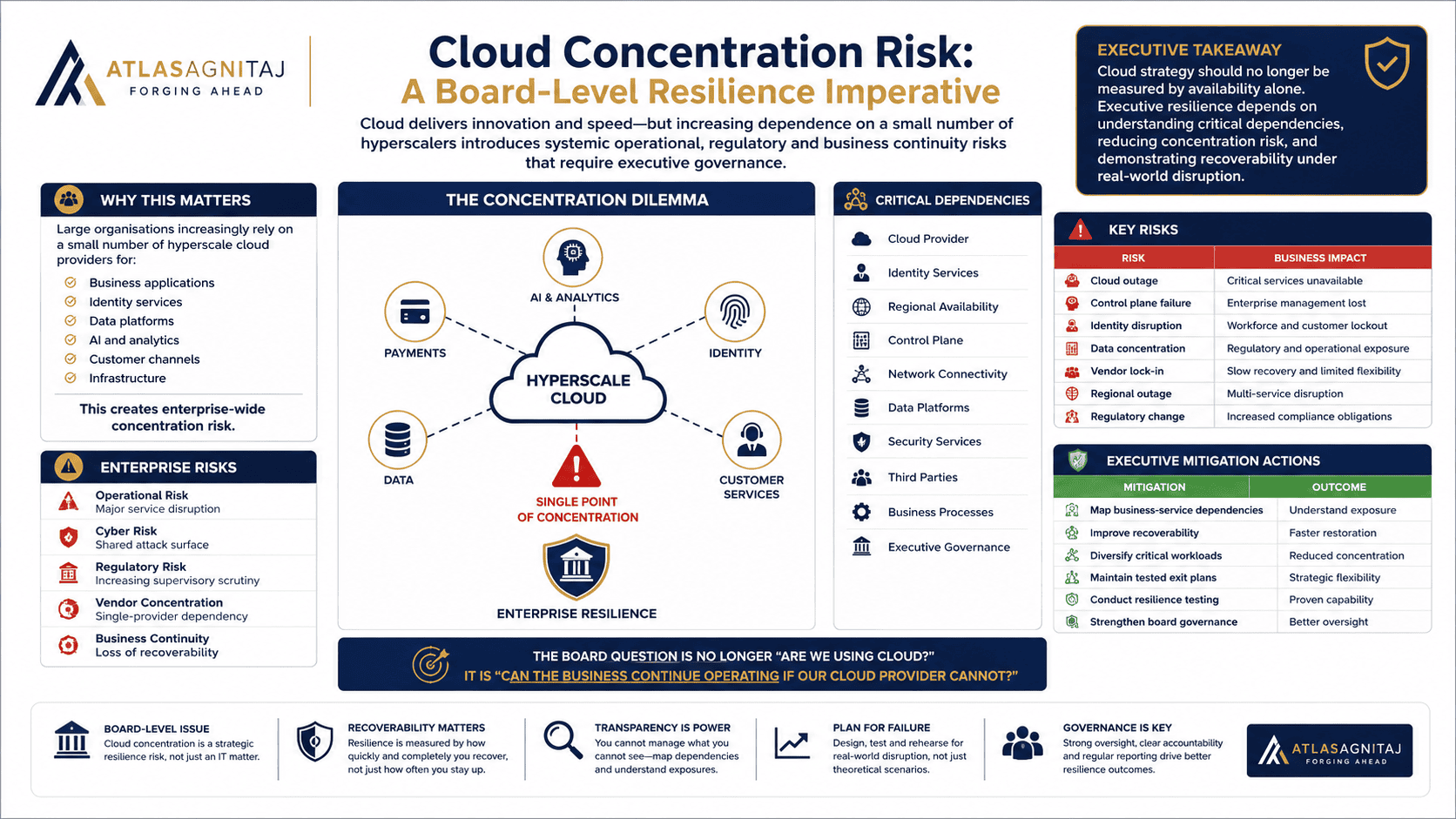
Cybersecurity is not just about stopping attacks. It is about keeping the business running. This distinction has never been more critical than it is today, yet most organisations still treat cyber resilience as a technology problem rather than a business continuity imperative. In 2026, this disconnect has become a board-level liability.
Across the GCC and the UAE, where digital transformation is accelerating at an unprecedented pace, cybersecurity and risk management remain the number-one priority for CIOs. But priorities alone do not guarantee outcomes. What distinguishes organisations that recover quickly from cyber incidents from those that become case studies in failure is not the sophistication of their firewalls. It is whether they can answer a single, brutal question: Can we operate when something goes wrong?
The timing is not accidental. As enterprises across the region adopt artificial intelligence, migrate critical workloads to cloud platforms, digitise government services, embrace open banking, deploy smart infrastructure, and integrate connected operations across supply chains, they have simultaneously expanded their attack surface and increased their exposure to threats that traditional cybersecurity approaches were not designed to address. A single compromise in a third-party AI vendor. A misconfigured cloud storage bucket. An identity breach in a connected partner ecosystem. These are no longer theoretical risks. They are operational realities that boards and executives are beginning to understand.
Part 1: Why Traditional Cyber Thinking Is Not Enough
The traditional cybersecurity paradigm was built on a straightforward assumption: build strong walls, monitor the gates, detect intrusions, and respond. Firewalls, intrusion detection systems, vulnerability scanners, penetration tests, and annual audits became the standard toolkit. For organisations operating in relatively contained environments with well-defined network boundaries and predictable threat models, this approach worked adequately. But the modern enterprise operates in a fundamentally different context.
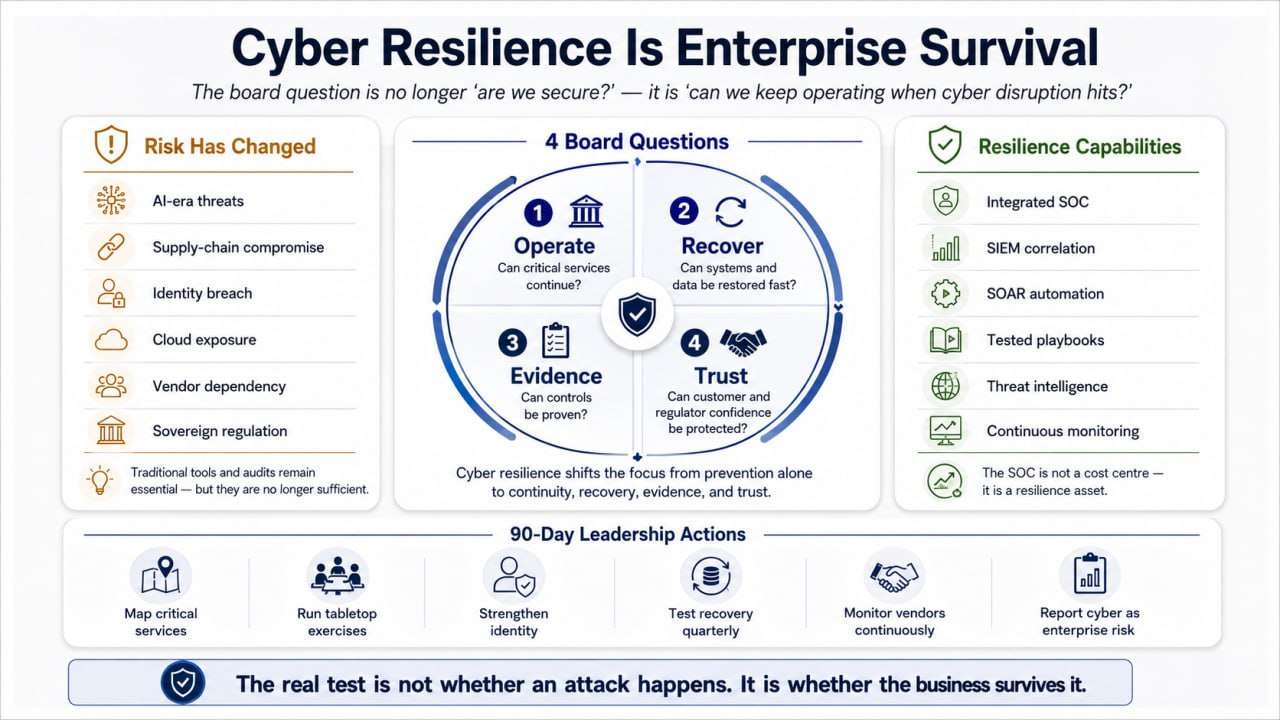
Firewalls, tools, and audits are important. They remain essential components of any defensive strategy. But they are not sufficient for the threat landscape organisations now face. Consider the dimensions of modern cyber risk:
- AI-era threats: Sophisticated attackers now use machine learning and automated reconnaissance to discover vulnerabilities faster than security teams can patch them. Traditional signature-based detection is outdated.
- Supply-chain risk: A breach in a single vendor or contractor can cascade across an entire ecosystem. Many organisations cannot even map their full third-party dependencies, let alone monitor them continuously.
- Identity compromise: In a cloud-first, hybrid, remote-work environment, the traditional perimeter has dissolved. Compromised credentials are now the most frequently exploited attack vector, and defending identity at scale requires fundamentally different approaches than firewall-based security.
- Cloud exposure: Public cloud environments introduce new complexity. Misconfigurations, overpermissioned service accounts, and inadequate monitoring of cloud-native threats require expertise and operational discipline that many organisations lack.
- Third-party dependency: As organisations increasingly adopt SaaS platforms, API integrations, and cloud services, they become dependent on vendor security practices they cannot directly control. A breach in your vendor becomes your breach.
- Regulatory and geopolitical pressure: Governments in the GCC are increasingly mandating data residency, local processing, and sovereign cloud adoption. These requirements create technical and operational constraints that traditional security architectures were not designed to accommodate.
The implication is stark: organisations cannot audit, patch, and monitor their way to security. Modern cyber resilience requires a fundamental shift in how enterprises think about risk, investment, governance, and operations. It requires moving from a technology-focused defensive posture to a business-aligned resilience strategy. This is not a recommendation. For regulated organisations, critical infrastructure operators, and enterprises with significant digital dependencies, it is a requirement.
Part 2: Cyber Resilience Means Business Resilience
The term ‘resilience’ signals a fundamental shift in perspective. Resilience is not about preventing all attacks. It is about designing organisations, processes, and systems that can absorb, adapt, and recover. A resilient organisation does not assume it will never be compromised. Instead, it prepares for compromise, detects it quickly when it occurs, contains it, recovers from it, and learns from it.
This shift is not purely operational. It is a board- and executive-level governance issue. The board should ask itself four critical questions, and the answers should inform investment, risk tolerance, and strategic planning:
Can we operate during an attack? If a critical system is compromised today, can the organisation continue to serve customers, meet regulatory obligations, and maintain revenue? For most organisations, the honest answer is no. This gap must be identified and addressed through business continuity planning, redundancy, and failover capabilities that are specifically designed with cyber incidents in mind. This is not a technology problem. It is a business architecture problem.
Can we recover? Recovery from a significant cyber incident is not a technology exercise. It requires tested, documented, and rehearsed processes for data restoration, system rebuild, supply chain coordination, and customer communication. Organisations that have not invested in backup and recovery architecture, tested restoration procedures, and recovery governance tend to face recovery times measured in weeks or months rather than hours or days. Recovery investment is cyber investment.
Can we evidence controls? In a regulated environment or after a significant incident, the organisation will be required to demonstrate that it had controls in place, that those controls were operating, and that there were no significant gaps. This requires logging, monitoring, documentation, and audit trails that are themselves protected and immutable. Many organisations maintain logs that are accessible to attackers, maintained on systems that can be compromised, and not reviewed until after an incident. Evidence of controls requires a deliberate architecture that assumes attackers will try to destroy or tamper with audit data.
Can we protect customers’ and regulators’ confidence? A cyber incident is a confidence event. Customers, partners, and regulators assess whether the organisation handled the incident transparently, fully understood it, and implemented meaningful controls to prevent recurrence. Organisations that can credibly answer these questions recover faster and suffer less competitive and reputational damage. This requires incident response planning, forensic capability, crisis communication, and engagement with regulators and partners. These are business and governance issues, not purely technology issues.
These four questions form a model of cyber resilience that is aligned with business objectives. They cannot be delegated entirely to the security team. They require engagement from the board, the CFO, the COO, the General Counsel, and business unit leaders. Cyber resilience, understood this way, is enterprise resilience.
Part 3: The Critical Role of Security Operations, SIEM, SOAR, and Managed Detection
If cyber resilience is the goal, then the foundation is effective security operations. A Security Operations Centre (SOC), properly designed and operated, is not a cost centre. It is a resilience asset. Its primary function is not to prevent all attacks. It is to detect attacks quickly, understand them thoroughly, contain them rapidly, and provide forensic clarity that informs both immediate response and long-term hardening.
Effective security operations require several integrated components:
Integration: A SOC that operates in silos—with separate tools, teams, and processes for network, endpoint, cloud, identity, and application security—will be slow and ineffective. Modern SOCs integrate data from multiple security tools into a single, searchable, correlated view. This requires a Security Information and Event Management (SIEM) platform or equivalent central repository.
Automation: The volume of security events in a modern enterprise exceeds the capacity of human analysts to process and investigate. Automation is not optional. Security Orchestration, Automation and Response (SOAR) platforms enable analysts to define playbooks—standard responses to known threat patterns—that execute automatically. This dramatically reduces the time between detection and response.
Response playbooks: Before an incident occurs, the SOC should have documented and tested procedures for responding to different threat categories. A ransomware incident requires different actions than an insider threat, which is different from a supply-chain compromise. Playbooks ensure consistency, reduce dwell time, and enable less-experienced analysts to execute effectively in high-pressure situations.
Threat intelligence: A SOC operating without threat intelligence is like a radiologist reading X-rays without understanding the principles of medical imaging. Threat intelligence—understanding adversary tactics, techniques, and procedures; tracking known malware and infrastructure; understanding geopolitical and industry-specific threat landscapes—enables analysts to interpret events in context and identify subtle indicators of compromise.
Continuous monitoring: The traditional security model of annual audits and quarterly vulnerability scans is inadequate for modern threats. Cyber resilience requires continuous monitoring. This means 24/7 visibility into network traffic, endpoint behaviour, cloud access, identity activity, and application behaviour. Monitoring gaps are attack opportunities.
Building and operating an effective SOC is resource-intensive. Many organisations lack the budget, talent, and expertise to build in-house capabilities. This has given rise to Managed Security Service Providers (MSSPs) and managed SOC services. For many organisations, particularly mid-market enterprises and those without significant security headcount, outsourced or hybrid SOC models are pragmatic solutions. What matters is not whether the SOC is built in-house or outsourced. What matters is whether it is effective, integrated, and aligned with the organisation’s risk tolerance and business objectives.
Part 4: Third-Party and AI Vendor Risk — The Hidden Vulnerability
One of the most underestimated cyber risks in the Middle East is the risk posed by third-party vendors and, increasingly, third-party AI vendors. As enterprises adopt generative AI, large language models, and other AI-driven solutions, they are bringing new vendors—and new risk—into their technology environments.
Middle Eastern enterprises are increasingly concerned about how third-party AI vendors handle sensitive data. These concerns are legitimate. But in many cases, the contracts, technical controls, and operational procedures that enterprises implement to manage vendor risk are insufficient. Common gaps include:
- No kill-switch: If the relationship with a vendor deteriorates, or if a vendor is compromised, the enterprise has limited ability to terminate access, retrieve data, and isolate systems quickly. This gives vendors disproportionate leverage and leaves enterprises vulnerable.
- No joint incident playbooks: If the vendor is breached, the enterprise does not know what the vendor will do, and the vendor does not know what the enterprise will do. This creates confusion and delays response. Pre-agreed, tested incident procedures are critical.
- Limited continuous monitoring: Many enterprises assume vendors are secure because they have passed a compliance assessment or security audit. In reality, these audits are point-in-time assessments. Continuous monitoring of vendor security posture, data handling, and access controls is essential.
- Data residency ambiguity: For AI vendors, it is not always clear where data is being processed, stored, or used. In the GCC context, where data residency and data sovereignty are increasingly mandated, this ambiguity poses compliance and risk challenges.
- Training data usage: Enterprises often do not know whether their data is being used to train the vendor’s models, to improve competitor products, or to optimise AI systems that will be sold to the enterprise’s competitors. Contracts that explicitly govern data usage and guarantee data isolation are essential.
Managing third-party and AI vendor risk requires a multi-layered strategy. Contracts must be precise and must address data handling, access control, incident notification, audit rights, and termination procedures. Due diligence must be rigorous and continuous, not a one-time event. Technical controls—encryption, key management, network segmentation, and access logging—must be implemented to ensure that sensitive data remains protected even if the vendor is compromised. And governance must ensure that vendor relationships are actively managed, monitored, and reviewed on a schedule aligned with each vendor’s criticality.
Part 5: What Senior Leaders Should Do Now
Cyber resilience is not achieved through a single initiative or a one-time investment. It is achieved through sustained, aligned leadership focus. For senior leaders—including board members, CEOs, CFOs, COOs, and CIOs—the following actions should be implemented in the next 90 days:
Link cyber investment to business services: Stop treating cybersecurity as a separate budget line. Instead, allocate cyber resources to critical business services. Ask: What are our most critical services? What would happen to revenue, customers, and reputation if each service were compromised? Allocate cyber investment proportionally. This ensures that resources are focused on risks that matter.
Run tabletop simulations: Before a major incident occurs, conduct tabletop exercises simulating a cyberattack. These exercises should involve the board, the executive team, and key business leaders. They should be realistic, pressurised, and designed to expose gaps in incident response planning and decision-making processes. Conduct at least two per year.
Strengthen identity management: In today’s threat landscape, robust identity controls are foundational. This means multi-factor authentication for all users, privileged access management for sensitive roles, and continuous monitoring of identity activity. If the organisation has not implemented these controls, prioritise them immediately.
Test recovery procedures: Backup and recovery are not one-and-done. It should be tested at least quarterly. Test restoration of critical databases, systems, and services. Measure recovery time and recovery point objectives. Identify gaps. Fix them. Document the results.
Monitor vendors continuously: Assign accountability for vendor risk management. Establish a vendor risk assessment process. Re-assess vendors at least annually. Monitor vendor security posture, news, and threat intelligence. Maintain an inventory of critical vendors and document the specific data and services each vendor has access to.
Align cyber with enterprise risk: Cyber risk is not separate from operational, financial, or reputational risk. Ensure that cyber risk is assessed and reported to the board as part of enterprise risk management. Ensure that cyber leaders participate in enterprise risk discussions.
Conclusion: Cyber Resilience as a Competitive Advantage
In 2026, cyber resilience is not a competitive disadvantage. It is increasingly becoming a competitive advantage. Customers, regulators, and partners now assess vendor security and resilience as part of due diligence. Organisations that have invested in effective cyber resilience can recover quickly from incidents and credibly demonstrate that their controls are winning business and building trust.
Conversely, organisations that treat cyber as a technology problem, that under-invest in resilience, and that wait for a major incident to drive change are increasingly exposed. The cost of recovery from a significant cyber incident—in terms of revenue loss, reputational damage, regulatory fines, and remediation costs—vastly exceeds the cost of building resilience. This is not a technology argument. It is a business argument.
For senior leaders in the GCC and UAE, the question is no longer whether cyber resilience matters. The question is whether you dare to treat it as a business imperative and the discipline to sustain the investment and governance required to achieve it. The organisations that answer yes will be the ones that survive the inevitable incidents that lie ahead.