Opening Hook: The Evolution of Cloud Strategy
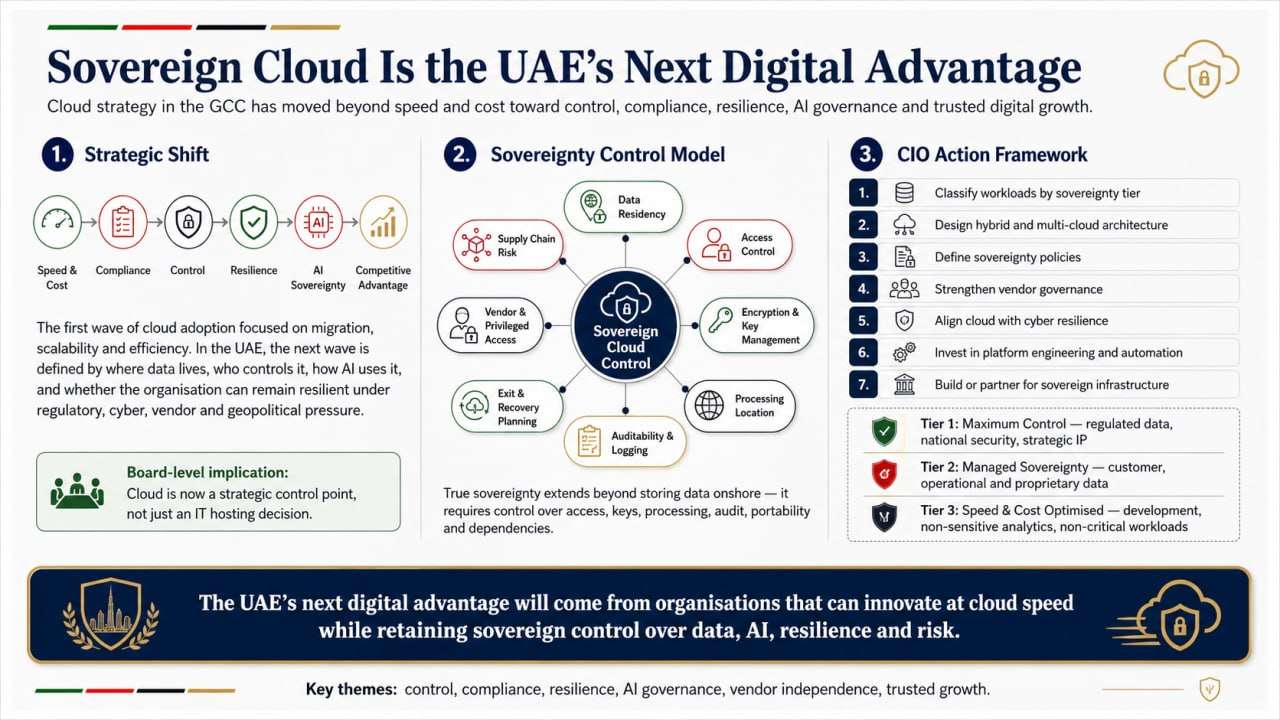
Cloud strategy is no longer only about speed and scalability. In the GCC, it is increasingly about trust, sovereignty, and resilience.
Five years ago, the cloud conversation in the Middle East centred on a straightforward value proposition: migrate workloads, reduce capital expenditure, gain operational flexibility, and access global infrastructure faster than building it yourself. The narrative was simple: cloud equals modernisation. Hyperscalers arrived, enterprises migrated, and the cloud infrastructure market grew rapidly across the region.
Today, that conversation has fundamentally shifted. While speed and cost remain important, they are no longer the primary drivers of cloud strategy in the UAE and broader GCC. Instead, governments, regulators, and enterprise leaders are asking harder questions: Where does my data live? Who has access to it? Can I comply with regulations while using cloud infrastructure? What happens if a supplier relationship breaks down? How do I ensure that my most sensitive assets—intellectual property, customer data, national security information, and financial infrastructure—remain under my control?
This shift represents a maturation of cloud thinking in the region. It reflects the convergence of several powerful forces: regulatory confidence in digital infrastructure, national digital strategies, investment in sovereign technology capabilities, the rapid rise of AI, which requires secure data and compute, geopolitical considerations, and a deepening awareness that cloud infrastructure is not merely a utility—it is a strategic control point.
For CIOs, CTOs, and technology leaders, this evolution creates both a challenge and an opportunity. The challenge is navigating an increasingly complex landscape of compliance requirements, vendor relationships, and architectural choices. The opportunity is to position your organisation as a leader in a new phase of digital transformation—one that balances innovation with control, growth with security, and global capability with local sovereignty.
—
Why Cloud Decisions Are Becoming Strategic
In the first generation of cloud adoption, technical leaders often operated in a relatively isolated domain. IT leaders and implementation teams drove the cloud decision. Today, cloud has become a boardroom topic, and for good reason.
Cloud infrastructure now affects virtually every aspect of an organisation’s strategic posture:
Regulatory Compliance and Data Governance. The UAE’s regulatory environment has matured significantly. From data localisation requirements to sector-specific rules in banking, healthcare, and government, compliance is no longer a post-implementation consideration—it is a foundational architectural requirement. The Central Bank of the UAE’s initiatives on fintech regulation, the national data strategy, and sector-specific governance frameworks all assume that technology leaders understand where data is stored and processed, and who has access to it. A cloud architecture that violates these principles, even inadvertently, creates legal and operational risk that extends far beyond IT.
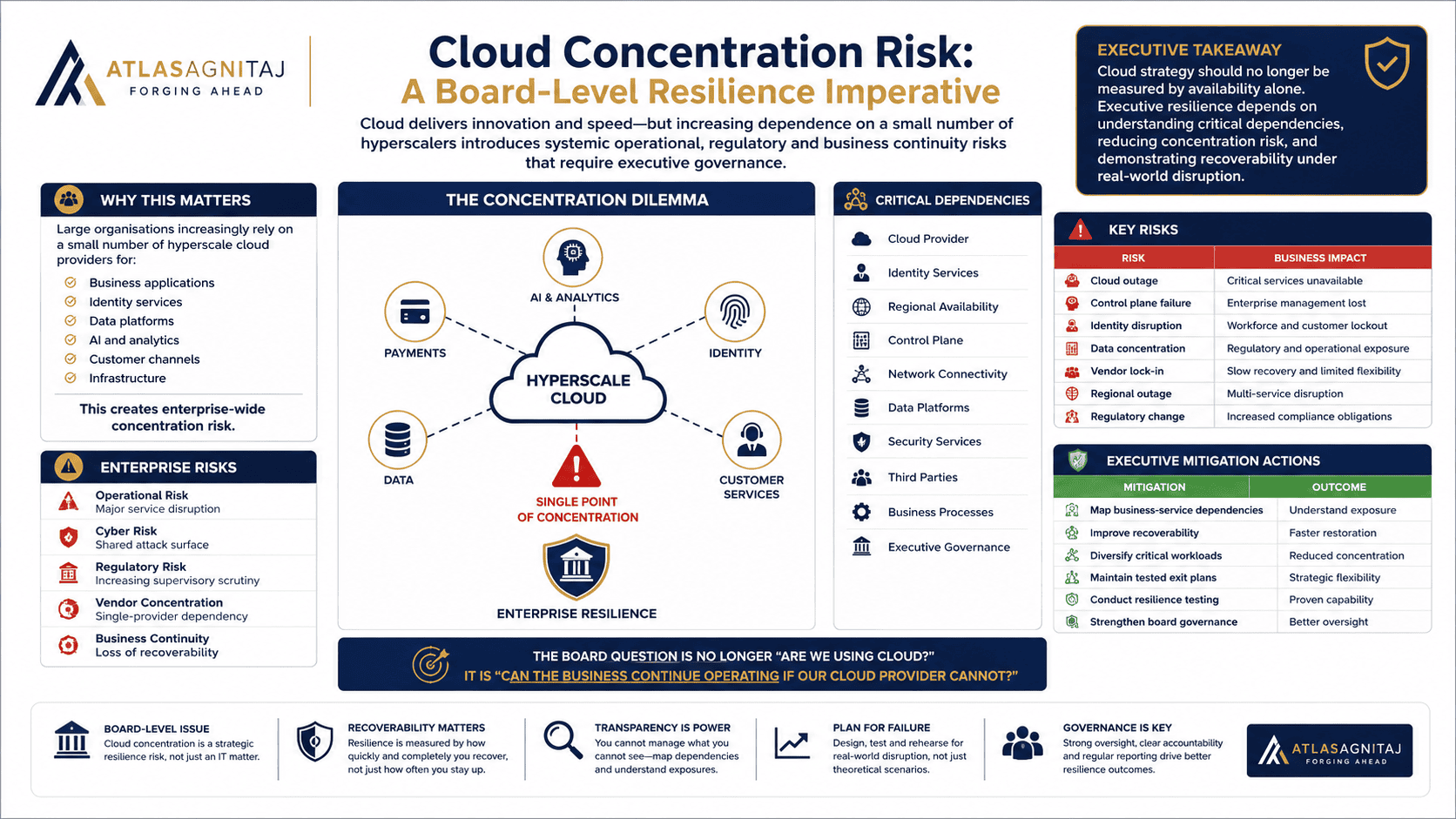
Operational Resilience and Business Continuity. The lessons of recent global disruptions have sharpened focus on resilience. Cloud architectures that depend entirely on a single provider, a single region, or infrastructure controlled by a foreign entity create concentration risk. In regulated sectors such as banking and government, regulators are increasingly scrutinising these dependencies. Organisations are discovering that resilience requires not just backup and disaster recovery but also architectural redundancy, vendor independence, and the ability to operate when external dependencies fail.
National Data Strategy and Competitive Advantage. The UAE has explicitly articulated that data is a strategic asset. The national AI strategy, the digital economy framework, and investment in sovereign cloud platforms all reflect an understanding that data—especially aggregated and analysed data—drives competitiveness and innovation. For enterprises operating in the region, this means aligning cloud strategy with national priorities creates alignment with regulators, access to government incentives, and positioning for participation in growing government technology initiatives.
AI Enablement and Model Governance. AI is not coming—it is here, and it is reshaping every industry. However, AI workloads are data-hungry and computationally intensive, raising new questions about control. If your AI models are trained on sensitive data, where does that training happen? If models are deployed on a cloud infrastructure you don’t control, who can access model outputs? If third-party APIs are part of your AI stack, what happens to the data flowing through them? These questions are becoming central to AI governance, and they cannot be answered without understanding your cloud architecture.
Cybersecurity and Attack Surface Management. Cloud infrastructure is not inherently less secure than on-premises infrastructure—but it is different. The attack surface changes. The responsibility model changes. The visibility changes. In a region increasingly targeted by sophisticated threat actors, understanding your cloud security posture is not optional. This includes not just technical controls but also vendor assessment, access governance, and incident response capabilities specific to cloud environments.
Business Agility and Time-to-Market. This remains true: cloud can accelerate business outcomes. But it must be controlled acceleration. An architecture that trades sovereignty and security for speed creates hidden debt that surfaces later. The organisations winning in the GCC are those that achieve both cloud speed and cloud control.
When cloud decisions affect compliance, resilience, competitive advantage, AI capability, security, and business velocity, they have become strategic decisions. They belong in conversations with the board, with regulators, and with business leaders, not just in the server room.
—
Data Residency Is Only the Starting Point
Many organisations interpret “data sovereignty” narrowly: data residency. That is, data must be stored in a specific geographic area—typically the UAE — for organisations operating in the UAE. This is necessary, but it is incomplete.
True sovereignty is multidimensional. It includes:
Data Residency. Where is data stored at rest? This is table stakes, and it is often the first question regulators ask. In the UAE, storing data onshore is increasingly a requirement. However, residency alone does not ensure control.
Access Control and Authentication. Who can access data? When? From where? In many cloud environments, data may be stored locally, but access controls are managed by a cloud provider’s global identity and access management system. This creates a dependency: if the provider’s systems are compromised, or if access control policies are not granular enough, your data can be accessed without your knowledge. Sovereignty requires that you define and enforce access controls, not delegate them entirely to a third party.
Encryption and Key Management. Data at rest can be encrypted, but who holds the keys? In many cloud services, the provider manages encryption keys. This means they can decrypt your data without your knowledge or permission. Sovereign cloud architectures implement customer-managed encryption, in which the organisation holds the keys and the provider is cryptographically locked out of the data. This is more operationally complex, but it establishes a clear boundary: the provider can host the infrastructure, but they cannot access the data.
Data Processing and Computation. Sovereignty is not just about storage. It is also about where data is processed. If your data is encrypted and stored in-country but processed offshore, you have only partial sovereignty. Data can be exfiltrated during computation. Sovereign architectures ensure that sensitive data processing occurs on infrastructure you control or on infrastructure in a trusted jurisdiction with enforceable agreements.
Auditability and Logging. Sovereignty includes the ability to see what is happening to your data. Who accessed it? When? What operations were performed? In what order? Cloud environments can generate enormous volumes of logs, but organisations often lack visibility into all access and operations. Sovereign cloud requires comprehensive logging, long-term retention, and the ability to audit independently—not just through the provider’s interface.
Recovery Capability and Exit Planning. Sovereignty includes the ability to leave. If you decide to move away from a cloud provider, can you extract your data in an open format? Can you recover it quickly? Are there technical or contractual barriers to migration? Organisations building sovereign cloud architectures assume they may need to exit a relationship and plan accordingly: open standards, no vendor lock-in, clear data ownership, and migration runbooks.
Privileged Access and Vendor Dependency. Even with strong access controls, there is often a category of people—cloud provider support staff, platform engineers, and administrative users—who have elevated access. Sovereignty includes understanding who these people are, how they are vetted, what they can do, and what oversight mechanisms are in place. In a sovereign cloud, there is no hidden backdoor. The provider’s ability to help is governed by explicit policies that the organisation controls.
Third-Party Dependencies and Supply Chain. Cloud infrastructure is never purely first-party. It depends on hardware vendors, network providers, security vendors, and software suppliers. Sovereignty includes understanding and governing these dependencies. Which vendors are involved? Where are they located? What are the regulatory and ownership structures? Are there geopolitical risks?
Organisations pursuing real sovereignty do not just check a box called “data residency” and move on. They think systematically about each of these dimensions and design their cloud architecture accordingly. This is more complex than a simple “use a provider in-country” approach, but it is also more robust.
—
The Rise of Sovereign Financial and Government Cloud Platforms
The most visible manifestation of this shift is the emergence of sovereign cloud platforms built specifically for regulated and government sectors.
The UAE Central Bank’s sovereign financial cloud is perhaps the clearest example. This is not a rebranded hyperscaler offering or a regional data centre. It is a cloud infrastructure built from the ground up with the specific needs of financial institutions in mind: data residency in the UAE, governance structures aligned with financial regulations, a security architecture appropriate for banking, and control mechanisms that enable regulators and institutions to understand and audit what is happening.
Similar initiatives are underway across the GCC. Saudi Arabia is investing in sovereign cloud and data centre capacity. Kuwait, Qatar, and other emirates are evaluating or building national cloud platforms. These are not anti-cloud initiatives. They are pro-control initiatives. They reflect a decision that some of the most critical digital infrastructure should be built and operated in a way that puts control in the hands of the nation and its regulated institutions.
For enterprises, this creates both a requirement and an opportunity. The requirement is to understand which sectors or workloads must move to sovereign cloud platforms—and the opportunity is early positioning in an emerging market.
Banking and financial services are the obvious cases. Regulated financial institutions cannot store customer data or transaction data on infrastructure they do not control. Sovereign financial clouds are being built specifically to meet this requirement. Similarly, government agencies must ensure that citizen data, government operations, and national security information remain under government control. Healthcare providers handling patient data, telecom operators with national infrastructure responsibilities, and energy companies managing critical resources face similar requirements.
But the sovereign cloud market is expanding beyond these obvious cases. Digital government services, education platforms, e-commerce infrastructure, and even private enterprises handling sensitive intellectual property are evaluating sovereign alternatives. This is driven partly by regulation and partly by a recognition that control is valuable—not just for compliance but for business continuity, innovation velocity, and competitive advantage.
For technology leaders, this shift means rethinking cloud strategy. The question is no longer “should we move to the cloud?” It is “which workloads go where, and why?” Some workloads may stay on sovereign infrastructure. Some may use hyperscaler cloud in specific regions with specific governance. Some may use a hybrid approach. The architecture depends on the workload, the regulatory context, the sensitivity of the data, and the organisation’s risk tolerance.
—
AI Makes Cloud Sovereignty More Urgent
The rise of AI has compressed timelines and raised the stakes around cloud sovereignty. This might seem counterintuitive: AI is often described as cloud-native and requires hyperscaler infrastructure. So why does it make sovereignty more urgent?
The answer lies in understanding how AI systems work and what they require:
Data Aggregation. AI systems are trained on large datasets. The more data, the more powerful the model. This incentivises centralising data and moving it to wherever the computing power is. In a hyperscaler cloud environment, this might mean moving sensitive data outside the region or outside the organisation’s direct control. For organisations handling regulated data, this creates governance problems.
Model and Algorithm Control. Once an AI model is trained, it becomes a strategic asset. It contains patterns derived from your data. If the model runs on someone else’s infrastructure, that someone else has insight into how your model works, what it predicts, and what patterns it has learned. In competitive sectors, model architecture and behaviour are closely guarded secrets. Sovereignty requires that models run on infrastructure you control, or that you have strong contractual guarantees and technical controls to ensure model confidentiality.
API Dependency and Data Leakage. Many AI systems rely on third-party APIs and cloud services. A chatbot might call APIs for language understanding, data retrieval, or external compute. Each API call is an opportunity for data to leave your control. Aggregate enough API calls, and you leak patterns in your business. Sovereign AI requires understanding and controlling each external dependency.
Vendor Dependency and Model Lock-in. AI platforms and frameworks are often optimised for specific cloud providers. Models trained in one environment may not easily port to another. This creates vendor lock-in at the AI layer. Organisations pursuing AI sovereignty need to be thoughtful about framework choice, model portability, and the ability to migrate or exit a provider without losing their AI capability.
Regulatory and Ethical Oversight. Regulators are increasingly interested in AI governance: how are decisions made? What data is used? Can outcomes be audited? Can bias be detected? If your AI system runs on infrastructure you don’t control, can you audit it? Can you understand the full chain of computation? Regulators in the GCC are developing AI governance frameworks and will expect organisations to demonstrate control and auditability. This is hard if your AI infrastructure is offshore.
Geopolitical and Export Control Concerns. Advanced AI capabilities are becoming subject to export controls and geopolitical considerations. In some cases, moving AI workloads, models, or data offshore may violate national laws or create geopolitical risk. For organisations operating in the GCC, this is an emerging but real consideration.
These factors combine to create a new imperative: AI governance requires cloud sovereignty. Organisations cannot achieve the level of control, auditability, and independence they need for AI if those systems run entirely on external, offshore infrastructure.
This does not mean abandoning cloud or hyperscalers. It means being intentional about which parts of the AI stack must be under your control and which can be outsourced. It means designing AI architectures with portability and independence in mind. It means partnering with sovereign cloud providers for the AI layers where control is essential, while leveraging hyperscaler services where they add value without compromising sovereignty.
—
How CIOs Should Approach This
For CIOs and technology leaders, the question is no longer whether cloud sovereignty matters. The question is how to operationalise it: how do you build a cloud strategy that balances innovation, cost, resilience, and control?
Here is a framework:
1. Classify Workloads by Sovereignty Requirements.
Not all workloads have the same sovereignty requirements. A public-facing web application might be fine on any cloud. Customer data might need to be on-shore. Patient data in healthcare or transaction data in banking might need to be on sovereign infrastructure with specific governance. Start by cataloguing your workload portfolio and assigning a sovereignty tier:
- Tier 1 (Maximum Control): Regulated data, national security information, strategic intellectual property. These workloads should run on infrastructure where the organisation has direct control or contractual guarantees of sovereignty.
- Tier 2 (Managed Sovereignty): Customer data, operational data, proprietary algorithms. These should run on cloud infrastructure in a trusted jurisdiction with strong governance and access controls.
- Tier 3 (Optimised for Speed and Cost): Development environments, non-sensitive analytics, non-critical workloads. These can use hyperscaler cloud services, potentially globally, if cost and speed are the primary drivers.
This classification is not static. As new regulations emerge, as technology evolves, or as business context changes, the classification should be revisited.
2. Design a Hybrid and Multi-Cloud Architecture.
Few organisations can operate entirely on a single platform. The winning strategy is a hybrid approach: sovereign cloud for Tier 1 workloads, regional cloud for Tier 2 workloads, and hyperscaler cloud for Tier 3 workloads.
This architecture has several benefits:
- Compliance: You can meet regulatory requirements for data residency and governance.
- Resilience: You are not dependent on a single platform. If one provider has an outage, you can fail over to another.
- Flexibility: You can choose the best platform for each workload based on capability, cost, and governance.
- Negotiating Power: Multiple platforms reduce your dependency on any single vendor.
The trade-off is complexity. Hybrid and multi-cloud architectures are harder to operate than single-platform approaches. You need strong platform engineering, automation, and governance. But for organisations with mixed workload portfolios and regulatory requirements, this complexity is worth it.
3. Define Sovereignty Requirements and Publish Policies.
Sovereignty should not be left to interpretation. Define it explicitly:
- Where must data be stored?
- Who is permitted to access what data?
- What encryption and key management standards apply?
- How frequently must systems be audited?
- What happens if a vendor is breached or fails?
- What are the contractual guarantees around data ownership, access, and exit?
Document these requirements and communicate them to the organisation. Update them as regulations change. Make them part of the architecture review process for new systems. Sovereignty is not a technical detail—it is an organisational policy.
4. Strengthen Vendor Governance.
Cloud is about outsourcing, but outsourcing does not mean abdicating responsibility. You need strong vendor governance:
- Vendor Assessment: Before signing a contract, deeply assess potential vendors. Understand their ownership, security practices, financial stability, regulatory compliance, and geopolitical positioning. Do not choose a vendor only on price.
- Contracts and SLAs: Contracts should explicitly address data ownership, residency, access rights, encryption, incident response, auditability, and exit terms. SLAs should reflect your sovereignty and resilience requirements.
- Continuous Monitoring: Vendor relationships should be monitored continuously. Regular audits, security assessments, and compliance reviews should verify that vendors are meeting commitments.
- Exit Planning: Assume you may need to exit a vendor relationship. Plan for it before you need it. What would it take to migrate? How much would it cost? How long would it take? These answers should inform your choice of vendor.
5. Align Cloud with Cyber Resilience.
Cloud architecture should be part of your overall cyber resilience strategy. This means:
- Zero-Trust Architecture: Assume no user or system is trusted by default. Verify every access, every API call, every data movement.
- Data Encryption End-to-End: Encrypt data in transit and at rest. Manage keys carefully.
- Segmentation: Isolate systems and data so that a breach in one area does not compromise everything.
- Visibility and Logging: Log everything. Ensure you can see what is happening in your cloud environment.
- Incident Response: Have a plan for responding to security incidents in cloud environments. This is different from on-premises incidents.
6. Invest in Platform Engineering and Automation.
A hybrid and multi-cloud architecture is only operationally viable if it is well-automated. This means investing in platform engineering: building internal tools and abstraction layers that make it easy for application teams to deploy and operate systems across multiple clouds without needing to understand the underlying complexity.
A good platform abstraction layer should:
- Provide a consistent way to deploy applications across clouds
- Handle networking, security, and compliance policies automatically
- Provide visibility and cost visibility
- Enable fast iteration and experimentation
- Make it easy to move workloads if needed
This requires investment in tooling, processes, and people. It is not cheap. But it is the only way to operate hybrid and multi-cloud at scale without losing efficiency.
7. Build or Partner for Sovereign Infrastructure.
For Tier 1 workloads, you may need to partner with or build sovereign cloud infrastructure. Options include:
- Public Sovereign Clouds: Use platforms like the UAE Central Bank’s sovereign financial cloud, national cloud initiatives, or regional sovereign cloud providers.
- Private Cloud: Build and operate your own on-premises or dedicated infrastructure. This gives maximum control but requires significant capital investment and operational expertise.
- Managed Sovereign Cloud: Partner with a provider that operates dedicated cloud infrastructure for your organisation, with contractual guarantees of sovereignty.
The choice depends on your workload, budget, technical capabilities, and regulatory requirements. But the key point is: do not assume that public cloud is the only option. Evaluate the full range of alternatives.
—
Putting It Together: A Path Forward
Cloud sovereignty is not a binary choice or a single investment. It is a strategic direction that your organisation pursues progressively, tailored to your workload, regulatory context, risk tolerance, and competitive strategy.
For CIOs starting this journey, here is a practical path:
- Audit your current state. Catalogue your cloud infrastructure. Understand where workloads are, what data they process, and what governance is in place.
- Assess your requirements. What does sovereignty actually mean for your organisation? Which workloads need it? What regulations drive it? What is the business case for it?
- Define your target architecture. Based on your workloads and requirements, design a hybrid and multi-cloud architecture. Which platforms will you use? How will you allocate workloads? What governance will you implement?
- Prioritise migration. You will not move everything at once—Prioritise based on risk, regulatory urgency, and business impact. Move the highest-risk, most-regulated workloads first.
- Build capability. Invest in the platform engineering, automation, and people needed to operate your target architecture.
- Establish governance. Create policies, processes, and controls that ensure sovereignty is maintained over time.
- Partner and invest. Identify vendors, platforms, and partners that can support your strategy. Invest in the infrastructure and relationships needed for success.
This is not a quick journey. But it is a necessary one. Organisations that successfully navigate cloud sovereignty over the next few years will have a strategic advantage in the GCC: they will be compliant, resilient, controllable, and ready for the next wave of digital innovation—including AI.
—
Conclusion: Sovereignty Is Competitiveness
Cloud strategy in the GCC has matured. It is no longer primarily about cost and speed. It is about control, compliance, resilience, and competitive advantage.
For CIOs and technology leaders, this is both a challenge and an opportunity. The challenge is complexity: building a hybrid, multi-cloud architecture that meets diverse requirements is difficult. The opportunity is relevant: technology leaders who master cloud sovereignty will be essential to their organisations and their nations.
The UAE and the GCC are positioning themselves as leaders in digital transformation, AI, and financial innovation. That leadership will depend on infrastructure—on cloud platforms that are secure, sovereign, and trustworthy. Organisations that build cloud strategies aligned with these principles will be ready to participate in that future.
Cloud is no longer coming to the GCC. It is here, and it is strategic. The question is whether your organisation is building the cloud strategy to match.