Cyber Resilience Is No Longer an IT Problem
Cyber Resilience Is No Longer an IT Problem: It Is an Enterprise Survival Issue
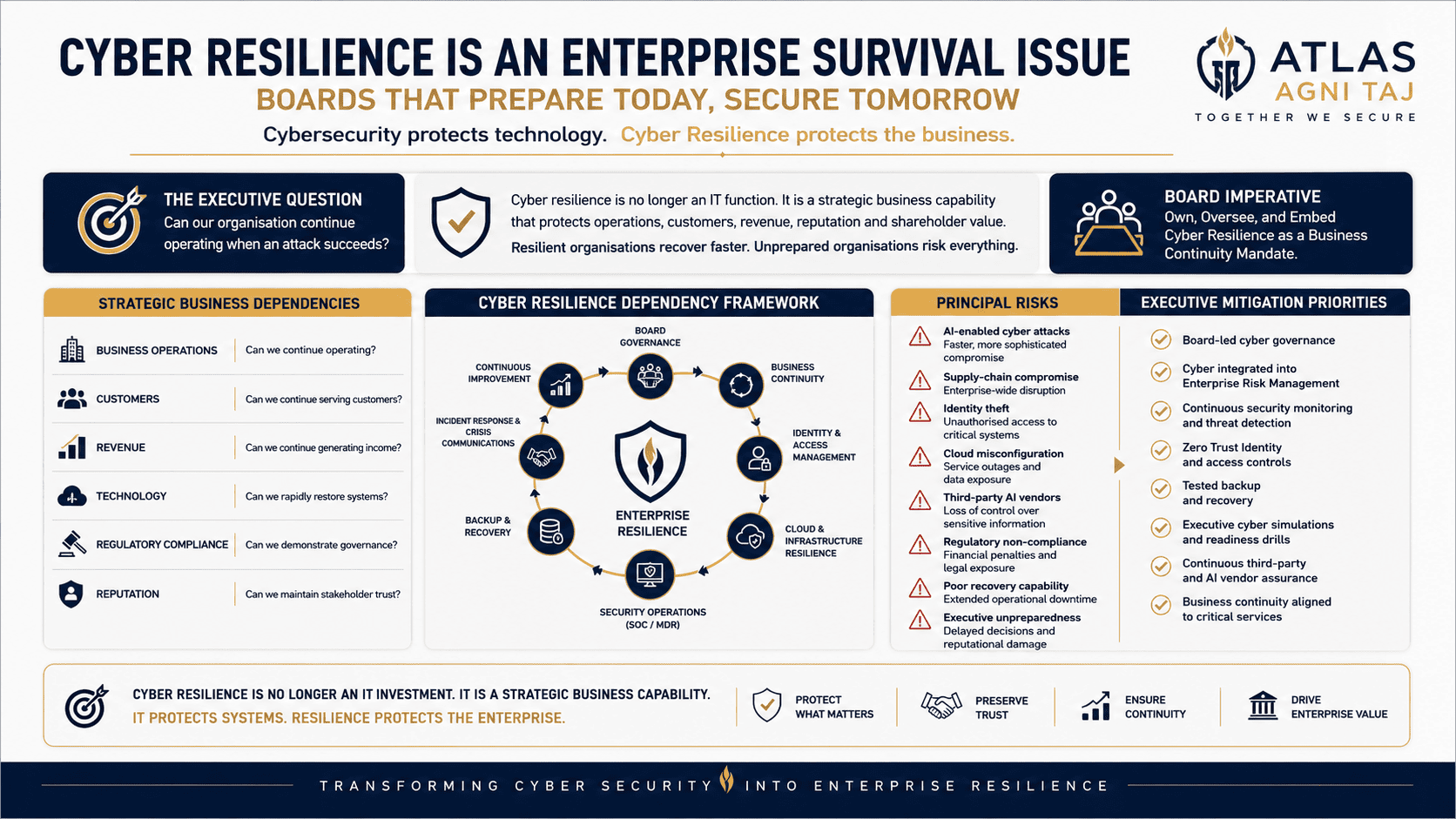
Cybersecurity is not principally about stopping attacks. It is about keeping the enterprise running when an attack succeeds. That distinction, subtle in language but enormous in consequence, is the one most boards in the GCC have yet to internalise.
For years, cybersecurity has been framed, funded and governed as a technology discipline: a matter for the CISO, the infrastructure team and the annual audit cycle. That framing was always incomplete, but in 2026 it has become dangerous. Across the UAE and the wider GCC, where governments and enterprises alike are accelerating investment in artificial intelligence, sovereign cloud, open banking, smart infrastructure and connected supply chains, the attack surface has expanded faster than the governance models built to defend it. Cyber risk and resilience have moved from being a standing item on the CIO’s agenda to being one of the defining tests of enterprise survival. Boards that continue to delegate this entirely to a technology function are, in effect, delegating a decision about the company’s continued existence.
The uncomfortable truth is that sophistication of tooling has stopped being the differentiator between organisations that recover from a cyber incident and those that do not. What separates them is whether leadership can answer one brutal, unglamorous question with confidence: can we continue to operate when something goes wrong? Most organisations, if they are honest with themselves, cannot yet answer yes.
Part 1: Why Traditional Cyber Thinking Is No Longer Sufficient
The classical cybersecurity model was built on a simple, defensible premise: build strong perimeters, monitor the gates, detect intrusion, and respond. Firewalls, intrusion detection systems, vulnerability scanners, penetration testing and annual audits became the standard toolkit of the discipline. In a world of contained networks and predictable threat models, this approach was largely adequate. It is no longer the world in which enterprises operate.
None of these controls have become irrelevant. Firewalls, endpoint tools and independent audits remain essential components of any credible defensive posture. But they are no longer sufficient on their own, because the shape of enterprise risk has changed fundamentally. Six dimensions of that change deserve direct board attention:
- AI-era threats. Adversaries now deploy machine learning and automated reconnaissance to identify exploitable weaknesses at a pace that outstrips traditional patch cycles. Signature-based detection, the backbone of legacy security operations, is being outpaced by attackers who adapt faster than static rule sets can be updated.
- Supply-chain exposure. A single compromised vendor, contractor or software component can cascade across an entire ecosystem of partners and customers. Few enterprises can map their full chain of third-party dependencies, let alone monitor it continuously, which means the true perimeter of the organisation is far larger and far less visible than most risk registers assume.
- Identity as the new perimeter. In a cloud-first, hybrid and remote-work environment, the network boundary has effectively dissolved. Compromised credentials are now the most common entry point for attackers, and defending identity at scale demands a fundamentally different architecture than perimeter-based security ever required.
- Cloud complexity. Public and private cloud adoption introduces new and often poorly understood failure modes: misconfigurations, over-permissioned service accounts and inadequate visibility into cloud-native threats. These are operational and architectural problems, not simply technical ones, and they require sustained discipline rather than a one-off migration project.
- Third-party and platform dependency. As enterprises adopt SaaS platforms, API integrations and managed cloud services at pace, they inherit the security posture of vendors they cannot directly control. A breach at a vendor is, for all practical and reputational purposes, a breach of the enterprise itself.
- Regulatory and sovereignty pressure. Governments across the GCC are increasingly mandating data residency, local processing and sovereign cloud adoption. These requirements are entirely reasonable from a national policy perspective, but they impose technical and operational constraints that many legacy security architectures were never designed to accommodate.
The implication for leadership is stark. Organisations cannot audit, patch and monitor their way to genuine security. Modern cyber resilience demands a shift in how enterprises think about investment, governance and operating discipline: from a technology-led defensive posture to a business-aligned resilience strategy. For regulated entities, critical infrastructure operators and organisations with material digital dependency, this is no longer best practice. It is a baseline requirement of doing business responsibly.
Part 2: Cyber Resilience Is Business Resilience
The word ‘resilience’ signals a deliberate shift in perspective, and it is worth boards pausing on its precise meaning. Resilience is not the pursuit of preventing every attack; no organisation, however well resourced, can credibly make that promise. It is the discipline of designing organisations, processes and systems that can absorb a shock, adapt to it and recover from it without existential damage. A genuinely resilient organisation does not assume it will never be compromised. It assumes the opposite, and prepares accordingly: it detects compromise quickly, contains it decisively, recovers from it methodically, and learns from it honestly.
This is not, at its core, an operational matter that can be left to the security function. It is a governance issue that belongs squarely at board and executive level. Four questions should sit permanently on the board risk agenda, and the quality of the answers should directly inform investment priorities, risk appetite and strategic planning:
Can we operate during an attack?
If a critical system were compromised this afternoon, could the organisation continue to serve customers, meet regulatory obligations and protect revenue? For most organisations, an honest answer is no. Closing that gap is a matter of business continuity planning, deliberate redundancy and failover capability designed specifically with cyber incidents, rather than natural disasters or infrastructure failure, in mind. This is a business architecture problem before it is a technology problem, and it deserves to be treated as one.
Can we recover?
Recovery from a significant cyber incident is not principally a technology exercise. It requires tested, documented and rehearsed procedures for data restoration, system rebuild, supply chain coordination and customer communication. Organisations that have not invested in backup architecture, tested restoration procedures and clear recovery governance typically face recovery timelines measured in weeks or months, not the hours or days their customers and regulators will expect. Recovery investment is, in the fullest sense, cyber investment.
Can we evidence our controls?
In a regulated environment, or in the aftermath of a serious incident, the organisation will be required to demonstrate that appropriate controls were in place, that they were operating as intended, and that there were no material gaps. This requires logging, monitoring and audit trails that are themselves protected and immutable. Many organisations maintain logs on systems that attackers can reach and tamper with, and that are only reviewed after the fact. Evidencing control requires a deliberate architecture that assumes an adversary will actively try to destroy or falsify the evidence of what happened.
Can we protect the confidence of customers and regulators?
A cyber incident is, above all, a confidence event. Customers, partners and regulators will assess whether the organisation handled the incident transparently, understood it fully, and implemented meaningful controls to prevent recurrence. Organisations that can answer credibly recover faster and sustain materially less reputational and competitive damage than those that cannot. This requires incident response planning, forensic capability, crisis communication discipline and structured engagement with regulators and partners, all of which are governance and leadership responsibilities rather than purely technical ones.
Taken together, these four questions describe a model of cyber resilience that is genuinely aligned with business objectives. They cannot be delegated wholesale to the security team. They require sustained engagement from the board, the CFO, the COO, General Counsel and business unit leaders, working from a shared understanding that cyber resilience, properly understood, is simply enterprise resilience by another name.
Part 3: Security Operations as a Resilience Asset, Not a Cost Centre
If cyber resilience is the objective, effective security operations are the foundation on which it is built. A properly designed and operated Security Operations Centre, whether built in-house, outsourced, or run as a hybrid, is not a cost centre to be minimised. It is a resilience asset. Its purpose is not to prevent every attack, an impossible standard, but to detect attacks quickly, understand them thoroughly, contain them rapidly and provide the forensic clarity that informs both immediate response and long-term hardening.
Effective security operations depend on several components working together, rather than in isolation:
- Integration. A security function that operates in silos, with separate tools, teams and processes for network, endpoint, cloud, identity and application security, will inevitably be slow and ineffective. Modern operations bring data from multiple security tools into a single, searchable, correlated view, typically anchored on a Security Information and Event Management platform or an equivalent central repository.
- Automation. The volume of security events in a modern enterprise now exceeds the capacity of human analysts to review manually. Security Orchestration, Automation and Response platforms allow teams to define playbooks, pre-agreed responses to known threat patterns, that execute automatically and dramatically reduce the time between detection and response.
- Response playbooks. Before an incident occurs, the security function should already have documented and tested procedures for each major threat category. A ransomware event requires a different response than an insider threat, which in turn differs from a supply-chain compromise. Playbooks ensure consistency, reduce dwell time, and enable less experienced analysts to act effectively under pressure.
- Threat intelligence. Security operations without threat intelligence are akin to a specialist reading a scan without understanding the underlying pathology. Understanding adversary tactics, tracking known malware and infrastructure, and following the geopolitical and sector-specific threat landscape enables analysts to interpret events in context and recognise subtle indicators of compromise before they escalate.
- Continuous monitoring. The traditional model of annual audits and quarterly vulnerability scans is inadequate for the pace of modern threats. Resilience requires genuine twenty-four-hour visibility into network traffic, endpoint behaviour, cloud access, identity activity and application behaviour. Every monitoring gap is, in practice, an invitation to an attacker.
Building and sustaining this capability in-house is resource-intensive, and many organisations, particularly mid-market enterprises without significant dedicated security headcount, do not have the budget, talent or bandwidth to do so credibly. This has driven the growth of managed security service providers and managed detection and response models. What matters to the board is not whether the capability sits in-house or is outsourced. What matters is whether it is genuinely effective, properly integrated, and aligned with the organisation’s specific risk tolerance and business priorities.
Part 4: Third-Party and AI Vendor Risk — The Hidden Vulnerability
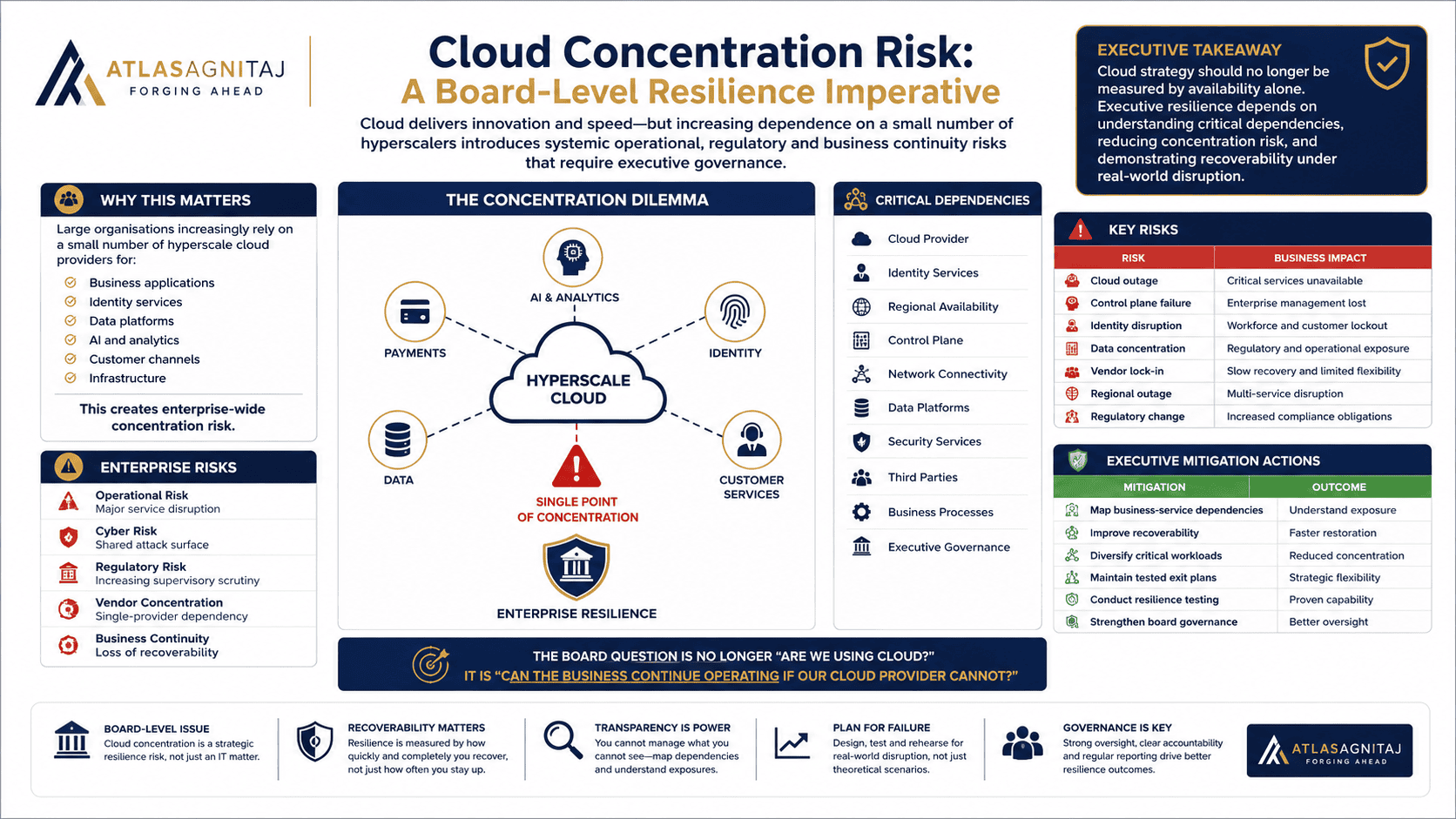
One of the most underestimated sources of cyber risk in the Middle East today is exposure through third-party vendors, and increasingly through third-party AI vendors. As enterprises adopt generative AI, large language models and other AI-driven solutions at pace, they are simultaneously bringing new vendors, and new categories of risk, into environments that were not designed to accommodate them.
Enterprises across the region are rightly concerned about how third-party AI vendors handle sensitive data. That concern is legitimate, yet in practice the contracts, technical controls and operational procedures that most organisations have in place to manage vendor risk remain insufficient. The most common gaps are worth naming explicitly, because each is addressable:
- No kill switch. If a vendor relationship deteriorates, or if a vendor is itself compromised, many enterprises have limited practical ability to terminate access, retrieve their data and isolate affected systems quickly. This asymmetry gives vendors disproportionate leverage and leaves the enterprise exposed at precisely the moment speed matters most.
- No joint incident playbooks. When a vendor is breached, the enterprise frequently does not know what the vendor intends to do, and the vendor does not know what the enterprise expects of it. This ambiguity creates confusion and delay at exactly the moment a coordinated response is required. Pre-agreed, tested joint procedures close this gap before it is tested under pressure.
- Limited continuous monitoring. Many enterprises assume a vendor is secure because it has passed a point-in-time compliance assessment or security audit. In reality, such assessments are a snapshot, not a guarantee. Continuous monitoring of vendor security posture, data handling practices and access controls is essential to keep pace with a vendor’s own evolving risk profile.
- Data residency ambiguity. For AI vendors in particular, it is not always clear where data is processed, stored or used. In a GCC context, where data residency and sovereignty requirements are increasingly mandated by regulators, this ambiguity creates both compliance exposure and operational risk that boards should not tolerate as an open question.
- Unclear training data usage. Enterprises frequently do not know whether their proprietary data is being used to train a vendor’s models, to improve competing products, or to optimise systems that will ultimately be sold to their own competitors. Contracts that explicitly govern data usage rights and guarantee data isolation are no longer optional clauses; they are a commercial necessity.
Managing third-party and AI vendor risk credibly requires a layered strategy rather than a single control. Contracts must be precise and must directly address data handling, access control, incident notification, audit rights and termination procedures. Due diligence must be rigorous and continuous, not a box ticked once at onboarding. Technical controls, including encryption, key management, network segmentation and access logging, must ensure that sensitive data remains protected even where a vendor is compromised. And governance must ensure that vendor relationships are actively managed, monitored and reviewed on a cadence aligned to each vendor’s criticality to the enterprise, not simply to the calendar.
Part 5: What Senior Leaders Should Do in the Next Ninety Days
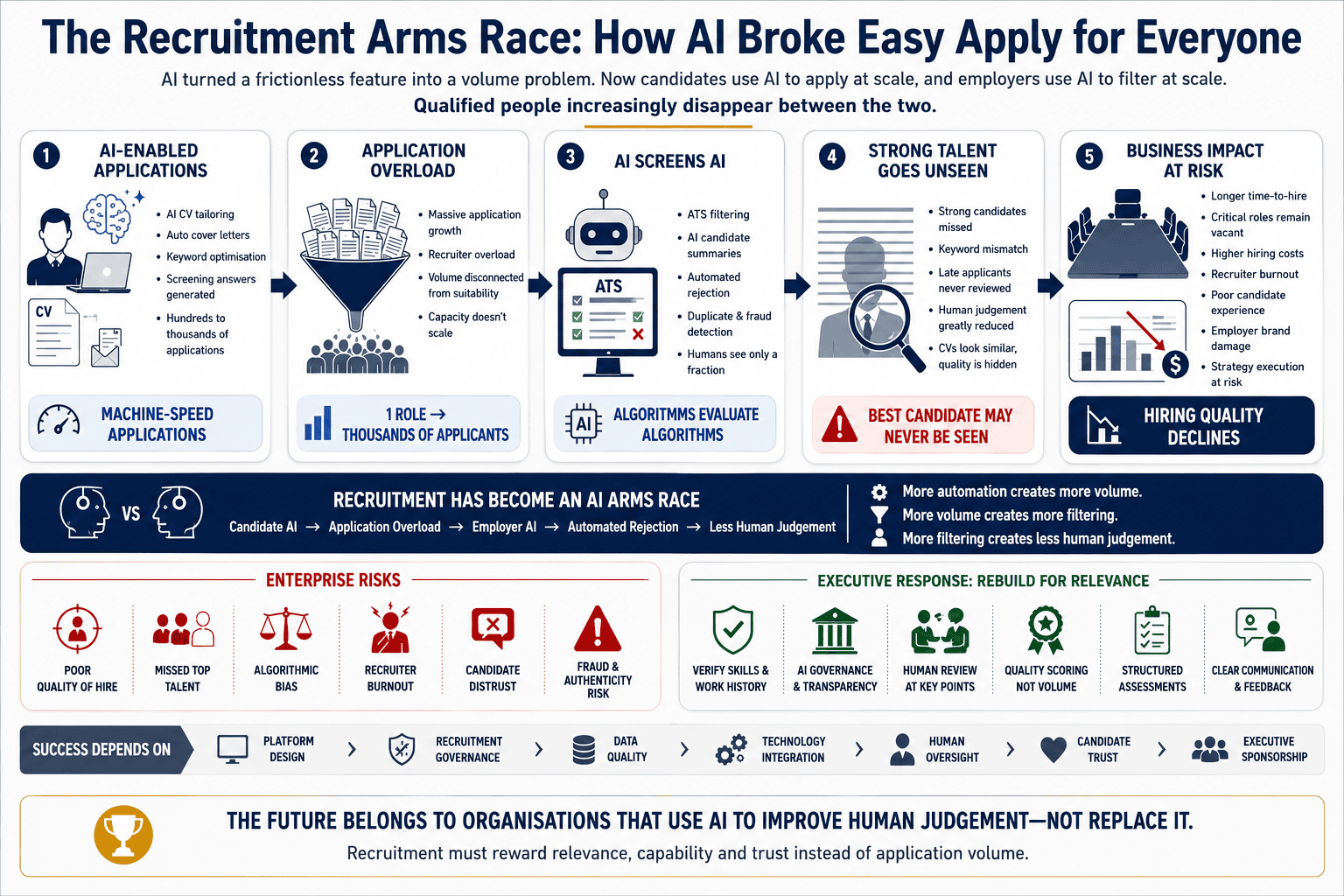
Cyber resilience is not achieved through a single initiative, a single budget cycle, or a single vendor relationship. It is achieved through sustained, aligned leadership focus across the board, the executive committee and business unit leadership. For senior leaders, including board members, chief executives, chief financial officers, chief operating officers and chief information officers, the following actions deserve to be underway within the next ninety days:
- Link cyber investment to business services, not IT budget lines. Stop treating cybersecurity as a separate, discretionary line item. Instead, map cyber investment to the enterprise’s most critical business services and ask, service by service, what would happen to revenue, customers and reputation if each were compromised. Allocate investment proportionally to what is actually at stake, so that resources follow risk rather than habit.
- Run realistic tabletop simulations. Before a major incident occurs, conduct exercises that simulate a genuine cyberattack, involving the board, the executive team and key business leaders directly, not only the security function. These exercises should be realistic, appropriately pressurised, and explicitly designed to expose gaps in incident response planning and executive decision-making. Two per year is a reasonable minimum cadence for most regulated or digitally dependent organisations.
- Strengthen identity management as a foundation, not an afterthought. Robust identity controls are now foundational to any credible security posture. This means multi-factor authentication for all users without exception, privileged access management for sensitive roles, and continuous monitoring of identity activity. Where these controls are not yet in place, they should be treated as an immediate priority rather than a future roadmap item.
- Test recovery procedures on a genuine schedule. Backup and recovery capability is not a one-off project to be signed off and forgotten. It should be tested at least quarterly, including the restoration of critical databases, systems and services under realistic conditions. Measure recovery time and recovery point objectives honestly, identify the gaps that testing reveals, close them, and document the results for the board.
- Monitor vendors continuously, with named accountability. Assign clear, named accountability for vendor risk management rather than leaving it diffuse across procurement and IT. Establish a structured vendor risk assessment process, reassess critical vendors at least annually, and maintain a live inventory of exactly which vendors hold access to which data and services.
- Integrate cyber risk fully into enterprise risk management. Cyber risk is not a category separate from operational, financial or reputational risk; it is frequently the mechanism through which those other risks materialise. Ensure that cyber risk is assessed and reported to the board as a core component of enterprise risk management, and that cyber leadership participates directly in enterprise risk discussions rather than reporting into them at a remove.
How Atlas Agni Taj Can Help
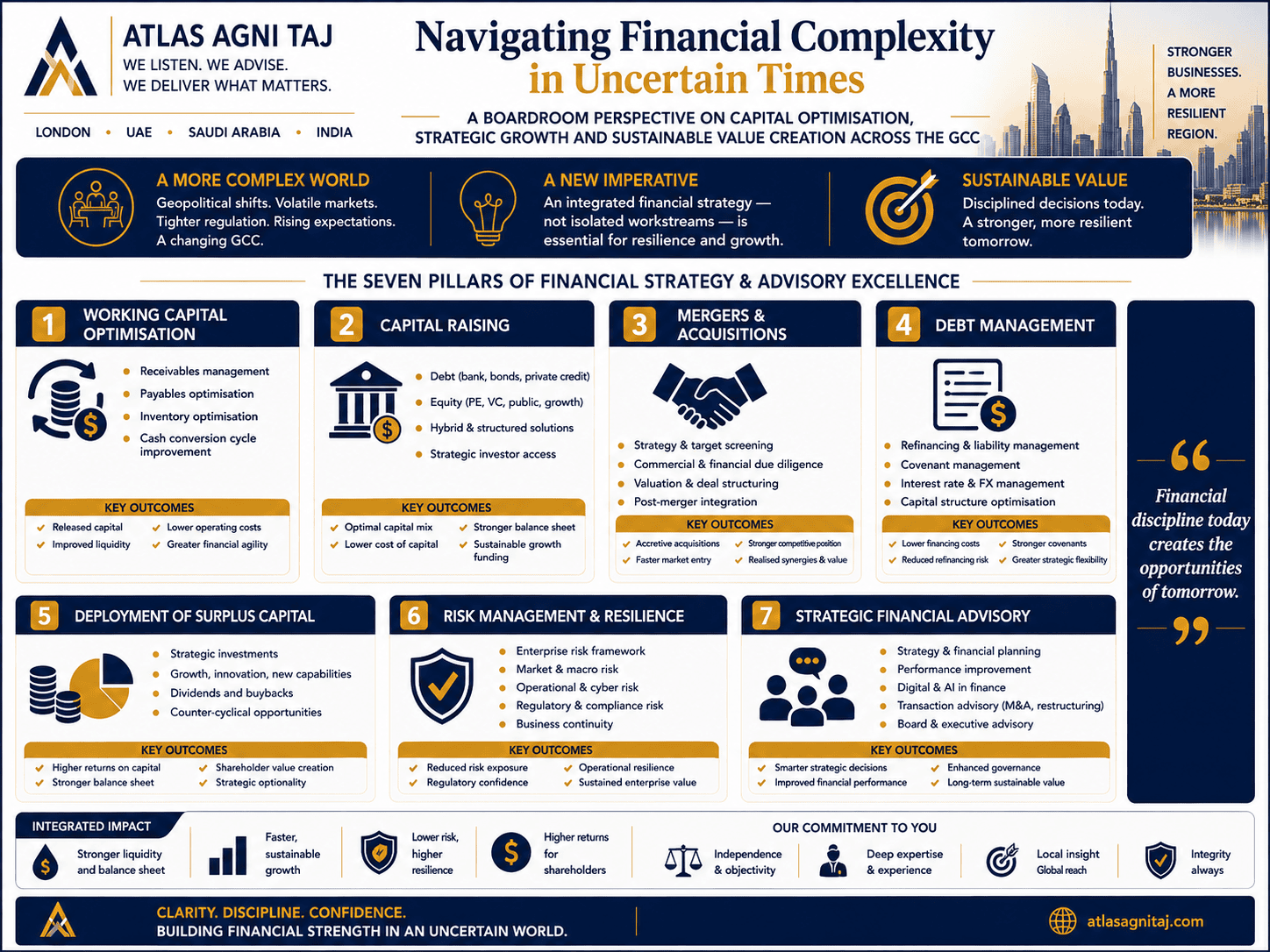
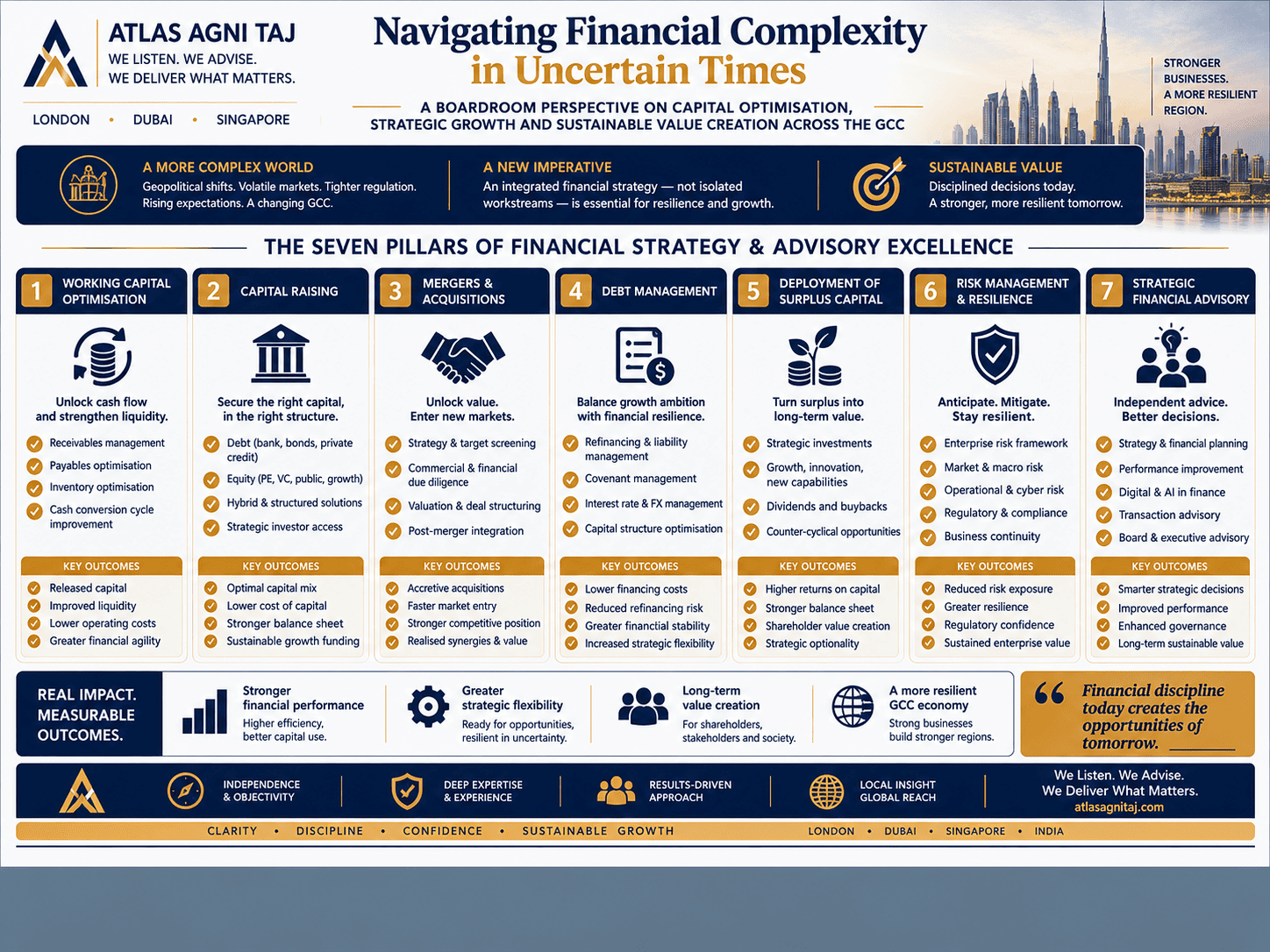
Atlas Agni Taj works with boards and executive teams across the UAE and the wider GCC to translate cyber resilience from a technology aspiration into a governed, funded and rehearsed business capability. Our engagement model is deliberately practical, drawing on decades of large-scale enterprise transformation, programme governance and regulated infrastructure delivery across sovereign, financial services and critical national infrastructure environments.
We support senior leaders in four principal ways:
- Board-level resilience diagnostics. We work directly with boards and executive committees to answer the four resilience questions honestly, mapping current capability for operating through, recovering from and evidencing control over a cyber incident, and identifying the specific investment and governance gaps that matter most to the organisation’s own risk profile.
- Business continuity and recovery architecture. We help design and stress-test the failover, backup and recovery architecture that determines whether a serious incident becomes a manageable disruption or an existential event, including establishing realistic recovery time and recovery point objectives tied to actual business services.
- Third-party and AI vendor governance. We build the contractual frameworks, continuous monitoring processes and joint incident playbooks required to manage vendor and AI supply-chain risk credibly, including data residency, training data usage and termination rights specific to the GCC regulatory context.
- Tabletop exercises and board simulation. We design and facilitate realistic, executive-level cyber incident simulations that expose genuine gaps in decision-making, escalation and crisis communication, and translate the lessons directly into governance and investment recommendations.
For organisations preparing for regulatory scrutiny, sovereign cloud transition, AI adoption at scale, or simply seeking an honest external view of their true resilience posture, Atlas Agni Taj offers an independent, senior-level perspective grounded in operational delivery rather than theoretical frameworks. To discuss how this applies to your organisation, connect directly or visit atlasagnitaj.com.
Conclusion: Cyber Resilience as a Competitive Advantage
In 2026, cyber resilience is no longer a competitive disadvantage to be managed defensively. It is fast becoming a competitive advantage in its own right. Customers, regulators and partners increasingly treat resilience as part of routine due diligence, assessing not only whether an organisation has been breached, but how it behaved when it was. Organisations that have genuinely invested in resilience recover quickly, communicate credibly, and convert that credibility directly into trust and commercial advantage.
Conversely, organisations that continue to treat cyber as a technology problem, that under-invest in resilience, and that wait for a major incident to force change, are increasingly exposed, not only technically but commercially and reputationally. The cost of recovering from a significant cyber incident, measured in lost revenue, reputational damage, regulatory penalty and remediation expense, vastly exceeds the cost of building resilience in advance. This is not, at its core, a technology argument. It is a business argument, and it belongs at board level.
For senior leaders across the GCC and the UAE, the question is no longer whether cyber resilience matters. It self-evidently does. The real question is whether leadership has the discipline to treat it as a genuine business imperative, and the sustained governance and investment required to make that resilience real rather than aspirational. The organisations that answer that question with conviction today will be the ones still standing after the incidents that are, for every enterprise, now simply a matter of time.
#CyberResilience #EnterpriseRisk #BoardGovernance #DigitalTransformation #GCCLeadership