AI-Native Government Needs Programme Discipline, Not Just AI Ambition
Abu Dhabi’s Government Digital Strategy 2025–2027 sets an ambitious course: full process digitisation, one hundred per cent sovereign cloud adoption, over two hundred artificial intelligence solutions in production, and a unified enterprise resource planning platform spanning government entities. Taken together, these commitments describe something more far-reaching than a technology upgrade. They describe the deliberate construction of an AI-native government — one in which artificial intelligence is not an add-on to public service delivery, but a structural feature of how that delivery operates.
This is a significant moment for the region, and for the technology leaders who will be judged on how well it is executed. Yet as the ambition accelerates, a familiar risk re-emerges: the gap between strategic intent and delivery capability. Governments and large enterprises across the UAE and the wider Gulf Cooperation Council are not short of vision. What determines whether that vision becomes reliable public value is programme discipline — the unglamorous, structural work of architecture, governance, data integrity, cyber resilience, vendor coordination and change adoption that sits beneath every successful transformation.
From Digital Government to AI-Native Government
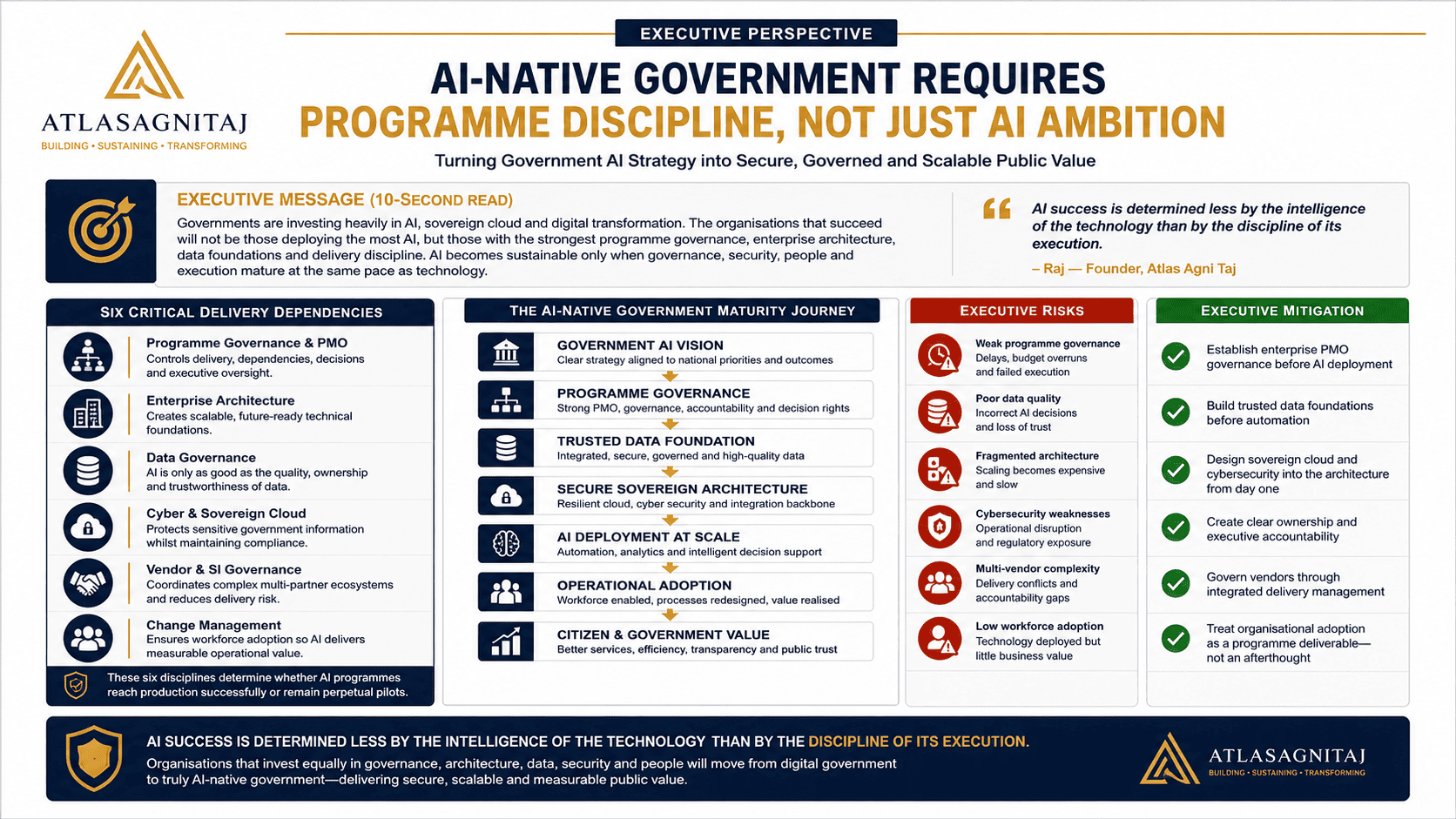
The shift underway is best understood as a maturity journey rather than a single leap. Most public and private sector organisations in the region have already achieved a reasonable level of digital service delivery: transactions can be initiated online, forms have been digitised, and citizen-facing portals have replaced much of the paper-based bureaucracy of a decade ago. This is a solid foundation, but it is only the first step.
The subsequent stages are considerably harder, and considerably more consequential. Integrated data — the ability to trust and share information consistently across departments and systems — is where many transformation programmes begin to falter, because it exposes years of fragmented systems, inconsistent taxonomies and siloed ownership. Sovereign cloud adoption then provides the secure, compliant infrastructure on which sensitive government and regulated-sector workloads can run at scale. Still, it requires careful architectural planning, not simply a lift-and-shift migration. AI-enabled operations follow, where automation and intelligent decision support begin to touch live processes — payments, permits, case management, citizen enquiries — with all the operational risk that entails. The final stage, AI-native government, is reached only when artificial intelligence is embedded so thoroughly into service design, workforce practice and decision-making that it becomes indistinguishable from the way the organisation works.
Underpinning every stage of this maturity curve is a governance layer that too often receives insufficient attention relative to the technology itself: programme management office discipline, cyber resilience, data governance, structured change adoption, vendor control and benefits realisation. Organisations that treat this layer as optional, or as something to be retrofitted once the technology has been deployed, consistently experience slower adoption, higher risk exposure and disappointing return on investment. Organisations that build this layer deliberately, from the outset, are the ones that convert ambition into sustained public and commercial value.
The Real Challenge Is Not Choosing the Technology
For technology leaders across government entities, regulated industries and large enterprises, the temptation is to frame AI transformation as a question of tool selection: which large language model, which automation platform, which analytics suite. In practice, this is rarely where the difficulty lies. The genuinely hard questions are structural, and they recur in almost every transformation programme I have been involved in over the course of a career spanning enterprise IT, ERP modernisation, cloud migration and sovereign infrastructure delivery across the UAE and internationally.
Can the organisation redesign its processes before it automates them, or is it simply encoding existing inefficiencies into faster, less visible form? Can data be trusted across departments, with consistent definitions, clear ownership and demonstrable quality, or does each new AI use case surface fresh evidence of fragmentation? Can the underlying cloud, cybersecurity, ERP and integration platforms genuinely support the pace of ambition, or are they being asked to bear a weight they were never architected to carry? Can governance structures — approval processes, risk frameworks, accountability lines — keep pace with the speed at which AI capability is being introduced? And can the workforce adopt new ways of working without creating operational risk in the process, particularly in service areas where errors have direct consequences for citizens or customers?
Technology transformation succeeds or struggles based on one factor above all others: whether leadership treats it as a programme of business change, not as an IT installation.
This distinction matters more than it may first appear. An IT installation is judged by whether the system goes live on schedule and within budget. A programme of business change is judged by whether the organisation’s people, processes and outcomes are genuinely different — and better — as a result. AI-native government, almost by definition, belongs firmly in the second category. It cannot be delivered through a procurement exercise and a go-live date alone.
What Programme Discipline Actually Requires
Programme discipline is not bureaucracy for its own sake. It is the set of structural mechanisms that allow ambitious technology change to be delivered safely, predictably and at scale. Six elements, in particular, distinguish transformation programmes that succeed from those that stall.
Architecture that anticipates scale
AI-native operations place new demands on enterprise architecture: real-time data pipelines, model governance, integration between legacy ERP estates and modern AI platforms, and infrastructure that can flex between sovereign cloud, hybrid and on-premises environments depending on data classification. Architecture decisions made in the early stages of a programme have consequences that surface years later, often at the point where the organisation is least able to unwind them.
A disciplined programme management office
A capable PMO does far more than track milestones on a Gantt chart. It provides the structure through which competing priorities are sequenced, interdependencies between workstreams are actively managed, risk is surfaced early rather than discovered late, and delivery remains visible and defensible to sponsors, boards and, in the government context, to citizens. In sovereign and regulated environments, this discipline is not optional; it is the mechanism by which public trust is maintained.
In practice, this means the PMO function for AI-native transformation looks somewhat different from the PMO function that governed earlier waves of digitisation. It must be capable of managing model performance and drift alongside traditional milestone tracking, of coordinating data science, engineering and business teams whose working rhythms rarely align naturally, and of translating technical risk into language that boards and government steering committees can act on decisively rather than defer.
Clear ownership and accountability
AI initiatives frequently span multiple departments, each with a legitimate but partial view of the outcome. Without a single accountable owner for end-to-end delivery, initiatives drift into a permanent pilot phase, generating enthusiasm without ever reaching the scale needed to produce measurable value.
Structured vendor and system integrator coordination
Large transformation programmes typically involve multiple technology vendors, consulting firms and system integrators working in parallel. Coordinating these relationships — aligning delivery timelines, managing commercial risk, ensuring knowledge transfer rather than dependency — is itself a specialist discipline, and one that is frequently underestimated at the point of contracting.
Cyber resilience embedded from the outset
As AI systems are granted access to sensitive citizen and enterprise data, and as decision-making authority is progressively delegated to automated systems, cybersecurity and data governance cease to be a downstream compliance checkpoint. They must be designed in from the architecture stage, with clear protocols for data classification, access control and incident response.
Change management that treats adoption as the deliverable
Technology that is deployed but not adopted by the workforce delivers no value, regardless of its technical sophistication. Structured change management — communication, training, incentive alignment, and honest engagement with the anxieties that AI-driven change understandably generates among staff — determines whether a capability is used, avoided or actively undermined.
This is particularly true in public sector contexts, where the workforce affected by AI-driven change often includes long-serving employees whose institutional knowledge and citizen-facing judgement cannot simply be replaced by automation, and whose genuine engagement is what ultimately determines whether a new operating model is trusted and sustained.
Each of these elements is, individually, well understood by experienced technology and transformation leaders. The difficulty lies in holding all six in balance simultaneously, under commercial pressure and political visibility. At the same time, the underlying technology itself continues to evolve at a pace that outstrips most organisations’ governance cycles.
What Happens When Discipline Is Absent
The consequences of pursuing AI ambition without programme discipline are rarely dramatic in the early stages, which is precisely what makes them dangerous. A proof of concept performs well in a controlled environment and is celebrated internally. A pilot is extended for a second and then a third quarter, without a clear decision gate for scaling or retiring it. A data quality issue, identified early but deprioritised in favour of visible progress, resurfaces months later as an operational incident affecting live citizen or customer transactions. None of these individually looks like failure. Collectively, they describe a transformation programme that has quietly lost its way.
I have observed this pattern recur across sectors and geographies over the course of a career spanning financial services, healthcare, aviation and government infrastructure delivery. The organisations that eventually recover tend to share a common response: they pause the proliferation of new use cases, invest in the governance layer that was under-built at the outset, and only then resume scaling. The organisations that do not recover tend to continue announcing new AI initiatives. At the same time, the underlying delivery capability erodes further, until a visible failure — a security incident, a service outage, a public complaint about an automated decision — forces the reckoning that disciplined governance would have prevented.
The lesson for government entities and regulated enterprises in the UAE and the wider GCC is not that ambition should be tempered. It is that ambition without a corresponding investment in delivery capability is not really ambition at all; it is exposure. The organisations that will lead this region’s transition to AI-native government are those willing to invest as visibly in governance, architecture and change adoption as they do in the AI capability itself, even when the former generates considerably less external attention than the latter.
The Regional Context Makes This More, Not Less, Urgent
There are features of the UAE and GCC context that make programme discipline more urgent than in many other markets, rather than less. The pace of public sector digital ambition in this region is genuinely exceptional by international standards, which means the gap between strategic intent and delivery capability, if left unmanaged, will open faster here than in more incrementally paced markets. Sovereign cloud requirements introduce architectural constraints — data residency, classification, cross-border restrictions — that must be reconciled with the technical realities of modern AI platforms, many of which were not originally designed with sovereignty in mind. A high concentration of large-scale, multi-vendor programmes running concurrently across government entities creates coordination complexity that a lighter-touch delivery model cannot absorb. And the reputational stakes attached to public sector transformation in this region are considerable: a citizen-facing service failure attracts scrutiny disproportionate to its technical scale, precisely because expectations of the region’s digital ambition are set so high.
None of this is a reason for caution to override ambition. It is a reason for governance, architecture and change management to be resourced with the same seriousness as the AI capability itself, from the earliest stage of programme design rather than as a retrofit once early momentum has been established.
Measured Not by Ambition, but by Outcomes
The next generation of digital transformation across the UAE and the GCC will not be judged by the number of AI use cases announced at conferences or captured in strategy documents. Announcements are inexpensive; sustained operational reliability is not. The genuine test is whether these use cases improve services in ways that citizens, employees and customers actually experience — reduced friction, faster resolution, more consistent outcomes, and demonstrable public or commercial value delivered safely and at scale.
For chief information officers, chief technology officers, chief digital officers and transformation leaders, this represents both a considerable opportunity and a considerable responsibility. The opportunity lies in the scale of investment and executive attention now directed toward AI-native transformation across government and regulated sectors in the region. The responsibility lies in ensuring that this attention translates into operational readiness rather than into a further round of pilots that never quite reach production.
AI transformation, in other words, is not solely a question of intelligence. It is a question of operational discipline. The organisations that internalise this distinction early — that invest as seriously in programme governance, data integrity and change adoption as they do in the underlying AI capability — will be the ones that move from digital government to genuinely AI-native government, and do so without the reputational, operational or security risks that accompany transformation pursued at speed without structure.
How Atlas Agni Taj Can Help
Atlas Agni Taj is a boutique transformation advisory firm, with offices in London, Dubai and Singapore, built specifically around the discipline this article describes. We work with government entities, regulated enterprises and private sector organisations across the UAE and GCC to convert AI and digital ambition into delivered, governed, adopted outcomes. Our advisory support typically spans:
- Programme and PMO design — establishing the governance architecture, milestone discipline and risk frameworks needed to deliver AI-native transformation at government and enterprise scale.
- Enterprise and cloud architecture advisory — designing sovereign cloud, ERP and integration architectures capable of supporting AI-enabled operations, not merely digital services.
- Data governance and readiness — assessing and structuring the data foundations that AI initiatives depend on, including ownership, quality and cross-departmental trust.
- Cyber resilience integration — embedding security and data governance into transformation programmes from inception, rather than as a downstream compliance exercise.
- Vendor and system integrator coordination — structuring and managing multi-vendor delivery ecosystems to reduce commercial risk and dependency.
- Change management and adoption strategy — ensuring workforce readiness, communication and capability building are treated as core deliverables, not afterthoughts.
- Benefits realisation and outcome measurement — defining and tracking the measurable public and commercial value transformation programmes are intended to deliver.
Drawing on close to four decades of enterprise technology and transformation leadership across financial services, healthcare, aviation, government and sovereign infrastructure programmes — including large-scale data platforms, ERP modernisation and cloud transformation delivered in the UAE — Atlas Agni Taj partners with leadership teams who are ready to move beyond ambition and build the delivery discipline that AI-native transformation genuinely requires.
If your organisation is navigating this transition — from digital services toward AI-native operations — and would value an independent, delivery-focused perspective on programme structure, governance or readiness, we would welcome the conversation.
Where Leaders Should Start
For a CIO, CTO or transformation leader inheriting an AI-native mandate today, the temptation is to begin with technology selection: which platform, which model provider, which automation suite will demonstrate progress fastest. Experience across enterprise transformation, ERP modernisation and sovereign infrastructure programmes suggests a more durable starting point.
Begin with an honest audit of data trust across the departments or business units the AI strategy depends on, rather than assuming existing systems of record are fit for purpose. Establish the governance layer — PMO structure, ownership model, risk framework — before the first large-scale AI use case reaches production, not after early pilots have already created informal precedents that are difficult to unwind. Treat cybersecurity and data governance as design inputs to the architecture, not as a compliance sign-off applied at the end of the process. Build the change management plan alongside the technical delivery plan, with the same level of executive sponsorship and resourcing, rather than as a communications afterthought scheduled for the final weeks before go-live. And define, in measurable terms, what public or commercial value each initiative is expected to deliver before committing significant budget to scale it — so that success and failure can both be recognised honestly, and resources redirected accordingly.
None of these steps is technically complex. What they require is discipline, sequencing, and a leadership team willing to prioritise durable delivery capability over the short-term visibility of rapid AI announcements. That is, in the end, the defining characteristic of the organisations that will lead the region’s transition from digital government to genuinely AI-native government.
A Question Worth Asking Your Own Organisation
What is the single biggest execution risk your organisation faces in moving from digital services to AI-native operations? Is it data trust, architectural readiness, governance capacity, vendor coordination, or workforce adoption? The answer to that question, honestly assessed, is usually the most reliable indicator of where transformation investment should be directed next.
#AINativeGovernment #DigitalTransformation #CIOLeadership #UAE #GCC #AIGovernance #PMO #TechnologyLeadership