
Cloud-First, Future-Ready: A Roadmap for Success
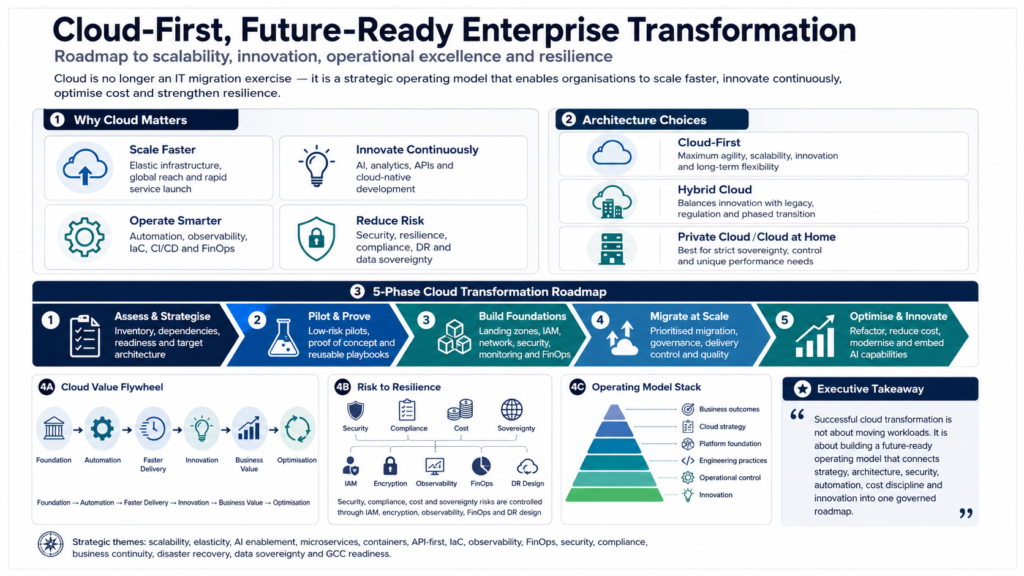
Why cloud adoption is key to scalability, innovation and operational excellence Introduction The digital landscape has fundamentally shifted. Organisations today face unprecedented pressure to innovate rapidly, scale efficiently, and remain resilient in the face of disruption. Cloud computing has emerged not merely as a technology choice, but as a strategic imperative that shapes how enterprises compete, operate, and evolve. For chief information officers (CIOs), chief technology officers (CTOs), and enterprise leaders, the question is no longer whether to adopt cloud technologies, but how to do so strategically. A cloud-first approach offers transformative potential—enabling organisations to respond to market changes faster, innovate at scale, and optimise operational costs. Yet this transformation is not a single-step migration; it requires a carefully orchestrated strategy that balances innovation with risk management, agility with governance, and transformation with stability. This article examines the strategic rationale for cloud adoption, explores multiple architectural approaches (cloud-first, hybrid, and on-premises), and provides a roadmap to achieve scalability, innovation, and operational excellence while managing inherent risks and ensuring organisational resilience. 1. The Business Case for Cloud: Strategic Imperatives Scalability and Elasticity Cloud platforms fundamentally redefine how organisations think about infrastructure. Traditional on-premises environments require capital-intensive investments in physical hardware, with capacity planning cycles that extend months into the future. Cloud architectures eliminate this constraint. Resources scale automatically based on demand, whether responding to seasonal traffic spikes, sudden user growth, or real-time workload fluctuations. For enterprises operating in the GCC region—where digital transformation initiatives frequently target rapid user acquisition, real-time transactions, and global service delivery—this elasticity translates to tangible competitive advantage. An organisation can launch new services, expand into new markets, or accommodate rapid scaling without the procurement delays and capital expenditure that constrain on-premises alternatives. Innovation Acceleration Cloud platforms democratize access to advanced technologies. Machine learning, artificial intelligence, data analytics, Internet of Things (IoT), and advanced security services—capabilities historically available only to technology leaders with substantial R&D budgets—are now accessible to organisations of any size via cloud services. This accessibility accelerates time-to-market for new capabilities. Development teams can experiment with emerging technologies, validate business hypotheses at low cost, and rapidly scale successful initiatives. Cloud-native development patterns—microservices, containerization, serverless computing—enable organisations to build modular, independently deployable applications that evolve more rapidly than monolithic architectures. The result is an organisation that innovates continuously rather than in quarterly or annual releases. Operational Excellence and Cost Optimisation Cloud infrastructure eliminates capital expenditure for hardware, facilities, and associated operational overhead. Organisations shift from paying for peak capacity (which sits idle during off-peak periods) to paying for actual consumption. This consumption-based model, when combined with cloud-native architectural patterns, substantially reduces the total cost of ownership. Beyond cost, cloud platforms provide comprehensive operational visibility. Native monitoring, logging, and analytics capabilities enable teams to understand system behaviour in detail, identify bottlenecks, and continuously optimise performance. Automated deployment pipelines, infrastructure-as-code, and policy-driven governance reduce manual operational effort and human error. In the GCC context, where labour costs are high and specialised technical talent is relatively scarce, the operational leverage provided by cloud platforms is particularly valuable. Organisations can accomplish more with smaller operational teams, freeing resources for strategic initiatives rather than routine infrastructure management. 2. Architectural Strategy: Cloud-First, Hybrid, and On-Premises Cloud adoption is not monolithic. Organisations must choose from distinct architectural approaches, each with specific advantages, constraints, and strategic implications. These decisions fundamentally shape technology roadmaps, operational models, and organisational capabilities for years to come. Cloud-First Architecture A cloud-first approach makes cloud the default platform for new applications, data, and infrastructure. Legacy systems migrate to the cloud when feasible; new capabilities are born in cloud environments. This strategy maximises the benefits outlined above: scalability, innovation velocity, and operational efficiency. Cloud-first is optimal when the organisation has the technical maturity to embrace cloud-native development practices, when regulatory constraints permit data residency in public clouds, and when the IT team has the capacity to modernise legacy systems. Technology leaders increasingly adopt this strategy because it provides the greatest long-term flexibility and competitive advantage. Hybrid Cloud Architecture Hybrid cloud environments span both cloud and on-premises infrastructure, with integrated operations, shared data, and coordinated workload deployment. This approach balances innovation with prudence, allowing organisations to move forward while maintaining investments in existing infrastructure. Hybrid architectures are strategically valuable in several contexts. Regulatory requirements may mandate data residency; hybrid allows organisations to maintain sensitive data on-premises while leveraging the cloud for non-sensitive workloads. Legacy applications with complex interdependencies may be impractical to migrate immediately; a hybrid approach allows them to coexist with cloud-native applications. Performance-sensitive workloads may benefit from proximity to on-premises infrastructure while other components operate in the cloud. However, hybrid architectures introduce operational complexity. Managing consistent security policies, data governance, and monitoring across disparate environments requires sophisticated tooling and organisational discipline. The long-term strategic trajectory should be toward either a committed cloud-first or a committed on-premises approach; sustained hybrid approaches often represent transitional states rather than stable end-states. On-Premises (Cloud at Home) Some organisations deploy cloud infrastructure technologies within their own data centres, leveraging containerization, Kubernetes, and cloud-native operational patterns without moving data beyond their physical control. This approach—sometimes called “cloud at home” or private cloud—offers cloud-like operational benefits while maintaining complete data sovereignty and control. This strategy appeals to organisations with stringent data sovereignty requirements, those operating in heavily regulated industries, or those with unique performance requirements. However, it requires significant investment in infrastructure expertise and does not provide the elasticity or cost advantages of public cloud. Organisations pursuing this path must have the technical depth to manage cloud infrastructure independently. 3. Enabling Scalability Through Cloud Architecture Scalability requires more than simply deploying to cloud infrastructure; it demands architectural decisions that enable systems to grow without proportional increases in complexity, cost, or operational overhead. Microservices and Modular Design Cloud-native architectures decompose applications into small, independently deployable services. Each service owns a specific business capability, maintains its own data, and communicates with other services through well-defined interfaces. This modularity enables teams to scale individual services independently based on specific demand
Navigating Financial Complexity in Uncertain Times
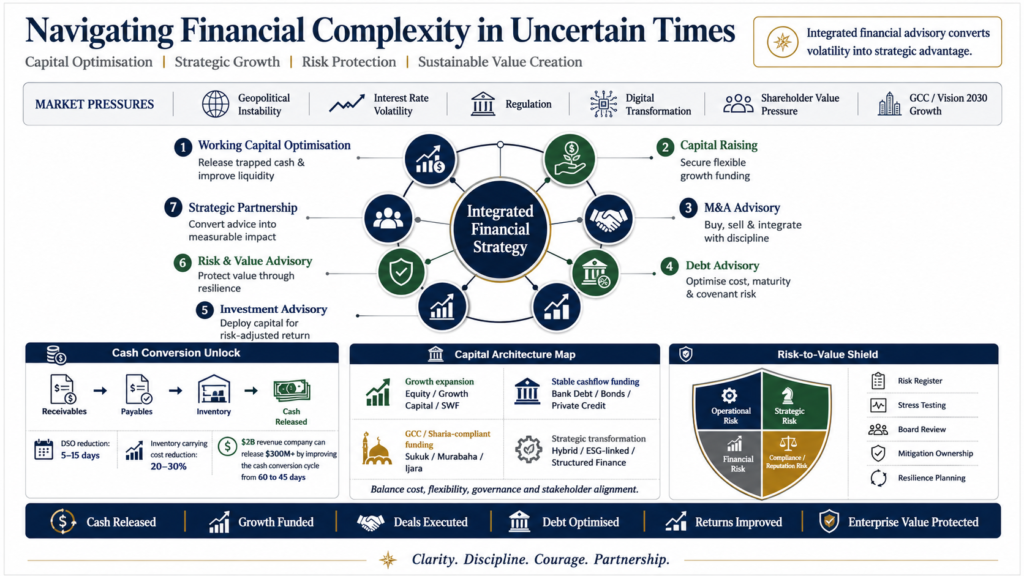
Comprehensive Strategies for Capital Optimisation, Strategic Growth, and Sustainable Value Creation Executive Overview The contemporary business landscape presents unprecedented challenges and opportunities. Organisations worldwide face a complex constellation of pressures: geopolitical instability, volatile interest-rate environments, evolving regulatory frameworks, digital transformation imperatives, and the perpetual need to deliver shareholder value amid economic uncertainty. In the Middle East and the GCC region—a market characterised by rapid transformation, diversification away from hydrocarbon dependence, and aggressive Vision 2030 objectives—these pressures are amplified by distinctive market dynamics, competitive intensity, and the imperative to balance innovation with cultural and regulatory stewardship. Success in this environment demands more than operational efficiency or tactical cost management. It requires a comprehensive, integrated approach to financial strategy that simultaneously addresses multiple imperatives: optimising working capital and cash flow, securing appropriate capital structures for growth, identifying and executing high-value M&A opportunities, managing debt strategically, identifying investment opportunities, and protecting enterprise value against emerging risks. These challenges cannot be addressed in isolation. They demand cross-functional expertise, market intelligence, and strategic foresight applied with precision and urgency. This article examines seven interconnected pillars of financial strategy and advisory excellence, providing practical frameworks and actionable guidance for senior executives, boards, and financial leaders seeking to navigate uncertainty with confidence and clarity. 1. Working Capital Optimisation: Unlocking Cash Flow in Uncertain Times Working capital—the lifeblood of operational continuity—has become the silent hero of financial performance. In uncertain macroeconomic conditions, the ability to convert operational assets into cash, reduce financing costs, and maintain liquidity provides a competitive advantage far disproportionate to its often-overlooked status in strategic discussions. The Strategic Imperative Organisations typically lock 15–25% of annual revenues in working capital—cash that could fund growth initiatives, retire debt, finance R&D, or strengthen balance-sheet resilience. In high-growth or cyclical industries, this percentage can exceed 40%. Each day of excess working capital ties up cash, increases financing costs, and constrains strategic flexibility. Conversely, aggressive working capital optimisation can free up substantial capital without requiring external financing, capex reductions, or operational compromises. Practical Optimisation Strategies Effective working capital management addresses three interconnected dimensions: The cumulative impact is substantial. A manufacturing organisation with $2B in annual revenue and a 60-day cash conversion cycle can liberate $300M+ by optimising to a 45-day cycle—capital that requires no external financing, no capex reduction, and no operational compromise. 2. Capital Raising: Securing Growth Funding with Strategic Clarity Growth requires capital. Whether funding organic expansion, entering adjacent markets, building digital capabilities, or executing transformational change, organisations must secure funding efficiently and on terms aligned with strategic objectives. Capital-raising decisions have multiyear implications for shareholder value, leverage ratios, strategic flexibility, and governance dynamics. The Capital Architecture Decision Contemporary organisations enjoy unprecedented diversity in capital sources: traditional equity and bank debt, venture capital and growth equity, private credit and structured finance, sovereign wealth and family office capital, ESG-linked financing, and hybrid instruments that blend equity and debt characteristics. The optimal capital structure reflects the organisation’s risk profile, growth trajectory, existing liabilities, shareholder base, strategic objectives, and market conditions. Equity Capital Equity capital—whether through IPO, private placement, secondary offerings, or venture/growth investment—provides capital without mandatory debt service obligations. However, equity dilutes existing shareholders and introduces new stakeholders with governance implications. IPOs unlock liquidity, provide acquisition currency, and signal market validation. However, they demand sustained profitability, quarterly disclosure obligations, and responsiveness to public market sentiment. Private equity provides growth capital, operational expertise, and network access, but typically demands strong returns and defined exit timelines. Family offices and SWFs increasingly participate in growth equity, often providing patient capital aligned with long-term value creation. Debt Capital Debt capital—bank facilities, bonds, private credit, structured finance—provides capital with defined repayment obligations and interest costs. Well-structured debt enhances returns to equity (through leverage) when the cost of debt is lower than the return on incremental capital deployed. However, excessive leverage constrains strategic flexibility, increases financial risk, and can trigger covenant breaches during downturns. The optimal debt level reflects cash flow stability, asset collateral, leverage ratios relative to peers, and access to capital markets. In the GCC context, organisations benefit from significant capital availability through sovereign wealth funds, Islamic finance instruments (such as Sukuk, Murabaha, and Ijara structures), and regional investment banks, alongside global capital markets. Strategic capital raising integrates these diverse sources into a coherent structure, optimising cost, flexibility, and stakeholder alignment. 3. M&A Advisory: Buying, Selling, and Merging with Confidence Mergers, acquisitions, and combinations represent quantum shifts in strategic position. Done well, they accelerate growth, add capabilities, enter markets, acquire talent and technology, or achieve cost synergies. Done poorly, they destroy shareholder value, distract management, and create integration chaos. The difference typically lies not in deal enthusiasm but in disciplined preparation, rigorous evaluation, and realistic integration planning. Buy-Side Advisory Acquisition strategy should begin with crystal clarity regarding the strategic rationale: market expansion, adjacent capabilities, technology or talent acquisition, competitive consolidation, cost synergies, or portfolio optimisation? Acquisitions with vague rationale frequently underperform. Due diligence must extend beyond financial statements to encompass commercial dynamics, customer concentration and retention, technology architecture and technical debt, organisational culture and talent retention, competitive positioning, regulatory exposure, and integration complexity. Valuation discipline is essential. The temptation to overpay—whether due to competitive pressure, deal fatigue, or enthusiasm for a strategic rationale—frequently destroys acquisition value. Sophisticated buy-side teams model deal returns under multiple scenarios, establish walk-away prices, and maintain patience to pass on overpriced opportunities. Sell-Side Advisory Exit decisions—whether for maturing companies, portfolio rationalisation, or founder liquidity—demand clarity regarding valuation objectives, timeline flexibility, stakeholder alignment, and operational readiness. Sell-side advisors manage the process to maximise valuation while minimising business disruption. Market preparation—financial statement enhancement, operational documentation, management readiness—typically adds 15–25% valuation premium relative to unprepared processes. Multiple buyer conversations create competitive tension that drives price realisation. Structured data rooms, synchronised due diligence, and disciplined process management protect confidentiality while enabling buyer evaluation. Merger Integration Deal completion marks the beginning, not the end. Integration—capturing synergies, retaining talent, addressing cultural differences, rationalising systems, and maintaining operational continuity—determines value realisation. Best-practice integration approaches establish: clear
Business Model Innovation
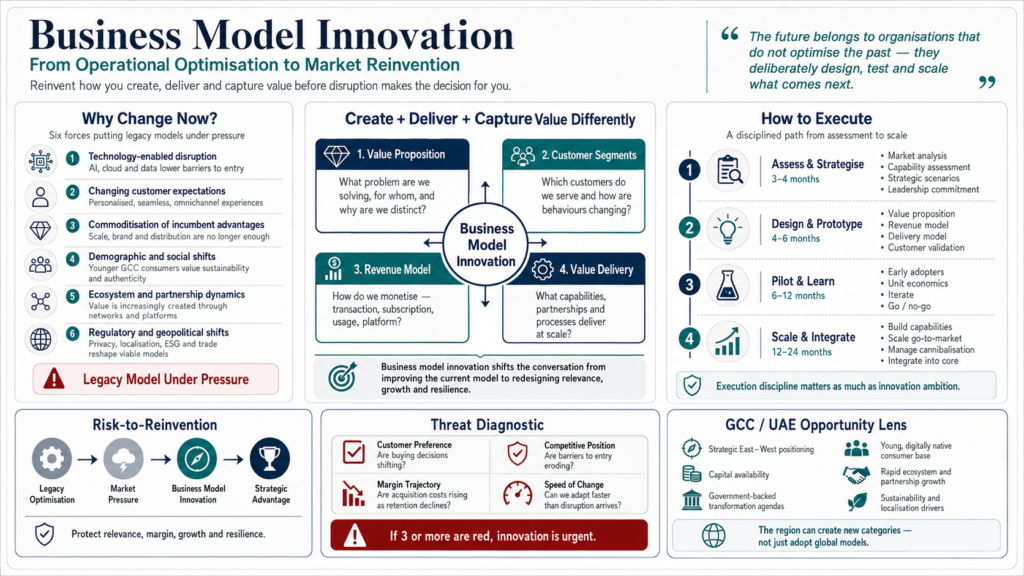
Adapting Your Business Model to Shifting Customer Needs and Market Realities A Comprehensive Guide for Enterprise Leaders Executive Summary Business model innovation has transitioned from a competitive advantage to an existential necessity. Organisations across every sector face unprecedented pressure to reimagine how they create, deliver, and capture value. The challenge is not incremental improvement—it is fundamental reinvention. Companies that merely optimise existing models while markets shift around them face obsolescence. This guide provides enterprise leaders with a structured framework for assessing, designing, and implementing business model innovation. It addresses the core drivers of change, the anatomy of successful transformations, implementation pitfalls, and practical guidance tailored to the unique dynamics of the UAE and GCC markets. The organisations that succeed will be those that view business model innovation not as a response to crisis but as an ongoing capability—embedded in strategy, governance, and organisational culture. Why Business Model Innovation Matters Now The business environment has entered a phase of structural volatility. Established competitive advantages erode faster than ever before. Industries that seemed stable a decade ago—retail, automotive, financial services, hospitality—now face existential threats from entrants operating under entirely different business models. The Difference Between Operational Excellence and Business Model Innovation This distinction is critical. Operational excellence focuses on doing the same thing better—improving margins, reducing defects, and accelerating delivery within an existing model. Business model innovation asks: Should we be doing this at all? Should we serve different customers? Should we create value differently? A company that optimises its manufacturing process but ignores shifts in consumer preferences will eventually become irrelevant. A competitor that understands the underlying customer need and redesigns how it meets that need will capture the market. The Acceleration of Disruption Technology adoption cycles have compressed dramatically. Cloud infrastructure, AI, mobile connectivity, and data analytics were considered cutting-edge advantages five years ago. Today, they are table stakes. The implications are profound: organisations must build innovation into their core operating model, not treat it as a periodic strategic exercise. The capability to sense emerging market shifts, rapidly prototype alternatives, and pivot the entire business must become as routine as quarterly planning. The Anatomy of Business Model Innovation A business model describes how an organisation creates, delivers, and captures value. It consists of four interdependent dimensions: Types of Business Model Innovation Business model innovations typically fall into several categories: Customer Segment Shift – Serving new customer groups with existing capabilities. Value Proposition Expansion – Broadening what you solve for customers. Revenue Model Transformation – Shifting from transaction-based to subscription, usage-based pricing, or freemium models. Value Delivery Reinvention – Fundamentally changing how value reaches customers. Platform and Ecosystem Models – Transitioning from vendor to orchestrator. Market Forces Driving Business Model Innovation Understanding what is forcing your business model to evolve is essential. Six structural forces are reshaping industries: 1. Technology-Enabled Disruption AI, cloud, and real-time data analytics have fundamentally lowered barriers to entry. For GCC organisations, this presents both risks and opportunities. Abundant capital and digital ambition in the region create conditions for the rapid scaling of new models. 2. Changing Consumer Expectations Customers increasingly expect personalisation, seamless omnichannel experiences, and value beyond the core product. Companies that fail to embed these in their core models lose market share to more adaptive competitors. 3. Commoditization of Incumbent Advantages Scale, brand, and distribution—once insurmountable moats—have become commodities. The advantage now belongs to companies that can innovate their business model faster than competitors can copy it. 4. Demographic and Social Shifts The GCC region is experiencing rapid demographic change: a younger population, increasing female workforce participation, and globalisation. Millennial and Gen Z consumers have fundamentally different values around sustainability and authenticity. 5. Ecosystem and Partnership Dynamics Success increasingly depends on orchestrating partner ecosystems. Organisations must innovate their business models to partner effectively and capture value from increasingly complex value chains. 6. Regulatory and Geopolitical Shifts Data privacy, environmental regulations, trade dynamics, and localisation requirements continuously reshape viable business models. GCC organisations must build adaptability into their models. Assessment Framework: Is Your Business Model Under Threat? Not every business requires radical model innovation. But leadership teams must honestly assess whether their current model will survive the next five years. Consider these diagnostic questions: If most questions yield concerning answers, business model innovation is urgent. You are in the window where you have capital and customer relationships to invest—but that window is closing. Critical Implementation Challenges Designing a new business model is tractable. Implementing it while maintaining an existing business that funds the organisation is exponentially harder. The Cannibalisation Paradox A new business model often cannibalises revenue from the existing business. The solution is to separate the new business unit operationally and financially, giving it distinct incentives, governance, and P&L accountability independent of the core business. Organizational Misalignment The capabilities required for a new business model often conflict with those embedded in the legacy organisation. A shift from transaction-based to subscription revenue requires different finance models and customer success infrastructure. Capital Allocation Discipline Business model innovation is inherently uncertain. Venture-style capital allocation is appropriate. Yet many large organisations apply traditional budgeting, requiring near-certainty of returns before funding. Talent and Skill Gaps Platform thinking, data analytics, agile product development, and ecosystem orchestration are not skills typically embedded in traditional organisations. Leadership must invest in recruiting or developing these capabilities. Speed and Scale Tension Early-stage models benefit from rapid iteration. But the business model must eventually scale, requiring process discipline and reproducibility. The transition from experimentation to scaling is where many initiatives falter. Strategic Guidance for GCC and UAE Market Leaders The GCC market presents distinct dynamics that shape business model innovation priorities: Leverage Strategic Positioning Regional companies operate at the nexus between East and West—between emerging markets and developed economies. This unique positioning creates opportunities for business model innovation that Western competitors cannot easily replicate. Ecosystem and Partnership Innovation The region is moving rapidly toward ecosystem-based business models. Success depends on partnerships with financial institutions, technology providers, and government entities. Domestic Versus Export Strategy Many