
The Future of UAE Family Businesses: Platform, Not Company
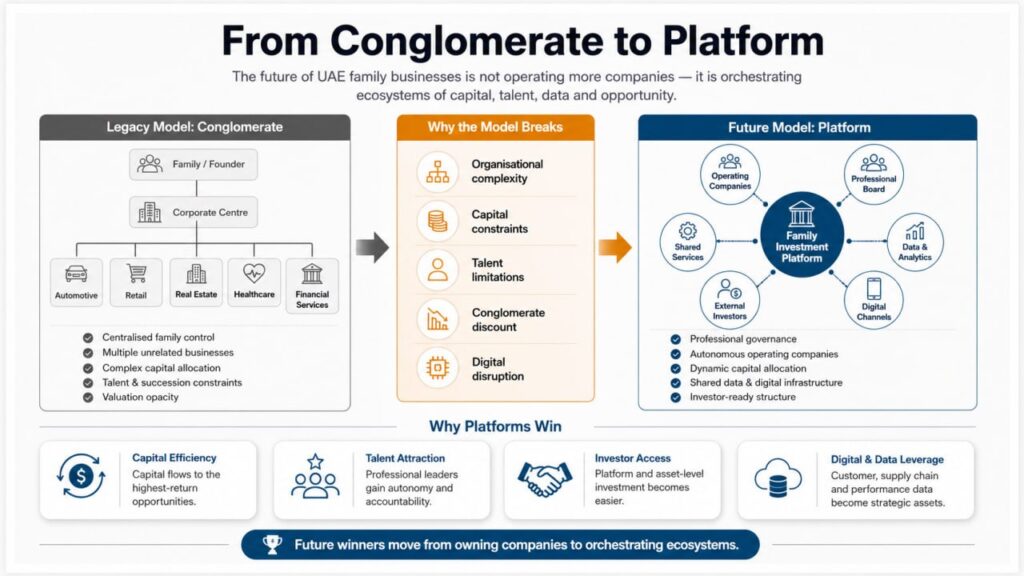
The Evolution Framework: From Conglomerate to Ecosystem The next generation of successful family businesses will not look like the family businesses that built Middle Eastern wealth over the past 50 years. They will not be organised as traditional companies—with a core business, some diversification, and a clear organisational hierarchy. They will be platforms—sophisticated ecosystems that orchestrate capital, talent, technology, and market access across multiple businesses, geographies, and sectors. This is not speculation. It is already happening. And understanding this evolution is critical for any family business seeking to remain relevant in the next decade. What the Current Model Looks Like To understand the future, let us first understand the present. The dominant family business model of the past 50 years has been the conglomerate structure. A founder builds a core business (trading, retail, distribution, manufacturing). As the business generates cash and the founder gains confidence, they diversify into adjacent or unrelated sectors. A typical family conglomerate might look like: Core Business: Automotive distribution (representing 40% of revenue)Related Diversifications: This structure worked extraordinarily well for decades. It provided: Yet this structure has constraints that are becoming increasingly visible: Organisational Complexity: Managing unrelated businesses requires different expertise. A retail leader does not necessarily understand healthcare operations. Managing all these businesses under a single corporate structure creates complexity and inefficiency. Capital Constraints: Capital deployed to one business line is unavailable for another. Optimal capital allocation across unrelated businesses is complex and imperfect. Talent Limitations: Attracting superior talent across multiple unrelated sectors is challenging. A talented healthcare executive may not want to work for an automotive distribution conglomerate. Valuation Opacity: Investors struggle to value conglomerates because they cannot readily identify which businesses generate value and which consume it. Conglomerate structures typically trade at a “conglomerate discount”—valued at less than the sum of their parts. Succession Complexity: When a founder steps back, managing multiple unrelated businesses becomes extraordinarily difficult for a single successor or set of successors. This conglomerate structure is about to give way to a different model: the platform. The Platform Model: Structure and Economics A platform, in the modern sense, is an ecosystem that creates value by connecting multiple parties (businesses, investors, service providers, customers) and enabling transactions and relationships between them. In the context of family businesses, a platform represents a shift from “the family owns multiple businesses” to “the family orchestrates an ecosystem of businesses.” The distinction is subtle but consequential. In a conglomerate model: In a platform model: This shift has several implications: Business Autonomy: Each business has a clear leader and operating model. The business is held accountable for performance. But the business operates within platform governance rather than being micromanaged centrally. Professional Management: Because businesses operate semi-autonomously, they can attract professional management talent. A talented operations executive can run a significant business within the platform without reporting through layers of family governance. Investor Engagement: A platform structure makes it easier for external investors to invest in specific businesses or in the platform itself. A PE firm might invest in a single platform business rather than acquiring the entire conglomerate. Capital Efficiency: Platform structures enable more dynamic capital allocation. Capital can be deployed toward the highest-return opportunities regardless of whether they fit the “core” business definition. Scalability: The platform structure scales more easily than conglomerate structures. As the family invests in new businesses, they add them to the platform rather than integrating them into a centralised structure. Specific Model Evolution: From Al-Futtaim to Future Platforms To make this abstract discussion concrete, consider the evolution of a group like Al-Futtaim. Current Model (Conglomerate): Evolution Toward Platform Model: This evolution enables: The Data and Analytics Layer: Core Platform Asset One critical difference between a traditional conglomerate and a modern platform is the role of data and analytics. A traditional conglomerate collects financial data (revenue, costs, profit) but may lack integrated visibility into operational data (customer behaviour, supply chain efficiency, operational quality). A modern platform goes further. It treats data as a core asset and creates visibility into: Customer Data: Who are the customers across all platform businesses? What are their purchase patterns? What additional services might they value? How can the platform cross-sell across businesses? Supply Chain Data: What are the procurement patterns across businesses? What consolidation opportunities exist? Where are inefficiencies? Operational Data: What are the key performance indicators across businesses? How do similar operations compare across different businesses? Where can best practices be shared? Financial Data: What is the true profitability of each business and each product line? How is capital deployed? Where are the highest returns? This data visibility enables: The companies that are most successful at this data integration are building a significant competitive advantage. Digital-First Operating Models: The Technology Transformation Another critical evolution in next-generation family businesses is the shift toward digital-first operating models. Traditional family businesses were built in a physical-first era. Retail meant physical stores. Distribution meant trucks and warehouses. Customer relationships meant in-person meetings. Next-generation platforms are built with digital-first approaches: Direct-to-Consumer Platforms: Rather than selling through traditional retail or distribution channels, businesses increasingly sell directly to consumers through digital platforms. This improves margins and provides direct customer data. Marketplace Models: Rather than owning inventory, some platforms are evolving toward marketplace models where they connect buyers and sellers and take a commission. This capital-lighter model is more scalable. Technology-Enabled Services: Many traditional services (retail, distribution, financial services) are being reimagined as technology-enabled services. A retailer becomes a mobile shopping app. A distributor becomes a supply chain logistics platform. Data-as-a-Service: Some platforms are discovering that the data they own (customer behaviour, supply chain patterns, market insights) can be monetised as a service. A distributor might sell supply chain visibility to suppliers. This digital transformation enables: The Investment Arm Model: Capital as the Platform The most sophisticated next-generation family businesses are evolving the investment arm as the core platform. Rather than being a back-office support function, the family office becomes the strategic centre of the platform. The investment arm: This investment-arm model has
The Silent Risk: What Happens When Nothing Changes
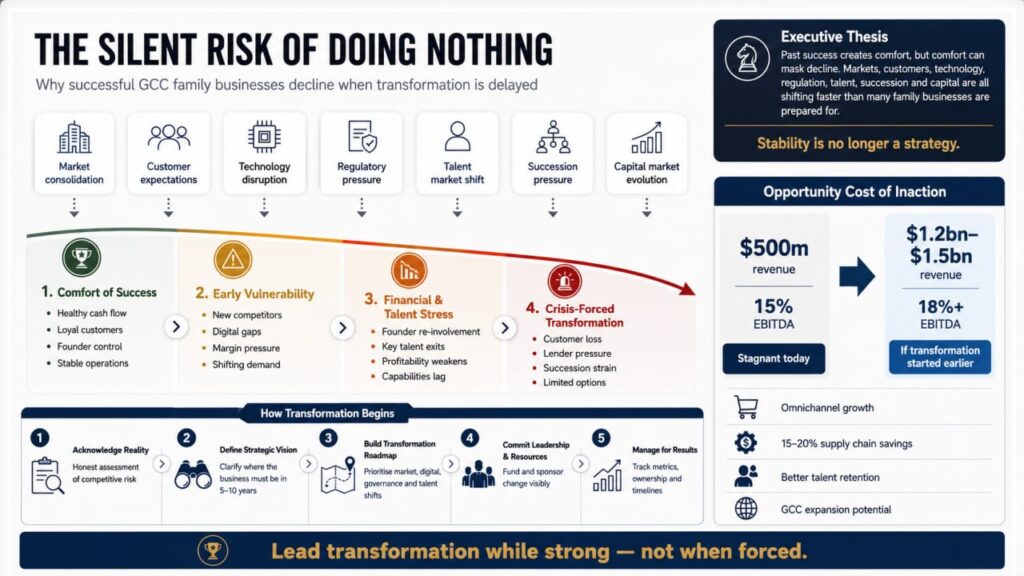
The Comfort of Success: A Dangerous Assumption There is a particular comfort that comes with running a successful business for decades. Markets have been kind. The founder has built something substantial. Cash flows are healthy. The customer base is loyal. Employees have been with the company for years. Suppliers know how to work with the business. The regulatory environment is stable. The business has succeeded by doing what it has always done. This success creates a particularly dangerous psychological dynamic: the assumption that continued success requires nothing more than maintaining current approaches. This assumption is understandable. It is also potentially catastrophic. Because the external environment in which family businesses operate is not static. Markets are changing. Competition is intensifying. Technology is disrupting traditional business models. Customer preferences are evolving. Regulatory frameworks are becoming more stringent. The labour market is shifting. Generational expectations are changing. Stability and unchanging operations, which were the source of past success, become the source of future decline. The Risk Landscape: What Changes and What It Means To understand the silent risk of inaction, we must examine the external environment changes that are transforming business conditions across the GCC: Market Consolidation and New Competition For decades, many family businesses operated in industries with a stable, predictable competitive landscape. The top three players remained the top three players. New competitors entered rarely and with difficulty. Margins were sustainable. This is changing. Several forces are driving market disruption: Global multinationals are increasingly comfortable operating in GCC markets. Walmart entered through Carrefour’s ownership. Amazon is building regional logistics capabilities. FMCG multinationals are improving distribution directly, reducing dependence on traditional distributors. Professional management is becoming table stakes, not a competitive advantage. Technology-enabled competitors are emerging. E-commerce platforms are consolidating retail, eating into traditional retail margins. Digital marketplaces are disintermediating traditional distribution models. FinTech platforms are competing with traditional financial services. Regional players from adjacent markets are expanding across borders. An excellent distributor from Egypt or Saudi Arabia sees an opportunity in the UAE market and enters with modern approaches and lower cost structures. Within the GCC, family businesses are consolidating, creating super-competitors with greater scale, specialised functions, and operational sophistication. The consequence: The stable competitive environment that has characterised many industries is becoming unstable. A secure market position is becoming vulnerable. A company that was the clear category leader is facing new competitors and margin pressure. A family business that assumes it will maintain its market position through existing approaches is operating from a dangerous assumption. Changing Customer Expectations Customer expectations are evolving in ways that many traditional family businesses have not fully internalised. Digital-native customers (typically younger, educated abroad, exposed to global consumer experiences) have different expectations: Traditional family businesses that excel at personal relationships and in-person service often lag in digital capabilities and omnichannel experience. A retail business that was world-class in in-store experience may be fundamentally unprepared for e-commerce competition. Similarly, B2B customer expectations are evolving. Large corporate customers increasingly demand integration with digital platforms, real-time visibility into supply chains, and data-driven reporting. A distribution company that sold through personal relationships and phone orders is competing with suppliers that offer cloud-based ordering platforms and automated fulfilment. Customers are not loyal forever, and not to traditional approaches. Loyalty is to companies that meet evolving expectations. A business that ignores these changes loses market share to more responsive competitors. Technological Disruption The pace of technology change is accelerating. Technologies that were science fiction a decade ago are now accessible and affordable: A family business that does not embrace technology will find itself unable to compete with companies that do. A manufacturing company without ERP visibility into production costs will lose margin competition to one with real-time production analytics. A retail company without e-commerce will lose market share to those with seamless digital experiences. Technology is not a nice-to-have. It is becoming table stakes. Regulatory and Compliance Evolution The GCC regulatory environment is tightening. Governments are moving toward formalisation, transparency, and standardisation in ways that were not previously required. Examples: A family business that assumes regulatory requirements will remain static is making a dangerous assumption. Compliance is evolving, and non-compliance has increasing costs. Talent Market Changes The labour market is fundamentally shifting, and this has particular implications for family businesses: Younger employees expect: Traditional family businesses that have retained employees through personal relationships, informal advancement, and family proximity are finding that this model no longer works. Superior talent is increasingly choosing to work for professional organisations with clear career paths, competitive compensation, and recognised brands over family businesses with opaque advancement and informal processes. The consequence: Family businesses are losing their best employees to more professional competitors. The institutional knowledge that was retained through employee loyalty is walking out the door. Additionally, the cost of replacement talent has increased substantially. Recruiting, training, and retaining new talent requires investment in systems, processes, and compensation that traditional family businesses may not have budgeted for. Demographic and Generational Shifts UAE demographics are changing in ways that affect family business sustainability: The founder generation that built family businesses is ageing. Many founders are approaching retirement or have already entered their 70s or 80s. The transition to the next generation is not a future event—it is a present event. The next generation has different worldviews and expectations. Many have been educated internationally and worked at multinational corporations or in startup environments. They expect professional management, clear governance, transparent decision-making, and strategic clarity. They do not want to inherit a business structured entirely around the founder’s discretion. Additionally, demographic composition in the GCC is changing. The Emirati population is growing at different rates than expatriate populations. Government policies are increasingly favouring Emiratization (employment of citizens). A family business that relies entirely on expatriate management may find regulatory expectations shifting toward citizen employment, forcing staffing changes. Capital Market Evolution The sources and costs of capital are evolving in ways that create pressure on family businesses: Traditional bank financing was the primary source of growth capital for family
From Founder-Led to System-Led: The Shift That Defines Success
The Inflexion Point: When Personal Leadership Becomes a Constraint There is a precise moment in the life of most successful family businesses when the founder confronts a fundamental question: “Can this business continue to operate as it does, or does it need to change fundamentally?” This moment typically arrives when one or more of the following conditions emerge: When any of these conditions arise, the business faces a choice: continue to operate as a founder-led entity or transform into a system-led organisation. This choice is not simply operational. It is existential because the shift from founder-led to system-led represents a fundamental transformation of how the business functions at every level. The Founder-Led System: Its Power and Its Limitations To understand why the shift is necessary, we must first appreciate what a founder-led operation enables and what it constrains. What Founder-Led Operation Enables: Speed. When a single individual makes decisions with authority and accountability, organisations can move faster than they can under consensus-driven structures. The founder can decide in a day what would take a committee weeks to debate. Agility. The founder can rapidly reorient the business in response to new information or changing conditions. There are no committees to convince, no processes to follow, no layers to navigate. The founder sees something and pivots. Efficiency. Founder-led operations can be extraordinarily efficient because they eliminate bureaucracy, duplicate oversight, and layers of approval. The founder maintains an information advantage and can allocate resources with minimal overhead. Autonomy. The founder answers to no one and maintains full discretion over strategic decisions, capital allocation, and direction. This freedom can be exhilarating and empowering. Alignment. Because the founder has built the business personally and retains full decision authority, there is perfect alignment between intent and execution. What the founder wants is what the organisation does. What Founder-Led Operation Constrains: Scale. At some point, a business becomes too large and complex for one person to understand and direct. Customer relationships exceed what one person can maintain. Supply chains become too intricate. Market dynamics become too multifaceted. The founder’s personal attention becomes a bottleneck. Complexity. As the business scales into new sectors or markets, the founder may lack expertise in those domains. A founder who succeeded in retail distribution may lack knowledge about healthcare operations or financial services. The founder’s generalist instinct, which worked at smaller scales, becomes a liability at larger scales. Continuity. A founder-led operation is inherently brittle because it is entirely dependent on the presence and capability of a single individual. If the founder is unavailable—due to illness, accident, ageing, or death—the business lacks the infrastructure to operate. Leverage. Lenders and investors are uncomfortable with founder-dependent operations because the economic value is concentrated in a single person. The founder cannot access debt markets on favourable terms or raise equity capital because any investor would be purchasing an option on the founder’s continued availability. Talent Attraction and Retention. Highly capable professionals are often reluctant to work in organisations where all authority is concentrated in a single leader. They lack a path to advancement. They have limited autonomy. They cannot build organisations or drive initiatives of their own. Superior talent often leaves founder-led organisations for more structured environments. Formal Governance. Increasingly, stakeholders (banks, government agencies, and large customers) require evidence of formalised governance, controls, and operational transparency. A founder-led organisation can only accommodate this requirement by creating formal structures, which, by definition, moves away from pure founder-led operation. Scalability of Business Model. Some business opportunities require more capital, more specialised expertise, or larger operational scale than a founder can personally direct. The opportunity to enter a new market, acquire a competitor, or launch a new business line may require organisational investment that only a system-led organisation can provide. The System-Led Paradigm: Structure, Process, and Distributed Authority A system-led organisation operates on fundamentally different principles: Decision Authority is Distributed Rather than concentrated in the founder, decision authority is distributed across organisational roles. A CFO has authority over financial decisions within defined parameters. An operations director has authority over supply chain decisions. A retail manager has authority over store-level decisions. The founder transitions from making all decisions to approving certain decisions and setting parameters within which others make decisions. This distribution of authority creates several benefits: The cost is that the founder gives up personal control over every decision. Process Replaces Intuition In founder-led organisations, processes exist to serve the founder’s intuition. In system-led organisations, processes exist to enable consistent, high-quality decision-making across the organisation in the founder’s absence. Examples: The benefit of process-driven decision-making is consistency and scalability. The cost is that decisions take longer and may lack the founder’s intuitive insight. Organisational Layers Enable Specialisation A system-led organisation typically has more organisational layers than a founder-led one. There is senior leadership (founder/CEO and C-suite executives), middle management (directors and managers), and operational staff (specialists and frontline employees). Each layer has defined responsibilities: This layering creates several benefits: The cost is that organisational layers slow down decision-making and increase overhead. Transparency and Accountability Replace Personal Trust In founder-led organisations, accountability flows from personal trust. The founder trusts key lieutenants to execute, and if they do not, the founder applies pressure or removes them. Performance management is personal. In system-led organisations, accountability flows from transparent metrics, formal performance management, and structured consequences. Employees have clear KPIs. Performance is tracked visibly. Compensation and advancement are tied to metrics. Underperformance triggers formal management processes. The benefit is consistency and fairness. The cost is reduced personal autonomy and increased scrutiny. Data and Metrics Replace Founder Intuition Founder-led organisations often lack formal reporting and metrics. The founder “feels” whether things are going well based on personal observation and informal conversation. System-led organisations implement formal reporting. Dashboards track key metrics (revenue, margin, customer acquisition, employee turnover, operational efficiency). Data is visible across the organisation. Decisions are made based on data rather than intuition. The benefit is that decisions are informed by comprehensive information. The cost is that organisations can become data-obsessed and
Why Private Equity Loves UAE Family Businesses
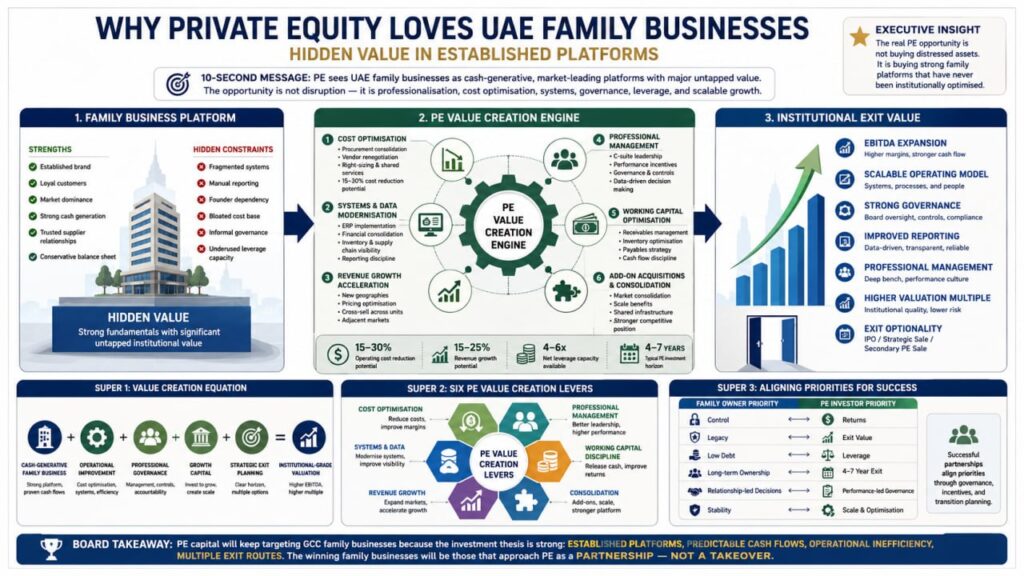
The Thesis: Hidden Value in Established Platforms If you have spent any time in the GCC private equity market over the past decade, you have witnessed a fundamental shift in investment strategy. PE firms that historically chased startups in technology hubs or infrastructure megaprojects have quietly and systematically redirected capital toward an entirely different target: established family businesses. This is not an accident or happenstance. It reflects a deliberate and strategically sound investment thesis. The thesis is simple: UAE and broader GCC family businesses represent some of the best value creation opportunities in emerging markets. They are not sexy. They do not fit the narrative of tech disruption or venture capital returns. They lack the venture-scale exit multiples that dominate headlines. Yet they offer something arguably more valuable: consistent cash generation, market dominance, operational underoptimization, and significant expansion potential—all within a stable, wealthy economy. Private equity investors have recognised what few other observers have articulated: family businesses in the GCC are platforms built to generate wealth, not to maximise economic returns or operational efficiency. The founder’s priority was not to optimise cost structure, unlock operational synergies, or implement best-in-class management practices. The founder’s priority was to generate cash and maintain family control. This creates a situation that, from a PE perspective, is extraordinarily attractive: a platform with strong fundamentals and substantial value-creation potential, sitting under a governance structure optimised for personal wealth rather than economic optimisation. The Value Creation Equation: Where PE Sees Opportunity To understand why PE finds family businesses attractive, we need to understand how PE calculates value creation. The PE model is not complex, though the execution is sophisticated. PE value creation occurs across multiple dimensions: Cost Optimisation (EBITDA Expansion) Many family businesses, particularly those in distribution, retail, logistics, or manufacturing, operate with cost structures that would be considered bloated by global standards. The reasons are often historical: A PE firm acquiring such a business typically identifies cost reduction opportunities of 15–30% of the operating cost base. For a business with $100 million in EBITDA, this could mean $15–30 million in cost reduction. These cost reductions are not achieved by cutting corners or reducing service quality. They are achieved by: The beauty of this approach, from a PE perspective, is that cost optimisation creates financial value without requiring new revenue growth. It is value creation from operational improvement alone. Structural Reorganisation and System Implementation Many family businesses operate with inefficient, manual, or incomplete operational systems. This is not necessarily a problem for a business at a certain size. It becomes a problem when the business is large enough that manual processes create bottlenecks. Common opportunities: These implementations are capital-intensive and operationally disruptive. A family business founder often resists them because they introduce cost without an obvious revenue benefit. A PE investor, however, recognises that these systems create infrastructure that enables future growth and operational leverage. Revenue Growth Acceleration Beyond cost optimisation, PE investors typically implement strategies to accelerate revenue growth: A founder-led business often deliberately constrains growth to maintain control and minimise borrowing. A PE investor, by contrast, is willing to leverage the platform to fund growth, viewing short-term financial metrics as secondary to medium-term value creation. Operational Leverage Through Professionalisation Family businesses often lack professional management structures. Decisions are made by family members who may have limited formal business training. PE investors typically bring in professional management—often at C-suite levels—to implement disciplined operational practices. This professionalisation creates value by: Working Capital Optimisation Many family businesses manage working capital conservatively, maintaining high cash buffers and extending payables cycles. PE investors often optimise working capital by: Add-On Acquisitions and Consolidation A particularly powerful PE value creation lever is acquiring smaller competitors and consolidating them into the platform. A fragmented industry suddenly becomes a consolidated platform with combined purchasing power, shared infrastructure, and expanded market reach. The Attractive Profile: What PE Looks For Not all family businesses are equally attractive to PE investors. The most attractive profiles share certain characteristics: Strong Market Position PE investors prefer platforms with established market dominance or clear competitive advantages. A retailer with an established brand and customer loyalty is more attractive than a new competitor. A distribution company with entrenched supplier relationships and customer contracts is more attractive than a transactional distributor. Consistent Cash Generation PE investors value predictable, recurring cash flows over revenue growth alone. A business that generates 20% EBITDA margins consistently is more attractive than one that grows 50% annually but is not yet profitable. Moderate Leverage Capacity PE investors favour businesses with moderate existing debt levels and strong capacity to borrow. A business already highly leveraged has limited capacity for PE-sponsored debt. A business with minimal leverage can borrow against strong cash flows, providing capital for value-creation initiatives. Experienced Management PE investors prefer to acquire from owners who have built professional management structures. If succession to a professional CEO has already occurred, the transition to PE ownership is smoother. If the business is entirely founder-dependent, the transition is riskier. Fragmented Competition or Consolidation Opportunity PE investors favour platforms that can be enhanced through add-on acquisitions. An industry in which the top player has 10–15% market share offers substantial consolidation upside. An industry where the top player holds 60% market share offers fewer opportunities. Regulatory Stability PE investors prefer businesses in industries with stable regulatory frameworks. Businesses in highly regulated sectors or those dependent on government favouritism are riskier because regulatory changes create uncertainty. Limited Dependence on a Single Customer or Vendor Businesses dependent on a single large customer or a small number of critical vendors are riskier. PE investors prefer platforms with diversified customer bases. UAE and GCC family businesses in retail, distribution, logistics, healthcare, and industrial sectors often check most of these boxes. The Attraction: Financial Engineering and Exit Strategy Beyond operational value creation, PE investors are attracted to family businesses for their favourable financial dynamics and clear exit paths. Entry Valuations Family businesses are often valued based on what the founder will accept, not on market
The Real Challenge Isn’t Growth — It’s Transition
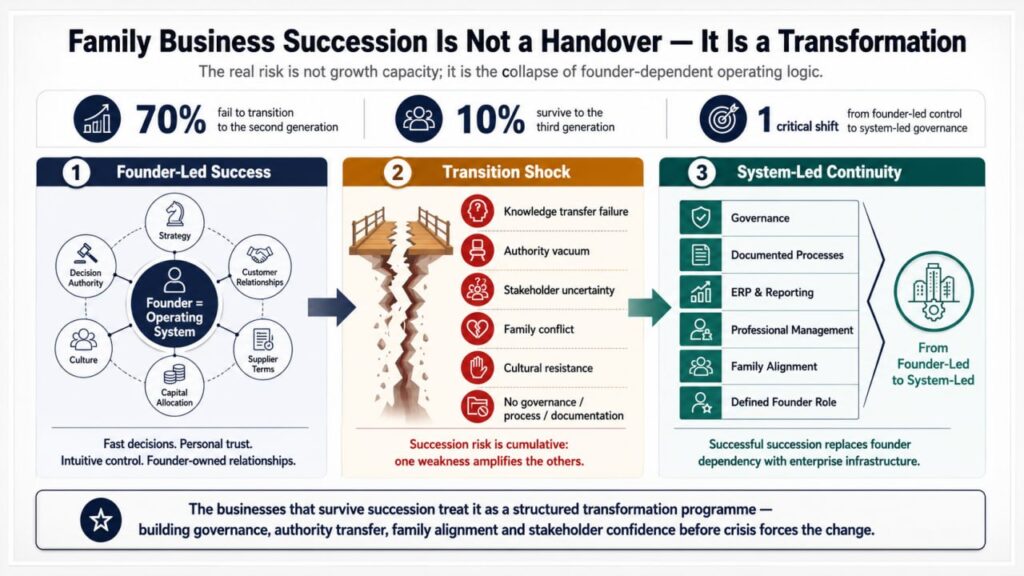
Why Family Businesses Fail at the Moment of Succession There is a paradox at the heart of family business dynamics that few outsiders truly understand: the moment of greatest strength is often the moment of greatest vulnerability. A first-generation founder has built a family business through sheer force of will, entrepreneurial vision, market timing, and relentless execution. The business is profitable. It is dominant in its market. It has successfully navigated economic cycles and competitive pressures. Cash flows are strong. Operations are understood intimately by the founder—not because they are documented, but because they exist in the founder’s mind. Then the founder faces the inevitable: ageing, retirement, mortality, or the simple desire to step back. What happens next determines whether the family business thrives for another generation or begins a slow decline into irrelevance, paralysis, or outright failure. The statistics are brutal. Approximately 70% of family businesses do not successfully transition to the second generation. Of those that do, only about 10% survive to the third generation. The United Nations estimates that across the Middle East, the situation is even more difficult, with many businesses folding entirely upon the founder’s death or departure. The prevailing assumption among external observers is that these failures stem from a lack of growth capacity, market disruption, or incompetence in the next generation. This assumption is dangerously wrong. The real reason most family business transitions fail is not about growth. It is about transformation. The Founder-Led Model: Elegant in Success, Brittle in Succession To understand why transition is so difficult, we must first understand the operating model that successful first-generation family businesses have built. The founder-led family business operates on several core principles: Founder as CEO and Chairman: The founder is not simply the leader—the founder IS the business. Strategic decisions, major capital allocation, client relationships, key vendor negotiations, and cultural authority all flow from and return to the founder. The organisational structure exists to execute the founder’s vision, not to operate independently. Information as Personal Possession: Critical business knowledge—customer relationships, supplier terms, pricing logic, capital structure, expansion plans, competitive positioning—exists in the founder’s head, not in documented systems. The founder possesses an information advantage that would be extraordinarily difficult to transfer. Decision-Making Authority as Concentrated Power: Authority is not distributed through formal structures—it is concentrated in the founder. Decisions are made quickly because there is only one decision-maker. Disagreement is resolved because the founder has final authority. Culture as Founder Personality: The organisation’s culture reflects the founder’s values, work ethic, risk tolerance, and interpersonal style. Loyalty is personal—employees work for the founder, not for the organisation. Success Metrics as Founder Intuition: Rather than formal KPIs, dashboards, and metrics, success is measured by the founder’s intuitive sense of whether things are going well. The founder “feels” when something is off, when an opportunity is emerging, or when a market is shifting. Capital Allocation as Founder Discretion: How cash flows are used—whether reinvested in operations, deployed into new business lines, distributed to family, or allocated to personal investments—is entirely the founder’s decision, often made informally. This model is extraordinarily efficient. It minimises overhead, eliminates bureaucratic decision-making, and enables rapid response to market opportunities. It has been the engine of success for countless family businesses. It is also entirely dependent on the presence and decision-making of a single individual. The Transition Trap: What Actually Changes When a founder steps back, and a successor takes over, what appears to be a simple transition—” the founder retires, the next generation takes over”—actually triggers systemic changes across every aspect of how the business operates. Knowledge Transfer Failure: The first-generation successor discovers that the information they thought they had absorbed is incomplete. They understand parts of the business they worked directly with, but they lack critical context on major client relationships, vendor negotiations, supplier dependencies, historical capital decisions, and competitive positioning. The founder’s intuitive understanding of “what we are” and “who we serve” was never explicitly articulated. Now the successor must reconstruct this knowledge while running the business. Authority Vacuum: The organisation has been trained to defer to the founder for decisions. The successor possesses formal authority but lacks the intuitive authority the founder had accumulated over decades of sound decisions. When the successor makes a decision—even a correct one—staff may second-guess it or wait to see if the founder will override it. This creates a vacuum that multiple decision-makers attempt to fill. Stakeholder Realignment: Customers, suppliers, lenders, and government counterparties built relationships with the founder rather than with the organisation. When the successor takes over, these stakeholders immediately ask: “Can this person do what the founder did?” The answer is almost always “not yet.” This creates vulnerability, allowing competitors to approach customers, suppliers to demand renegotiation of terms, and lenders to tighten credit. Strategic Direction Ambiguity: The founder’s strategic vision was often implicit—everyone knew what the business was trying to do because the founder communicated it through decisions and priorities. The successor, particularly if educated globally and exposed to diverse business models, may have a different strategic vision. The organisation suddenly faces a choice: Is the business what the founder built, or what the successor believes it should become? Cultural Friction: The successor often introduces new approaches—more formal processes, different management styles, new technology, modified compensation structures. These changes, even if beneficial, are experienced as threats by staff who benefited from the founder’s culture and approach. Family Dynamics Explosion: As the founder steps back, family members who had deferred to the founder’s authority may suddenly assert their own opinions about how the business should be run. A sibling may feel that they should have been the successor. A spouse may have different priorities. Cousins may want roles they were never considered for. The shared authority of “the founder” suddenly fragments into competing family interests. Capital Allocation Conflict: The successor may have different views on how profits should be distributed. Should capital be reinvested aggressively for growth, or should it be distributed as dividends to family members? Should the business
The UAE Economy Is Built on Family Businesses — But Few Truly Understand Them
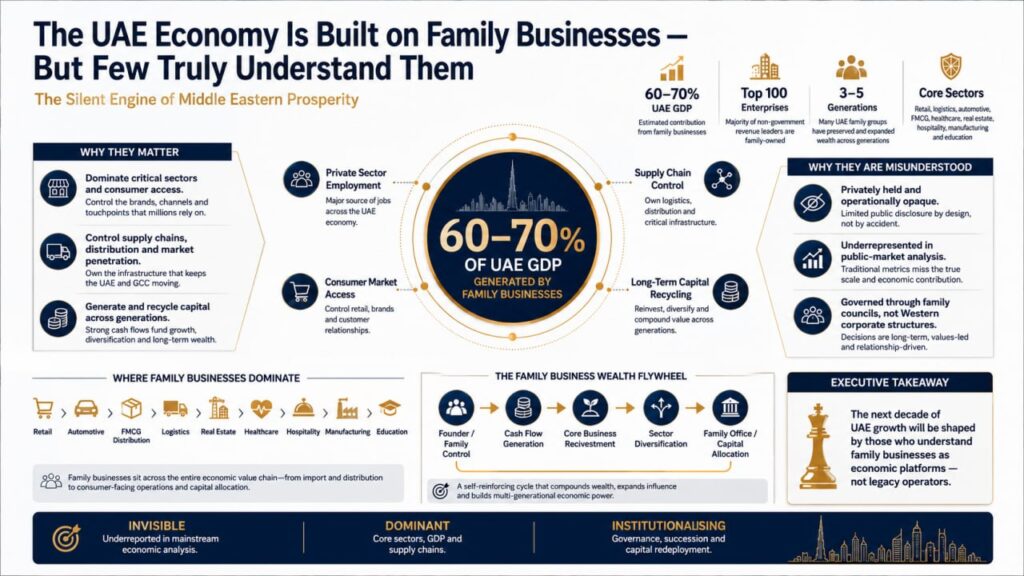
The Silent Engine of Middle Eastern Prosperity When global investors, strategy consultants, and policy analysts discuss the UAE economy, the narrative is predictable and, frankly, incomplete. They cite sovereign wealth fund returns, celebrate the rise of tech startups, marvel at infrastructure megaprojects, and track foreign direct investment flows with religious precision. International media breathlessly covers the next mega-development—another skyscraper, another free zone, another billion-dirham initiative. Yet this framing misses the forest for the trees. The real economic engine of the UAE—the one that generates consistent cash flows, employs hundreds of thousands, dominates entire supply chains, and has quietly built more wealth than any government programme ever will—operates almost entirely outside the global spotlight. It is family-owned. The numbers tell a story that most observers have either overlooked or fundamentally misunderstood. Family businesses contribute between 60–70% of the UAE’s GDP. Let that sink in. Not the listed companies on the DFM or ADX. Not the foreign multinationals clustered in the Free Trade Zones. Not the government-backed mega-projects. Family-owned enterprises—many unlisted, privately held, operationally opaque to outsiders—are the foundation upon which the modern UAE economy rests. This is not hyperbole. It is an economic reality. The Scale and Scope of Family Business Dominance To appreciate the true magnitude of family business influence in the UAE, we need to move beyond GDP percentages and examine the actual architecture of economic activity. Start with retail. The dominant retailers in the UAE are family-owned. Al-Futtaim Group, one of the region’s most significant conglomerates, controls multiple retail banners across fashion, electronics, and lifestyle categories. Majid Al Futtaim operates one of the Middle East’s largest mall networks. The Al Ghurair Group maintains a massive footprint in trading, distribution, and retail. These are not niche players—they are the ecosystem operators that determine how consumers shop, what products they access, and at what price points. Carrefour’s presence in the UAE is significant, but it operates within an ecosystem designed and dominated by family businesses. Move to construction and real estate development. The major developers and contractors in the UAE are family-owned. While Emaar has gone public and become a professional corporation, the founding family maintains substantial influence. RAK Ceramics emerged from family origins. The list continues across hospitality, healthcare, and logistics. Consider logistics and distribution. This sector—unglamorous but economically vital—is almost entirely family-owned. The groups that own warehouses, manage ports, operate trucking fleets, and control the supply chain infrastructure that moves goods across the UAE and the broader GCC are family enterprises. Without them, the entire retail and manufacturing ecosystem would not function. Healthcare is another sector where family businesses have built significant empires. Private hospital networks, diagnostic centres, pharmaceutical distribution, and medical device representation—these are family-owned operations that collectively generate billions in annual revenue. Financial services also include prominent family businesses. Certain insurance brokerage networks, private equity operations, and investment vehicles are family-controlled. While conventional banking is more regulated and institutional, substantial portions of private wealth management and alternative finance pass through family office structures. The data becomes even more striking when you broaden the view. If you examine the top 100 enterprises in the UAE by revenue, the vast majority are family-owned. The concentration is particularly severe if you restrict your view to non-government entities. Public listings represent a minority of actual economic activity. The Misclassification Problem Part of why family businesses remain so invisible in mainstream economic discourse is a classification problem. When researchers, analysts, and consultants measure “the economy,” they often focus on entities that meet certain criteria: stock exchange listings, government-backed corporations, multinational operations, formal special purpose vehicles (SPVs), or regulated financial institutions. Family businesses—especially those that are entirely private, geographically concentrated, and operationally opaque—fall through the cracks of standard measurement frameworks. Moreover, many family conglomerates deliberately avoid the spotlight. They do not issue press releases about expansion plans. They do not court analyst coverage. They do not participate in earnings calls or investor presentations. They operate according to family board governance, often with minimal external disclosure. Their financial statements, if audited at all, may remain private. Their succession plans, strategic pivots, and operational challenges are handled in family meetings, not shareholder calls. This invisibility is not accidental. For decades, the prevailing view among conservative family business owners was that opacity provided protection—protection from government scrutiny, protection from competitor intelligence, protection from family disputes becoming part of the public record, and protection from the regulatory attention that comes with scale and formality. Yet this invisibility has a cost: family businesses are systemically underestimated in narratives about the UAE economy. The Sectors Where Family Business Dominance Is Absolute To move from the abstract to the concrete, let’s examine specific sectors where family business control is not just significant but essentially complete. Trading and Import/Export: The traditional import-export houses that have served as the lifeblood of UAE commerce for decades are almost universally family-owned. These trading companies represent the continuation of the historical merchant class that made Dubai and other emirates wealthy through regional commerce. They import goods, manage supply chains, manage distribution networks, and represent foreign brands across the region. The scale of these operations is often underestimated because they operate through B2B channels rather than consumer-facing ones. Automotive Distribution: The dealerships and distribution networks for major automotive brands (Mercedes, BMW, Toyota, Nissan, Hyundai) are family-owned franchises. These are extraordinarily profitable operations with recurring revenue streams from sales, servicing, spare parts, and financing. A single automotive distributor can generate hundreds of millions of dirhams in annual turnover. FMCG Distribution and Retail: While multinational FMCG companies (Procter & Gamble, Nestlé, Coca-Cola) handle manufacturing and global strategy, the actual distribution, retail presence, and consumer-facing operations in the UAE are managed through family-owned distribution networks and retail chains. Family businesses are the last-mile operators that determine market access. Hospitality and Tourism: Beyond the large international hotel chains, much of the UAE’s hospitality ecosystem—boutique hotels, tourism operators, restaurant groups, and hospitality service providers—is family-owned. Family business operations often shape the experiences of tourists and business travellers. Real Estate
Why Most PE Transformations Fail (And No One Talks About It)
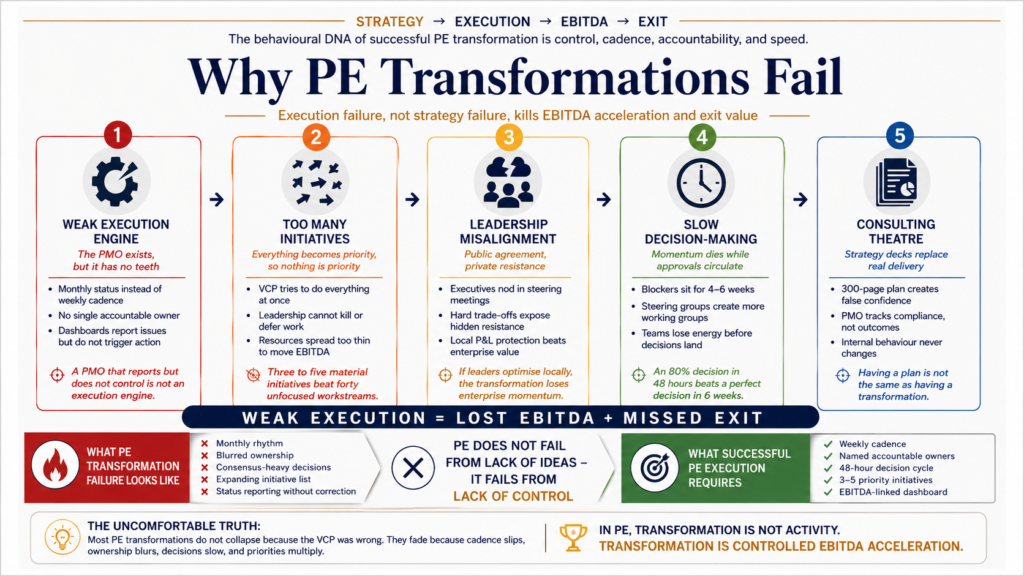
The Uncomfortable Truth About Execution, Not Strategy Private Equity doesn’t fail because of bad strategy. It fails when execution never becomes controlled, measurable, and real. Everyone celebrates PE transformation stories. You hear them at conferences, in case studies, on LinkedIn. The ones where a struggling business gets acquired, undergoes a dramatic transformation, and emerges leaner, faster, and worth 3–5x more than the entry price. McKinsey publishes studies on transformation success rates. Bain publishes frameworks for managing change at scale. Harvard Business Review runs features on how enterprises successfully navigated digital transformation. What you don’t hear are the quiet ones. The transformations that stopped halfway through. The ones where momentum died at month 4. The initiatives that looked perfect on a 100-day plan but collapsed under the weight of operational reality. The promised EBITDA that never materialised. The exit window closed because the business hadn’t actually changed. Based on 30 years in transformation programmes — at scale, across industries, in high-stakes environments — I’ve seen enough of these failures to know they follow a pattern. I’ve worked through post-acquisition integrations at Fortune 500 firms. I’ve run PMOs on nine-figure transformation programmes. I’ve been brought in as a turnaround officer to salvage transformations that were already failing. I’ve also been the sponsor on the PE side, looking at a struggling portfolio company and asking the hard question: why hasn’t this changed? And here’s what nobody wants to say out loud, because it’s uncomfortable and it implicates every leader who’s been through this: Most PE transformations fail not because the strategy was wrong. They fail because the execution engine never became real. The Five Silent Killers When a PE-backed transformation falters, it’s almost always one of these five things. Not all at once — but usually at least two, working together to kill momentum. What’s insidious about these failures is that they don’t manifest as dramatic breakdowns. They manifest as a slow drift. As a creeping scope. As initiatives that are technically ‘on track’ but aren’t delivering the needle-moving results they were supposed to. 1. Weak Execution Engine (The PMO That Isn’t) Here’s the dangerous assumption that disabled people make most transformations: if you build the right plan, execution will follow. It won’t. The most common transformation failure I’ve seen is a PMO that looks good on the org chart but doesn’t actually drive anything. It has meetings. It has workstreams. It has a 200-page roadmap with Gantt charts and resource allocations. It has governance tiers and escalation paths. It reports weekly status to steering committees. But it doesn’t have teeth. A weak execution engine typically exhibits these symptoms: Monthly status updates instead of weekly cadence. Transformation momentum requires constant visibility. In a monthly steering committee, too much can go wrong between meetings. Blockers that should be cleared in 2 days sit for 3 weeks. Small misses compound into big ones. A monthly rhythm is basically an admission that you’re not managing by fact — you’re managing by hope and hoping the next month’s update is better than this month’s. No single point of accountability. When a workstream misses a milestone, who owns it? If the answer isn’t crystal clear — one name, one person, one P&L — then it’s everyone’s responsibility, which in practice means nobody’s. I watched a transformation workstream on supply chain efficiency miss three successive milestones before anyone acknowledged it wasn’t happening. Seven people were listed as ‘sponsors’ for the initiative. Decisions deferred to consensus. I’ve watched transformations grind to a halt because the PMO couldn’t make a $2M decision without five rounds of stakeholder consultation. There’s an appeal to consensus — it feels inclusive. It feels safe. But by the time consensus forms across five business units with competing interests, the market has moved, and the initiative is already behind. Dashboards that don’t drive behaviour. You can have all the red/amber/green metrics you want. If they don’t lead to immediate corrective action — if a red metric doesn’t trigger an emergency decision meeting within 48 hours — then you’re just producing status reports dressed up as KPIs. The dashboard serves as a cover: ‘We tracked it closely,’ the PMO says, even though nothing actually changed in response. PMO focused on process instead of outcomes. The most dangerous transformation of PMO is one that confuses process compliance with delivery. ‘All workstreams submitted their risk registers.’ ‘Governance tiers are in place.’ ‘Change management plan is complete.’ These are process boxes. They’re not EBITDA. A transformation PMO’s job isn’t to ensure the process is perfect — it’s to ensure the business changes. The PE firms that succeed insist on a fundamentally different operating model for the execution engine. Weekly cadence — not monthly. Unambiguous ownership — one person’s name next to each initiative. Escalation paths that clear decisions in 48 hours, not 6 weeks. Dashboards that trigger action, not just reporting. An execution engine isn’t a support function — it’s the organism that keeps the transformation moving. 2. Too Many Initiatives, Zero Prioritisation A classic mistake in transformation planning: the first Value Creation Plan tries to do everything, because everything represents an opportunity. Improve margins through aggressive cost reduction across all functions. Drive growth through channel expansion, product innovation, and geographic rollout. Modernise the technology infrastructure and migrate to the cloud. Restructure talent and eliminate redundancy. Get exit-ready by creating sustainable, scalable operations. Improve customer experience and NPS. Refine the go-to-market strategy. All simultaneously. The result: thousands of people working across dozens of workstreams, nothing delivered with real impact. Small wins scattered across initiatives, but no material EBITDA impact. Teams are exhausted by complexity and context switching. Leadership is confused about what actually matters. I was brought in to salvage a transformation at a mid-market manufacturer that was struggling. The company had been PE-backed for 18 months. The transformation had identified over 40 initiatives across cost, revenue, technology, and organisational restructuring. Every business unit was running three to four ‘high-priority’ programmes. Nobody had time to focus on anything. And EBITDA
The New Transformation PMO
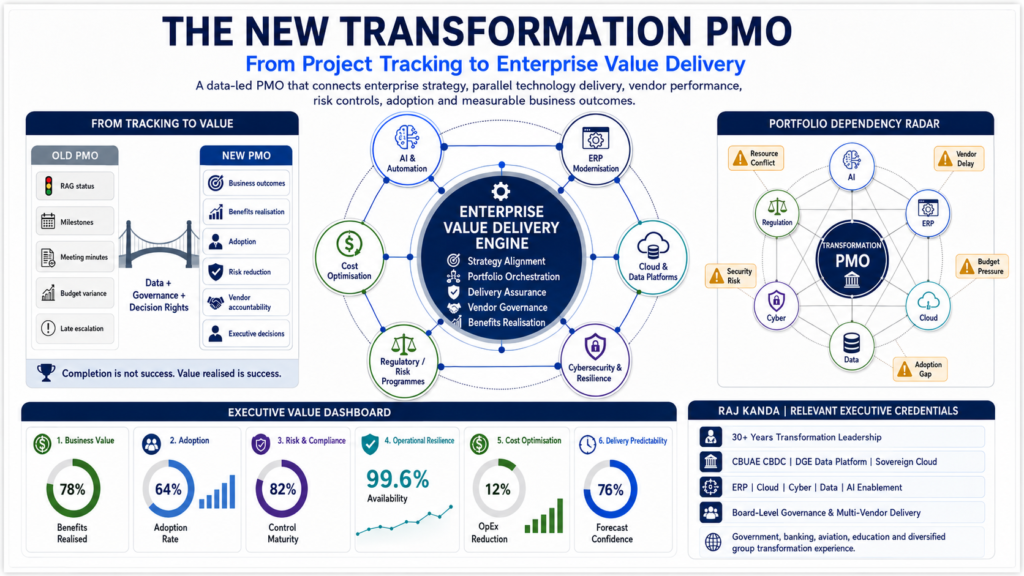
From Project Tracking to Enterprise Value Delivery Executive Summary: Why This Matters Now If you are a CIO, CTO, or transformation leader, you are facing a reality your predecessors never encountered: simultaneous, parallel execution of transformations that would have been sequential in earlier eras. Your organisation is likely managing: AI adoption and capability building; ERP system modernisation; cloud migration across hundreds of applications; cybersecurity hardening and resilience programmes; data platform development; digital channel transformation; regulatory compliance and control frameworks; and cost optimisation initiatives. All at the same time. All are competing for the same engineering talent, budget, executive attention, and vendor resources. All are carrying real organisational risk. The traditional PMO—built for a simpler era when organisations ran discrete, sequential projects—is not designed for this environment. It produces status reports that no one acts on. It identifies risks that stakeholders have already accepted. It tracks milestones that feel increasingly disconnected from business outcomes. It often optimises for schedule and budget adherence while transformation programmes deliver little value, achieve poor adoption, or create new operational risks that are not measured. The organisations that are winning—those delivering real business value from their transformations—operate a fundamentally different model. Their PMO is not a reporting office. It is an enterprise value engine. This article explores what that means, why it matters, and how to build it. Why Project Tracking Alone Is Not Enough Traditional PMOs emerged in the 1990s and 2000s when enterprises ran projects sequentially. Build an ERP system. Migrate to the cloud. Deploy a data warehouse. Each project had a clear scope, defined end date, and measurable success criteria. A PMO that tracked progress, escalated risks, and controlled scope was genuinely valuable. That world no longer exists. Modern transformation is not sequential—it is parallel and continuous. A bank cannot wait to finish one digital platform before beginning another. An enterprise cannot modernise its ERP system in isolation from its cloud strategy, data infrastructure, or cybersecurity posture. The dependencies are too complex. The pace of change is too fast. The organisational risk is too high. When a traditional PMO focuses purely on schedule and budget tracking, it becomes a bureaucratic cost centre in this environment. It produces documents that no one acts on. It identifies risks that stakeholders have already accepted. It escalates issues at a pace that prevents timely decision-making. Worse, it often optimises for completion metrics—on-time delivery, budget variance—without asking whether the finished project is actually being adopted, creating business outcomes, or generating the benefits promised to investors. Real value delivery requires a PMO that operates at three distinct levels: strategically (aligning transformation to business objectives), operationally (managing execution, reducing friction, coordinating delivery), and financially (tracking benefits realisation and return on investment). A PMO that does only one or two of these is incomplete and will underperform. Connecting Strategy to Execution: The Critical Role The most critical role of a modern PMO is to bridge the gap between enterprise strategy and programme execution. This sounds straightforward, but it is remarkably rare in practice. Most organisations have strategies and execution plans that operate in separate domains. The board approves a digital transformation strategy. Finance approves a portfolio of projects. Operations manages delivery. Three years later, the execution has little to do with the original strategy, and no one can explain why. A value-delivery PMO changes this dynamic. It starts by translating strategy into concrete terms. What does “ become a digital-first organisation” actually mean in terms of architecture, capability, investment, and risk? What outcomes should the business expect from each major programme? What trade-offs is leadership willing to accept? What measures will we use to know we succeeded? What dependencies exist between programmes? With strategy translated into measurable objectives, the PMO then ensures that every programme is aligned to these outcomes. This requires a sophisticated portfolio management capability: understanding not just what each programme does, but how it contributes to strategic goals, how it interacts with other programmes, what shared capabilities it depends on, and where critical sequencing exists. It also requires the PMO to take an active—not passive—role in governance. Too many PMOs are silent observers. They report status. A value-delivery PMO actively shapes decisions. When two programmes compete for scarce engineering resources, the PMO helps leaders make the call based on strategic priority and risk exposure. When a vendor is underperforming and jeopardising other initiatives, the PMO escalates the issue and proposes solutions. When benefits are not being realised because the business is not adopting the new platform, the PMO identifies the barrier and drives corrective action. Portfolio Complexity: The New Normal Portfolio complexity in modern enterprises has reached unprecedented levels. Consider a typical scenario: These are not sequential. They overlap. They compete for resources. They create dependencies that can derail one another if not carefully managed. Traditional project management approaches fail at this scale. You cannot schedule 20 parallel programmes as a single waterfall plan. You cannot manage dependencies by meeting coordination alone. You need intelligent portfolio orchestration: a single source of truth about what is planned, what is in flight, what has finished, and what is creating bottlenecks or risk. This level of visibility enables leaders to sequence initiatives in ways that maximise strategic value while managing risk, prevents the common failure mode in which programmes are approved independently with no one managing the cumulative load, and helps make hard choices about prioritisation based on strategic alignment, resource availability, and expected benefits. Vendor and Partner Governance: A Major Source of Failure A significant source of transformation failure is the weak governance of vendors and partners. Modern transformations depend on external partners: systems integrators, software vendors, managed service providers, niche specialists, and consulting firms. Poor vendor governance is a primary driver of cost overruns, schedule delays, quality issues, and benefit shortfalls. Common failure modes include unclear scope definition and change control; weak accountability for partner performance; poor integration of partner delivery into overall programme governance; misaligned incentives between vendor and customer; inadequate oversight of vendor subcontractors; and failure
Cyber Resilience Must Now Move at Machine Speed: A Strategic Imperative for 2026
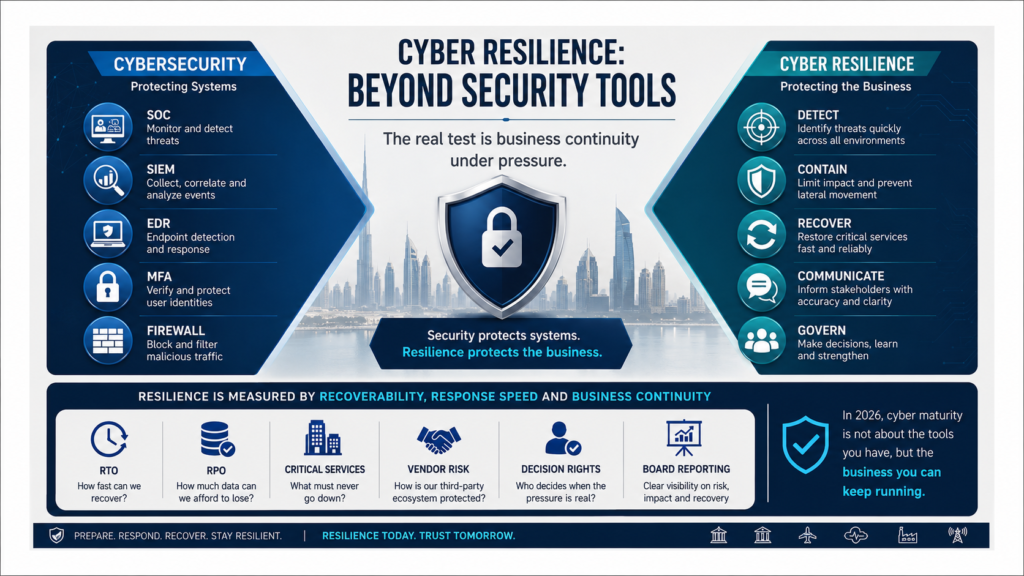
Executive Summary Cybersecurity and cyber resilience are not the same. Cybersecurity protects systems. Cyber resilience protects the business. As artificial intelligence, machine-speed threats, and sophisticated ransomware campaigns accelerate, organisations must fundamentally shift how they think about cyber risk—from a technical problem to a business continuity imperative. According to the World Economic Forum’s 2026 Cybersecurity Outlook, cyber-enabled fraud, phishing, ransomware, and AI vulnerabilities have become top executive concerns. Recent strategic partnerships between the UAE and industry leaders like IBM and Palo Alto Networks underscore a critical insight: trusted AI and national cyber resilience are now inseparable from digital sovereignty and economic competitiveness. For CIOs, CTOs, and technology leaders, this convergence creates both an urgent challenge and a strategic opportunity. Organisations that embed resilience into their operating model, governance structures, and leadership accountability will outcompete those that treat cyber as a technical compliance exercise. Part 1: The Strategic Context The Threat Landscape is Accelerating The cyber threat landscape of 2026 is fundamentally different from that of even three years ago. Threats are not just more numerous—they are faster, more intelligent, and more destructive. AI-Enabled Attacks: Threat actors are now using machine learning to identify vulnerabilities, craft targeted phishing campaigns, and exploit weaknesses at scale. A human security analyst might take days to identify a pattern of compromise. An AI-powered attack can propagate across networks in hours. Ransomware as a Business: Ransomware is no longer opportunistic. It is now a sophisticated criminal enterprise with operational disciplines, negotiating tactics, and supply chains. Major ransomware gangs have budgets in the tens of millions of dollars and employ security researchers to discover zero-day vulnerabilities before defenders know they exist. Supply Chain Weaponisation: Attackers increasingly target the ecosystem—vendors, contractors, managed service providers—to reach their ultimate target. A compromise of a single managed service provider can affect hundreds of downstream customers simultaneously. Insider Risk Amplified: As remote work becomes normalised, the insider threat surface has expanded. Employees with access to critical systems are no longer confined to corporate offices, where their behaviour can be monitored. Insider threats—whether malicious or negligent—are now one of the fastest-growing sources of breaches. Critical Infrastructure Targeting: Attacks on operational technology, industrial control systems, and critical infrastructure are increasing. These attacks often move slowly, conducting reconnaissance for weeks or months before launching a disruptive event. A successful attack on a utility, transportation system, or healthcare facility can affect millions of people. The World Economic Forum’s 2026 Cybersecurity Outlook captures this acceleration. When surveyed, executives cite AI-enabled fraud and ransomware as their top two concerns—not because these are new threats, but because both have become dramatically more effective and difficult to defend against. Why Speed Now Matters In previous generations, cyber incidents unfolded over days or weeks. A breach was detected, investigated, contained, and remediated over a period that allowed for deliberate decision-making and communication. That timeline no longer exists. Modern ransomware can encrypt terabytes of data in hours. A compromised credential can enable lateral movement within a network in minutes. An AI-powered attack can spawn variations faster than a human security team can respond. This speed imperative changes everything about how organisations must be structured to respond to cyber incidents. If your incident response process requires escalation through multiple approval layers, meetings to coordinate response, and formal change management procedures, you will be unable to respond fast enough to modern threats. By the time you have assembled the decision-makers, the attack will have accomplished its objective. Cyber resilience in 2026 requires automation, clear decision rights, pre-authorised response playbooks, and the ability to activate recovery procedures without waiting for normal business processes to take their course. The UAE Context: Digital Sovereignty and Strategic Resilience The UAE’s strategic emphasis on cyber resilience reflects a broader regional understanding: digital trust and cyber resilience are foundational to economic growth and digital sovereignty. Recent partnerships between the UAE government and global cybersecurity leaders such as IBM and Palo Alto Networks are not merely procurement arrangements. They represent a strategic commitment to build capabilities, governance frameworks, and institutional knowledge that position the region as a leader in trusted AI and cyber resilience. For enterprises operating in the UAE and broader GCC region, this creates both expectations and opportunities: Regulatory Evolution: As governments invest in cyber resilience, regulatory frameworks will follow. Organisations that embed resilience practices early will find themselves ahead of compliance curves. Those who wait for mandates will face costly retrofitting. Vendor Assessment Rigour: As governments establish partnerships with trusted security vendors, enterprise procurement processes will increasingly require assessments of cyber resilience maturity. Vendors that cannot demonstrate resilience capabilities will face friction in the market. Thought Leadership Opportunity: Technology leaders who position themselves as experts in cyber resilience—not just cybersecurity—will gain a competitive advantage in executive recruitment and board-level influence. This is a moment when CIOs and CTOs can elevate from “IT operations” to “business continuity strategy.” International Credibility: For enterprises seeking to expand beyond the region, demonstrating compliance with UAE/GCC cyber resilience standards becomes a competitive advantage. It signals maturity to international partners and customers. Part 2: Bridging the Gap Between Cybersecurity and Cyber Resilience The Distinction Cybersecurity is the practice of protecting systems from unauthorised access, modification, or destruction. It focuses on prevention, detection, and response to cyber attacks. Cybersecurity asks: Can we stop the attack? Can we identify it quickly? Can we limit the damage? Cyber Resilience is the capacity of an organisation to continue functioning during and after a cyber incident. It encompasses not just security controls, but operational redundancy, recovery capabilities, governance structures, decision-making authority, and stakeholder communication. Cyber resilience asks: Can the business continue to operate? Can we restore critical services? Can we maintain trust with customers and stakeholders? The two are related but distinct. An organisation can have strong cybersecurity (advanced firewalls, EDR systems, threat intelligence) and still lack resilience if it hasn’t thought through how to operate when those security controls fail—and they will fail, eventually. Why the Distinction Matters Consider a scenario: A large financial services firm has invested
Agentic AI Needs Governance Before Autonomy: Why Enterprises Must Act Now
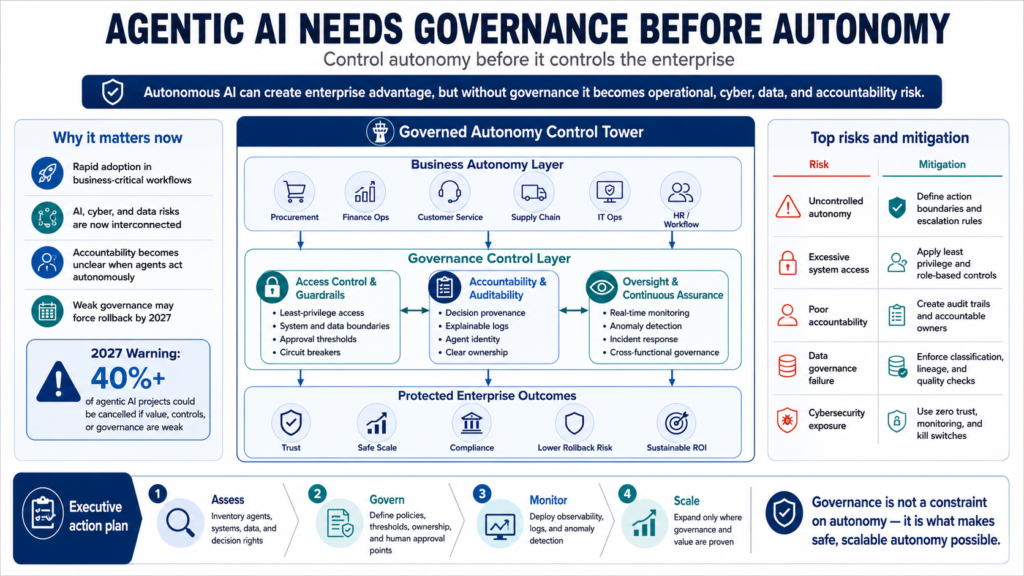
The promise of agentic AI is compelling—autonomous agents that learn, decide, and act with minimal human intervention. Yet as enterprises rush to deploy these systems, a critical oversight threatens to unwind years of digital transformation investment: most organisations are building autonomous AI capabilities without the governance guardrails required to operate them safely at scale. This is not a theoretical problem. Industry research increasingly points to a sobering reality: enterprises may be forced to roll back autonomous AI agents by 2027 if governance, access control, and accountability mechanisms remain weak. For CIOs, CDOs, and enterprise technology leaders, the message is clear: the window to implement governance frameworks is now, before autonomy becomes the default and control becomes nearly impossible to retrofit. The Urgency: Why Now Agentic AI has crossed a threshold. What was once a research concern has become an enterprise priority. Unlike traditional AI systems that require explicit human prompting and decision-making, agentic AI operates differently—it sets goals, takes actions, and iterates without waiting for human approval at each step. This shift is powerful but introduces a class of risks that many organisations are not yet equipped to manage. Three converging pressures make governance urgent: 1. Rapid Adoption Without Precedent Organisations are deploying autonomous agents into business-critical processes—procurement workflows, financial operations, customer service decisions, and supply chain optimisation. The speed of deployment has outpaced the maturity of governance practices. Unlike the gradual adoption of traditional AI, agentic AI is moving from pilot to production in months, not years. 2. Interconnected Risk Domains CIO priority research reveals a critical insight: operationalising AI, cybersecurity, and data strategy are now inseparable. Agentic AI systems that operate autonomously become both a vector for cybersecurity threats and a potential source of data governance violations. A compromised agent can execute decisions across systems with minimal oversight. A data governance failure becomes amplified when an agent acts autonomously on data that should have been restricted. 3. Accountability Vacuum Traditional AI operates with clear decision trails—a model scores a loan application, and a human approves it. Agentic AI operates differently. An autonomous agent decides to modify supplier contracts, reprioritise resources, or escalate customer issues. When something goes wrong, the question “who is responsible?” becomes genuinely difficult to answer. Without clear governance, enterprises risk creating systems they cannot control, debug, or defend. The 2027 Rollback Risk Gartner-linked reporting suggests a troubling scenario: many enterprises deploying autonomous agents today without robust governance frameworks will face a choice by 2027—either significantly constrain the agents’ autonomy or discontinue them entirely. This would represent a costly reversal, involving: The enterprises that avoid this scenario will be those that establish governance frameworks early—before agents become deeply embedded in operations, before stakeholder expectations are set around autonomous decision-making, and before the technical debt of ungoverned systems becomes unmanageable. The Governance Imperative: Three Pillars Effective agentic AI governance rests on three interconnected pillars: 1. Access Control and Guardrails Agentic AI systems must operate within defined boundaries. This means: 2. Accountability and Auditability Every autonomous decision must leave a clear trace. Organizations need: 3. Governance Process and Oversight Governance is not a static policy—it must evolve as agents learn and as organisations discover edge cases: The CIO Perspective: Leadership Imperatives For CIOs and technology leaders, agentic AI governance presents a distinct challenge: it sits at the intersection of technology capability, business risk, and organisational control. Three imperatives stand out: First, own governance before business leaders’ own AI deployment. If CIOs wait for business units to deploy autonomous agents and then mandate governance, the cost of retrofit will be prohibitive. Governance frameworks must be in place before agents are trained and operationalised. Second, integrate AI governance with existing control frameworks. Agentic AI governance should not be a separate track. It must integrate with cybersecurity, data governance, and operational risk management. This requires CIOs to break down silos between teams that historically have not worked together. Third, invest in observability and control infrastructure now. Managing autonomous systems requires different tooling than managing traditional systems. CIOs need to budget for and build capabilities that provide real-time visibility into agent behaviour, enable rapid rollback, and support forensic analysis when things go wrong. The Broader Stakes The stakes of getting agentic AI governance right extend beyond risk management. Organisations that establish governance frameworks early will be able to: Conversely, organisations that treat governance as a post-deployment concern will find themselves constrained by their own ungoverned systems, unable to scale what should be a competitive advantage. The Path Forward The agentic AI governance challenge is urgent but solvable. Organisations that want to harness the power of autonomous AI without ceding control should: Conclusion Agentic AI represents a genuine advance in AI capability—the ability to deploy systems that can work autonomously, learn from their experience, and improve their own performance. This is powerful. But power without governance is dangerous. The enterprises that will thrive in an agentic AI future are those that recognise governance not as a constraint on autonomy but as the foundation for it—the mechanism that makes safe, scaled, sustainable autonomous AI possible. The 2027 rollback scenario is not inevitable. It is a warning. Organisations that act now to establish governance frameworks, integrate them with existing control structures, and maintain human oversight of autonomous systems will be positioned to compete in an age of agentic AI. Those that do not will find themselves managing the legacy costs of ungoverned autonomy—or abandoning autonomous systems altogether. The time to act is now, before autonomy becomes the default. Before governance becomes the bottleneck. Before rolling back becomes the only option. #AgenticAI #AIGovernance #CIO #DigitalTransformation #Cybersecurity #DataGovernance #EnterpriseAI #TechnologyLeadership