Adapting Your Business Model to Shifting Customer Needs and Market Realities
A Comprehensive Guide for Enterprise Leaders
Executive Summary
Business model innovation has transitioned from a competitive advantage to an existential necessity. Organisations across every sector face unprecedented pressure to reimagine how they create, deliver, and capture value.
The challenge is not incremental improvement—it is fundamental reinvention. Companies that merely optimise existing models while markets shift around them face obsolescence.
This guide provides enterprise leaders with a structured framework for assessing, designing, and implementing business model innovation. It addresses the core drivers of change, the anatomy of successful transformations, implementation pitfalls, and practical guidance tailored to the unique dynamics of the UAE and GCC markets.
The organisations that succeed will be those that view business model innovation not as a response to crisis but as an ongoing capability—embedded in strategy, governance, and organisational culture.
Why Business Model Innovation Matters Now
The business environment has entered a phase of structural volatility. Established competitive advantages erode faster than ever before. Industries that seemed stable a decade ago—retail, automotive, financial services, hospitality—now face existential threats from entrants operating under entirely different business models.
The Difference Between Operational Excellence and Business Model Innovation
This distinction is critical. Operational excellence focuses on doing the same thing better—improving margins, reducing defects, and accelerating delivery within an existing model. Business model innovation asks: Should we be doing this at all? Should we serve different customers? Should we create value differently?
A company that optimises its manufacturing process but ignores shifts in consumer preferences will eventually become irrelevant. A competitor that understands the underlying customer need and redesigns how it meets that need will capture the market.
The Acceleration of Disruption
Technology adoption cycles have compressed dramatically. Cloud infrastructure, AI, mobile connectivity, and data analytics were considered cutting-edge advantages five years ago. Today, they are table stakes.
The implications are profound: organisations must build innovation into their core operating model, not treat it as a periodic strategic exercise. The capability to sense emerging market shifts, rapidly prototype alternatives, and pivot the entire business must become as routine as quarterly planning.
The Anatomy of Business Model Innovation
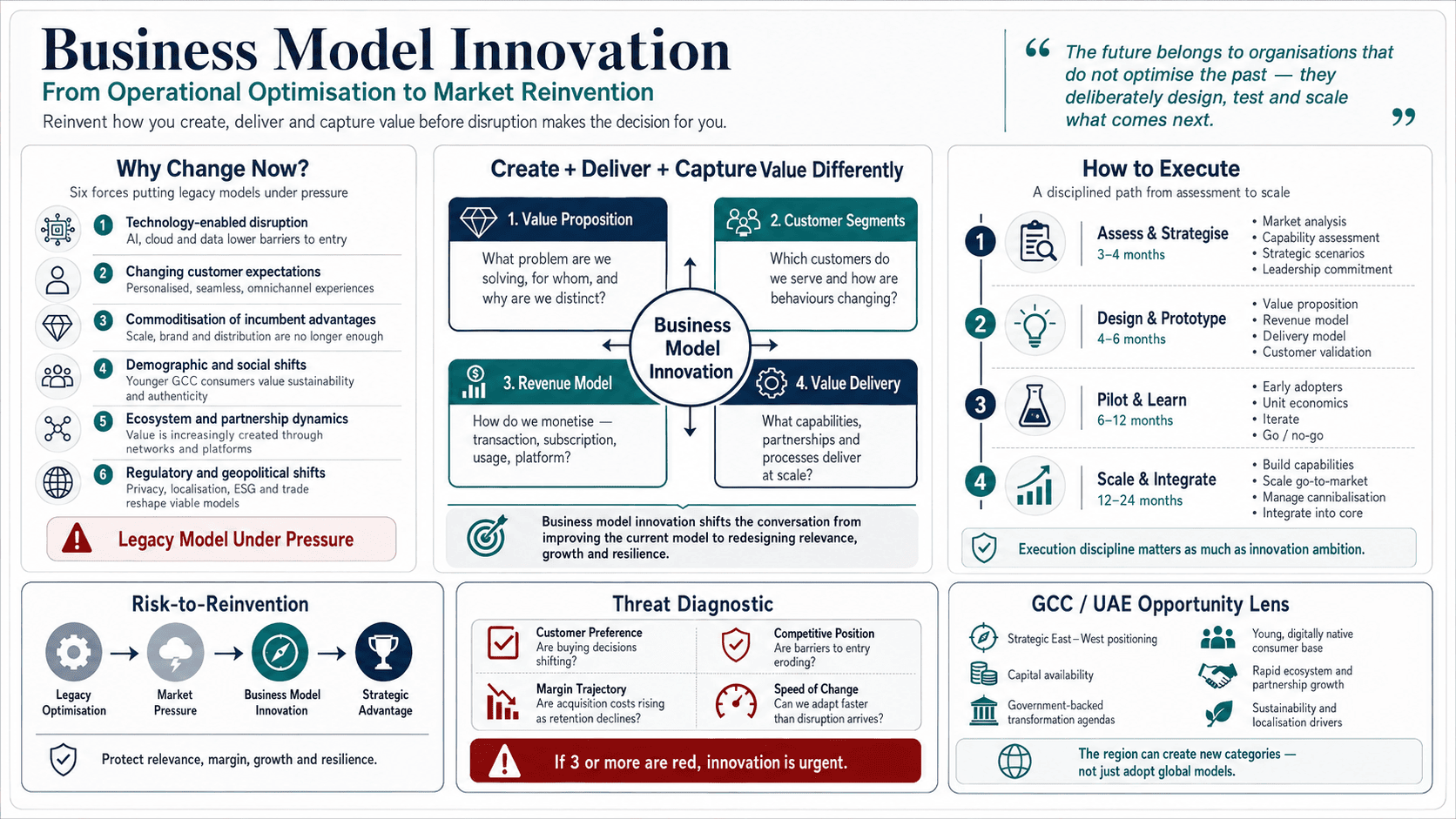
A business model describes how an organisation creates, delivers, and captures value. It consists of four interdependent dimensions:
- Value Proposition: What problems are we solving? For whom? What makes our solution distinct?
- Customer Segments: Which customers do we serve? What are their characteristics, needs, and behaviours?
- Revenue Model: How do we monetise? What is the unit of transaction? What is the price of architecture?
- Value Delivery: What capabilities, partnerships, and processes enable us to deliver at scale?
Types of Business Model Innovation
Business model innovations typically fall into several categories:
Customer Segment Shift – Serving new customer groups with existing capabilities.
Value Proposition Expansion – Broadening what you solve for customers.
Revenue Model Transformation – Shifting from transaction-based to subscription, usage-based pricing, or freemium models.
Value Delivery Reinvention – Fundamentally changing how value reaches customers.
Platform and Ecosystem Models – Transitioning from vendor to orchestrator.
Market Forces Driving Business Model Innovation
Understanding what is forcing your business model to evolve is essential. Six structural forces are reshaping industries:
1. Technology-Enabled Disruption
AI, cloud, and real-time data analytics have fundamentally lowered barriers to entry. For GCC organisations, this presents both risks and opportunities. Abundant capital and digital ambition in the region create conditions for the rapid scaling of new models.
2. Changing Consumer Expectations
Customers increasingly expect personalisation, seamless omnichannel experiences, and value beyond the core product. Companies that fail to embed these in their core models lose market share to more adaptive competitors.
3. Commoditization of Incumbent Advantages
Scale, brand, and distribution—once insurmountable moats—have become commodities. The advantage now belongs to companies that can innovate their business model faster than competitors can copy it.
4. Demographic and Social Shifts
The GCC region is experiencing rapid demographic change: a younger population, increasing female workforce participation, and globalisation. Millennial and Gen Z consumers have fundamentally different values around sustainability and authenticity.
5. Ecosystem and Partnership Dynamics
Success increasingly depends on orchestrating partner ecosystems. Organisations must innovate their business models to partner effectively and capture value from increasingly complex value chains.
6. Regulatory and Geopolitical Shifts
Data privacy, environmental regulations, trade dynamics, and localisation requirements continuously reshape viable business models. GCC organisations must build adaptability into their models.
Assessment Framework: Is Your Business Model Under Threat?
Not every business requires radical model innovation. But leadership teams must honestly assess whether their current model will survive the next five years.
Consider these diagnostic questions:
- Customer Preference: Does your value proposition align with how customers are actually making decisions?
- Competitive Position: Are barriers to entry eroding? Can new entrants easily replicate your model?
- Margin Trajectory: Are gross margins stable? Is customer acquisition cost rising while retention declines?
- Speed of Change: How rapidly are market dynamics shifting? Can you adapt faster than the disruption arrives?
If most questions yield concerning answers, business model innovation is urgent. You are in the window where you have capital and customer relationships to invest—but that window is closing.
Critical Implementation Challenges
Designing a new business model is tractable. Implementing it while maintaining an existing business that funds the organisation is exponentially harder.
The Cannibalisation Paradox
A new business model often cannibalises revenue from the existing business. The solution is to separate the new business unit operationally and financially, giving it distinct incentives, governance, and P&L accountability independent of the core business.
Organizational Misalignment
The capabilities required for a new business model often conflict with those embedded in the legacy organisation. A shift from transaction-based to subscription revenue requires different finance models and customer success infrastructure.
Capital Allocation Discipline
Business model innovation is inherently uncertain. Venture-style capital allocation is appropriate. Yet many large organisations apply traditional budgeting, requiring near-certainty of returns before funding.
Talent and Skill Gaps
Platform thinking, data analytics, agile product development, and ecosystem orchestration are not skills typically embedded in traditional organisations. Leadership must invest in recruiting or developing these capabilities.
Speed and Scale Tension
Early-stage models benefit from rapid iteration. But the business model must eventually scale, requiring process discipline and reproducibility. The transition from experimentation to scaling is where many initiatives falter.
Strategic Guidance for GCC and UAE Market Leaders
The GCC market presents distinct dynamics that shape business model innovation priorities:
Leverage Strategic Positioning
Regional companies operate at the nexus between East and West—between emerging markets and developed economies. This unique positioning creates opportunities for business model innovation that Western competitors cannot easily replicate.
Ecosystem and Partnership Innovation
The region is moving rapidly toward ecosystem-based business models. Success depends on partnerships with financial institutions, technology providers, and government entities.
Domestic Versus Export Strategy
Many organisations face a strategic choice: whether to focus on the GCC region or pursue international expansion. This choice fundamentally shapes business model design.
Sustainability and Social Impact
Younger GCC consumers emphasise sustainability, ESG, and authentic purpose. Business models that embed environmental and social considerations will capture market share and talent.
Capital Efficiency
Business models that demonstrate capital efficiency and a path to profitability face lower execution risk. Models requiring less capital become sustained competitive advantages as markets mature.
Framework for Action: Launching Business Model Innovation
Successful business model innovation follows a structured approach:
Phase 1: Assessment and Strategy (3–4 months)
- Conduct deep market analysis: How are customer needs evolving? What alternative models are emerging?
- Assess organisational capability: What is your capacity to innovate while operating the legacy business?
- Define strategic scenarios: What are 2–3 plausible future business models?
- Prioritise and commit: Which model offers the best balance?
Phase 2: Design and Prototyping (4–6 months)
- Detail the value proposition: What is the compelling case for customers to switch?
- Design the revenue model: What is the unit of pricing? What is willingness to pay?
- Map value delivery: What capabilities must you build, buy, or partner for?
- Validate with customers: Test core hypotheses with early adopter customers.
Phase 3: Pilot and Learning (6–12 months)
- Launch with early adopters: Identify 10–20 customers willing to adopt early.
- Measure critical metrics: Track unit economics, customer acquisition cost, and lifetime value.
- Iterate the model: Refine based on feedback.
- Make a go/no-go decision: Does the model demonstrate sufficient unit economics?
Phase 4: Scale and Integration (12–24 months)
- Build operating capabilities: Establish processes, technology, talent, and partnerships.
- Scale customer acquisition: Transition from pilot to repeatable, scalable go-to-market.
- Manage cannibalisation: Actively manage the transition from legacy to new model.
- Plan for integration: Define the timeline for merging the new business into core operations.
Conclusion: The Imperative and the Opportunity
Business model innovation is no longer a strategic option—it is an existential necessity. Markets shift faster than organisations can optimise. The question for every leader is not whether to innovate their business model, but when and how to do it deliberately rather than in crisis.
The organisations that thrive over the next decade will be those that view business model innovation as a core capability—embedded in strategy, governance, and culture. This requires moving beyond periodic strategic planning exercises to establishing continuous sensing of market evolution, rapid prototyping of alternatives, and disciplined testing of new models.
For GCC and UAE leaders, the opportunity is particularly acute. The region’s capital, talent, and strategic position create conditions for business model innovations that could establish entirely new categories and competitive advantages.
The time to begin is now. Start with an honest assessment of your current model. Identify the forces reshaping your market. Engage your best talent in designing plausible futures. Test them with customers. And commit the resources required to move from concept to scaled reality.
The future belongs not to the companies that optimise the past, but to those that deliberately shape what comes next.