Executive Overview
The global operating environment confronting today’s executive leadership teams is one of compounding complexity. Geopolitical instability, volatile interest-rate cycles, tightening regulatory regimes, the imperatives of digital and artificial intelligence transformation, and unrelenting shareholder expectations have converged to create a financial landscape in which yesterday’s playbooks are no longer sufficient. Nowhere is this more pronounced than across the Middle East and the wider GCC, a region distinguished by rapid economic diversification, ambitious national transformation agendas, intensifying competitive dynamics, and a distinctive obligation to balance innovation with regulatory and cultural stewardship.
In this environment, resilience and growth are no longer delivered through operational efficiency or tactical cost discipline alone. They demand an integrated financial strategy that addresses, simultaneously, the optimisation of working capital, the architecture of capital structure, the disciplined pursuit of mergers and acquisitions, the strategic management of debt, the deployment of surplus capital, and the protection of enterprise value against an expanding universe of risk. These are not discrete workstreams to be managed in isolation by separate teams operating to separate mandates. They are interconnected dimensions of a single strategic discipline, and organisations that treat them as such consistently outperform those that do not.
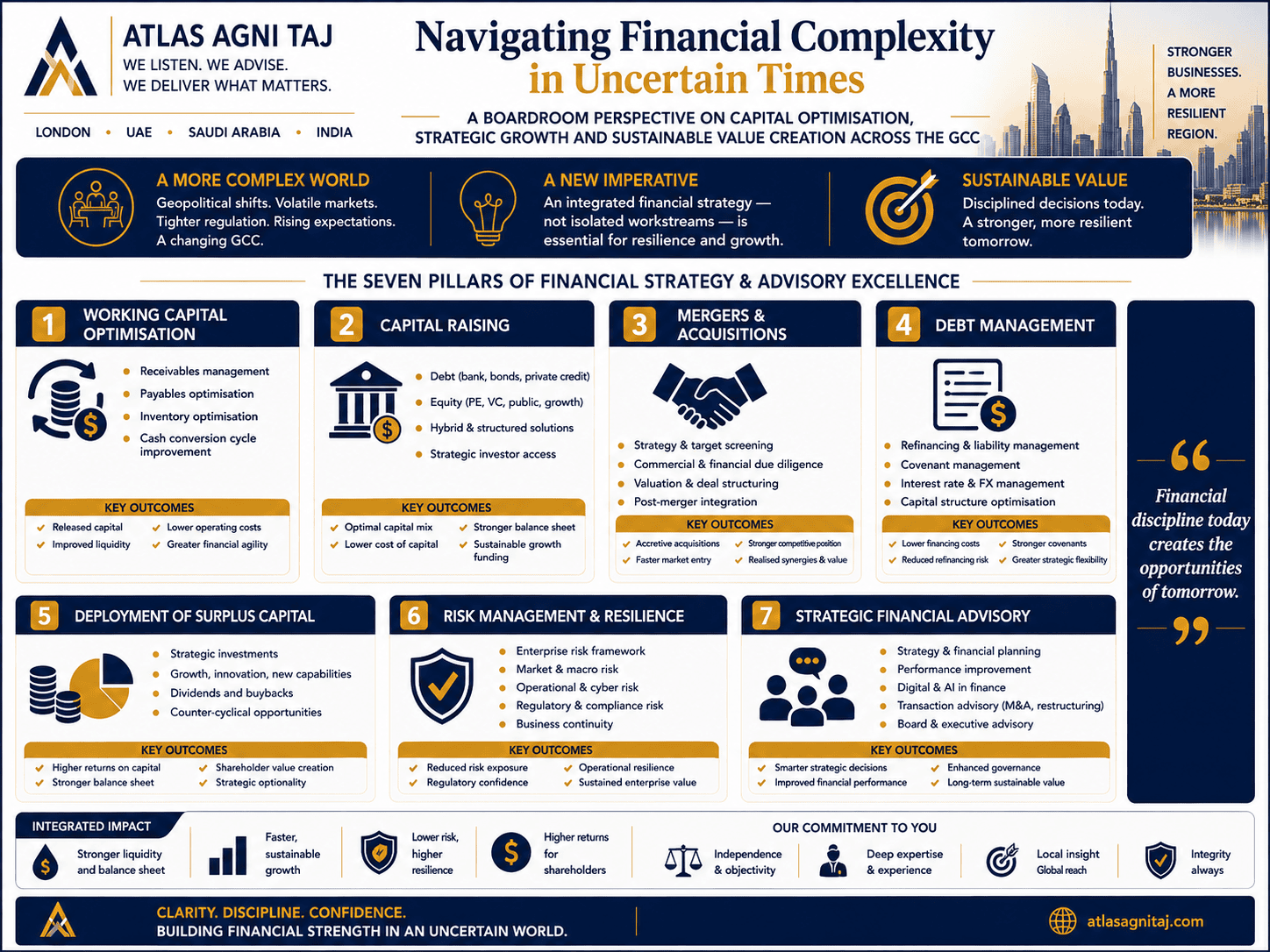
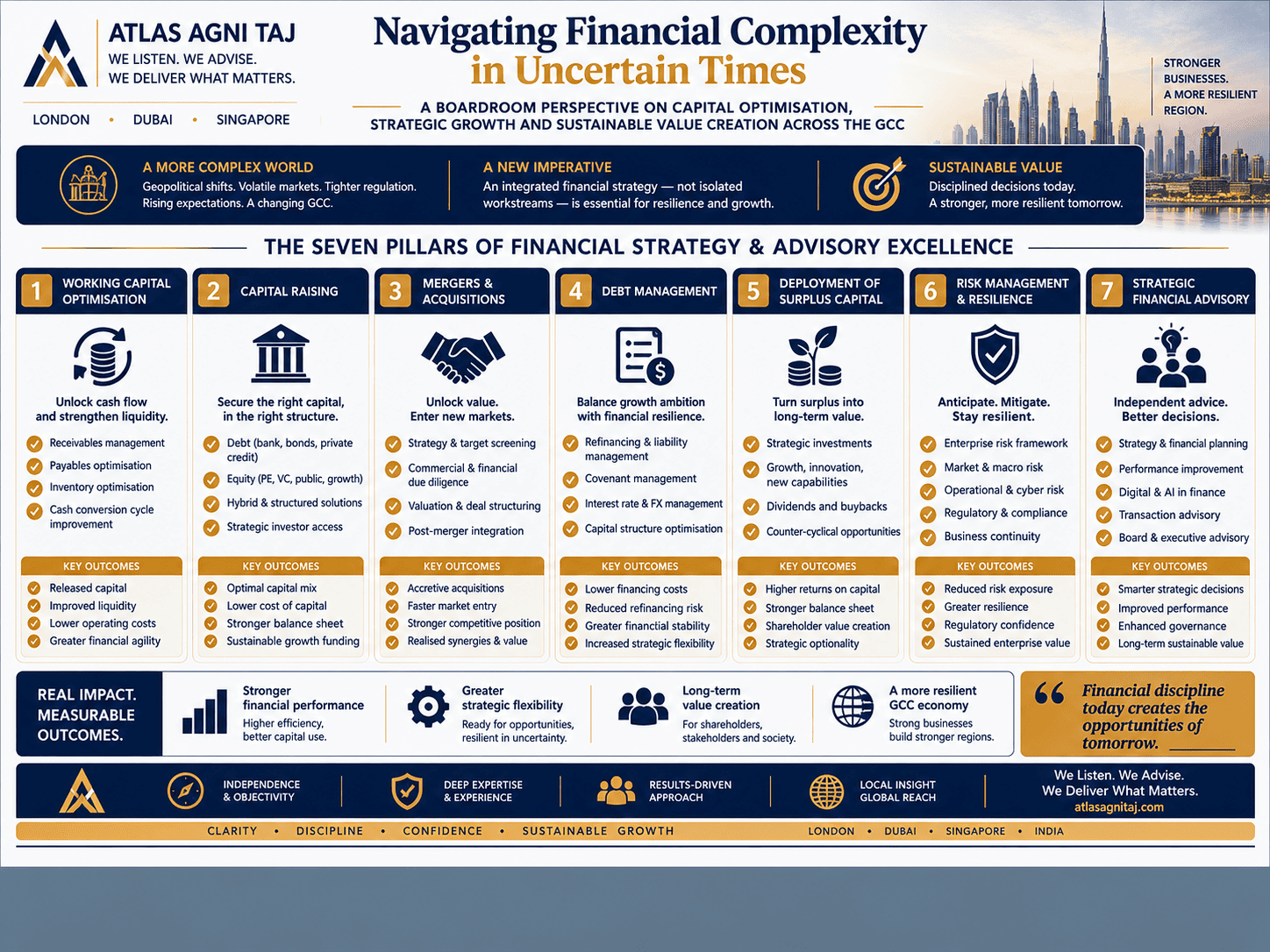
This article sets out seven interconnected pillars of financial strategy and advisory excellence that, in our experience, distinguish organisations capable of navigating uncertainty with confidence from those left exposed by it. It is intended as a practical reference for chief executives, chief financial officers, boards, and senior finance leaders operating in, or expanding into, the GCC market.
1. Working Capital Optimisation: Unlocking Cash Flow in Uncertain Times
Working capital is frequently the most underappreciated lever available to management, and yet it is often the single largest source of unfunded liquidity available to an organisation. In stable conditions it is easy to treat working capital as a housekeeping matter, delegated to finance operations rather than elevated to board-level strategic discussion. In volatile conditions, that neglect becomes expensive.
Most organisations lock between fifteen and twenty-five per cent of annual revenue in working capital, a figure that can exceed forty per cent in cyclical or high-growth sectors. Every additional day that capital remains tied up in receivables, payables, or inventory represents cash that cannot be deployed towards growth, debt reduction, research and development, or balance sheet resilience. Conversely, disciplined working capital optimisation can release substantial capital without recourse to external financing, capital expenditure reduction, or compromise to operational performance.
Three Dimensions of Discipline
— Receivables management: calibrated credit policy, improved billing discipline, dynamic discounting, and automated collections can compress Days Sales Outstanding by five to fifteen days, unlocking substantial cash.
— Payables optimisation: strategic extension of Days Payables Outstanding through supply chain financing, reverse factoring, and vendor consolidation, often strengthening supplier relationships in the process.
— Inventory optimisation: demand sensing, safety stock recalibration, and category-specific strategies can reduce Days Inventory Outstanding and carrying costs by twenty to thirty per cent without eroding service levels.
The cumulative effect can be transformational. A manufacturing organisation generating two billion dollars in annual revenue, operating a sixty-day cash conversion cycle, can release in excess of three hundred million dollars in freed capital simply by compressing that cycle to forty-five days — capital that requires no new financing, no capex reduction, and no operational trade-off.
2. Capital Raising: Securing Growth Funding with Strategic Clarity
Growth cannot be financed by ambition alone. Whether an organisation is funding organic expansion, entering adjacent markets, building digital and AI capability, or executing transformational change, the manner in which capital is raised carries multi-year consequences for shareholder value, leverage, governance, and strategic flexibility.
Today’s executive teams enjoy an unprecedented breadth of capital sources: traditional bank debt and public equity, venture and growth equity, private credit and structured finance, sovereign wealth and family office capital, ESG-linked instruments, and hybrid structures blending debt and equity characteristics. The optimal architecture reflects an organisation’s risk appetite, growth trajectory, existing liabilities, shareholder composition, and prevailing market conditions — there is no universal formula.
Equity capital provides funding without mandatory debt service, but it dilutes existing ownership and introduces new stakeholders with governance expectations. Public listings unlock liquidity and provide acquisition currency, but demand sustained profitability and continuous market disclosure. Private equity brings growth capital and operational expertise, typically alongside defined return expectations and exit horizons. Family offices and sovereign wealth funds increasingly provide more patient capital aligned to long-term value creation, a dynamic of particular relevance across the region.
Debt capital provides funding with defined obligations and cost. Well-structured debt enhances equity returns when the cost of capital is lower than the return on incremental capital deployed, yet excessive leverage erodes strategic flexibility and can precipitate covenant breach in a downturn. Within the GCC specifically, organisations benefit from a deep and growing pool of capital through sovereign wealth funds and Islamic finance instruments — Sukuk, Murabaha, and Ijara structures among them — alongside regional investment banks and international capital markets. The organisations that raise capital most effectively are those that integrate these diverse sources into a coherent structure rather than pursuing them opportunistically.
3. M&A Advisory: Buying, Selling and Merging with Confidence
Mergers, acquisitions, and combinations represent step-changes in strategic position. Executed with discipline, they accelerate growth, add capability, open new markets, and secure talent, technology, or cost synergy. Executed poorly, they destroy shareholder value, distract leadership, and generate integration chaos that can persist for years. The distinguishing factor is rarely deal enthusiasm; it is the rigour of preparation, evaluation, and integration planning.
Buy-Side Discipline
Acquisition strategy must begin with absolute clarity of rationale — is the objective market expansion, capability acquisition, competitive consolidation, cost synergy, or portfolio optimisation? Acquisitions pursued without a precise rationale routinely underperform. Diligence must extend well beyond the financial statements to encompass commercial dynamics, customer concentration and retention, technology architecture and technical debt, organisational culture, competitive positioning, regulatory exposure, and integration complexity. Valuation discipline is non-negotiable: the temptation to overpay is the single most common destroyer of acquisition value.
Sell-Side Preparation
Exit decisions demand clarity of valuation objective, timeline flexibility, stakeholder alignment, and operational readiness. Preparation — financial statement enhancement, operational documentation, management readiness — typically adds fifteen to twenty-five per cent to realised valuation relative to an unprepared process, and disciplined management of competing buyer conversations sustains the tension that drives price realisation.
Integration as Value Realisation
Deal completion marks the beginning of value creation, not its conclusion. Integration determines whether the strategic case is ever realised, and the discipline required is considerable: clear governance and decision rights, dedicated integration leadership with genuine organisational authority, a detailed hundred-day plan, synergy ownership with accountability, and a communication cadence that maintains confidence among stakeholders throughout. Organisations that build integration plans before close typically realise between eighty and one hundred per cent of modelled synergies; those without structured integration frequently realise less than half.
4. Debt Advisory: Optimising Financing Structure
Debt is not a single instrument but a spectrum of configurations — bank facilities against capital markets issuance, fixed against floating rate, secured against unsecured, senior against subordinated, and straight debt against instruments carrying equity features. Each carries distinct implications for cost, flexibility, and covenant exposure, and the optimal configuration reflects cash flow characteristics, balance sheet capacity, market access, and strategic intent.
In a volatile rate environment, refinancing opportunities emerge with regularity, and sophisticated treasury functions maintain a disciplined maturity ladder, monitor the rate environment continuously, and act when the economics align. Equally critical is the discipline to refinance ahead of covenant pressure rather than in response to it: proactive restructuring, undertaken before breach, consistently secures more favourable terms and preserves stakeholder relationships that reactive negotiation frequently damages.
The GCC context adds a further dimension of sophistication through Islamic finance. Sukuk, Murabaha, Ijara, and Musharaka structures offer both Sharia compliance and, frequently, highly competitive pricing, with regional Sukuk issuance providing access to deep investor pools. Organisations capable of operating fluently across both Islamic and conventional financing markets are best positioned to optimise capital structure in a manner that satisfies stakeholder preference while capturing the most advantageous market opportunity available at any given time.
5. Investment Advisory: Identifying and Maximising Returns
Beyond the deployment of capital into operations, organisations accumulate surplus capital through cash generation, insurance proceeds, pension performance, or strategic divestiture, and that capital must be deployed with the same discipline applied to any other strategic decision. Investment returns compound over years and decades in a manner that is easy to underestimate: a two-hundred-basis-point improvement in return on one hundred million dollars of capital generates two million dollars of incremental annual value in perpetuity, equivalent, at typical multiples, to twenty to thirty million dollars of enterprise value.
Investment strategy should reflect institutional mandate, risk tolerance, liquidity requirement, and return objective. Family offices and sovereign wealth funds increasingly deploy sophisticated multi-asset strategies spanning public equities, private markets, real assets, fixed income, and alternatives, while traditional corporates more often retain conservative positioning in high-grade fixed income and defensive equity. Across both, environmental, social, and governance considerations are becoming material to long-term value and risk management, and across the GCC specifically, capital is increasingly directed towards Vision 2030 priority sectors — renewable energy, advanced manufacturing, fintech, healthcare, and tourism — where financial return and national strategic priority converge.
Effective portfolio construction rests on diversification, correlation analysis, disciplined risk budgeting, and continuous stress-testing against adverse scenarios. The difference between competent and exceptional investment management often appears modest on an annual statement, yet compounds to enormous effect over time: for institutional portfolios exceeding five hundred million dollars, the difference between a five and a seven per cent annual return equates to hundreds of millions of dollars of incremental value over an investment horizon.
6. Risk and Value Advisory: Building Resilience
Enterprise value is generated from three interconnected sources: operational excellence, which produces returns above the cost of capital; strategic positioning, which secures durable competitive advantage; and financial engineering, which optimises capital structure and tax efficiency. Risk advisory exists to protect that value by identifying threats before they crystallise into crises, and by designing mitigation with clarity and discipline rather than in reaction to events already underway.
A comprehensive risk framework spans operational risk, strategic risk, financial risk, and reputational and compliance risk. The organisations that manage risk most effectively maintain living risk registers with clear ownership, defined mitigation strategies, escalation protocols, and continuous monitoring, with board-level risk committees reviewing material exposures quarterly and actively challenging management’s mitigation assumptions rather than accepting them by default.
Resilience extends beyond crisis response to encompass sustained performance under adverse conditions: supply chain diversification and visibility, operational flexibility, financial buffer capacity, robust stakeholder relationships, and an organisational culture that prizes accountability over the concealment of bad news. Rigorous stress-testing — modelling performance under a thirty per cent revenue decline, a forty per cent cost inflation, the loss of a key customer, or regulatory sanction — reveals vulnerabilities well before they are exposed by events, and organisations that have undertaken this discipline consistently navigate genuine disruption far more effectively than those managing by surprise.
7. Strategic Partnership: Trusted Advisors for Lasting Impact
What distinguishes an exceptional advisory relationship is rarely technical expertise alone — that expertise is, in truth, increasingly commoditised across capable firms. What distinguishes it is strategic alignment, genuine executive engagement, measurable organisational impact, and the willingness to remain accountable for outcomes rather than deliverables. The most effective advisors operate simultaneously at multiple levels of the organisation: at board level, offering an independent governance perspective; alongside the chief financial officer, as a genuine partner on strategic initiatives; within operational teams, integrating rather than observing; and with ownership directly, on the decisions that matter most.
Such partnerships are characterised by a deep understanding of industry dynamics and competitive positioning, access to distinctive market intelligence, sophistication and creativity in financial modelling, genuine organisational change management capability, and a demonstrable track record of successful outcomes. The most trusted advisors do not merely identify problems; they structure solutions, navigate the organisational dynamics required to implement them, and remain present to ensure that implementation is sustained well beyond the point of initial recommendation.
Navigating Forward: Integrated Financial Strategy
The seven pillars set out above — working capital optimisation, capital raising, M&A advisory, debt advisory, investment advisory, risk and value protection, and strategic partnership — are not independent domains to be delegated to separate teams pursuing separate mandates. They are interconnected elements of a single, coherent financial strategy. An organisation pursuing aggressive growth through acquisition requires, simultaneously, an appropriate capital structure, robust risk governance, working capital discipline to fund that growth, and absolute clarity on expected returns. A mature organisation harvesting cash must, with equal rigour, optimise every dollar through working capital efficiency, deploy surplus capital strategically, manage refinancing risk proactively, and maintain resilience against disruption it cannot fully anticipate.
Within the distinctive context of the GCC — a region experiencing rapid transformation, ambitious national diversification agendas, accelerating technological disruption, and considerable demographic dynamism — organisations face both distinctive opportunity and genuine complexity. Those that integrate financial strategy across every dimension, execute with discipline, and partner with advisors who combine technical expertise with intimate regional market understanding will emerge as the winners of this cycle.
The path forward demands clarity of strategic intent, discipline in execution, the courage to make difficult decisions, and partnership with advisors who understand both the technical architecture of finance and the organisational dynamics of sustainable value creation. In uncertain times, it is precisely these characteristics — clarity, discipline, courage, and partnership — that distinguish the organisations that do not merely survive, but thrive.
How Atlas Agni Taj Can Help
Atlas Agni Taj is a boutique transformation advisory firm, with a presence across London, Dubai, and Singapore, built specifically to help organisations translate the seven pillars outlined in this article into disciplined, executed reality. Our practice is grounded in decades of senior executive experience delivering large-scale enterprise transformation, ERP modernisation, cloud and AI adoption, and programme governance across the UAE, GCC, and international markets, complemented by a deep understanding of sovereign, regulated, and family-owned institutional environments.
We support boards and executive leadership teams across the following dimensions:
— Working capital and cash flow diagnostics — identifying trapped liquidity across receivables, payables, and inventory, and designing pragmatic, rapidly implementable optimisation programmes.
— Capital structure advisory — helping organisations evaluate and access the full spectrum of equity, debt, Islamic finance, and hybrid instruments available across the GCC, aligned to strategic objective and governance appetite.
— M&A readiness and integration design — supporting buy-side and sell-side preparation, diligence rigour, and the hundred-day integration planning that determines whether deal value is ever realised.
— Debt and treasury advisory — including refinancing strategy, covenant management, and the structuring of Sukuk and other Sharia-compliant instruments alongside conventional facilities.
— Risk, governance, and resilience programmes — including risk register design, board-level risk committee support, and structured stress-testing against adverse scenarios.
— Programme and portfolio delivery leadership — providing interim and advisory Chief Information Officer, Chief Technology Officer, and Programme Director capability to organisations undertaking transformation at pace.
Organisations seeking to navigate financial complexity with genuine strategic confidence are welcome to begin that conversation with Atlas Agni Taj: with clarity on objectives, an honest assessment of current capability and constraint, and the collaborative design of initiatives addressing the most material opportunities and risks facing the business today.
Atlas Agni Taj — Proprietary
London · Dubai · Singapore | atlasagnitaj.com
#FinancialStrategy