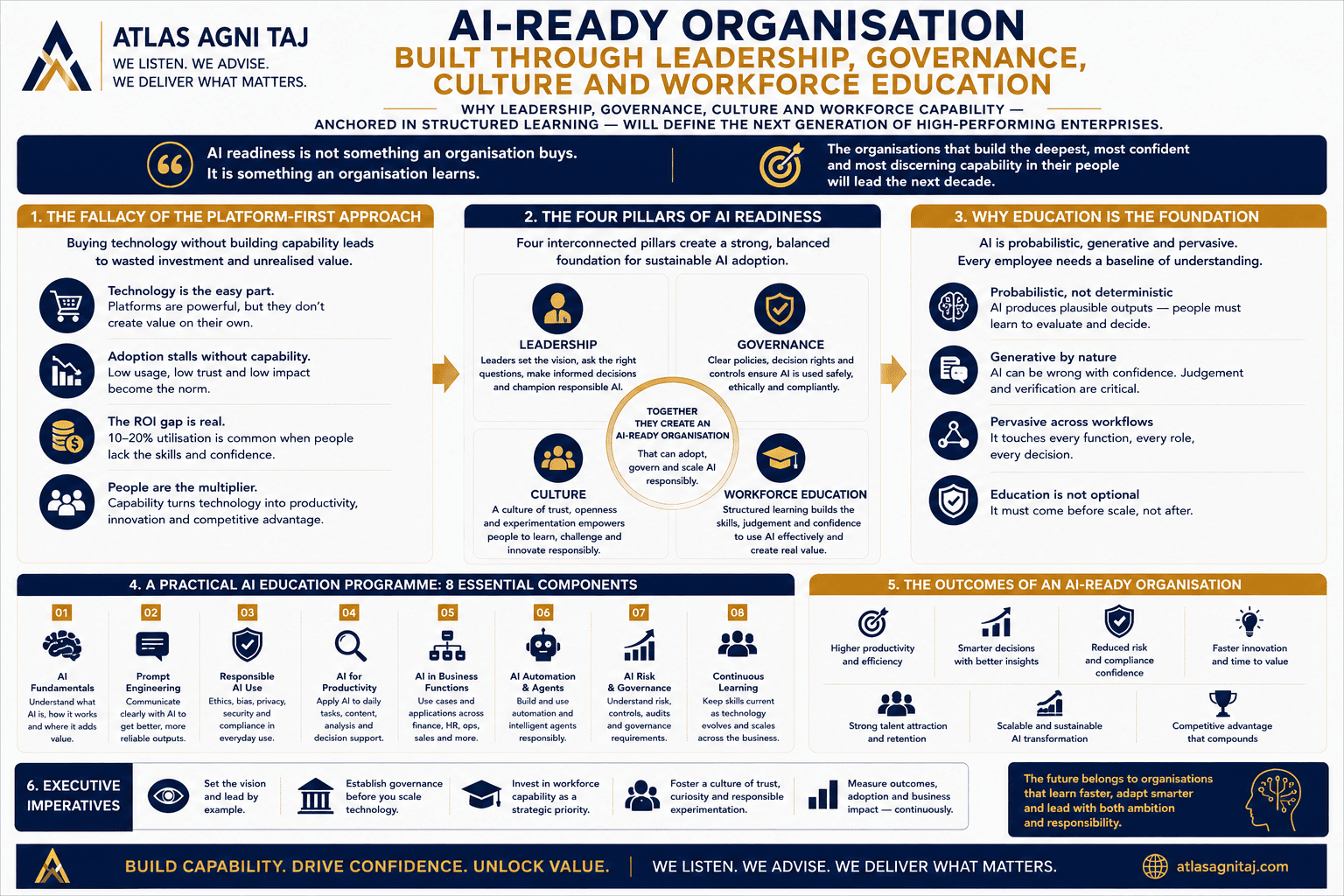
Why leadership, governance, culture and workforce capability — anchored in structured learning — will define the next generation of high-performing enterprises.
Across boardrooms in London, Dubai, Riyadh, Singapore and beyond, a single question now dominates the executive agenda: “How do we become AI-ready?” It is asked by chief executives navigating shareholder expectations, by chief information officers modernising legacy estates, by chief human resources officers redesigning the future of work, and by chief risk officers grappling with a new class of technology-driven exposure. It is a question that reflects both ambition and anxiety in equal measure.
Yet the answer, contrary to the marketing narratives that saturate our inboxes, is not to be found in the procurement of the latest artificial intelligence platform. Software licences, however sophisticated, do not confer capability. Cloud subscriptions, however elastic, do not confer readiness. A shiny copilot deployed across a workforce that neither understands its limits nor trusts its outputs will deliver disappointment, not transformation.
Genuine AI readiness is not a purchase. It is a state of organisational maturity — built deliberately, layer by layer, through the disciplined alignment of leadership intent, governance rigour, cultural openness and, most decisively, workforce capability.
The Fallacy of the Platform-First Approach
Over the past twenty-four months, many organisations have followed a familiar pattern. A senior sponsor secures budget. A vendor is selected. A platform is deployed. Pilots are launched with fanfare. And then, quietly, adoption stalls. Usage curves flatten. Business cases that once looked compelling are quietly revised. The board asks difficult questions. The programme is rebranded and relaunched, or discreetly wound down.
This pattern is not the fault of the technology. It is the predictable consequence of treating artificial intelligence as an IT project rather than a business transformation. Platforms are the easy part. What is far harder — and far more valuable — is the human infrastructure required to translate technological capability into commercial and operational outcomes.
The organisations that will lead the next decade are not those that acquired the most powerful models first. They are those that built the deepest, most confident, most discerning capability in their people. Technology is now a commodity. Human judgement, informed by structured understanding of that technology, is the differentiator.
The Four Pillars of AI Readiness
A credible AI readiness posture rests on four interdependent pillars. Neglect any one and the structure becomes unstable.
Leadership. Executives must not only sponsor AI adoption but also understand it sufficiently to challenge it, direct it and, where necessary, restrain it. A board that cannot interrogate an AI business case is a board that cannot govern one.
Governance. Clear policies, decision rights, escalation pathways and control frameworks must be in place before deployment, not retrofitted after an incident. This includes model risk management, data governance, ethical review and third-party oversight.
Culture. Employees must feel psychologically safe to experiment, to disclose errors, to challenge machine-generated outputs and to advocate for human judgement where it is warranted. A culture of fear will produce a culture of shadow AI usage, and shadow AI is where regulatory and reputational risk quietly accumulate.
Workforce capability. The workforce must understand what AI is, what it is not, where it adds value, where it introduces risk and how to work with it responsibly. This is the pillar that carries the weight of the others — and it is built, above all, through education.
AI readiness is not something an organisation buys. It is something an organisation learns.
Why Education Is the Foundation, Not the Afterthought
In most enterprise transformation programmes, training arrives at the end. The system is built, the process is redesigned, and only then does the change management workstream circulate a series of e-learning modules and lunch-and-learn invitations. This sequencing may have been defensible in the era of enterprise resource planning rollouts. In the era of artificial intelligence, it is dangerous.
Artificial intelligence is unlike previous waves of technology in three important respects. First, it is probabilistic rather than deterministic — it produces plausible outputs, not guaranteed ones, and users must be equipped to evaluate the difference. Second, it is generative — it can produce content that appears authoritative but is materially incorrect, and the reputational cost of blind acceptance can be severe. Third, it is pervasive — unlike a bounded system, it touches almost every workflow, from customer correspondence to financial analysis to legal drafting to software engineering.
These characteristics mean that every employee, not merely the specialists, requires a baseline of understanding. Education is therefore not a downstream activity to be scheduled after go-live. It is the foundation upon which every other element of the AI operating model rests. Deploy the platform without the education, and the organisation will absorb the risk without capturing the value.
A Practical AI Education Programme: The Eight Essential Components
A well-designed AI education programme is not a single course. It is a structured curriculum, tiered by role and seniority, that builds confidence progressively. In our experience advising boards and executive committees across the Gulf and the United Kingdom, the following eight components represent the minimum viable syllabus for any organisation serious about AI readiness.
1. AI Fundamentals
Employees must understand, in accessible terms, what artificial intelligence actually is. This includes the distinction between traditional machine learning, generative models and agentic systems; the concept of training data and its influence on outputs; the meaning of terms such as hallucination, grounding, retrieval and fine-tuning; and the difference between narrow AI and the broader systems that increasingly integrate multiple capabilities. This is not a technical deep dive. It is the vocabulary of an informed workforce.
2. Business Use Cases
Abstract knowledge is quickly forgotten. Applied knowledge endures. Every education programme must translate AI concepts into concrete, function-specific use cases: how the finance team can accelerate variance analysis, how the legal team can compress contract review, how the customer service team can improve resolution times, how the marketing team can personalise at scale. When employees see AI through the lens of their own work, adoption ceases to be a corporate initiative and becomes a personal opportunity.
3. Prompt Engineering Basics
The quality of an AI output is almost entirely determined by the quality of the input. Yet the vast majority of employees have never received structured instruction in how to formulate a prompt, how to provide context, how to specify format, how to iterate towards a useful answer, or how to recognise when a model is failing. Prompt engineering is not the arcane discipline it is sometimes portrayed to be. It is a practical, teachable skill, and its absence is the single largest cause of unrealised value in enterprise AI deployments.
4. Data Privacy
The moment an employee pastes a document into a public AI tool, they may have crossed a data protection boundary. Every workforce must be equipped to understand the difference between enterprise-grade platforms and consumer tools, the classification of information they handle, the specific obligations imposed by regulations such as the UK GDPR, the UAE Personal Data Protection Law and the emerging patchwork of AI-specific regulation across the Gulf, and the practical rules governing what may and may not be shared with which systems.
5. Security Awareness
AI has expanded the attack surface of every enterprise. Prompt injection, model manipulation, data poisoning, deepfake-enabled social engineering and the exfiltration of sensitive information through inadvertent disclosure are all now routine considerations. Employees do not need to become security specialists, but they do need to recognise the signals of risk and know how to escalate. Security awareness training must be updated to reflect the AI threat landscape, not left in the world of phishing emails and password hygiene.
6. Responsible AI
Every organisation deploying artificial intelligence takes on a set of ethical obligations. These include fairness across demographic groups, transparency in automated decision-making, accountability for outcomes, explainability where individuals are affected and the avoidance of harm. Responsible AI training equips employees to recognise when a use case raises ethical questions, to escalate appropriately and to contribute to a culture in which such questions are welcomed rather than suppressed. This is not a compliance exercise. It is a leadership one.
7. Organisational Policies
Education must be grounded in the specific rules of the enterprise. Which tools are approved? What data may be entered into which system? Who authorises the deployment of a new use case? What is the escalation path when something goes wrong? Which regulatory regimes apply to which business unit? Generic training is insufficient; every employee must understand the policies that govern their own conduct, and those policies must be written in language that a reasonable person can follow.
8. Real-World Exercises
Knowledge that is not applied is knowledge that is not retained. The final and most important component of any AI education programme is structured, hands-on practice. Employees must be given opportunities to work with real tools on real problems, under supervision, with feedback. Case studies, simulation exercises, sandboxed environments and supervised pilots are all essential. It is in the doing, not the listening, that capability is built.
The Business Case for Investment
Executives rightly demand a business case for any material investment, and AI education is no exception. The evidence is unambiguous. Organisations that invest in structured AI education achieve materially higher adoption rates, faster time-to-value, lower incident frequency and stronger employee engagement than those that do not. They spend less on remediation, less on shadow tooling, less on regulatory response and less on the reputational recovery that follows avoidable incidents.
Perhaps more importantly, they cultivate something that cannot be purchased at any price: a workforce that experiments confidently, that flags concerns proactively, that recognises where machine assistance adds value and where human judgement remains indispensable, and that continuously improves both its own practice and the organisation’s posture. This is the essence of a culture of continuous innovation, and it is the foundation upon which sustained competitive advantage is built.
The return on investment is not solely defensive. Organisations with a well-educated workforce identify more use cases, deliver them more quickly, scale them more safely and iterate on them more effectively. The compounding effect over three to five years is very substantial, and it accrues disproportionately to those who begin the journey early.
Common Pitfalls to Avoid
In advising organisations across sectors and jurisdictions, we have observed a small number of recurring errors that undermine even well-intentioned education programmes.
- One-size-fits-all curricula. A frontline colleague and a chief financial officer require different depths and different emphases. Tiered content, delivered in different formats, is essential.
- Vendor-led training in isolation. Vendor materials are valuable but partial. They teach the tool, not the discipline. Independent framing is required to place vendor capability within a broader operating model.
- One-off events. A single half-day workshop, however well received, does not build enduring capability. Sustained programmes with reinforcement, community and ongoing measurement are the only credible design.
- Neglect of the board. Education is too often designed for the middle of the organisation and neglects the top. A board that cannot govern AI is a board that cannot protect the enterprise.
- Absence of measurement. If capability is not measured, it cannot be managed. Structured assessment, at both individual and organisational levels, is a prerequisite for improvement.
A Regional Perspective: The Gulf Opportunity
The Gulf Cooperation Council region occupies a distinctive position in the global AI landscape. National strategies in the United Arab Emirates and the Kingdom of Saudi Arabia have placed artificial intelligence at the centre of long-term economic diversification. Sovereign investment in compute, data centres, models and talent has accelerated to a scale unmatched in most Western economies. Ministerial-level appointments, dedicated regulatory authorities and sector-specific mandates have created an environment of exceptional velocity.
For enterprises operating in the region, this creates both opportunity and pressure. The opportunity is to build capability at a pace and scale that would be difficult elsewhere. The pressure is that expectations, both governmental and commercial, are rising rapidly. Organisations that do not demonstrate credible AI readiness will find themselves at a competitive disadvantage in tenders, in partnerships, in talent attraction and in market perception. Education is the most direct and most defensible response to that pressure.
The Road Ahead
Over the next three to five years, AI capability will become one of the defining characteristics of high-performing organisations. It will be visible in productivity metrics, in customer experience scores, in innovation pipelines, in the quality of executive decision-making and in the calibre of talent an organisation is able to attract and retain. Those that prepared their people early will lead. Those that deferred the investment will spend the following decade attempting to catch up, at greater cost and with diminished returns.
The organisations that will lead tomorrow are those that are educating today. Not with a single course, not with a vendor’s marketing deck, but with a structured, tiered, sustained programme that treats capability building as the strategic priority that it is. This is not an IT decision. It is a board-level commitment to the future of the enterprise.
The organisations that prepare their people today will lead tomorrow.
How Atlas Agni Taj Can Help
Atlas Agni Taj is a boutique transformation advisory firm operating from London, Dubai and Singapore. We work with boards, chief executives and senior leadership teams to design and deliver the capability foundations upon which credible AI adoption depends.
Our AI Education and Readiness practice offers a structured, modular engagement model designed to move an organisation from ambition to demonstrable capability. Our services include:
- AI Readiness Diagnostic. A structured assessment of leadership, governance, culture and workforce capability, benchmarked against sector peers and delivered with a prioritised roadmap.
- Executive and Board Education. Bespoke sessions designed for senior audiences, focused on the strategic, governance and risk dimensions of artificial intelligence rather than the technical detail.
- Enterprise Curriculum Design. End-to-end design of tiered AI education programmes across the eight essential components, integrated with existing learning platforms and aligned to specific business use cases.
- AI Masterclass Delivery. Facilitated, high-impact learning experiences for executive committees, transformation teams and functional leadership, delivered in person or virtually.
- Governance and Policy Frameworks. Design and implementation of responsible AI policies, model risk management frameworks, data protection controls and third-party oversight mechanisms.
- Ongoing Advisory. Trusted advisory support to boards and executive committees as they navigate the practical, ethical and regulatory questions that AI adoption inevitably surfaces.
We combine deep enterprise transformation experience across the Gulf, the United Kingdom and Asia with a pragmatic, business-first approach to artificial intelligence. Our engagements are designed to build lasting capability within the client organisation, not perpetual dependency on the advisor.
If you are considering how to build genuine AI readiness in your organisation — beginning, as it must, with the education of your people — we would welcome the opportunity to discuss how Atlas Agni Taj can support you.
Atlas Agni Taj — Transformation, delivered with discipline.
London · Dubai · Singapore
atlasagnitaj.com
#AIReadiness #DigitalTransformation #Leadership #AIEducation #ResponsibleAI #FutureOfWork #AtlasAgniTaj