Why the most important control in any AI programme is not a framework, but a workforce that knows what it is doing.
Across boardrooms, regulatory forums and industry conferences, the conversation on responsible AI has settled into a familiar vocabulary. We discuss governance frameworks, model risk taxonomies, algorithmic auditing standards, red-teaming protocols, and the growing weight of regulatory instruments such as the European Union’s AI Act, the NIST AI Risk Management Framework, ISO/IEC 42001, and, for those of us operating in the Gulf, the UAE’s National Strategy for Artificial Intelligence 2031 and the emerging guidance from the UAE AI Office. These instruments are indispensable. They define the outer perimeter of what is permissible, articulate lines of accountability, and give assurance functions a defensible basis for enquiry.
Responsible AI Starts with Educated Employees
Yet as soon as one steps from the framework into the operating enterprise, a quieter and arguably more consequential picture emerges. It is not the framework that misuses artificial intelligence. It is the well‑intentioned analyst who pastes sensitive customer data into a public model to accelerate a management report. It is the marketing manager who publishes an AI‑generated statistic without verifying the underlying source. It is the recruiter who allows a scoring engine to shape a shortlist without understanding the provenance of its training data. It is the finance graduate who trusts a plausible‑sounding hallucination because it is delivered in fluent, confident prose. In every one of these cases, governance was present on paper. Judgement, at the point of use, was absent.
The uncomfortable truth is that responsible AI, in practice, begins upstream of the framework. It begins with the individual employee who must decide, in the moment, whether the prompt they are typing is prudent, whether the output they are consuming is credible, and whether the decision they are about to inform ought properly to be made by a human being. That decision is made hundreds of times a day, across every function of the modern enterprise. Unless the judgement behind it is informed, no policy manual, however elegantly drafted, will hold the line.
The Limits of Governance Alone
There is a persistent temptation, particularly at board level, to treat responsible AI as a matter that can be resolved through structure. A steering committee is convened, a policy is issued, an ethics charter is signed, a risk register is populated, and the organisation reassures itself that its exposure is managed. In regulated industries, this instinct is compounded by a compliance culture that measures maturity through documentation. If the artefacts exist, the risk is understood to be controlled.
This posture, however well intentioned, misreads the nature of AI risk. The technology is not confined to a bounded platform under the stewardship of a specialist team. It has diffused into everyday knowledge work through browsers, plug‑ins, native features embedded in productivity suites, mobile applications and unsanctioned personal tools. The average employee now has, within one or two clicks, access to a system capable of drafting communications, summarising confidential documents, generating code, producing images and offering advice with an authority that belies its actual reliability. The perimeter that governance imagines rarely exists in the field.
Consequently, the gap between policy and practice widens by the week. Frameworks describe an ideal steady state. Employees, working under commercial pressure and to demanding deadlines, resolve ambiguity in whatever way makes their next task easier. In the absence of understanding, they will assume that anything a corporate‑branded tool produces is safe, that anonymisation is a matter of removing names, that a plausible answer is a correct answer, and that a signed acceptable‑use policy is a substitute for informed judgement. Each of these assumptions is wrong, and each is quietly consequential.
Governance without literacy is theatre. It creates the appearance of control while leaving the substance of risk untouched. The organisations that will navigate the next decade of AI adoption successfully are those that recognise this early and invest, deliberately and at scale, in the capability of their people.
The Employee as the Decisive Control
In every mature discipline of enterprise risk — cyber security, health and safety, anti‑money‑laundering, market conduct — the same lesson has been learned, often at cost. Technology can raise the floor. Policy can define the ceiling. But it is the trained, alert, well‑briefed employee who determines what actually happens in the space between. A phishing email is defeated not by the mail gateway but by the colleague who pauses before clicking. A financial‑crime alert becomes an investigation not because of a rules engine but because a relationship manager asks a question that does not sit on any script. Safety incidents are avoided when a shift supervisor refuses to take a shortcut that the manual technically permits.
Artificial intelligence is no different, save that the surface area is larger and the pace of change more relentless. Every employee who uses AI — knowingly or otherwise — is making decisions that affect data security, regulatory compliance, customer trust, brand reputation and, ultimately, business outcomes. The prompts they craft, the outputs they trust, the disclosures they omit, the biases they fail to notice, the confidentiality they inadvertently breach, and the accountability they quietly delegate to a machine all constitute acts of enterprise‑scale consequence. They are not incidental. They are the substance of AI adoption.
Recognising this has a clarifying effect on the executive agenda. It moves foundational AI literacy from the periphery of the change programme, where it is often filed as an item under “change management” and delegated to internal communications, to the centre of the risk conversation. It becomes as material as information‑security awareness or anti‑bribery training, and arguably more urgent, because the technology it addresses is expanding into every workflow simultaneously.
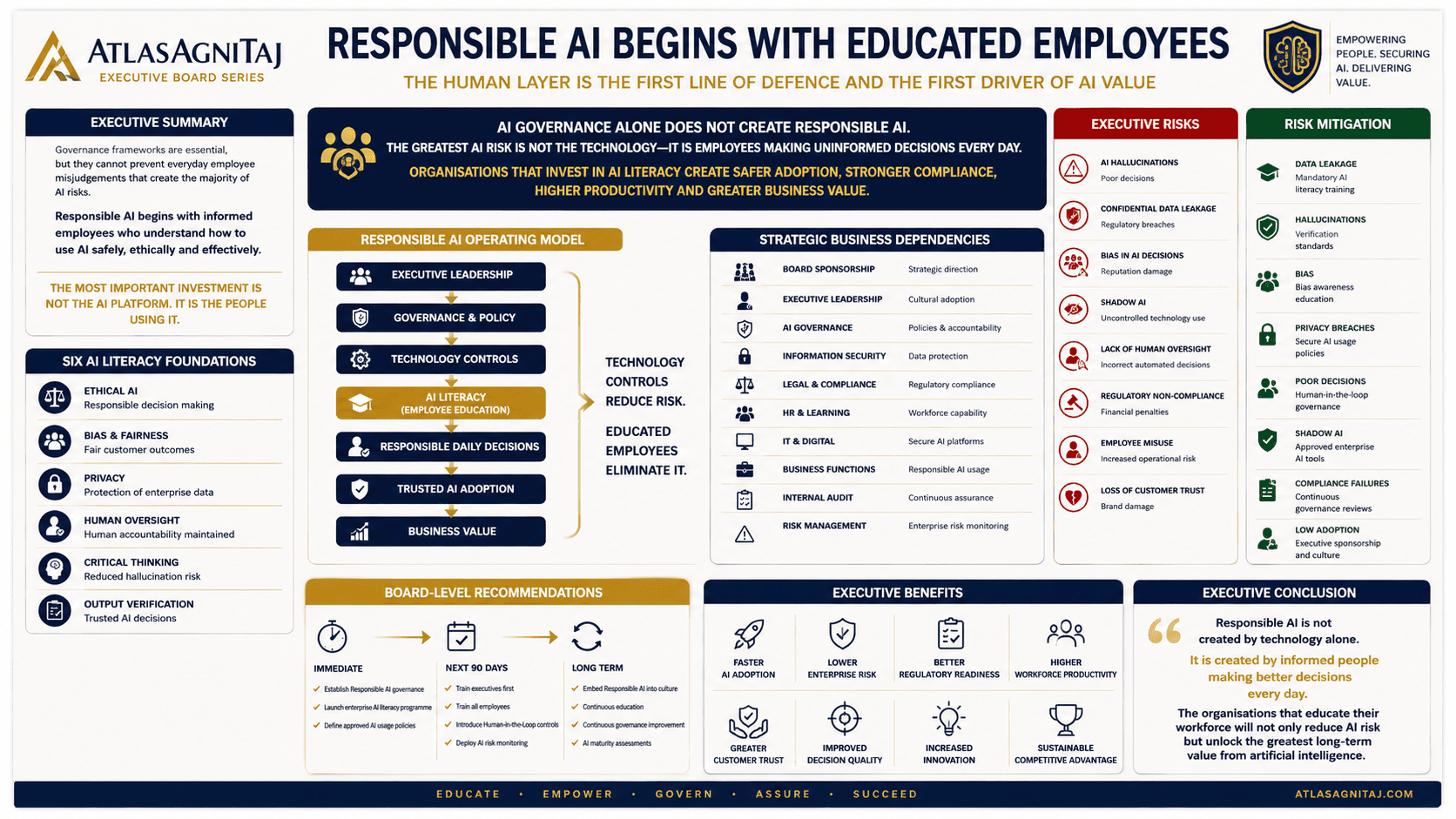
The Six Pillars of Foundational AI Literacy
A well‑designed baseline programme in AI literacy is not a lecture on the history of neural networks, nor a demonstration of prompt techniques. It is a targeted intervention that equips employees to make better decisions in the moments that matter. In our experience advising senior leaders across the Gulf and beyond, six pillars consistently emerge as the essential foundation. Each addresses a specific failure mode observed in the field, and each is amenable to being taught, practised and assessed.
1. Ethical AI Use
Employees must be able to recognise when a use case is ethically appropriate and when it is not. This is broader than legality. It encompasses fairness in customer treatment, honesty in disclosure, respect for consent, the avoidance of manipulative design, and the exercise of restraint in high‑stakes settings such as employment, credit, health and access to services. Ethical fluency is what allows an employee to say, without needing to consult a lawyer, that a particular application would be technically feasible but reputationally indefensible — and to escalate rather than proceed.
2. Bias and Fairness
A workforce that treats AI outputs as neutral is a workforce that will, in time, embed the biases of its training data into its most consequential decisions. Employees do not need to become data scientists to recognise this risk. They do need to understand that models learn patterns from historical data, that historical data reflects historical inequities, and that a system trained to predict success on the basis of past success will tend to reproduce the demographics of that success. Practical literacy here means the habit of asking, before acting on any AI‑derived recommendation, whose interests are served by the pattern the model has learned, and whose are not.
3. Privacy Obligations
The single most common category of AI incident in the enterprise is the inadvertent disclosure of confidential or personal data through a public model. Employees paste client information, employee records, strategic plans, source code and draft contracts into consumer‑grade tools with a casualness that reflects unfamiliarity rather than malice. Literacy in privacy means an intuitive grasp of what constitutes personal data under regimes such as the UK GDPR, the UAE Personal Data Protection Law and the DIFC Data Protection Law, an understanding of the difference between an enterprise‑tenanted model and a public one, and the discipline to treat every prompt as a disclosure until proven otherwise.
4. Human Oversight
Artificial intelligence is at its best when it augments human judgement, and at its most dangerous when it silently replaces it. Employees must understand where the human must remain in the loop — and, more subtly, what meaningful oversight actually looks like. A tick‑box review of a machine‑generated recommendation, conducted in three seconds by a busy colleague, is not oversight. It is theatre with a signature attached. Literacy here means understanding the difference between reviewing a document and interrogating one, and knowing which decisions in one’s own domain require the latter.
5. Critical Thinking
Large language models are exceptionally fluent, and fluency is easily mistaken for accuracy. Employees who have grown accustomed to searching for information encounter, for the first time, a source that answers with confidence, structure and apparent authority regardless of whether it is right. The result is a subtle but pervasive erosion of the sceptical instinct that underpins good professional work. Restoring that instinct — the habit of asking how a model arrived at an answer, what it might be omitting, and where it is likely to fail — is perhaps the single most valuable outcome of any AI literacy programme.
6. Verification of AI Outputs
Critical thinking, translated into practice, becomes verification. Employees must acquire simple, repeatable habits: checking a cited source against the original, cross‑referencing a statistic against a trusted dataset, testing a piece of generated code before it enters a repository, reading a summarised document to confirm that nothing material has been dropped or distorted. These habits are unremarkable in isolation. Institutionalised across a workforce of thousands, they are the difference between an organisation that harnesses AI and one that is quietly misled by it.
From Individual Literacy to Institutional Defence
Once these six pillars are in place, something interesting happens at the aggregate level. The workforce ceases to be the weakest point in the AI risk chain and becomes its strongest sensor. Employees who understand privacy obligations report unsafe tools before they proliferate. Employees who understand bias flag questionable outputs before they influence a decision. Employees who understand verification catch hallucinations before they reach a client. Employees who understand oversight decline to sign off on decisions that should not have been delegated to a machine in the first place.
This distributed vigilance is what governance frameworks presuppose but cannot themselves supply. It is the human layer that makes every other control work. Without it, the finest policy library in the world is a set of documents that no one reads and that no one is equipped to apply. With it, even modest governance structures acquire genuine force, because they are being enacted, in thousands of small decisions each day, by people who understand what they are for.
This is also where the executive tone matters. AI literacy is not a training module to be relegated to the learning management system and forgotten. It is a cultural signal. When a chief executive speaks publicly about the responsibility that comes with these tools, when a board asks pointed questions about how the workforce is being prepared, and when senior leaders visibly model verification, restraint and disclosure in their own use, the message is unambiguous. Responsible AI is not a compliance obligation being managed at the periphery. It is a leadership commitment being lived at the centre.
The Board‑Level Case for Investment
For the board and the executive committee, the case for investment in workforce AI literacy is not principally about ethics, though the ethical case is compelling. It is about durable enterprise value. The organisations that will extract genuine competitive advantage from artificial intelligence over the coming decade are those that can deploy it at scale, safely, across every function, with the confidence of regulators, customers and their own people. That is not achievable through technology procurement alone. It is achievable only where the human capability to use the technology well has been built with the same seriousness as the technology itself.
The cost of inaction, conversely, is beginning to crystallise. Regulators are moving from principle to enforcement. Customers are becoming more sophisticated in the questions they ask about how their data is handled and how decisions affecting them are made. Employees, particularly younger cohorts, increasingly assess employers on the coherence and integrity of their AI practice. And the reputational damage from a single well‑publicised incident — a leaked prompt, a biased outcome, a hallucinated statement issued in the organisation’s name — can undo years of brand investment in an afternoon.
Set against these stakes, the investment required to establish foundational AI literacy across a workforce is modest. It is measured in weeks of design and delivery, not years. It requires no new technology stack. It builds on the muscle already developed for cyber and compliance training, and it repays itself many times over in incidents avoided, decisions improved and adoption accelerated.
Responsible AI Starts with Responsible Users
The phrase deserves to be taken seriously. It is not a slogan; it is a strategic proposition. The frameworks, the regulations and the controls will continue to evolve, and organisations must engage with them thoughtfully. But the decisive variable in whether artificial intelligence delivers on its promise, or delivers a decade of avoidable damage, is the quality of judgement exercised by the people who use it every day.
That judgement is not innate. It is taught, practised and reinforced. It is the product of deliberate investment by leaders who understand that the human layer is not a residual concern to be addressed after the technology is deployed, but the foundation on which safe deployment rests. An informed workforce is the first line of defence against AI misuse, and the first engine of value from AI adoption. The two are the same workforce, and they are built in the same way.
Responsible AI, in the end, is not a property of the model. It is a property of the organisation that chooses to use it. And that begins, without exception, with educated employees.
How Atlas Agni Taj Can Help
Atlas Agni Taj is a boutique transformation advisory firm with offices in London, Dubai and Singapore, working with boards, chief executives and transformation leaders across the GCC and internationally. We combine deep experience of enterprise‑scale programme delivery with a practical, executive‑grade view of what responsible AI adoption actually requires inside a large organisation.
Our support in this domain typically spans four areas:
- AI Literacy Programmes. We design and deliver foundational and role‑specific AI literacy curricula for executive committees, senior leadership cohorts and the wider workforce, calibrated to the organisation’s risk profile, regulatory environment and cultural context.
- Responsible AI Governance. We help boards and executive teams establish practical governance structures, policy frameworks and assurance models aligned with international standards and local regulation, translated into operating rhythms that senior leaders can actually run.
- Human‑in‑the‑Loop Operating Models. We advise on the redesign of decision workflows so that human oversight is meaningful rather than ceremonial, and so that accountability remains clearly located as AI is embedded across functions.
- Culture, Communications and Executive Signalling. We work with chief executives and communications leaders on the internal narrative that turns responsible AI from a compliance obligation into a source of institutional pride and competitive differentiation.
If your organisation is beginning this journey, accelerating it, or repairing an early misstep, we would welcome a conversation. The most valuable investments in responsible AI are almost always the earliest ones, and the most valuable ones are almost always in people.
Atlas Agni Taj · London · Dubai · Singapore · atlasagnitaj.com
#ResponsibleAI