An executive perspective on turning artificial intelligence investment into measurable enterprise capability
Artificial intelligence has become one of the most consequential business topics of the decade. Boards are commissioning strategies, executive committees are approving capital, and functional leaders across every industry are procuring platforms, copilots, automation engines and intelligent assistants in the expectation of material gains in productivity, customer experience and operational efficiency. Very few enterprise conversations now conclude without a reference to AI, and very few strategic plans omit it entirely.
AI Business Training: The Smartest Investment for Enterprise AI Success
Yet beneath the enthusiasm, a common and quietly serious challenge is emerging across boardrooms in the United Kingdom, the Gulf and beyond. The technology has arrived considerably faster than the understanding of the people expected to use it. While executives debate model selection, sovereign hosting and enterprise licensing, a significant proportion of the workforce remains uncertain about what artificial intelligence actually is, how it functions in practical terms, when it is appropriate to use, and — perhaps most importantly — which risks and pitfalls to avoid.
This is not a peripheral concern. It sits at the very heart of whether an organisation will realise the returns it has forecast on its AI investments. It is precisely why foundational AI business training, delivered thoughtfully and at scale, remains one of the most disciplined and highest-yielding investments a leadership team can authorise today.
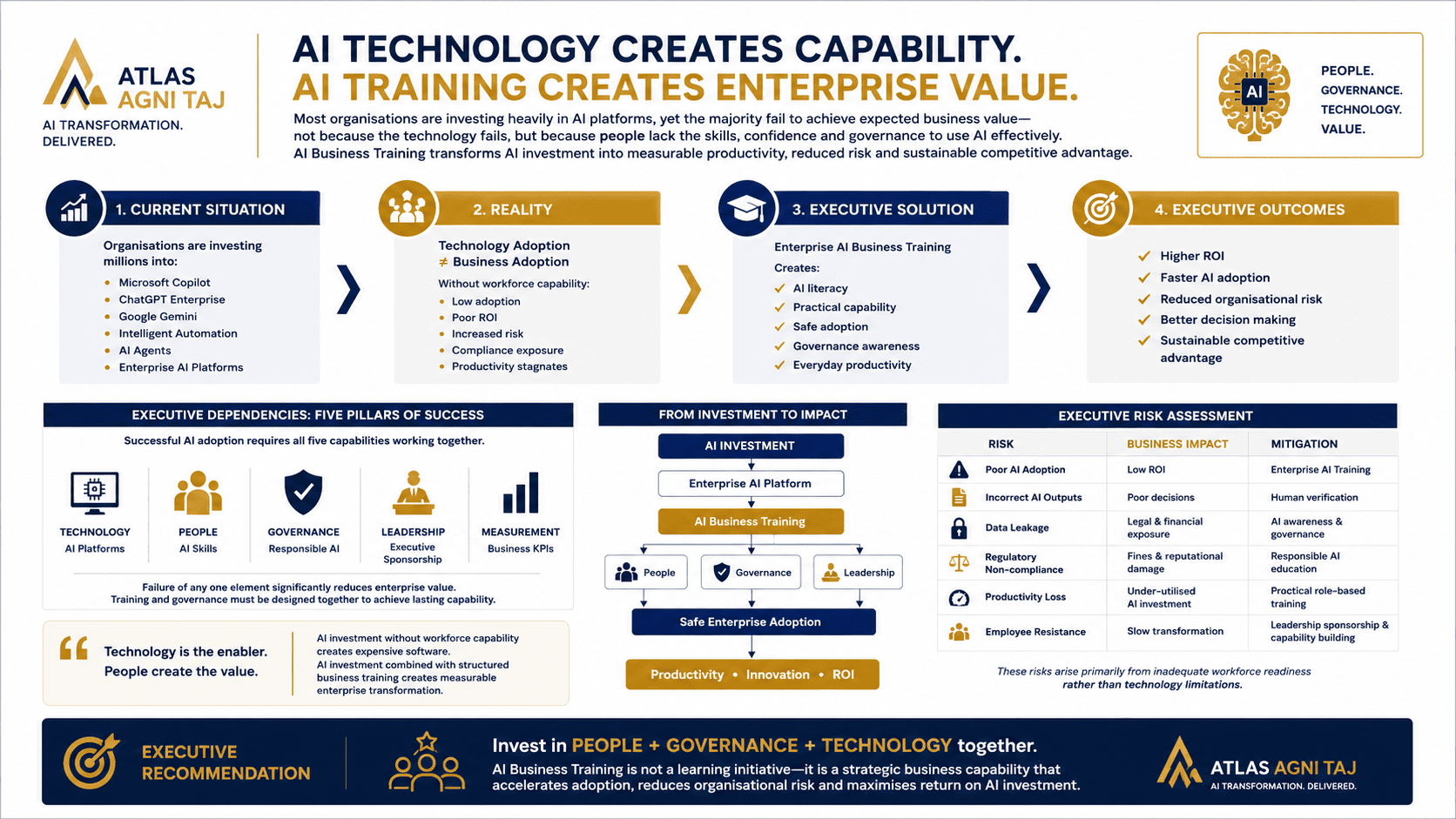
The market context reinforces the point. Investment in enterprise AI has accelerated markedly over the past two years, with corporate spend on generative AI, agentic platforms and intelligent automation reaching levels that would have seemed improbable at the start of the decade. Yet independent studies from leading advisory firms consistently indicate that a majority of AI pilots fail to reach production, and that a still larger proportion of those which do reach production fail to deliver the value originally forecast in the business case. The most common cause is not model performance or technical integration. It is the readiness of the workforce to adopt, question and apply the tools that have been provided.
AI adoption is fundamentally about people, not platforms
Enterprise transformation programmes rarely fail because the technology does not work. They falter because the people expected to adopt the technology are not sufficiently prepared, informed or confident to use it well. Three decades of experience delivering large-scale change programmes across financial services, healthcare, aviation, manufacturing and government points to a consistent conclusion: technology implementation is the more tractable half of transformation. Helping colleagues understand, trust and confidently deploy new capability is where organisations either succeed conclusively or stall expensively.
Artificial intelligence intensifies this dynamic considerably. Unlike a new enterprise resource planning system or a customer relationship management platform, generative AI is not a discrete tool bounded by a defined process. It is a general-purpose capability that reshapes how work itself is conceived, drafted, reviewed and delivered. Its value emerges only when employees at every level integrate it into everyday judgement and everyday output. That integration cannot be mandated by policy. It has to be enabled through education.
Employees do not require deep technical expertise in transformer architectures, tokenisation or retrieval-augmented generation. What they require is practical, applied knowledge that connects the technology to the reality of their working day. In particular, a well-designed AI literacy programme should ensure that every colleague, regardless of function or seniority, is able to explain and act upon the following:
- What generative AI is, in plain business language, and how it differs from traditional software.
- Where AI can meaningfully improve productivity within their specific role and function.
- How to write clear, structured prompts that elicit useful, defensible output.
- Why every AI-generated response should be critically reviewed and verified before it is relied upon.
- What categories of information must never be entered into public or unsanctioned AI tools.
- The principles of responsible AI, fairness, transparency and human oversight.
- How to escalate concerns, errors, hallucinations or ethical issues through the correct governance channels.
When these foundations are in place, AI ceases to be an intimidating novelty confined to the technology function. It becomes a familiar, trusted instrument in the everyday toolkit of the wider organisation.
Reducing organisational risk through informed adoption
The absence of basic AI awareness is not a neutral condition. It actively exposes organisations to categories of risk that are commercially, legally and reputationally material. Regulators across the United Kingdom, the European Union, the United Arab Emirates and the wider Gulf Cooperation Council region are moving swiftly to codify expectations, and enforcement activity is beginning to follow. Executive teams that treat AI literacy as optional are, in effect, accepting these exposures on behalf of their shareholders, customers and colleagues.
The most frequently observed risks include the following:
- Data leakage arising from employees entering confidential customer, commercial or personal information into public AI services that retain and, in some cases, train upon that input.
- Compliance breaches under data protection regimes, sectoral regulation and increasingly specific AI-focused legislation such as the EU AI Act and emerging UAE guidance.
- Poor decision-making stemming from an over-reliance on AI-generated content that has not been verified against authoritative sources.
- Incorrect or fabricated AI-generated content — commonly termed hallucinations — being circulated internally or, worse, externally to customers, regulators or the market.
- Reputational damage where AI-produced material is later found to be biased, factually incorrect, plagiarised or otherwise inconsistent with the organisation’s values.
- Intellectual property exposure where proprietary material is inadvertently used to fine-tune or seed third-party models.
Structured AI training gives employees the vocabulary and the mental models to recognise these risks before they become incidents. It also equips first-line managers to spot early warning signs among their teams and to intervene proportionately. In practice, an hour of well-designed training frequently prevents the sort of incident that would otherwise consume weeks of remediation, legal review and executive attention.
The regulatory dimension is worth underscoring. In the United Arab Emirates, the establishment of dedicated AI governance authorities and the appointment of ministerial responsibility for artificial intelligence have signalled a clear expectation that organisations operating in the country will demonstrate mature, evidenced AI practices. In the United Kingdom, sectoral regulators — including the Financial Conduct Authority, the Prudential Regulation Authority, the Information Commissioner’s Office and the Competition and Markets Authority — have collectively articulated principles-based expectations that place a substantial burden of proof on regulated firms. In the European Union, the AI Act introduces classification, documentation and monitoring obligations that will influence the design of enterprise AI programmes for the foreseeable future. In every case, the ability to evidence that colleagues have been trained, that acceptable-use standards are understood, and that oversight is operating as designed will be a material factor in supervisory conversations.
Improving business value and return on AI investment
The commercial case for AI literacy is at least as compelling as the risk case. Organisations that invest in developing the AI fluency of their workforce consistently achieve stronger, faster and more durable returns on the platforms they have licensed. The pattern is straightforward. Licences and platforms represent fixed cost. The value they generate is directly proportional to the depth and quality of their day-to-day use. A copilot licence used casually by an untrained employee generates a fraction of the value produced by the same licence in the hands of a colleague who understands prompting, verification and workflow integration.
The mathematics reward scale. A modest twenty-minute daily productivity improvement, achieved consistently by a workforce of several thousand colleagues, translates into thousands of reclaimed working hours each month. Those hours are reinvested in higher-value analysis, customer engagement, judgement and creative problem-solving. Multiplied across a financial year, the impact on cost, capacity and competitive positioning becomes strategically significant, and it appears in the operating margin rather than merely in the technology budget narrative.
There is a second, subtler dividend. Well-trained employees ask better questions of the technology. They identify opportunities for automation and augmentation that no central transformation team could have surfaced on its own. In this way, AI literacy transforms the workforce from passive consumers of a corporate initiative into active contributors to it, generating a continuous pipeline of practical use cases grounded in the operational reality of the business.
A third and increasingly important consideration is workforce retention and engagement. Employees who feel adequately equipped to work alongside AI tend to view the technology as an enabler of their careers rather than a threat to them. Those who feel unprepared, by contrast, frequently report anxiety, disengagement and, in some cases, a heightened intention to leave. In markets such as the United Arab Emirates and the wider Gulf, where competition for skilled professionals is fierce and where the cost of replacing experienced talent is material, this dimension of the business case is far from trivial. Investing in AI literacy is, at least in part, an investment in the confidence and retention of the workforce upon whom the organisation’s future depends.
The way forward: from experimentation to enduring capability
AI literacy should now be regarded as a core component of every organisation’s digital capability programme, on the same footing as cybersecurity awareness or data protection training. It should be embedded into onboarding for new joiners, refreshed annually for the existing workforce, and tailored to the specific responsibilities of executive, managerial and specialist populations.
The objective is not to convert accountants into machine learning engineers or lawyers into prompt engineers. The objective is to cultivate a workforce of confident, responsible and informed AI users, each capable of applying artificial intelligence safely and effectively to the business challenges within their remit. That is a distinctly different and more valuable outcome than a small centre of AI excellence surrounded by an uninformed organisation. It is also considerably more resilient to changes in vendor, model or platform, because the underlying capability resides in the people rather than in a single tool.
Achieving this outcome requires a considered programme rather than a one-off webinar. Leading organisations are structuring their AI literacy investment across three layers. The foundational layer establishes universal awareness for all colleagues, covering the essentials of what AI is, how to use it responsibly and how to protect the organisation. The intermediate layer develops applied fluency by function, equipping finance, legal, marketing, operations, human resources and technology teams with role-specific use cases, prompts and guardrails. The advanced layer prepares senior leaders and specialists to shape strategy, govern AI systems and engage credibly with regulators, boards and external stakeholders.
Underpinning all three layers is a governance framework that clarifies which tools are sanctioned, which data may be used, how outputs are validated, and how issues are escalated. Training without governance produces confusion. Governance without training produces resistance. The two must be designed and delivered together, and they must be visibly sponsored from the top of the organisation.
Equally important is measurement. AI literacy programmes should be evaluated against outcomes rather than attendance. Meaningful metrics include the volume and quality of sanctioned AI usage, the number of use cases progressed from ideation to production, the incidence of policy breaches, the reduction in cycle times for target processes, and colleague confidence measured through periodic surveys. Where these metrics are transparently reported to the executive committee, AI literacy ceases to be an intangible good intention and becomes a managed capability with clear ownership, budget and trajectory.
Technology enables transformation. People deliver it. That principle, tested repeatedly across decades of enterprise change, applies with particular force to artificial intelligence. The organisations that will benefit most from AI over the next five years are not those with the largest technology budgets or the most fashionable model choices. They are those that have invested seriously and systematically in the understanding, judgement and confidence of their people.
How Atlas Agni Taj can help
Atlas Agni Taj is a boutique transformation advisory firm with offices in London, Dubai and Singapore, established to help executive teams translate ambition in artificial intelligence, cloud, data and enterprise technology into measurable enterprise outcomes. Our work is grounded in decades of senior delivery experience across financial services, aviation, healthcare, government and diversified industrial groups in the United Kingdom, the Gulf and Asia.
We support organisations building AI capability across three complementary practices:
- AI literacy and executive education, including tailored curricula for boards, executive committees, senior leadership populations and the wider workforce, designed to be culturally appropriate to the UAE, GCC and international markets in which our clients operate.
- AI governance and responsible adoption, encompassing policy design, risk frameworks, data classification, acceptable-use standards and the operating models required to sustain them.
- AI-enabled transformation delivery, from strategy through business case, target operating model, vendor selection, programme governance and post-implementation value realisation.
Our approach is deliberately practical. We do not deliver theoretical content or generic training material. Every engagement is calibrated to the sector, regulatory environment and strategic priorities of the client, and every programme is designed to produce outcomes that are visible in the operating results of the business rather than solely in a training completion dashboard.
For executive teams considering how to translate AI investment into durable enterprise capability, we would welcome the opportunity for an initial conversation. Whether the priority is building foundational awareness across the workforce, designing an AI governance framework fit for boardroom scrutiny, or preparing senior leaders to shape AI strategy with confidence, Atlas Agni Taj can help ensure that the investment already committed to technology is matched by the equally important investment in the people who will make that technology deliver.
A closing reflection
Artificial intelligence will continue to advance rapidly, and the technology available in eighteen months will differ materially from the technology available today. That is precisely why the most durable investment an organisation can make is not in any particular platform or model, but in the enduring capability of its people to understand, adopt, govern and benefit from whatever the next iteration of AI brings. Training is not the soft edge of the AI agenda. It is its foundation.
The organisations that recognise this now — and act upon it with the same seriousness they bring to their technology investment decisions — will be the ones that look back on this decade as the moment they built a genuine, lasting competitive advantage. Those that defer will find, in due course, that they are competing not only against better-equipped rivals but also against a workforce elsewhere that has become measurably more capable, more confident and more productive. The gap, once it opens, will not be easy to close.
For every executive team asking where to begin, the answer is generally the same. Begin with a candid assessment of current AI literacy across the organisation. Establish clear, sponsored governance. Design a layered curriculum that reaches every colleague. Measure outcomes rigorously. And, above all, treat the people agenda in artificial intelligence as inseparable from the technology agenda. Handled with discipline, AI business training is not an expense to be minimised. It is one of the smartest, highest-return and most enduring investments an organisation can make.
#AtlasAgniTaj #AILiteracy #ExecutiveLeadership #DigitalTransformation #ResponsibleAI #AIGovernance #FutureOfWork