Why AI literacy is the foundation on which every governance framework must be built
A perspective by Atlas Agni Taj
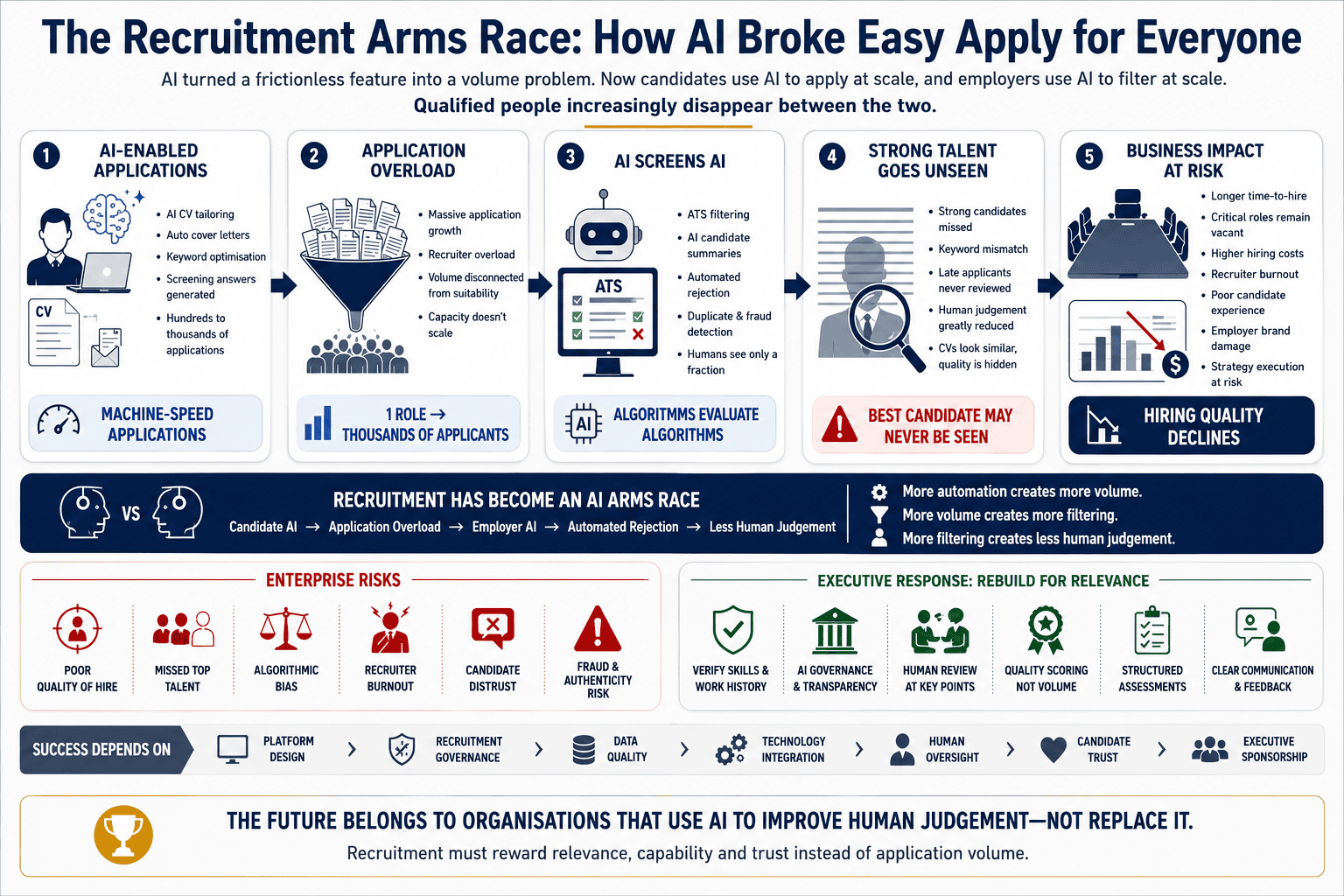
The conversation about responsible artificial intelligence has, quite understandably, been dominated by boardroom concerns: governance frameworks, ethical charters, oversight committees, model risk registers and increasingly rigorous security controls. These instruments matter. They provide the scaffolding on which organisations defend their reputations, satisfy regulators, and demonstrate seriousness to shareholders, customers and employees. In sectors bound by supervisory expectation, from financial services to healthcare to critical national infrastructure, a documented governance posture is no longer optional; it is a licence to operate.
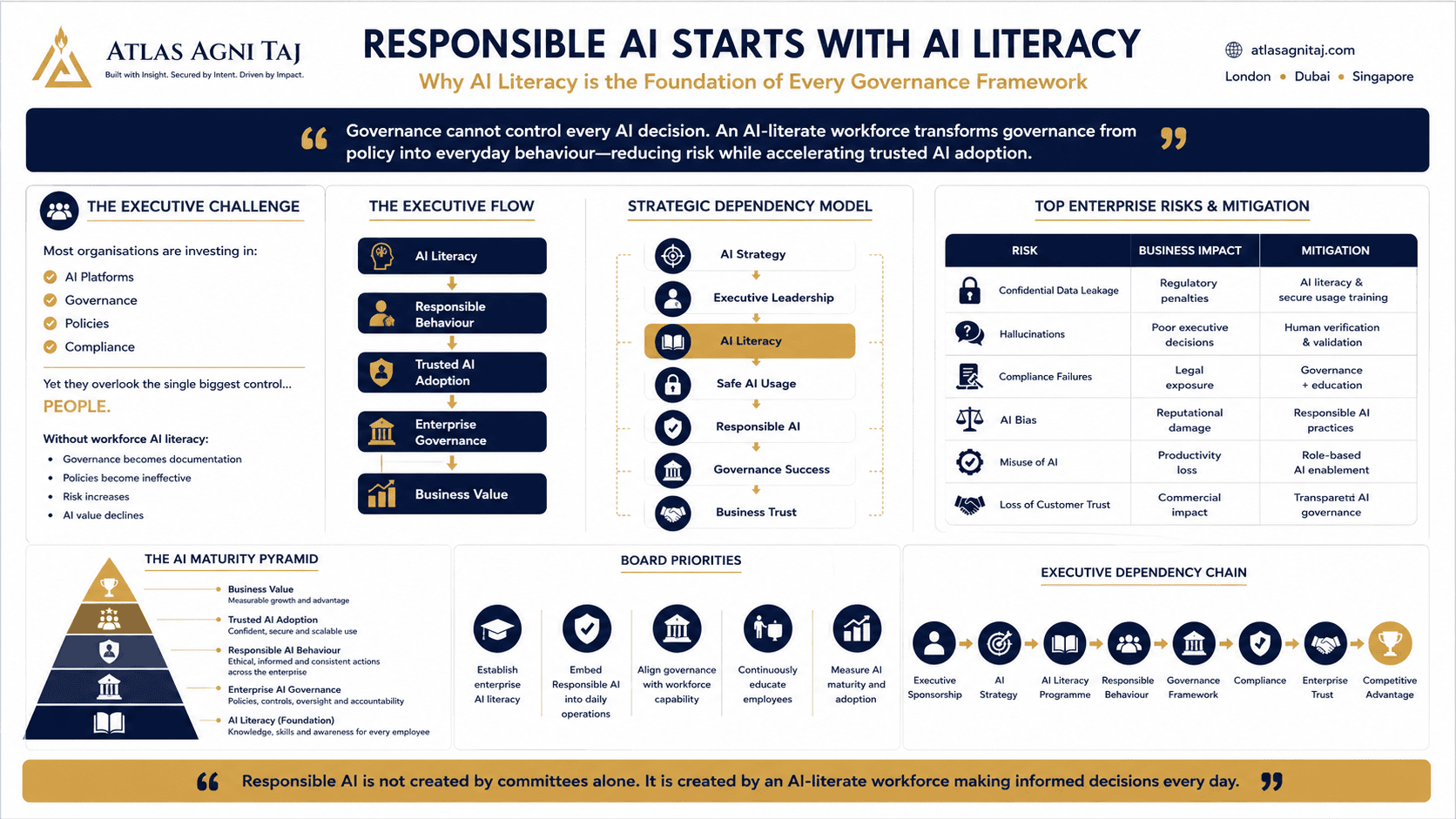
And yet, in the rush to codify AI accountability at the strategic level, an uncomfortable truth is too often overlooked. Responsible AI does not begin in the committee room. It begins at the desk of every employee who opens a chat window, uploads a document, or trusts an algorithmic recommendation. Governance without literacy is a locked front door on a house whose windows are all open. If the enterprise is to translate policy into practice, it must invest in the human beings whose everyday choices will determine whether artificial intelligence becomes a genuine competitive advantage or a source of avoidable regret.
The gap between governance and behavior
Every major operational failure of the last two decades, from mis-selling scandals to catastrophic data breaches, has followed a similar pattern. Policies existed. Committees met. Controls were documented. And yet, at the point of execution, someone made a decision, or a series of small decisions, that the framework had not adequately anticipated. Artificial intelligence introduces this familiar dynamic at a new order of magnitude. The difference is that AI tools are now embedded in the daily workflow of finance clerks, marketing coordinators, human resources administrators, legal reviewers, engineers and executive assistants. Adoption is horizontal and it is fast.
The result is that the surface area of decision-making has expanded dramatically. Where once a compliance officer might review a batch of outbound communications, today those communications may be drafted, translated, summarised and personalised by an AI model in seconds. Where once a data analyst carefully considered which datasets to combine, today an employee may paste a spreadsheet into a chatbot without a moment’s thought. The governance committee, meeting quarterly, cannot possibly inspect every prompt, every output, every judgement made at the edge of the organisation. It can only set the rules. Whether those rules are honoured, and whether the spirit behind them is understood, depends entirely on the literacy of the workforce.
The everyday risks of an AI-illiterate organisation
Consider what can go wrong when adoption outpaces understanding.
The first and most immediate risk is the inadvertent disclosure of confidential information. When employees paste sensitive material into a public model interface, whether customer records, unpublished financial results, contract drafts or personally identifiable data, they are often unaware that the content may leave the corporate perimeter. Some are equally unaware that even where enterprise tenancy protects data from external training, internal audit trails and cross-departmental visibility may still surface material that should not have been shared. The employee did not intend to breach; they simply did not know.
The second risk is the uncritical acceptance of incorrect outputs. Large language models are extraordinarily fluent, which is precisely what makes them dangerous in the hands of a user who mistakes fluency for accuracy. Confident, well-structured, grammatically pristine text is not the same as verified fact. Employees who have never been taught to interrogate an AI-generated citation, to sense-check a fabricated statistic, or to notice the subtle drift from source material into invention will, in good faith, embed errors into client deliverables, board papers, medical notes, legal advice and engineering specifications. The consequences range from professional embarrassment to material harm.
The third risk is compliance exposure. Regulatory regimes across jurisdictions, from the European Union’s AI Act to the emerging frameworks across the Gulf Cooperation Council, from sector-specific supervisory expectations in financial services to data protection statutes globally, all place obligations on how AI is used, documented and disclosed. An employee who uses an unapproved tool for a regulated purpose, who fails to record the provenance of an AI-assisted decision, or who omits a required disclosure to a customer or counterparty, exposes the organisation to enforcement action. Ignorance is not a defence recognised by any regulator.
The fourth risk is the amplification of bias. AI systems reflect the data on which they were trained and the prompts through which they are invoked. An employee who does not understand this dynamic may reinforce existing patterns of exclusion in hiring shortlists, credit assessments, customer segmentation, performance reviews and promotion decisions. Bias is rarely introduced maliciously; it is introduced through inattention. Without literacy, inattention is the default.
The fifth risk is the misuse of the tools themselves. Employees may deploy AI for tasks it cannot reliably perform, delegate judgement that should remain human, or fail to deploy it where it would create genuine value. The organisation ends up with an AI estate that is simultaneously overstretched and underused, generating risk where it should not be trusted and forfeiting productivity where it should have been embraced.
A sixth, and increasingly consequential, risk sits at the intersection of the previous five: reputational and third-party exposure. Clients, counterparties and regulators are asking sharper questions than ever about how AI is used in the delivery of professional services, in the handling of their data, and in the decisions that affect them. An organisation whose workforce cannot articulate, credibly and consistently, how it uses artificial intelligence, is an organisation whose commercial relationships will come under strain. In an environment where trust is a strategic asset, the inability to answer a straightforward due-diligence questionnaire, or to demonstrate that employees have been properly prepared for the tools on their desks, is no longer an operational nuisance. It is a live commercial risk that will be priced into contracts, renewals and partnerships.
Why top-down governance cannot compensate
Faced with these risks, the instinctive response of many boards has been to intensify governance. Additional committees are formed. Approval workflows are lengthened. Acceptable-use policies are drafted, circulated and, in the best cases, acknowledged by employees at annual compliance training. This response is necessary but insufficient. It is necessary because the enterprise requires a coherent statement of principle and a documented locus of accountability. It is insufficient because policy, however well drafted, cannot substitute for judgement at the point of use.
Consider the analogy of cybersecurity. Two decades of hard-won experience have taught the discipline a familiar lesson: the most sophisticated firewall in the world is defeated by a single employee who clicks a phishing link. The industry responded, over time, by pairing technical controls with sustained user education. Awareness campaigns, simulated phishing exercises, contextual training and cultural reinforcement together produced a workforce capable of recognising and refusing the everyday attacks that automated defences alone could not stop. Artificial intelligence is in the same position today that cybersecurity occupied in the early 2000s. The controls are maturing. The frameworks are being drafted. But without a parallel investment in the human layer, the frameworks will fail in the same way, and for the same reason.
Governance cannot inspect every keystroke. Security cannot police every prompt. Compliance cannot review every output. What each of these functions can do is set the conditions under which employees are equipped to make good decisions on their own. That equipping is the work of education.
What an AI-aware workforce looks like
An AI-aware workforce is not a workforce of data scientists. It is a workforce in which every employee, at every level, possesses a working understanding of what these tools are, what they can and cannot do, and how to use them responsibly within the specific context of their role. In practical terms, this means several things.
Employees understand, at a conceptual level, how generative models produce their outputs, why those outputs can be inaccurate, and what verification steps are appropriate before those outputs are relied upon. They know the difference between a public consumer interface and an enterprise tenancy, and they know which category of information may be shared with each. They recognise the categories of data, whether personal, commercial, regulated or client-confidential, that require particular care, and they know where to turn when they are uncertain.
They understand the principles of prompting well enough to draw genuine value from the tools without accidentally introducing bias or leakage. They know how to attribute AI-assisted work in accordance with organisational policy and, where relevant, regulatory expectation. They understand the boundary between augmentation, where AI supports human judgement, and automation, where AI substitutes for it, and they know that certain decisions must remain firmly in the former category.
Perhaps most importantly, they treat AI with the same considered scepticism that a well-trained professional applies to any other source of information. They neither dismiss it as unreliable nor embrace it as infallible. They use it as a capable but imperfect colleague whose contributions must be reviewed before they are relied upon. This posture cannot be legislated. It can only be cultivated.
Education as the first layer of AI governance
The proposition, then, is straightforward. Education is not an adjunct to AI governance. It is the first and most consequential layer of it. Every other layer, whether policy, control, audit or committee, depends for its effectiveness on the informed judgement of the users who sit within it.
This has meaningful implications for how boards, executives and chief risk officers should allocate their attention and their budget. The proportion of AI-related investment devoted to workforce enablement remains, in most organisations, disproportionately small relative to spend on tooling, infrastructure and consultancy. That imbalance is likely, in time, to correct itself, as the first waves of incidents attributable to user error make the case that no procurement decision can. Organisations that get ahead of that curve, that treat literacy as a strategic capability rather than a training-department chore, will find themselves materially better positioned when the incidents inevitably come.
Effective AI education is not a single mandatory module completed once a year and forgotten. It is a sustained programme of role-specific enablement, calibrated to the actual work that employees do, refreshed as the technology evolves, and reinforced consistently by the tone from the top. It combines conceptual understanding with practical exercises. It addresses the risks candidly, without either dramatising them or minimising them. And it is delivered by practitioners who understand both the technology and the business, and who can translate credibly between the two.
How Atlas Agni Taj supports AI-aware organisations
Atlas Agni Taj was founded to help organisations navigate exactly this kind of transformation, where the pace of technological change outstrips the pace at which institutions can adapt. Our work with clients across the United Kingdom, the Gulf Cooperation Council and Southeast Asia consistently returns to a single conviction: technology programmes succeed or fail on the quality of the human capability that surrounds them.
We support boards and executive teams in building the AI literacy that responsible governance requires. Our engagements typically combine three interlocking components. First, we work with leadership to establish a shared understanding of what artificial intelligence can and cannot do within the specific commercial and regulatory context of the organisation. This is not a generic overview; it is a directed conversation grounded in the client’s own operating model, risk appetite and strategic objectives. Second, we design and deliver role-specific literacy programmes, calibrated to the responsibilities of frontline employees, middle managers and senior leaders alike. These programmes emphasise practical judgement over abstract theory and are supported by materials that endure long after the engagement concludes. Third, we help clients connect literacy to their broader governance architecture, ensuring that policies, controls and committees are informed by, and reinforce, the behaviours that literacy makes possible.
Our AI Masterclass series has been developed specifically for executive audiences who need to make informed decisions about artificial intelligence without necessarily becoming technical practitioners themselves. Delivered as a structured programme of executive sessions, it addresses the strategic, commercial, regulatory and ethical dimensions of AI adoption in a manner calibrated to board-level and C-suite consumption. It is designed to close the gap between the fluency required to lead an AI-enabled enterprise and the technical depth that many executives, quite reasonably, will never acquire. Beyond the Masterclass, we offer bespoke advisory engagements for organisations at earlier stages of their journey, where the question is not yet how to govern advanced deployment but how to build the foundational understanding on which any subsequent deployment must rest.
Our work is informed by decades of collective experience delivering large-scale technology and transformation programmes in regulated environments, from sovereign infrastructure and financial services to healthcare, aviation and public administration. We bring the practical scars of enterprise delivery to the challenge of AI enablement, which distinguishes our advice from that of pure-play consultancies that have never had to answer to a regulator or a board audit committee on a Monday morning. Clients engage us because we speak the language of both the executive and the operator, and because our recommendations are shaped by what we know, from experience, will actually work inside a complex organisation.
Above all, our approach is anchored in the belief that responsible AI is a leadership discipline, not a technology exercise. The organisations that will thrive over the next decade are those that treat their people as the first and most important line of defence, and equally as the first and most important source of advantage, in the age of intelligent systems.
A concluding reflection
The temptation, when confronted with a new class of risk, is to reach first for the instruments of control. Committees, policies, audits and architecture all have their place, and no serious organisation should be without them. But the deepest and most durable form of responsible AI is not achieved through control alone. It is achieved when every employee, at every level, understands enough about the technology to use it wisely, to challenge it appropriately, and to escalate when uncertain.
Governance frameworks are important. Policies are important. Security controls are important. But responsible AI begins, and ultimately ends, with informed people making considered decisions. Building an AI-aware workforce is not a soft investment. It is one of the strongest strategic commitments an organisation can make in an environment where the technology will only become more capable, more embedded and more consequential.
The question for every executive team is no longer whether to govern AI. It is whether their people are equipped to make governance real. Frameworks, however elegant, are inert without an educated workforce to give them effect. Boards that recognise this early, and that resource literacy accordingly, will find that the returns compound quietly across every subsequent decision the organisation makes.
Has your organisation prioritised AI literacy alongside AI governance?
#ResponsibleAI #AIGovernance #AILiteracy #CyberSecurity #RiskManagement #ArtificialIntelligence #Leadership #DigitalTransformation #ExecutiveEducation #AtlasAgniTaj