The Rise of AI Workforce Management: Who Manages Non-Human Employees?
Every CIO will soon oversee thousands of digital employees. The governance question is no longer theoretical — it is urgent.
There is a curious moment in every technology cycle when the surface of enterprise operations appears unchanged, yet the substrate beneath has shifted irrevocably. We are living in one such moment. Across boardrooms in London, Dubai, Singapore and New York, chief executives continue to discuss headcount, succession planning and talent retention in the familiar vocabulary of human resource management. Meanwhile, quietly and at increasing scale, a second workforce is arriving — one that does not sleep, does not resign, does not require a visa, and multiplies at the pace of a software release.
This second workforce is composed of AI agents: autonomous, goal-directed digital entities capable of executing multi-step business processes with minimal human intervention. They are not the chatbots of the last decade. They are not the deterministic scripts of robotic process automation. They are systems that reason, plan, delegate to other agents, invoke tools, negotiate with counterparties, and — most consequentially — take actions that carry commercial, legal and reputational weight.
Within three years, the majority of large enterprises will operate blended workforces in which digital employees outnumber their human colleagues by an order of magnitude. Some organisations will manage this transition with intention and discipline. Most will drift into it, discovering only in retrospect that they have accumulated thousands of unmanaged, unaccountable, unsupervised non-human workers acting in their name.
The question that follows is deceptively simple, and it is one that few executive teams have yet answered with clarity: who, precisely, manages the AI workforce?
From Software Assets to Non-Human Colleagues
For four decades, the CIO’s remit has been organised around a stable conceptual model. Software was an asset to be procured, deployed, patched and eventually decommissioned. Users were people. The two interacted through interfaces, and accountability flowed cleanly along human reporting lines. When something went wrong, an individual — identifiable, employed, and answerable — was ultimately responsible.
That model is now obsolete.
An AI agent, once deployed, does not sit passively on a server awaiting instruction. It acts. It initiates communications, opens tickets, moves money, updates records, contacts customers, drafts contracts and, in the more sophisticated architectures now entering production, instructs other agents to do the same. It operates on behalf of the organisation, using the organisation’s credentials, in the organisation’s name.
To describe such an entity as “software” is to miss the essential shift. A conventional application waits to be invoked; an agent pursues objectives. A conventional application follows deterministic paths; an agent selects among options. A conventional application produces predictable outputs; an agent produces outcomes whose specific route to completion may never be reproduced. In behaviour, if not in ontology, the agent has crossed a threshold. It is closer in operational character to a junior employee than to a piece of code.
This is not a matter of anthropomorphism. It is a matter of governance. The moment an entity acts with agency, on behalf of an organisation, the governance apparatus designed for passive software becomes structurally inadequate.
The Governance Vacuum
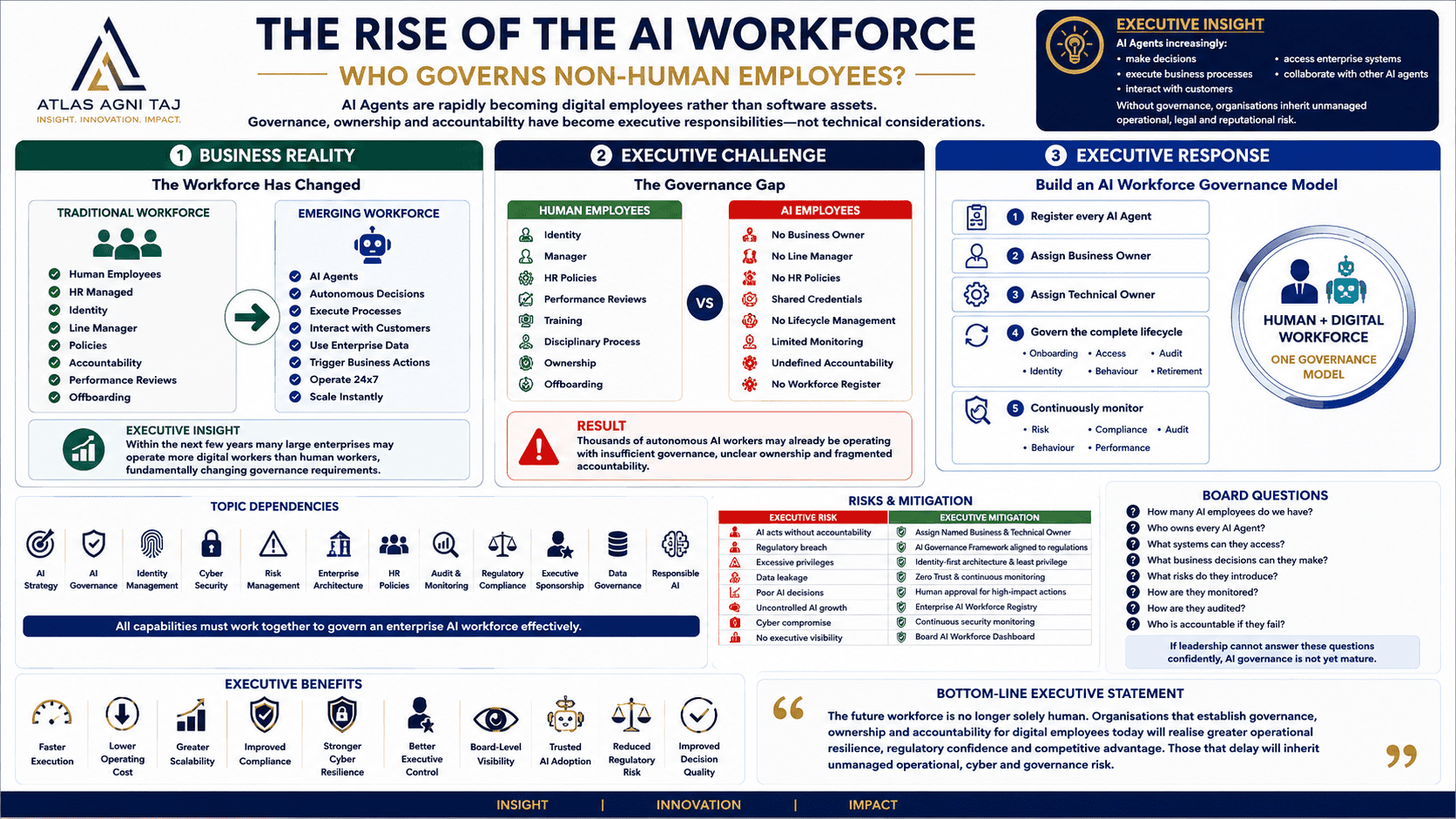
Consider the current state of controls in most large enterprises. Human employees are onboarded through a formal process that establishes their identity, verifies their right to work, provisions their access, records their reporting line, sets their objectives, and subjects them to performance review, disciplinary procedures and termination protocols. There is a clear owner, a clear line manager, and a clear escalation path.
Now consider the typical AI agent in production today. It is often deployed by a development team, integrated with production systems via API keys or service accounts, assigned permissions based on expedience rather than principle, and monitored — if at all — through generic logging tools designed for infrastructure rather than behaviour. It has no line manager. It has no performance review. It has no defined objectives beyond those expressed in a system prompt that may have been written by a contractor eighteen months ago and never revisited.
When this agent acts in a manner that harms a customer, breaches a regulation, or exposes the organisation to reputational risk, who is answerable? The developer who wrote the prompt? The vendor whose foundation model underpins it? The business owner whose process it automates? The CIO whose infrastructure hosts it? In most organisations today, the honest answer is that no one has been formally assigned. The governance vacuum is complete.
Regulators are noticing. The European Union’s AI Act, the emerging UAE frameworks for high-risk AI deployment, the Monetary Authority of Singapore’s guidance on model risk, and the developing United States executive-branch requirements around agentic systems all point in the same direction. Accountability for the actions of autonomous systems must be located in specific, named human beings within the deploying organisation. Diffuse responsibility is no longer acceptable, and it will not survive the first significant enforcement action.
The First Pillar: Identity for the Non-Human Workforce
Any credible governance model for AI agents begins with identity. Every human employee has an identity: a name, an employee number, a role, a department, a set of entitlements, and an authoritative record in the human-resources system of record. That identity is the anchor to which everything else — access, accountability, compensation, review — is attached.
Digital employees require an analogous framework. Each agent must possess a distinct, non-shared identity. It must be registered in a system of record that is authoritative for the non-human workforce. That identity must carry metadata: what the agent is designed to do, which business owner sponsors it, which technical owner maintains it, which foundation model or models it invokes, what data it may access, what actions it may take, and under what circumstances it must escalate to a human.
Critically, agent identities must not be conflated with the service accounts that IT teams have historically used for machine-to-machine authentication. A service account executes narrowly defined, deterministic tasks. An agent identity represents a purposeful, semi-autonomous actor. The two require different governance regimes, different audit trails, and different lifecycle management. Treating them as equivalent — as many organisations currently do — is one of the principal sources of the accountability gap.
This is a substantial undertaking. It requires investment in identity infrastructure purpose-built for the agentic era, integration with existing joiner-mover-leaver processes, and the establishment of a new organisational function with a remit to steward the digital workforce. It also requires the acknowledgement, uncomfortable in many technology functions, that identity management for non-human employees is not merely a technical problem but an organisational-design problem.
The Second Pillar: Human Resource Policies for Digital Employees
The moment one accepts that AI agents, for governance purposes, behave more like junior employees than conventional software, the outlines of the necessary policy framework begin to emerge. The mature enterprise has, over decades, developed a sophisticated body of practice for managing human workers. That body of practice offers a substantial and underused resource for the management of digital ones.
Consider the parallels. Human employees have job descriptions; agents require formally documented specifications that describe their permitted actions, required inputs, expected outputs, and boundaries. Human employees have probationary periods; agents require staged rollouts with defined success criteria before broader deployment. Human employees receive performance reviews; agents require periodic behavioural audits that compare actual actions with expected behaviour. Human employees are subject to disciplinary procedures when they misbehave; agents require formal remediation protocols when their outputs deviate from policy. Human employees leave the organisation through a controlled offboarding process; agents require decommissioning procedures that revoke access, archive audit logs, and confirm dependent systems have been updated.
None of this is technically novel. What is novel is the recognition that these disciplines must be applied to entities that are not, in the conventional sense, people. The chief people officer and the chief information officer, historically operating in largely separate spheres, must now co-design a workforce management framework that treats humans and agents as jointly governed populations. In several of the more forward-leaning organisations I advise, this convergence is beginning to produce a new role: head of workforce, human and digital, reporting jointly into the executive committee. The title is imperfect. The concept is essential.
The Third Pillar: Accountability and Risk Ownership
Even with identity established and human-resource-style disciplines in place, the question of accountability remains. When an agent acts in a manner that produces loss, breach or harm, who is answerable?
The answer must be located in a named human being. This is not a technological requirement; it is a legal, regulatory and ethical one. No organisation can credibly claim that responsibility for the actions of its autonomous systems rests with the systems themselves. The doctrine of the “electronic person,” occasionally floated in academic and regulatory discussions, has found no serious purchase in the law and is unlikely to do so. Corporations act through human agents, and the actions of digital agents they deploy must ultimately be traceable to human decision-makers.
In practice, this requires the assignment of two roles for every deployed agent. The first is the business owner: the executive whose function the agent serves and whose profit and loss bears the agent’s costs and benefits. The business owner is accountable for the agent’s outcomes. The second is the technical owner: the individual within the technology function responsible for the agent’s construction, monitoring, maintenance and remediation. The technical owner is accountable for the agent’s fitness for purpose. Neither role can be delegated to a committee, nor can it be assigned by default to the CIO. Both must be formally documented, communicated, and reflected in the individuals’ objectives and performance evaluations.
Risk ownership follows the same logic. Every agent introduces risk — operational, regulatory, reputational, cyber, ethical. Those risks must be enumerated, quantified where possible, and assigned to owners within the enterprise risk framework. The chief risk officer, historically concerned with financial and operational exposures, must now extend the risk register to include the population of digital workers, their aggregate exposure, and the systemic risks that emerge when hundreds or thousands of agents interact with one another and with the enterprise’s environment.
The CIO’s Expanded Mandate
For the chief information officer, this represents the most significant expansion of remit since the enterprise adoption of the internet. The CIO of the coming decade is not merely a steward of technology. The CIO is the executive responsible for the deployment, governance and behaviour of an entire workforce category that did not previously exist.
This is a mandate of a different order from the one most CIOs currently occupy. It requires fluency in domains that have historically sat outside the technology function: labour policy, ethics, organisational design, behavioural audit, and — increasingly — the emerging body of regulation that governs autonomous systems. It requires a new operating model in which the technology function is not merely a supplier of tools to the business but a co-manager of the workforce that executes the business.
CIOs who approach this transition as a matter of tooling and platform selection will find themselves outpaced by events. Those who approach it as a matter of organisational transformation — building the identity infrastructure, the workforce management disciplines, the accountability frameworks, and the executive relationships that agentic operations demand — will find themselves in the strongest position of their careers.
There is a further implication, less often discussed. If the CIO is to be effective in this expanded role, the CIO must be materially involved in commercial strategy. Decisions about which processes to automate, which functions to augment, which workflows to reimagine, and which risks to accept are decisions with profound commercial consequences. A CIO consulted only after such decisions have been taken cannot govern the digital workforce that results from them. The seat at the executive table, long argued for and inconsistently delivered, is now a governance necessity.
A Board-Level Question
None of what has been described so far is a matter that boards can safely delegate. The board of a large organisation carries ultimate accountability for the entity’s conduct, its regulatory compliance, its risk posture and its treatment of stakeholders. Each of these is now materially affected by the behaviour of digital employees. It follows that the governance of the AI workforce is a board-level question, not merely a management one.
In practice, boards should be asking a small set of unavoidable questions. How many autonomous agents does the organisation currently operate? Who owns each of them? What actions can they take? What data can they access? What is the aggregate risk exposure they represent? What audit trail exists for their decisions? How are they decommissioned when no longer required? What is the escalation path when they behave outside expected parameters? What regulatory obligations attach to their operation, and how are those obligations discharged?
In my experience, no more than a handful of major boards can today answer these questions with the specificity they require. That is not a criticism; it is a description of a rapidly emerging governance frontier. It is, however, a criticism if the questions are not being asked. The absence of the questions from the audit committee agenda, from the risk committee agenda, and from the executive committee’s forward-looking discussion is itself a governance failure — one that will become increasingly conspicuous as the digital workforce grows.
A Practical Blueprint
For executives seeking to move from principle to practice, a five-part programme offers a practical starting point.
First, establish an authoritative register of the digital workforce. Every agent in production and every agent in pilot should appear in a single system of record, with its identity, owners, permissions, actions, and risk classification. Where no such register exists, its creation is the priority. It is difficult to govern what one has not counted.
Second, formalise the two owners for every agent — business and technical — and reflect these accountabilities in objectives, performance evaluations and remuneration decisions. Accountability that carries no consequence for the accountable is not accountability. It is a diagram.
Third, extend the enterprise risk framework to encompass the digital workforce. The risk register should include, at an appropriate level of granularity, the exposures introduced by agentic operations. The chief risk officer should carry an explicit remit for this population, supported by dedicated analytical capability.
Fourth, develop human-resource-analogous policies for digital employees, co-authored by the chief people officer and the chief information officer. These should cover the full lifecycle: onboarding, deployment, monitoring, performance review, remediation and decommissioning. The vocabulary may be adapted, but the disciplines are transferable.
Fifth, elevate the governance of the digital workforce to a standing agenda item at the executive committee and, at appropriate intervals, at the board. Regularity of executive attention is the single most reliable predictor of governance maturity. Ad hoc engagement produces ad hoc control.
None of this is easy, and none of it is optional. The organisations that undertake it early will possess a decisive operational and reputational advantage. Those who defer it will discover, in due course, that governance retrofitted after a crisis is significantly more expensive and considerably less effective than governance designed with intention from the outset.
A Closing Reflection
The rise of the AI workforce is not a story about technology. It is a story about institutions. The technologies that enable agentic operations are impressive, and their capabilities will continue to advance at a pace that outpaces most organisational responses. But the outcomes that matter — whether the digital workforce augments human potential or diminishes it, whether it strengthens institutional trust or erodes it, whether it advances the interests of stakeholders or exposes them to unmanaged risk — will be determined not by the technologies themselves but by the governance choices made by the leaders who deploy them.
Those leaders now occupy a moment of considerable consequence. The decisions made over the next twenty-four months about how digital employees are identified, managed, held accountable, and integrated into the fabric of the enterprise will shape the operating character of organisations for a generation. This is not a matter for the technology function alone. It is a matter for the chief executive, the chief people officer, the chief risk officer, the general counsel, the chief information officer and the board — acting in concert, with clarity of purpose, and with an honest acknowledgement that the workforce they lead is no longer wholly human.
The organisations that recognise this now and act on it with the seriousness it deserves will define the next chapter of enterprise leadership. Those that do not will be defined by it.
#AIWorkforce #DigitalEmployees #AIGovernance #CIOLeadership #FutureOfWork