Executive Thought Leadership
From Conglomerate to Ecosystem — Governance, Capital and Data in the Next Generation of Gulf Family Enterprise
For fifty years, the family conglomerate has been the defining institution of Gulf commerce. A founder builds a core trading or distribution business, cash is generated, confidence grows, and the enterprise diversifies into real estate, retail, healthcare, and financial services. This model has created extraordinary wealth and remains, in many respects, a Gulf success story without parallel.
But the model that built this wealth is not the model that will sustain it. The next generation of leading family enterprises across the UAE and the wider GCC will not resemble the conglomerates of their founders. They will be platforms: orchestrated ecosystems of capital, talent, technology, and market access, spanning multiple businesses, sectors, and geographies. This is not a distant prospect. It is already under way, and it is reshaping how the region’s most consequential private enterprises will be governed, capitalised, and led.
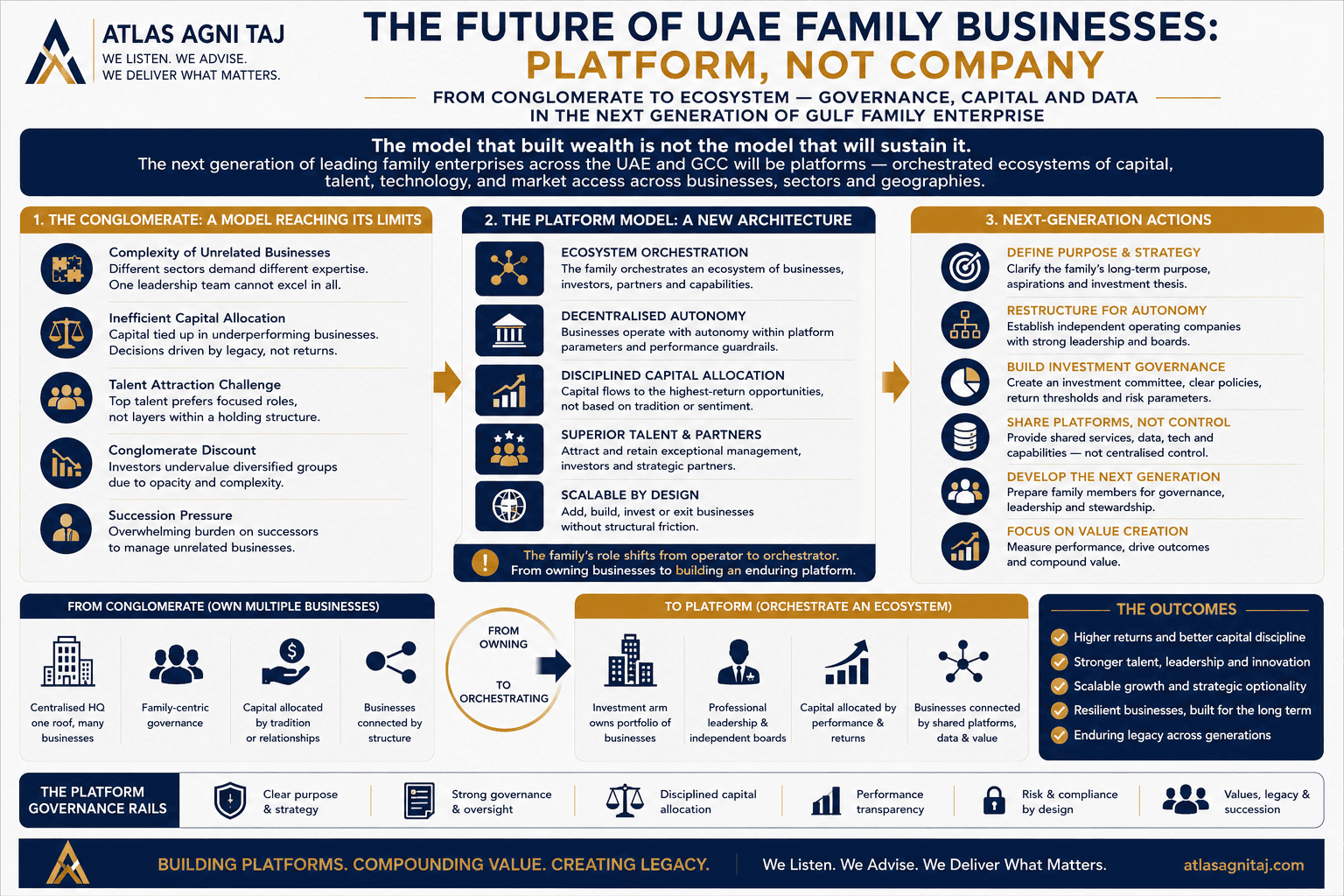
The Future of UAE Family Businesses: From Conglomerate to Platform
The conglomerate structure served its purpose well. A core business generated cash, which funded diversification. Risk was distributed across sectors. Scale conferred negotiating power. For a first generation building an enterprise from limited capital and limited institutional infrastructure, this was a rational, resilient design.
Its constraints, however, are becoming difficult to ignore. Managing unrelated businesses under one roof demands fundamentally different operating expertise, and a leadership team well suited to automotive distribution is rarely equally suited to healthcare delivery or financial services. Capital allocated to one line of business is capital unavailable to another, and without disciplined, comparable metrics across sectors, optimal allocation becomes more art than science. Attracting exceptional talent is harder still: a distinguished healthcare executive is seldom drawn to a role inside an automotive-led group, however successful that group may be.
Perhaps most tellingly, investors and capital markets have long applied a “conglomerate discount” to diversified holding structures, unable to cleanly value which businesses create value and which merely consume it. And when the founding generation steps back, the burden of overseeing an unrelated portfolio of businesses frequently overwhelms a single successor or even a small group of them.
These are not new observations. What is new is the confluence of external pressure and internal readiness that is now driving family enterprises to resolve them — not through incremental adjustment, but through structural transformation.
Defining the Platform Model
A platform, in its modern sense, is an ecosystem that creates value by connecting multiple parties — businesses, investors, service providers, and customers — and by enabling transactions and relationships between them. Applied to a family enterprise, the platform model represents a shift in the family’s role: from a family that owns multiple businesses, to a family that orchestrates an ecosystem of businesses.
The distinction is subtle in language but consequential in practice.
Under a conglomerate model, the family owns and operates its businesses directly. These businesses connect through corporate structure and internal capital flows. A single centre — typically the corporate head office or family office — manages all businesses and makes strategic decisions centrally, allocating capital according to founder judgement.
Under a platform model, the family instead owns an investment arm that invests in and manages a portfolio of businesses. These businesses connect through shared infrastructure, customer networks, and capital flows, but the centre’s role shifts from control to governance, capital provision, and capability building. Business units retain significant operating autonomy within platform parameters, and capital is allocated according to comparative return, not tradition or sentiment.
This shift carries several practical implications for how a group is run. Each business gains a clear leader and a distinct operating model, held accountable on its own terms rather than absorbed into a single corporate identity. Because businesses operate with meaningful autonomy, they become able to attract professional management talent that would not otherwise consider a role several layers beneath a family holding structure. External investors — private equity in particular — find it far easier to invest in a specific, well-defined business than to acquire an entire diversified conglomerate. Capital allocation becomes more dynamic, directed toward the highest-return opportunity regardless of whether that opportunity sits within the group’s traditional “core.” And the structure itself scales more naturally: new businesses are added to the platform rather than absorbed into an increasingly unwieldy centralised entity.
From Conglomerate to Platform: An Illustrative Evolution
To make this transition concrete, consider how a diversified regional group might evolve from a classical conglomerate toward a platform architecture.
In its conglomerate form, such a group typically operates through a single central headquarters overseeing business units in retail, automotive, real estate, and industrial sectors. Governance is family-centred, and capital allocation is determined at the centre, largely by relationship and precedent rather than comparative return.
In its platform form, the same group would establish separate operating companies for each business line, each with its own identity, professional CEO, and board. An investment arm — a dedicated capital allocation vehicle — takes responsibility for the group’s overall portfolio strategy, deploying capital across operating companies according to return expectations rather than historical allegiance. Shared services such as finance, HR, and IT remain centralised, but are repositioned as internal service providers to the operating businesses rather than as instruments of central control. Family governance is retained, but is exercised at the level of the investment company, not within the day-to-day management of individual operating businesses.
The dividends of this evolution are considerable. Each operating company becomes simpler to understand, govern, and value in isolation. Each is better positioned to attract world-class talent by offering genuine autonomy alongside clear accountability. External capital — whether private equity, sovereign co-investment, or institutional debt — becomes accessible either at the level of an individual operating company or at the level of the platform itself. And the platform gains the capacity to acquire and integrate new businesses without forcing them into a predetermined corporate mould.
Several prominent Gulf groups are widely regarded, in industry commentary, as illustrating stages of this evolution — from diversified trading conglomerates toward structures with distinct operating companies and dedicated investment arms. The specifics of any single group’s internal governance are, of course, a matter for that group alone; the broader pattern, however, is unmistakable across the region’s most sophisticated private enterprises.
Data as the Core Platform Asset
One of the most consequential differences between a conglomerate and a platform lies in the treatment of data.
A traditional conglomerate typically collects financial data — revenue, cost, and profit — at the level of each business unit, but frequently lacks integrated visibility into operational data: customer behaviour, supply chain efficiency, and operational quality across the group as a whole.
A modern platform treats data as a core strategic asset in its own right, building visibility across four dimensions. It seeks to understand its customers holistically: who they are across every platform business, what their purchasing patterns reveal, and what additional value the platform might offer through cross-selling. It examines supply chain data to identify consolidation opportunities and eliminate inefficiency across previously siloed procurement functions. It compares operational performance across businesses to identify best practice and transplant it where it can create the greatest value. And it interrogates true, comparable profitability at the level of each business and product line, enabling capital allocation decisions grounded in evidence rather than assumption.
This integrated visibility enables portfolio optimisation — identifying with confidence which businesses are creating value and which should be divested; cross-selling across previously disconnected customer bases; procurement leverage through consolidated supplier relationships; systematic best-practice transfer between businesses; and materially better-informed capital allocation. The groups building genuine data integration today are establishing a competitive advantage that will be extraordinarily difficult for slower-moving competitors to close.
The Digital-First Operating Model
Traditional family businesses were built for a physical-first era: retail meant physical stores, distribution meant trucks and warehouses, and customer relationships were built through in-person meetings. The platforms of the next decade are, by contrast, built with digital-first assumptions embedded from the outset.
Increasingly, businesses sell directly to consumers through digital channels rather than through traditional retail or distribution intermediaries, improving margin and capturing first-party customer data in the process. Some platforms are evolving toward marketplace models, connecting buyers and sellers and earning commission rather than owning inventory — a structurally lighter, more scalable approach to growth. Long-standing services are being reimagined through technology: the retailer becomes, in effect, a mobile shopping platform; the distributor becomes a supply chain logistics operator. And a number of platforms are discovering that the data they already hold — customer behaviour, supply chain patterns, market insight — can itself be monetised as a service to suppliers and partners.
The resulting advantages are substantial: materially lower capital intensity relative to physical expansion; market reach that scales across geographies far more efficiently than store-by-store growth; richer, more direct customer insight; and entirely new revenue streams built on data and digital services that did not previously exist within the group’s commercial model.
The Investment Arm as the Platform’s Centre of Gravity
The most sophisticated next-generation family enterprises are repositioning their investment arm as the strategic centre of the entire platform, rather than as a back-office support function.
In this configuration, the investment arm makes the group’s core investment decisions — which businesses to acquire, divest, or grow — and manages portfolio companies through professional governance structures rather than informal family oversight. It allocates capital according to return expectations and strategic fit, actively sources new investment opportunities rather than passively administering existing ones, and develops a cadre of investment professionals capable of evaluating and managing businesses across multiple sectors.
This model offers professional discipline, in that capital allocation follows investment logic rather than founder preference; genuine scalability, because growth depends on professional investing capability rather than founder bandwidth; improved access to external capital, since institutions and family offices are considerably more willing to co-invest alongside professional investment teams; and a cleaner exit capability, allowing value to be monetised at the investment level rather than requiring the sale of entire operating businesses. A number of leading regional groups have moved decisively in this direction, building investment arms of genuine scale and sophistication.
The Sovereign Wealth Fund Analogy
The most ambitious next-generation family enterprises are evolving toward what might be described as a sovereign wealth fund model in miniature — an institutional investment platform built on the foundation of an operating business heritage.
In this model, the family accumulates capital generated by its operating businesses, and a professional investment team assumes responsibility for deploying that capital across sectors, geographies, and asset classes. Some capital remains within the operating businesses, but a growing share is directed into financial investments spanning real estate, equity stakes, fixed income, and alternative assets. Over time, the platform itself becomes a substantial capital allocator, commanding institutional respect and genuine market influence.
This model is distinguished by several characteristics: scale sufficient to command institutional standing; genuine diversification across asset classes rather than concentration in a handful of operating sectors; an explicit focus on return generation rather than the operation of any single business; management by world-class investment professionals rather than the founder personally; and institutional gravitas that allows the platform to compete credibly alongside pension funds, endowments, and sovereign wealth funds. Some of the region’s most prominent institutional investors began as family-controlled entities before evolving, over decades, toward precisely this model — now managing assets at a scale few could have anticipated at their founding.
Governance: From Family Control to Institutional Discipline
As family enterprises evolve from company to platform, governance must evolve in step, typically progressing through four recognisable stages.
In the earliest stage, the founder makes all decisions personally, family members are involved informally, and governance structures are minimal by design. In the second stage, the family begins to meet formally to make decisions, and governance structures emerge, though they remain firmly family-focused with limited professional management. In the third stage, a professional family office assumes responsibility for managing assets and investments, a professional board oversees major decisions, and the family retains meaningful governance input even as day-to-day decisions become increasingly professional. In the fourth and most advanced stage, the platform is governed as a professional institution in every material respect; the family retains ownership but relinquishes operational control, and governance becomes, for practical purposes, indistinguishable from that of a professionally managed institutional investor.
Most next-generation platforms across the region are moving from the second stage toward the third; the most sophisticated are approaching the fourth. This evolution is not optional. As platforms grow, family-based decision-making becomes an operational constraint rather than an asset; complexity demands professional governance simply to be manageable; professional managers expect — and increasingly require — professional governance as a condition of joining; and external investors, without exception, prefer to commit capital alongside professional governance rather than informal family oversight.
From Business Families to Investment Families
The cumulative implication of this evolution is that family enterprises are gradually converting from business families — families that operate businesses — into investment families — families that manage capital and investment portfolios. This convergence is already visible across the region: families whose wealth was built in trading now manage diversified investment portfolios; families that built retail empires now invest across multiple, often unrelated sectors; and families that operated manufacturing businesses now oversee sophisticated capital allocation strategies that bear little resemblance to their founding activity.
This shift changes the nature of family engagement in three fundamental ways. The family’s focus moves from operations to strategy — from managing day-to-day activity to setting capital allocation priorities and strategic direction. Personal relationships give way, gradually, to professional management, as the platform comes to rely on professional leadership rather than founder-driven relationships. And the definition of success itself changes, from company building — measured by business size and market presence — to wealth management, measured by return on capital and long-term wealth creation.
The Generational Advantage
The next generation of family business leaders is uniquely positioned to drive this evolution, having been educated and exposed to institutional investing, professional management, and global capital markets in ways their parents’ generation typically was not. A second- or third-generation leader who studied at a leading business school and worked within private equity or an institutional asset manager brings frameworks and instincts that lead naturally toward platform thinking. Many of these leaders find themselves genuinely frustrated by traditional family business structures, precisely because they can see the potential for more professional, more efficient, and more scalable models close at hand.
The family enterprises that will thrive over the next twenty years share three characteristics: the founding or senior generation recognises the value of platform evolution rather than resisting it; the next generation brings the skills and perspective required to build genuinely professional platforms; and the transition is managed as a deliberate strategic evolution, planned and sequenced, rather than as a crisis-driven transformation forced by circumstance.
Why Platform Positioning Matters Now
Understanding this evolution carries a direct, practical implication for family business leaders today. Positioning a business at the forefront of this shift — moving deliberately toward platform models, professional governance, and sophisticated capital allocation — signals to the market, to investors, and to the organisation itself that leadership understands where the future is heading.
This positioning attracts private equity investors who see an opportunity to partner in genuine platform evolution; professional managers who see a clear career path within a sophisticated, well-governed platform; customers and suppliers who value a stable, professionally managed partner; and next-generation family leaders who see the opportunity to build something ambitious and enduring. Conversely, family enterprises that remain anchored to traditional conglomerate structures signal stagnation, limited growth potential, and vulnerability to disruption — an increasingly costly signal to send in a region where capital, talent, and ambition are more mobile than ever before.
Conclusion: The Coming Transformation
The family enterprises that will dominate the GCC and the wider Middle East in twenty years’ time will look substantially different from those that dominate today. They will be organised as platforms, not conglomerates. They will be managed by professional investors, not solely by founders. They will be governed by institutional boards, not by family councils alone. They will compete on capital efficiency and return generation, not on founder reputation. And they will be digital-first, data-driven, and globally connected as a matter of design, not aspiration.
This transition is already under way. Some groups are leading it decisively; others are lagging, often without fully recognising the gap that is opening between them. For family business leaders reading this, the relevant question is no longer whether this evolution will occur — it will. The relevant question is whether you will lead it, or be led by it.
The families that proactively evolve toward platform models — professionalising governance, attracting genuine investment talent, building digital capability, and creating institutional structures fit for the next fifty years, not merely the last fifty — will generate materially more wealth than those that remain attached to traditional models out of habit or sentiment. The opportunity is extraordinary. But it requires recognising, clearly and early, that the future of the family enterprise is not about operating more companies. It is about orchestrating ecosystems of capital, talent, and opportunity with the discipline of an institution and the ambition of a founder.
How Atlas Agni Taj Can Help
Atlas Agni Taj works with family enterprises and their boards at precisely this inflection point — where operational scale has outgrown conglomerate governance, and where the transition to a platform model must be designed, sequenced, and executed without disrupting the businesses that fund it.
Our support typically spans four areas. We help boards and family principals assess current governance maturity against the four-stage model outlined above, and design a realistic, phased pathway toward institutional governance. We support the design of investment-arm operating models, capital allocation frameworks, and portfolio governance structures that allow professional decision-making to sit comfortably alongside family ownership. We advise on the data and technology architecture required to give a platform genuine cross-business visibility — customer, supply chain, operational, and financial — drawing on our background in large-scale ERP, cloud, and AI-readiness transformation across the region’s most complex regulated environments. And we help leadership teams and family principals build the case for platform positioning to investors, professional talent, and their own organisations, translating strategic intent into a credible, sequenced transformation programme.
If your organisation is beginning to ask whether it is still a company, or is ready to become a platform, we would welcome the conversation.
#FamilyBusiness #GCC #UAE #PlatformStrategy #CorporateGovernance #PrivateEquity #DigitalTransformation #WealthManagement #BusinessLeadership #AtlasAgniTaj
Atlas Agni Taj Proprietary