The Real Challenge Isn’t Growth — It’s Transition
Why Family Businesses Fail at the Moment of Succession — and What GCC Leaders Can Do Differently
There is a paradox at the heart of family business dynamics that few outsiders truly understand, and that even seasoned insiders are often reluctant to name: the moment of greatest strength is frequently the moment of greatest vulnerability. A founder who has built a formidable enterprise stands, at the very peak of that achievement, on the threshold of the single event most likely to unravel it.
A first-generation founder builds a family business through sheer force of will, entrepreneurial instinct, precise market timing, and relentless personal execution. The business becomes profitable. It becomes dominant in its category. It weathers economic cycles, competitive incursions, and periods of genuine crisis. Cash flows are strong and dependable. Operations are understood intimately by the founder — not because they have been documented, but because they exist, in granular and largely unwritten form, in the founder’s own mind.
Then the founder confronts the inevitable: ageing, retirement, ill health, or simply the private wish to step back and enjoy the fruits of a life’s work. What happens in the months and years that follow determines whether the enterprise thrives into a second and third generation, or begins a slow drift into paralysis, dilution, or outright failure.
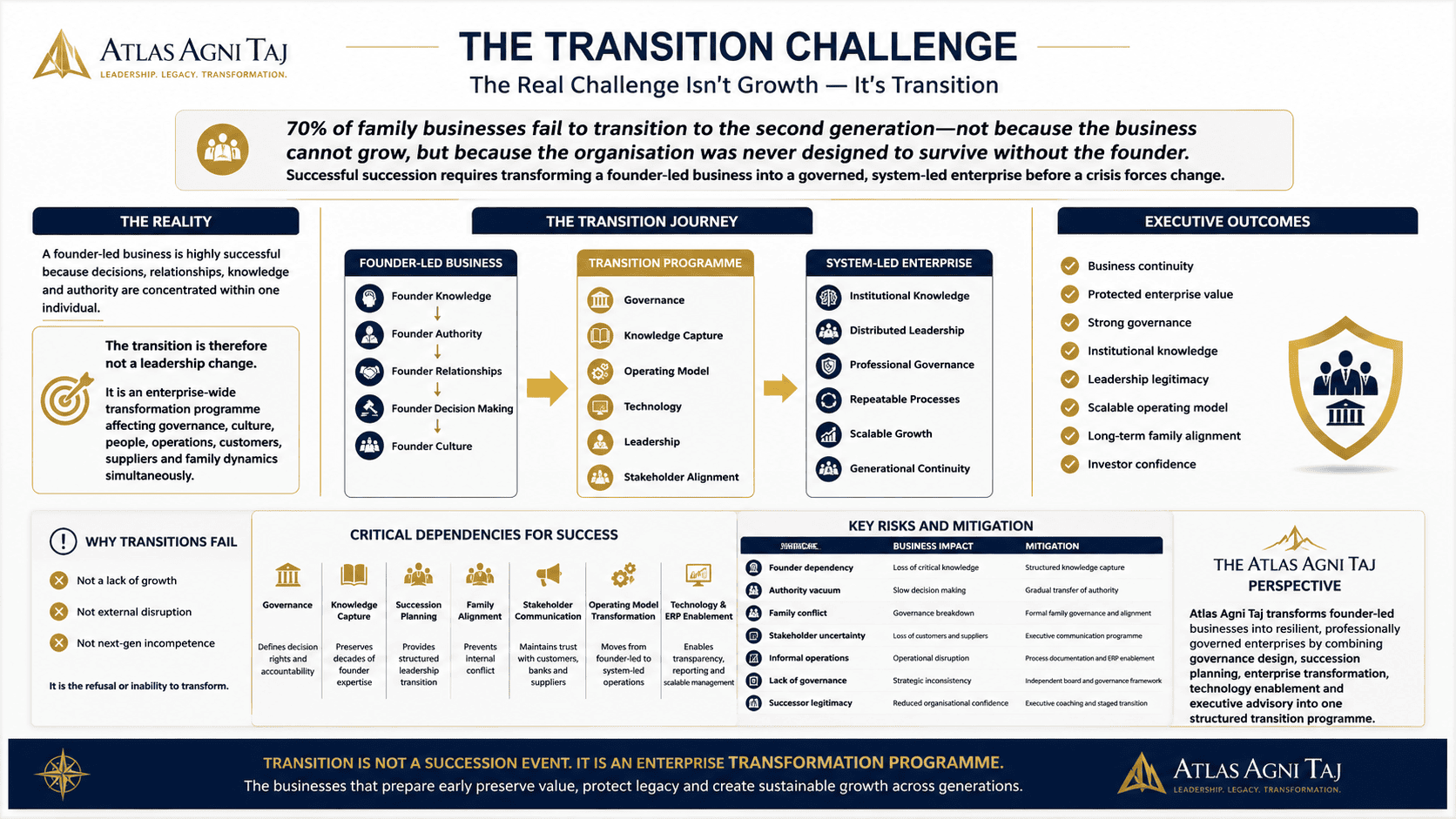
The statistics are unambiguous and sobering. Approximately seventy per cent of family businesses do not successfully transition to the second generation. Of those that do, only around ten per cent survive intact to the third. Across the Middle East specifically, the picture is more acute still: a meaningful proportion of enterprises fold entirely upon the founder’s death or departure, taking decades of accumulated value with them.
The prevailing explanation offered by external observers — bankers, advisors, commentators — is that these failures reflect a lack of growth capacity, unexpected market disruption, or incompetence on the part of the next generation. This explanation is comfortable. It is also, in the overwhelming majority of cases, wrong.
The real reason most family business transitions fail has very little to do with growth. It has everything to do with transformation — and specifically, with the refusal or inability to recognise that succession is not an event but a systemic re-engineering of the enterprise.
The Founder-Led Model: Elegant in Success, Brittle in Succession
To understand why transition proves so difficult, it is necessary first to understand the operating model that successful first-generation family businesses have, often unconsciously, constructed. This model rests on a small number of interlocking principles, each of which is a source of tremendous strength during the founder’s tenure and a source of tremendous fragility the moment that tenure ends.
Founder as chief executive and chairman: the founder is not simply the leader of the enterprise; in every meaningful sense, the founder is the enterprise. Strategic direction, major capital allocation, principal client relationships, key vendor negotiations, and cultural authority all originate from, and return to, a single individual. The organisational structure exists to execute the founder’s intent, not to operate as an independent system.
Information as personal possession: critical business knowledge — customer relationships, supplier terms, pricing logic, capital structure, expansion plans, and competitive positioning — resides in the founder’s memory rather than in documented systems of record. The founder holds an information advantage that would be extraordinarily costly, and in some cases practically impossible, to transfer wholesale to another individual.
Decision authority as concentrated power: authority is not distributed through formal governance; it is concentrated in one person. Decisions are made quickly precisely because there is only one decision-maker, and disagreement resolves quickly because that individual holds final authority.
Culture as an extension of personality: the organisation’s culture mirrors the founder’s own values, work ethic, risk appetite, and interpersonal style. Loyalty, in this model, is personal rather than institutional: employees work for the founder, not for the organisation as an abstract entity.
Success measured through intuition, not instrumentation: rather than formal key performance indicators, dashboards, and management information, success is measured through the founder’s own accumulated feel for the business — an intuitive sense of whether things are going well, whether an opportunity is emerging, or whether a market is beginning to shift beneath the surface.
Capital allocation as personal discretion: how cash is deployed — reinvested into operations, directed into new ventures, distributed to family members, or allocated to personal holdings — is entirely the founder’s call, frequently exercised informally and without recourse to a board.
This model is, without question, extraordinarily efficient. It minimises overhead, eliminates layers of bureaucratic decision-making, and enables the kind of rapid, decisive response to market opportunity that has been the genuine engine of growth for countless GCC family enterprises.
It is also, by its very design, entirely dependent on the continued presence and active decision-making of a single individual. And that dependency is precisely what makes the model brittle the instant succession becomes real rather than theoretical.
The Transition Trap: What Actually Changes
When a founder steps back and a successor assumes control, what appears on the surface to be a simple handover — “the founder retires, the next generation takes over” — in fact triggers systemic change across virtually every dimension of how the business functions. Executives who treat this as an administrative event, rather than a structural transformation, are rarely prepared for what follows.
Knowledge transfer failure: the incoming successor discovers that the information they believed they had absorbed over years of proximity to the founder is, in practice, incomplete. They understand the parts of the business in which they worked directly, but lack critical context on major client relationships, vendor negotiation history, supplier dependencies, historical capital decisions, and competitive positioning that was never explicitly articulated because it never needed to be. The successor must now reconstruct this knowledge in real time, while simultaneously running the business.
Authority vacuum: the organisation has been trained, over years or decades, to defer to the founder on consequential decisions. The successor holds formal authority but lacks the accumulated, intuitive authority the founder built through decades of demonstrably sound judgement. When the successor makes a decision — even an entirely correct one — staff may quietly second-guess it, delay execution, or wait to see whether the founder will intervene and override it.
Stakeholder realignment: customers, suppliers, lenders, and government counterparties built their relationships with the founder personally, not with the organisation as an institution. The moment the successor takes over, these stakeholders inevitably ask, explicitly or implicitly: can this person do what the founder did? The honest answer, at least initially, is almost always not yet — creating a genuine window of vulnerability in which competitors approach customers, suppliers seek to renegotiate terms, and lenders quietly tighten credit conditions.
Strategic direction ambiguity: the founder’s strategic vision was typically implicit rather than documented — the organisation understood direction through the founder’s pattern of decisions and priorities rather than through any written strategy. A successor, particularly one educated internationally and exposed to different business models, may hold a genuinely different strategic vision, forcing an unspoken but consequential question: is this business what the founder built, or what the successor now believes it should become?
Cultural friction: the successor often introduces new approaches — more formal processes, a different management style, new technology platforms, revised compensation structures. Even where these changes are objectively beneficial, they are frequently experienced by long-serving staff as a threat to a culture and way of working from which they personally benefited.
Family dynamics explosion: as the founder steps back, family members who had long deferred to the founder’s singular authority may suddenly assert competing views on how the business should be run. A sibling may believe they, not the appointed successor, should have taken the reins. A spouse may hold different priorities entirely. Cousins may seek roles they were never previously considered for. The unifying authority of “the founder” fragments, almost overnight, into a set of competing family interests.
Capital allocation conflict: the successor may hold different views on how profits should be used. Should capital be reinvested aggressively for growth, or distributed as dividends to family members? Should the business diversify into new sectors or concentrate on its core? Should ownership remain entirely family-controlled, or should outside capital be considered? Decisions that were implicit and unquestioned under the founder now become explicit and, frequently, contested.
Operational formalisation pressure: as the business grows in scale and complexity, the informal mechanisms that worked well under founder leadership — verbal authorisation, personal relationships with key suppliers, gentleman’s agreements — begin to fail. The successor faces mounting pressure to formalise: to build processes, documentation, and governance structures. Yet this formalisation is frequently experienced by long-tenured staff as a loss of flexibility, and dismissed as unwelcome bureaucracy.
None of this constitutes a simple transition. It constitutes a transformation — and one that unfolds across multiple dimensions of the enterprise simultaneously, often without any explicit acknowledgement that this is what is actually happening.
The Generational Divide: Education, Exposure, and Ambition
The difficulty of family business transition is compounded, particularly across the UAE and the wider Middle East, by a specific generational reality: founders and successors frequently hold profoundly different educational backgrounds, international exposure, and worldviews — and this divergence shapes everything that follows.
The first-generation founder, who often built the enterprise in the 1970s, 1980s, or 1990s, typically grew up in a developing UAE, received a primarily domestic education, and learned business through direct practice rather than formal study. That founder built the company in an environment of rapid economic expansion, comparatively limited competition, and abundant market opportunity.
The second-generation successor, frequently now in their thirties or forties, grew up in a substantially wealthier and more globally connected UAE. Many studied at leading international universities in the United Kingdom, the United States, or Canada, and spent their formative professional years in London, New York, Boston, or Sydney. They were exposed to global best practice, modern management theory, start-up culture, and technology-driven business models, often having interned or worked within multinational corporations, investment banks, or consulting firms before returning to the family enterprise.
The consequence is that founder and successor genuinely do not think alike. They do not prioritise the same considerations. They do not view the same business challenge through the same lens.
The founder tends to see the family business as:
- A source of family security and long-term wealth preservation
- A vehicle for personal achievement and enduring legacy
- An entity to be controlled, protected, and kept intact
- Something to be grown organically, through disciplined reinvestment
- A cash-generating engine that funds the needs of the family
The successor tends to see the same enterprise as:
- A platform that remains meaningfully under-optimised relative to its potential
- A vehicle for professional achievement and genuine innovation
- An entity that urgently requires professionalisation and formal governance
- Something to be scaled aggressively, potentially with external capital or M&A
- A business that should be structured for a future exit or institutional ownership
While the founder remained in charge, these divergent worldviews carried no operational consequence. The moment the successor assumes control, they become the central axis of conflict within the enterprise. The successor wishes to hire a professional chief executive; the founder perceives this as abdication. The successor wishes to implement enterprise-wide systems; the founder perceives unnecessary complexity. The successor wishes to establish a board with independent, external advisors; the founder perceives a dilution of hard-won family control. The successor wishes to explore private equity partnership; the founder perceives, in effect, the sale of a life’s work. The successor wishes to modernise the supply chain; the founder perceives the severing of relationships with longstanding vendors instrumental to the original success of the business.
Each of these tensions is genuine. Each reflects authentically different values and priorities, shaped by two very different formative experiences. And critically, none of them is fundamentally about growth. They are disputes about the fundamental operating philosophy of the enterprise.
The Missing Infrastructure: Governance, Process, and Documentation
The transition challenge is further amplified by a structural reality that is close to universal among founder-led family businesses across the region: the near-total absence of the infrastructure that would make an orderly transition possible in the first place.
There is, typically, no formal board. There are no documented strategic plans. There are no defined governance structures setting out who is authorised to make which decisions. There is no succession plan of substance. Key relationships and commercial agreements are undocumented, existing instead as handshake understandings between the founder and long-serving employees, customers, or suppliers. Compensation is unstandardised, varying according to the founder’s own personal assessment of individual contribution. The capital structure is frequently opaque, with assets distributed across multiple entities or ownership vehicles for tax or personal reasons that were never fully recorded.
This absence of formal infrastructure is a feature, not a defect, while the founder remains in charge. It provides flexibility, minimises overhead, and enables the rapid decision-making that gave the enterprise its original competitive edge. The moment transition occurs, however, this same absence becomes genuinely catastrophic.
The successor inherits an enterprise in which nobody is entirely certain what decisions they are authorised to make; in which key relationships are undocumented and immediately vulnerable should the founder become unavailable; in which the capital structure is unclear; in which financial reporting is inconsistent across business units; in which compensation practice lacks any coherent logic; in which strategic direction has never been made explicit; and in which risk management has never been formalised.
The successor is then required, simultaneously, to run the business day to day, to construct the governance infrastructure that should have existed already, to navigate an active transition of authority, to manage complex family dynamics, and to maintain the confidence of customers, suppliers, and lenders throughout. This is an extraordinarily demanding combination of responsibilities, and the overwhelming majority of successors — however capable individually — are simply not prepared for it.
The Professionalisation Imperative: When Growth Requires Structure
One of the central insights that successful family business successors eventually internalise is that scaling to the next tier of size requires a fundamental shift from founder-led to system-led operation — and that this shift is not optional if growth is to continue.
For as long as an enterprise remains small enough that the founder can personally know every significant customer, every major vendor, every key member of staff, and every relevant competitive dynamic, the business can operate effectively under founder leadership. The founder’s personal relationships are sufficient for governance. The founder’s intuitive decision-making is fast enough to respond to changing conditions in the market.
As the enterprise scales, however — and successful family businesses do scale — the founder can no longer sustain personal relationships with everyone who matters. The business becomes too complex for any single individual to hold every dimension in mind. The volume of simultaneous decisions required exceeds what one person, however talented, can process effectively.
At this point, one of two paths tends to unfold. In the first, the business simply stops growing: the founder, consciously or otherwise, declines to expand beyond the scale that can be personally managed, and the enterprise plateaus, with genuine growth opportunity left unrealised on the table. In the second, the business professionalises: founder and successor jointly recognise that continued growth requires a shift from founder-led to system-led operations, and they proceed to build governance structures, document core processes, hire professional management, implement enabling technology platforms, and establish clear decision-making authority. The founder, in this scenario, transitions from operator to strategic director or senior advisor.
The second path is what a genuinely successful family business transition looks like in practice. Achieving it, however, requires a transformation not only of the organisation, but of the founder’s own sense of identity — and this is, for many founders, the single hardest part of the entire process. The business is not merely a commercial asset; it is, in a very real sense, an extension of self. Control is not merely a management preference; it is a source of personal identity and lifetime achievement. The willingness to relinquish direct operational control, and to accept a more distant advisory role, demands a genuine psychological shift that a great many founders are neither able nor willing to make voluntarily. This cannot be forced upon a founder. It must be chosen — and ideally chosen while the founder retains the standing and the energy to shape that transition personally, rather than having it imposed by crisis.
The Transition Playbook: What Actually Works
Despite the difficulty, successful family business transitions do follow recognisable and repeatable patterns. None of these patterns is mysterious, and none is genuinely complicated to describe — the challenge lies almost entirely in the discipline required to execute them.
Explicit succession planning: successful transitions typically begin with the founder making a clear, deliberate decision on succession, and communicating it plainly — including who the successor will be, when the transition will take place, what the founder’s own role will be thereafter, and the governing timeline.
Gradual authority transfer: rather than a sudden handover, successful transitions involve a progressive transfer of authority and responsibility, with the successor gradually assuming greater decision-making, client ownership, and strategic responsibility as the founder gradually withdraws.
Infrastructure creation: in parallel with the transfer of authority, the enterprise builds the governance and operational infrastructure that enables genuinely system-led decision-making — formal governance structures, documented processes, enterprise systems, professional management layers, and transparent reporting.
Family alignment: ahead of the transition, the founder ensures that the wider family is genuinely aligned on the succession plan, on the future direction of the business, and on individual family members’ roles. Ambiguity on any of these points is a near-guaranteed source of future conflict.
Stakeholder communication: the founder proactively communicates the transition to key customers, suppliers, and business partners, explicitly and visibly endorsing the successor, and taking deliberate steps to ensure that critical relationships transfer smoothly rather than being left to chance.
Psychological preparation: the founder, ideally supported by external advisors or mentors, prepares psychologically for the transition — accepting the successor’s different approach, acknowledging their own mortality or ageing candidly, and cultivating a sense of legacy that extends beyond continued personal control.
A clearly defined founder role: rather than leaving the founder’s post-transition position ambiguous, successful transitions define precisely what the founder will do afterwards — remaining as chairman, serving on the board, acting as advisor on specific strategic matters, or stepping back entirely. Clarity here prevents both the inappropriate exercise of residual power by the founder and any sense of being undermined on the part of the successor.
This playbook is neither mysterious nor complex. And yet the great majority of family businesses across the region do not follow it — not for lack of awareness, but because executing it requires confronting realities that are genuinely uncomfortable to face.
Why Transition Remains So Difficult
Given that the patterns behind successful transition are well understood and widely documented, why does transition failure remain so common? The answer lies in the fact that transition requires founders to acknowledge, and act upon, realities to which most founders are, understandably, psychologically resistant.
Mortality: the founder must accept that they will not lead the business indefinitely.
Fallibility: the founder must accept that the successor’s approach, while different, may not be wrong — and may in fact be better suited to conditions the founder did not build the business for.
Change: the founder must accept that the business will change in ways the founder may not personally prefer, and that such change may nonetheless prove genuinely beneficial.
Obsolescence: the founder must accept that skills and approaches which proved highly successful in the past may not remain optimal for the future.
The loss of personal control: the founder must accept that running the business as a system, rather than through personal direction, entails relinquishing granular control over day-to-day operations.
These are not comfortable realisations for anyone to reach, let alone for a founder whose entire professional identity has been built around personal control and decisive authority. A great many founders — arguably most — are unwilling to reach them until external circumstances force the issue. By that point, the transition is very often already in crisis, and the range of options available has narrowed considerably.
The Successor’s Challenge: Legitimacy and Vision
Where the founder’s challenges are primarily psychological, the successor’s challenges are more practical and, frequently, more political. The successor must establish genuine legitimacy in the eyes of employees who may have worked alongside the founder for decades; customers who built their relationship with the founder personally; suppliers who developed trust in the founder’s individual authority; family members who may openly question whether the successor was the right choice; and lenders or government counterparties long accustomed to dealing with the founder directly.
This legitimacy cannot simply be assumed on the basis of title or bloodline. It must be earned — and it must be earned precisely while the successor is introducing changes that many of these same stakeholders will instinctively resist.
Beyond legitimacy, the successor must also articulate a credible vision for what the business will become. That vision must be grounded in a genuine market opportunity and the enterprise’s actual capabilities; differentiated enough from the founder’s original vision to justify meaningful change, yet not so radically different that it appears to abandon everything the business has built; compelling enough to inspire employees and, where relevant, attract external capital; and realistic given the resources and market environment actually available. Many successors understand very clearly what is wrong with the founder’s original approach. Considerably fewer are able to articulate, with equal clarity, precisely what should replace it.
How Atlas Agni Taj Supports Family Businesses Through Transition
At Atlas Agni Taj, we work with founders, boards, and next-generation leaders across the UAE and the wider GCC to convert this transition from a source of existential risk into a structured, well-governed programme of transformation. Our advisory approach is deliberately built around the realities set out above, rather than around generic change-management theory.
Governance and board design: we help family enterprises establish the formal governance structures, board composition, and decision-rights frameworks that founder-led businesses have typically never required — but which successors cannot operate without.
Knowledge capture and institutionalisation: we work directly with founders to externalise tacit, undocumented knowledge — client relationships, vendor terms, capital history, and competitive positioning — converting personal memory into institutional record before it is lost.
Succession and transition programme design: we design and sequence the gradual transfer of authority, responsibility, and stakeholder relationships, so that the handover is managed deliberately over time rather than executed abruptly under pressure.
Operating model and ERP-enabled professionalisation: drawing on deep enterprise transformation and ERP experience, we help businesses move from founder-led, informal operations to system-led, technology-enabled operations without losing the agility that made the original enterprise successful.
Family alignment and stakeholder communication: we facilitate structured, candid conversations among family members and with key external stakeholders, reducing the ambiguity that so often escalates into conflict during transition.
Advisory support to both generations: we provide independent, external counsel to founders navigating the psychological dimension of stepping back, and to successors building legitimacy and articulating a credible forward vision — bridging the generational divide with structured facilitation rather than leaving it to chance.
Atlas Agni Taj brings together decades of enterprise transformation, governance, and technology delivery experience across sovereign, regulated, and family-owned institutions in the UAE and GCC. We do not offer generic succession templates; we build transition programmes tailored to the specific commercial, cultural, and family realities of each enterprise we serve.
Conclusion: Transition as Transformation
The transition from founder-led to successor-led family business is not simply a changing of the guard. It is a transformation of how the business operates, how decisions are made, what its culture stands for, and what it is ultimately trying to achieve.
This transformation is extraordinarily difficult precisely because it demands change across multiple dimensions simultaneously: authority must shift, infrastructure must be created, family dynamics must be negotiated, stakeholder confidence must be actively maintained, a new strategic vision must be articulated and executed, and the founder must relinquish control even as the successor works to establish legitimacy in the founder’s place.
Most family businesses fail at this juncture — not because they lack growth potential, and not because the incoming successor is incompetent, but because the sheer complexity of managing simultaneous transformation across so many dimensions exceeds what most families are institutionally prepared to handle without deliberate, structured support.
The enterprises that succeed are those that begin the transition well before any crisis forces their hand; that treat transition as an explicit transformation programme rather than a natural, self-managing process; that build governance and operating infrastructure in parallel with the transfer of authority; that manage family dynamics explicitly, with external support where it is genuinely needed; and that clearly define, in advance, what the founder’s role will be once the transition is complete.
The question facing every family business leader in the region today is not whether transition is necessary. Transition is a certainty. The only genuine question is whether it will be prepared for with intention, or confronted, unprepared, at the moment it can no longer be postponed.
#FamilyBusiness #Succession #CorporateGovernance #Transformation #GCC #UAE #BoardAdvisory #ExecutiveLeadership #AtlasAgniTaj
Atlas Agni Taj — Proprietary. All rights reserved.