Sovereign AI Is Changing the GCC Cloud Conversation
For much of the past decade, the cloud conversation across the Gulf Cooperation Council followed a familiar script. Migration was the goal, the public hyperscalers were the destination, and the principal measures of success were speed, cost reduction and the retirement of ageing data centres. That script is now being rewritten. The catalyst is not cloud computing in the abstract; it is artificial intelligence, and specifically the emergence of sovereign AI as a strategic priority for governments and regulated enterprises across the region.
Momentum in the market makes this shift difficult to ignore. The UAE has articulated clear sovereign cloud ambitions at national level, and hyperscaler investment in AI-scale infrastructure across the country is accelerating rapidly, as set out below. For technology and business leaders across the GCC, this is not simply an infrastructure story. It is a signal that the fundamentals of enterprise cloud strategy are changing, and that the organisations best placed to benefit will be those with the governance discipline to make sharper, more differentiated workload decisions.
The Shift Underway: From Hosting Question to Sovereignty Question
The traditional cloud business case was, in essence, a hosting question. Could an application run more reliably, more cheaply, or more flexibly outside the enterprise’s own data centre? For most workloads, the answer was yes, and cloud migration became a default assumption in technology strategy across banking, government, energy, healthcare, and telecommunications in the region.
Artificial intelligence changes the calculus in three important ways.
First, it introduces a new and much larger appetite for compute. Training and running large models, whether foundation models, domain-specific models, or fine-tuned enterprise variants, requires access to advanced GPU infrastructure at a scale that many organisations neither own nor can economically build themselves. This drives dependency on a small number of specialised providers and platforms, concentrating both opportunity and risk.
Second, AI dramatically increases the sensitivity of the data in motion. Where a traditional application might process transactional records, an AI system frequently ingests, aggregates, and learns from far richer pools of personal, operational, and sometimes classified information. Data residency, data sovereignty, and control over how a model is trained and where its outputs are stored move from compliance footnotes to board-level risk items.
Third, AI heightens the strategic importance of vendor relationships. A small number of global hyperscalers and their regional partners now sit close to the centre of national digital infrastructure strategy. Governments and regulated sectors across the GCC understand this, which is precisely why sovereign cloud and sovereign AI have become explicit policy priorities rather than technical preferences.
The result is that the binary question of the past decade, “should we move to cloud”, has been replaced by a more nuanced and more consequential one: which workloads require sovereignty, which require scale, and which require cost discipline. Answering that question well, consistently, and defensibly is now a core executive leadership responsibility, not a technical delegation.
Why the Timing Matters
Three forces are converging in the GCC at the same moment, and each amplifies the others.
The first is national policy. The UAE, alongside its regional peers, has set out an explicit ambition to build sovereign digital and AI infrastructure as a pillar of long-term economic competitiveness, rather than treating cloud purely as a cost-optimisation lever. Government entities and regulated industries are increasingly required, whether through policy, regulation, or contractual obligation, to demonstrate a clear rationale for where sensitive workloads sit.
The second is hyperscaler investment. Global technology providers are committing multi-billion-dollar sums to build regional capacity precisely because they recognise this policy direction and the scale of enterprise demand it will generate. Microsoft and Abu Dhabi’s G42 have confirmed a further 200-megawatt expansion of data centre capacity in the UAE, delivered through G42’s subsidiary Khazna Data Centers, with initial capacity expected to come online before the end of 2026. This sits within a wider USD 15.2 billion Microsoft investment commitment in the UAE through 2029, alongside an earlier USD 1.5 billion Microsoft equity stake in G42. This is not experimental investment; it is infrastructure being built to serve a demand curve that regional boards are only beginning to fully appreciate.
The third is enterprise readiness, or in many cases, the lack of it. Many organisations across the GCC still carry cloud estates that were built primarily around cost and speed rather than sovereignty, resilience, or AI readiness. Workloads were migrated in bulk during earlier transformation waves, often without the granular decision discipline that AI-era requirements now demand. The gap between where infrastructure investment is heading and where enterprise architecture currently stands is precisely where executive leadership needs to focus.
From Infrastructure Discussion to Business Architecture Discussion
The most important reframing for boards and executive committees is this: cloud strategy in the AI era is no longer an infrastructure discussion. It is a business architecture discussion, with direct implications for risk, cost, resilience, regulatory standing, and competitive positioning.
This reframing matters because it changes who needs to be in the room when cloud and AI infrastructure decisions are made. A decision that used to sit largely within the technology function now carries direct relevance for the chief risk officer, the chief financial officer, the general counsel, the chief information security officer, and, in regulated sectors, the board’s risk and audit committees. Treating this purely as a technology procurement exercise significantly understates its strategic weight.
Boards that grasp this early will be better positioned to ask sharper questions of their executive teams: where does our most sensitive data currently reside, and why? What is our actual exposure to a small number of cloud and AI vendors? Do we have a documented, defensible rationale for every category of workload, or have decisions simply accumulated over successive migration projects? Can we demonstrate, to a regulator or an auditor, the logic behind our cloud and AI architecture choices?
Organisations that cannot answer these questions with confidence are exposed, not necessarily today, but as scrutiny of AI governance, data sovereignty, and vendor concentration intensifies across regulated sectors in the region.
A Practical Decision Framework for Enterprise Workloads
Not every workload should be treated the same way, and the organisations that will benefit most from the current wave of AI and sovereign cloud investment are those that resist the temptation to apply a single, one-size-fits-all cloud policy.
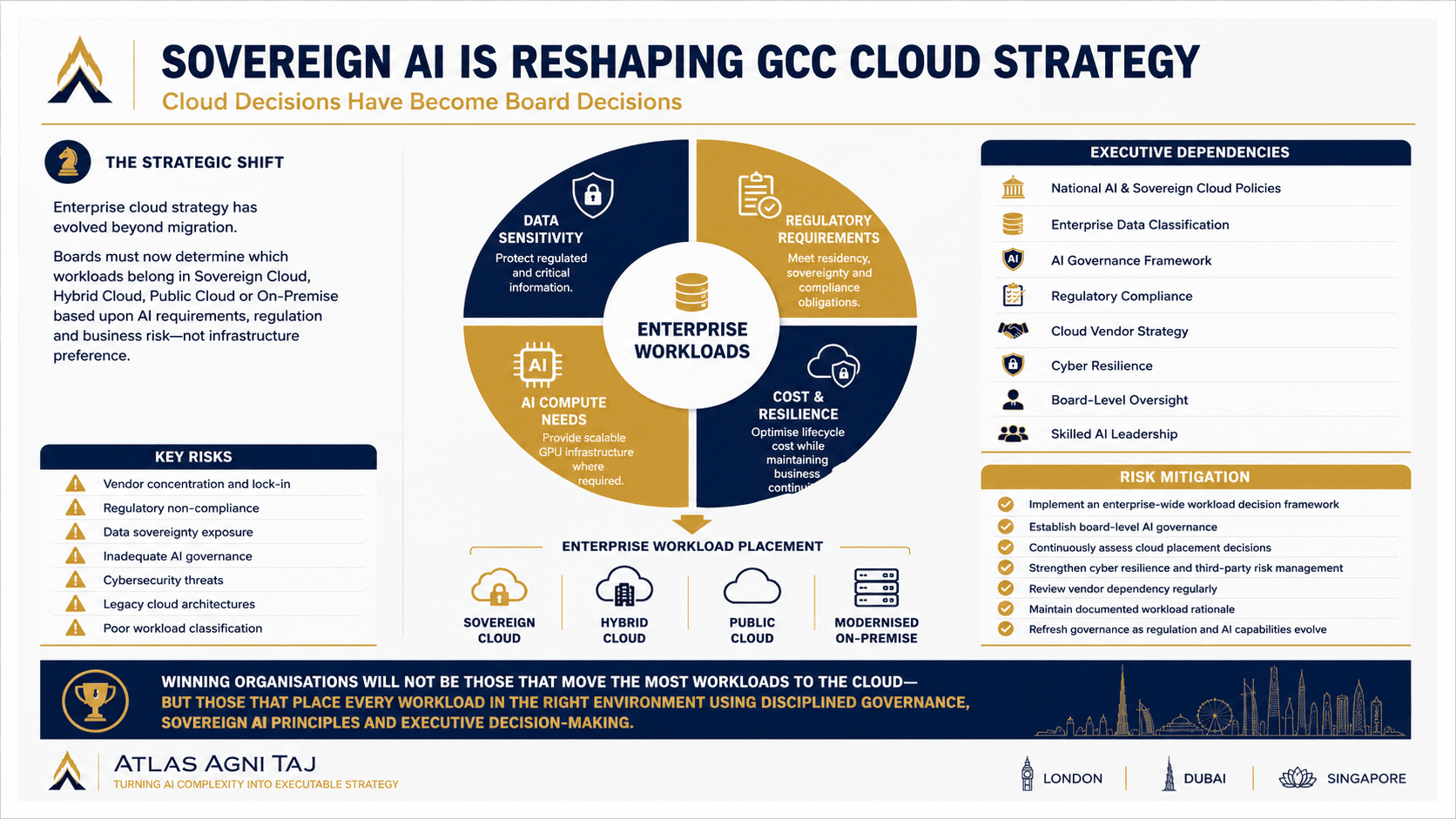
A practical enterprise workload decision framework rests on four pillars.
The first pillar is data sensitivity. What is the classification of the data involved, and what would the consequence of exposure or loss actually be? Highly sensitive government, citizen, financial, or health data typically points towards sovereign or tightly controlled hybrid architectures. Lower-sensitivity operational data may comfortably sit on public cloud infrastructure.
The second pillar is regulatory requirement. Does the workload sit within a regulated sector or jurisdiction with explicit data residency, localisation, or sovereign infrastructure obligations? Where such requirements exist, they should drive the architecture decision directly, rather than being retrofitted as a compliance exercise after the fact.
The third pillar is AI compute need. Does the workload require access to large-scale GPU compute, advanced model training capability, or high-performance AI infrastructure that the enterprise cannot economically build or sustain in-house? If so, the decision must weigh the benefits of scale against the governance controls needed to manage vendor dependency and data exposure.
The fourth pillar is cost and resilience. What is the total cost of ownership across the workload’s lifecycle, and what level of operational resilience, redundancy, and business continuity does it require? A workload with modest sensitivity but high resilience requirements may still justify a different architecture choice than one with low resilience needs.
Applying these four pillars consistently produces one of four broad outcomes for any given workload: a sovereign cloud placement, a hybrid architecture, a public cloud placement, or a decision to retain, modernise, or ultimately retire the workload on-premise. The value of the framework lies not in any single outcome, but in the discipline of applying the same structured logic across the entire enterprise estate, so that decisions are consistent, explainable, and defensible over time.
The Governance Dimension
A workload decision framework is only as strong as the governance that sits around it. Three governance disciplines deserve particular executive attention as AI and sovereign cloud strategies mature across the region.
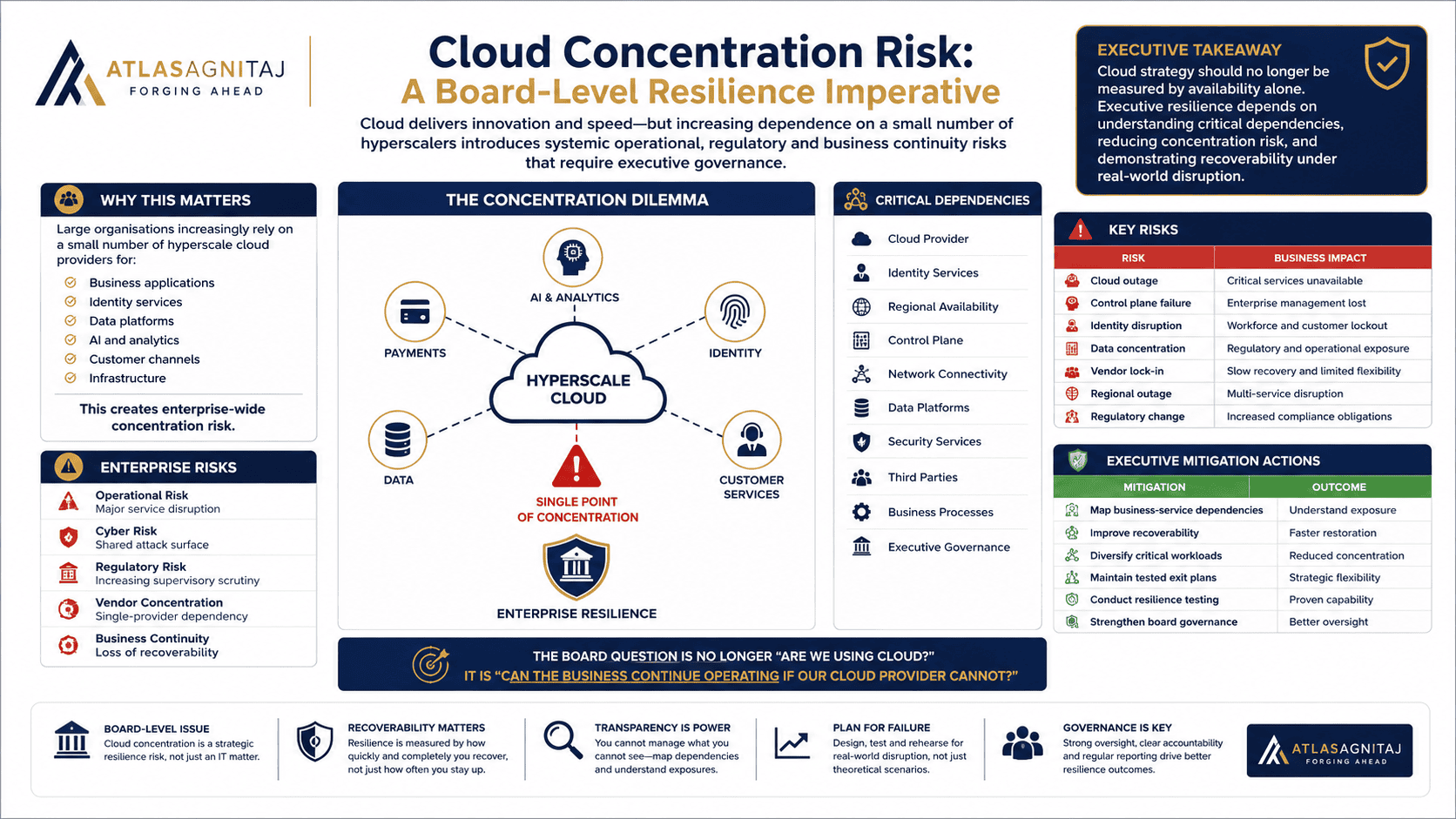
The first is vendor concentration risk. As a small number of hyperscalers and regional partners become central to national AI infrastructure, enterprises need a clear-eyed view of their own dependency on any single provider, and a credible contingency position should that relationship, pricing structure, or regulatory standing change.
The second is data lineage and model governance. Where AI models are trained on enterprise data, whether proprietary models or fine-tuned variants of third-party foundation models, organisations need to be able to demonstrate what data was used, how it was protected, and what controls exist over model outputs. This is increasingly a board-level assurance question, not solely a technical one.
The third is cyber resilience. Sovereign and AI-scale infrastructure represents an increasingly attractive target, precisely because of the value and sensitivity of what it holds. Cyber resilience planning, incident response capability, and third-party risk management need to evolve in step with the scale and sensitivity of the infrastructure being built.
Lessons From Adjacent Regulated Sectors
The GCC is not building sovereign AI capability in isolation, and there is real value in looking at how other regulated sectors have handled comparable inflection points. Financial services offers perhaps the closest parallel. Over the past decade, banks and central banks across the region have progressively refined their approach to cloud adoption, moving from early caution, through selective public cloud use for non-critical workloads, to today’s more sophisticated position where core banking, payments, and customer data are routinely subject to explicit sovereignty and localisation requirements, while less sensitive functions run comfortably on public infrastructure.
The lesson from that journey is not that caution should dominate. It is that clarity of framework, applied consistently and revisited periodically as regulation and technology evolve, allows an institution to move with confidence rather than hesitation. Energy, healthcare, and telecommunications operators across the region are now working through a similar maturation curve with respect to AI specifically, and are finding that the organisations furthest ahead are those that established a workload decision framework early, rather than waiting for regulatory clarity to arrive before acting.
A second lesson concerns the pace of change. Sovereign AI infrastructure investment in the GCC is moving faster than many enterprise governance structures were designed to accommodate. Committees that meet quarterly, procurement cycles measured in months, and risk frameworks last updated before generative AI became mainstream, all risk falling behind the infrastructure reality on the ground. Executive teams should treat the current period as an opportunity to compress that governance cycle time deliberately, rather than allowing it to be compressed involuntarily by events.
Implications for Executive and Board Agendas
For chief executives, chief information officers, chief technology officers, and board members across the GCC, several practical implications follow directly from this shift.
Cloud and AI infrastructure strategy should be treated as a standing board agenda item, not an occasional technology update. The pace of regional investment and policy development means that decisions taken, or deferred, in the next twelve to twenty-four months will shape enterprise architecture, cost structure, and regulatory standing for years to come.
Executive teams should commission, or refresh, a structured workload assessment against a clear decision framework, rather than relying on the accumulated outcome of previous migration projects. This is as much a governance exercise as a technical one, and it should produce a defensible, documented rationale for every major category of enterprise workload.
Vendor and partner strategy should be reviewed explicitly through the lens of sovereign AI and data sovereignty, not solely through commercial terms and service levels. Boards should understand precisely where their most sensitive data and workloads sit, why they sit there, and what contingency exists.
Talent and capability should be assessed honestly. Cloud, AI, cybersecurity, and regulated-sector platform expertise are in high demand across the region, and organisations that have not invested in this capability internally will need to secure it through experienced external leadership, at least through the current phase of transformation. This is not a criticism of internal teams; it is a recognition that the specific combination of skills required, deep cloud and AI architecture knowledge, regulated-sector governance experience, and the programme discipline to translate strategy into a defensible, auditable roadmap, is genuinely scarce, and building it purely from within can take longer than the current investment cycle allows.
Finally, executive teams should resist the temptation to treat this as a one-off assessment. Sovereign AI infrastructure, hyperscaler investment, and regional regulation are all moving targets. A workload decision framework that is accurate today may need revisiting within twelve to eighteen months as new capacity comes online, as new regulatory guidance is issued, and as the enterprise’s own AI ambitions mature. Building the review cycle into governance calendars now avoids the far more costly exercise of rebuilding the framework from scratch once gaps have already become visible to regulators, auditors, or the market.
The Competitive Stakes
It is worth being direct about what is at stake. The winners in this next phase of GCC digital transformation will not be the organisations that migrate the greatest number of systems to cloud, nor those that make the largest headline AI infrastructure announcements. They will be the organisations that make the clearest, most disciplined workload decisions, and that can demonstrate, to regulators, boards, and customers alike, exactly why each workload sits where it does.
This is a meaningful change in what constitutes strong technology leadership in the region. It rewards judgement, governance discipline, and the ability to translate infrastructure decisions into business language, over sheer speed of migration or scale of investment announcement. It is, in short, a leadership opportunity as much as a technology one.
The question every board and executive committee across the region should now be asking is a simple one: is our cloud and AI roadmap genuinely ready for the sovereign AI era, or has it simply kept pace with where cloud strategy used to be?
There is also a quieter, longer-term dimension to this shift that deserves executive attention. The organisations building sovereign AI and cloud governance discipline now are, in effect, building the institutional muscle they will need for whatever the next wave of technology-driven disruption turns out to be. The specific technology will change; it always does. The underlying discipline, of classifying workloads honestly, of understanding vendor dependency, of maintaining a defensible rationale for every significant infrastructure decision, will remain valuable regardless of what comes after generative AI and sovereign cloud. Viewed this way, the current moment is not simply a cloud strategy exercise. It is an opportunity to build a durable governance capability that will serve the enterprise well beyond this particular technology cycle.
How Atlas Agni Taj Can Help
Atlas Agni Taj is a boutique transformation advisory firm, with a presence across London, Dubai, and Singapore, built specifically to help executive teams and boards navigate exactly this kind of inflection point. Its work sits at the intersection of enterprise technology strategy, programme governance, and regulated-sector delivery, informed by decades of hands-on leadership across cloud, ERP, cybersecurity, sovereign infrastructure, and large-scale digital transformation programmes in the UAE and wider GCC market.
For organisations grappling with the sovereign AI and cloud shift described above, Atlas Agni Taj can support executive teams in several concrete ways: conducting an independent, structured assessment of the enterprise workload estate against a clear sovereignty, regulatory, compute, and cost framework; facilitating board and executive-committee level briefings that translate technical infrastructure decisions into business risk and competitive language; reviewing vendor and partner dependency exposure and helping design credible contingency positions; strengthening AI and data governance frameworks so that model use, data lineage, and cyber resilience controls keep pace with the scale of infrastructure now being deployed; and providing interim or advisory programme leadership to organisations that need experienced, hands-on capability to translate strategy into a governed delivery roadmap.
Whether the requirement is a focused workload assessment, board advisory support, or full programme leadership through a sovereign cloud or AI infrastructure transition, Atlas Agni Taj brings the practical, delivery-tested experience needed to help GCC enterprises move with both ambition and discipline through this next phase of digital transformation.
Atlas Agni Taj — Proprietary
#SovereignAI #SovereignCloud #CloudStrategy #UAE #GCC #CIOLeadership #AIInfrastructure #DigitalTransformation