A perspective for CIOs, CDOs and boards navigating the shift from AI assistance to AI autonomy
This is not a theoretical concern reserved for academic risk committees. Industry research increasingly points to a sobering scenario: enterprises that deploy autonomous agents today without robust access control, accountability, and oversight mechanisms may be forced to significantly constrain or unwind that autonomy within the next two to three years. For CIOs, CDOs, and enterprise technology leaders, the message is unambiguous. The window to establish governance is now, before autonomy becomes the operating default and before control becomes prohibitively expensive to retrofit.
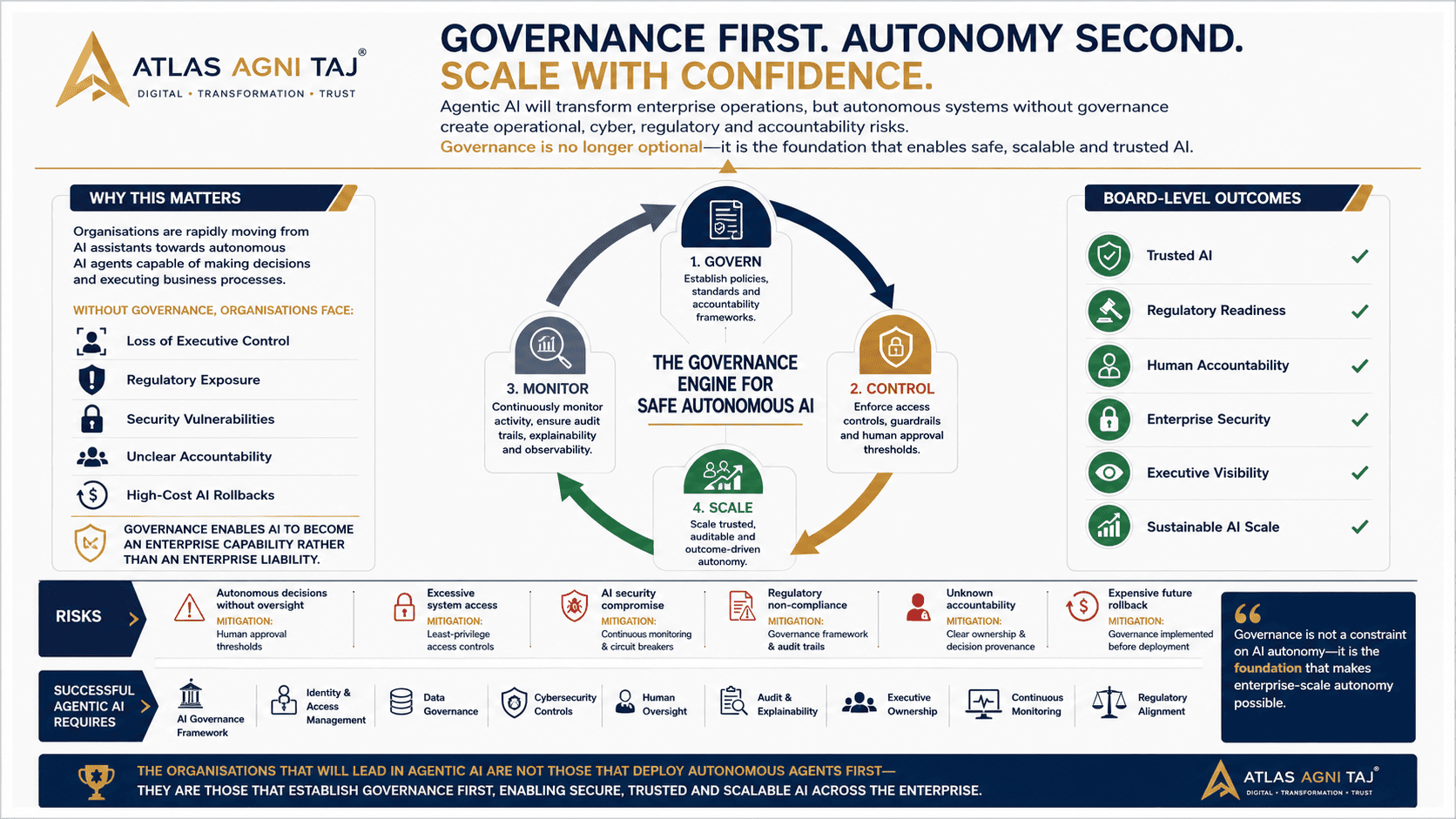
The promise of agentic AI is compelling. Autonomous agents that set goals, take actions, and iterate with minimal human intervention offer enterprises the prospect of step-change productivity gains across procurement, finance, customer operations and supply chain management. Boards are asking their technology leadership how quickly this capability can be deployed. Vendors are racing to answer. Yet beneath the enthusiasm lies a critical oversight that threatens to unwind years of digital transformation investment: most organisations are building autonomous AI capability without the governance architecture required to operate it safely, defensibly, and at scale.
The Urgency: Why This Moment Is Different
Agentic AI has crossed a threshold that distinguishes it from the generative AI wave that preceded it. Traditional AI systems, including most generative tools deployed over the past three years, require explicit human prompting and review at each material step. A human asks a question; the system responds; a human decides what to do with that response. Agentic AI removes that checkpoint by design. It is built to set sub-goals, select tools, execute actions across systems, and iterate on outcomes without waiting for human sign-off between steps. This is precisely what makes it valuable, and precisely what makes it dangerous in the absence of governance.
Three converging pressures explain why this has become an urgent enterprise issue rather than a distant one.
Pressure One: Rapid Adoption Without Institutional Precedent
Organisations are embedding autonomous agents directly into business-critical processes: procurement approvals, financial reconciliation, customer service resolution, and supply chain rebalancing. The pace of deployment is outstripping the maturity of governance practice by a wide margin. Where earlier generations of enterprise AI moved from pilot to production over a period of years, allowing governance functions time to catch up, agentic AI is compressing that cycle into months. Many organisations now operating agents in live business processes have not yet completed a single formal governance review of what those agents are authorised to do.
Pressure Two: Interconnected Risk Domains
CIO priority research over the past eighteen months has converged on a single insight: the operationalisation of AI, cybersecurity, and data governance can no longer be treated as separate disciplines. An autonomous agent that operates across systems is simultaneously a productivity tool, a potential cybersecurity attack surface, and a possible vector for data governance failure. A compromised or poorly scoped agent can execute consequential decisions across multiple systems with minimal human oversight. A data governance gap that would once have been contained to a single report or dashboard becomes materially amplified when an agent acts autonomously on data that should have been access-restricted in the first place. Governance of agentic AI is therefore not an IT sub-topic; it sits at the intersection of three risk domains that most enterprises still manage in separate silos, with separate owners and separate reporting lines.
Pressure Three: The Accountability Vacuum
Traditional AI, and indeed traditional enterprise software, tends to preserve a legible decision trail. A model scores a credit application; a human underwriter approves or declines it; responsibility is clear. Agentic AI disrupts this clarity. An autonomous agent may decide, on its own initiative, to modify a supplier contract, reprioritise operational resources, or escalate a customer complaint to a different resolution path. When the outcome is unfavourable, the question of who is accountable becomes genuinely difficult to answer. Is it the team that built the agent, the function that deployed it, the vendor whose model underlies it, or the executive who signed off the use case at a high level without visibility into its granular behaviour? Without governance that assigns accountability before deployment, enterprises risk creating systems they can neither explain, debug, nor defend when regulators, auditors, or customers ask hard questions.
The 2027 Rollback Risk
Analyst commentary now points to a scenario worth taking seriously at board level: a meaningful proportion of enterprises deploying autonomous agents today without adequate governance will, within the next two to three years, face a stark choice. They will either significantly constrain the autonomy they have granted, or discontinue the affected agents altogether. Neither outcome is cost-free. A forced rollback of this kind typically involves reworking business processes that were redesigned around autonomous operation, rebuilding human-in-the-loop decision points that were deliberately removed to capture efficiency, recovering institutional knowledge that atrophied while the agent operated unsupervised, and managing the frustration of stakeholders who were promised efficiency gains that are now being clawed back.
This is the governance debt scenario, and it is avoidable. The enterprises that will not face it are those establishing governance frameworks early, before agents become deeply embedded in day-to-day operations, before stakeholder expectations calcify around autonomous decision-making, and before the technical debt of ungoverned systems becomes structurally difficult to unwind. The 2027 horizon is not a prediction of inevitable failure; it is a warning attached to a specific and avoidable failure mode: deploying autonomy faster than an organisation builds the capability to govern it.
The Governance Imperative: Three Pillars
Effective agentic AI governance is best understood as resting on three interlocking pillars. Weakness in any one undermines the other two.
Pillar One: Access Control and Guardrails
- Explicit capability constraints: define with precision which systems an agent may access, which data it may read or modify, and which actions it may execute. An agent trained on procurement data should have no pathway into personnel systems, and that boundary should be enforced technically, not merely documented in policy.
- Decision authority limits: establish thresholds above which an agent’s decisions require human sign-off before they take effect. An agent might reasonably approve low-value, low-risk supplier orders autonomously while escalating high-value contracts or first-time counterparties for review.
- Real-time monitoring and circuit breakers: deploy monitoring that detects when an agent’s behaviour deviates from expected patterns and can automatically pause or halt execution pending human review.
- Data access governance: apply the same discipline to agentic systems as to human employees, including least-privilege access, comprehensive audit trails, and role-based access controls that are reviewed on the same cadence as human access rights.
Pillar Two: Accountability and Auditability
- Decision provenance: maintain comprehensive logs explaining why an agent reached a specific decision, which data influenced it, and which alternatives were considered and rejected.
- Human oversight points: identify the strategic moments in a workflow where a human must review, validate, or override an agent’s decision before it takes effect, rather than after the fact.
- Explainability requirements: require not merely a record that an agent decided X, but a defensible explanation of why it decided X, based on which inputs, under which policy.
- Liability frameworks: define, before deployment, who bears responsibility when an agent makes a harmful decision, whether that is the function that built it, the organisation that deployed it, or the vendor that supplied the underlying model.
Pillar Three: Governance Process and Oversight
- Continuous validation: test agent behaviour on an ongoing basis against organisational values and risk tolerance, not solely against technical performance metrics.
- Cross-functional ownership: ensure governance is not owned by the technology function alone. Finance, legal, operations, risk, and compliance must each have a formal voice in how agents operate within their respective domains.
- Incident response: establish clear procedures for investigating failures, identifying root causes, and implementing fixes without waiting for a formal quarterly review cycle to convene.
- Stakeholder engagement: maintain transparency with employees, customers, and regulators about what autonomous systems are doing, why they were deployed, and how they are supervised.
The CIO Perspective: Three Leadership Imperatives
For CIOs and technology leaders, agentic AI governance sits at an uncomfortable intersection of technical capability, business risk appetite, and organisational control. Three imperatives stand out for leaders navigating this terrain.
First, own governance ahead of business-led deployment. Where CIOs wait for business units to deploy autonomous agents independently and only then attempt to impose governance retrospectively, the cost of retrofit is typically prohibitive, both financially and politically. Governance frameworks need to be in place before agents are trained and operationalised, not layered on afterwards.
Second, integrate AI governance into existing control frameworks rather than standing it up as a parallel track. Agentic AI governance should be woven into cybersecurity governance, data governance, and operational risk management, not managed as a bolt-on function. This requires CIOs to actively dismantle silos between teams that have historically operated with limited coordination.
Third, invest in observability and control infrastructure now, ahead of scaled deployment. Managing autonomous systems requires materially different tooling from managing traditional enterprise software. CIOs need to budget for, and build, capability that delivers real-time visibility into agent behaviour, enables rapid rollback when required, and supports forensic analysis when something goes wrong. This is infrastructure spend that should be justified on the same basis as cybersecurity infrastructure: not optional, and not deferrable until after an incident.
A fourth, quieter imperative underlies the other three: CIOs must be prepared to say no, or at least “not yet,” to business sponsors eager to deploy autonomous agents ahead of governance readiness. This is rarely a comfortable position, particularly where a business case is compelling and competitive pressure is real. But the alternative, granting autonomy first and attempting to impose discipline later, is precisely the pattern that leads to the 2027 rollback scenario. The CIOs who navigate this well are those who can articulate governance not as friction, but as the condition that makes scaled deployment defensible in the first place, and who bring a credible, proportionate framework to the table quickly enough that it does not become the reason a legitimate initiative stalls.
A Note on Timing: Why Waiting Is Not a Neutral Choice
Executives sometimes frame the governance question as one of sequencing: build the capability first, prove the value, and govern it once it has demonstrated its worth. This logic held reasonably well for earlier generations of enterprise software, where systems were largely deterministic, human-supervised at every material step, and slow to embed themselves into the fabric of daily operations. It does not hold for agentic AI, for a specific structural reason: autonomy compounds. Every week an agent operates without defined guardrails, it accumulates decisions, precedents, and dependencies that become progressively harder to unpick. Business processes are quietly redesigned around the assumption that the agent will act without escalation. Staff who once performed a task manually move on to other responsibilities, taking institutional knowledge with them. Stakeholders, internal and external, come to expect a certain speed of resolution that only autonomous operation can sustain. By the time a governance review is finally commissioned, the honest answer to “what would it take to constrain this agent’s autonomy” is often “a great deal more than anyone anticipated.” Waiting, in other words, is not a neutral holding position. It is an active decision to let governance debt accumulate at compound interest.
The Regulatory Horizon
Regulators across major markets, including the UAE and wider GCC, are moving steadily towards frameworks that will hold enterprises accountable for the decisions their AI systems take, not merely for the intent behind their deployment. Boards should assume that within a small number of years, an inability to explain why an autonomous agent took a particular action will be treated in the same category as an inability to explain why a human employee took an equivalent action: a governance failure, not a technology limitation. Enterprises that build explainability, audit trails, and accountability into their agentic AI estate now will find compliance with future regulation to be a relatively light lift. Those that do not will face a considerably heavier one, likely under greater time pressure and with less room to design thoughtfully rather than reactively.
The Broader Stakes
The implications of getting agentic AI governance right extend well beyond risk mitigation. Organisations that establish governance frameworks early position themselves to deploy agents with greater confidence, knowing appropriate control mechanisms are already in place. They build trust with employees, customers, and regulators by demonstrating a responsible and defensible approach to autonomous decision-making. They sustain a genuine competitive advantage by operating autonomous systems at scale while less disciplined competitors accumulate governance debt they cannot see. And they will be materially better placed to adapt when regulation catches up with the technology, as it inevitably will, because governance is already embedded rather than retrofitted under regulatory pressure.
Conversely, organisations that treat governance as a post-deployment concern will find themselves constrained by the very systems they built to create advantage, unable to scale what should have been a source of competitive differentiation because trust and control were never designed in from the outset.
The Path Forward
The agentic AI governance challenge is urgent, but it is solvable. Organisations seeking to harness the power of autonomous AI without ceding control should proceed through five deliberate steps.
- Assess the current state: inventory every autonomous agent currently in development or deployment, evaluate existing governance gaps honestly, and understand precisely which business-critical processes already involve autonomous decision-making, whether formally sanctioned or not.
- Build a governance baseline: establish minimum standards for agent access control, decision authority, auditability, and human oversight. These standards need not be elaborate at the outset; they should be proportionate to risk and capable of being operationalised quickly rather than perfected slowly.
- : create governance structures that formally involve technology, business, compliance, and risk leadership. Agentic AI governance is too consequential to be owned by the technology function alone.
- : fund the observability, monitoring, and control systems required to manage autonomous agents responsibly at scale, treating this as core infrastructure rather than discretionary spend.
- : expect governance frameworks to evolve as the organisation gains direct experience with autonomous systems. Begin with what is known, measure what proves effective, and refine continuously based on real-world feedback rather than theoretical design.
Conclusion: Governance as the Foundation for Autonomy, Not a Constraint on It
Agentic AI represents a genuine advance in enterprise capability: the ability to deploy systems that work autonomously, learn from experience, and improve their own performance over time. This is powerful. But power without governance is dangerous, and the enterprises that will thrive in an agentic AI future will not be those that moved fastest. They will be those that recognised governance not as a constraint on autonomy, but as the foundation that makes safe, scaled, and sustainable autonomy possible in the first place.
The 2027 rollback scenario is not inevitable. It is a warning. Organisations that act now to establish governance frameworks, integrate them with existing control structures, and preserve meaningful human oversight of autonomous systems will be positioned to compete confidently in an agentic AI economy. Those that do not will eventually find themselves managing the legacy costs of ungoverned autonomy, or abandoning autonomous systems altogether at far greater expense than governing them properly would ever have cost.
The time to act is now, before autonomy becomes the default, before governance becomes the bottleneck, and before rolling back becomes the only option left on the table.
How Atlas Agni Taj Can Help
Atlas Agni Taj advises CIOs, CDOs, and executive committees on the practical design and implementation of agentic AI governance, drawing on decades of enterprise transformation, programme governance, and regulated infrastructure delivery experience across the UAE, GCC, and international markets. Our support typically spans:
- Governance readiness assessments: rapid inventory and risk assessment of autonomous agents already in development or production, benchmarked against emerging governance standards and regulatory expectations.
- Governance framework design: design of proportionate access control, decision authority thresholds, and audit trail architecture that can be operationalised quickly without stalling legitimate AI initiatives.
- Operating model and oversight structures: establishment of cross-functional governance forums spanning technology, risk, legal, compliance, and business leadership, with clear escalation paths and defined accountability.
- Infrastructure and control advisory: guidance on the observability, monitoring, and control infrastructure required to manage autonomous agents defensibly at scale, integrated with existing cybersecurity and data governance investment.
- Executive and programme leadership: bringing decades of large-scale programme leadership to help enterprises implement governance without derailing the pace of AI-enabled transformation.
Enterprises that engage early gain a decisive advantage: the ability to scale agentic AI with confidence, rather than manage its consequences after the fact.
Atlas Agni Taj — Proprietary
#AgenticAI #AIGovernance #CIO #DigitalTransformation #EnterpriseAI #Cybersecurity #DataGovernance #TechnologyLeadership #AtlasAgniTaj