EXECUTIVE INSIGHT
From AI Pilots to AI Value: Why CIOs Must Move Beyond Experimentation
AI pilots are easy to launch and easy to celebrate. AI value is an altogether harder, longer, and more disciplined undertaking — and it is the one that boards are now demanding.
The Pilot Paradox
Walk into almost any boardroom across the Middle East, Asia-Pacific, or North America today, and you will encounter a remarkably consistent narrative. The organisation has embraced generative AI and agentic AI. Multiple proof-of-concept projects have been launched. Dedicated AI teams may even have been hired. Slide decks showcasing early wins have been presented with genuine enthusiasm.
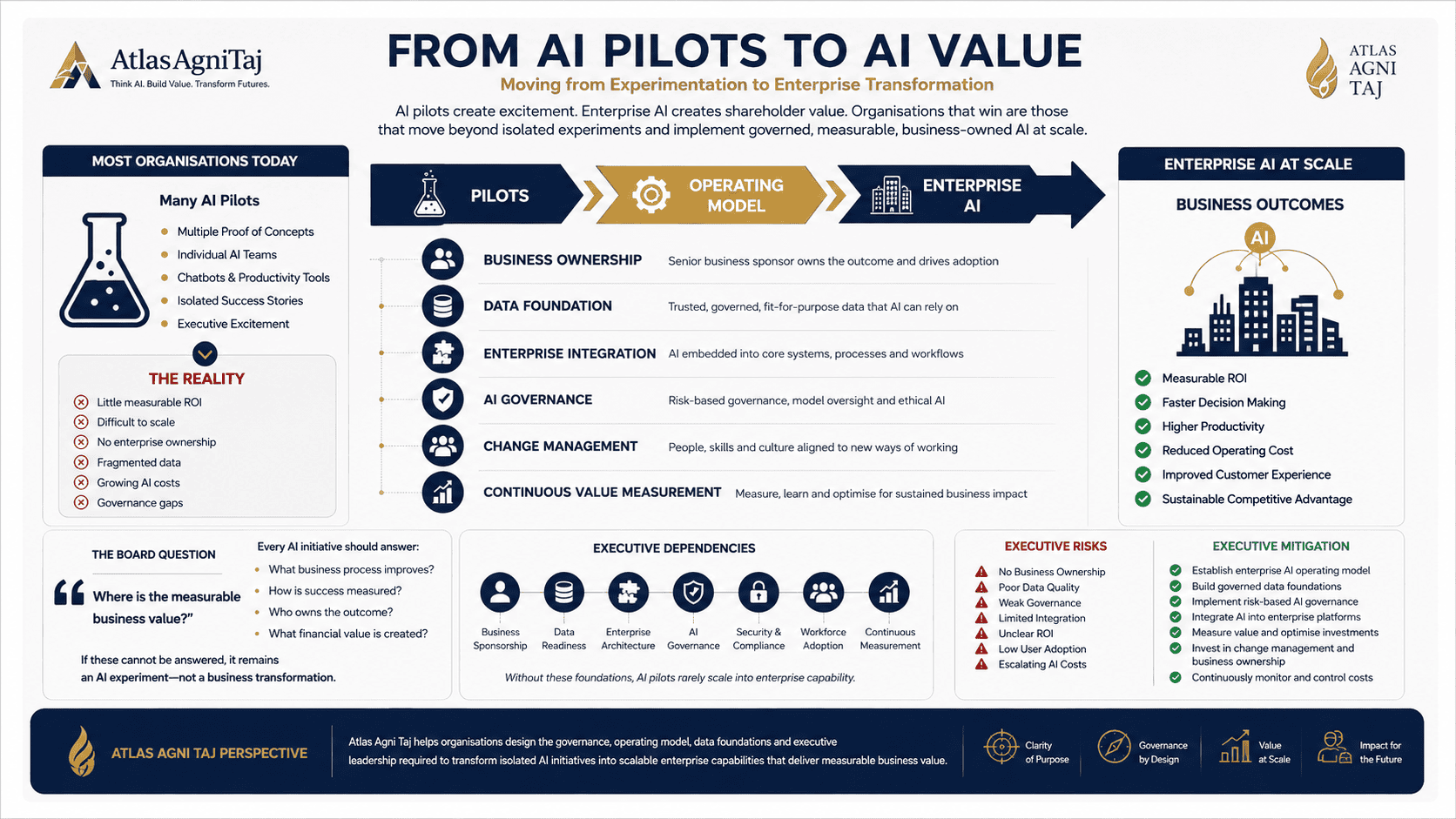
Yet when the Chief Financial Officer asks a simple question — where, precisely, is the measurable business value? — the room tends to go quiet.
This is the pilot paradox, and it has become the defining tension of enterprise technology leadership over the past eighteen months. Recent CIO research consistently places operationalising AI, establishing robust governance, ensuring data readiness, maintaining cybersecurity posture, and controlling escalating costs firmly at board level. Cybersecurity remains the foremost concern for most CIOs, closely followed by the challenge of operationalising AI and building a coherent data strategy.
The question of whether enterprises should adopt AI was settled two years ago. The question that matters now is how to make AI work — reliably, safely, and at a scale that moves the needle on enterprise performance. This is not, at its core, a technology problem. It is an operating model problem, and it demands executive-level ownership rather than technical stewardship alone.
Why AI Pilots Fail to Scale
Enterprises that fail to translate promising pilots into enterprise-wide value tend to fail for a small, consistent set of reasons. Recognising these failure patterns is the essential first step towards building AI capability that endures.
The absence of genuine business ownership is the most critical failure point. Too many AI initiatives are launched by the technology function — often with real enthusiasm from Chief Technology Officers or innovation teams — but without a senior business sponsor who owns the outcome. A pilot can demonstrate technically that a model works. What it cannot do, on its own, is secure the budget, authority, and organisational will required to move from a controlled environment into full production. Without a business owner prepared to champion the transition, the initiative remains an interesting laboratory exercise rather than a genuine transformation programme. Incentives, authorities, and governance structures simply are not aligned to carry the work forward.
Inadequate data preparation and governance compounds the problem. Generative and agentic AI systems are only as good as the data that feeds them, and most enterprises discover during the pilot phase that their data landscape is fragmented across legacy systems, inconsistently defined, and often duplicated or stale. A small team can manage around these limitations during a pilot, manually curating datasets and suppressing noise. Scaling to an enterprise-wide deployment, however, requires master data governance, data lineage, and compliance frameworks that are unglamorous, lengthy, and expensive to build. Many organisations quietly abandon their scaling ambitions once they confront the true scope of this work — and where governance is not established from the outset, pilots can inadvertently create regulatory exposure and audit risk that undermines organisational appetite for AI altogether.
The isolation of AI from core enterprise architecture is a third, equally damaging pattern. Pilots are frequently built on standalone platforms, fed by manually extracted data, with outputs delivered through dashboards or APIs that never touch the systems of record. Scaling requires genuine integration into ERP platforms, HCM systems, customer data platforms, and financial systems — work that is complex, demands changes to core business processes, and requires close coordination between technology and business stakeholders. Many pilots never progress beyond the demonstration stage because this integration effort is underestimated or its business case is never properly articulated.
Undefined, measurable return on investment may be the most damaging gap of all. Many pilots launch under aspirational banners — “improve efficiency,” “enhance decision-making,” “elevate customer experience” — without ever translating these ambitions into financial or operational terms. When the moment comes to make the case for scaling, the organisation cannot say with confidence whether the pilot delivered value, whether that value is sustainable, or whether the cost of full deployment is justified. Executive leaders, having heard AI promises for several years now, have become understandably sceptical. They want proof, not pilots.
Missing governance and risk frameworks round out the picture. Traditional IT governance was never designed for the particular risks that AI systems introduce — model drift, data bias, explainability requirements, and liability for errors that ripple through downstream processes. Pilots frequently operate in something close to a governance vacuum. Once organisations recognise the scope of governance required — model monitoring, retraining protocols, access controls, audit trails, human oversight — many quietly pull back from their scaling plans, leaving otherwise capable initiatives permanently stranded in pilot purgatory.
The CIO’s New Mandate: Balancing Innovation with Governance
The role of the Chief Information Officer has changed fundamentally. Where CIOs once managed stability, security, and efficiency as their primary mandate, today’s CIOs must simultaneously balance innovation velocity with risk management, enable business agility without compromising security, and control costs even as competitors invest aggressively in the same capabilities.
This balancing act is especially demanding in regulated sectors such as financial services and government, where the pressure to modernise is intense — customers expect contemporary digital experiences, competitors are moving quickly, and boards are asking pointed questions about AI strategy — while the risk of deploying immature AI systems into critical business processes remains equally intense.
The tension between innovation and governance is real, and it is not easily resolved by leaning entirely into one or the other. Pure governance approaches strangle innovation with exhaustive approvals and documentation before any experiment can proceed. Pure innovation approaches invite regulatory violations, operational failures, security breaches, and lasting reputational damage. The answer is not to choose a side, but to design an AI operating model that enables experimentation within a framework of genuinely managed risk. In practice, this means building:
- Sandbox environments in which teams can experiment rapidly with new models and techniques, within clear constraints on data access, compute resources, and output scope.
- Clear escalation and approval pathways, allowing lower-risk experiments to proceed under lightweight governance while higher-risk changes — those touching customer data, financial processes, or regulatory obligations — receive the deeper scrutiny they warrant.
- Automated governance controls embedded directly into the AI pipeline — data quality checks, fairness assessments, anomaly detection — rather than governance that relies solely on manual human review.
- Living documentation and playbooks that capture what good practice looks like, allowing teams to move quickly while maintaining consistency and avoiding repeated governance effort.
Cost control forms a second, equally pressing dimension of the CIO’s new mandate. Generative AI and advanced analytics consume significant compute resources, and cloud spending can spiral rapidly without active management — particularly as licensing models for AI platforms and tools remain immature and, in many cases, opaque. CIOs must ensure that AI investment delivers returns commensurate with its cost, which requires rigorous cost attribution, benchmarking against peer organisations, and disciplined decisions about whether to build, buy, or partner. Not every AI idea deserves funding, and some pilots should be discontinued the moment their benefits no longer justify their expense.
Change management and business adoption represent a third, frequently underestimated dimension. A technically successful AI deployment can still fail to generate value if end users do not adopt new processes, do not understand how to use the system, or simply do not trust the insights it generates. CIOs must ensure their organisations invest as seriously in training, adoption support, and change management as they do in the underlying technology — working closely with business leaders to design workflows where AI is woven naturally into existing processes, supported by feedback mechanisms that surface where adoption is falling short.
From Chatbot Thinking to Genuine Workflow Redesign
One of the most persistent misconceptions about enterprise AI is that its purpose is to automate small, discrete tasks — deploy a chatbot here, draft an email there, automate a piece of data entry elsewhere. These are legitimate applications, but they represent only a fraction of AI’s transformational potential. The more powerful application of agentic AI lies in workflow redesign: examining end-to-end business processes and fundamentally reimagining how they operate once genuinely augmented by AI capability.
Consider finance operations. A traditional accounts payable process involves multiple manual steps — invoice receipt, system entry, matching against purchase orders and receipts, exception handling, approval, and payment — each labour-intensive and prone to error. An agentic AI system can reshape this workflow entirely: receiving invoices across multiple formats, extracting key data, validating against purchase orders and receipts, flagging exceptions for human review, routing approvals according to business rules, and initiating payment. The finance team’s role shifts from data processing towards exception management and strategic oversight. Cost per transaction falls, cycle times improve, and error rates decline — but only where finance and IT collaborate to redesign the workflow from first principles, retrain teams to interpret and where necessary override AI-generated decisions, and commit to genuine process redesign rather than a bolt-on automation layer.
Similar transformations are available in human resources, where recruitment workflows can be reimagined with AI agents that screen applications, conduct initial interviews, and prepare briefing documents for human recruiters; in procurement and supply chain, where AI can optimise vendor management, inventory levels, and demand planning; and in customer service, where agents handle increasingly complex queries and escalate to humans only when genuinely necessary. The common thread across every example that succeeds is the same: the organisations capturing the greatest value are not chasing individual tasks or point-solution chatbots. They are redesigning workflows, redefining roles, and rebuilding operating models so that AI functions as a decision-making and execution partner — not merely a cost-reduction tool bolted onto an unchanged process.
Governance Cannot Be Retrofitted
If there is one lesson successful enterprises have learned, it is that AI governance cannot be retrofitted after the fact. It must be designed into the operating model from the outset, built around a small number of core elements.
Model ownership and accountability must be explicit. Every AI model requires a clear owner — a business or technical leader accountable for its performance and outcomes, empowered to make decisions about retraining, retirement, or significant change. Data provenance and quality assurance must be documented and continuously monitored, with automated data quality checks built into the pipeline so that any AI output can be traced back to its underlying sources. Fairness and bias testing must be embedded in model development and ongoing monitoring, given the real risk that AI systems inadvertently perpetuate historical bias against protected groups. Explainability and interpretability must be sufficient — not necessarily perfect, but sufficient — for human decision-makers to understand and, where appropriate, override AI recommendations that affect customers, employees, or business outcomes. Model monitoring and drift detection must be continuous, since models trained on historical data inevitably degrade as underlying business conditions evolve.
The most effective organisations apply these elements through a layered, risk-based approach rather than a single blanket policy — lighter-touch governance for lower-risk experimentation, and considerably more rigorous review, monitoring, and external audit for AI systems that touch customer data, financial processes, or regulated decisions. This layering prevents governance from becoming a bureaucracy that stifles innovation, while ensuring the deployments that carry genuine risk receive the scrutiny they deserve.
What Good Looks Like: From Concept to Scale
Organisations that succeed in scaling AI from pilot to enterprise deployment share a recognisable set of characteristics.
They begin not with technology but with business value streams, asking directly which business processes — if genuinely improved by AI — would have the most material impact on financial performance, customer satisfaction, or competitive position. They then map each value stream in detail, identify where AI could realistically help, and estimate the potential impact before a single line of code is written.
Rather than treating each AI initiative in isolation, they build portfolios of related use cases within each business function, creating economies of scale in data preparation, governance, and platform investment, and establishing clear priorities for sequencing and resource allocation. These portfolios are typically tiered: immediate high-impact opportunities ready for deployment now; medium-term opportunities requiring process redesign or further data work; and longer-term exploration of emerging techniques.
Every use case carries a named business owner — not merely a technical owner — with authority over process change, training investment, and success metrics, because without this accountability, pilot success simply does not translate into business outcomes. Success metrics are defined before deployment and measured rigorously against baseline afterwards, covering cost reduction, quality improvement, cycle time, revenue impact, and customer satisfaction, reviewed on a monthly cadence to build the evidence base for further scaling.
Scaling itself proceeds in phases with feedback loops, an initial deployment in one region or function followed by expansion as lessons are captured and governance refined, reducing risk and creating space to adjust the operating model before broader rollout. Underpinning all of this is sustained investment in data architecture and governance — the unglamorous, foundational work that enables multiple AI use cases simultaneously — together with deliberate investment in talent and capability, recruiting and retaining data scientists, machine learning engineers, and governance specialists, while reskilling existing finance, HR, and operations professionals to work effectively alongside technical teams.
The Path Forward for CIOs
For Chief Information Officers across the GCC region and globally, the imperative is unambiguous: move beyond pilots. The organisations that will lead over the next five years will not be those that ran the greatest number of AI experiments; they will be those that scaled AI systematically, deliberately, and safely across the enterprise.
Six steps define that path. First, establish clear governance frameworks and operating models before scaling begins — defining risk-tiered governance layers, resolving the question of centralised versus decentralised AI ownership, and establishing decision-making authorities and approval pathways in advance. Second, invest in foundational data and technology infrastructure — data platforms, master data management, and governance tooling — recognising these as essential prerequisites rather than optional extras. Third, identify and sequence high-impact AI use cases into a business-driven, multiyear portfolio, prioritised by impact potential, data readiness, and governance complexity. Fourth, build genuine business ownership and change management capability, ensuring every major initiative carries clear sponsorship, outcome accountability, and adoption support. Fifth, develop talent and capability deliberately, recruiting and retaining AI expertise while building internal capability alongside trusted external partners. Sixth, measure and communicate value relentlessly — establishing clear metrics, measuring results rigorously, and sharing outcomes with business leaders and the board to build sustained momentum.
Conclusion: The Real Question
The question facing CIOs is no longer whether AI can be used. That question was settled two years ago, and competitors are already acting on the answer. The real question is whether an organisation can safely, securely, and commercially scale AI across the enterprise to build sustainable competitive advantage.
That is a fundamentally different challenge. It demands moving beyond experimentation into disciplined, governance-driven, value-focused deployment. It demands business ownership and genuine collaboration, not technology prowess alone. And it demands the patience to build foundational capabilities and governance that may never be visible to the board, yet are precisely what makes scaling possible.
The organisations that answer this question well will emerge as industry leaders. Those that remain in the pilot phase will find themselves progressively left behind. The time for pilots has passed. The time for transformation has begun. The question that remains is a simple one: is your organisation ready to move forward?
How Atlas Agni Taj Can Help
Atlas Agni Taj works with boards and CIOs precisely at the point where AI ambition meets operating reality. Drawing on decades of enterprise transformation, programme governance, and sovereign infrastructure delivery across the UAE and wider GCC, Atlas Agni Taj supports organisations in translating AI pilots into durable, governed, board-ready value through:
- AI Operating Model Design — establishing the governance layers, ownership structures, and decision rights required to scale AI safely, without stifling innovation.
- Business Value Stream Mapping and Use-Case Portfolio Design — identifying and sequencing the AI initiatives most likely to deliver material, measurable impact, tiered by readiness and complexity.
- AI Governance and Risk Frameworks — designing model ownership, data provenance, fairness testing, explainability, and monitoring frameworks appropriate to each organisation’s regulatory context.
- Data Foundation and Enterprise Integration Advisory — assessing data readiness and designing the master data, governance, and integration architecture needed to move AI from standalone pilots into core enterprise systems.
- Programme Leadership and Change Management — providing interim or advisory Programme Director and Head of Portfolio Delivery capability to drive scaling programmes to completion, with the business ownership and adoption discipline that pilots typically lack.
For CIOs and boards ready to move from experimentation to enterprise value, Atlas Agni Taj offers an independent, experienced partner for that journey.
#ArtificialIntelligence