ERP Modernisation Is Becoming an AI Readiness Test
Why the next eighteen months will decide which enterprises lead the intelligent era — and which spend a decade catching up
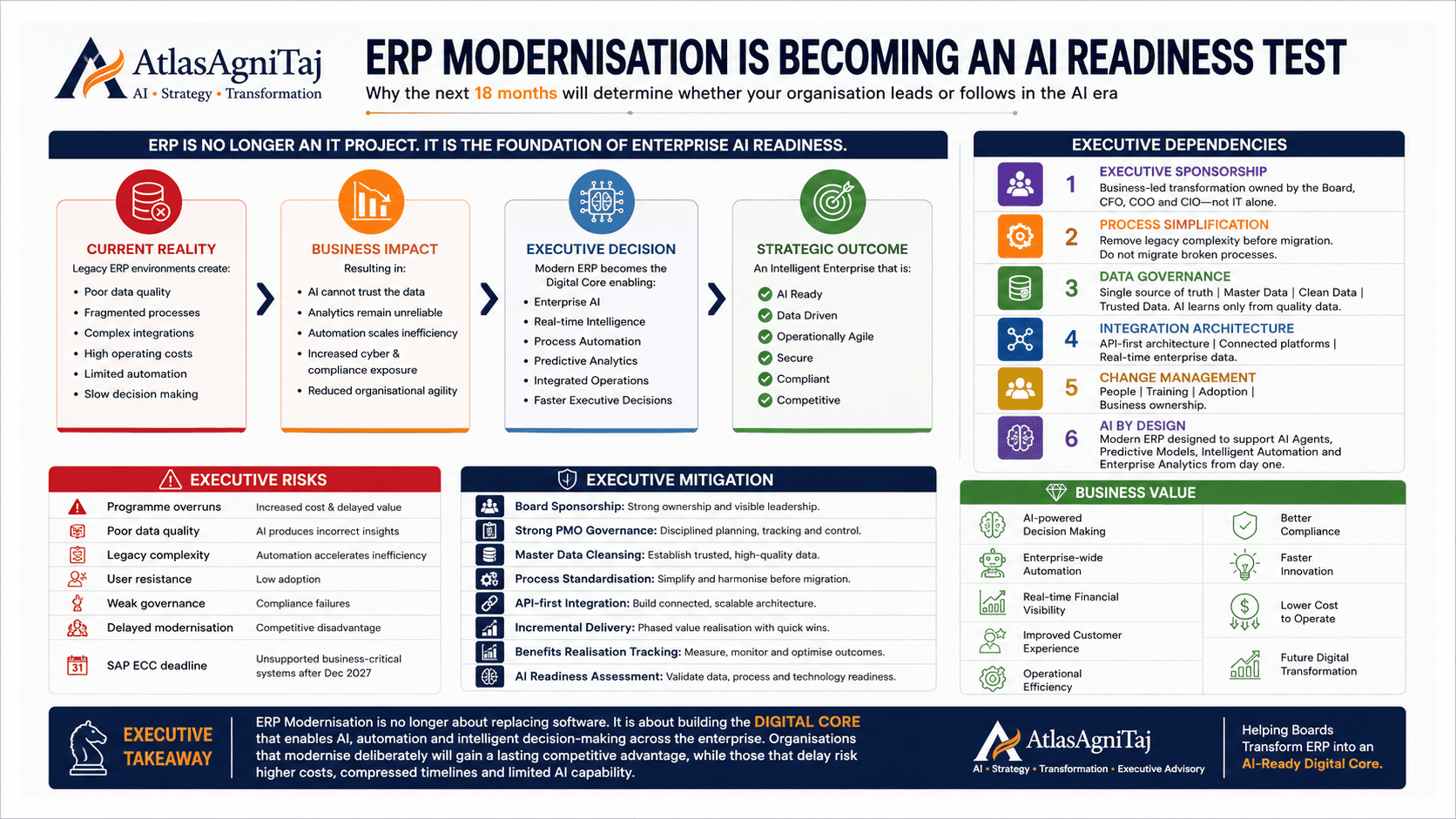
For most of its history, Enterprise Resource Planning has been treated as plumbing: essential, expensive, and largely invisible to the boardroom. That era is over. In 2026, the state of an organisation’s ERP estate has become the clearest available signal of whether that organisation is capable of deploying artificial intelligence with any real effect. This is no longer a technology conversation. It is a test of institutional readiness, and increasingly, of leadership judgement.
Why This Moment Is Different
Three forces have converged to make ERP modernisation an unavoidable executive priority, rather than a discretionary IT programme.
- A hard deadline is now real. SAP has confirmed that mainstream support for ECC ends on 31 December 2027. This is not a soft target that can be quietly extended. Once it passes, security patching, functional enhancement, and vendor support stop. For organisations operating in regulated sectors — financial services, healthcare, energy, government — the exposure this creates is not hypothetical. Several large enterprises that deferred their decisions beyond 2025 have already found themselves inside compressed timelines, inflated vendor pricing, scarce implementation talent, and inadequate room for proper change management. The remediation cost, in more than one case, has run into the billions.
- The competitive premium on AI has become unforgiving. Across every sector, boards now expect AI-enabled decision-making, predictive analytics, and automated workflows to deliver measurable advantage. But AI performance is entirely bounded by the quality of the data, the clarity of the process, and the integrity of the integration architecture beneath it. Poor data produces biased models. Fragmented processes create blind spots that no algorithm can see past. Weak integration produces insight in silos rather than insight at enterprise scale. Put simply: no organisation builds a superior AI operating model on an inferior ERP foundation.
- The cost of inaction has become impossible to ignore. Legacy ERP environments routinely consume sixty to seventy per cent of IT budgets simply to keep the lights on, leaving little for genuine innovation. The opportunity cost — in automation never captured, insight never generated, and decisions made a quarter too late — now frequently exceeds the cost of modernisation itself. Modern cloud ERP inverts that ratio, freeing capital and attention for the initiatives that actually move the enterprise forward.
Why Legacy ERP Environments Defeat AI
Most large enterprises operate ERP landscapes shaped by decades of customisation, acquisition, reorganisation, and accumulated workaround. The pattern is remarkably consistent across industries.
- Data quality. Master data for customers, products, vendors, and general ledger hierarchies is frequently unstandardised, duplicated, and inconsistently named. It is not unusual for a multinational manufacturer to find the same vendor represented in more than forty different ways across regional instances — producing distorted supplier performance metrics, missed volume discounts, and a supply chain leadership team operating with compromised visibility. Any model trained on this data inherits its defects.
- Process complexity. Legacy environments accumulate manual interventions, informal exception handling, and approval routes that quietly bypass system controls. One large bank discovered, during a process assessment, that its accounts payable function ran forty-seven undocumented exception procedures alongside its official three-step process — and that these exceptions consumed more effort than the process they were meant to be exceptions to. Redesign becomes almost impossible when the true process is invisible to the people meant to be improving it.
- Integration fragmentation. Truth about the business is frequently scattered — ERP holds one version, finance systems another, supply chain a third, sales a fourth. This prevents the unified, real-time view that AI systems require to function, forcing reconciliation to remain manual, slow, and error-prone. One global industrial group was found to be maintaining twenty-three separate sources of product master data, generating ten to fifteen hours of reconciliation effort each week and leaving genuine blind spots in profitability analysis.
- Control weakness. Years of regulatory change, M&A activity, and operational pressure often leave control frameworks that are documented on paper but inconsistently enforced in practice. Confidence in the data erodes. Risk appetite contracts. Auditors increasingly qualify their opinions where they cannot be confident the control environment supports what the numbers claim to show.
The consequence of layering AI onto this foundation is what might best be described as automated inefficiency: processes that run faster while continuing to produce precisely the same errors, blind spots, and inconsistencies they always have. Automation does not fix a broken foundation — it accelerates it.
ERP as the Digital Core, Not the Back Office
Genuine ERP modernisation requires reframing what ERP actually is within the enterprise. Rather than a finance-and-operations utility sitting behind the business, modern ERP should be understood as the digital core that connects and orchestrates the enterprise as a whole: finance and controlling; procurement and supply chain; human capital management; sales and revenue operations; manufacturing and operations; data and analytics; and controls and compliance.
Understood this way, modernisation stops being a technology replacement exercise and becomes a strategic redesign of how the enterprise operates, integrates, and learns. That reframing raises the apparent complexity of the programme — but it also clarifies precisely why the investment is justified. One global financial services firm that repositioned its S/4HANA programme as an operating model transformation, rather than an ERP migration, secured materially greater executive buy-in, additional budget, and ultimately delivered benefits some forty per cent above its original projections.
Why Speed, Pursued Carelessly, Becomes the Enemy
One of the more damaging instincts in ERP modernisation is the pressure toward rapid, compressed deployment. Speed matters, but not at the expense of the quality on which the entire investment depends. A European automotive supplier compressed its S/4HANA implementation from twenty-four months to fourteen, eliminating process simplification, abbreviating user testing, and deferring control implementation to save time. The result was nine months of additional post-go-live support, cost overruns exceeding fifteen million euros, and twenty-four months to reach stability. The attempt to save ten months cost the organisation thirty-four months of disrupted value delivery.
A disciplined approach follows a clear sequence: assess current-state complexity; simplify processes before migration, not after; cleanse master data to a high standard; execute a staged migration under firm integration governance; establish controls immediately post-go-live; and track benefits realisation systematically. Depending on complexity, this typically requires eighteen to thirty-six months — but it produces a genuinely transformed enterprise rather than old complexity running on new infrastructure.
What Distinguishes the Programmes That Succeed
Across a wide range of major ERP programmes, certain factors consistently separate those that transform the business from those that merely replace its technology.
- Clear scope definition. Leading programmes state explicitly what must migrate, what will retire, and what will be bridged temporarily, avoiding the scope creep that quietly erodes timeline and budget discipline.
- Business ownership. The strongest programmes are sponsored by the CFO, COO, or Chief Digital Officer, not by IT alone, ensuring business priorities drive technical decisions. Programmes with highly committed executive sponsors have been shown to achieve results roughly three times faster than those with passive sponsorship.
- Process simplification before migration. Redesigning processes ahead of migration, rather than transplanting legacy complexity into a new system, typically reduces process complexity by twenty to forty per cent. One financial services firm eliminated 230 of 680 process steps during simplification, cutting implementation costs by thirty-five per cent and accelerating go-live by six months.
- Master data governance. Preparing data to a high standard before migration, and governing it thereafter, typically consumes ten to fifteen per cent of total programme cost — yet returns five to eight times that investment through better decisions and fewer post-go-live defects.
- Integration governance. APIs must be managed as critical infrastructure with clearly defined service levels, preventing the fragmentation that quietly undermines AI readiness downstream.
- Testing discipline. Programmes allocating twenty-five to thirty per cent of effort to testing, and treating it as continuous rather than a final compressed phase, consistently experience fewer post-go-live defects and faster stabilisation.
- Change management and capability building. Sustainable transformation requires that users understand not only what has changed, but why, and how to operate within it. Comprehensive change management has been shown to accelerate adoption by up to sixty per cent.
- Benefits tracking and realisation. Programmes that establish clear KPIs before go-live and actively manage realisation for two to three years afterward achieve return on investment two to three times faster than those that treat benefits as an afterthought.
Designing Explicitly for AI Readiness
ERP modernisation must treat AI readiness as an explicit design principle from the outset, not a capability bolted on afterward.
- Data architecture for AI. The ERP and its supporting data platform must sustain high-quality master data, transactional integrity, and historical retention with clear lineage — architected to support both traditional reporting and machine learning pipelines.
- API-first integration. Treating APIs as first-class infrastructure allows AI platforms and analytics tools to consume ERP data directly, without brittle custom extraction routines. One manufacturer implemented forty-seven APIs during its modernisation programme, enabling nineteen advanced analytics and AI capabilities that would otherwise have been impossible.
- Process standardisation. Consistency is what allows machine learning to find reliable patterns; fragmentation and exception-handling defeat it. A retailer that standardised its order-to-cash process across six hundred locations lifted demand-forecasting model accuracy from an average of sixty-eight per cent to ninety-four per cent.
- Governance for explainability. As AI increasingly influences business decisions, governance must support explanation — strong data lineage, feature documentation, and audit trails. Regulators are moving toward requiring organisations to demonstrate how automated decisions were reached, which is only possible on a foundation of clean data and disciplined governance.
- Security and compliance foundations. Trust in AI output ultimately rests on trust in the underlying data and control environment. Organisations deploying AI without strong ERP controls should expect increasing regulatory scrutiny of bias, transparency, and decision accuracy.
Managing the Principal Risks
ERP modernisation programmes carry material risk, and the failure modes are well understood.
- Schedule overrun. Scope expansion, underestimated complexity, and testing delays can extend timelines by twenty to fifty per cent. Mitigation lies in strict change control, realistic estimation with genuine contingency, and proactive resource management.
- Budget overrun. Hidden complexity and vendor cost escalation can raise costs by twenty-five to forty per cent. Mitigation requires detailed, line-item cost visibility and disciplined contingency management.
- User resistance. Inadequate change management and training produce poor adoption and workaround behaviour. Mitigation requires early, honest stakeholder engagement and clear articulation of benefit.
- Data quality failure. Insufficient cleansing and validation before migration erodes confidence in decision-making. Mitigation requires systematic remediation before go-live, not after.
- System stability issues. Inadequate performance tuning and capacity planning produce instability post-go-live. Mitigation requires comprehensive load testing and headroom built in from the outset.
The Conversation Executive Leaders Should Be Having
For CIOs, CTOs, and transformation leaders, positioning ERP modernisation correctly is not simply a matter of programme management — it shapes how the organisation, and the market, perceives the leader driving it.
- With boards and executive teams: the case must be made in the language of competitive advantage, risk mitigation, and strategic optionality — not technology features. ERP modernisation is a growth and resilience investment, not a cost-reduction exercise.
- With CFOs and finance leaders: the conversation should centre on real-time financial visibility, predictive cash management, and faster close cycles. One retailer’s move to cloud ERP reduced its cash conversion cycle by eight days, releasing €180 million in working capital.
- With COOs and operations leaders: the emphasis belongs on cycle time, quality, and resilience. One manufacturer cut order-to-delivery time from thirty-five days to twelve through a combination of ERP modernisation and process redesign.
Executives who master this framing position themselves not as technology managers, but as strategic advisors — a distinction that increasingly determines who is invited into board discussions, interim leadership mandates, and advisory roles as organisations navigate transformations of this scale.
The Question Beyond the Migration
The question that should anchor every ERP programme is not “when are we migrating from ECC to S/4HANA?” That is a project question with a timeline for an answer. The deeper and more consequential question is: what kind of intelligent enterprise are we building?
Answering it well requires clarity across four dimensions: the business outcomes the organisation intends to enable; how the operating model, accountability, and roles will evolve; the data and analytics strategy and AI priorities that will govern the enterprise going forward; and the technology architecture choices — cloud posture, integration approach, cybersecurity, and compliance — that will underpin all of it. When these questions are answered before the programme begins, migration becomes the tactical execution of strategic choices already made, rather than a technical project searching retrospectively for its business justification. That shift in framing changes the entire character of the programme: from “can we migrate?” to “what are we becoming?”
Conclusion: An Inevitable Transformation
ERP modernisation in 2026 is no longer optional. The December 2027 SAP ECC deadline is real. The competitive pressure to deploy AI effectively is unrelenting. The cost of delay continues to mount. The genuine question facing every enterprise leader is not whether to modernise, but whether to do so strategically, with discipline and vision, or reactively, under deadline pressure, with shortcuts and compromise.
Organisations that use this moment to simplify process, elevate data quality, strengthen governance, and design deliberately for AI readiness will emerge as intelligent enterprises — capable of faster decisions, greater resilience, and analytical capability that constitutes genuine competitive advantage. Those that treat modernisation as a like-for-like technology swap, deferring process improvement and adopting minimal governance, will simply replicate their existing complexity on newer infrastructure — and find that automation accelerates the very inefficiencies they hoped to leave behind.
The transformation is coming, whether by design or by default. SAP has set the date. Market pressure enforces it. The technology to do it well already exists. The only open question is whether your enterprise will lead this transformation deliberately, on its own terms — or follow it reactively, under compressed timelines and constrained options. This is not, at its core, a technology decision. It is a decision about what your organisation is going to become, and it deserves the seriousness and executive engagement that decisions of that magnitude require.
How Atlas Agni Taj Can Help
Atlas Agni Taj works with boards, CIOs, CFOs, and transformation sponsors across the UAE and GCC to ensure that ERP modernisation is approached as the strategic decision it is, rather than a technology migration seeking justification after the fact. Our advisory support typically spans:
- AI-readiness and current-state assessment: an independent diagnostic of data quality, process complexity, integration architecture, and control maturity, benchmarked against what genuine AI deployment requires.
- Business case and operating model reframing: repositioning the programme from an IT migration to an enterprise operating model transformation, with the language, benefits case, and governance structure that secures sustained executive sponsorship and budget.
- Programme governance and PMO design: establishing scope discipline, integration governance, testing rigour, and benefits-realisation tracking from day one, informed by direct experience of large-scale ERP, cloud, and sovereign infrastructure programmes across financial services, government, and enterprise technology.
- Master data and process simplification advisory: structuring the pre-migration cleansing, standardisation, and process redesign work that determines whether AI, once deployed, produces trustworthy results.
- Risk and control framework design: building the governance, audit trail, and explainability foundations that regulators and boards increasingly expect from any AI-enabled decision process.
- Interim and fractional leadership: providing experienced Programme Director, Head of Portfolio Delivery, or advisory capacity to lead or oversee transformation delivery where organisations need proven, hands-on leadership rather than another layer of consulting recommendation.
If your organisation is approaching its ERP modernisation decision and wants an independent, execution-grounded perspective on how to use this moment to build genuine AI readiness, we would welcome the conversation. Visit atlasagnitaj.com or connect directly to discuss your specific context.
#ERPModernisation #AIReadiness #DigitalTransformation #S4HANA #CIOLeadership #BusinessTransformation #DataGovernance #IntelligentEnterprise #OperatingModelRedesign #AtlasAgniTaj