Cyber Resilience in 2026: A Strategic Imperative for Leaders

Cyber Resilience Must Now Move at Machine Speed: A Strategic Imperative for 2026 Why boards, CEOs, and technology leaders must treat resilience — not just security — as the defining test of organisational maturity Executive Summary Cybersecurity and cyber resilience are frequently used interchangeably in boardrooms, yet they are fundamentally different disciplines. Cybersecurity protects systems. Cyber resilience protects the enterprise. As artificial intelligence accelerates the speed and sophistication of attacks, and as ransomware matures into a professionalised criminal industry, organisations can no longer afford to treat cyber risk as a technical compliance exercise confined to the IT function. The World Economic Forum's 2026 Global Cybersecurity Outlook places AI-enabled fraud, phishing, ransomware, and AI-specific vulnerabilities at the very top of executive concern. In the UAE, recent strategic partnerships between government entities and global technology leaders such as IBM and Palo Alto Networks confirm what forward-looking executives already sense: trusted AI, national cyber resilience, digital sovereignty, and economic competitiveness are now inseparable. For CIOs, CTOs, and boards, this convergence presents both an urgent operational challenge and a genuine strategic opportunity. Organisations that embed resilience into their operating model, governance architecture, and leadership accountability will decisively outperform those that continue to treat cyber as a technical afterthought. Part 1 — The Threat Landscape Has Changed Its Physics The threat environment of 2026 bears little resemblance to that of even three years ago. The change is not simply one of volume; it is one of velocity, intelligence, and destructive intent. AI-enabled attacks now allow adversaries to identify vulnerabilities, craft convincing phishing campaigns, and exploit weaknesses at industrial scale. Where a human analyst might once have required days to detect a pattern of compromise, an AI-orchestrated attack can propagate across an enterprise network within hours. Ransomware, meanwhile, has matured from opportunistic crime into a disciplined business model, complete with negotiation playbooks, affiliate structures, and research budgets in the tens of millions of dollars directed at discovering zero-day vulnerabilities before defenders are even aware they exist. Supply chains have become the preferred attack vector. Adversaries increasingly target vendors, contractors, and managed service providers as a route into their true objective — a single compromised provider can expose hundreds of downstream enterprises simultaneously. At the same time, the normalisation of remote and hybrid working has widened the insider risk surface considerably; employees with privileged access are no longer confined to environments where behaviour can be readily monitored. Critical infrastructure — utilities, transport networks, healthcare systems — remains a persistent and patient target. These campaigns often involve weeks or months of quiet reconnaissance before a disruptive event is triggered, with the potential to affect millions of citizens at once. What unites these trends is speed. In previous cycles, a cyber incident might unfold over days or weeks, allowing for deliberate investigation, escalation, and communication. That timeline has effectively disappeared. Modern ransomware can encrypt terabytes of data within hours. A single compromised credential can enable lateral movement across a network within minutes. If an organisation's incident response process still depends on multi-layered approvals, coordination meetings, and formal change management, it will simply be too slow to matter — by the time decision-makers are assembled, the objective will already have been achieved. Cyber resilience in 2026 therefore demands automation, clearly pre-assigned decision rights, pre-authorised response playbooks, and the operational confidence to activate recovery procedures without waiting for business-as-usual governance to catch up. It is worth stressing that none of these trends are transient. AI tooling used by adversaries is improving at a pace comparable to AI tooling used by defenders, which means the balance of advantage will not resolve itself through technology procurement alone. It will be resolved by which organisations have built the governance, muscle memory, and decision discipline to act decisively under pressure. This is precisely why cyber resilience has moved from a technical specialism to a board-level competency in its own right. Part 2 — The UAE Context: Digital Sovereignty as Strategic Resilience The UAE's deliberate emphasis on cyber resilience reflects a wider regional conviction: digital trust is now foundational to economic growth and national sovereignty, not a peripheral IT concern. Recent partnerships between the UAE government and global leaders such as IBM and Palo Alto Networks are not simply procurement decisions — they signal a strategic commitment to build institutional capability, governance maturity, and trusted-AI leadership across the region. For enterprises operating in the UAE and the wider GCC, this creates both new expectations and new opportunities. Regulatory frameworks will inevitably tighten as national investment in resilience matures; organisations that embed sound practice early will find themselves ahead of the compliance curve, while those that wait for mandates will face costly retrofitting under pressure. Procurement standards will follow the same trajectory. As government bodies formalise partnerships with trusted security vendors, enterprise procurement processes will increasingly demand demonstrable resilience maturity from suppliers — those unable to evidence it will face friction, delay, and lost commercial opportunity. There is also a genuine leadership opportunity here. Technology executives who position themselves as authorities in cyber resilience — rather than cybersecurity alone — will gain distinct advantage in executive recruitment and board-level influence. This is the moment for CIOs and CTOs to elevate their remit from 'IT operations' to 'business continuity strategy', and for enterprises expanding beyond the region, demonstrable alignment with UAE and GCC resilience standards is fast becoming a signal of maturity to international partners and customers alike. Part 3 — Cybersecurity and Cyber Resilience Are Not the Same Discipline Cybersecurity is the practice of protecting systems from unauthorised access, modification, or destruction. It is concerned with prevention, detection, and response. It asks: can we stop the attack, identify it quickly, and limit the damage? Cyber resilience is a broader and more consequential capability — the capacity of an organisation to continue functioning during and after a cyber incident. It encompasses operational redundancy, recovery capability, governance clarity, pre-defined decision authority, and stakeholder communication. It asks a different question entirely: can the business continue to operate, can critical services be restored, and can trust with customers, regulators, and shareholders be preserved? An organisation can possess strong cybersecurity — advanced firewalls, endpoint detection, mature threat intelligence — and still lack resilience, because it has never rehearsed how to operate once those controls inevitably fail. And they will fail, eventually; the question is never if, but when. Consider a well-defended financial services firm with a mature security operations centre, endpoint detection deployed across the estate, network segmentation, and a zero-trust architecture. By conventional cybersecurity metrics, it is exemplary. An attacker compromises a third-party vendor's API credentials, gaining access to a segment of the firm's cloud environment. The SOC detects the intrusion within two hours — a genuinely creditable response time. Yet by then, customer data including personal information, account numbers, and transaction history has already been exfiltrated. From a cybersecurity standpoint, the organisation performed well. From a resilience standpoint, it now faces a full-blown crisis: regulatory notification obligations, customer communication, reputational exposure, law enforcement coordination, forensic investigation, remediation, and potentially litigation and fines. A genuinely resilient organisation would already have pre-negotiated relationships with forensic and incident response providers, prepared regulatory notification templates, designated executive decision-makers for crisis scenarios, and rehearsed its crisis communications. The gap between the two postures is the difference between extinguishing the fire and protecting the building — and everything inside it. This has direct governance implications. The CISO and security team typically own cybersecurity; the entire enterprise must own resilience. That means embedding resilience thinking into operational planning, enterprise risk management, budget allocation, vendor governance, crisis communications, and legal and compliance frameworks. When resilience is genuinely embedded across governance, the CISO evolves from a technical gatekeeper into a strategic advisor to the business. Part 4 — The Seven Pillars of Genuine Cyber Resilience Effective resilience rests on seven interdependent pillars. Organisations must be strong across all seven; excellence in one or two is not sufficient to claim genuine resilience. First, asset and service criticality assessment. Most organisations maintain compliance inventories and infrastructure diagrams, yet few have rigorously determined which services are truly mission-critical, what business impact would follow their failure, and what downtime is genuinely tolerable. This assessment must be led by business leaders, not IT alone — a technically complex data warehouse may not be mission-critical, while a seemingly simple email system frequently is. Second, access control and identity governance. A disproportionate share of the most damaging incidents begin with a single compromised credential and inadequate access controls. Least-privilege access, continuous authentication, disciplined credential hygiene, and privileged access management with just-in-time elevation are now baseline expectations, not aspirational goals. Third, redundancy and recovery infrastructure. Resilience demands deliberate investment in geographic, technological, and data redundancy — with backups that are regular, tested, isolated from production networks, and diversified across locations and media. Recovery time objectives should be tiered by criticality, and a recovery plan that has never been tested is not a plan; it is fiction. Fourth, operational technology and cloud security. Perimeter-based defence is no longer adequate in a distributed environment spanning multiple cloud providers, on-premises data centres, and mobile endpoints. Continuous cloud security posture management and disciplined segmentation between IT and OT environments are essential, particularly where OT systems cannot be patched without disrupting live operations. Fifth, continuous monitoring and threat detection. Detection speed is directly proportional to resilience. Comprehensive monitoring across network, endpoint, application, and user behaviour — supported by disciplined alert tuning to reduce false-positive fatigue — allows security teams to focus attention where it matters most. Sixth, incident response and pre-authorised playbooks. Incident response must never require building a plan in the moment. Organisations need documented playbooks covering detection, containment, eradication, recovery, and communication, together with pre-authorised decision rights — the CISO empowered to isolate compromised systems, IT empowered to segment networks, and finance empowered to release emergency spend, all without waiting for conventional approval chains. Seventh, governance, communication, and board oversight. Resilience must be governed at board level, with quarterly reporting on RTO and RPO achievement, incident response capability, and recovery testing results — sitting alongside financial, operational, and strategic risk, not beneath it. Crisis communication plans, regulatory notification readiness, and cyber insurance coverage should all be prepared well in advance of any incident, not improvised during one. Part 5 — An Implementation Roadmap for Executive Sponsors Building genuine resilience is a multi-year programme, best sequenced in four phases. The first three months should be devoted to assessment and governance: conducting a rigorous gap analysis, establishing a cross-functional resilience governance body spanning technology, operations, risk, communications, and business leadership, and completing a business impact analysis to define critical services and acceptable downtime. Months four to twelve should focus on foundational controls — identity and access governance, isolated and tested backup infrastructure, a monitoring stack encompassing SIEM, EDR, CSPM, and user behaviour analytics, and the development and testing of core incident response playbooks alongside initial disaster recovery drills. Months thirteen to twenty-four should build advanced capability — security orchestration and automated response for routine incident handling, proactive threat hunting, formalised vendor resilience assessment, realistic tabletop exercises involving both business and technical leadership, and structured training for incident responders and executives alike. From that point forward, resilience becomes a continuous discipline rather than a project: post-incident reviews after every event, quarterly recovery drills, ongoing threat intelligence integration, periodic technology refresh, and consistent quarterly reporting to the board. Progress should be measured, not assumed. Technical metrics — RTO and RPO achievement, backup success and testing rates, detection and containment time — should be tracked alongside operational metrics such as playbook coverage and communication readiness, strategic metrics including third-party resilience assessment coverage and regulatory compliance, and user-level metrics such as training completion and phishing susceptibility. What is not measured is rarely improved. Sponsorship discipline matters as much as sequencing. Programmes of this nature routinely stall when accountability is left ambiguous between the CIO, CISO, and business unit leadership, or when funding is treated as a one-off capital project rather than a sustained operating commitment. The most successful executive sponsors treat the roadmap as a standing item on the risk committee agenda, assign a single accountable owner for each phase, and insist on independent validation of testing results rather than relying solely on internal self-assessment. Part 6 — The Competitive and Governance Dividend Organisations that treat resilience as a genuine strategic priority secure a measurable competitive advantage. Speed and agility in incident response minimise business continuity impact, reduce recovery time, preserve stakeholder trust, and — in many jurisdictions — reduce regulatory penalties, since regulators explicitly weigh the speed and effectiveness of an organisation's response. Customer and partner confidence follows directly. In an era of frequent, high-profile breaches, customers and partners increasingly ask a direct question: if you are compromised, can you protect my data and continue our relationship? Organisations able to answer credibly in the affirmative gain real advantage in sales, partnership negotiations, and market positioning. The dividend extends to talent and capital. Security and technology professionals increasingly favour organisations that treat resilience seriously, strengthening recruitment and retention. Investors and boards, meanwhile, increasingly scrutinise cyber governance maturity as a proxy for overall operational discipline — a factor that can influence valuation and cost of capital. Finally, from the CEO's vantage point, cyber risk has never been a purely technological concern. It is a business risk capable of disrupting operations, compromising confidentiality, undermining reputation, triggering regulatory consequences, and creating material financial exposure. What a CEO wants — and increasingly expects the CIO or CTO to provide — is assurance that critical assets are identified and protected, that the organisation can respond quickly and effectively, that stakeholders will be managed appropriately, and that the enterprise will emerge from any incident with its reputation and trust intact. The technology leader who can frame resilience in these business terms, rather than purely technical ones, earns lasting credibility with the CEO and the board. Conclusion — The Imperative and the Opportunity Cyber resilience is no longer optional; it is a strategic imperative. The threat landscape continues to accelerate — AI-enabled attacks, ransomware-as-a-service, supply chain exploitation, and critical infrastructure targeting are all growing in sophistication and consequence. Organisations that have not invested in redundancy, governance, and recovery capability will simply be unable to operate effectively when — not if — an incident occurs. The cost of that unpreparedness is measured not only in technical recovery time, but in business disruption, regulatory penalty, reputational damage, and eroded stakeholder trust. Conversely, organisations that invest deliberately in resilience gain a durable competitive advantage: they respond faster, recover more completely, retain stakeholder confidence, and emerge from adversity with reputation intact. For CIOs, CTOs, and boards across the UAE and GCC, this is a genuine moment of opportunity — to elevate cyber risk from a technical domain into a strategic business conversation, and in doing so, to become an indispensable advisor to the CEO and the board. The question every executive team must now confront is not whether their organisation will face a cyber incident — it will — but whether the people, processes, technology, and governance are in place to respond effectively when it does. That is the true test of resilience. And in an era of machine-speed threats, it is a test every organisation must be prepared to pass, starting now, before the crisis arrives and the window for proactive investment closes. How Atlas Agni Taj Can Help Atlas Agni Taj is a boutique transformation advisory firm, with a presence across London, Dubai, and Singapore, established to help boards and executive teams convert exactly this kind of strategic imperative into an executable programme of work. Our practice brings together decades of enterprise transformation, programme governance, and regulated-sector delivery experience — including large-scale technology leadership across financial services, aviation, healthcare, and sovereign government entities — to help organisations move from cyber awareness to genuine cyber resilience. We support clients across each stage of the journey outlined above: independent resilience assessments and gap analyses benchmarked against NIST CSF 2.0 and ISO/IEC 27001/27002; design of governance charters, decision rights, and board reporting frameworks that give the CISO or CTO a credible seat at the table; business impact analysis and critical service mapping to define realistic RTOs and RPOs; and the design and facilitation of incident response playbooks, tabletop exercises, and crisis communication rehearsals that are tested rather than theoretical. For technology leaders preparing to make the business case for investment, Atlas Agni Taj also provides board-ready narrative and reporting design, vendor and third-party resilience assessment frameworks, and programme leadership to sequence multi-year resilience roadmaps without disrupting business-as-usual delivery. Our approach is deliberately pragmatic: we do not sell technology, and we are not aligned to any single vendor or platform — our role is to help you build the governance, discipline, and organisational muscle that makes resilience real, sustainable, and demonstrable to your board, regulators, and customers. If your organisation is assessing where it currently stands on the resilience journey — or is ready to move from strategy to execution — Atlas Agni Taj welcomes the conversation. About the Author Raj Kanda is a senior technology executive with over 35 years of experience in enterprise technology transformation, digital resilience, and cyber governance across financial services, aviation, healthcare, and government sectors in the UAE, GCC, and international markets. He has led technology initiatives at CIO, CTO, and Programme Director level, and is the founder of Atlas Agni Taj, advising boards and executive teams on technology strategy, governance, and operational resilience. Cloud-First Strategy

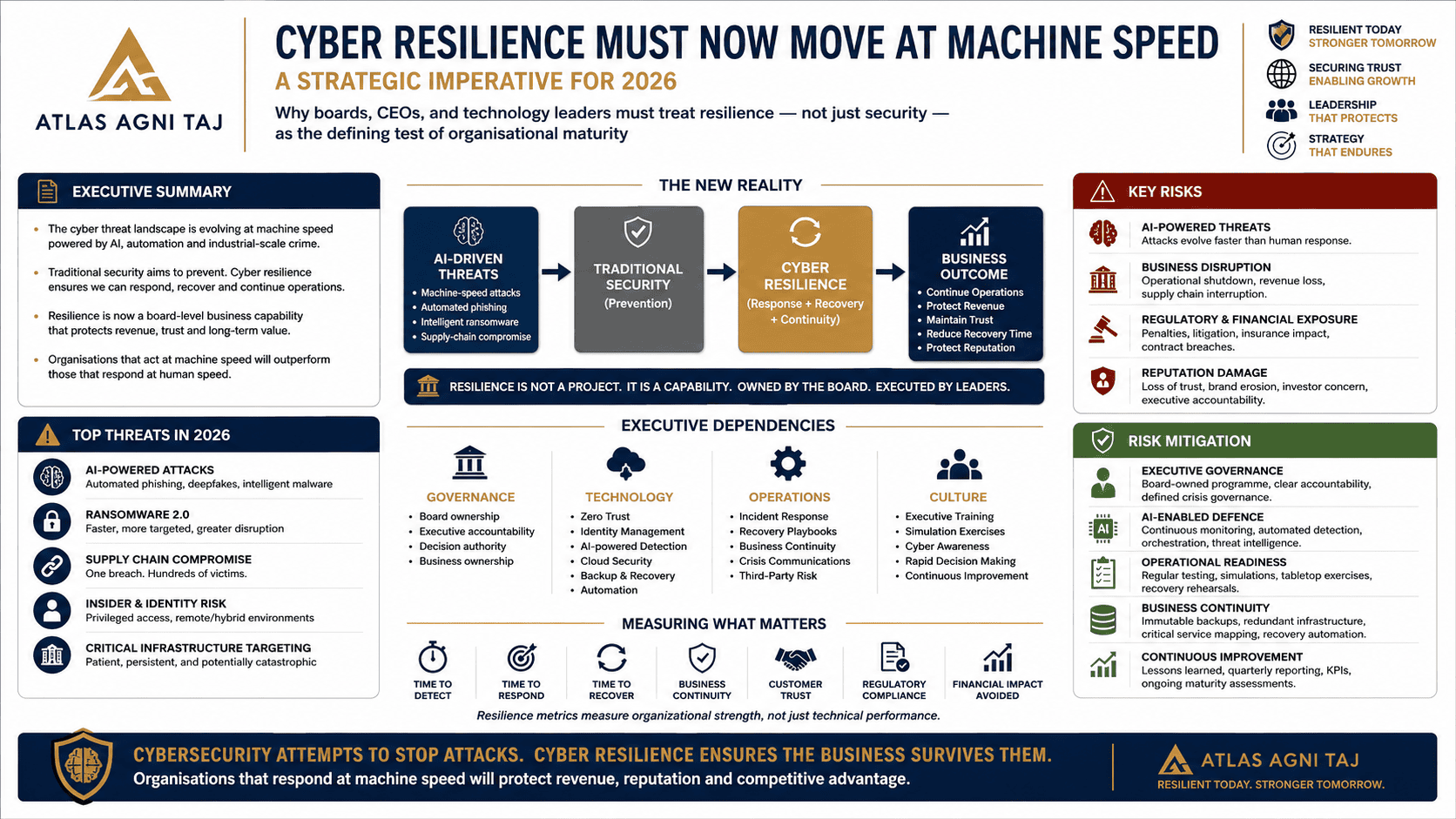
Cyber Resilience Must Now Move at Machine Speed: A Strategic Imperative for 2026

Why boards, CEOs, and technology leaders must treat resilience — not just security — as the defining test of organisational maturity 

Executive Summary 

Cybersecurity and cyber resilience are frequently used interchangeably in boardrooms, yet they are fundamentally different disciplines. Cybersecurity protects systems. Cyber resilience protects the enterprise. As artificial intelligence accelerates the speed and sophistication of attacks, and as ransomware matures into a professionalised criminal industry, organisations can no longer afford to treat cyber risk as a technical compliance exercise confined to the IT function. 

The World Economic Forum’s 2026 Global Cybersecurity Outlook places AI-enabled fraud, phishing, ransomware, and AI-specific vulnerabilities at the very top of executive concern. In the UAE, recent strategic partnerships between government entities and global technology leaders such as IBM and Palo Alto Networks confirm what forward-looking executives already sense: trusted AI, national cyber resilience, digital sovereignty, and economic competitiveness are now inseparable. 

For CIOs, CTOs, and boards, this convergence presents both an urgent operational challenge and a genuine strategic opportunity. Organisations that embed resilience into their operating model, governance architecture, and leadership accountability will decisively outperform those that continue to treat cyber as a technical afterthought. 

Part 1 — The Threat Landscape Has Changed Its Physics 

The threat environment of 2026 bears little resemblance to that of even three years ago. The change is not simply one of volume; it is one of velocity, intelligence, and destructive intent. 

AI-enabled attacks now allow adversaries to identify vulnerabilities, craft convincing phishing campaigns, and exploit weaknesses at industrial scale. Where a human analyst might once have required days to detect a pattern of compromise, an AI-orchestrated attack can propagate across an enterprise network within hours. 

Ransomware, meanwhile, has matured from opportunistic crime into a disciplined business model, complete with negotiation playbooks, affiliate structures, and research budgets in the tens of millions of dollars directed at discovering zero-day vulnerabilities before defenders are even aware they exist. 

Supply chains have become the preferred attack vector. Adversaries increasingly target vendors, contractors, and managed service providers as a route into their true objective — a single compromised provider can expose hundreds of downstream enterprises simultaneously. At the same time, the normalisation of remote and hybrid working has widened the insider risk surface considerably; employees with privileged access are no longer confined to environments where behaviour can be readily monitored. 

Critical infrastructure — utilities, transport networks, healthcare systems — remains a persistent and patient target. These campaigns often involve weeks or months of quiet reconnaissance before a disruptive event is triggered, with the potential to affect millions of citizens at once. 

What unites these trends is speed. In previous cycles, a cyber incident might unfold over days or weeks, allowing for deliberate investigation, escalation, and communication. That timeline has effectively disappeared. Modern ransomware can encrypt terabytes of data within hours. A single compromised credential can enable lateral movement across a network within minutes. If an organisation’s incident response process still depends on multi-layered approvals, coordination meetings, and formal change management, it will simply be too slow to matter — by the time decision-makers are assembled, the objective will already have been achieved. 

Cyber resilience in 2026 therefore demands automation, clearly pre-assigned decision rights, pre-authorised response playbooks, and the operational confidence to activate recovery procedures without waiting for business-as-usual governance to catch up. 

It is worth stressing that none of these trends are transient. AI tooling used by adversaries is improving at a pace comparable to AI tooling used by defenders, which means the balance of advantage will not resolve itself through technology procurement alone. It will be resolved by which organisations have built the governance, muscle memory, and decision discipline to act decisively under pressure. This is precisely why cyber resilience has moved from a technical specialism to a board-level competency in its own right. 

Part 2 — The UAE Context: Digital Sovereignty as Strategic Resilience 

The UAE’s deliberate emphasis on cyber resilience reflects a wider regional conviction: digital trust is now foundational to economic growth and national sovereignty, not a peripheral IT concern. Recent partnerships between the UAE government and global leaders such as IBM and Palo Alto Networks are not simply procurement decisions — they signal a strategic commitment to build institutional capability, governance maturity, and trusted-AI leadership across the region. 

For enterprises operating in the UAE and the wider GCC, this creates both new expectations and new opportunities. Regulatory frameworks will inevitably tighten as national investment in resilience matures; organisations that embed sound practice early will find themselves ahead of the compliance curve, while those that wait for mandates will face costly retrofitting under pressure. 

Procurement standards will follow the same trajectory. As government bodies formalise partnerships with trusted security vendors, enterprise procurement processes will increasingly demand demonstrable resilience maturity from suppliers — those unable to evidence it will face friction, delay, and lost commercial opportunity. 

There is also a genuine leadership opportunity here. Technology executives who position themselves as authorities in cyber resilience — rather than cybersecurity alone — will gain distinct advantage in executive recruitment and board-level influence. This is the moment for CIOs and CTOs to elevate their remit from ‘IT operations’ to ‘business continuity strategy’, and for enterprises expanding beyond the region, demonstrable alignment with UAE and GCC resilience standards is fast becoming a signal of maturity to international partners and customers alike. 

Part 3 — Cybersecurity and Cyber Resilience Are Not the Same Discipline 

Cybersecurity is the practice of protecting systems from unauthorised access, modification, or destruction. It is concerned with prevention, detection, and response. It asks: can we stop the attack, identify it quickly, and limit the damage? 

Cyber resilience is a broader and more consequential capability — the capacity of an organisation to continue functioning during and after a cyber incident. It encompasses operational redundancy, recovery capability, governance clarity, pre-defined decision authority, and stakeholder communication. It asks a different question entirely: can the business continue to operate, can critical services be restored, and can trust with customers, regulators, and shareholders be preserved? 

An organisation can possess strong cybersecurity — advanced firewalls, endpoint detection, mature threat intelligence — and still lack resilience, because it has never rehearsed how to operate once those controls inevitably fail. And they will fail, eventually; the question is never if, but when. 

Consider a well-defended financial services firm with a mature security operations centre, endpoint detection deployed across the estate, network segmentation, and a zero-trust architecture. By conventional cybersecurity metrics, it is exemplary. An attacker compromises a third-party vendor’s API credentials, gaining access to a segment of the firm’s cloud environment. The SOC detects the intrusion within two hours — a genuinely creditable response time. Yet by then, customer data including personal information, account numbers, and transaction history has already been exfiltrated. 

From a cybersecurity standpoint, the organisation performed well. From a resilience standpoint, it now faces a full-blown crisis: regulatory notification obligations, customer communication, reputational exposure, law enforcement coordination, forensic investigation, remediation, and potentially litigation and fines. A genuinely resilient organisation would already have pre-negotiated relationships with forensic and incident response providers, prepared regulatory notification templates, designated executive decision-makers for crisis scenarios, and rehearsed its crisis communications. The gap between the two postures is the difference between extinguishing the fire and protecting the building — and everything inside it. 

This has direct governance implications. The CISO and security team typically own cybersecurity; the entire enterprise must own resilience. That means embedding resilience thinking into operational planning, enterprise risk management, budget allocation, vendor governance, crisis communications, and legal and compliance frameworks. When resilience is genuinely embedded across governance, the CISO evolves from a technical gatekeeper into a strategic advisor to the business. 

Part 4 — The Seven Pillars of Genuine Cyber Resilience 

Effective resilience rests on seven interdependent pillars. Organisations must be strong across all seven; excellence in one or two is not sufficient to claim genuine resilience. 

First, asset and service criticality assessment. Most organisations maintain compliance inventories and infrastructure diagrams, yet few have rigorously determined which services are truly mission-critical, what business impact would follow their failure, and what downtime is genuinely tolerable. This assessment must be led by business leaders, not IT alone — a technically complex data warehouse may not be mission-critical, while a seemingly simple email system frequently is. 

Second, access control and identity governance. A disproportionate share of the most damaging incidents begin with a single compromised credential and inadequate access controls. Least-privilege access, continuous authentication, disciplined credential hygiene, and privileged access management with just-in-time elevation are now baseline expectations, not aspirational goals. 

Third, redundancy and recovery infrastructure. Resilience demands deliberate investment in geographic, technological, and data redundancy — with backups that are regular, tested, isolated from production networks, and diversified across locations and media. Recovery time objectives should be tiered by criticality, and a recovery plan that has never been tested is not a plan; it is fiction. 

Fourth, operational technology and cloud security. Perimeter-based defence is no longer adequate in a distributed environment spanning multiple cloud providers, on-premises data centres, and mobile endpoints. Continuous cloud security posture management and disciplined segmentation between IT and OT environments are essential, particularly where OT systems cannot be patched without disrupting live operations. 

Fifth, continuous monitoring and threat detection. Detection speed is directly proportional to resilience. Comprehensive monitoring across network, endpoint, application, and user behaviour — supported by disciplined alert tuning to reduce false-positive fatigue — allows security teams to focus attention where it matters most. 

Sixth, incident response and pre-authorised playbooks. Incident response must never require building a plan in the moment. Organisations need documented playbooks covering detection, containment, eradication, recovery, and communication, together with pre-authorised decision rights — the CISO empowered to isolate compromised systems, IT empowered to segment networks, and finance empowered to release emergency spend, all without waiting for conventional approval chains. 

Seventh, governance, communication, and board oversight. Resilience must be governed at board level, with quarterly reporting on RTO and RPO achievement, incident response capability, and recovery testing results — sitting alongside financial, operational, and strategic risk, not beneath it. Crisis communication plans, regulatory notification readiness, and cyber insurance coverage should all be prepared well in advance of any incident, not improvised during one. 

Part 5 — An Implementation Roadmap for Executive Sponsors 

Building genuine resilience is a multi-year programme, best sequenced in four phases. The first three months should be devoted to assessment and governance: conducting a rigorous gap analysis, establishing a cross-functional resilience governance body spanning technology, operations, risk, communications, and business leadership, and completing a business impact analysis to define critical services and acceptable downtime. 

Months four to twelve should focus on foundational controls — identity and access governance, isolated and tested backup infrastructure, a monitoring stack encompassing SIEM, EDR, CSPM, and user behaviour analytics, and the development and testing of core incident response playbooks alongside initial disaster recovery drills. 

Months thirteen to twenty-four should build advanced capability — security orchestration and automated response for routine incident handling, proactive threat hunting, formalised vendor resilience assessment, realistic tabletop exercises involving both business and technical leadership, and structured training for incident responders and executives alike. 

From that point forward, resilience becomes a continuous discipline rather than a project: post-incident reviews after every event, quarterly recovery drills, ongoing threat intelligence integration, periodic technology refresh, and consistent quarterly reporting to the board. 

Progress should be measured, not assumed. Technical metrics — RTO and RPO achievement, backup success and testing rates, detection and containment time — should be tracked alongside operational metrics such as playbook coverage and communication readiness, strategic metrics including third-party resilience assessment coverage and regulatory compliance, and user-level metrics such as training completion and phishing susceptibility. What is not measured is rarely improved. 

Sponsorship discipline matters as much as sequencing. Programmes of this nature routinely stall when accountability is left ambiguous between the CIO, CISO, and business unit leadership, or when funding is treated as a one-off capital project rather than a sustained operating commitment. The most successful executive sponsors treat the roadmap as a standing item on the risk committee agenda, assign a single accountable owner for each phase, and insist on independent validation of testing results rather than relying solely on internal self-assessment. 

Part 6 — The Competitive and Governance Dividend 

Organisations that treat resilience as a genuine strategic priority secure a measurable competitive advantage. Speed and agility in incident response minimise business continuity impact, reduce recovery time, preserve stakeholder trust, and — in many jurisdictions — reduce regulatory penalties, since regulators explicitly weigh the speed and effectiveness of an organisation’s response. 

Customer and partner confidence follows directly. In an era of frequent, high-profile breaches, customers and partners increasingly ask a direct question: if you are compromised, can you protect my data and continue our relationship? Organisations able to answer credibly in the affirmative gain real advantage in sales, partnership negotiations, and market positioning. 

The dividend extends to talent and capital. Security and technology professionals increasingly favour organisations that treat resilience seriously, strengthening recruitment and retention. Investors and boards, meanwhile, increasingly scrutinise cyber governance maturity as a proxy for overall operational discipline — a factor that can influence valuation and cost of capital. 

Finally, from the CEO’s vantage point, cyber risk has never been a purely technological concern. It is a business risk capable of disrupting operations, compromising confidentiality, undermining reputation, triggering regulatory consequences, and creating material financial exposure. What a CEO wants — and increasingly expects the CIO or CTO to provide — is assurance that critical assets are identified and protected, that the organisation can respond quickly and effectively, that stakeholders will be managed appropriately, and that the enterprise will emerge from any incident with its reputation and trust intact. The technology leader who can frame resilience in these business terms, rather than purely technical ones, earns lasting credibility with the CEO and the board. 

Conclusion — The Imperative and the Opportunity 

Cyber resilience is no longer optional; it is a strategic imperative. The threat landscape continues to accelerate — AI-enabled attacks, ransomware-as-a-service, supply chain exploitation, and critical infrastructure targeting are all growing in sophistication and consequence. Organisations that have not invested in redundancy, governance, and recovery capability will simply be unable to operate effectively when — not if — an incident occurs. The cost of that unpreparedness is measured not only in technical recovery time, but in business disruption, regulatory penalty, reputational damage, and eroded stakeholder trust. 

Conversely, organisations that invest deliberately in resilience gain a durable competitive advantage: they respond faster, recover more completely, retain stakeholder confidence, and emerge from adversity with reputation intact. For CIOs, CTOs, and boards across the UAE and GCC, this is a genuine moment of opportunity — to elevate cyber risk from a technical domain into a strategic business conversation, and in doing so, to become an indispensable advisor to the CEO and the board. 

The question every executive team must now confront is not whether their organisation will face a cyber incident — it will — but whether the people, processes, technology, and governance are in place to respond effectively when it does. That is the true test of resilience. And in an era of machine-speed threats, it is a test every organisation must be prepared to pass, starting now, before the crisis arrives and the window for proactive investment closes. 

How Atlas Agni Taj Can Help 

Atlas Agni Taj is a boutique transformation advisory firm, with a presence across London, Dubai, and Singapore, established to help boards and executive teams convert exactly this kind of strategic imperative into an executable programme of work. Our practice brings together decades of enterprise transformation, programme governance, and regulated-sector delivery experience — including large-scale technology leadership across financial services, aviation, healthcare, and sovereign government entities — to help organisations move from cyber awareness to genuine cyber resilience. 

We support clients across each stage of the journey outlined above: independent resilience assessments and gap analyses benchmarked against NIST CSF 2.0 and ISO/IEC 27001/27002; design of governance charters, decision rights, and board reporting frameworks that give the CISO or CTO a credible seat at the table; business impact analysis and critical service mapping to define realistic RTOs and RPOs; and the design and facilitation of incident response playbooks, tabletop exercises, and crisis communication rehearsals that are tested rather than theoretical. 

For technology leaders preparing to make the business case for investment, Atlas Agni Taj also provides board-ready narrative and reporting design, vendor and third-party resilience assessment frameworks, and programme leadership to sequence multi-year resilience roadmaps without disrupting business-as-usual delivery. Our approach is deliberately pragmatic: we do not sell technology, and we are not aligned to any single vendor or platform — our role is to help you build the governance, discipline, and organisational muscle that makes resilience real, sustainable, and demonstrable to your board, regulators, and customers. 

If your organisation is assessing where it currently stands on the resilience journey — or is ready to move from strategy to execution — Atlas Agni Taj welcomes the conversation. 

About the Author 

Raj Kanda is a senior technology executive with over 35 years of experience in enterprise technology transformation, digital resilience, and cyber governance across financial services, aviation, healthcare, and government sectors in the UAE, GCC, and international markets. He has led technology initiatives at CIO, CTO, and Programme Director level, and is the founder of Atlas Agni Taj, advising boards and executive teams on technology strategy, governance, and operational resilience. 

#CyberResilience #DigitalSovereignty #BoardGovernance #UAETechLeadership #AtlasAgniTaj 
Most Popular

Get The Latest Updates

No spam, notifications only about new products, updates.

You have been successfully Subscribed! Ops! Something went wrong, please try again.

Categories

On Key

Related Posts


Registrations
Form doesn't exist in the database
Please login to view this page.

Register in less than a minute to read full articles and download PDF resources.

Register with us by filling out the form below.
Gender
Contact Information
AI Experience