Introduction: Sovereign AI Is Changing the GCC Cloud Conversation
The Gulf Cooperation Council is entering a new phase of its cloud and digital infrastructure journey, one defined not by the migration of applications but by the architecture of intelligence itself. For more than a decade, the regional cloud conversation centred on a relatively simple question: should an organisation move its workloads out of the data centre and into the cloud? That question has now been superseded. The conversation occupying boardrooms across Abu Dhabi, Dubai, Riyadh and Doha in 2026 is considerably more sophisticated, and considerably more consequential.
The catalyst is sovereign artificial intelligence. Governments and enterprises across the region are no longer treating cloud as a cost-optimisation exercise. They are treating it as the foundation of national digital infrastructure, economic competitiveness and geopolitical positioning. The scale of recent investment underlines the point. Microsoft and Abu Dhabi’s G42 have confirmed a 200-megawatt expansion of UAE data centre capacity, delivered through G42’s subsidiary Khazna Data Centers, with initial capacity expected to come online before the end of 2026. This sits within Microsoft’s wider USD 15.2 billion commitment to the UAE through 2029, of which USD 7.3 billion had already been deployed by the end of 2025.
These are not incremental announcements. They represent a structural shift in how compute, data sovereignty and artificial intelligence capability are being planned, financed and governed across the Gulf. For senior technology leaders, this shift changes the nature of the decisions boards now expect them to make.
For much of the last decade, cloud strategy was treated as a technology decision delegated to IT leadership: which hyperscaler, which region, which migration methodology. That framing is now inadequate. Cloud strategy in the era of sovereign AI is a business architecture discussion, and it belongs at board level alongside decisions on capital allocation, regulatory exposure and enterprise risk.
From Infrastructure Discussion to Business Architecture Discussion
Three forces are driving this elevation. First, artificial intelligence workloads consume compute at a scale and intensity that traditional application hosting never required, which means capacity planning now has direct commercial and competitive implications. Second, data sensitivity and sovereignty requirements have become sharper as governments across the region formalise national data residency and AI governance frameworks. Third, boards are increasingly required to demonstrate clarity on vendor dependency, cyber resilience and cost exposure, particularly in regulated sectors such as banking, healthcare, energy and government services.
The practical consequence is that the question chief information officers and chief technology officers are now being asked has changed. It is no longer, in essence, “Should we move to cloud?” It is a more precise and more demanding question: “Which workloads require sovereignty, which require scale, and which require cost discipline?” That distinction matters enormously, because treating every workload the same way, whether through wholesale migration or wholesale retention, is no longer a defensible strategy in front of a board, a regulator or an audit committee.
Why Sovereign AI Raises the Stakes
Sovereign AI is not simply artificial intelligence hosted within national borders. It is a broader concept encompassing control over the models, the data used to train and fine-tune them, the compute infrastructure they run on, and the governance frameworks that determine how they are used. For governments, sovereign AI has become a matter of national strategy. For regulated enterprises, it has become a matter of licence to operate.
The UAE’s approach illustrates this well. The Microsoft and G42 expansion, delivered through Khazna Data Centers, is explicitly positioned to strengthen what the companies describe as Microsoft Azure’s secure, scalable and sovereign cloud services in the country, supporting public sector organisations and regulated industries as they adopt AI at scale. Khazna itself is expanding aggressively, having unveiled a further gigawatt-scale expansion plan and broken ground on additional facilities, positioning the UAE as one of the more ambitious sovereign compute build-outs globally.
This scale of investment sends an unambiguous signal to enterprise leaders across the region. Sovereign infrastructure is being built at national level, and boards should expect it to reshape vendor strategy, procurement frameworks and workload placement decisions across every regulated sector over the next twenty-four months. Organisations that fail to anticipate this shift risk finding their cloud roadmaps out of step with the infrastructure, regulation and procurement expectations forming around them.
The Enterprise Workload Decision Framework
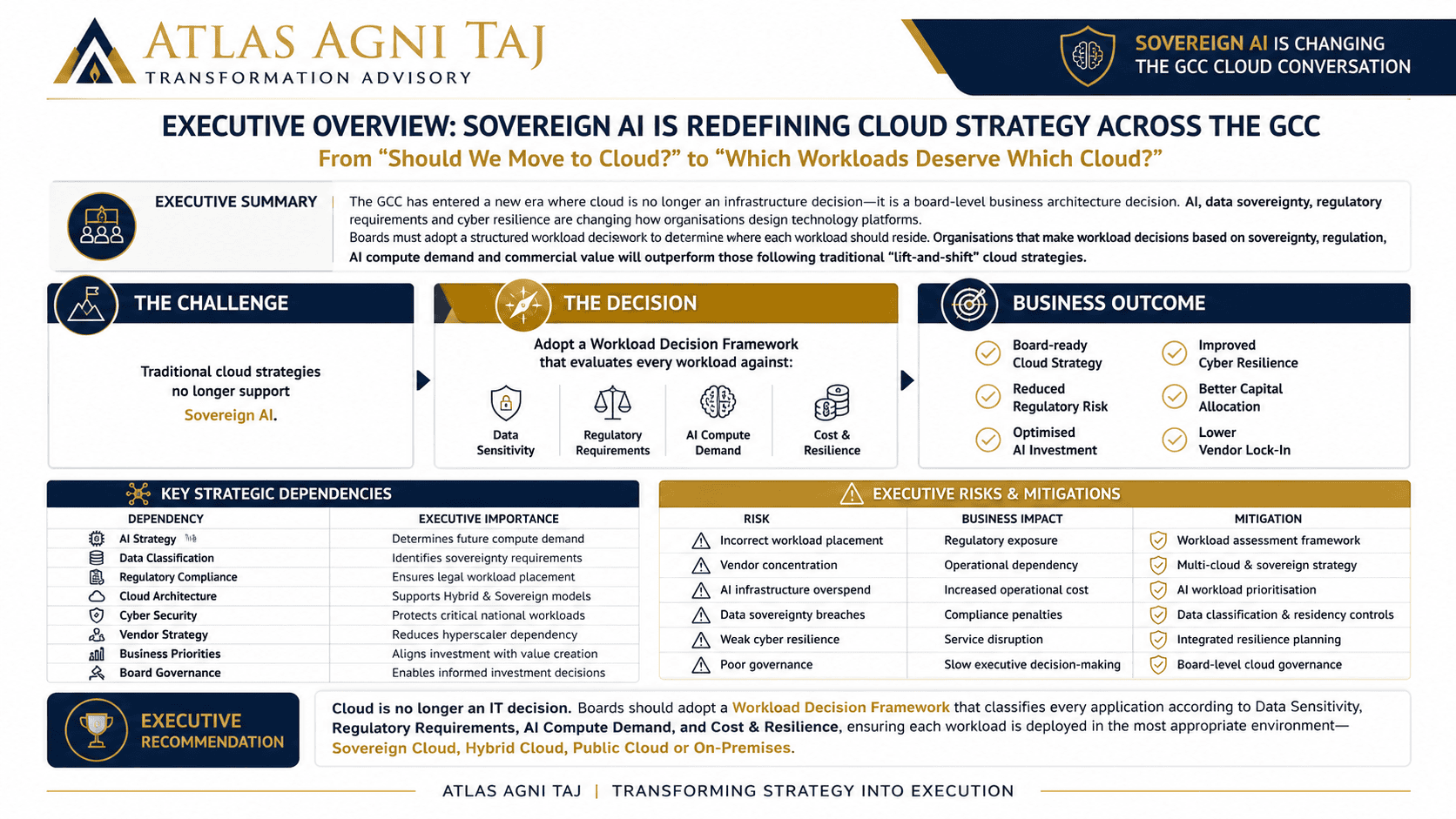
In my experience across cloud transformation, managed services, cybersecurity and regulated platform delivery, the organisations that navigate this shift successfully share one characteristic: they resist the temptation to treat cloud as a single, binary decision. Instead, they apply a structured, workload-by-workload decision framework built around four core dimensions.
1. Data Sensitivity
Not all data carries the same risk profile. Personally identifiable information, financial records, healthcare data, critical national infrastructure telemetry and classified government information each demand different handling, residency and access-control regimes. A rigorous classification exercise, conducted before any migration or AI adoption decision, remains the single most important control most organisations still under-invest in.
2. Regulatory Requirement
Financial services, healthcare, energy and government entities across the GCC operate under increasingly explicit data residency, cross-border transfer and AI governance obligations. Regulatory requirement should be treated as a hard constraint on workload placement, not a retrospective compliance check applied after architecture decisions have already been made.
3. AI Compute Need
Large language models, computer vision workloads and advanced analytics platforms have compute and GPU requirements that differ fundamentally from conventional enterprise applications. Understanding which workloads genuinely require AI-scale compute, versus those that merely benefit from it, is essential to controlling cost and avoiding over-engineered architecture.
4. Cost and Resilience
Total cost of ownership, vendor concentration risk and operational resilience must be assessed together. A workload that is technically capable of running in sovereign cloud may still carry unacceptable cost or performance trade-offs; equally, a workload placed in public cloud purely for cost reasons may expose the organisation to unacceptable concentration or continuity risk.
Applied consistently, these four dimensions produce one of four defensible outcomes for any given workload: migration to sovereign cloud, deployment within a hybrid architecture, migration to public cloud, or retention and modernisation on-premise ahead of any future migration. Some workloads, inevitably, should simply be retired. The discipline lies not in the framework itself, which is straightforward, but in the rigour with which it is applied and the willingness of leadership to accept that different workloads will land in different places.
What the Winners Will Look Like
The organisations that will lead in this next phase of GCC digital transformation will not be the ones that migrate the greatest number of systems, nor the ones that make the boldest public announcements about AI adoption. They will be the organisations that make the clearest, most defensible workload decisions, and that can articulate those decisions to their boards, their regulators and their shareholders in plain commercial language.
Cloud is no longer an infrastructure discussion. It is a business architecture discussion.
This distinction has direct implications for how chief information officers and chief technology officers position themselves within their organisations. The CIO’s role in this environment is not to be the custodian of a migration plan. It is to bring structure, discipline and commercial clarity to a set of choices that increasingly determine an organisation’s competitiveness, regulatory standing and cyber resilience. Boards are beginning to expect this level of fluency as a baseline, not a differentiator.
For technology leaders operating across the UAE and wider GCC, this represents both a challenge and an opportunity. The challenge is that cloud and AI strategy can no longer be delegated wholesale to vendors or systems integrators; it requires independent, board-level judgement grounded in workload economics, regulatory context and enterprise risk. The opportunity is that leaders who develop this fluency, and who can demonstrate a track record of applying it in regulated, large-scale environments, will find themselves increasingly sought after across banking, government technology, energy, healthcare and PE-backed platforms preparing for AI-enabled growth.
Implications for Boards, CIOs and Investment Committees
For boards, the immediate implication is governance. Cloud and AI infrastructure decisions should be subject to the same rigour applied to any major capital allocation or risk decision, with clear accountability for workload classification, vendor concentration and regulatory alignment. Relying on a single hyperscaler relationship, however strategically important, without an explicit sovereignty and resilience assessment is no longer a prudent default.
For CIOs and CTOs, the implication is one of positioning. Technology leadership that continues to frame cloud purely in terms of infrastructure modernisation or cost reduction will struggle to secure the mandate and investment required to compete in an AI-enabled market. Leadership that reframes cloud as a business architecture and risk discipline, directly tied to commercial outcomes, will find far greater traction with boards and investment committees.
For private equity-backed platforms and family businesses undergoing transformation, the implication is one of due diligence. Portfolio companies and family enterprises preparing for growth, sale or succession will increasingly be assessed on the maturity of their cloud and AI governance, not merely their technology stack. A clear, defensible workload decision framework is fast becoming a marker of operational maturity that sophisticated investors and acquirers actively look for.
For executive recruiters and talent committees, the implication is a sharper set of hiring criteria. The next generation of CIOs, CTOs and portfolio directors across the region will be judged less on their familiarity with a particular hyperscaler platform and more on their demonstrated ability to build and apply exactly this kind of decision discipline across complex, regulated, multi-jurisdictional environments.
Regional Context: A Gulf-Wide Pattern, Not a UAE Anomaly
While the Microsoft and G42 expansion provides the clearest recent illustration of this shift, it is best understood as one data point within a much broader regional pattern rather than an isolated UAE development. Saudi Arabia has pursued its own sovereign AI and compute ambitions with comparable intensity, backing large-scale data centre and AI infrastructure programmes tied directly to Vision 2030 diversification goals. Qatar, Bahrain and Oman are each, to varying degrees, positioning national cloud and data infrastructure as a pillar of economic diversification rather than a purely technical utility.
What unites these efforts is a shared recognition among GCC governments that compute capacity, data governance and artificial intelligence capability are now instruments of national economic strategy, not merely enablers of digital services. Sovereign wealth funds, telecommunications operators and national champions across the region are being mobilised to build or co-invest in the physical and regulatory infrastructure required to support this ambition. For enterprise leaders, the practical consequence is that national sovereign cloud infrastructure will increasingly become a genuine, credible option, not merely a theoretical alternative to the established hyperscalers.
This has two important implications for organisations operating across multiple GCC jurisdictions. First, workload placement decisions can no longer be made on a single-country basis if an organisation operates across the UAE, Saudi Arabia and other Gulf markets; data residency, AI governance and vendor strategy increasingly need to be assessed jurisdiction by jurisdiction, even within a single regional operating model. Second, procurement and vendor management functions will need to develop genuine fluency in comparing sovereign, national and hyperscaler options on their commercial and technical merits, rather than defaulting to whichever hyperscaler relationship already exists. Boards operating across more than one GCC market should expect this complexity to increase before it simplifies.
Cyber Resilience as the Silent Partner to Sovereignty
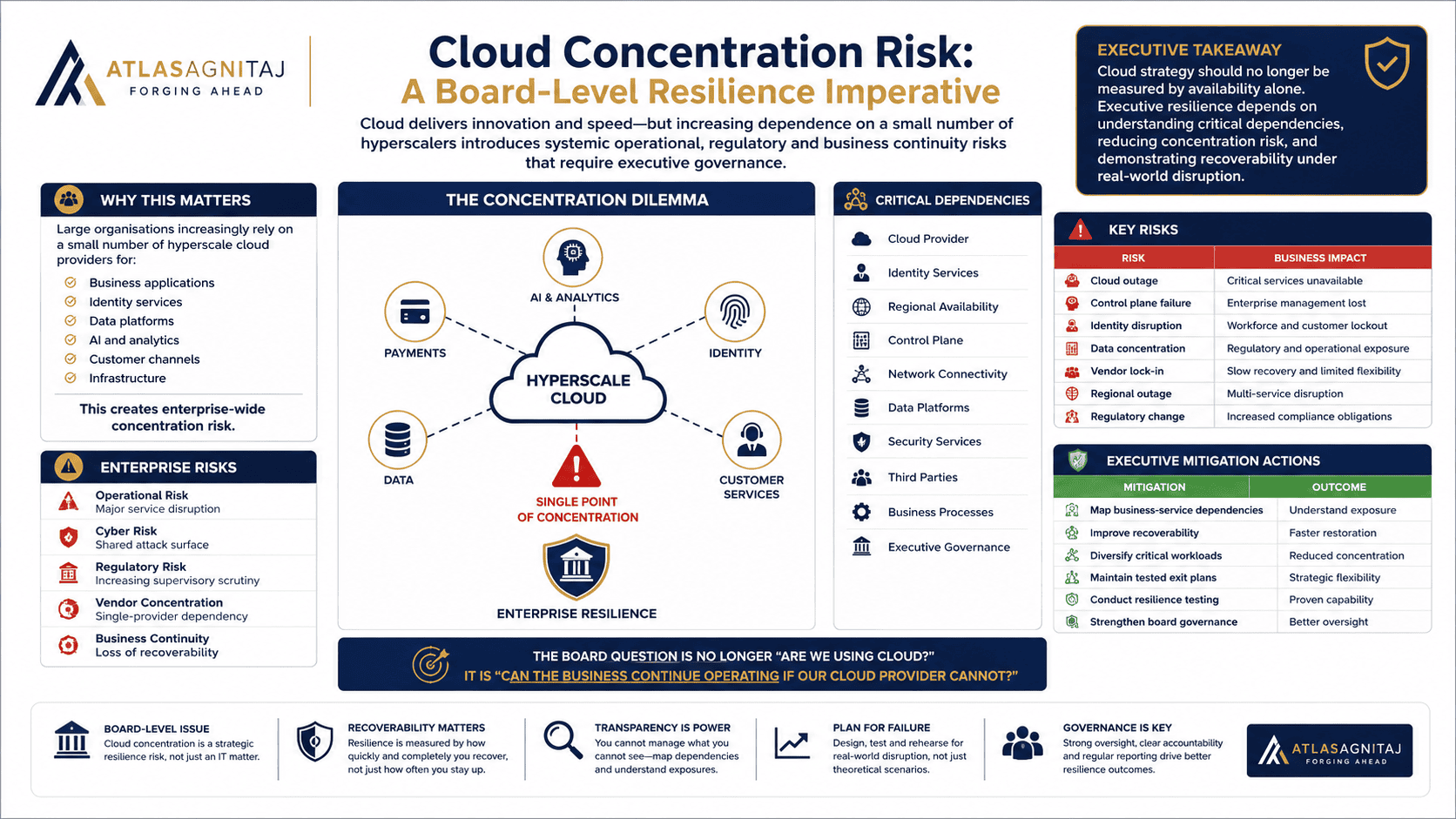
Sovereignty and resilience are frequently discussed as though they were separate workstreams, one concerned with data residency and regulatory alignment, the other with the ability to withstand and recover from disruption. In practice, they are inseparable. A workload that sits within a sovereign or nationally governed cloud environment but lacks a credible resilience and continuity posture has not solved its risk problem; it has simply relocated it.
As AI adoption accelerates across regulated sectors, the attack surface associated with critical infrastructure grows correspondingly. Large language models, AI-enabled decision systems and the data pipelines that feed them introduce new categories of risk, from data poisoning and model manipulation to third-party AI dependency and concentration risk where a small number of providers underpin a disproportionate share of an economy’s AI capability. Boards should expect their cyber resilience and business continuity frameworks to evolve accordingly, extending beyond traditional infrastructure and application resilience to explicitly address AI-specific failure modes and dependencies.
This is precisely where sovereignty, governance and resilience intersect most directly with commercial value. Organisations that can demonstrate a coherent, integrated approach across all three, rather than treating them as separate compliance exercises owned by different teams, are the ones best positioned to secure regulatory confidence, investor confidence and, increasingly, customer trust in an environment where AI-enabled trust itself has become a competitive differentiator.
A Practical Starting Point
Organisations seeking to respond constructively to this shift do not need to begin with a wholesale cloud strategy review. A more practical starting point is a focused workload assessment: a structured exercise, typically deliverable within a matter of weeks, that classifies an organisation’s most critical workloads against the four dimensions of data sensitivity, regulatory requirement, AI compute need, and cost and resilience. The output is not a migration plan in itself, but a defensible, board-ready decision framework that clarifies which workloads warrant further investment, which require sovereign or hybrid placement, and which can safely proceed to public cloud.
This kind of assessment also creates a natural bridge into the broader governance questions boards are now expected to answer: how AI adoption is being risk-assessed, how vendor concentration is being managed, and how cyber resilience is being tested against increasingly sophisticated threats targeting AI-enabled infrastructure. Addressed early and structurally, these questions become a source of competitive advantage. Addressed late and reactively, they become a source of regulatory and reputational exposure.
How Atlas Agni Taj Can Help
Atlas Agni Taj is a boutique transformation advisory firm, with offices spanning London, Dubai and Singapore, built specifically to help boards, CIOs and investment committees navigate exactly this kind of inflection point. Our practice sits at the intersection of enterprise technology, cloud and AI strategy, cybersecurity and programme governance, informed by decades of hands-on delivery across regulated sectors, sovereign infrastructure programmes and large-scale enterprise transformation across the UAE and wider GCC.
For organisations grappling with the shift described in this article, Atlas Agni Taj offers practical, senior-level support across several areas:
- Enterprise Workload Decision Frameworks: structured, board-ready assessment of critical workloads against data sensitivity, regulatory requirement, AI compute need, and cost and resilience, producing clear sovereign, hybrid, public cloud or retain-and-modernise recommendations.
- Sovereign and AI-Ready Cloud Strategy: independent, vendor-neutral advisory on cloud architecture, vendor concentration risk and sovereign compute positioning, aligned to national data residency and AI governance requirements across the GCC.
- AI Governance and Risk Advisory: practical governance frameworks for AI adoption in regulated environments, covering model risk, data governance, third-party AI dependency and board-level reporting.
- Cyber Resilience and Business Continuity: assessment and design of resilience programmes fit for AI-scale infrastructure, including vendor dependency mapping and continuity planning for critical national and enterprise workloads.
- Programme and Portfolio Governance: interim leadership, programme direction and PMO design for organisations executing large-scale cloud, AI or data centre transformation programmes, drawing on direct delivery experience across sovereign infrastructure, CBDC and enterprise ERP programmes.
- Due Diligence for Investors and Boards: independent technology and cloud maturity assessments to support private equity due diligence, family business succession planning and board-level assurance ahead of major capital decisions.
Atlas Agni Taj works directly with boards, CIOs, CTOs, heads of transformation and investment committees who need senior, independent judgement rather than another layer of vendor-aligned advice. Organisations exploring how sovereign AI and the wider GCC cloud shift affect their own workload strategy, governance and resilience posture are welcome to reach out for an initial conversation.
Conclusion
The Gulf’s cloud conversation has fundamentally changed character. What began as an infrastructure modernisation exercise has become a strategic discipline sitting at the heart of national competitiveness, enterprise risk and board governance. The scale of sovereign investment now visible across the UAE, from the Microsoft and G42 expansion through Khazna Data Centers to the wider national digital economy agenda, makes clear that this shift is not theoretical. It is already under way, and it is accelerating.
The organisations, and the leaders, who will define the next phase of this journey will not be those who move fastest or migrate the most. They will be those who bring the greatest clarity to a genuinely difficult set of choices: which workloads require sovereignty, which require scale, and which require cost discipline. That clarity, applied consistently and defended rigorously at board level, is what will separate genuine competitive advantage from expensive infrastructure spend.
The question every board across the region should now be asking is a simple one, even if the answer rarely is: is your cloud roadmap genuinely ready for sovereign AI and enterprise-scale AI adoption?
#SovereignAI #SovereignCloud #CloudStrategy #UAE #GCC #CIOLeadership #AIInfrastructure #DigitalTransformation #AtlasAgniTaj