Driving Efficiency and Business Agility in the Modern Enterprise
Executive Summary
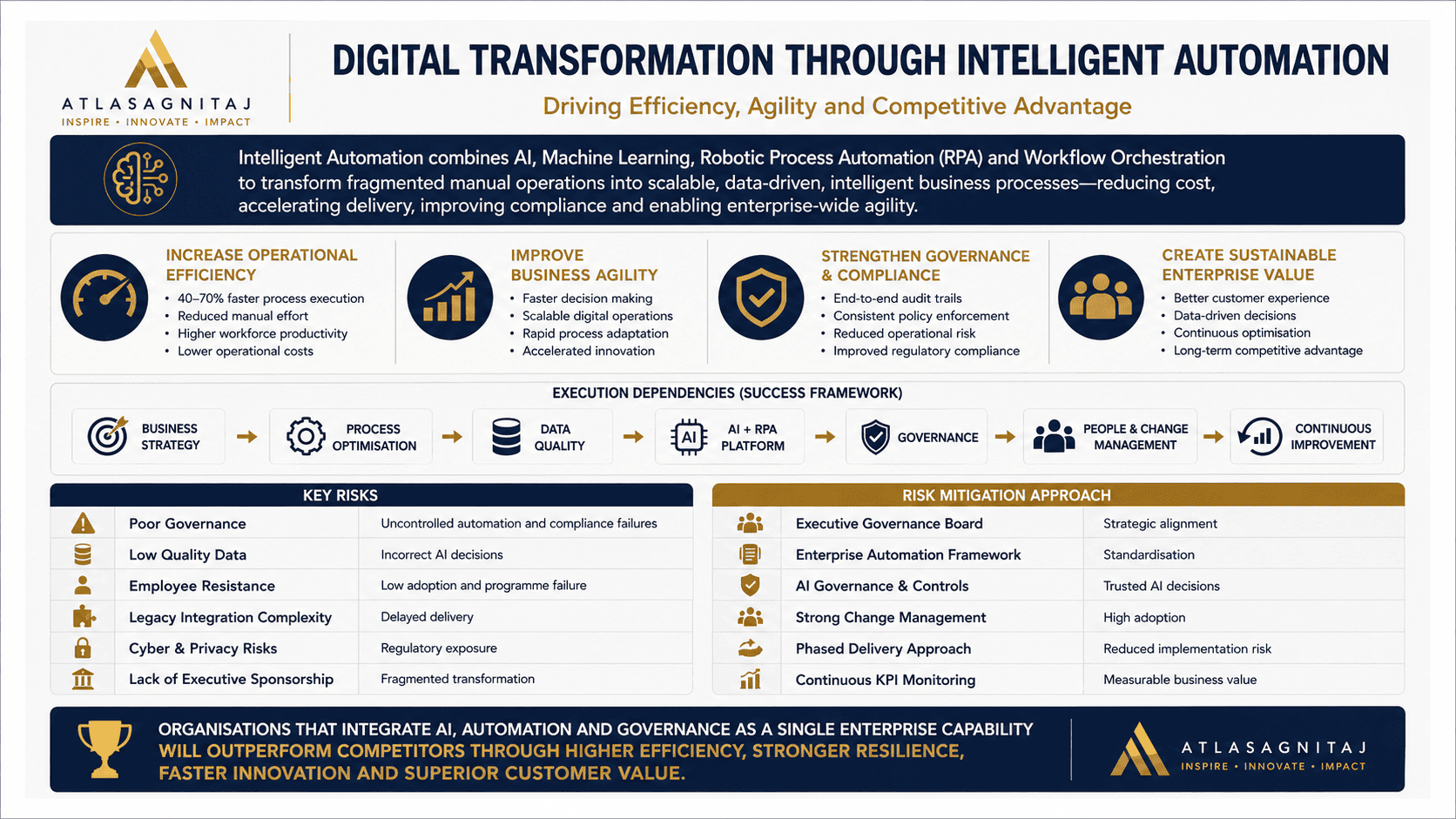
The enterprise landscape is undergoing a structural shift. Digital transformation has moved from being a discretionary technology initiative to an unavoidable business imperative, and at the heart of that shift sits intelligent automation: the convergence of robotic process automation, artificial intelligence, machine learning and workflow orchestration into a single operating capability.
Traditional automation followed rigid scripts. Intelligent automation adapts, learns and scales, changing not only how work is executed but why and when it happens at all. For organisations across the GCC and beyond, this represents an opportunity to unlock efficiency, accelerate business model evolution and build the agility required to compete in a digital-first economy. This article sets out why the moment has arrived, what leading organisations are already achieving, and the governance disciplines required to scale automation safely across the enterprise.
Part One: The Case for Intelligent Automation — Why Now
Three converging forces have compressed a decade of digital transformation timelines into five years.
Economic Pressure and Operational Resilience
Talent shortages persist across the GCC, particularly in highly technical roles, making unconstrained headcount growth unsustainable. Margin compression demands operational excellence, while regulatory complexity — KYC/AML obligations, data localisation mandates, evolving governance frameworks — requires organisations to do more with finite resources. Intelligent automation addresses this directly, absorbing repetitive, rules-based work at scale without adding headcount. Financial institutions now process KYC documentation in minutes rather than days; healthcare providers automate insurance verification; government entities accelerate permit processing. Typical outcomes are a 40–70 per cent reduction in cycle time and a 30–50 per cent reduction in cost per transaction.
Technology Maturity and Accessibility
Intelligent automation was once the preserve of global technology leaders with deep engineering resources. Cloud-native platforms, pre-built process templates and low-code/no-code tooling have since democratised access. Organisations no longer need to engineer automation from first principles; they configure, integrate and deploy. This is particularly significant across the GCC, where many organisations pursue ambitious digital agendas without the deep specialist talent pools available in more mature technology markets. Modern platforms increasingly allow business analysts, not just developers, to design and deploy automation, materially shortening time-to-value.
AI/ML Readiness and Data Availability
Early automation was purely rules-based — a fixed condition triggering a fixed action. Modern intelligent automation combines classical RPA with machine learning capable of classifying documents, extracting data, predicting outcomes and optimising routing decisions. Crucially, organisations now hold the historical transaction data, process logs and outcome metrics — and the cloud infrastructure — required to train and run these models at scale, without material capital outlay. For GCC organisations sitting on substantial historical data assets, this represents a largely untapped source of competitive advantage: data that can be converted into automation that is not merely efficient, but genuinely adaptive.
Part Two: Real-World Business Impact
The business case is no longer theoretical; it is well documented across sectors.
A regional bank applied intelligent automation across its mortgage origination process, cutting processing time from twenty-one days to three. The automation manages document verification, data validation, compliance checking and funding coordination, freeing staff to focus on customer-facing engagement and complex exceptions—the result: forty per cent higher volume processed with twenty-five per cent fewer full-time staff.
A multinational pharmaceutical company automated its invoice-to-pay process across forty-seven global entities, handling invoice receipt, three-way matching, exception flagging and payment processing. Days payable outstanding improved by eight days, alongside stronger supplier satisfaction and payment accuracy.
A GCC government entity deployed intelligent document processing for permit applications, extracting data from unstructured submissions, validating it against multiple databases and routing it automatically to the correct approver. Processing time fell from forty-five days to five; citizen satisfaction scores rose by thirty per cent; staff handling capacity increased without additional budget.
A large regional retailer automated inventory reconciliation, demand forecasting and replenishment, integrating point-of-sale, warehouse management, supplier systems and market data. Stockouts fell by thirty-five per cent and inventory carrying costs by eighteen per cent.
Across these and comparable cases, the pattern is consistent: cycle times fall by sixty to eighty per cent, transaction costs fall by forty to sixty per cent, error rates fall by twenty-five to forty per cent, throughput rises by fifty to two hundred per cent without proportional cost increase, and compliance strengthens through the consistent application of rules and complete audit trails.
Beyond the headline metrics, a further pattern is emerging: organisations that treat these early wins as the beginning of a longer capability curve, rather than a series of isolated projects, consistently outperform those that stop after the first wave. The initial automation typically targets the most visible pain point — a bottleneck process, a compliance exposure, a customer complaint driver. The organisations that extract the greatest value are those that then systematically mine the surrounding process landscape for the next tier of opportunity, using the templates, governance and internal expertise built in the first wave to accelerate the second and third.
Part Three: The Architecture of Intelligent Automation
Intelligent automation is not a single technology; it is an orchestrated ecosystem, and understanding its components is essential to designing an effective strategy.
Robotic Process Automation — The Foundation
RPA bots mimic human interaction with existing systems — logging in, navigating interfaces, entering and validating data — without requiring integration development or modification to legacy platforms. This is especially valuable across the GCC, where many organisations operate fragmented landscapes of legacy and highly customised systems with limited vendor support. RPA allows automation to proceed without system-level change, and is best suited to high-volume, rules-based, repetitive work where processes are stable, and rules are well defined.
Artificial Intelligence and Machine Learning — The Intelligence Layer
RPA plus AI equals intelligent automation: RPA executes, while AI/ML classifies, extracts, predicts and optimises. For organisations holding substantial unstructured data — correspondence, invoices, feedback, applicant documents — natural language processing and document intelligence unlock enormous value, replacing manual review with automated classification, extraction and routing. Computer vision extends this further, enabling automated inspection, defect identification, compliance verification and fraud detection wherever physical documents or imagery are involved.
Integration and Orchestration — The Nervous System
Effective automation connects RPA, AI/ML models, core business systems, data platforms and human decision-making through platforms that provide API management, data mapping, event-driven orchestration, monitoring and audit trails. In complex GCC organisations running multiple ERP instances, legacy platforms and third-party SaaS applications, this orchestration capability — the ability to integrate new automation without custom development — is a decisive enabler.
Governance and Control — The Operating System
As automation scales, new questions emerge: which processes are automated, who approved them, what happens when they fail, how security and compliance are maintained. Robust governance provides a process inventory and automation registry, approval and change management workflows, audit and compliance tracking, performance monitoring, risk assessment and documentation. Without it, automation initiatives fragment, create compliance gaps and become operationally unmanageable at scale.
Recurring Design Patterns
- The Attended Bot Pattern: Automation runs with human guidance — the user initiates, the bot executes, and the human validates. Ideal where decisions require judgement.
- The Unattended Bot Pattern: Full end-to-end execution without human interaction, with alerts raised only on exception. Suited to high-volume, low-exception processes demanding extremely high reliability.
- The Hybrid Intelligent Pattern: RPA handles routine work, AI/ML scores medium-complexity items, and humans focus on genuine exceptions — maximising efficiency while managing risk.
- The Continuous Learning Pattern: Human decisions on exceptions are captured and fed back into model retraining, so the automation becomes progressively more capable over time.
Part Four: Strategic Implementation — A Phased Approach
Disciplined opportunity identification precedes any successful programme. Quantitative criteria include transaction volume (processes exceeding roughly a thousand transactions annually carry superior economics), rules clarity, system stability, the proportion of manual effort involved, and exception rates. Qualitative criteria include alignment with strategic priorities, stakeholder readiness, risk profile and interconnectedness with dependent processes. A rigorous assessment framework keeps the programme focused on high-impact, high-probability opportunities rather than automation pursued for its own sake.
Phase One — Foundation and Governance (3–6 months)
This phase establishes strategy and objectives, governance frameworks and approval processes, a centre of excellence, foundational platforms, internal capability and measurement frameworks. Organisations that rush this phase routinely surface governance gaps, conflicting standards and capability shortfalls later, slowing everything that follows.
Phase Two — Quick Wins and Capability Building
A programme of ten to fifteen smaller automation projects validates the chosen platform, builds organisational confidence, generates early value and momentum, surfaces obstacles, and establishes a library of reusable components. Success here is measured by time-to-value, quality and capability development rather than sheer volume.
Phase Three — Platform Scaling and Enterprise Transformation (18–36 months)
This phase expands automation across departments and business units, automates interconnected process chains rather than isolated tasks, integrates automation with wider transformation initiatives such as cloud migration and operating model redesign, and embeds automation as standard practice for continuous process improvement. It demands disciplined governance to manage risk as automation proliferates across the organisation.
Part Five: Change Management and Capability Building
Technology accounts for perhaps a fifth of transformation success; organisational change, stakeholder engagement and capability development account for the rest. Business leadership must articulate vision, secure investment and resolve conflict. Process owners must lead change within their domains. Affected staff must understand what is changing, develop new skills and transition into new roles. Technology teams must build, integrate and support the platforms involved.
Effective change management confronts the difficult questions directly: what work disappears, what work changes, what new skills are required, how career paths evolve, and what happens to staff whose previous work is now automated. Organisations that treat these as peripheral concerns typically encounter resistance, quality issues and adoption failure. Those that address them directly frequently uncover unexpected benefits — reskilling opportunities, improved career trajectories and stronger engagement.
This requires deliberate capability investment across business process analysis, automation design, AI/ML fundamentals, data analysis, and governance and risk management. Organisations building genuine centres of excellence typically develop in-house training, certification pathways and career tracks — investments that compound as the automation estate scales.
Part Six: Measuring Impact and Return on Investment
Intelligent automation creates value across four dimensions: operational efficiency (cycle time, cost per transaction, error rates, throughput), financial impact (direct cost savings, working capital improvement, revenue effects), risk and compliance (audit trail completeness, exception resolution, regulatory consistency, data security) and strategic outcomes (capability development, organisational agility, employee engagement, scalability). Rigorous measurement requires an honest current-state baseline, clear attribution of automation’s specific contribution, sustained tracking through implementation and operation, and comparative benchmarking against peers.
The economics are typically strong. Individual automations commonly require an investment of $150,000 to $500,000 depending on complexity, with payback periods of six to eighteen months and first-year returns of 150 to 400 per cent. These economics improve further at scale, as platform costs decline, reusable component libraries accelerate delivery, internal capability reduces dependence on external vendors, and organisational knowledge sharpens opportunity identification. A well-executed three-year programme frequently realises cumulative benefits of three to five times the initial investment, with value continuing to accrue long after the formal programme concludes.
Part Seven: The GCC Imperative
The GCC presents a particularly compelling context for intelligent automation. Structural labour market dynamics — limited local talent pools, dependence on expatriate labour, wage pressure — make automation a direct lever for doing more with existing teams rather than expanding headcount. National digital economy strategies, from Saudi Arabia’s Vision 2030 to the UAE’s national digital agenda and Egypt’s Digital Transformation Strategy, have placed digitalisation at the centre of government procurement and private-sector investment priorities. Regulatory frameworks — SAMA, DFSA, CBE — are evolving rapidly, with growing KYC/AML, sanctions screening and governance obligations that automation is well placed to satisfy at scale. Competitive intensity is rising as global entrants compete with established regional players, making efficiency and agility a genuine strategic differentiator rather than a cost-saving exercise.
Saudi organisations frequently frame automation investment explicitly against Vision 2030 objectives — reskilling, improved government service delivery, stronger private-sector competitiveness — which helps secure executive sponsorship. UAE organisations, particularly in government, finance and logistics, have invested heavily, supported by a culture of operational excellence and active cross-government sharing of best practice. Egypt’s scale — a large population and expanding private sector — creates substantial automation opportunity, with early adopters already establishing meaningful competitive advantage.
For leadership teams operating across multiple GCC jurisdictions simultaneously, the automation agenda also carries a portfolio dimension. A model proven in one market rarely transplants unchanged into another: regulatory expectations, data residency rules and workforce composition differ meaningfully between Saudi Arabia, the UAE and Egypt, and a governance framework designed for a single-market rollout will not survive contact with a genuinely regional programme. The organisations achieving the strongest returns are those that design governance and platform architecture with this regional variation in mind from the outset, rather than retrofitting it once expansion is already under way.
Part Eight: Governance and Risk
Intelligent automation introduces new categories of risk that must be actively managed. Credential management for bots requires secure practices — no embedded credentials, complete access audit trails, regular rotation. Data residency and localisation obligations across GCC jurisdictions require automation platforms capable of localised storage and processing. Complete audit trails — what was processed, when, by whom, and what decisions were made — must be maintained and available for regulatory review. AI/ML models driving decisions must remain explainable and be regularly assessed for bias, since an organisation must be able to explain why an application was declined or a transaction flagged.
Operational resilience matters equally. Every automation requires clear exception handling — what happens when the automation cannot process something, who is notified, how quickly it is resolved — and a defined fallback if the automation itself fails. Successful organisations maintain a complete automation registry, conduct impact analysis on downstream dependencies, apply rigorous testing before production deployment, monitor automation health in real time, and maintain clear incident response procedures. Without this discipline, automation initiatives fragment and become progressively harder to control as they scale.
Part Nine: The Road Ahead
The frontier continues to move. Event-driven automation responds to real-world triggers — a customer enquiry, a failed payment, a breached inventory threshold — rather than executing on a fixed schedule. Advanced AI models increasingly support autonomous decision-making in areas such as loan approvals, investment decisions and retention offers, functions that previously required human judgement. Predictive and prescriptive analytics extend automation from reaction to anticipation — predicting equipment failure before it occurs, forecasting demand, identifying at-risk customers before they churn.
The next generation of automation will learn continuously rather than operate from static rules. Federated learning trains models across distributed datasets without centralising sensitive data, preserving privacy and residency. Reinforcement learning enables automation to discover optimal policies through trial and feedback. Foundation models — large language models adapted to specific business domains — are increasingly applied to document understanding, customer communication and knowledge work. For GCC organisations managing data residency requirements, large volumes of Arabic-language unstructured data and strict privacy considerations, federated and localised AI capability is becoming a genuine strategic requirement rather than a technical nicety.
Hyperautomation extends this further — using process mining to understand how work actually happens, task mining to identify automation opportunities at the individual task level, and decision mining to optimise decision-making itself. Together, these techniques allow organisations to visualise entire process landscapes and optimise value chains rather than isolated tasks.
Conclusion: The Path Forward
Intelligent automation is no longer an emerging capability; it is table stakes for competitive organisations today. The convergence of RPA, AI/ML and advanced integration has created an unprecedented opportunity to reimagine how organisations operate — and for GCC organisations, facing structural labour constraints, mounting regulatory complexity and intensifying competition, the opportunity is especially significant. Early adopters are already establishing durable competitive advantage.
Success, however, requires more than technology deployment. It demands strategic clarity on how automation aligns with organisational objectives; disciplined governance to identify opportunities and manage risk; genuine organisational readiness through capability development and change management; and a sustained commitment to continuous improvement, recognising that automation is an ongoing organisational capability rather than a single project. The organisations that will lead their industries over the coming decade are those that treat intelligent automation not as an IT initiative but as a fundamental reimagining of how work happens — where automation is embedded in culture, process improvement is continuous, and technology frees people to focus on genuinely high-value work.
The technology is ready. The business case is proven. The time to act is now.
How Atlas Agni Taj Can Help
Atlas Agni Taj is a boutique transformation advisory firm, with a presence across London, Dubai and Singapore, built specifically to help organisations translate the intelligent automation opportunity into disciplined, measurable delivery. Drawing on decades of enterprise technology leadership across financial services, government, healthcare and business process outsourcing, Atlas Agni Taj supports leadership teams across the full transformation lifecycle:
- Automation Strategy and Opportunity Assessment — Structured, evidence-based identification of high-value automation candidates, using the quantitative and qualitative criteria that separate genuine opportunity from automation for its own sake.
- Governance Framework Design — Establishing the process inventories, approval workflows, audit trails and risk frameworks required to scale automation safely, particularly within regulated GCC environments governed by SAMA, DFSA, CBE and equivalent bodies.
- Centre of Excellence Set-Up — Designing the operating model, capability structure, training pathways and reusable component libraries that allow organisations to scale automation efficiently rather than project by project.
- Phased Delivery Leadership — Programme direction across foundation, quick-win and enterprise-scaling phases, ensuring each stage builds the capability and evidence required for the next.
- Change Management and Capability Development — Structured stakeholder engagement, workforce transition planning and skills development that address the organisational questions technology alone cannot answer.
- Benefits Realisation and ROI Tracking — Baseline measurement, attribution and sustained performance monitoring to ensure automation programmes deliver, and continue to deliver, their promised return.
For organisations across the UAE and wider GCC seeking to move from automation ambition to disciplined execution, Atlas Agni Taj offers the independent, senior-level advisory support required to get it right the first time.
#IntelligentAutomation