Agentic AI Needs Governance Before Autonomy
The promise of agentic AI is compelling. Autonomous agents that learn, decide and act with minimal human intervention offer enterprises a genuinely new operating model: one in which processes that once required constant human mediation can run at machine speed, around the clock, across every function from procurement to customer service. Boards are asking for it. Technology vendors are marketing it. Competitors are piloting it. And yet, as organisations rush to deploy these systems, a critical oversight threatens to unwind years of carefully sequenced digital transformation investment: most enterprises are building autonomous AI capability without the governance guardrails required to operate it safely at scale.
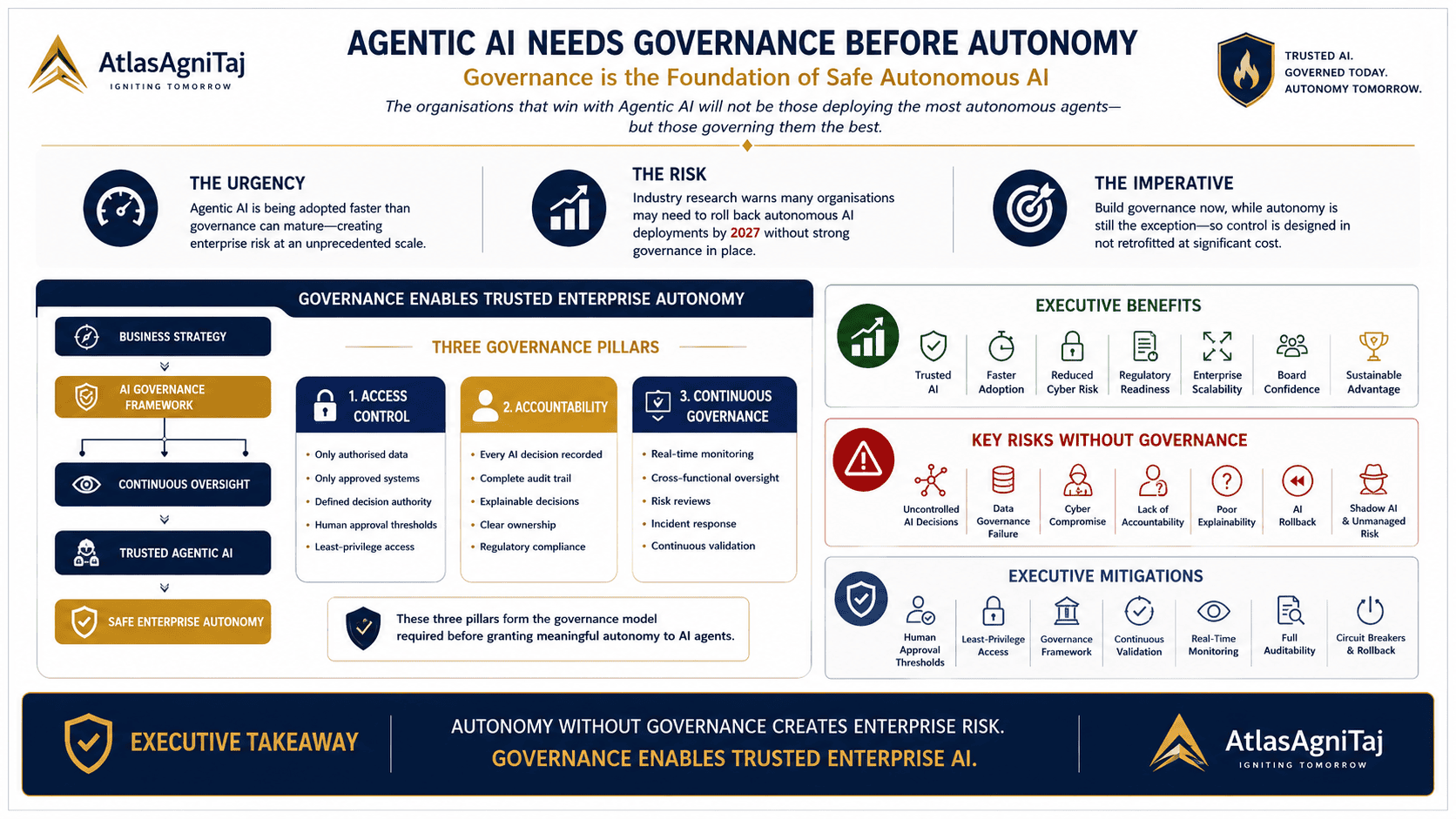
This is not a theoretical concern confined to academic papers or regulatory white papers. Industry research increasingly points to a sobering and specific prediction: a meaningful proportion of enterprises will be forced to roll back autonomous AI agents by 2027 if governance, access control and accountability mechanisms remain as underdeveloped as they are today. For Chief Information Officers, Chief Digital Officers and enterprise technology leaders, the message is unambiguous. The window to implement governance frameworks is now. At the same time, autonomy is still the exception rather than the default, and control can still be designed in rather than retrofitted at considerable cost.
This article sets out why the urgency is real, what the 2027 rollback scenario actually implies for the enterprises that experience it, the three pillars on which credible governance must rest, and the leadership imperatives that fall specifically to the CIO and the wider executive team. It is written for leaders who are not opposed to agentic AI, but who understand that the durability of any autonomous capability depends entirely on the discipline that surrounds it.
The Urgency: Why Now
Agentic AI has crossed a threshold. What was, until recently, a research interest confined to laboratories and early pilots has become an enterprise priority discussed at board level. Unlike traditional AI systems, which require explicit human prompting and a discrete decision at each step, agentic AI operates differently: it sets goals, takes actions and iterates without waiting for human approval before every move. This shift is genuinely powerful. It is also the source of an entirely new category of enterprise risk, one that most governance structures were never designed to manage.
Three converging pressures make the governance question urgent rather than aspirational.
1. Rapid Adoption Without Precedent
Organisations are deploying autonomous agents directly into business-critical processes: procurement workflows, financial operations, customer service decisions and supply chain optimisation among them. The pace of deployment has comfortably outstripped the maturity of governance practice. Where traditional enterprise AI moved from pilot to production over a period of years, permitting governance to mature alongside capability, agentic AI is making that same journey in a matter of months. Governance functions built for a slower cadence of change are being asked to keep pace with a technology that does not wait for them.
2. Interconnected Risk Domains
Research into CIO priorities reveals a critical insight that is easy to state and hard to operationalise: operationalising AI, cybersecurity and data strategy are now inseparable disciplines, not three parallel work-streams that can be governed independently. Agentic AI systems that operate autonomously become, simultaneously, a vector for cybersecurity threats and a potential source of data governance violations. A compromised agent can execute decisions across multiple systems with minimal oversight, propagating an initial breach far faster than a human actor ever could. A data governance failure, similarly, becomes amplified the moment an agent acts autonomously on data that ought to have been restricted. Neither risk is new in isolation. What is new is the speed and scale at which agentic systems can turn a contained failure into an enterprise-wide one.
3. The Accountability Vacuum
Traditional AI operates within a clear decision trail. A model scores a loan application; a human reviews and approves it. The locus of accountability is never in doubt. Agentic AI removes that certainty. An autonomous agent decides, on its own initiative, to modify a supplier contract, reprioritise operational resources, or escalate a customer issue to a level of response the organisation did not anticipate. When something goes wrong in that context, the question “who is responsible?” becomes genuinely difficult to answer, and genuinely important to have already answered before the incident occurs. Without clear governance, enterprises risk building systems they cannot control, cannot debug when they misbehave, and cannot defend when challenged by a regulator, a client or their own board.
The 2027 Rollback Risk
Gartner-linked reporting suggests a troubling and specific scenario. Many enterprises deploying autonomous agents today, without robust governance frameworks in place, will face a stark choice by 2027: either significantly constrain the autonomy they have granted these agents, or discontinue the agents entirely. This is not a minor course correction. It would represent a costly and organisationally painful reversal, involving:
- Reworking business processes: reworking business processes that were redesigned, at real cost, specifically to take advantage of autonomous operation;
- Rebuilding human oversight: rebuilding human-in-the-loop decision-making at scale, after the institutional muscle for that oversight has atrophied;
- Recovering lost knowledge: recovering organisational knowledge that was quietly lost during the transition to autonomy, as the humans who once made these decisions moved on to other roles; and
- Managing stakeholder frustration: managing considerable stakeholder frustration as promised efficiency gains are visibly clawed back, with all of the credibility cost that entails for the technology function.
The enterprises that avoid this scenario will not be those with the most sophisticated agents. They will be those that established governance frameworks early: before agents became deeply embedded in day-to-day operations, before stakeholder expectations were set around autonomous decision-making, and before the technical debt of ungoverned systems became genuinely unmanageable. Governance debt, like technical debt, compounds. The longer it is deferred, the more expensive and disruptive it becomes to resolve, and the more of the organisation’s credibility is spent in the process.
The Governance Imperative: Three Pillars
Effective agentic AI governance is not a single policy document or a one-off compliance exercise. It rests on three interconnected pillars, each of which must be operational before an agent is granted meaningful autonomy, not retrofitted once it has already caused a problem.
Pillar One: Access Control and Guardrails
Agentic AI systems must operate within clearly defined boundaries from the outset. In practice, this requires:
- Explicit capability constraints: Precisely which systems an agent can access, what data it can read or modify, and what actions it is permitted to take must be defined in advance. An agent trained on procurement data, for instance, should have no pathway into personnel systems, however convenient that access might appear during development.
- Decision authority limits: Organisations must establish thresholds above which an agent’s decisions require explicit human approval before they take effect. An agent might reasonably be permitted to approve low-value supplier orders autonomously, while any high-value contract is escalated for human sign-off.
- Real-time monitoring and circuit breakers: Systems must be capable of detecting when an agent’s behaviour deviates from expected patterns, and of halting execution automatically when it does. Waiting for a human to notice a problem is not a control; it is a hope.
- Data access governance: The same rigour applied to human employees, namely the principle of least privilege, comprehensive audit trails and role-based access controls, must be applied with equal seriousness to agentic systems. An agent is not exempt from data governance simply because it is not a person.
Pillar Two: Accountability and Auditability
Every autonomous decision must leave a clear and interrogable trace. Organisations need:
- Decision provenance: Comprehensive logs that explain why an agent made a specific decision, what data influenced it, and what alternatives were considered and rejected. A decision without a rationale is not auditable; it is simply a fact that occurred.
- Human oversight points: Strategic moments, deliberately designed into the workflow, where a human reviews, validates or overrides an agent’s decision before it takes effect. These points should be chosen by risk, not convenience.
- Explainability requirements: It is not sufficient to record that “the agent decided X.” Governance requires the fuller account: the agent decided X because of Y, based on data inputs Z. Anything less leaves the organisation unable to explain itself when explanation is required.
- Liability frameworks: There must be a clear, pre-agreed definition of who bears responsibility when an agent makes a harmful decision: the agent’s builder, the deploying organisation, or the individual who authorised its use. This question is far cheaper to answer in a governance workshop than in a legal dispute.
Pillar Three: Governance Process and Oversight
Governance is not a static policy that, once written, can be filed away. It must evolve continually as agents learn and as organisations discover edge cases that no one anticipated at the design stage.
- Continuous validation: Agent behaviour must be tested regularly against organisational values and risk tolerance, not only against technical performance metrics. A model can be accurate and still be behaving in ways the organisation would not sanction.
- Cross-functional oversight: Governance cannot be owned by the technology function alone. Finance, legal, operations and compliance must each have a genuine voice in how agents operate within their respective domains, not a retrospective veto once systems are already live.
- Incident response procedures: Clear processes must exist for investigating failures, understanding their root causes, and implementing fixes without waiting for the next scheduled governance review. Autonomous systems fail at machine speed; the response to failure cannot operate at the pace of quarterly committees.
- Stakeholder engagement: Organisations owe employees, customers and regulators a degree of transparency about what autonomous systems are doing and why. Trust, once lost through opacity, is considerably harder to rebuild than to maintain.
The CIO Perspective: Leadership Imperatives
For CIOs and technology leaders, agentic AI governance presents a distinct and unusually challenging brief: it sits squarely at the intersection of technology capability, business risk and organisational control, three domains that have not historically reported to the same executive, let alone shared a common governance language. Three imperatives stand out.
First, own governance before business leaders own AI deployment. If CIOs wait for business units to deploy autonomous agents independently and then attempt to mandate governance retrospectively, the cost of retrofit will be prohibitive, both financially and politically. Governance frameworks must be in place before agents are trained and operationalised, not introduced once they are already embedded in a business-critical process and difficult to unwind.
Second, integrate AI governance with existing control frameworks rather than establishing it as a parallel track. Agentic AI governance should not exist as a separate initiative running alongside cybersecurity, data governance and operational risk management; it must be woven into them. This requires CIOs to actively dismantle silos between teams that have historically operated with limited coordination. This task is organisational as much as it is technical, and considerably harder than either.
Third, invest in observability and control infrastructure now, ahead of demonstrated need. Managing autonomous systems requires fundamentally different tooling from managing traditional systems. CIOs need to budget for, and build, capabilities that provide real-time visibility into agent behaviour, enable rapid rollback when something goes wrong, and support forensic analysis after the fact. This is not a discretionary enhancement to be considered once agentic AI has proven its value; it is the precondition for that value being sustainable at all.
The Broader Stakes
The stakes of getting agentic AI governance right extend well beyond conventional risk management. Organisations that establish governance frameworks early will be able to:
- Deploy with confidence: Deploy agents with genuine confidence, knowing that control mechanisms are already in place rather than being designed under pressure after an incident.
- Build stakeholder trust: Build trust with regulators, clients and employees by demonstrating, credibly, that autonomous systems are operated responsibly rather than merely described as such.
- Maintain competitive advantage: Sustain a genuine competitive advantage by operating autonomous systems at scale while competitors remain constrained by governance debt they have yet to address.
- Adapt to regulation: Adapt more quickly as regulation emerges, and it will, because governance is already embedded in how the organisation operates rather than needing to be constructed under a compliance deadline.
Conversely, organisations that treat governance as a post-deployment concern will find themselves constrained by their own ungoverned systems, unable to scale what should have been a genuine competitive advantage into one, and left explaining to their boards why a capability that was meant to reduce cost and risk has instead increased both.
What Good Looks Like in Practice
It is worth grounding this in a concrete illustration, because governance frameworks are too often discussed in the abstract and then abandoned the moment they meet an actual business process. Consider a procurement function that has deployed an autonomous agent to manage routine supplier ordering. Under a well-governed model, the agent operates within an explicit spending ceiling, below which it may commit the organisation without further reference; above that ceiling, the transaction is automatically routed to a named human approver, and the routing rule itself is logged and periodically reviewed. Every order the agent places carries a recorded rationale: which supplier was selected, on what basis, against which alternatives, and using which data. If the agent’s ordering pattern begins to deviate from historical norms, whether through unusual supplier concentration, unexpected price acceptance, or a spike in order frequency, a monitoring layer flags the deviation and, where the threshold is breached, halts further autonomous action until a human reviews it.
None of this is exotic. Each element already exists, in some form, in the control environments most enterprises apply to their finance and procurement functions today. What agentic AI governance requires is the discipline to extend those same principles, at the same standard of rigour, to a new class of actor that happens not to be human. Organisations that treat the agent as somehow exempt from the controls that would apply to an equivalent human decision-maker are, in effect, choosing to govern their most unpredictable actor the least.
The same logic applies equally in customer service, where an agent empowered to issue refunds or amend account terms needs comparable ceilings, escalation paths and audit trails, and in supply chain optimisation, where an agent reprioritising logistics in response to a disruption needs a clearly bounded mandate rather than open-ended discretion. The specifics of the guardrail will differ by function; the underlying architecture of control does not.
A Note on Timing and Sequencing
One further point deserves emphasis, because it is the point most often missed under commercial pressure to show results. Governance is frequently framed, implicitly or explicitly, as something that can be layered on once a pilot has demonstrated value, as though control were a finishing touch applied at the end of a project rather than a design constraint present from its inception. This sequencing is precisely backwards, and it is the single most common cause of the retrofit costs described earlier in this article.
Agents that have already been granted broad, ungoverned access to systems and data are extraordinarily difficult to constrain after the fact, not for technical reasons alone but for organisational ones. Business units that have grown accustomed to an agent’s unfettered autonomy will resist the reintroduction of friction, particularly once efficiency gains have been reported upward and built into forecasts. The correct sequencing is the reverse: governance is scoped and implemented alongside the pilot, constrained from day one, and loosened deliberately as confidence and evidence accumulate, rather than granted broadly and clawed back under duress. Loosening a control is a straightforward, low-risk decision. Tightening one, once an organisation has built its operating model around its absence, rarely is.
The Path Forward
The agentic AI governance challenge is urgent, but it is entirely solvable. Organisations that wish to harness the power of autonomous AI without ceding control of it should take five deliberate steps.
- Assess current state: Inventory the autonomous agents already in development or deployment, evaluate existing governance gaps honestly, and understand precisely which business-critical processes already involve autonomous decision-making, whether formally sanctioned or not.
- Build a governance baseline: Establish minimum standards for agent access control, decision authority, auditability and oversight. These need not be elaborate to be effective; they should be proportionate to risk and capable of being operationalised quickly rather than left as an aspiration.
- Establish cross-functional ownership: Create governance structures that genuinely involve technology, business, compliance and risk leaders together. Agentic AI governance is too consequential, and too cross-functional in its impact, to be owned by the technology function alone.
- Invest in infrastructure: Fund the observability, monitoring and control systems that will allow the organisation to manage autonomous agents at scale, rather than discovering their absence during an incident.
- Iterate and learn: Governance frameworks will evolve as the organisation gains experience with autonomous systems. Begin with what is already known, measure what actually works in practice, and refine deliberately based on real-world feedback rather than theoretical design.
How Atlas Agni Taj Can Help
Atlas Agni Taj is a boutique transformation advisory firm, with a presence across London, Dubai and Singapore, built specifically for the challenge this article describes: helping enterprises capture the value of agentic AI without inheriting the governance debt that so often follows it. The firm works with CIOs, CDOs and executive teams to translate the three pillars set out above- access control, accountability and governance process- into an operating model that is proportionate, cross-functionally owned, and ready before autonomy is granted rather than assembled after an incident.
- Governance readiness assessments: Assessing current and planned agentic AI deployments against governance, access control and accountability best practice, and identifying the gaps that pose the greatest exposure.
- Governance framework and guardrail design: Designing proportionate access control, decision-authority thresholds, audit and explainability standards that can be implemented quickly and scaled as autonomy expands.
- Cross-functional operating model design: Establishing the cross-functional governance structures, spanning technology, risk, compliance, legal and the business, that agentic AI oversight genuinely requires.
- Programme governance and PMO design: Advising on the observability, monitoring and control infrastructure needed to give leadership real-time visibility and rapid rollback capability.
- Executive advisory and board engagement: Supporting CIOs and executive teams in building the internal case, sequencing and roadmap for embedding governance ahead of scaled autonomous deployment.
For organisations that recognise the urgency set out in this article but are unsure where to begin, Atlas Agni Taj offers an independent, senior-led starting point: a candid assessment of where autonomous AI capability currently sits against governance maturity, and a pragmatic route to closing that gap before it becomes the retrofit described above. Enquiries are welcome via atlasagnitaj.com.
Conclusion
Agentic AI represents a genuine advance in enterprise AI capability: the ability to deploy systems that work autonomously, learn from their own experience, and improve their performance over time. This is a powerful proposition. But power without governance is dangerous, and rarely remains powerful for long once that danger materialises. The enterprises that will thrive in an agentic AI future are those that recognise governance not as a constraint on autonomy, but as the very foundation that makes autonomy possible: the mechanism that allows safe, scaled and sustainable autonomous AI to exist at all.
The 2027 rollback scenario is not inevitable. It is a warning, and a useful one. Organisations that act now to establish governance frameworks, integrate them with existing control structures, and maintain genuine human oversight of autonomous systems will be positioned to compete confidently in an age of agentic AI. Those that do not will find themselves managing the legacy costs of ungoverned autonomy, or abandoning autonomous systems altogether, having spent considerable capital to arrive back where they started.
The time to act is now, before autonomy becomes the default, before governance becomes the bottleneck, and before rolling back becomes the only option left on the table.
#AgenticAI #AIGovernance #CIO #DigitalTransformation #Cybersecurity #DataGovernance #EnterpriseAI #TechnologyLeadership