Building Resilient Organisations Through Proactive Risk Management and Governance
Introduction
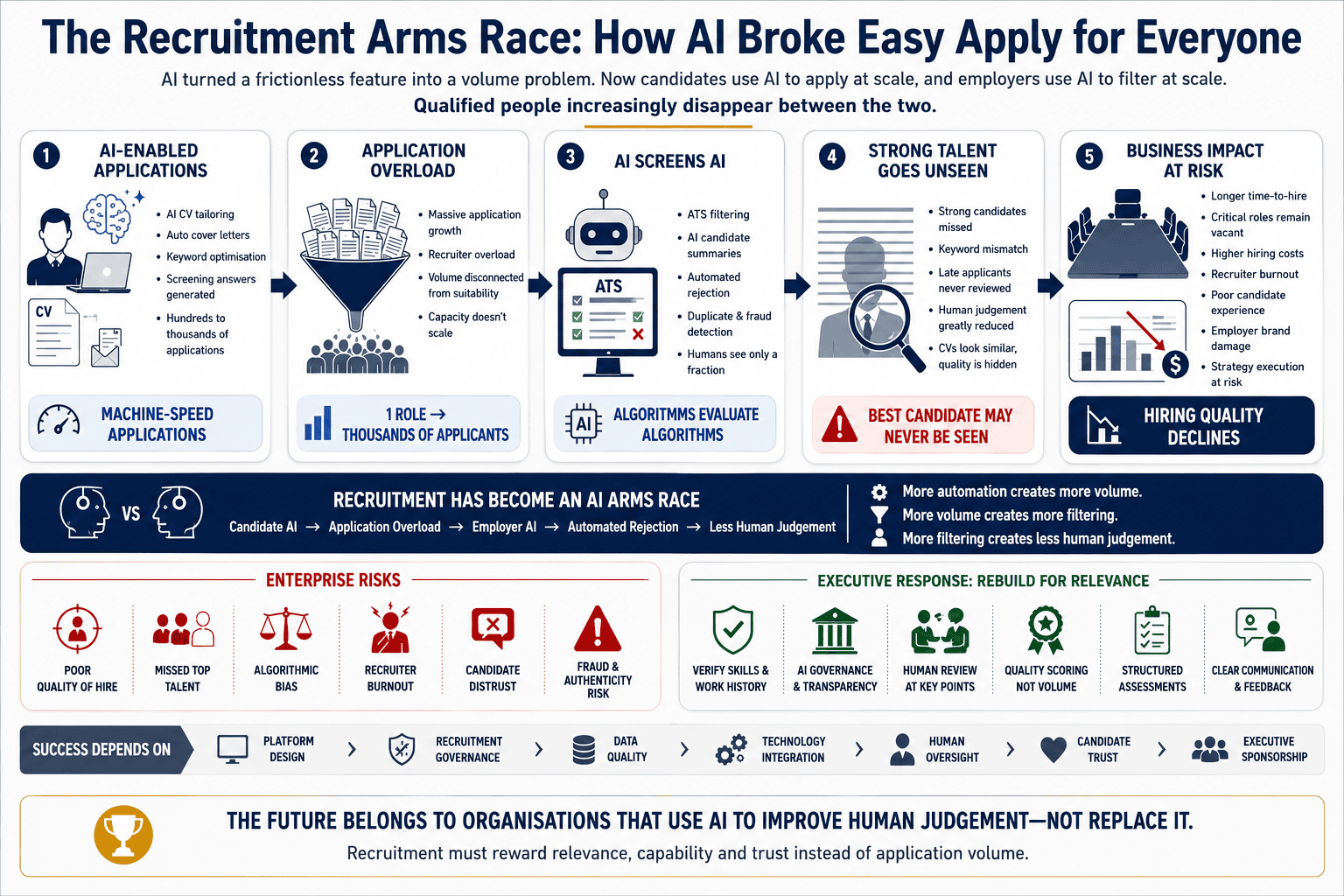
The risk landscape has fundamentally transformed. Where once organisations operated within relatively predictable frameworks—regulatory cycles, market downturns, operational disruptions—we now inhabit an environment characterised by exponential change, interconnected threats, and the accelerating integration of artificial intelligence into every layer of business operations. The pandemic exposed systemic fragility across global supply chains. Geopolitical tensions have destabilised energy and raw materials markets. Climate volatility compounds operational uncertainty. And now, artificial intelligence introduces both unprecedented opportunity and asymmetric risk—amplifying human decision-making, automating critical processes, and introducing novel failure modes we are only beginning to understand.
For chief executives, chief information officers, chief technology officers, and boards, the question is no longer whether to manage risk, but how to build organisations capable of thriving amid continuous disruption. This requires rethinking governance, embedding resilience into strategy, and treating risk management not as a compliance obligation, but as a core competitive advantage.
The Evolution of Risk: From Stability to Dynamism
The Traditional Risk Model
For decades, organisational risk management operated on an assumption of relative stability. Risks were catalogued—financial, operational, reputational, compliance—and managed through established frameworks: enterprise risk management (ERM) systems, risk registers, audit cycles, and mitigation plans. This approach worked reasonably well in environments where change was gradual and predictable. A bank could forecast interest rate scenarios. A manufacturer could hedge commodity exposure. A regulator could establish rules and expect compliance within reasonable timescales.
This model had inherent limitations. It was retrospective—based on historical data and experience. It was siloed—with risk ownership fragmented across functions. It was static—risk registers updated quarterly or annually, disconnected from real-time operational reality. And it was inherently blind to Black Swan events, by definition.
The New Risk Reality
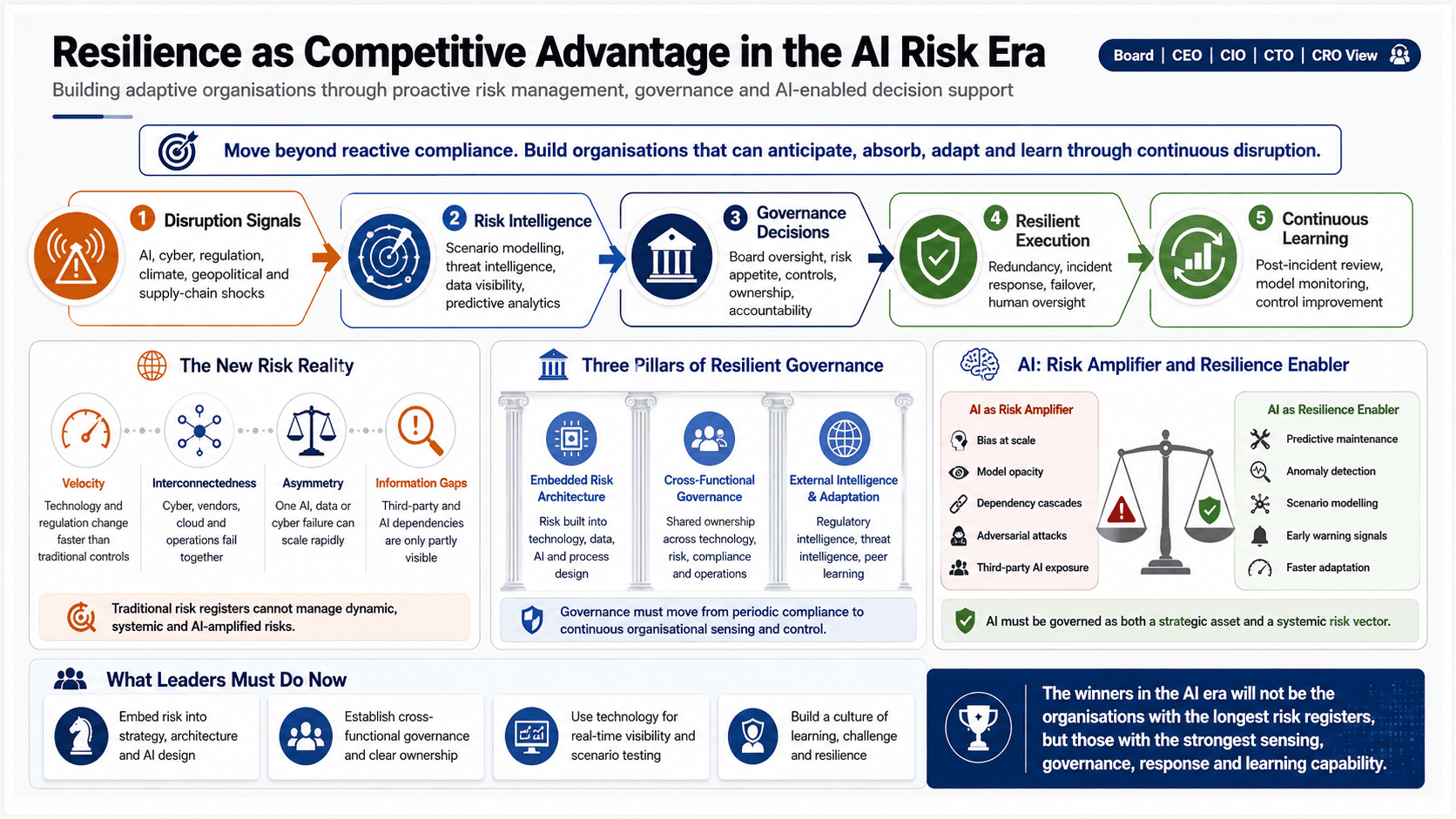
Today’s risk landscape defies the assumptions of traditional ERM. Consider:
Velocity of change: The time from technological breakthrough to mainstream adoption has compressed from decades to years. Generative AI models progressed from research curiosity to enterprise deployment in months. Quantum computing, transitioning from theoretical to practical, represents an existential threat to current encryption standards. Regulatory frameworks, which once remained stable for 5–10 years, now face fundamental redesign every 18–24 months.
Interconnectedness: Supply chain disruptions in Southeast Asia ripple through global manufacturing. Cybersecurity breaches at a single vendor compromise thousands of downstream customers. Climate events in one region drive migration and geopolitical instability across continents. A policy change in one jurisdiction affects multinational operations globally. Traditional risk silos—treating financial, operational, cyber, and reputational risks separately—miss the cascading failures that emerge from systemic interdependence.
Asymmetric risk: The potential downside of uncontrolled AI adoption, data misuse, or algorithmic bias is orders of magnitude larger than the upside of caution. A single AI model deployed without adequate governance could generate widespread discriminatory outcomes, breach privacy at scale, or cause operational failure affecting millions. Yet the competitive pressure to adopt is immense.
Information asymmetry: Organisations face unprecedented complexity in what they don’t know. Third-party dependencies, subcontractor networks, cloud infrastructure, geopolitical supply chain vulnerabilities—the expanded attack surface of modern business is incompletely mapped by most organisations.
This environment demands a fundamentally different approach to resilience.
Artificial Intelligence: Amplifying Both Opportunity and Risk
The Dual Nature of AI
Artificial intelligence is a force multiplier. It amplifies human capability but also human limitations. It accelerates decision-making but introduces new failure modes. It enables predictive insights but creates dependencies on data quality and model robustness that we do not fully understand.
AI as a Risk Amplifier:
Consider several dimensions:
Concentration of decision-making authority: An enterprise AI model, once validated and deployed, concentrates decision authority in a single artefact. If that model is trained on biased data, those biases scale across thousands of decisions. If the model makes systematic errors under adversarial conditions or unusual input combinations, those errors compound. The traditional mitigation—human review and override—becomes infeasible at scale. A bank approving 10,000 mortgages per day cannot manually review each AI-recommended decision.
Opacity and interpretability: Large language models, deep learning systems, and ensemble approaches lack explainability. A credit decision made by a neural network cannot be easily articulated to the customer. An alert from a fraud detection system cannot be justified in causal terms. This opacity creates regulatory vulnerability (explainability is increasingly mandated) and operational risk (responding to alerts without understanding causation leads to false positives and wasted investigation).
Dependency cascade: When an organisation deploys AI across recruiting, financial forecasting, supply chain optimisation, customer service, and fraud detection, it creates a silent dependency: all these systems rely on quality data pipelines, training infrastructure, and computational availability. If the data pipeline fails, if model retraining introduces a silent bug, or if the GPU cluster fails, multiple critical functions degrade simultaneously.
Adversarial vulnerability: Machine learning models, particularly those operating in open environments (customer-facing applications, security systems), are vulnerable to adversarial attack—deliberately crafted inputs designed to elicit incorrect outputs. Printed glasses and a specific pattern can fool a facial recognition system. A language model can be jailbroken through prompt injection. These vulnerabilities scale with the complexity and sensitivity of the application.
Talent and third-party risk: Deploying advanced AI often requires partnership with cloud providers, specialist vendors, or researchers whose organisational practices may not align with your governance standards. You inherit their risk.
AI as a Resilience Enabler:
But this is only half the story. AI, deployed thoughtfully, is a powerful resilience tool:
Predictive capability: Machine learning excels at pattern recognition across high-dimensional data. Predictive maintenance systems identify equipment failures days or weeks before they occur, preventing catastrophic downtime. Demand forecasting improves supply chain buffering. Early warning systems detect anomalies in financial transaction patterns, operational metrics, and even organisational behaviour indicative of trouble ahead.
Speed of adaptation: Traditional organisations redesign processes quarterly. AI systems continuously adapt to input patterns. This allows for dynamic responses to emerging risks, real-time resource reallocation, and rapid hypothesis testing.
Scenario modelling at scale: AI-powered Monte Carlo simulations can evaluate thousands of scenarios—geopolitical disruptions, climate events, supply chain disruptions, demand shocks—and stress-test organisational strategy. This moves risk management from static registers to dynamic, continuous scenario analysis.
Detection capabilities: Anomaly detection, pattern recognition, and behavioural analysis at scale enable early identification of fraud, breach activity, compliance violations, and operational drift before they become critical incidents.
The Governance Imperative: Proactive Risk Architecture
Moving from Reactive Compliance to Proactive Governance
Traditional compliance operates on a reactive cycle: regulations are issued, organisations adapt, and auditors verify compliance. This is increasingly inadequate. Regulatory frameworks cannot keep pace with technological change. By the time a rule is established for AI governance, the underlying technology has evolved significantly.
Proactive governance inverts this model. Rather than waiting for a mandate, the organisation anticipates emerging risks, establishes principles and frameworks, and embeds governance into technology and process design from inception.
Principles-based governance:
Rather than rule-based frameworks, establish guiding principles that allow adaptive application:
- Explainability: All material business decisions supported by AI must be explainable to stakeholders, whether customers, regulators, or colleagues.
- Human agency: High-stakes decisions retain human judgment. AI augments, but does not replace, human decision-making in areas affecting individual opportunity (hiring, lending, insurance), safety, or strategic direction.
- Data integrity: Any AI system depends on data quality. Governance must ensure data provenance, completeness, accuracy, and absence of systematic bias.
- Resilience by design: Systems must degrade gracefully. If an AI system fails, the organisation must maintain core capabilities through alternative processes.
- Transparency: Stakeholders must understand when they are interacting with AI, how their data is used, and what rights they possess.
These principles translate into architecture: training data governance, model validation frameworks, continuous monitoring, incident response protocols, and rights management.
The Three Pillars of Resilient Governance
First Pillar: Embedded Risk Architecture
Risk governance must be embedded into technology and process design, not grafted onto operations after the fact.
This means:
- Risk-driven architecture: When designing systems (particularly those involving AI), begin with threat modelling and resilience requirements. What is the worst-case scenario? How does the system behave under adversarial conditions? What is the acceptable degradation path?
- Resilience by design: Build redundancy, fault tolerance, and graceful degradation into critical systems. Know your single points of failure and have mitigation strategies in place.
- Data governance as foundation: Implement rigorous data governance—quality assurance, lineage tracking, access controls, audit trails. No AI system is better than its training data.
- Continuous validation: Move beyond one-time model validation to continuous monitoring. Track model performance across different cohorts, seasons, and edge cases. Implement automated retraining protocols.
Second Pillar: Cross-Functional Risk Governance
Risk is not a technical or compliance function—it is an organisational capability.
Establish:
- Three lines of defence: Operational teams own risk within their domain (first line). Risk management and compliance provide oversight and governance frameworks (second line). Internal audit provides independent verification (third line). Each line must have sufficient independence and authority.
- Risk forums: Regular forums bringing together operational leaders, technology leaders, compliance, and risk to discuss emerging risks, validate mitigation strategies, and challenge assumptions.
- Scenario planning: Quarterly or semi-annual scenario exercises where the organisation models responses to realistic stress events—supply chain disruption, significant AI system failure, regulatory shock, geopolitical escalation.
- Skills and expertise: Ensure risk and governance functions have sufficient technical capability to evaluate complex systems. This may require investment in talent—data scientists, AI researchers, security architects—on the risk team, not only in technology.
Third Pillar: External Intelligence and Adaptation
No single organisation has complete visibility into the risk landscape. Institutionalise external intelligence:
- Regulatory intelligence: Monitor not only existing requirements but emerging regulatory proposals, consultations, and guidance. Participate in industry forums influencing standards development.
- Threat intelligence: Subscribe to threat intelligence feeds, participate in sector-specific information sharing, and monitor emerging attack patterns and vulnerabilities.
- Peer learning: Engage with peer organisations on risk challenges. Anonymised case studies of near-misses and failures are invaluable learning material.
- Research partnership: Consider partnerships with academic institutions and research organisations working on emerging risks—AI safety, quantum computing implications, systemic risk propagation.
Building Organisational Resilience in Practice
Strategy as Risk Mitigation
Organisational resilience begins at the strategy level. Strategic choices have risk implications.
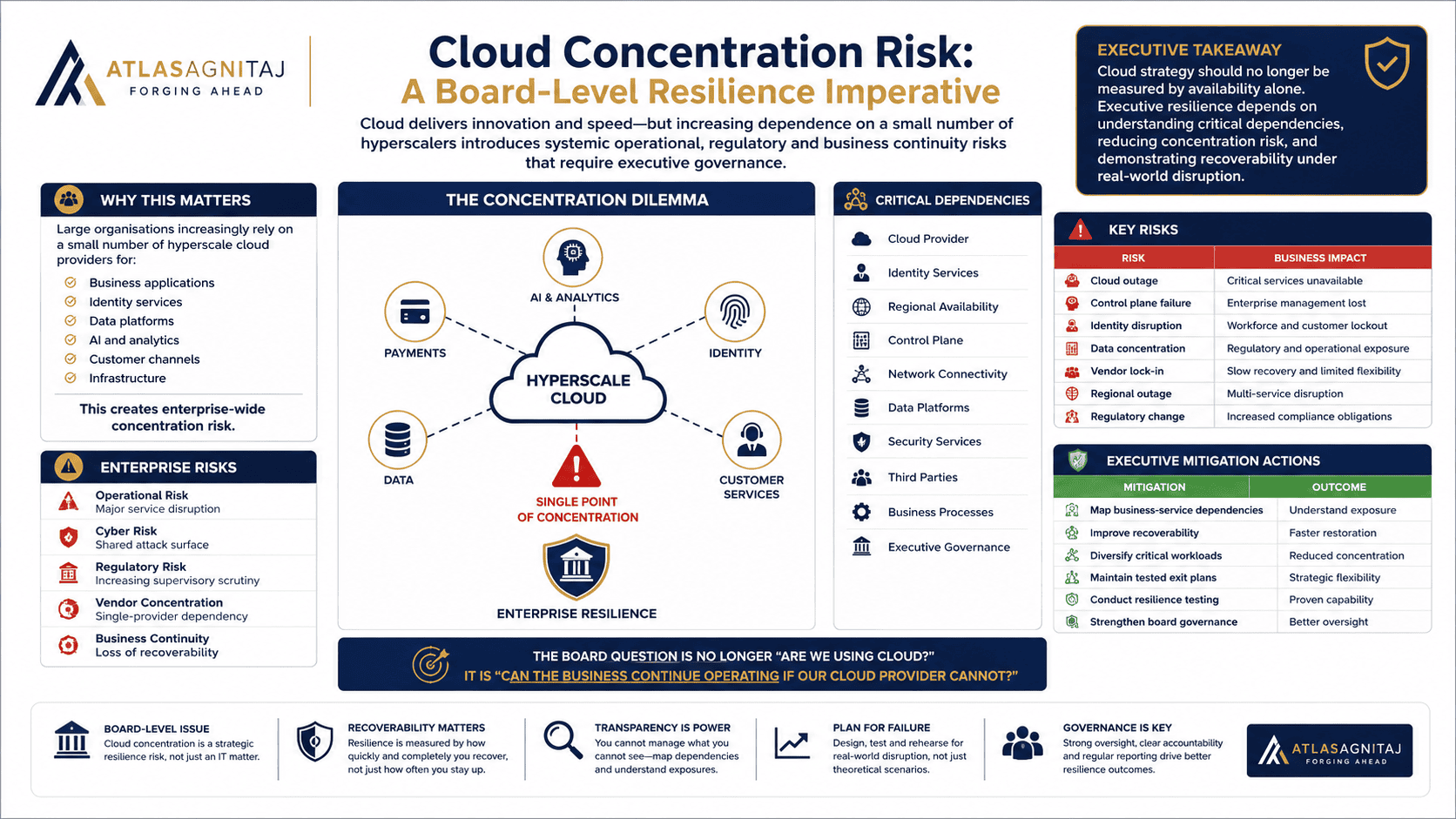
Consider: A decision to rely primarily on a single cloud provider improves operational efficiency but concentrates risk. A strategy to automate high-risk decisions with AI can improve speed but introduces regulatory and reputational exposure if the system fails. A choice to extend supply chains globally for cost optimisation sacrifices resilience for marginal savings.
Mature organisations explicitly model the risk implications of strategic choices. This requires executives to ask:
- What are the worst-case scenarios associated with this strategy?
- Do we have sufficient visibility into third-party risks?
- What capabilities would we lose if this assumption proved wrong?
- How would we detect early warning signs of failure?
- What is the fallback position if this strategy needs to be reversed?
Operational Resilience Capability
Strategy translates into operational practice through capability building:
Scenario readiness: Regular exercises test the response to a realistic disruption. These should not be theoretical—they should involve actual system failover, communication protocols, decision-making under uncertainty, and post-action analysis.
Distributed decision-making: Centralised governance; distributed decision-making. Senior leadership establishes principles and oversight, but operational teams have authority and accountability for risk decisions within their domain. This accelerates response and distributes intelligence.
Incident response protocols: Clear protocols for identifying, escalating, and responding to incidents. This includes criteria for incident severity, escalation paths, communication templates, and decision authorities. AI and automation can assist—by identifying anomalies, alerting teams, and even triggering initial response steps—but escalation and critical decisions require human judgment.
Skills and cultural embedding: Resilience and risk management must be part of organisational culture. This requires:
- Hiring and promotion criteria that value risk awareness and contingency thinking
- Training programmes on risk management, decision-making under uncertainty, and systemic thinking
- Psychological safety—environments where people raise concerns and near-misses are analysed for learning, not blame
- Leadership modelling—senior executives visibly engage with risk, ask difficult questions, and reward good risk governance
Technology as Risk Infrastructure
Treat technology not as a source of risk alone, but as enabling infrastructure for resilience:
Real-time visibility: Monitoring and observability systems that provide visibility into operational health—system performance, data quality, anomalies, and user behaviour. This allows early detection of drift.
Automated response: Orchestration systems that can implement predetermined response steps—failing over to backup systems, quarantining compromised data, pausing deployments, and throttling load. Humans set policy; automation enforces it.
Simulation and testing: Continuous testing and simulation of failure scenarios. Chaos engineering—deliberately introducing faults into production systems to test resilience—has moved from cutting-edge practice to mainstream necessity.
Decision support: AI systems that augment risk decision-making by providing scenario analysis, anomaly detection, and predictive insight. But always with human oversight and final authority.
Resilience in the AI Age: Special Considerations
Governing AI Systems at Scale
As organisations scale AI adoption, governance becomes increasingly critical:
Model governance: Establish clear ownership for each model. Who is responsible for performance monitoring? Who authorises retraining? What are the criteria for retiring a model? Models should have documented assumptions, known limitations, and explicit acceptance of risk from business stakeholders.
Data governance: Data is the foundation. Implement data quality frameworks, lineage tracking, access controls, and audit trails. Identify and document data limitations and potential biases. Regularly test models for performance across demographic groups, geographic regions, and edge cases.
Testing and validation: Move beyond one-time validation. Implement continuous validation:
- Baseline monitoring: Is the model performing as expected?
- Cohort analysis: Does performance vary across subgroups?
- Drift detection: Has the data distribution changed, making the model less reliable?
- Adversarial testing: How does the model respond to unusual or malicious inputs?
Explainability and transparency: For material business decisions, implement explainability requirements. Why did the system make this decision? What factors were most influential? Could this decision be unfair or discriminatory?
Human oversight: Retain human judgment in the loop for high-stakes decisions. Implement review workflows, enable human override, and monitor human overrides—this indicates model failure modes.
AI Risk in the Supply Chain
Third-party AI systems introduce risks you may not fully control:
- Commercial AI models (whether cloud-based or licensed) may be updated by the provider without your consent, changing behaviour
- Fine-tuned models may carry hidden limitations or vulnerabilities
- Third-party AI systems may consume your proprietary data for training purposes
- Dependency on specific vendors or technologies creates concentration risk
Mitigate through:
- Contractual clarity on model updates, performance guarantees, and data usage
- Regular testing of third-party systems independent of the vendor
- Avoiding over-reliance on any single AI system or vendor
- Maintaining alternative capabilities or processes that do not depend on the AI system
Conclusion: Resilience as Competitive Advantage
The organisations that thrive in the coming decades will not be those that eliminate risk—an impossible goal—but those that build systems and cultures capable of continuously learning, adapting, and improving in the face of uncertainty.
This requires:
- Proactive governance that anticipates risks rather than reacting to events, embedded into technology and process design from inception
- Cross-functional risk architecture that distributes risk intelligence and decision-making throughout the organisation while maintaining clear oversight and accountability
- External intelligence and learning that ensures the organisation benefits from collective knowledge—regulatory developments, threat intelligence, peer experiences, academic research
- Strategic clarity on risk tolerance and implications of strategic choices
- Cultural embedding of risk awareness, psychological safety, and continuous learning
- Technology as enabler—using AI, monitoring, and automation to augment human decision-making and enable rapid response
In this environment, boards must ensure that risk governance is not delegated to a compliance function, but is visibly owned and actively managed by senior leadership. CFOs and CIOs must ensure that financial and technology architecture incorporates resilience. Chief risk officers must evolve from auditors to architects of organisational capability.
The rapidly changing risk landscape—accelerated by artificial intelligence, geopolitical volatility, and climate uncertainty—is indeed the defining challenge of this decade. But it is also an opportunity. Organisations that build genuine resilience, governance, and adaptive capacity will compete more effectively, maintain stakeholder trust, and emerge stronger through inevitable disruption.
The question is not whether your organisation will face significant risk events. It will. The question is whether you will be prepared and whether you will learn and improve from the experience. That is the essence of resilience, and it is the work of leadership.