Why successful transformation is about more than projects — it’s about creating lasting impact.
—
Most transformation initiatives fail not because the strategy is wrong, but because organisations mistake motion for momentum. They launch projects, celebrate milestones, declare victory—and then watch the organisation drift back to its original state within months. The gap between strategic intent and sustained value is where countless billions are lost each year, and understanding it is essential for any organisation seeking competitive advantage in rapidly changing markets.
This gap exists because transformation is treated as a finite undertaking rather than a fundamental shift in how an organisation thinks, decides, and executes. It’s the difference between a project that ends and a capability that endures. And the distinction matters profoundly—not just for internal morale but for survival in markets where the speed of adaptation has become the primary competitive differentiator.
—
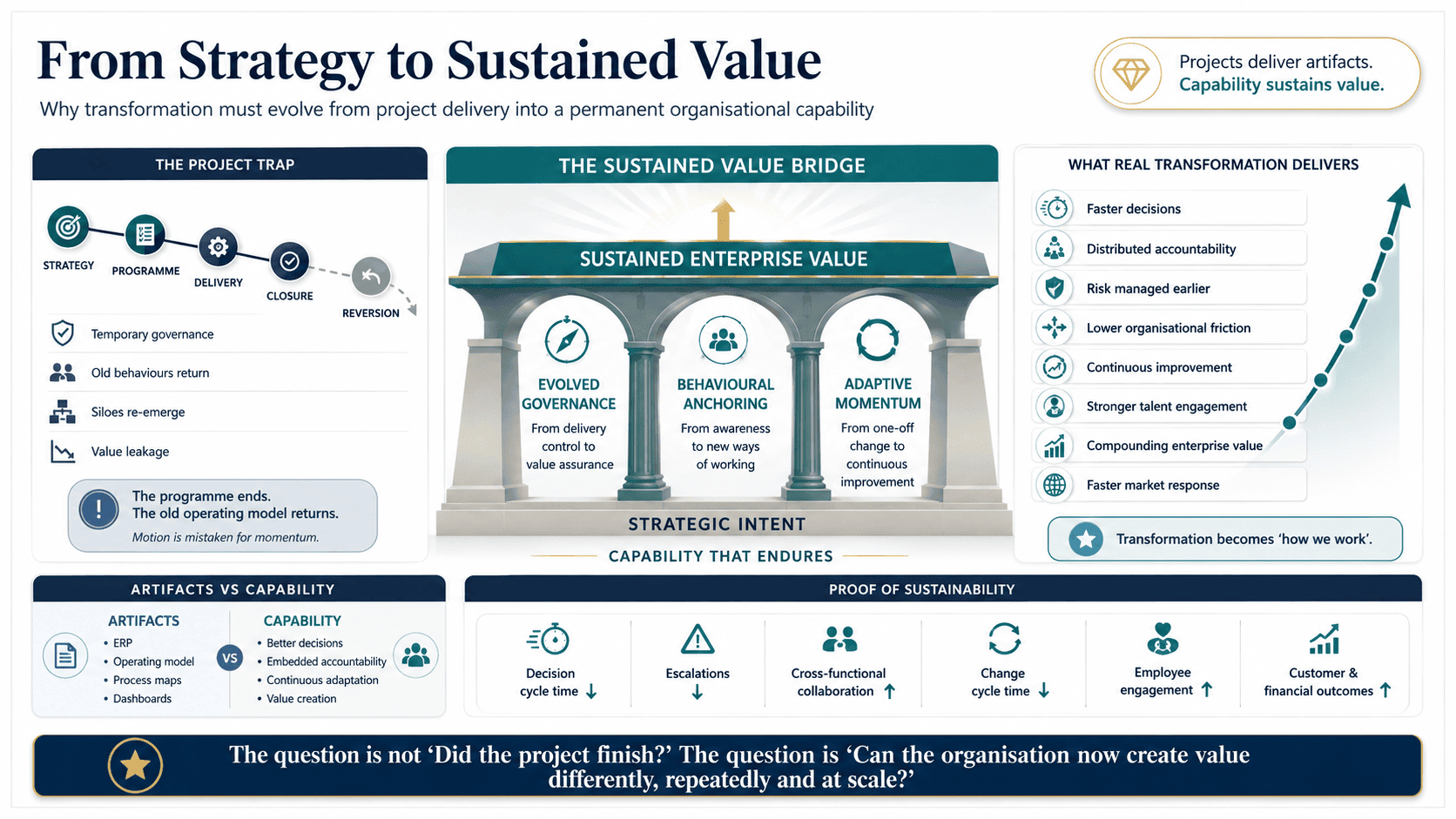
The Project Trap: Why Most Transformations Fade
Consider the typical transformation playbook that organisations have been following for decades: You define strategic objectives, assemble a program office, organise work into deliverable workstreams, execute against a timeline, celebrate milestones, and then declare victory and close the program. By traditional project management measures, the initiative is deemed “successful.” The CIO moves on to the next initiative. Governance is stood down. External consultants and program advisors exit the organisation. The PMO either shrinks dramatically or disappears entirely.
What happens in the months and years that follow tells a different story.
Without active governance and systematic reinforcement, organisations fail to sustain the transformation. They revert—not overnight, but gradually, almost imperceptibly. The new operating model encounters friction from old habits and informal power structures, and people begin to work around it rather than within it. Teams slip back into familiar patterns because those patterns are easier, socially accepted, and don’t require the cognitive overhead of new ways of working. Systems that were supposed to be integrated into a seamless environment develop silos again as business units prioritise local optimisation over enterprise-wide benefit. The cultural shifts that were supposed to be permanent become footnotes in the annual review, referenced occasionally but no longer active in how people behave.
The projects delivered tangible outputs—a new ERP system, a restructured organisational chart, a documented process architecture, training programs, and technology infrastructure. These are real. They exist. But the transformation itself—the sustained shift in capability, behaviour, and value creation—never took hold.
This happens because the organisation never moved from doing transformation projects to being transformed.
The Economics of Reversion
The costs of this reversion are staggering and often hidden. A financial services organisation invests $200 million in a digital transformation program, delivers all planned systems and processes, declares success, and then watches as decision-making cycles remain as slow as before because the new system was layered onto old governance structures. An industrial company restructures for agility, only to watch the new matrix organisation calcify into the same political battlegrounds that existed before. A government agency modernises its technology platform but never reshapes how it actually makes decisions, resulting in faster access to the same suboptimal processes.
In each case, the organisation spent enormous capital and consumed years of leadership attention to deliver an infrastructure for transformation that was never actually used for that purpose. The infrastructure became a new layer on top of the old operating model, creating cost without benefit.
The economic loss extends beyond the direct cost of the program. There are opportunity costs—the strategic initiatives that couldn’t be undertaken because the transformation project itself consumed all available energy. There’s the erosion of organisational capability as talented people, frustrated by the gap between the promised transformation and the operating model in practice, leave for organisations where change actually happens. And there’s the strategic vulnerability that comes from spending three years and hundreds of millions in resources to end up in a position only marginally different from the starting point.
Why Reversion Is Structural, Not Personal
It’s tempting to blame reversion on failed change management or a lack of leadership commitment. These factors matter, but they’re not the root cause. The root cause is structural: organisations don’t maintain what they don’t measure, and they don’t measure what they don’t expect to persist.
When a transformation program has an end date, everything in the program is designed around that endpoint: governance is temporary, investment is time-bound, success metrics are designed to prove the program delivered, and attention spans are calibrated to the program timeline. The organisational infrastructure—the systems that sustain behaviour change, distribute decision rights, and reinforce new practices—is never built because it isn’t within the scope of a time-bound project.
The moment the program closes, the organisation returns to its default state: the operating model that evolved to handle the work the organisation actually does, which now includes whatever new systems were put in place, but not the behavioural or governance infrastructure to use them differently.
—
The Distinction That Matters: Artefacts Versus Capability
Here’s the critical insight that separates organisations that sustain the value of transformation from those that don’t: Transformation projects deliver artefacts. Transformation capability creates value.
Artefacts are important—they’re the mechanism, the foundation, the enabling infrastructure. But they are not the destination. Understanding this distinction is essential.
A new enterprise resource planning system is not a transformation; it’s an enabler of transformation. The transformation occurs when information flows through the organisation without institutional friction, enabling faster, better decisions. A process map is not a transformation; it’s a blueprint. The transformation is when people actually execute work according to the new process because the incentives, capabilities, and governance structures make it the easiest path. A restructured organisation is not a transformation; it’s a structure awaiting new behaviours. The transformation is when accountability shifts, information flows differently, and people collaborate across boundaries because the structure makes it natural rather than forced.
Most organisations can deliver artefacts. The evidence is everywhere: thousands of successful system implementations, process redesigns, restructurings, and technology deployments. What organisations struggle with is translating artefacts into sustained capability change.
What Real Transformation Looks Like
The real transformation manifests in observable changes in how the organisation actually operates:
- Decisions accelerate because information flows without institutional friction, approval cycles shorten, and distributed decision-making replaces hierarchical consensus-seeking
- Risk is understood and managed at the point of decision-making rather than escalated up the chain, creating both faster decisions and better risk management
- Accountability becomes distributed because people understand how their decisions cascade through the system and what their role is in the larger strategic context
- Change becomes normal, not because people love change, but because the organisation has built the muscle to adapt continuously without requiring a major program every time something needs to shift
- Value compounds because each improvement today builds on the improvements made yesterday, and the organisation develops the capability to stack improvements on top of each other
- Talent is attracted and retained because working in the organisation becomes energising rather than frustrating, with good ideas moving faster than politics
- Competitive position strengthens not from a single initiative but from the organisation’s ability to sense market signals and respond faster than competitors who are still planning their response
These outcomes don’t come from completing projects. They come from building organisational maturity—the muscle memory to think, decide, and act differently.
—
The Three Elements That Sustain Transformation Value
Organisations that sustain transformation value do something fundamentally different from those that don’t. They don’t treat transformation as an event with a defined end date. They treat it as a capacity—something the organisation continuously develops and exercises.
This requires three elements that most traditional transformation programs overlook or underestimate:
1. Structural Reinforcement Through Evolved Governance
Transformation governance doesn’t end when the program closes; it evolves. What changes is the fundamental question being asked. Rather than “Are we delivering the plan on time and within budget?”, the governance becomes “Are we realising the intended value? Are we extending the transformation further? Are we identifying where the next iteration needs to happen?”
This means maintaining a backbone of strategic oversight—often through an evolved PMO or transformation management function—that continuously aligns operations with strategic intent. This isn’t about micromanaging execution or creating bureaucratic overhead. It’s about sustaining the discipline.
The role of evolved governance includes:
- Translating strategy into operational reality by maintaining clear sight lines between strategic decisions and how they cascade into operational priorities and resource allocation
- Early signal detection by monitoring whether the operating model is delivering the intended outcomes and identifying where friction or resistance is emerging
- Investment sequencing by determining what the next priority improvement should be and ensuring resources flow toward building capability rather than just maintaining the status quo
- Capability mapping by understanding which capabilities are still developing, which are mature, and which require attention to prevent atrophy
- Organisational learning by capturing what’s being learned from the transformation, codifying it, and applying it to future changes more efficiently
This is work that cannot be done without dedicated capacity and attention. The executive team is focused on running the business. The operating units are focused on delivering results. Without a governance function that maintains focus on how the business is run, discipline erodes and entropy takes over.
2. Behavioural Anchoring: Embedding New Ways of Working
Cultural change is often cited as the hardest part of transformation and as the reason transformations fail. But culture isn’t actually mysterious or immutable. Culture is simply the accumulated result of thousands of small decisions and interactions that happen repeatedly until they become “how we do things here.”
The challenge is that culture is invisible until it’s embedded in daily decisions. You can’t legislate culture. You can’t culture-change people through training programs and town halls alone. But you can create conditions in which new behaviours become the easiest path forward, and when those conditions are sustained, the culture shifts.
Organisations that sustain transformation don’t rely on culture change initiatives. They hardwire new behaviours into how work actually happens:
- How people are evaluated and rewarded — Are they rewarded for collaborating across boundaries or for optimising their own function? Are they rewarded for surfacing risks early or for hiding problems? Are they rewarded for questioning decisions or for compliance?
- How decisions are made — Do decisions surface issues and debate until consensus emerges, or is there an owner who decides and others comply? Is dissent welcomed or discouraged? Do decisions stick, or are they relitigated in different forums?
- How success is measured and recognised — Are visible wins celebrated even if they’re local optimization that hurts enterprise value? Are long-term capability improvements recognised as valuable even though they’re invisible to outsiders?
- How failures are discussed — Are failures treated as learning opportunities or as reasons to blame and punish? Are near-misses analysed for what they reveal about emerging risks, or are they ignored because nothing bad actually happened?
These patterns become the unwritten rules that persist beyond any formal mandate. New people learn them through observation and experience. They become “how we do things here” because they’re reinforced constantly through thousands of small interactions.
Making behavioural anchoring concrete:
When a senior leader makes a major decision by building consensus among peers rather than making an edict and expecting compliance, that’s a behavioural moment. When that same leader later reflects on that decision-making process in a leadership team meeting, acknowledges that it took longer but resulted in greater buy-in and better decisions, and that this behaviour is recognised as valuable, the culture shifts. Repeat this thousands of times across the organisation, and what felt artificial and uncomfortable becomes natural.
When a mid-level manager shares a risk assessment that reveals a significant problem in their area, and instead of the typical response of “Why didn’t you see this sooner?” the leader’s response is “Thank you for bringing this forward early; here’s what we’re going to do about it,” the message about how the organisation handles risk shifts. The next manager is more likely to surface risks early. And the organisation benefits from earlier intervention in problems.
3. Adaptive Momentum: Building Continuous Improvement Into the Operating Model
Most organisations attempt to solve every problem they identify in a major transformation program that runs for two to three years. This approach has a critical flaw: by the time the program is delivered, the environment has changed, new problems have emerged, and the organisation’s understanding of what needs to change has evolved. The organisation is implementing solutions to yesterday’s problems.
Organisations that sustain transformation value do something different. They build the capability to solve problems continuously rather than attempting to solve them all at once.
This requires three sub-elements:
Sensing and signal detection: Mechanisms for understanding what’s not working—not at the level of big strategic shifts, but at the operational level. What processes are creating frustration? What customer feedback indicates that the value proposition isn’t being delivered? What market signals suggest that the operating model needs to adapt? What early warning signs indicate that risk is accumulating in an area?
These signals come from many sources: customer feedback, employee surveys, operational metrics, market intelligence, and regulatory changes. But organisations often have poor signal-to-noise filtering. They’re overwhelmed with data but struggle to identify what actually matters.
Rapid response capability: Having the governance discipline and organisational structure to respond to signals without requiring another major program. This means reserving some capacity for unplanned work, having clear decision-making authority on what’s worth addressing, and being able to launch focused improvement initiatives without derailing ongoing operations.
This is different from “agile” or “continuous improvement” programs—those are useful frameworks, but often remain contained within functional areas. Adaptive momentum requires enterprise-level capability to sense and respond.
Experimentation and learning: The organisation doesn’t have to get every improvement right the first time. It can run small experiments, learn from them, and iterate. This requires a culture that treats small failures as valuable learning rather than evidence of incompetence, and governance that can tolerate controlled experiments rather than requiring every change to be a full rollout.
When an organisation can sense that something needs to change, quickly prototype a solution, learn from the prototype, and scale what works without requiring a major program each time, transformation becomes self-renewing. The organisation develops the ability to transform itself continuously.
—
Understanding Different Types of Transformation
Not all transformations are identical, and sustaining value requires understanding which type of transformation is underway, as each requires different governance structures and behavioural anchoring.
Digital Transformation
Digital transformation is about leveraging technology to change how value is created fundamentally. For a retailer, the shift is from store-centric to omnichannel. For a bank, it’s shifting from branch-based to digital-first service delivery. For a manufacturer, the shift is from reactive to predictive maintenance, driven by sensor data.
The challenge with digital transformation is that technology is often implemented while the operating model, incentives, and decision-making don’t change. A customer service centre receives new technology but continues to optimise for call-handling speed rather than customer outcomes. An inventory system gets real-time visibility, but decision-making remains hierarchical. A diagnostic tool provides early warnings, but the organisation lacks the agility to respond.
For digital transformation to sustain value:
- The organisation must reshape how decisions are made to take advantage of new information flows
- Incentives must shift from optimising functions to optimising enterprise outcomes
- Governance must focus on data quality, integration, and the decisions being made with that data, not just on system uptime
Organisational/Structural Transformation
Organisational transformations reshape how the enterprise is structured: shifting from functional silos to a matrix, from centralised to federated, from hierarchical to network-based. Examples include transitioning to a pod-based structure, creating cross-functional customer-centric teams, or moving to a guild-based knowledge management model.
The challenge is that structure alone doesn’t change behaviour. A matrix structure doesn’t automatically increase collaboration if the incentive systems reward individual or functional optimisation. A customer-centric team structure doesn’t improve customer outcomes if decision-making authority hasn’t shifted to the team or if the team lacks the information needed to make good decisions.
For organisational transformation to sustain value:
- Governance must shift from functional hierarchy to outcome-based accountability
- Information architecture must support the new structure—if you’re creating cross-functional teams, you need integrated visibility, not data siloed by function
- Career progression and recognition systems must reward behaviours that the new structure requires
- The old structure’s informal power networks must be disrupted, not absorbed into the new structure
Process Transformation
Process transformation focuses on how work actually gets done. Examples include shifting from a transactional, rule-based operation to one that’s adaptive and exception-focused; moving from sequential processes to parallel processes with feedback loops; or shifting from individual specialist work to team-based collaborative work.
The challenge is that processes are embedded in systems, physical layouts, skill sets, and how people think about their work. You can redesign the process on paper, but unless the systems, physical environment, and skill development support the new process, people will revert to the old way.
For process transformation to sustain value:
- Systems must enforce the new process, not just enable it
- Training and skill development must focus on how to think about the new process, not just how to execute the steps
- Metrics must shift from activity-based (number of transactions processed) to outcome-based (quality, speed, cost, or customer satisfaction)
- Governance must monitor whether the process is actually being executed as designed and why, if not
Business Model Transformation
Business model transformation fundamentally changes how the organisation creates and captures value. Examples include shifting from a product-centric to a service-centric model, moving from selling to renting or licensing, or shifting from a B2C to a B2B2C model.
Business model transformations are the most challenging because they require not just operational change but fundamental shifts in how the organisation thinks about its markets, customers, and competitive position. They often require organisational, process, and digital transformation simultaneously.
For business model transformation to sustain value:
- Governance must maintain strategic alignment as the organisation transitions between models—often running the old and new models in parallel
- Organisational structures must support both models during the transition, but with a clear line of sight about what’s core and what’s legacy
- Incentives must eventually reward outcomes aligned with the new model, but need to transition gradually to avoid destroying the old model before the new one is viable
- The organisation must maintain investment in building the new model even when the old model is still generating profits
—
Measuring Sustained Transformation Value
One reason organisations fail to sustain transformation is that they never establish clear metrics for sustained value. They measure whether the program delivered on time and on budget, but they don’t measure whether the transformation delivered lasting operational change.
Leading Indicators of Sustained Value
Rather than waiting years to see whether value is sustained, organisations should establish leading indicators that suggest the transformation is taking hold:
- Decision cycle time across key decision types: If the new operating model is working, decisions should be faster. Not all decisions—some trade speed for quality. But decisions that should be faster should be made faster.
- Escalation patterns in the organisation: Are issues being resolved at the level where they occur, or is everything still escalating upward? A transformation that distributes decision-making should show fewer escalations of operational decisions.
- Cross-functional collaboration patterns (if that’s what the transformation required): Analysis of project participation, meeting attendance, and communication patterns should show more cross-functional work happening with less friction.
- Cycle time to implement changes: How long does it take to implement a new process change, system change, or organisational change? Organisations that have sustaining transformation capability should see cycle time decreasing as they repeat the change process.
- Variance in performance across the organisation: If the new operating model is working, units should be more consistent in their performance. High variance suggests that some units have adopted the new model while others haven’t.
- Employee engagement and retention: In areas that have successfully transformed, engagement should be higher (people feel like they’re doing meaningful work with effective tools and processes) and retention should be better (good people stay because they’re effective).
Lagging Indicators of Sustained Value
The ultimate proof of sustained transformation value is changes in business outcomes, but these often take time to manifest:
- Customer satisfaction and loyalty: Does the new operating model result in better customer outcomes? This should be measurable through NPS, retention rates, or customer lifetime value.
- Financial performance: Cost reduction (through efficiency), revenue growth (through faster decision-making and innovation), or margin improvement (through better portfolio management and customer segmentation).
- Competitive position: Market share, win rates against competitors, or speed-to-market for new offerings.
- Organisational capability: Ability to execute major initiatives faster, with lower cost, and with better outcomes than before the transformation.
—
The Sustaining Challenge: What Happens After Success
The most dangerous moment in a transformation is when it starts to work. Paradoxically, success creates conditions for reversion.
The Success Trap
When a transformation starts delivering value, the sense of urgency diminishes. The crisis that drove the urgency for transformation has been addressed. The new operating model, which felt uncomfortable and unnatural for the first six months, is becoming comfortable. The external consultants have been thanked and sent on their way. The program office can finally be scaled down, and resources can be returned to the business to deliver results.
This is the point at which organisations most often begin to lose the transformation. With the sense of urgency gone and the discomfort of change fading, the organisation begins to optimise locally again. Teams revert to familiar patterns because those patterns are now easier than the new ways that have only just become comfortable. The discipline maintained by active governance begins to fade as the governance function is disbanded to demonstrate cost discipline.
Sustaining During Maturity
The organisations that successfully sustain transformation shift their approach during the maturity phase:
Governance evolves rather than disappears. Rather than standing down, the PMO or transformation function evolves from “deliver the program” mode to “maintain the discipline and guide continuous improvement” mode. The budget allocated to this function should actually increase during maturity, because this is when it becomes most valuable—the cost of maintaining discipline is far lower than the cost of reverting and having to re-transform.
Behavioural anchoring becomes more sophisticated. During the early phase of transformation, behavioural change happens through intensive focus and active reinforcement. As the organisation matures, the focus shifts to embedding the new behaviours so deeply that they persist with less conscious attention. This happens through hiring for cultural fit with the new model, training new employees in the new ways of working, and ensuring that all systems and processes reinforce the new behaviours.
The transformation becomes invisible. In many ways, the ultimate success of a transformation is that it becomes invisible—it’s no longer viewed as “the transformation” but simply as “how we work.” This is when the organisation has truly transformed.
—
Common Pitfalls in Sustaining Transformation
Understanding common mistakes can help organisations avoid them:
Pitfall 1: Confusing Activity with Impact
The program is executing work—projects are being delivered, milestones are being met, systems are being implemented. But is the organisation actually becoming different? Activity is easy to measure. Impact is harder but essential.
Pitfall 2: Maintaining Old Governance Structures
Many organisations create new transformation governance structures that operate in parallel to the old operating model. When the program ends, the old governance structures—the approval hierarchies, the functional silos, the risk escalations—remain unchanged. The new operating model is a layer on top, not a replacement.
Pitfall 3: Underinvesting in Capability Building
Organisations invest heavily in systems, process design, and project delivery, but underinvest in building the capability for people to work differently. This is why so many digital transformations result in more powerful tools being used to execute the same inefficient processes.
Pitfall 4: Not Addressing the Organisation’s Informal Power Structure
Organisations have formal structures and informal power structures. A transformation that ignores the informal structure often fails because it absorbs the new structure, preventing real change.
Pitfall 5: Abandoning the Transformation Too Early
Some transformations falter during the difficult middle phase when the benefits of the new operating model haven’t yet outweighed the discomfort of change. Organisations that abandon the transformation at this point lose all their investment and revert to the original state.
—
The Role of Technology in Sustained Transformation
Technology is often viewed as the primary enabler of transformation, but this perspective overlooks the critical point: technology is a constraint-relaxer, not an outcome creator.
A new system eliminates constraints that prevented the old operating model from working better. But if the operating model itself is unchanged, the system accelerates the old way of working. A faster transaction-processing system, executed through an old approval hierarchy, still has a slow decision-making process.
For technology to drive sustained transformation:
- The operating model must be designed to take advantage of what the technology enables
- Governance must focus on how the technology is being used, not just whether it’s working
- The organisation must resist the temptation to build the new technology around the old processes
- Investment in data integration and quality is as important as investment in the systems themselves
—
The Competitive Imperative in the GCC Context
The urgency of sustained transformation is particularly acute in the GCC market. The region is experiencing rapid regulatory evolution, digital disruption, talent migration, and demographic shifts in customer expectations simultaneously.
Organisations that compete in the GCC cannot afford to spend two years transforming and then spend the next five years reverting. The market is moving too fast. By the time reversion is complete, the organisation will have been disrupted by a competitor that began its transformation later but sustained it more effectively.
The organisations that will dominate the GCC in the next decade will not be those with the most sophisticated transformation program. There will be those who have built the capacity to continuously transform, embedding the discipline of strategic alignment and operational excellence in how they think and work.
This requires that the transformation is no longer viewed as something you do once. It must be viewed as a fundamental organisational capability.
—
The Path Forward: Five Imperatives for Sustaining Transformation
Transformation that creates lasting value requires a fundamentally different mindset from the one that delivers projects efficiently. It requires five key shifts:
1. Shift from Project Completion to Capability Building
Stop measuring transformation success by whether the program delivered what was planned. Start measuring it by whether the organisation has developed new capabilities. The test isn’t “Did we deliver the ERP system?” but “Can the organisation now make better decisions faster because of the system?”
2. Shift from Temporary Governance to Sustained Governance
Don’t shut down the program office when the program ends. Evolve it into a sustained governance function that maintains alignment between strategy and operations. The investment in this function is far lower than the cost of reverting and re-transforming.
3. Shift from Awareness to Behaviour Change
Don’t assume that training programs, communications, and leadership messages will change how people work. Build the systems, processes, governance, and incentives that make new behaviours the easiest path forward.
4. Shift from Batch Change to Continuous Improvement
Don’t attempt to solve every problem in a major program. Build the capability to sense what’s not working and respond to it continuously. This creates an organisation that adapts faster than its environment changes.
5. Shift from Program Success to Strategic Outcomes
Don’t declare success when the program is delivered. Declare success when the organisation is delivering better business outcomes as a result of how it has fundamentally changed.
—
Sustaining Value: The Real Transformation
The organisations that win in the next decade will not be those that executed the most impressive transformation programs. There will be those who built the capacity to transform continuously, embedding the discipline of strategic alignment and operational excellence into how they think and work.
That’s not a project. That’s a capability. It’s the difference between an organisation that transforms and one that is transformed.
The difference between a transformation initiative that fades back into the original state and one that compounds its value for years to come is not in the brilliance of the original strategy or the sophistication of the program management. It’s in whether the organisation has built the governance structures, behavioural anchors, and adaptive capacity to sustain the transformation amid the natural entropy that pulls every organisation back toward its default state.
The most valuable transformations are invisible because they’re no longer viewed as transformations—they’re how the organisation works. This is the aspiration: not to execute a successful program, but to fundamentally shift the organisation’s trajectory toward continuously creating more value, faster, with better risk management and more engaged talent.
That’s the transformation imperative.
—
Questions for Reflection
As you assess your organisation’s transformation efforts and consider the path to sustained value, ask yourself honestly:
- If the program office were closed tomorrow, would the transformation continue? Or does it depend entirely on external energy and oversight?
- Are people making decisions differently? Or are they using new systems to make decisions the same way they always did?
- Has accountability shifted? Or is risk still flowing to the top of the organisation, where decisions get made more slowly?
- Are you sensing market signals faster? Or are you as responsive as you were before the transformation, just with more expensive systems?
- Is change becoming easier? Or does each change still require an epic effort and a major program?
- Has the talent profile of your organisation shifted? Or are people with the old operating-model mindset still dominant in leadership?
- Can you point to specific decisions that are now made differently because of how you’ve transformed? Or are the business outcomes from transformation largely still projected into the future?
- What percentage of your transformation benefits are already locked in through changed processes and systems, versus what percentage still depends on sustained behavioural change?
Honest answers to these questions reveal whether you have achieved a true transformation or executed a project that produced impressive artefacts without fundamental change.
The difference between the two often determines competitive destiny.
—
The transformation imperative isn’t about executing one magnificent change program. It’s about building an organisation that continuously transforms itself, embedding the discipline of strategic alignment and operational excellence into every decision, process, and interaction. That’s the competitive advantage that compounds. That’s the transformation that lasts.