The promise of agentic AI is compelling—autonomous agents that learn, decide, and act with minimal human intervention. Yet as enterprises rush to deploy these systems, a critical oversight threatens to unwind years of digital transformation investment: most organisations are building autonomous AI capabilities without the governance guardrails required to operate them safely at scale.
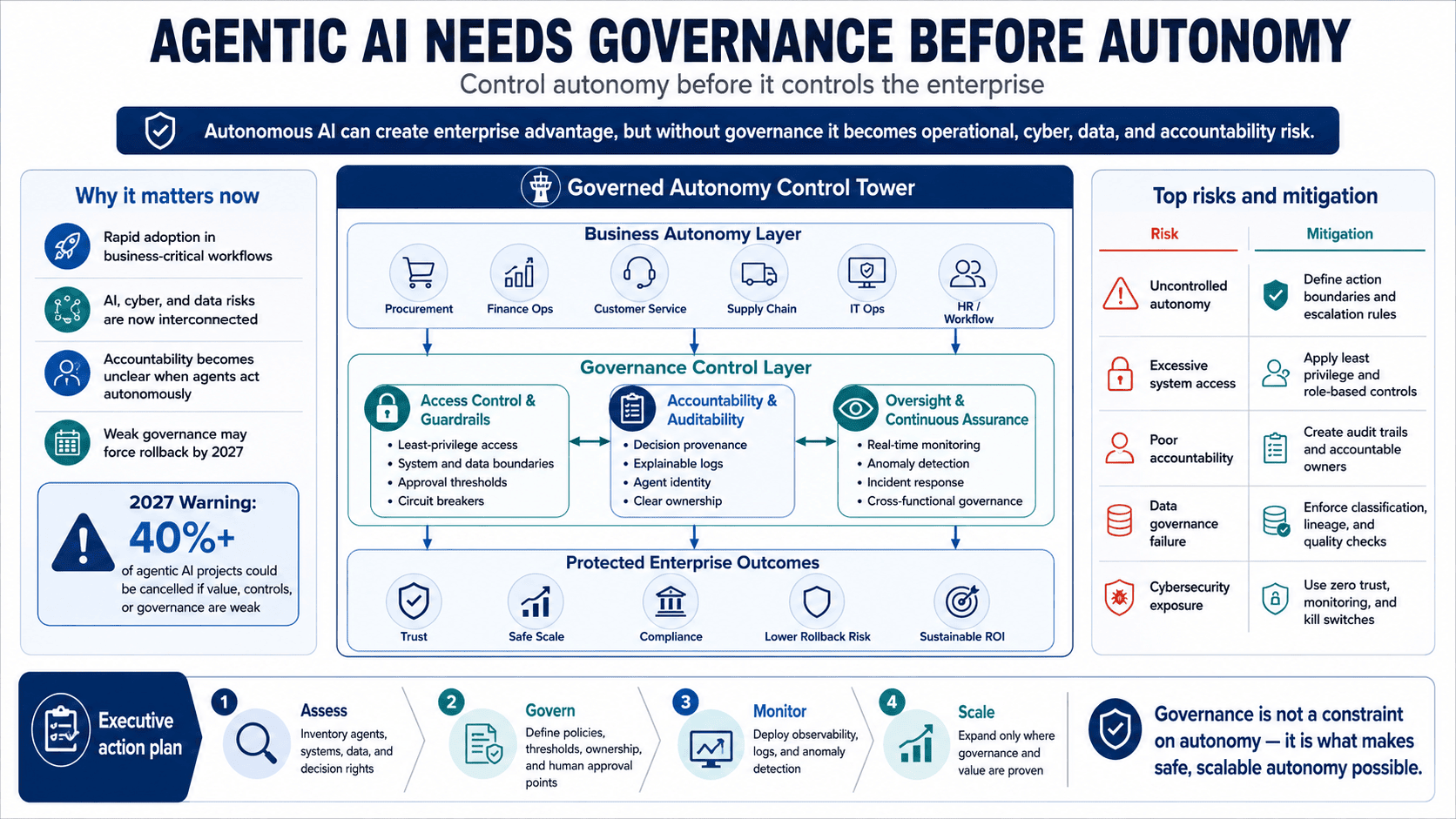
This is not a theoretical problem. Industry research increasingly points to a sobering reality: enterprises may be forced to roll back autonomous AI agents by 2027 if governance, access control, and accountability mechanisms remain weak. For CIOs, CDOs, and enterprise technology leaders, the message is clear: the window to implement governance frameworks is now, before autonomy becomes the default and control becomes nearly impossible to retrofit.
The Urgency: Why Now
Agentic AI has crossed a threshold. What was once a research concern has become an enterprise priority. Unlike traditional AI systems that require explicit human prompting and decision-making, agentic AI operates differently—it sets goals, takes actions, and iterates without waiting for human approval at each step. This shift is powerful but introduces a class of risks that many organisations are not yet equipped to manage.
Three converging pressures make governance urgent:
1. Rapid Adoption Without Precedent Organisations are deploying autonomous agents into business-critical processes—procurement workflows, financial operations, customer service decisions, and supply chain optimisation. The speed of deployment has outpaced the maturity of governance practices. Unlike the gradual adoption of traditional AI, agentic AI is moving from pilot to production in months, not years.
2. Interconnected Risk Domains CIO priority research reveals a critical insight: operationalising AI, cybersecurity, and data strategy are now inseparable. Agentic AI systems that operate autonomously become both a vector for cybersecurity threats and a potential source of data governance violations. A compromised agent can execute decisions across systems with minimal oversight. A data governance failure becomes amplified when an agent acts autonomously on data that should have been restricted.
3. Accountability Vacuum Traditional AI operates with clear decision trails—a model scores a loan application, and a human approves it. Agentic AI operates differently. An autonomous agent decides to modify supplier contracts, reprioritise resources, or escalate customer issues. When something goes wrong, the question “who is responsible?” becomes genuinely difficult to answer. Without clear governance, enterprises risk creating systems they cannot control, debug, or defend.
The 2027 Rollback Risk
Gartner-linked reporting suggests a troubling scenario: many enterprises deploying autonomous agents today without robust governance frameworks will face a choice by 2027—either significantly constrain the agents’ autonomy or discontinue them entirely. This would represent a costly reversal, involving:
- Reworking business processes optimised for autonomous operation
- Rebuilding human-in-the-loop decision-making at scale
- Recovering organisational knowledge lost during the transition to autonomy
- Managing stakeholder frustration as promised efficiency gains are clawed back
The enterprises that avoid this scenario will be those that establish governance frameworks early—before agents become deeply embedded in operations, before stakeholder expectations are set around autonomous decision-making, and before the technical debt of ungoverned systems becomes unmanageable.
The Governance Imperative: Three Pillars
Effective agentic AI governance rests on three interconnected pillars:
1. Access Control and Guardrails
Agentic AI systems must operate within defined boundaries. This means:
- Explicit capability constraints: Define exactly which systems an agent can access, what data it can read or modify, and what actions it can take. An agent trained on procurement data should not be able to access personnel systems.
- Decision authority limits: Establish thresholds above which agent decisions require human approval. An agent might autonomously approve low-value supplier orders but escalate high-value contracts.
- Real-time monitoring and circuit breakers: Implement systems that detect when an agent’s behaviour deviates from expected patterns and can automatically halt execution.
- Data access governance: Apply the same rigour to agentic systems as to human employees—principle of least privilege, audit trails, and role-based access controls.
2. Accountability and Auditability
Every autonomous decision must leave a clear trace. Organizations need:
- Decision provenance: Comprehensive logs that explain why an agent made a specific decision, what data influenced it, and what alternatives were considered.
- Human oversight points: Strategic moments where humans review, validate, or override agent decisions before they take effect.
- Explainability requirements: Not just “the agent decided X” but “the agent decided X because Y, based on data inputs Z.”
- Liability frameworks: Clear definition of who bears responsibility when an agent makes a harmful decision—the agent builder, the organisation, or the user who deployed it.
3. Governance Process and Oversight
Governance is not a static policy—it must evolve as agents learn and as organisations discover edge cases:
- Continuous validation: Regular testing of agent behaviour against organisational values and risk tolerance, not just technical performance metrics.
- Cross-functional oversight: Governance cannot be owned by IT alone. Finance, legal, operations, and compliance must have input into how agents operate in their domains.
- Incident response procedures: Clear processes for investigating failures, understanding root causes, and implementing fixes without waiting for formal review cycles.
- Stakeholder engagement: Transparency with employees, customers, and regulators about what autonomous systems are doing and why.
The CIO Perspective: Leadership Imperatives
For CIOs and technology leaders, agentic AI governance presents a distinct challenge: it sits at the intersection of technology capability, business risk, and organisational control. Three imperatives stand out:
First, own governance before business leaders’ own AI deployment. If CIOs wait for business units to deploy autonomous agents and then mandate governance, the cost of retrofit will be prohibitive. Governance frameworks must be in place before agents are trained and operationalised.
Second, integrate AI governance with existing control frameworks. Agentic AI governance should not be a separate track. It must integrate with cybersecurity, data governance, and operational risk management. This requires CIOs to break down silos between teams that historically have not worked together.
Third, invest in observability and control infrastructure now. Managing autonomous systems requires different tooling than managing traditional systems. CIOs need to budget for and build capabilities that provide real-time visibility into agent behaviour, enable rapid rollback, and support forensic analysis when things go wrong.
The Broader Stakes
The stakes of getting agentic AI governance right extend beyond risk management. Organisations that establish governance frameworks early will be able to:
- Deploy agents more confidently, knowing they have control mechanisms in place
- Build trust with stakeholders by demonstrating responsible AI practices
- Maintain competitive advantage by operating autonomous systems at scale while competitors struggle with governance debt
- Adapt more quickly when regulations emerge—and they will—because governance is already embedded
Conversely, organisations that treat governance as a post-deployment concern will find themselves constrained by their own ungoverned systems, unable to scale what should be a competitive advantage.
The Path Forward
The agentic AI governance challenge is urgent but solvable. Organisations that want to harness the power of autonomous AI without ceding control should:
- Assess current state: Inventory autonomous agents in development or deployment. Evaluate existing governance gaps. Understand which business-critical processes involve autonomous decision-making.
- Build governance baseline: Establish minimum standards for agent access control, decision authority, auditability, and oversight. These need not be elaborate—they should be proportionate to risk and operationalised quickly.
- Establish cross-functional ownership: Create governance structures that involve technology, business, compliance, and risk leaders. Agentic AI governance is too important to be owned by IT alone.
- Invest in infrastructure: Fund observability, monitoring, and control systems that enable organisations to manage autonomous agents at scale.
- Iterate and learn: Governance frameworks will evolve as organisations gain experience with autonomous systems. Start with what you know, measure what works, and refine based on real-world feedback.
Conclusion
Agentic AI represents a genuine advance in AI capability—the ability to deploy systems that can work autonomously, learn from their experience, and improve their own performance. This is powerful. But power without governance is dangerous. The enterprises that will thrive in an agentic AI future are those that recognise governance not as a constraint on autonomy but as the foundation for it—the mechanism that makes safe, scaled, sustainable autonomous AI possible.
The 2027 rollback scenario is not inevitable. It is a warning. Organisations that act now to establish governance frameworks, integrate them with existing control structures, and maintain human oversight of autonomous systems will be positioned to compete in an age of agentic AI. Those that do not will find themselves managing the legacy costs of ungoverned autonomy—or abandoning autonomous systems altogether.
The time to act is now, before autonomy becomes the default. Before governance becomes the bottleneck. Before rolling back becomes the only option.
#AgenticAI #AIGovernance #CIO #DigitalTransformation #Cybersecurity #DataGovernance #EnterpriseAI #TechnologyLeadership