A Strategic Imperative for Enterprise Leaders in 2026 and Beyond
Executive Summary
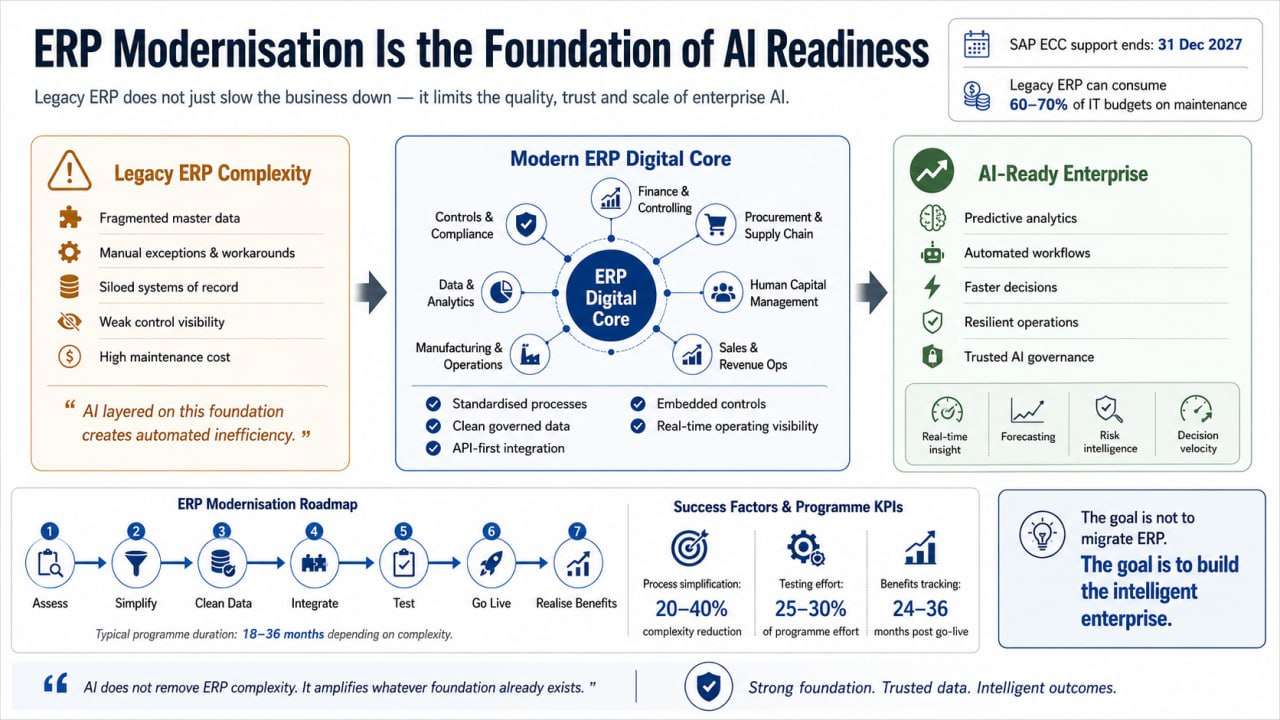
Enterprise Resource Planning (ERP) modernisation has transcended its traditional role as a back-office technology initiative. In 2026, it has evolved into a fundamental strategic decision that determines an organisation’s ability to harness artificial intelligence effectively. As SAP ECC mainstream support approaches its end date of December 31, 2027, enterprise leaders face a critical juncture. This is not simply a technology migration challenge—it is a business transformation imperative that will shape competitiveness, operational resilience, and AI readiness for the next decade.
The central thesis is straightforward yet profound: organisations that attempt to layer AI atop legacy ERP complexity will achieve only automated inefficiency. Those that use ERP modernisation as an opportunity to redesign their operating model fundamentally will emerge as intelligent enterprises capable of real-time decision-making, predictive analytics, and adaptive operations.
Why This Moment Matters Now
The confluence of three critical factors has created urgency around ERP modernisation in 2026:
First, SAP has announced the definitive end of mainstream support for ECC on December 31, 2027. This is not a soft deadline. After this date, security patches, functional enhancements, and vendor support cease. For enterprises running complex ERP environments subject to regulatory requirements—particularly in financial services, healthcare, energy, and government sectors—this poses a genuine business risk. The cost of remediation increases exponentially as the deadline approaches. Organisations waiting until 2027 to plan their migration face compressed timelines, inflated vendor costs, scarcity of skilled resources, and insufficient time for proper change management. Several Fortune 500 companies found themselves with extended implementations and billions in unplanned costs when they delayed decisions beyond 2025.
Second, the competitive pressure to leverage AI has become relentless. Across sectors, organisations are recognising that AI-driven decision-making, predictive analytics, and automated workflows represent genuine competitive advantages. However, AI’s effectiveness is entirely constrained by data quality, process clarity, and integration architecture. Poor data creates biased algorithms. Fragmented processes create blind spots in automation. Weak integration creates siloed insights. In short, you cannot build a superior AI operating model on an inferior ERP foundation. Financial institutions deploying AI for credit risk models, manufacturers implementing predictive maintenance, retailers using demand forecasting—all require the clean, integrated data foundation that only modernised ERP systems provide.
Third, the cost of inaction has become undeniable. Legacy ERP systems consume a disproportionate share of IT budgets for maintenance, workaround management, and shadow IT. The opportunity cost of delaying modernisation—measured in forgone automation, process improvement, and analytical capability—often exceeds the investment cost of migration itself. Industry research suggests legacy ERP systems consume 60-70% of IT budgets for maintenance, leaving only 30-40% for innovation. Modern cloud ERP reverses this ratio.
The Current State: Why Legacy ERP Environments Fail AI
Many large enterprises operate within ERP landscapes shaped by decades of customisation, organisational change, system integration, and the accumulation of workarounds. Characteristically, these environments feature:
Data Quality Issues: Master data—customer, product, vendor, GL account hierarchies—often lack standardisation, contain duplicates, suffer from inconsistent naming conventions, and carry significant historical baggage. A multinational manufacturing company might have the same vendor represented 47 different ways across regional ERP instances, resulting in incorrect supplier performance metrics, missed volume discounts, and fragmented supply chain visibility. When organisations attempt to train AI models on such data, the models inherit these defects, producing biased or unreliable predictions.
Process Complexity: Legacy ERP environments typically feature numerous manual interventions, exception-handling procedures, approval chains that bypass system controls, and informal workarounds outside documented process flows. These hidden workflows are often unknown to process improvement teams, making true process redesign nearly impossible. A large bank discovered during process assessment that its accounts payable function had 47 exception-handling procedures outside the primary three-step documented process. These exceptions consumed more effort than the documented process itself.
Integration Fragmentation: Data often exists in multiple systems of record—ERP holds some truth, finance systems hold another, supply chain holds another, sales holds yet another. This fragmentation prevents the real-time, unified view of the business that AI systems require. Reconciliations become manual, time-consuming, and error-prone. A global industrial company maintained 23 different data sources for product master data, resulting in 10-15 hours per week of reconciliation work and creating blind spots in product profitability analysis.
Control Weaknesses: Years of regulatory change, M&A activity, and operational pressure often result in control frameworks that are documented but not consistently enforced. Compliance testing becomes laborious. The trust in data diminishes. Risk appetite declines because the organisation cannot confidently assert that its data reflects economic reality. Auditors increasingly qualify their opinions when they lack confidence in the control environment that supports financial data.
Attempting to introduce AI automation on top of this foundation produces what can only be described as “automated inefficiency”—processes run faster but continue to produce the same errors, inefficiencies, and blind spots they always have. The cost of automation scales linearly with the cost of legacy complexity.
ERP as the Digital Core: Rethinking the Scope
Successful ERP modernisation requires a fundamental reframing of ERP’s role within the enterprise architecture. Rather than viewing ERP as a back-office finance and operations system, modern ERP must be positioned as the digital core of the entire business. This core connects and orchestrates:
Finance and Controlling: Real-time GL posting, statutory accounting, management reporting, cash visibility, predictive financial modelling, and automated reconciliations
Procurement and Supply Chain: Sourcing, purchase-to-pay, supplier management, inventory optimisation, demand sensing, and supply chain risk management
Human Capital Management: Workforce planning, compensation, workforce analytics, skills mapping, succession planning, and organisational design
Sales and Revenue Operations: Order-to-cash, customer master data, revenue recognition, pricing analytics, and customer profitability analysis
Manufacturing and Operations: Production planning, quality management, asset management, predictive maintenance, and yield optimisation
Data and Analytics: Master data management, integration architecture, data governance, real-time analytics, and AI model deployment
Controls and Compliance: Access governance, audit trails, exception management, regulatory compliance, fraud detection, and cybersecurity
When ERP is understood in this integrated way, modernisation becomes far more than a technology project. It becomes a strategic redesign of how the enterprise operates, integrates, and learns. This scope inevitably increases complexity, but it also clarifies why the investment is justified. A global financial services firm that reframed its S/4HANA programme as “operating model transformation” rather than “ERP migration” increased executive buy-in, secured additional budget, and achieved benefits 40% above initial projections.
The True Cost of Speed: Why “Move Fast” Often Means “Move Wrong”
One of the most damaging trends in ERP modernisation is the pressure to achieve “rapid deployment” or “fast-track implementation.” While speed is important, it must be balanced against the requirement for quality. A poorly executed ERP migration creates technical debt, operational risk, and frustrated stakeholders that organisations carry for years.
Consider the cautionary tale of a European automotive supplier that compressed its S/4HANA implementation from 24 months to 14 months. The accelerated timeline required the elimination of process simplification activities, abbreviated user testing, and deferred control implementation. The result: post-go-live operational issues required 9 months of additional support effort, cost overruns exceeded €15 million, and the organisation took 24 months to stabilise the system. The attempt to save 10 months cost them 34 months of value delivery disruption.
A disciplined approach to ERP modernisation establishes a clear sequencing: assess current-state complexity, simplify processes before migration, clean master data to high standards, execute a staged migration with integration governance, establish controls and governance post-go-live, and systematically track and realise benefits. This approach requires 18-36 months, depending on complexity, but it produces a genuinely transformed enterprise. The shortcut approach—compress the timeline, accept technical debt, defer control implementation—often fails, resulting in extensions, rework, and diminished benefits realisation.
Critical Success Factors: What Distinguishes Winners
Across dozens of major ERP programmes—from S/4HANA migrations to cloud ERP implementations—certain success factors consistently distinguish programmes that transform the business from those that replace technology:
Clear Scope Definition: Programmes that clearly articulate what is in scope (must migrate), what is out of scope (will retire), and what is managed through temporary bridges (will integrate) avoid scope creep and maintain focus. Scope clarity also enables realistic timeline and cost estimation. Best-practice programmes document scope at multiple levels: business process, system, geographic, and phasing.
Business Ownership: The most successful programmes are sponsored and actively governed by business leaders, not IT leaders. The CFO, COO, or Chief Digital Officer owns the programme. IT provides expert execution. This ensures business priorities drive technical decisions, not vice versa. Programmes with executive sponsors rated as “highly committed” achieve results 3x faster than those with passive sponsorship.
Process Simplification Before Migration: Rather than migrating legacy processes to new systems, successful programmes redesign processes first. This typically reduces process complexity by 20-40%, thereby lowering customisation, integration, and ongoing support costs. A financial services company eliminated 230 of 680 process steps during simplification, reducing implementation costs by 35% and accelerating go-live by 6 months.
Master Data Governance: Data is prepared to high-quality standards before migration, with governance structures established to prevent regression. Organisations that defer data cleaning until post-go-live face years of data remediation. Pre-migration data preparation typically requires 10-15% of total programme cost but delivers 5-8x return through improved decision-making and reduced post-go-live issues.
Integration Governance: A clear integration architecture defines how ERP connects to peripheral systems. APIs are managed as critical infrastructure. Clear SLAs govern data flows. This prevents the fragmentation that undermines AI readiness. Modern integration platforms enable real-time data exchange while maintaining governance visibility.
Testing Discipline: Successful programmes invest heavily in test case development, defect management, and UAT governance. Testing is not compressed at the end of the schedule; it is a continuous activity throughout implementation. Programmes allocating 25-30% of effort to testing typically experience fewer post-go-live defects and faster stabilisation than those allocating 15-20%.
Change Management and Capability Building: Sustainable transformation requires that users understand not just what changed, but why it changed and how to operate in the new environment. Successful programmes invest in training, mentoring, and sustaining change management well beyond go-live. Programmes with comprehensive change management achieve user adoption 60% faster than those with minimal change support.
Benefits Tracking and Realisation: Programmes that establish clear KPIs before go-live, track performance throughout, and actively manage benefits realisation achieve ROI 2-3x faster than programmes that treat benefits as a post-project concern. Leading organisations establish benefits management offices that actively manage realisation through 24-36 months post-go-live.
The AI Readiness Dimension: Building for Tomorrow
ERP modernisation must be architected with AI readiness as an explicit design principle. This means:
Data Architecture for AI: The ERP and supporting data platform must support high-quality master data, transactional atomicity, and historical data retention with clear lineage. Data warehouse or lakehouse structures should be designed to support both traditional reporting and ML pipelines. This requires investment in data infrastructure that some organisations view as separate from ERP, but must be orchestrated with it.
API-First Integration: APIs are designed as first-class mechanisms for data exchange, enabling modern AI platforms and analytics tools to consume ERP data without custom extraction routines. This supports both real-time and batch ML use cases. A manufacturing company implemented 47 APIs during its ERP modernisation, enabling 19 advanced analytics and AI capabilities that would have been impossible with traditional ETL approaches.
Process Standardisation: Simplified, standardised processes reduce the variability that undermines ML accuracy. When processes are consistent, AI models can learn reliable patterns. When processes are fragmented with numerous exceptions, ML models struggle. A retail organisation that standardised its order-to-cash process across 600 locations achieved 94% model accuracy in demand forecasting, compared to an average of 68% before standardisation.
Governance for Explainability: As organisations deploy AI models that influence business decisions, governance structures must enable explanation of model decisions. This requires strong data lineage, feature documentation, and audit trails. Regulatory environments increasingly demand that organisations demonstrate how automated decisions were made—this is only possible with clean ERP data and clear governance.
Security and Compliance Foundations: AI systems require trust in the underlying data and control environment. Strong cybersecurity, access governance, and compliance controls are prerequisites for responsible AI deployment. Organisations deploying AI without strong ERP controls face increasing regulatory scrutiny around bias, transparency, and decision accuracy.
Risk Management: What Can Go Wrong and How to Prevent It
ERP modernisation programmes carry significant risks that must be actively managed. The most common failure modes include:
Schedule Overrun: Scope expansion, underestimated complexity, resource constraints, or testing delays can extend timelines by 20-50%. The typical remediation involves temporary parallel system operation, extended dual-support costs, and compressed post-go-live stabilisation. Mitigation: strict change control, realistic estimation with buffer allocation, and proactive resource management.
Budget Overrun: Hidden complexity, vendor cost escalation, or extended resource engagement can increase costs by 25-40%. Programmes operating with fixed budgets and insufficient contingency face difficult choices between scope reduction and timeline extension. Mitigation: detailed cost estimation with line-item visibility, vendor cost governance, and contingency reserve management.
User Resistance and Adoption Failure: Insufficient change management, inadequate training, or perceived threats to job security can lead to poor adoption, workarounds, and operational disruption post-go-live. Mitigation: proactive stakeholder engagement, comprehensive training and support, and clear communication of benefits.
Data Quality Failure: Insufficient data cleansing, inadequate validation during migration, or post-migration data degradation can lead to operational issues and loss of decision-making confidence. Mitigation: comprehensive data quality assessment, systematic remediation before migration, and governance enforcement post-go-live.
System Stability Issues: Inadequate performance tuning, integration failures, or unexpected transaction volumes can result in system slowness or unavailability post-go-live. Mitigation: comprehensive load testing, performance baseline establishment, and capacity planning with growth headroom.
Positioning for CIOs, CTOs, and Transformation Leaders
If you are a CIO, CTO, or transformation leader, positioning yourself as an expert in ERP-as-strategic-transformation serves multiple audiences and creates multiple career opportunities:
Boards and Executive Teams: You can articulate why ERP modernisation is not a cost-reduction initiative but a growth and resilience investment. This reframing opens budget conversations and aligns technology strategy with business strategy. Board-level discussions about ERP typically expect executives to speak the language of competitive advantage, risk mitigation, and strategic optionality—not technology features.
CFOs and Finance Leaders: You can explain how modern ERP enables real-time financial visibility, predictive cash management, and faster close cycles. You can quantify working capital improvements, cash flow benefits, and cost-of-capital optimisation. A retailer moving to cloud ERP reduced cash conversion cycle by 8 days, releasing €180M in working capital.
COOs and Operations Leaders: You can demonstrate how process simplification, automation, and real-time visibility reduce cycle times, improve quality, and enhance resilience. You can position ERP modernisation as an operating model transformation. A manufacturer reduced order-to-delivery time from 35 days to 12 days through a combination of ERP modernisation and process redesign.
Recruiters, Board Advisors, and Strategic Consultants: Your expertise in ERP-as-transformation positions you as a strategic advisor, not just a technology manager. This positioning opens doors to board roles, interim leadership roles, fractional CTO roles, and strategic advisory positions. Organisations managing complex ERP transformations increasingly seek experienced leaders in advisory roles.
The Question Beyond Migration
The question that should drive every ERP programme is not, “When are we migrating from ECC to S/4HANA?” That is a project question with a timeline answer. The deeper question is, “What kind of intelligent enterprise are we building?”
Answering this question requires clarity on:
Business Outcomes: What capabilities do we want to enable? What decisions do we want to make faster or better? What processes do we want to automate? What customer or stakeholder experiences do we want to improve? What revenue growth or cost reduction targets should drive the programme?
Operating Model Evolution: How will decision-making change? How will accountability shift? How will roles and responsibilities evolve? What new capabilities will the organisation need? How will we balance centralisation and local autonomy?
Data and Analytics Strategy: What analytics capabilities are essential? What AI use cases are the highest priority? How will we govern data? How will we manage AI governance and responsible AI? What investments in data infrastructure are required?
Technology Architecture: What platform choices best enable our operating model? How will we manage integration? How will we balance cloud versus on-premises? How will we manage cybersecurity and compliance? What is our investment in data and analytics infrastructure?
When these questions are answered clearly before the ERP programme begins, the migration itself becomes a tactical implementation of strategic choices rather than a technical project seeking business justification. This shift in framing changes programme dynamics entirely—it elevates the conversation from “Can we migrate?” to “What are we becoming?”
Conclusion: The Inevitable Transformation
ERP modernisation in 2026 is not optional. The December 2027 SAP ECC support deadline is real. The competitive pressure to leverage AI is relentless. The cost of delay is mounting. The question is not whether you will modernise, but whether you will modernise strategically, with discipline and vision, or reactively, under pressure, with shortcuts and compromises.
Organisations that use ERP modernisation to simplify processes, elevate data quality, strengthen governance, and design for AI readiness will emerge as intelligent enterprises capable of competing in an AI-driven future. These organisations will have decision-making speed, operational resilience, and analytical capabilities that create genuine competitive advantage.
Those who treat modernisation as a technology replacement project, defer process improvement, and adopt minimal governance will replicate old complexity on a new platform and find that automation accelerates their existing inefficiencies. They will spend more to achieve less, and find themselves dependent on vendors and consultants for ongoing support and adaptation.
The transformation is coming. SAP has announced it. Market pressures enforce it. Technology capabilities enable it. The question is whether your enterprise will lead this transformation—deliberately, strategically, and at your own pace—or follow it reactively, under deadline pressure, with constrained options.
This is not a technology decision. It is a strategic decision about what your organisation will become. Approach it with the seriousness and executive engagement it deserves.
—
Recommended Hashtags for LinkedIn Distribution
#ERPTransformation #SAP #S4HANA #AIReadiness #DigitalTransformation #EnterpriseApplications #PMO #CIOLeadership #BusinessTransformation #DataGovernance #CloudMigration #IntegrationArchitecture #OperatingModelRedesign #IntelligentEnterprise
Target Audience for Engagement
Primary Audience:
Board Members and C-Suite Executives (CIO, CTO, CFO, COO, Chief Digital Officer), ERP Programme Sponsors, Chief Procurement Officers, Chief Data Officers, VP Enterprise Applications
Secondary Audience:
SAP Partners and Implementation Consultants, Enterprise Application Leaders, PMO Directors, Transformation Programme Managers, Data and Analytics Leaders, HR and Finance Shared Services Directors, IT Infrastructure Leaders, Cybersecurity Officers
Tertiary Audience:
Large Family Office CFOs, Transformation Recruiters, Business Process Outsourcing Leaders, IT Service Management Leaders, Enterprise Architects, Risk and Compliance Officers
Content Utilisation Strategy
This article can be deployed across multiple channels:
LinkedIn: Publish as Article format (10-15 minute read), breaking into 3-4 separate posts with key sections
Thought Leadership Platform: Post full article on Medium, Substack, or personal publication platform
Speaking Engagements: Use as a foundation for webinars, conference presentations, or executive roundtable discussions
Client Conversations: Reference specific sections during business development or capability-building conversations
Recruitment Positioning: Use the article as evidence of strategic thinking during interviews or the negotiation of executive roles